Archive for the ‘Passion’ Category

By Satan’s Power — Friday, 27th Week in Ordinary Time—Year II

October 10, 2014

Readings: Galatians 3:7-14; Luke 11:15-26

Some in the crowd said of Jesus, “By the power of Beelzebul, the prince of demons, he drives out demons.” In a certain sense, those people would be right.

Satan’s power in the world led to Jesus’ Passion. The devil probably thought he was winning by getting Jesus crucified, for ‘cursed is everyone who hangs on a tree.’ Yet Jesus surprised him by turning this curse into ‘a blessing for all nations.’ Jesus suffered Satan’s power, but brought good out of the evil. In this way, by the power of Beelzebul, the prince of demons, Jesus drove out demons from the world.

Originally posted on October 8, 2010

The Stations of the Cross

March 29, 2014

Christ Carrying the Cross by El Greco, 1580.1. Pilate Condemns Jesus to Death
– Jesus stood his ground, with neither fight nor flight
– Pilate only pities and does not protect the innocent
– Holiness is not admired by all, and often condemned

2. Jesus Carries his Cross
– The Good Shepherd takes his staff to seek lost sheep
– Your unique cross is designed and meant for you

3. Jesus Falls the First Time
– When you fall, get back up
– To recreate man God goes down to earth’s dust again

4. Jesus Meets his Mother
– Saints may suffer more than most, but are rewarded
– God gives us people to help us through our trials

5. Simon of Cyrene Helps Jesus Carry the Cross
– We know neither what good we do nor our sins’ cost
– It could have been Simon Peter instead if he’d come
– Simon helps Jesus with his masculine strength

Christ Carrying the Cross by Hieronymous Bosch, 1485-1490.6. Veronica Wipes the Face of Jesus
– Veronica helps Jesus with her feminine tenderness
– The name “Veronica” means “true image” in Latin
– All loving deeds bear the likeness of Jesus

7. Jesus Falls the Second Time
– Let us kneel before Jesus

8. Jesus Meets the Women of Jerusalem
– Jesus used his sufferings for compassion to others
– Jerusalem would be destroyed some 40 years later

9. Jesus Falls the Third Time
– Three falls, three failures, but none of them sins

10. Jesus is Stripped of his Garments
– A seamless garment, as Jewish high priests wore
– Jesus is made as naked as Adam

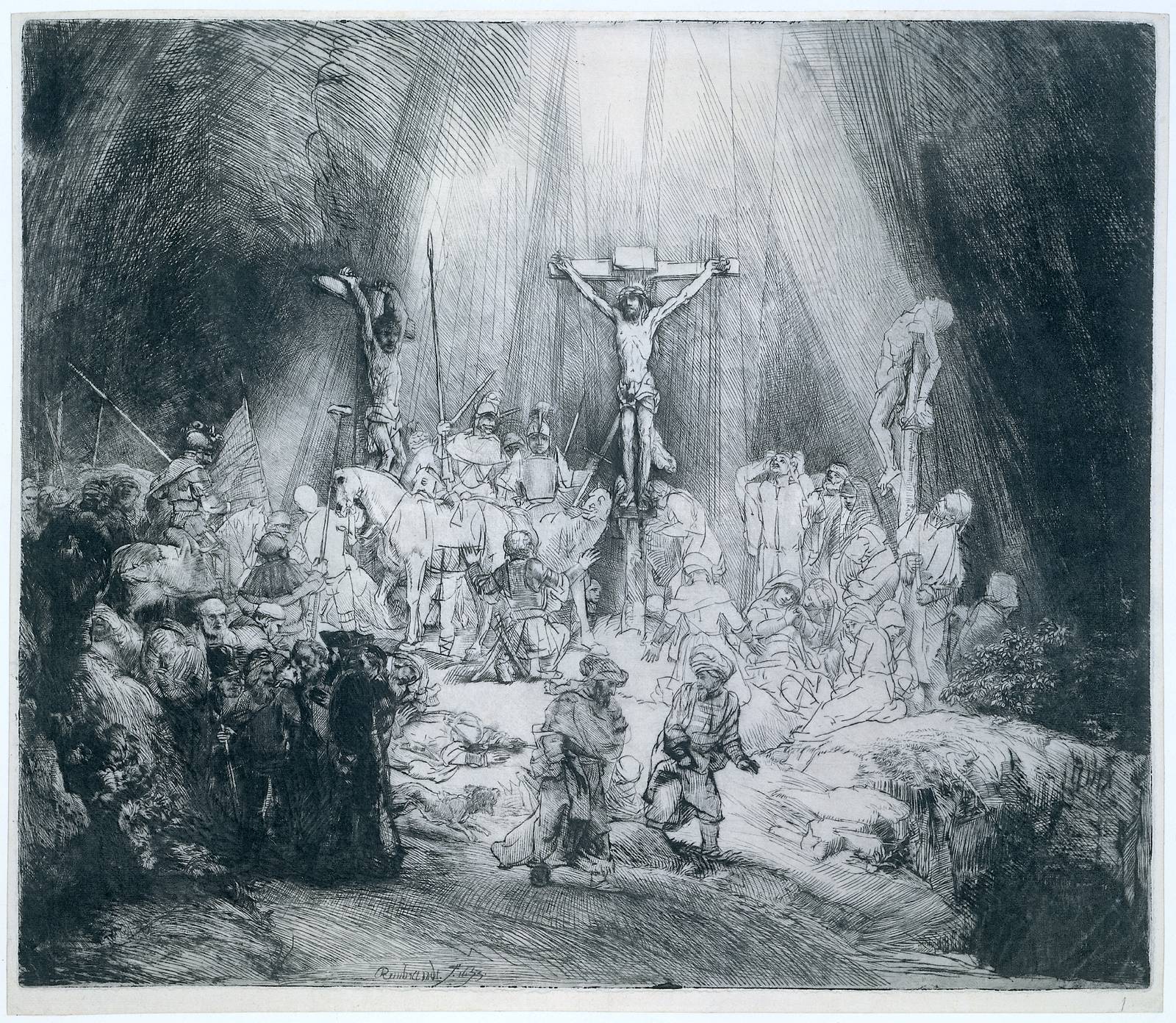
The Three Crosses by Rembrandt. 165311. Jesus is Nailed to the Cross
– Behold the new Tree of Knowledge of Good and Evil
– Jesus is showing us how much he loves us

12. Jesus Dies on the Cross
– Jesus extends his arms between Heaven and earth
– Our crucified God endures the problem of evil

13. Jesus is Taken Down from the Cross
– Love can require letting ourselves be a “burden”
– The world took all it could, but God had more to give

14. Jesus is Laid in the Tomb
– From a new womb to a new tomb, both freely offered
– The mustard seed is planted

The Seven Last “Words” of Christ

March 21, 2014

“Father, forgive them for they know not what they do.”  (Luke 23:34)

To the good thief:  “Amen, I say to you: this day you will be with me in paradise.”  (Luke 23:43)

To Mary:  “Woman, behold your son.” And to his beloved disciple:  “Behold your mother.”  (Luke 19:26-27)

“My God, my God, why have you forsaken me?”  (Mark 15:34)

“I thirst.”  (John 19:28)

“It is consummated.”  (John 19:30)

“Father, into your hands I commend my spirit.”  (Luke 23:46)

Tempting the Messiah — 1st Sunday in Lent—Year A

March 7, 2014

Gospel: Matthew 4:1-11

Jesus Tempted in the Wilderness by James Tissot 1886-1894.The devil suggests Jesus should change stones into bread. He wants Jesus to be a materialistic Messiah who will focus on nourishing bodies to the neglect saving souls. Jesus replies that “one does not live on bread alone, but on every word that comes forth from the mouth of God.” Christ shall change bread into himself at the Last Supper “for the life of the world.” (John 6:51)

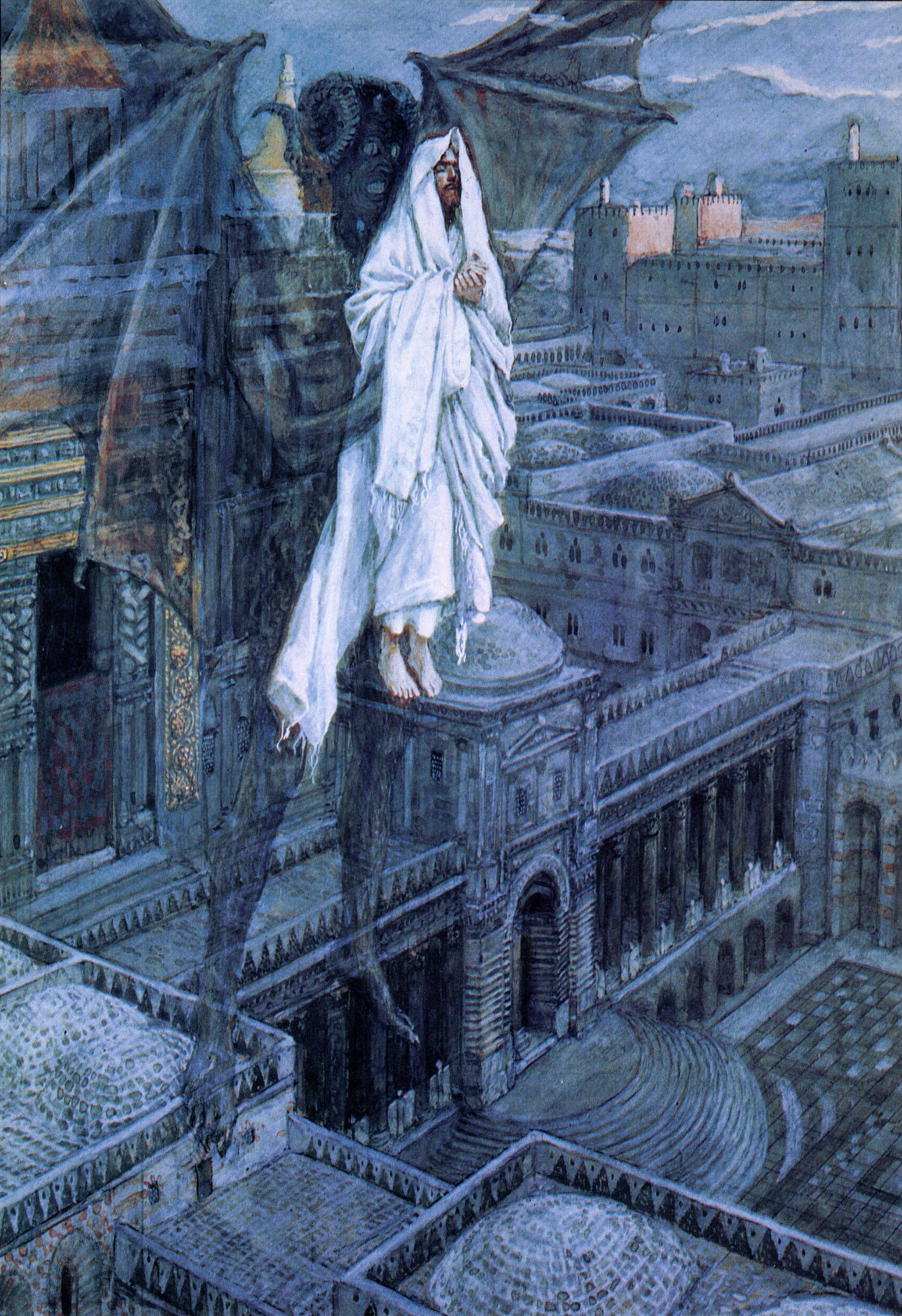
A depiction of Jesus being tempted at the temple by James Tissot, 1895The devil takes Jesus to a precipice atop the temple in Jerusalem and challenges him to throw himself down. He wants Jesus to be a Messiah who will hope to never suffer. Jesus responds that “you shall not put the Lord, your God, to the test” by trying to force him into doing our will. Christ shall be tested and condemned by the Sanhedrin in Jerusalem and be made a suffering Savior according to God’s plan. (Isaiah 53)

The devil takes Jesus up to a very high mountain, shows him all the kingdoms of the world, and promises to bestow them all if Jesus would simply prostrate himself and worship him. He wants Jesus to be a compromised Messiah who will pursue good by doing (or serving) evil. Jesus replies that “Lord, your God, shall you worship and him alone shall you serve.” By unwavering obedience to his heavenly Father, Christ shall become the king of all nations, enthroned high upon a cross on Mount Calvary. (Matthew 20:21)

Four Cheeks Turned — 7th Sunday in Ordinary Time—Year A

February 22, 2014

Gospel: Matthew 5:38-48

When attacked, our natural response is “fight or flight,” but Jesus suggests a  supernatural response: “When someone strikes you on your right cheek, turn the other one as well.” Since the Jews regarded the left hand as unclean, they would reflexively strike with the right hand. If the right cheek were hit, then one had been backhanded with contempt. Responding by turning the other cheek neither attacks not retreats, but insists on being regarded as an equal, whom one must strike (if at all) with an open hand. Jesus wants us to stand our ground in the face of injustice, assertively but lovingly, in hopes that the offender will reconsider his ways. Jesus modeled this response when he was struck during his trial before Annas:

The high priest questioned Jesus about his disciples and about his doctrine. Jesus answered him, “I have spoken publicly to the world. I have always taught in a synagogue or in the temple area where all the Jews gather, and in secret I have said nothing. Why ask me? Ask those who heard me what I said to them. They know what I said.” When he had said this, one of the temple guards standing there struck Jesus and said, “Is this the way you answer the high priest?” Jesus answered him, “If I have spoken wrongly, testify to the wrong; but if I have spoken rightly, why do you strike me?” (John 18:19-24)

Another saintly example was shown by Blessed Mother Teresa of Calcutta. Though reports vary, Mother Teresa was once begging bread from a baker for her orphanage. When the baker responded by spitting into her hand, she replied to effect, ‘I will keep this for me, but please give something for my children.’

In Victor Hugo’s Les Miserables, a bishop welcomes an impoverished convict to join his table and sleep at his home. However, that night, Jean Valjean steals his host’s silverware and goes away. The police catch him and take him to the bishop. Looking at Jean Valjean, the good bishop exclaims, “Ah! here you are! I am glad to see you. Well, but how is this? I gave you the candlesticks too, which are of silver like the rest, and for which you can certainly get two hundred francs. Why did you not carry them away with your forks and spoons?” Jean Valjean opens his eyes wide and stares at the venerable Bishop “with an expression which no human tongue can render any account of.” The bishop’s turn of the cheek spares the thief’s freedom and saves his soul.

And finally, a true story from a modern marriage: A woman’s husband had a terrible temper and every time it flared she would say, “That’s just like you to lose your temper!” But then, following a stroke of insight, she began responding differently. The next time he began to fly of the handle she told him, “That’s not like you to lose your temper,” and he nearly fell out of his chair. Even the kids looked at her funny, but she stuck with her new resolution. Months later, while at a restaurant together, he became irritated by the slow service. He started to fume about it, but then he suddenly stopped, turned to her, and said, “That’s not like me to lose my temper, is it?” This time, it is said, she nearly fell on the floor.

Was it true the first time the woman declared that it was not like her husband to lose his temper? The claim did not match his previous behavior, but perhaps he changed because she revealed to him that his uncontrolled anger was quite unlike the father, husband, and Christian man he truly and deeply wanted to be. This is the sort of realization and conversion we are to hope for in turning the other cheek.

Plus, a fifth story: “If a teen mugs you for your wallet…

Stained Glass Symbols — The Holy Cross

February 20, 2014

Holy Cross - Sacred Heart Catholic Church -  Wauzeka WIA Symbol of Christ’s Triumph

Jesus Christ’s cross is holy because it is the instrument he uses to save the world. The Roman Empire, in a demonstration of worldly wisdom and power, used crucifixion to humiliate, torture, and terrorize whoever would dare to oppose them. Jesus takes the cross, the worst evil the spiritual and human rulers of this world could wield against him, and employs it to achieve his victory.

Stained Glass Symbols — Mount Calvary’s Cross

February 18, 2014

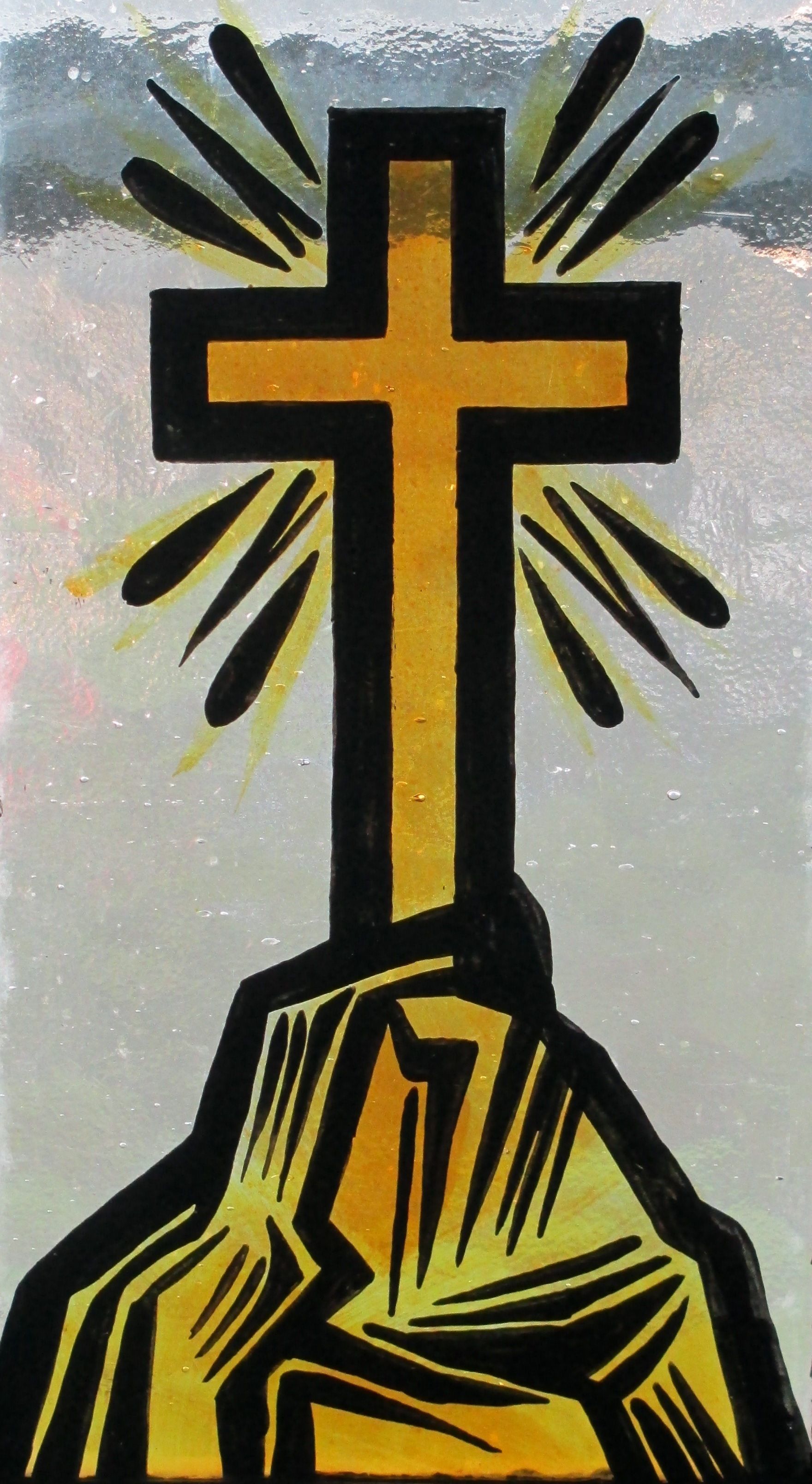
Mount Calvary's Cross - Sacred Heart Catholic Church -  Wauzeka WIA Symbol of the Source & Summit of the Christian Life

Jesus Christ’s sacrifice on Mount Calvary’s cross was offered in love of God and man. It is the source or fount for all saving grace, and the summit or pattern to which all Christians are called.

The Way, Truth, & Life — 5th Sunday in Easter—Year A

May 22, 2011

Jesus said, “I am the way and the truth and the life. No one comes to the Father except through me.”

The Mass is an encounter with Jesus Christ, leading us to God the Father. Like Jesus Himself, the Mass contains the Way, the Truth, and the Life of Jesus. First, we journey on the Way to Jesus, then we come to the Truth of Jesus, finally we join in the Life of Jesus.

The Mass begins with the sign of the cross, for God is the beginning and end of everything. Next, we confess our unworthiness to approach the Lord, asking mercy for our sins, so that we may dare to take this journey to God. The, from the Holy Scriptures, we hear of God’s words and deeds among the Old Testament peoples and within the New Testament Church. In this, we learn of the providential way that God has prepared throughout time for us to encounter Jesus Christ today. Just as the journey on this Way through history leads to Jesus Christ, so the liturgy of the Word leads to the Gospel. Certainly, Jesus Christ the Word of God is present throughout the entire Word of God which is Sacred Scripture, but for the reading of the Gospel, we all stand up for Him and sing “Alleluia,” “Praise the Lord,” because we have come to Jesus Christ and He is more fully present among us in the proclamation of the Gospel.

The Gospel reading proclaims Jesus, who is the Truth. The homily that follows proclaims that the Truth matters for us here and now and demands our personal response. To this call, we answer with the Creed, proclaiming our faith in who God is and what He has done for us. In the Creed, we proclaim our acceptance of Jesus, the Truth. In the prayers of the faithful, we petition the Lord for our needs and concerns, saying in so many words, “Lord, let your kingdom come, on earth as it is in Heaven! Let us share you life! Give us your life!” At Mass, the Way leads to the Truth, and from the Truth we long for God’s Life. At Mass, the Liturgy of the Word leads to the Liturgy of the Eucharist.

The presentation of the gifts is not merely about moving around cash and bread and water and wine. The presentation of the gifts is about the presentation of everything that we have, and everything that we are, to God. We lift up our hearts to be one with our sacrifice. Amidst praises to the Father, the one life-giving sacrifice of the Last Supper, of the cross, and of Heaven becomes present here to us. We join in offering this sacrifice through Jesus, with Jesus, and in Jesus, in union with the Holy Spirit, to God the Father in Heaven.

Through this offered sacrifice, we join in God’s Life. We pray “Our Father,” because uniting with the paschal mystery, the great Easter deeds of Jesus, gives us life as the Father’s sons and daughters. Then we share with one another the sign of peace, the loving peace that is possessed by God’s holy ones. Finally, at the climax, we partake of Jesus Christ, Life Himself, most truly present in the Holy Eucharist.

Sometimes people say, “I just don’t get anything out of going to Mass. Father, I know that you say all this important and wonderful stuff is going on, but I don’t see it and I don’t feel it. The Mass is boring for me.” I understand. When I was a boy, I made a point of going to the bathroom (sometimes twice) during every Mass, just to break up the monotony. When I would see the priest cleaning the dishes at the altar—that was a good sign, because it meant that the Mass was almost done. I didn’t really know what was happening at Mass, so I really didn’t believe in what was happening at Mass. But as I grew older I began to learn what was happening, and as I grew in faith I began to believe in what was happening, and my experience of the Mass was transformed.

People who say that the Mass is boring resemble St. Phillip in something he said to Jesus at the first Eucharist, the Last Supper: “Master, (we don’t see or feel the presence of God the Father,) show us the Father, and that will be enough for us.” And Jesus said to him, “Have I been with you for so long a time and you still do not know me, Philip? Whoever has seen me has seen the Father. (Whoever has been to Mass has encountered my mysteries.) How can you say, ‘Show us the Father’? (How can you say, ‘The Mass is boring?’)” The awesome mystical realities of the Mass are true, and real, and present and active at every Mass we attend, whether we see them, or feel them, or believe in them, or not.

Jesus Christ and the Holy Mass contain the Way, the Truth, and the Life, and we shall receive from them according to our faith. Let us pray, that at this Mass and every Mass, we may be as fully present to Jesus Christ and His mysteries as they are to us at every Mass.

“I Thirst” — Good Friday

April 22, 2011

Shortly before He died on the cross, Jesus said, “I thirst.” Why did He say, “I thirst”? He was certainly physically dehydrated. As Psalm 22 foretells, His throat was as dry as broken pottery and His tongue stuck to His palate, but there was more reason for His words than just this.

Last night, at the Last Supper, Jesus had postponed drinking the traditional fourth and final cup of Passover. He said “I thirst” so that they would bring Him wine, so that He could drink, and unite the Last Supper and His Passion as one event. However, there is even more reason for His words than this.

Beside the crucifixes, in all of the chapels, in all of her religious houses around the world, Blessed Mother Teresa had written the words, “I thirst.” She understood that what Jesus thirsts for on the cross is us. Mother Teresa wrote, “Jesus is God, therefore His love, His Thirst, is infinite. He the Creator of the universe, asked for the love of His creatures. He thirsts for our love…” 

As we come to Him on the cross today, let us satisfy His thirst with the refreshment we can give to Him.

“Do This…” — Holy Thursday

April 21, 2011

At the Last Supper, the night before he suffered for us, Jesus took some bread. He thanks to God for it and He broke it. And He declared it to be His body which would be given up for others. Then He offered it to those He loved. When the supper was ended, Jesus took a cup of wine. Again He gave thanks and praise to the Father. And He declared it to contain His blood, blood to be shed for all. Then He offered the cup to His disciples and said, “Do this in remembrance of me.”

At the Last Supper, Jesus ordained His apostles the first priests of the New Covenant. They and their successors would do this in remembrance of Him, throughout the centuries, up to this very night, and until He comes again. When you and I celebrate the Mass we remember Him and what He did, and more than just recalling it, we re-encounter it as that same sacrifice is offered in front of us. But Jesus’ words, ‘to do this in memory of Him’ means more than just coming to Mass.

Jesus is calling and commanding us to do the thing that He is doing. We must give God thanks and praise for what He has given us. We must take our bodies and give them up. We must take our life’s blood and pour it out. And we can do this, for God and for each other, in as many ways as there is to love. The sacrifices of your daily life, at home, at work, and at prayer; the work of washing feet; may not seem significant to you now, but these sacrifices shall your glory in Heaven forever.

As Jesus washed His apostles’ feet He said, “What I am doing, you do not understand now, but you will understand later.” And when He had finished He said, “If I, … the master and teacher, have washed your feet, you ought to wash one another’s feet.  I have given you a model to follow, so that as I have done for you, you should also do.” At the Last Supper, Jesus said to His disciples, “Do this in remembrance of me.” Tonight, He says the same to us as well.

Our Triduum Crowd — Palm Sunday—Year A

April 20, 2011

On Palm Sunday, the crowds welcomed Jesus into Jerusalem as a hero.  On Good Friday, the crowds will clamor for His death. How do we explain this dramatic switch from love to hate? It might be that the mob had become infatuated with Jesus, thinking that He was going to be the earthly messiah of their dreams, the one who would force the hated Romans out of their land and reign as a new and greater King David. Perhaps the crowd realized that this wasn’t Jesus’ plan, and then angrily turned on Him like a lover spurned, hating Him for disappointing their high hopes.

Another possibility is that we are seeing two different crowds, made up almost entirely of different people. Perhaps the chief priests and the Pharisees had assembled a mob around them of those they knew they could easily manipulate. They had arrested Jesus late in the night and brought Him to Pilate early the next morning. Perhaps many of Jesus’ the Palm Sunday supporters had no idea what was happening until Jesus was already in the tomb. Perhaps the next day many of them said, “I wish I had known! I would have been there for Jesus!” Or perhaps they did hear about what was afoot, but had already disowned Jesus for disappointing their messianic dreams. Maybe some people said, “Jesus of Nazareth? I’m too busy to be bothered with Him anymore. I’ll keep my distance, and see how this thing plays out in the end.” Whatever the reason, the crowd that turned-up for Jesus’ trial was short on those who loved Him.

The liturgy of Holy Thursday, Good Friday, and Easter Vigil (what we call the Easter Triduum) is our greatest celebration in the Church. It’s bigger than Christmas and Jesus invites you to be there. Jesus invites you to attend his last meal and to keep watch with Him Thursday night, to accompany Him through His Passion and to reverence Him on the cross, and to keep vigil at His tomb Saturday night and to be the first witnesses to His resurrection. If you truly cannot make it, Jesus understands, but if you would come here to join this crowd accompanying Jesus throughout these holy days, it would please Him, very much.

We Owe Him Big — Tuesday of Holy Week

April 20, 2011

When I was your age, there was a popular show on TV that I liked to watch that maybe you’ve heard of, the show was called The Simpsons. And though it was 20 years ago, I still remember my favorite episode: “Bart Gets an F.” This episode happens to be the most highly-rated Simpsons of all-time and Entertainment Weekly once picked it as the “31st Greatest Moment in Television [History].”

Bart Simpson was failing the fourth grade, and Mrs. Krabappel told him that if he failed his next exam he would forced to repeat the year. Bart tries to prepare by teaming up with Martin to study, but Martin abandons him. And so, the night before the exam, Bart has run out of time. Bart goes to his bedside, kneels down, and prays.

“I know I haven’t always been a good kid, but, if I have to go to school tomorrow, I’ll fail the test and be held back.  I just need one more day to study, Lord.  I need Your help! A teachers strike, a power failure, a blizzard… Anything that’ll cancel school tomorrow.  I know it’s asking a lot, but if anyone can do it, You can!  Thanking You in advance, Your pal, Bart Simpson.” Bart turns off the light, goes to bed, and outside, snowflakes begin to fall.

The next day, the whole world is white and deep. Kids are throwing snowballs, building forts, and riding sleds downhill. Even the adults are joining in the fun. Mayor Quimby solemnly proclaims, “I hereby declare this day to be Snow Day, the funnest day in the history of Springfield!” Bart grabs his sled and makes to rush out the front door, but when arrives at the door, Lisa’s ominous shadow blocks the way.

“I heard you last night, Bart.  You prayed for this.  Now your prayers have been answered.  I’m no theologian; I don’t know who or what God is exactly, all I know is He’s a force more powerful than Mom and Dad put together, and you owe Him big.”

Bart pauses and says, “You’re right.” He removes his goggles from his head and hands them to Lisa. “I asked for a miracle, and I got it.  I gotta study, man!” He goes up stairs and studies like he’s never studied before, or probably since. The next day Bart passes his exam, and the fourth grade, with a D—, and mother Marge puts his test proudly on the fridge.

This weekend, we are going to have a lot of days off from school. Let us remember whom we have to thank for that, what he did for us, and what this long weekend is for. I know you will all be in church on Easter. Everybody’s in church on Easter. But Holy Thursday evening, and Good Friday afternoon, Jesus would enjoy your company at church then, too. If you can’t come at least think of Him then, and of what He’s done for us. Let’s not be like Judas, who was without gratitude, and was the first one out the door. Let us be like Bart Simpson, at least in this much, in showing our thanks to the God who saved our butts, because we owe Him big.

Penance Service Rosary Meditations

April 20, 2011

The First Sorrowful Mystery: The Agony in the Garden

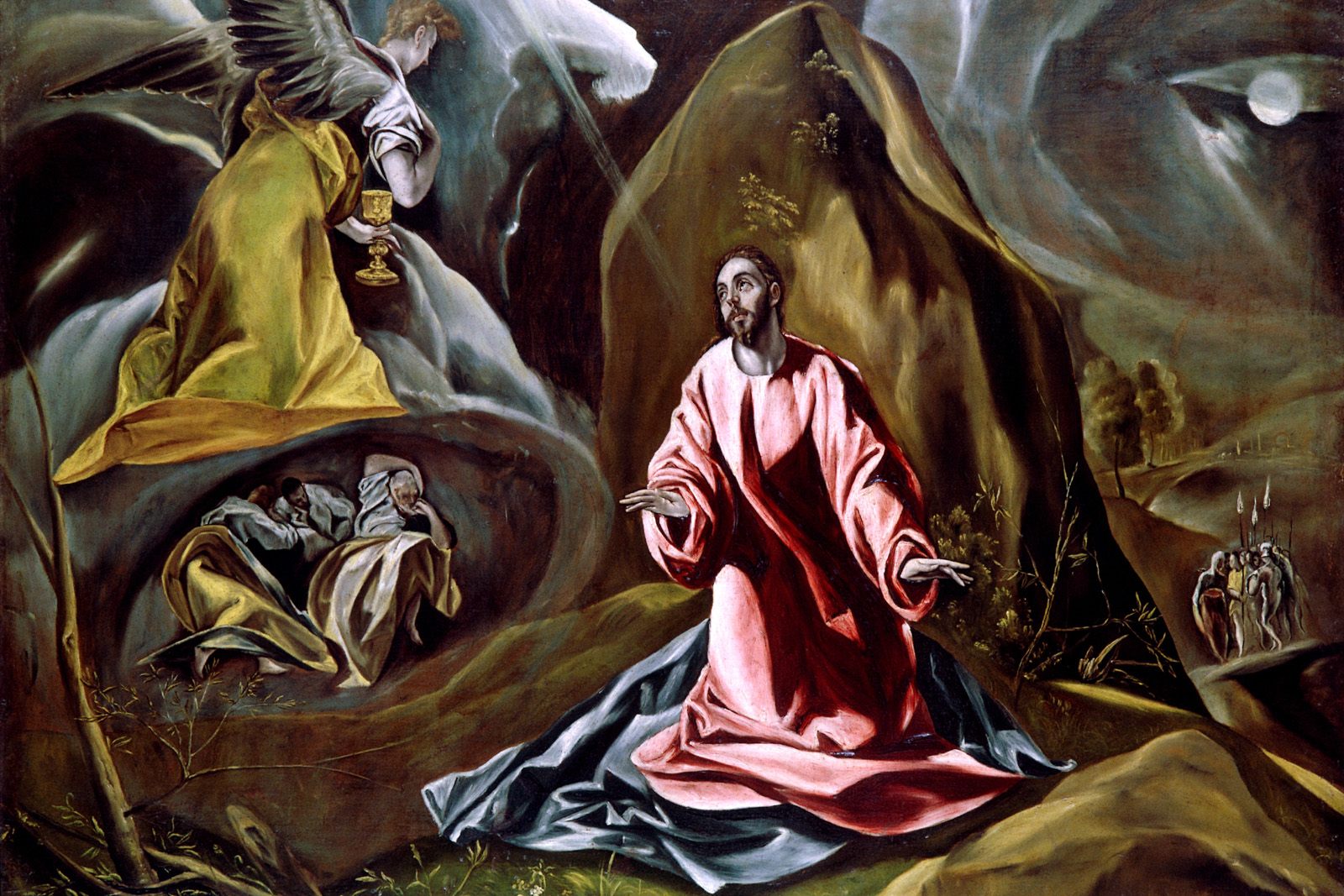
Jesus went out with his disciples across the Kidron Valley. There was a garden there and he and his disciples entered it. He took along Peter and Zebedee’s two sons, and began to experience sorrow and distress. Then he said to them, “My heart is nearly broken with sorrow. Remain here and stay awake with me.” He advanced a little and fell prostrate in prayer. “Father, if it is possible, let this cup pass me by. Yet not my will, but yours be done.” In his anguish he prayed with all the more intensity, and his sweat became like drops of blood falling to the ground. Then he rose from prayer and came to his disciples, only to find them sleeping. He said to Peter, “Simon, are you asleep? Could you not keep watch for one hour? ”

When Peter, James and John fell asleep that hour in the garden, they let Jesus down, but Jesus still loved them. When we sin, we also let Jesus down, but Jesus still loves us, too. Let us all make good confessions, and pray attentively, in this hour with Jesus.

The Second Sorrowful Mystery: The Scourging at the Pillar

When it was morning, those who had arrested Jesus bound him, led him away, and handed him over to Pilate, the governor. Now for Passover, the governor was accustomed to release to the crowd one prisoner whom they wished. At that time they had a notorious prisoner, a revolutionary, a robber and a murderer, called Jesus Barabbas. (The name Barabbas means “son of the father.) When they had assembled, Pilate said to the crowd, “Which one do you want me to release to you, Jesus Barabbas, or Jesus called Christ?” They answered, “Barabbas!” Then he released Barabbas to them, but after he had Jesus scourged, he handed him over to be crucified.

Whenever we sin, we choose a Barabbas instead of Christ. Jesus promises us that choosing Him will make us the most happy, but when we choose to do what’s wrong, we disbelieve Him, and choose someone or something else to make us happy. With our confession and these prayers, let us recommit ourselves to always choosing Jesus Christ, who suffered whips for love of us.

The Third Sorrowful Mystery: The Crowning with Thorns

Then the soldiers of the governor took Jesus inside of their fortress and gathered the whole army around him. They stripped off his clothes and threw a scarlet military cloak about him. Weaving a crown out of thorns, they placed it on his head, and put a reed in his right hand. And kneeling before him, they mocked him, saying, “Hail, King of the Jews!” They spat upon him and took the reed and kept striking him on the head. And when they had mocked him, they stripped him of the cloak, dressed him in his own clothes, and led him off to crucify him.

For as much as those soldiers mocked Jesus, let us now honor Jesus sincerely through this decade of the Rosary, with our hearts full of sorrow and thanks.

The Fourth Sorrowful Mystery: The Carrying of the Cross

They took Jesus, and carrying the cross himself he went out to what is called the Place of the Skull, in Hebrew, Golgotha. As they led him away, they laid hold of a man named Simon who was coming in from the country. They put a crossbeam on Simon’s shoulder for him to carry behind Jesus. A great crowd of people followed him, including women who beat their breasts and lamented over him.

During this decade of the Rosary, let us imagine ourselves helping Jesus to carry His cross. By being with Him and knowing how He felt, this will help us to love Him more. And who knows, perhaps our prayer will travel through space and time to help lighten, even just a little, the burden that He carried.

The Fifth Sorrowful Mystery: The Crucifixion

They brought Jesus to the place of Golgotha (which is translated Place of the Skull) and crucified Him there. At noon, darkness came over the whole land until three in the afternoon. And at three o’clock Jesus cried out in a loud voice, “My God, my God, why have you forsaken me?” Finally, Jesus cried out in a loud voice, “Father, into your hands I commend my spirit”; and when he had said this he breathed his last.

The forgiveness of our sins is so easy for us. When we go to confession and it is brief and painless. But let us always remember this: the forgiveness of our sins is so easy for us in the confessional because Jesus let the forgiveness of our sins be so hard on Him on the cross. Let us thank Him and honor Him for this great gift.

Lenten Penance Service Homily

April 15, 2011

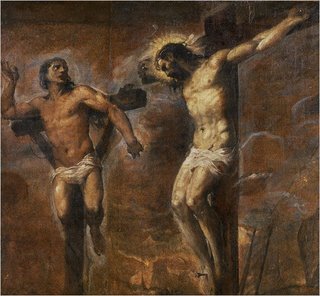
When they came to the place called the Skull, they crucified him and the criminals there, one on his right, the other on his left. Now one of the criminals hanging there reviled Jesus, saying, “Are you not the Messiah? Save yourself and us.” The other, however, rebuking him, said in reply, “Have you no fear of God, for you are subject to the same condemnation?  And indeed, we have been condemned justly, for the sentence we received corresponds to our crimes, but this man has done nothing criminal.” Then he said, “Jesus, remember me when you come into your kingdom.” He replied to him, “Amen, I say to you, today you will be with me in Paradise.”

Sadly, all of us have sinned. Each of us is guilty. Now a sin is more than just an innocent mistake or a misunderstanding. (There is in guilt in those things.) The truth is that each of us at times have sinned by knowingly choosing to do what is wrong instead of doing what is right. With every sin, we hurt each other. We also hurt our relationship with Jesus, who is entirely good, and the most deserving of our love. All of us are guilty. We have all committed crimes against God and our neighbors. So what shall we do?

Like the two criminals in the gospel we just heard, this morning we have the opportunity to encounter Jesus Christ, in the sacrament He gives us. But like which of those two criminals will we be in His presence? The first criminal didn’t acknowledge or care about his own sins. He tried to ignore his terrible situation and treated Jesus on the cross like a joke. However, the second criminal, who tradition calls the Good Thief, acted wisely and well. He recognized in Jesus Christ the one person in the whole world who could really help him. This guilty man praised Jesus for his goodness and asked for Him for His mercy. And Jesus forgave him and promised him great things.

On behalf of Jesus Christ, I beg you this morning to make a good confession, heartfelt confession of your all sins. Jesus said to the Good Thief, “Amen, I say to you, today you will be with me in Paradise.” Like the Good Thief, Jesus wants you to know the blessings of His complete forgiveness today.

3 Mountains / 3 Montañas — 2nd Sunday in Lent—Year A

March 20, 2011
In the life of Jesus, he climbs three significant mountains; The mountain of the sermon on the mount, the mountain of Transfiguration (in today’s reading) and the mountain of the crucifixion. In the Christian life, we must also visit these three mountains. 
 
The three mountains are united. The wisdom of the sermon on the mount, on the first mountain, brings the pleasures and pains of the other mountains. The life of the Gospel brings the joys of the light and the suffering of the cross. Wisdom, glory and sacrifice; the three are a trio here on this earth. Our glories without sacrifice pass quickly. Our sacrifices without wisdom we regret quickly. And our wisdom will be without glory forever if we do not follow Christ in sacrifice. Which mountain should visit more this season of Lent?
 
Do you lack wisdom? Do you not know well that Jesus and his Church teaches? Go to the first mountain to learn, like the disciples at the Sermon on the Mount, with the Bible, or the Catechism or many popular resources available in audio or visual forms.
 
Do you need consolation? Do you not feel well that Jesus is your beloved friend? Go to the second mountain, to feel like Jesus and his disciples at the Transfiguration, through time in a quiet place with God.
 
Do you need perfection in your love? Do you not carry the cross well? Go to the last mountain to practice it, like Jesus at the crucifixion, through good works for others.
 
Jesus climbed the mountains of wisdom, glory and sacrifice. To be with him, we must climb these also.
 

En la vida de Jesús, él sube tres montañas notables. La montaña del sermón del monte, la montaña de la transfiguración (en la lectura de hoy) y la montaña de la crucifixión. En la vida cristiana, debemos visitar estas tres montañas también.

Las tres montañas están unidas. La sabiduría del sermón del monte, de la primera montaña, trae los placeres y dolores de las otras montañas. La vida del Evangelio trae las alegrías de la luz y los sufrimientos de la cruz.  Sabiduría, gloria y sacrificio; los tres son un trío unido en esta tierra.

Nuestras glorias sin sacrificio pasan rápidamente. Nuestros sacrificios sin sabiduría lamentamos rápidamente. Y nuestra sabiduría será sin gloria para siempre si no nos siga a Cristo en sacrificio. ¿Qué montaña deben visitar más esta temporada de Cuaresma?

¿Faltas de sabiduría? ¿No sabes bien lo que Jesús y su Iglesia enseñan? Vaya a la primera montaña para aprender como los discípulos al sermón del monte, con la Biblia, o el catecismo o muchos recursos populares disponibles en formularios visuales o de audio.

¿Necesitas consuelo? ¿No te sientes bien que Jesús es tu amigo amado? Vaya a la segunda montaña para sentirlo como Jesús y sus discípulos a la transfiguración, con tiempo con Dios en un lugar tranquilo.

¿Necesitas perfección en tu amor? ¿No llevas bien la cruz? Vaya a la última montaña para practicarlo como Jesús a la crucifixión, con buenas obras para otros.

Jesús subió las montañas de sabiduría, de gloria y de sacrificio. Para estar con él, debemos subir estas también.