Archive for the ‘Typology’ Category

Consoling the New Jerusalem — 14th Sunday of Ordinary Time—Year C

July 8, 2019

This word of the Lord regarding Jerusalem was spoken through the Prophet Isaiah in our first reading:

“Thus says the LORD: Rejoice with Jerusalem and be glad because of her, all you who love her; exult, exult with her, all you who were mourning over her! For thus says the LORD: Behold, I will spread prosperity over Jerusalem like a river. As a mother comforts her child, so will I comfort you; in Jerusalem you shall find your comfort. When you see this, your heart shall rejoice and your bodies flourish like the grass; the LORD’s power shall be known to his servants.”

When reading Old Testament prophesies, the tone can really widely vary. Depending upon the particular century, the Lord’s message directed towards Jerusalem or the Israelites can be consoling, encouraging, promising good things to come; or denouncing, woeful, declaring punishments to follow. I find it really difficult to place our country and our present time amongst these Old Testament messages. I can imagine the people of our land being pleasing the Lord in many respects and I can see us meriting his correcting chastisement for other reasons. So do the consoling words of Isaiah apply to us? Let me explain how I think that they can.

In Old Testament times, Jerusalem, the holy city, was the place of God’s temple, his dwelling place on earth. But in 70 A.D., the Romans sieged Jerusalem and destroyed the temple leaving not one stone upon another, as Jesus had proselytized and foretold. In New Testament times, Jesus is the Temple. In John’s Gospel, Jesus tells a crowd, “Destroy this temple and in three days I will raise it up,” and John notes Jesus “speaking about the temple of his body.” The Body of Christ is the New Temple. The Christian understanding of Jerusalem changes, too. In the Book of Revelation, St. John beholds “the holy city, a new Jerusalem, coming down out of heaven from God, prepared as a bride adorned for her husband.” John hears a loud voice from the throne say, “Behold, God’s dwelling is with the human race. He will dwell with them and they will be his people and God himself will always be with them as their God.” So the New Temple is the Body of Christ. And the New Jerusalem is the Bride of Christ. Where is the Body of Christ now and where is his Bride? As New Testament Scriptures tell us, they are present on earth and in Heaven, as his Holy Church.

There are wounds and sufferings in the Body of Christ. This was personally true for Jesus on earth, and it is true for his members. In our second reading, St. Paul writes: “From now on, let no one make troubles for me; for I bear the marks of Jesus on my body.” Paul composed his letter in Greek, and here the Greek word for “marks” is literally “stigmata.” In the ancient world, slaves and devotees of pagan deities were often branded by marks called “stigmata” to indicate to whom they belonged, who they served or who was their god. In a Christian context, “stigmata” has come to mean the miraculous sign or gift of receiving the wounds of Christ, in one’s hands, feet, or side. St. Francis of Assisi experienced the stigmata near the end of his life, and St. Padre Pio bore Christ’s wounds in his hands for fifty years. But what St. Paul is describing in this passage is not necessarily that. In 2nd Corinthians, he enumerates the sufferings he had endured: “Five times at the hands of the Jews I received forty lashes minus one. Three times I was beaten with rods, once I was stoned…” St. Paul greatly suffered in Christ, but many wounds are not physical.

I hate that wolves in sheep’s clothing have hurt and scarred members of the Body of Christ, the Church. I hate that the Bride of Christ I love is denounced as something evil. Perhaps it has never been easy to be a Catholic, but it is hard to be a Catholic today. How are we going to respond? In today’s gospel, Jesus says, “Beg the master of the harvest [that is, God his Father] to send laborers into his harvest.” In other words, we should ask God to raise up saints. In the worst and hardest times in Church history, God has supplied holy saints. And he still lifts up saints in our modern times as well.

In the year 2010, a baby boy was born in Illinois with neither breath nor pulse. The parents prayed for the intercession of another native son of Illinois. That man had grown up in El Paso, Illinois, become a priest and eventually an archbishop, was an excellent preacher and author, and even won an Emmy for his highly-rated, prime-time, national TV show called “Life is Worth Living.” Archbishop Fulton J. Sheen died in 1979, but after praying for his help in saving their son’s life, after sixty-one minutes of no signs of life, their boy began to breathe and show a pulse. Today, James Fulton Engstrom is a fully healthy eight-year-old, and yesterday the Vatican officially announced that his inexplicable healing was a miracle, which clears the way for Archbishop’s Sheen’s beatification in the near future.

Fulton Sheen was a twentieth century saint, but God desires to raise up twenty-first century saints as well. And not just among others elsewhere, but among we ourselves. You and I likely never be beatified or canonized, but we are all called to be saints because we are all called to Heaven, and to begin living the life of Heaven here and now.

Notice how in today’s gospel, Jesus does not send out his missionaries one-by-one but in pairs. He told them to stick together, “stay in the same house.” Why? He wanted them to be a help, encouragements to each other, to be faithful and fruitful. Likewise, we have the fellowship of one another to help us become saints. And we have holy friends who know and love us to help us, the saints in Heaven. And we have our greatest friend who provides the means for our sanctification in himself, Jesus Christ. Let us become saints together. Then the words of Isaiah will be fulfilled among us. All who were mourning over Jerusalem will exult and all who love her will rejoice. In holiness the Lord’s power shall be known to his servants. And we will be comforted and flourish, in the New Jerusalem here on earth and in Heaven without end.

Returning to Dust & Rising From the Ashes

March 11, 2019

Funeral Homily for Daniel G. Zwiefelhofer
by Fr. Victor Feltes on March 7, 2019

The Fall of Mankind and Expulsion from Paradise
by Michelangelo on the ceiling of the Sistine Chapel

Remember that you are dust, and to dust you shall return.” These words were heard many times yesterday on Ash Wednesday as ashes were applied to foreheads. There is another phrase the ash-bestowing minister can say, but “remember that you are dust, and to dust you shall return” is the classic option. Where does this phrase come from? It’s from the story of Genesis, following the Original Sin, the Fall of Man.

When Adam and Eve sinned in the Garden, punishments were placed on them and their descendants. To the woman God said, “I will intensify your toil in childbearing; in pain you shall bring forth children.” And to the man God said, “In toil you shall eat the ground’s yield all the days of your life. Thorns and thistles it shall bear for you, and you shall eat the plants of the field. By the sweat of your brow you shall eat bread, until you return to the ground, from which you were taken; for you are dust, and to dust you shall return.” And God announced a punishment upon the wicked serpent too: “I will put enmity between you and the woman, and between your offspring and hers; he will strike at your head, while you strike at his heel.”

We still feel the consequences of sin and observe of the brokenness of our world. Birthing babies is painful and raising children is challenging. Daniel learned these truths firsthand alongside Marion. And, as a lifelong farmer, Daniel experienced firsthand that farming is hard work. Growing food, from beasts or fields, demands the sweat of one’s brow. And today, after eighty-one years of life on this earth, we gather for Daniel’s funeral; for we are dust, and to dust we return. If these things were all that we saw and knew we would be left in sad despair, but this is not the end of the story; for Genesis, for Daniel, or for us.

I mentioned earlier that there’s another phrase option for ash-distributors to say on Ash Wednesday: “Repent and believe in the Gospel.” The Gospel is a message of living hope and it was proclaimed from the beginning. The Church teaches that the Protoevangelium, or “First Gospel” promising salvation was announced in the Garden of Eden. Recall how God said to the serpent, in the presence of Adam and Eve: “I will put enmity between you and the woman, and between your offspring and hers; he will strike at your head, while you strike at his heel.” This is speaking to more than the natural hatred between humans and deadly snakes – it’s a prophesy. That “he,” the offspring of the woman, was to be Jesus. The ancient serpent, the devil, struck out at Jesus’ lowly flesh (as at Jesus’ heel) in the Passion. But Jesus the New Adam, triumphed through his Passion, death, and resurrection, crushing the enemy’s head.

Jesus is the New Adam. Tempted in a garden (the Garden of Gethsemane) Jesus did not falter. Called to lay down his wife for his bride (the Church) Jesus did not balk. And by the sweat of his brow (even sweating blood) he has provided her bread, in the Most Holy Eucharist, which is himself. He accepted a crown of thorns from a world turned against him, but by his toil of carrying his Cross Jesus has produced a fruitful yield on earth. Jesus was placed into the dust of the earth — entombed at death, but Jesus was not abandoned to the dustbin of history. The New Adam triumphs over death.

And the New Eve, his bride the Church, continues (with toil and pains, but also with joy) to bear forth children who live and die with faith in Christ, like Daniel. And, as Daniel’s prophetic namesake says in our first reading, “Those who sleep in the dust of the earth shall awake; and some shall live forever…” Likewise, in our second reading, St. Paul proclaims to the Thessalonians: “We do not want you to be unaware, brothers and sisters, about those who have fallen asleep, so that you may not grieve like the rest, who have no hope. For if we believe that Jesus died and rose, so too will God, through Jesus, bring with him those who have fallen asleep.” The first Adam, by sinning, and gave death to all his descendants. But Jesus Christ, the new faithful Adam, offers life to all who follow him.

On Ash Wednesday and at any funeral, we are reminded that are dust and to dust we shall return. But we must also remember to repent and believe in the Good News of the Gospel. As night lead to dawn and sleep to arising; as winter leads to spring and Lent leads to Easter, so the dying of friends of Jesus leads to joyful resurrection.

A Christmas Funeral

December 29, 2018

Funeral Homily for Marie Clark

There is an understandable and natural sadness felt in the passing of a well-loved mother, sister, aunt, grandma, and  great-grandmother like Marie in any season of the year. But a funeral like this, so close to Christmas, can feel strange as well. Perhaps I have forgotten but I can’t remember — in almost a decade of priesthood — ever offering a funeral Mass so close to the celebration of Jesus’ birth, with Christmas trees still in the sanctuary. And yet, this is not so strange as it may seem, for the birth of Jesus the Christ bears many connections with and foreshadowings of his death:

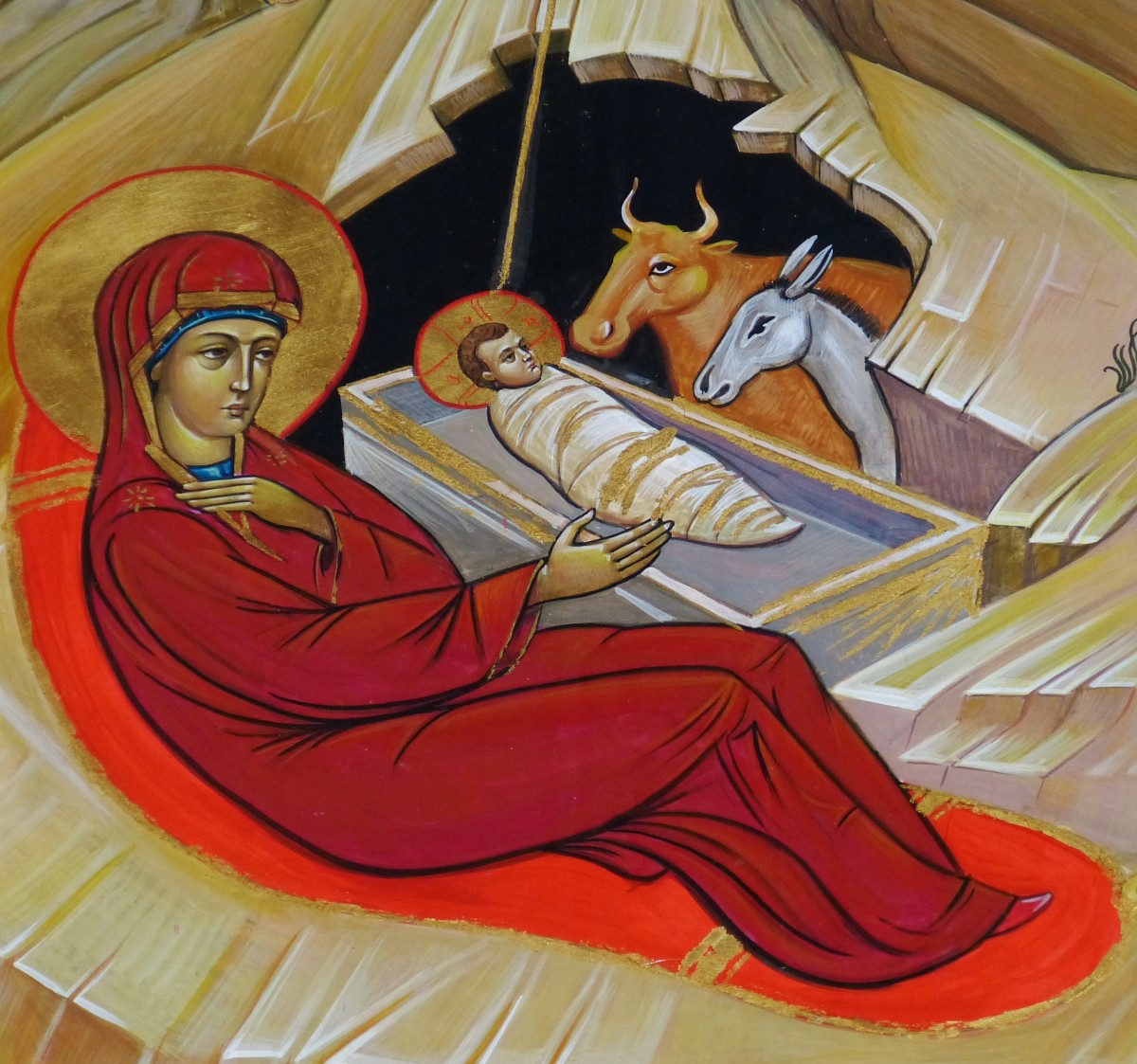
Jesus’ birthplace, a stable, was actually a cave. His burial-place, his tomb, was a cave as well.

The first cave was prepared by Joseph, the poor carpenter from Nazareth. The second cave was also prepared by a Joseph, a rich man from Arimathea.

At his birth, Mary wrapped Jesus’ body tightly in cloths for swaddling clothes. At his death, Mary also wrapped Jesus’ body, in linen cloth, for a burial shroud.

She placed his body in a manger, a feed-box for grain. He would give his own body as food, feeding his flock with his flesh and blood.

Who first heard the news of Jesus’ birth? It was shepherds in the fields outside Bethlehem. From Bethlehem’s flocks the lambs were provided for sacrifice at the Temple in Jerusalem about 5½ miles away. Jesus is the Lamb of God who was born to die as a sacrifice to take away our sins.

The Christmas trees in our sanctuary are evergreen and gloriously-lighted. Contrast that to the wood of the Cross, stark and dead, where we see the starkness of death in Christ crucified. Yet the cross bears the Light of the World, for Jesus says, “I am the Light of the World.” Life flows from this tree.

The Church, in these days following Christmas, celebrates a series of martyrs. The day after Christmas is the feast of St. Stephen, the first martyr after Jesus’ Ascension. Tomorrow, it’s St. Thomas Becket, a bishop martyred more than a millennium later. Today, it’s the Holy Infants of Bethlehem, who died unknowingly for Christ, but who the Church has long-celebrated as martyrs. We can fittingly celebrate the martyrs or even a funeral so close to Christmas because the birth of Jesus Christ has great and vast implications for life and death.

As we heard in our first reading, “If before men, indeed they be punished, yet is their hope full of immortality. … They seemed, in the view of the foolish, to be dead; and their passing away was thought an affliction, and their going forth from us, utter destruction. But they are in peace.” So, even in the dark valleys of life, we are courageous (as St. Paul twice declares in the second reading) for the Lord who died and rose is our shepherd. “Even though I walk in the dark valley I fear no evil; for you are at my side.” And this is our Gospel: ‘this is the will of the Father, that everyone who sees the Son and believes in him may have eternal life, and Jesus shall raise them on the last day.’

Pray for Marie’s soul, as is fitting and right, but be courageous and even joyful through the sadness; for at Christmas we see:

Christ, by highest heaven adored,
Christ, the everlasting Lord.
Late in time behold he comes,
offspring of the Virgin’s womb.

Mild he lays his glory by,
born that we no more may die,
born to raise us from the earth,
born to give us second birth.

With the herald angels sing,
“Glory to the newborn King.”

Christ, the Peace Light, is Born

December 27, 2018

In the city of Israel that is called Bethlehem, the ancient Church of the Nativity marks the site of the first Christmas. There one can actually stoop and bend down beneath the central altar & touch the celebrated spot where Jesus Christ was born. It is fitting that the pilgrims bend low to do this, because the miracle of God becoming a human being — to live and die and rise for us — surely deserves humble reverence with everything that we are.

Earlier this year, as has happened for a number of years now, an Austrian child and their family was selected to travel to Bethlehem. Candles and lamps are always burning within the Church of the Nativity, and there this chosen child transferred their fire into two blast-proof lanterns. Then they all flew back to Austria, where this flame (called “The Peace Light”) has spread from lamp to lamp, light to light, candle to candle, into more than thirty European countries and to places around the world. On December 1st of this year, the Peace Light arrived at J.F.K. Airport in New York City and it has traveled from there across our country. This week, it providentially came to our parish.

Last Friday, a Hudson couple traveling with the Peace Light approached me after morning Mass at St. Paul’s. I had never heard of the Peace Light before, but I happily received it and kept it for this Christmas celebration. All the flames you see burning our sanctuary this Christmas were originally lit from Bethlehem’s flame. Now I carefully carried, protected, and preserved this light; especially when I only had one vigil candle. I realized that one error, one jostling of the liquid wax, could extinguish the fire; and then what would become of this, my Christmas homily? I’d be lost. But, thanks be to God, these candles are lit here today.

So why do we have candles at Mass? Since the early days of Christianity, when Catholic Mass was celebrated in hiding, underground in the catacombs, lamps have provided useful illumination. But these lights are not merely practical. In the late 300’s A.D., a heretic named Vigilantius criticized Christians in the East about many of their practices, including their lighting of great piles of candles while the sun was still shining in the sky. St. Jerome declared in answer to him that candles are lighted where the Gospel is proclaimed not merely to put darkness to flight, but as a sign of joy. As an added symbol, these candles on the altar (and the Easter Candle) are, by tradition, mostly made of beeswax. Because beeswax, which is the product of the virginal female bee, is like the flesh of Our Lord supplied by the Blessed Virgin Mary.

Of course, the celebrated Peace Light is not merely a symbol of some abstract notion or idea of peace; it’s a symbol of the very real person of Jesus Christ. The “Light of the World” entered our world from his mother’s womb in Bethlehem. And his light has spread across the world and throughout time to this place and our day. Today, our candles burn and shine for him.

Within you there is also candle, but it is a very vulnerable light. Through error or neglect its light can go out. And without this light we are in darkness without true joy. So Jesus commands us to regularly gather all our candles together here, to be re-lit from the Source, the Light of Christ. In conclusion, in case my symbolism has been too subtle: Have a very joyful Christmas, and know that Jesus Christ (who loves you) wishes you to return here again for his Holy Mass next Sunday.

Christ the King & His Kingdom Among Us

November 27, 2018

We tend to think of Mexico as one of the most Catholic countries on earth, but for a time in 1920’s it was illegal to publicly celebrate Mass there. Following a revolution, the new, socialist, Mexican government effectively sought to outlaw the Catholic Church. They seized church property, expelled all foreign priests, and closed the monasteries, convents and religious schools.

But this did not stop priests like Blessed Miguel Pro from secretly ministering to the faithful; celebrating the Eucharist, distributing Holy Communion, hearing confessions, and anointing the sick clandestinely. He would often sneak from place to place in disguise, sometimes as a mechanic, or an office worker, or as a beggar. After many close calls, Fr. Pro was arrested by the government and, without trial, condemned to death on false charges that he was connected to a bombing assassination plot.

On November 23, 1927, Fr. Pro was led out for his execution by firing squad. He blessed the soldiers, knelt and quietly prayed for a time. He declined the blindfold and faced his executioners with a crucifix in one hand and a rosary in the other. He held out his arms like the crucified Christ and shouted, “May God have mercy on you! May God bless you! Lord, you know that I am innocent! With all my heart I forgive my enemies!”

Just before the order was given to fire, he proclaimed, “Viva Cristo Rey!” (which means “Long live Christ the King!”) When the initial bullets failed to kill him, a soldier shot him point-blank. The anti-Catholic government had a photographer on hand to capture these moments for propaganda purposes, but soon after these images were published in all the newspapers the possession of these pictures was outlawed. Seeing this Catholic priest dying innocently, bravely, and faithfully was an inspiration to the oppressed people of Mexico, who eventually won back their freedom of religion and freedom for Christ’s Catholic Church.

Today we celebrate “Christ the King,” but where is his Kingdom? During his ministry, Jesus said, “If I cast out devils by the finger of God, [and he did] then the kingdom of God has come upon you.” On another occasion he said, “Behold, the Kingdom of God is among you.” And at the Last Supper he declared, “Amen, I say to you, I shall not drink again the fruit of the vine until the day when I drink it new in the kingdom of God.” The next time he drank the fruit of the vine (that is to say, wine) was the next day, Good Friday, when he drank it from a sponge held to his lips as he hung upon the Cross. So when Jesus tells Pilate, “My kingdom does not belong to this world,” and, “My kingdom is not here,” he is not saying it is entirely absent from this world, that we will only begin to see it in Heaven or at his Second Coming when his Kingdom will come in its fullness. His Kingdom is not here because it is not yet here fully, and his Kingdom does not belong to this world because it is not from this world but from Heaven.

So where is Jesus’ Kingdom on earth? Jesus was called the “Son of David,” that is, the descendant of King David and heir to his throne. It was believed that the Christ would become the new King of Israel. And in fact, when Jesus was put to death on the Cross, the written charge declared above his head was: “This is Jesus the Nazarene, King of the Jews.” The Kingdom of David and his successors (the old, Davidic dynasty) was imperfect but it prefigured Jesus’ Kingdom. As St. Augustine taught, the Old Testament is the New Testament concealed, and the New Testament is the Old Testament revealed. The old foreshadows and points to the new. So, we can draw clues from the old Davidic Kingdom to identify Jesus’ new Kingdom in our midst.

The kings in the Davidic dynasty had many, many wives. From the beginning, God intended marriage to be between one man and one woman, but the kings of Israel – thinking blood is thicker than water – used marriages to seal their peace treaties and alliances with other nations. But this presented a problem: when the king has many wives, who is the queen? You can imagine the rivalry and discord this question could generate. The solution in the Davidic dynasty was to have the mother of the king fulfill that role, as Queen Mother. She had a throne of honor at the king’s right hand and served as an intercessor for the people of the kingdom. If someone had a request, one might bring it to her to present to the king. If the request were pleasing to the king and good for the kingdom he would happily grant it to please his well-loved mother.

The king of Israel had many ministers, but there was one prime minister among them: the king’s chief steward, the master of the royal household. As a sign of that man’s office and authority, the chief steward carried a large wooden key on his shoulders. When he would retire, or die, or be removed from office, another would take his place. His power was that of the king, on whose and with whose authority he acted. But a chief steward acting contrary to the king’s will would soon find himself replaced.

In the courts of ancient kingdoms, including Israel’s, you would find eunuchs. A eunuch is a man born or rendered physically incapable of marrying or having children. Eunuchs were preferred for practical reasons. First, they were safe to be around the king’s wives and harem. Secondly, since they had no wife or children of their own, eunuchs were entirely focused on the king and the kingdom. Their mission, personal success, and legacy were entirely wedded to that of the king’s.

Now we can see how the old conceals the new, and how the new reveals what the old prefigured. Jesus called all those willing and able to be “eunuchs for the sake of the Kingdom of Heaven.” Today, many ministers serve him devotedly in his celibate Priesthood. Jesus told Peter, “I give you the Keys to the Kingdom of Heaven. Whatever you bind on earth shall be bound in Heaven, and whatever you loose on earth shall be loosed in Heaven.” Jesus made Peter the first Pope, the first prime minister, chief steward, and master of his royal household on earth. Jesus has sealed his peace treaty and alliance with peoples of all nations through a single marriage: his marriage to his bride, the Church. But among the Church’s many members, is anyone the queen? As before, she is the mother of the King. The Lord has called Mary to a throne at his right hand where she intercedes for his people. If we have a request, we can ask her to present it to her Son, and if the request is pleasing to the King and good for his Kingdom he will happily grant it because he loves his mother so.

We are called to be good citizens of this country, but we are first and foremost citizens of Christ’s Kingdom. We are to vote and participate in the political process (for good polices and laws do good, while bad laws and policies do great harm) but we are not to put our trust in princes or politicians. We are to obey the law, but we know there is a higher law that supersedes unjust laws, and we know that above every earthly leader there is a higher King. That is why Blessed Miguel Pro was willing to defy the laws and president of Mexico to celebrate the Church’s sacraments and was not too terrified to face death before a firing squad. Let us remain loyal to Christ our King, and remain loyal to his Kingdom, a Kingdom which is among you, in His Holy Catholic Church.

The Ox, the Ass, & the First Manger Scene

December 20, 2017

In the year 1223 A.D., about two weeks before Christmas and three years before his death, St. Francis of Assisi shared an innovative idea with a beloved friend: “I want to do something that will recall the memory of that child who was born in Bethlehem, to see with bodily eyes the inconveniences of his infancy, how he lay in the manger, and how the ox and ass stood by.” With Pope Honorius III’s approval and his generous friend’s help everything was ready for Christmas Eve.

Blessed Thomas of Celano (writing just six years after) recounts the unveiling of that first manger scene, or crèche:

“With glad hearts, the men and women of that place prepared, according to their means, candles, and torches to light up that night which has illuminated all the days and years with its glittering star. Finally the holy man of God arrived and, finding everything prepared, saw it and rejoiced. … The manger is ready, hay is brought, the (live) ox and ass are led in. The brothers sing, discharging their debt of praise to the Lord, and the whole night echoes with jubilation. The holy man of God stands before the manger full of sighs, consumed by devotion, and filled with a marvelous joy. The holy man of God wears a deacon’s vestments, for he was indeed a deacon, and he sings the holy gospel with a sonorous voice. Then he preaches sweetly to the people standing about, telling them about the birth of the poor king and the little city of Bethlehem.”

The Gospel accounts of Jesus’ birth make no mention of an ox or donkey, but St. Francis included them in his scene because the duo had so commonly appeared in Christian imagery and writings since the Early Church.

Like the crucified thieves beside Jesus’ cross, this pair of creatures beside Jesus’ crib can represent two types of people in our world. Some respond to the birth of God among us like a donkey, with a foolish, stubborn resistance. But others, like an ox, humbly take the yoke of Christ upon their shoulders, learn from him, and produce a great harvest. Some attend Christmas Mass eager to leave early and without plans to soon return, like Judas Iscariot at the Last Supper. Yet Jesus calls us to attend to him week in and week out as his faithful oxen so that we may have peace in this world: “Take my yoke upon you and learn from me, for I am meek and humble of heart; and you will find rest for yourselves. For my yoke is easy, and my burden light.”

“The Ten Virgins & Wedding Party Prudence” — 32nd Sunday of Ordinary Time—Year A

November 13, 2017

Learning about first century Jewish marriage customs helps us understand the Gospels better, including the Parable of The Wise and Foolish Virgins. In Jesus’ day, when a young man wished to marry a woman, he would journey from his father’s house to hers. He and her father would agree upon a dowry and once this dowry price was paid the marriage covenant was established. This event was called “betrothal” and the man and woman thereafter were considered husband and wife. The groom, however, would not then begin to live with his bride. He returned to his father’s house for twelve months, manifesting his respectful self-restraint and honorableness toward her. (Betrothal was the situation St. Matthew described: “When Mary… was betrothed to Joseph, but before they lived together, she was found with child through the Holy Spirit.” So Mary was never an unwed mother, but she knows the experience of having a crisis pregnancy.) During their year apart, the man and woman would prepare for their new life together. One of the groom’s most important tasks in this period was to prepare living accommodations for them at his father’s house.

Once their time of separation was over, the groom would return to his bride’s house with his groomsmen, usually at night with a torchlight procession. She would be expecting him but not know the exact hour of his arrival. That is why the groom’s second coming would be preceded by his messenger’s shout. Then the bride and her female attendants and the groom and his groomsmen would return to his Father’s house (their new home) for a wedding feast with their other gathered friends, family, and neighbors. There the husband and wife would consummate their marriage, and seven days of feasting and merriment would begin.

In the Gospels, Jesus is declared and calls himself “the bridegroom.” The New Testament names the Church his “bride.” The relationship between Christ and his Church parallels a Jewish marriage. For instance, in the Incarnation, God the Son left his Father’s house in Heaven to journey to our dwelling place on earth. Jesus paid our dowry price with his own blood. And after establishing his covenant, Jesus ascends to his Father’s house for a time until his second coming. This is why Jesus says at the Last Supper:

In my Father’s house there are many dwelling places. If there were not, would I have told you that I am going to prepare a place for you? And if I go and prepare a place for you, I will come back again and take you to myself, so that where I am you also may be.”

This Sunday’s second reading describes this return.  As St. Paul tells the Thessalonians, “The Lord himself, with a word of command, with the voice of an archangel and with the trumpet of God, will come down from heaven…” Notice how the Lord’s angelic messenger announces to the bride that her bridegroom is at hand. St. Paul continues, “And then the dead in Christ will rise first. Then we who are alive, who are left, will be caught up together with them in the clouds to meet the Lord in the air. Thus we shall always be with the Lord.”

In the Book of Revelation we see this nuptial union of Christ and his Church continues above. St. John hears Heaven sing:

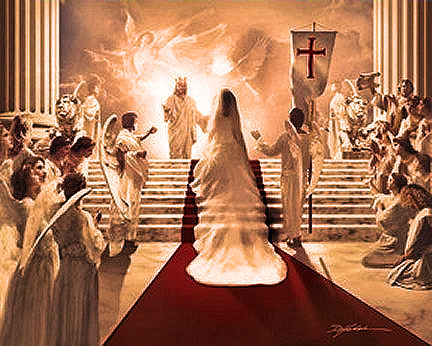
Let us rejoice and be glad and give him glory. For the wedding day of the Lamb has come, his bride has made herself ready. She was allowed to wear a bright, clean linen garment.” (The linen represents the righteous deeds of the holy ones.) Then the angel said to me, ‘Write this: Blessed are those who have been called to the wedding feast of the Lamb.‘”

The virgin, young women in today’s parable are the bride’s attendants awaiting the bridegroom. Five are called wise and five are called foolish. The important distinction between them is not one of I.Q.—of being naturally intelligent or unintelligent—but in being thoughtful versus thoughtless. In the 1994 Best Picture Winning film, Forrest Gump is a man of below-average intelligence who, by his simple virtue, lives an admirable and remarkable life. A couple of times he’s asked, “Are you stupid or something?” and Forrest replies, “Stupid is as stupid does, sir.” I didn’t know what this meant when I was a kid, so I asked my dad. He explained that if you’re blessed with intelligence, but keep doing bad or foolish things, then you’re stupid. On the other hand, even if you’re not that bright but you make good and smart choices, then you are wise.

What is the meaning of the oil lamps that play such a significant role in Jesus’ story? The consensus of the Church Fathers is that they represent good works. Elsewhere in Matthew’s Gospel, Jesus likens lamps to good deeds:

No one lights a lamp and then put its under a bushel basket; it is set on a lampstand, where it gives light to all in the house. Just so, your light must shine before others, that they may see your good deeds and glorify your heavenly Father.

(But doesn’t Jesus warn us, just a few verses before in his Sermon on the Mount, “Take care not to perform righteous deeds in order that people may see them; otherwise, you will have no recompense from your heavenly Father”? What reconciles these two teachings The answer is in whose glory is being sought. If I pray, fast, and give alms for my own glory, then some people may think well of me for a little while until they forget, and I will have received my reward. But if I do good works for the glory of God, then he will be glorified and he will reward me and I will share in his glory.)

The two types of virgins in the parable represent two types of people awaiting Christ the bridegroom. All the virgins fall asleep. Likewise, all of us (unless Jesus comes again first) will experience the falling asleep of death. The virgins are roused from sleep. Likewise we will be roused from sleep in the Resurrection. All of the virgins have at least a little oil, some light. At the Judgment, I suspect everyone will have some good deeds to point to – even murderous dictators have loved their dogs. But is that love sufficient? Are those good deeds enough? For the thoughtless, foolish virgins, their little oil is not enough.

They say, “Give us some of your oil, for our lamps are going out.” But the wise ones reply, “No, for there may not be enough for us and you.” (Apparently, their oil and abundance is not something that can be shared or transferred between persons.) “Go instead to the merchants and buy some for yourselves.” That’s where the wise virgins would have bought their oil in preparation, but remember what time it is. The bridegroom’s arrival was announced at midnight. All the stores are closed. Where are the foolish virgins going to find a merchant to sell them oil? They won’t. It’s too late.

Who are these merchants that we must buy our oil from now, before it is too late? These merchants are your neighbors in their need. At the judgment of the world, the Lord Jesus will say the righteous, “Come, you who are blessed by my Father. Inherit the kingdom prepared for you from the foundation of the world. For I was hungry and you gave me food, I was thirsty and you gave me drink, a stranger and you welcomed me, naked & you clothed me, ill and you cared for me, in prison and you visited me.’ Then these righteous ones will wonder when this happened. And our king will say in reply, “Amen, I say to you, whatever you did for one of these least brothers of mine, you did for me.” And elsewhere, Jesus tells us, “Whoever gives only a cup of cold water to one of these little ones to drink because he is a disciple — amen, I say to you, he will surely not lose his reward.” Our neighbors, near and far, are the merchants from whom we obtain the oil of good works now for our lamps of glory later. We pay our neighbors with our time, our talents, and our treasure to purchase our good deeds.

This opportunity to do good on earth will not last forever. In Charles Dickens’ “A Christmas Carol,” old man Scrooge is visited by the ghost of his old business partner, Jacob Marley.

[Standing in his bed chamber, Scrooge] became sensible of confused noises in the air; incoherent sounds of lamentation and regret; wailings inexpressibly sorrowful and self-accusatory. The [ghost of Jacob Marley], after listening for a moment, joined in the mournful dirge; and floated out upon the bleak, dark night. Scrooge followed to the window: desperate in his curiosity. He looked out. The air was filled with phantoms, wandering hither and thither in restless haste, and moaning as they went. Every one of them wore chains like Marley’s Ghost; some few…were linked together; none were free. Many had been personally known to Scrooge in their lives. He had been quite familiar with one old ghost, in a white waistcoat, with a monstrous iron safe attached to its ankle, who cried piteously at being unable to assist a wretched woman with an infant, whom it saw below, upon a doorstep. The misery with them all was, clearly, that they sought to interfere, for good, in human matters, and had lost the power for ever.”

We know the souls in Heaven can help effect good on earth – that’s why we pray for their intercession. The souls in Purgatory may or may not be able to pray and intercede for us – that’s an open question in Catholic theology. The souls in Hell definitely do not help us, but both they and those in Purgatory regret and lament having failed to do more good on earth when they had their chance in life.

When the foolish virgins finally arrive late to the wedding feast they find the door is locked. They cry, “Lord, Lord, open the door for us!” But the bridegroom says in reply, “Amen, I say to you, I do not know you.” This echoes what Jesus teaches elsewhere:

Not everyone who says to me, ‘Lord, Lord,’ will enter the kingdom of heaven, but only the one who does the will of my Father in heaven. Many will say to me on that day, ‘Lord, Lord, did we not prophesy in your name? Did we not drive out demons in your name? Did we not do mighty deeds in your name?’ Then I will declare to them solemnly, ‘I never knew you. Depart from me, you evildoers.’”

Jesus is teaching us that we are not saved by faith alone, by the mere acknowledgment that he is “Lord, Lord.” Nor are we saved by the vast accumulation of good works, for one could even prophesy, drive out demons, or do mighty deeds without having a saving relationship with him. We are saved by Jesus’ love for us and our loving him in return; by both faith in him and good works in him.

So what was the foolish virgins’ great sin? Who hasn’t accidentally forgotten to pack something on occasion? It’s hard to imagine Jesus condemning people for a mere accident. I think the virgins’ oversight in this parable suggests a far more serious fault. These young women heard there was going to be a big party and that a lot of people were going. They jumped on the bandwagon but were just going along for the ride. They did not really know the bride or groom and didn’t really care about them. If they had loved the couple, they would have put more thought into being their good guests and true friends, they would have been more serious in their personal preparations, and that prudent diligence would have saved them from being locked out in the end.

I do not wish to unsettle you, but Jesus preached this parable to the crowds and ensured that it was included in Matthew’s Gospel because he wanted us to consider this question: am I loving the bridegroom and his bride, am I loving the Church and her Lord? Are you dedicating your time, talents, and treasure to God and your neighbor? Are you striving for the narrow path and the narrow door that Jesus tells us few attain? Or are you, like many, just going with the flow in comfortable complacency? Jesus’ final warning in today’s gospel is, “Stay awake, (be vigilant, be diligent,) for you know neither the day nor the hour.” The bridegroom and bride request the honor of your presence at their banquet. So let us wisely be diligent, doing good works in Christ, while this precious daylight remains.
Mary, the New Ark of the Covenant

September 4, 2017

Did you ever see Indiana Jones and The Raiders of the Lost Ark? You may recall seeing the movie’s replica of the Ark of the Covenant featured as the McGuffin artifact everyone was seeking out. This movie has been very helpful to preachers in providing a visual aid to everyone of what the Ark of the Covenant looked like.

Like Noah’s Ark, the Ark of the Covenant was a box constructed according to God’s design and command. It served as a portable throne bearing the presence of God on earth. The Ark held inside of it three important things: the two tablets of the Ten Commandments, the wooden staff of Moses’ brother Aaron the High Priest, and a gold jar containing some of the Manna God provided his people to eat in the desert. The reason I mention these things today is because the Ark of the Covenant in the Old Testament foreshadows the Blessed Virgin Mary in the New Testament.

The old Ark held the Ten Commandments, the word of God in stone; the Virgin Mary bears the Word of God in flesh. The old Ark held the priestly staff which on one occasion miraculously blossomed despite being dead; Mary conceives by the power of the Holy Spirit despite her perfect virginity. The old Ark contained Manna bread in a golden vessel; Mary’s holy womb contains the true Bread from Heaven, provided to us for our journey to Promised Land — Jesus Christ, our Prophet, Priest, and King.

At God’s command, the old Ark was made of natural wood overlaid with pure gold inside and out. Mary is a human woman who is made “full of grace.” King David once joyfully leaped and danced before the Ark of the Lord. At the Visitation, when Mary visits Elizabeth her relative, John the Baptist likewise leaps with joy within his mother’s womb. David once asked, “How can the Ark of the Lord come to me?” Elizabeth likewise asks, “And how does this happen to me, that the mother of my Lord should come to me?” On one occasion, the old covenant ark was kept for three months in the house of a man named Obed-edom outside Jerusalem, and Scripture records that God blessed his whole household. Mary likewise dwelt three months in the home of Zechariah and Elizabeth near Jerusalem and was surely a blessing to them.

No man was to touch the Old Covenant Ark, lest they be struck down dead. (God instructed his ministers to move that holy Ark only by means of two gilded poles which slid through rings on the sides of the Ark.) Joseph of Nazareth held a similar reverence towards Mary, his ever-virgin wife. In the Old Testament, the Lord was to be found wherever the old Ark dwelt, from the Sinai wilderness to the Temple in Jerusalem. In the New Testament, “on entering the house, [the Magi] saw the child with Mary his mother,” and, “standing by the cross of Jesus [was] his mother.”

In the movie, Indiana Jones and the Nazis were looking for the “lost” Ark because Scripture reports that the Old Covenant Ark was hidden soon before the Jewish Temple was destroyed by the Babylonians in 587 BC. Jeremiah the Prophet took the Ark and placed it in a secret cave. Unlike in the 1981 movie, the Lost Ark has never been recovered. Yet, in his revelations recorded at the end of the New Testament, John the Apostle sees the new Ark revealed. John writes: “God’s temple in Heaven was opened, and the ark of his covenant could be seen in the temple.” The next thing John describes is a glorious woman pregnant with the Christ child, “A great sign appeared in the sky, a woman clothed with the sun, with the moon under her feet, and on her head a crown of twelve stars.” This is Mary, the New Ark of the Covenant, whom at the end of her time on earth God lifted up body and soul into Heaven.

The old Ark was of central, though secondary, importance in the Old Covenant. Drawing physically nearer to it brought one closer to the presence of God on earth. Likewise, God gives the Blessed Virgin Mary, the new Ark, a central role in his New Covenant. If you draw closer in your relationship with her, you will surely draw closer to our Lord Jesus Christ.

But It Was Not Enough For Him

April 16, 2017

At Passover, in Jesus’ day and in our own, the Jewish people remember and celebrate the great Exodus, how God delivered his people from slavery in Egypt and led them into the freedom of the Promised Land. Through Moses, God commanded his people to keep the Passover feast as an everlasting memorial. Jesus’ Last Supper was something of a transformed Passover meal, and his Passion, Death, and Resurrection are the mystery that the Passover foreshadowed and prefigured.

Jews today observe their annual Passover meal with an assortment of ancient traditions. Among these is singing or reciting an up-beat Hebrew song named “Dayenu” (Da-yea-nu.) Dayenu means “it would have been enough for us!” Here is an English translation of this more than one thousand year old song:

If [the Lord] had brought us out from Egypt, and had not carried out judgments against them
Dayenu, it would have been enough!

If He had carried out judgments against them, and not against their idols
Dayenu, it would have been enough!

If He had destroyed their idols, and had not struck their first-born
Dayenu, it would have been enough!

If He had struck their first-born, and had not given us their wealth
Dayenu, it would have been enough!

If He had given us their wealth, and had not split the sea for us
Dayenu, it would have been enough!

If He had split the sea for us, and had not taken us through it on dry land
Dayenu, it would have been enough!

If He had taken us through the sea on dry land, and had not drowned our oppressors in it
Dayenu, it would have been enough!

If He had drowned our oppressors in it, and had not supplied our needs in the desert for forty years
Dayenu, it would have been enough!

If He had supplied our needs in the desert for forty years, and had not fed us the Manna
Dayenu, it would have been enough!

If He had fed us the Manna, and had not given us the Sabbath
Dayenu, it would have been enough!

If He had given us the Sabbath, and had not brought us before Mount Sinai
Dayenu, it would have been enough!

If He had brought us before Mount Sinai, and had not given us the Law
Dayenu, it would have been enough!

If He had given us the Law, and had not brought us into the land of Israel
Dayenu, it would have been enough!

If He had brought us into the land of Israel, and not built for us the Holy Temple
Dayenu, it would have been enough!

It would have been enough for us,” for how could we demand more than what God had given? He created the universe out of nothing and every good thing is his gift. Apart from God’s promises (freely-imposed upon himself by His covenants) we could not rightfully insist upon anything more. As Job said at the onset of his trials, “Naked I came forth from my mother’s womb, and naked shall I go back there. The Lord gave and the Lord has taken away; blessed be the name of the Lord!” We could not demand more—but we would still desire more.

We would continue to desire life without end. We would still want deliverance from evils, outside us and within us. We would still desire unending delights, for as King Solomon observed, “The eye is not satisfied by seeing nor has the ear enough of hearing.” And would long for divine intimacy with the Holy Source of all good. All these desires are fulfilled for us through Jesus Christ.

We could not demand more, but we would still desire more, for the Lord has placed these desires within us. He did this that He might fulfill our desires and they reflected his own desires for us.

The Lord did all the great things that came before
— But this was not enough for Him!

He did all these great things, and then He became man for us
— But this was not enough for Him!

He became man for us, and then He taught us the New Law of Love
— But this was not enough for Him!

He taught us the New Law, and then He suffered and died to forgive us
— But this was not enough for Him!

He suffered and died to forgive us, and then He rose from the dead to save us from death
— But this was not enough for Him!

He rose from the dead to save us from death, and then He left us the Church
— But this was not enough for Him!

He left us the Church, and then He wedded and united himself to us through the Holy Sacraments

What God has given us, what Jesus has done for us, what we are given, what we are promised — this is enough for us. Let us rejoice in Him this day!

Jesus as the Anti-Cain

February 17, 2017

A Reflection on Genesis 4:1-15

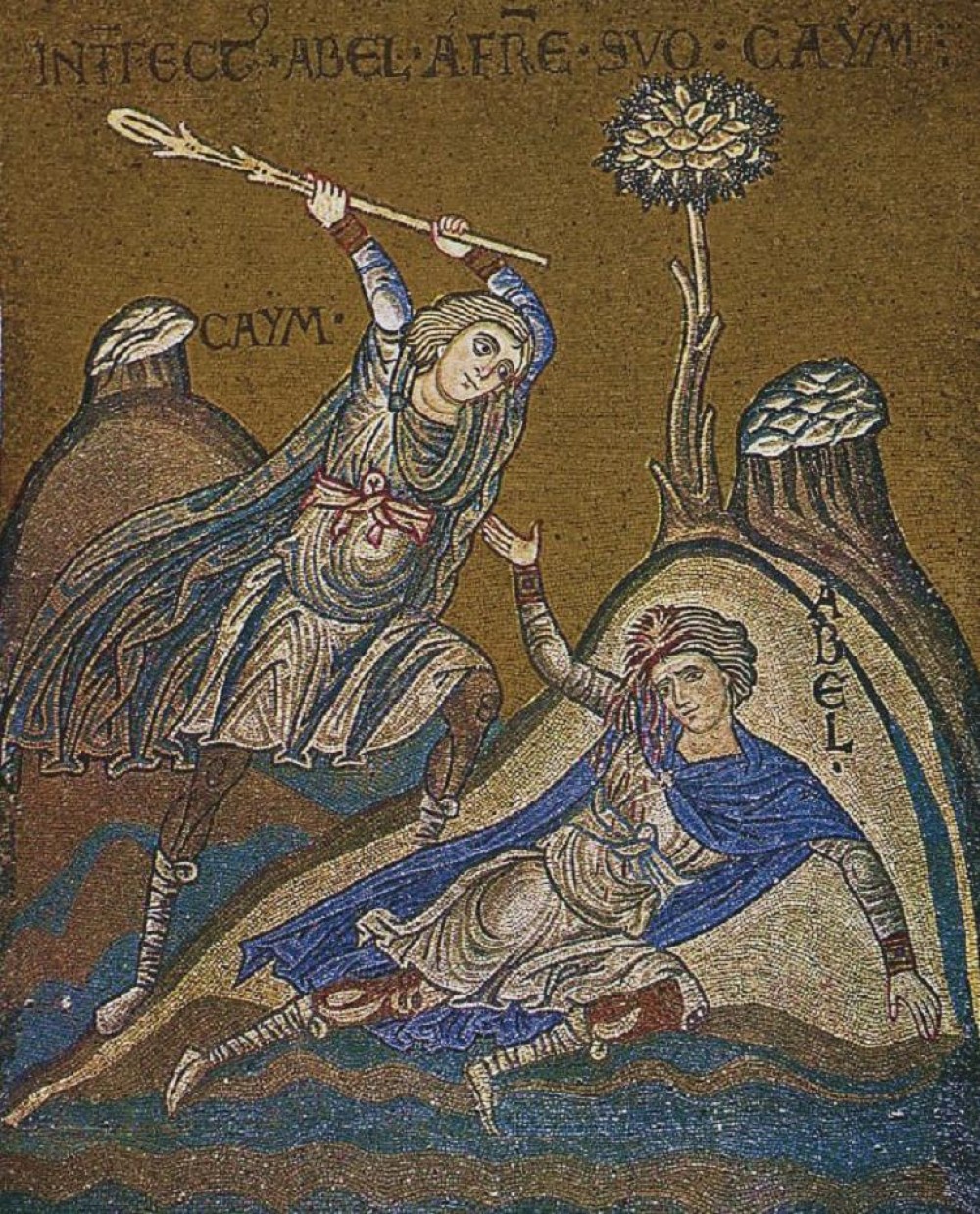
Cain and Abel Mosaic in Monreale, Sicily, 12th century.Adam had relations with his wife Eve, and she conceived and bore Cain, saying, “I have produced a man with the help of the Lord.” Through Eve, Cain is the firstborn of man. Through Mary, the new Eve, Jesus is firstborn of God.

Cain brought an offering to the Lord from the fruit of the soil, while Abel, for his part, brought one of the best firstlings of his flock. This implies that Cain is not offering his very best. Jesus’ sacrifice offers everything to God.

Cain said to his brother Abel, “Let us go out in the field.” When they were in the field, Cain attacked his brother Abel and killed him. Jealousy and a hardened heart leads Cain to murder his brother in the countryside. Similar wickedness leads to Jesus being murdered by his own outside Jerusalem’s gates.

The Lord asked Cain, “Where is your brother Abel?” He answered, “I do not know.  Am I my brother’s keeper?” Cain is not a keeper of animals, but Jesus says: “I am the good shepherd, and I know mine and mine know me.” (John 10:14)

The Lord God then said to Cain: “What have you done! Listen: your brother’s blood cries out to me from the soil!” The blood that Cain shed cried out to Heaven for vengeance, but “the sprinkled blood [of Jesus] speaks more eloquently than that of Abel.” (Hebrews 12:24) The blood of Jesus outpoured begs mercy, for the forgiveness of sins on earth.

Cain said to the Lord: “My punishment is too great to bear. Since you have now banished me from the soil, and I must avoid your presence and become a restless wanderer on the earth, anyone may kill me at sight.” “Not so!” the Lord said to him. “If anyone kills Cain, Cain shall be avenged sevenfold.” So the Lord put a mark on Cain, lest anyone should kill him at sight. Cain is given a protective mark (perhaps a tattoo, common in violent nomadic cultures.)

Jesus enjoys no protective  distinction: “There was in him no stately bearing to make us look at him, nor appearance that would attract us to him.” Cain was not executed for his crime, but Jesus “was pierced for our sins” and “the Lord laid upon him the guilt of us all.” (Isaiah 53:2,6) Killing Cain would have returned “seven fold revenge,” but Jesus’ death  brings forth multitudes of mercy, as through the seven Sacraments.

Our Lord Jesus Christ is the anti-Cain. Praise be to God!

The Significance of Anna’s Age and Lifestyle — Sixth Day in the Christmas Octave

December 31, 2015

Readings: 1st John 2:12-17, Luke 2:36-40

Whenever we read the Bible, it is profitable for us to remember that every detail is there for a reason. The sacred authors and the Holy Spirit chose to omit so many minor facts that “I do not think the whole world would contain the books that would be written” if they had described everything. (John 21:25) Instead, all that we find in Scripture has been purposely included for our benefit. (John 20:30-31) Consider the details mentioned in this encounter from the Presentation, when Joseph and Mary brought the baby Jesus to the temple in Jerusalem for the first time:

The Presentation of Jesus in the Temple by James Tissot

There was a prophetess, Anna, the daughter of Phanuel, of the tribe of Asher. She was advanced in years, having lived seven years with her husband after her marriage, and then as a widow until she was eighty-four. She never left the temple, but worshiped night and day with fasting and prayer. And coming forward at that very time, she gave thanks to God and spoke about the child to all who were awaiting the redemption of Jerusalem.

This is the only episode in the New Testament where the prophetess Anna appears. Why does St. Luke include Anna’s age and the length of her marriage? Let’s explore this obscure detail. The 84-year-old widow was married for seven years, and thus was unmarried for 77 years of her life. She is 7 x 12: the Jewish number symbolizing completeness and perfection times the number of the tribes of Israel. Anna personifies Old Testament Israel at her best. But of the twelve tribes, which tribe would correspond with Anna’s seven years of marriage?

After the death of Saul, all the tribes of Israel came to David (of the tribe of Judah) seeking to make him their king. They said: “Look! We are your bone and your flesh,” echoing the words of Adam towards Eve at the beginning of their marriage covenant, “This one, at last, is bone of my bones and flesh of my flesh.” (2nd Samuel 5:1, Genesis 2:23) Old Testament Israel had been wedded for a time to David, but now she awaited the kingship of a Son of David from the tribe of Judah. While David had once conquered Jerusalem from the Jebusites, Anna and others in her day were “awaiting the redemption of Jerusalem” by the Messiah/Christ. (1st Chronicles 11:4-5)

Living like a Christian nun veiled in anticipation of her bridegroom’s arrival, Anna “never left the temple, but worshiped night and day with fasting and prayer.” Why would Anna, or any woman, choose to live in this way? St. John’s first epistle offers this admonition:

Do not love the world or the things of the world. If anyone loves the world, the love of the Father is not in him. For all that is in the world, sensual lust, enticement for the eyes, and a pretentious life, is not from the Father but is from the world. Yet the world and its enticement are passing away. But whoever does the will of God remains forever.

Alexandrian World Chronicle (5th century) featuring Anna the ProphetessThough Anna understood the evil corruptions of “the world,” she was also well aware of the goodness of creation. She had known the blessings of marriage and the (at least occasional) pleasures of feasting, but Anna knew that these passing things could not fully satisfy her. Her deepest longings could only be met by the One to come, not only for her but for all Jews and Gentiles. When Jesus Christ came to the temple, Anna rejoiced, gave thanks, and “spoke about the child to all who were awaiting the redemption of Jerusalem.” Because she devoted herself to “the will of God,” Anna’s scriptural legacy and joy before the Lord ‘remain forever.’

The Two (Old & New) Arks of God

December 17, 2015

Remember Raiders of the Lost Ark? The Ark that Indiana Jones and the Nazis were pursued in that entertaining film was the most precious object in the entire Old Testament. But what is lost on many is how that holy artifact is related to the most important woman in the New Testament and its New Covenant.

The Old Testament Ark of the Covenant was a box built in the days of Moses according to God’s instructions at Mount Sinai. It was made of wood overlaid with pure gold, inside and out. No man was allowed to touch God’s Holy Ark—lest they die—so it was designed to be carried about using a pair of poles. The Ark was the throne for God’s presence on earth. The wings of two, golden Cherubim angel statues atop the Ark’s lid served as his “mercy-seat.” The Ark itself contained within several interesting items from the time of the Exodus: the two stone tablets of the 10 Commandments, the wooden staff of Aaron (which miraculously blossomed to confirm his divinely-ordained priesthood), and a gold container holding some of the Manna from heaven which God provided to feed his people on their desert pilgrimage.

Ark

About 450 years after its construction, around 1000 BC, King David reigned over all of Israel. He tried to bring the Ark up to his royal city, Jerusalem, until one of the priests (who should have known better) touched the Ark and fell down dead. David exclaimed, “How can the Ark of the Lord come to me?” He arranged for it to be kept at the house of Obed-edom in the Judean countryside. The Ark remained there for three months and manifestly blessed the whole household. When it was reported to the king how richly Obed-edom was being graced, King David decided to try transporting the Ark into Jerusalem once more. David himself led that procession, dancing and leaping before the Lord with joyful abandon.

The Ark would eventually reside in the Jerusalem Temple built by David’s son, King Solomon. It is written that before that Temple was destroyed by the Babylonians in 587 BC, Jeremiah the Prophet took the Ark and hid it in a secret cave, saying, “No one must know about this place until God gathers his people together again and shows them mercy.”Unlike in the 1981 film, the Lost Ark has never been found, but a new Ark of God did appear.

The Blessed Virgin Mary is the New Ark of the Covenant because she bears Jesus Christ, God’s fullest presence on earth. By God’s design, the first Ark was made of wood and covered with gold; Mary is a human being full with grace. The former Ark carried the word of God in stone; Mary’s womb carries the Word become flesh. Aaron’s dead staff miraculously flowered; Mary’s virgin womb blossomed with a bud from the stump of Jesse. The Ark held Manna from heaven; Mary bore the true bread from heaven. Mary’s womb holds Jesus Christ, our Prophet, Priest, and King.

The Visitation by Albertinelli, 1503.As the Gospel of Luke tells us, after she was visited by St. Gabriel the Archangel at the Annunciation, “Mary set out and traveled to the hill country in haste to a town of Judah, where she entered the house of Zechariah and greeted Elizabeth. When Elizabeth heard Mary’s greeting, the infant leaped in her womb, and Elizabeth, filled with the holy Spirit, cried out in a loud voice and said, ‘Most blessed are you among women, and blessed is the fruit of your womb. And how does this happen to me, that the mother of my Lord should come to me?’” And Mary would bless them with her help and companionship, staying at their house in the Judean hill country about three months.

Like King David, St. Elizabeth questions and St. John the Baptist leaps for joy before the Ark of the Lord. St. Joseph, regarding the inviolable sanctity of his wife with reverent fear, never touched her virginity. Mary would also go on to literally serve as God’s throne, his mercy-seat; “On entering the house [the Magi] saw the child with Mary his mother.”

In the Book of Revelation, St. John’s vision of heaven includes a sighting of the Lost Ark: “Then God’s temple in heaven was opened, and the Ark of his Covenant could be seen in the temple.” Then John beholds “in the sky, a woman clothed with the sun, with the moon under her feet, and on her head a crown of twelve stars.” We soon discover that this  glorious woman is pregnant with “a son, a male child, destined to rule all the nations….” This is the Christ, and she is his Holy Ark.

Now the Lord’s Ark is not meant to be worshiped. (Though among God’s most holy creations, an Ark of God is not divine.) Yet, as one draws nearer to the Holy Ark, one inevitably draws nearer to God’s presence. Just as the old Ark of the Covenant was of central (though secondary) importance in the Old Covenant, so God gives the Blessed Virgin Mary an essential role in his New Covenant. All who come to her are drawn nearer to her Son.

Imagine daring to enter the old Jewish Temple’s the Holy of Holies where the Ark of God was kept. What awe and reverence would you feel before the all-holy presence of God? Now consider drawing near to the even greater Ark, Mary the Mother of all Christians, who reaches out to each of us with love and takes away our fear. And now reflect upon the great privilege we have in approaching and even touching the Christmas Gift of God she bore, Jesus Christ himself. Mary is blessed among women and blessed is the fruit of her womb, Jesus. But blessed are we who would believe in all that the Lord has revealed to us.

“One on His Right, the Other on His Left”

March 24, 2015

Revealing fascinating prophetic connections between Moses, Joshua, Samson, and Jesus Christ on the Cross; featuring the religious paintings of James Tissot (1836-1902.)

Mysteries of the Holy Family

December 26, 2014
  • Mary with Jesus in Swaddling ClothesThe Holy Family’s first Christmas was both stressful and joyful.
  • Jesus the Bread of Life was born in Bethlehem, which means “House of Bread.”
  • Jesus was born and laid to rest in caves. His body was wrapped, in birth and death.
  • Joseph taught carpentry to Him through whom all things were made.
  • Mary taught prayers to God.
  • St. Joseph, protector of the Holy Family, is now universal patron of the Church.
  • St. Mary, the bearer of one child, is now mother of all Christians.

Our Lady’s Wisconsin Message: The Meaning of the Two Trees

September 25, 2014

In the Garden of Eden, there were many fruit-bearing trees, but Genesis mentions only two by name: the Tree of Life, and the Tree of the Knowledge of Good and Evil. By partaking of the Tree of Life the human race could keep living forever, but the Lord warned that to eat from the other tree would mean our certain death. On October 9th, 1859, the Blessed Virgin Mary appeared near Green Bay to a 28 year-old Belgian immigrant named Adele Brise while she was walking eleven miles home from Sunday Mass. Interestingly, Our Lady chose to appear to Adele not in a church, or a thousand other places, but between two trees: a Maple and a Hemlock.

Maple LeavesYou’re familiar with the beauty and goodness of the Maple. In the fall, its leaves turn the most striking colors, and in the spring its sap yields sweet syrup. But do you know about the Hemlock tree? The poison that the Greek philosopher Socrates was condemned to drink came from this plant. Ingesting just six or eight fresh Hemlock leaves can kill a healthy adult. [Post-Script: The Hemlock Tree found in Wisconsin is not poisonous, but merely shares the name.]  The Maple is a tree of life while the Hemlock is a tree of death. Mary, the New Eve, stood between the two.

Three Conium Maculatum (or Poison Hemlock), Cedar Bog, Champaign CoMary told Adele, “I am the Queen of Heaven, who prays for the conversion of sinners, and I wish you to do the same. You received Holy Communion this morning, and that is well. But you must do more. Make a general confession, and offer Communion for the conversion of sinners. If they do not convert and do penance, my Son will be obliged to punish them.” Our Lady’s message between the two trees is akin the words of Moses, who told the Israelites: “I have set before you life and death, the blessing and the curse. Choose life, then, that you and your descendants may live, by loving the Lord, your God, heeding his voice, and holding fast to him. For that will mean life for you, a long life for you to live on the land….

Peshtigo Fire MapApparently, Our Lady’s warnings were not sufficiently heeded. In October of 1871, exactly twelve years later, disaster came. Both in terms of size and number of lives lost, the Peshtigo Fire remains the worst recorded forest fire in U.S. history. Between 1,200 and 2,400 lives ended in that firestorm which saw, according to an eyewitness, “large wooden houses torn from their foundations and caught up like straws by two opposing currents of air which raised them till they came in contact with the stream of fire.” This seems to be the punishment due to sin that Mary spoke of, yet this does not mean that everyone who perished in that fire was condemned. We should remember that at harvest time, the wheat and the weeds are pulled up together in a moment, but their future fates are not the same. Once uprooted, the good are gathered and kept in the barn, while the bad are thrown away forever.

The firestorm came and surrounded the shrine of Our Lady, where hundreds had come for refuge with their families and herds, beseeching her intercession before God. As many as fled to her there were saved. The shrine’s consecrated earth was an emerald-green island in an ocean of smoldering ashes as far as eyes could see.

Mary, the Queen of Heaven, prays for the conversion of sinners and she wishes you to do the same. You receive Holy Communion, and that is well. But you must do more. Begin by receiving the sacrament of reconciliation regularly, because it is powerful for growing in holiness. The sinner whose conversion you are most responsible for is your own.