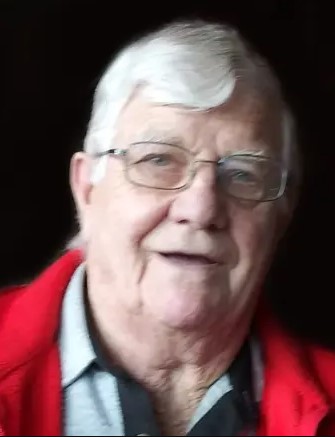
In Jesus, We Find Total Comfort — Funeral Homily for John “Jack” Clark, 89

November 17, 2023

By Fr. Chinnappan Pelavendran

On behalf of the parish community of St. Paul’s, I would like to extend our sincere condolences and sympathy to the members of John William Clark’s family. I would like to assure his children, grandchildren, and near and dear ones of my prayers.

Death is not the end but the beginning of a new life. We pray that our brother Jack is with God and enjoys eternal life with the communion of saints. A life with countless blessings, joy, love, and happiness. We are all hoping for that life.

Our brother Jack was born on March 1st, 1934. In the town of Auburn. Jack attended elementary school in Fox Settlement and graduated from Colfax High School in 1951. He married Marie Rubenzer at St. Paul’s Catholic Church and were they both longtime members. Jack served in the military for two years, and after that, he worked at the Sand Creek Creamery, and as a truck driver for various companies. Jack owned and operated a dairy for many years. Later he worked for ITW Corporation for eleven years.

After his retirement, he enjoyed deer hunting, cutting wood, gardening, and spending time with his grandchildren. He enjoyed the dance called Polka and the waltz, and fun conversations with his friends. He was known as a man with a beer in his hand who loved Friday Fish Fries.

Our readings this morning give us great consolation. In our first reading, we were told the Lord would wipe away tears from every cheek. We know that everything we do makes sense only if it is leading us to peace in God. We know there are many distractions and temptations in life, all pretending to offer us peace and happiness, but none of them do because we know that we will find this peace and happiness only in God. When we find our peace in God, we become friends of God, when we live with God’s love in our hearts, then we have peace. That is why our first reading says the Lord will wipe away the tears from every cheek. When we hope in the Lord for salvation, how blessed we are.

All of us have problems in life. Big or small, these problems burden us and make us sad. When these problems go unsolved for a long time, we feel disappointed and become depressed. In these moments from whom do we seek help? Here is the good news our gospel today. “Come to me, all you who labor and are burdened, and I will give you rest.” The most comforting words of Jesus in the gospel. Anyone who is feeling tired, disappointed, or depressed can be lifted up by the comforting promise of Jesus.

As we believe our brother Jack is in the arms of God, we pray for him during this Mass. We pray for him to be embraced by Jesus’ unconditional love and merciful judgment. We pray for him to be embraced by Mother Mary, the Mother of God who knows how to bring her children to Jesus.

Eternal rest, grant unto him, O Lord,
and let perpetual light shine upon him
May he rest in peace!
Amen.

Sometimes Just Being There Is Enough

November 12, 2023

32nd Sunday in Ordinary Time
By Deacon Dick Kostner

Today’s Gospel message of the ten women who had the job of greeting the bridegroom (Jesus) teaches us that we might not be able to be perfect in the mission God has for us but that’s OK God only asks for us to say “yes” and be present as his representative when we are challenged with his call for service. Our gospel today has five women who, in their mind dropped the ball on not being properly prepared to great a bridegroom because they did not anticipate that he would be late and that they would not have enough oil for their candles to be lit when he arrived so they left the scene to get more oil. They underestimated the fact that their presence was what was the gift to the bridegroom not their lit candle.

Sometimes we overestimate the details of a mission God has for us because we want to be “perfect” in doing ministry for God and we forget about what is really important to God, and so we miss out on seeing God smile at us for doing his will even though we missed out on being “perfect” in carrying out a request by God. Two examples that made me realize these facts come to my mind when I was asked by God to help out as a member of the Body of Christ.  The first was when I did my first Communion Service as a lay minister at St. Paul’s. I was nervous and after I had completed that mission request, I realized that I had forgot to do the prayer petitions. This bothered me all day but after Mass one Sunday a parishioner came up to me and thanked me for “being there for them” in doing a Communion Service when Father was not able to celebrate a Mass.

The second example was when I had just recently been ordained a deacon. Father was out of town and I received a call at 1:30 AM from the hospital saying a family had requested the Last Rites for their son who was involved in an accident and was dying.  I told the nurse that I was not able to anoint but she persisted and asked if I could just come and say some prayers with the family? I gulped hard, put on some clothes, grabbed my prayer book and left for the hospital. I did not know what I could  or should say to the family as I was unprepared for this event, kind of like the women in today’s gospel.  When I got there everyone was around the sons hospital bed and crying. The injured man was in great pain and was fighting for his life. I opened my prayer book and began saying a “Litany of Prayers.” It was not long and everyone began to stop crying and the injured person relaxed and settled down.

It was like a faucet of suffering had been shut off for both the family and their son through the prayers that I had shared with them.  After the prayers, the family thanked me for “being there” for their son and for them. As I left I realized that I had not put on my Deacon Shirt and collar which would have been proper if I had only thought of it and I felt bad for dropping the ball. As I was driving home I remembered the last words the family spoke to me. “Thanks for being there for us.” I envisioned Jesus smiling at me and saying, “You done good, thanks for being there for me!

Recently, I had an opportunity to talk to an adult within our community who is in constant touch with and contact with our young people.  I told that person that I was concerned about the our world and how we don’t have any tolerance for a difference of opinion. This person told me that within our community he has seen a very positive response from young people to be patient with other young people who are not only opposed to their idea of what being Christian is all about, and who have also been tolerant with those who feel that they need to oppose with aggression those who are not in agreement with their beliefs. He told me that it was not only with Catholic children but also children of other faiths within our community who are tolerant with others who have opposing views. A child’s primary mentor is its parents and family. God speaks to us through our mind and the mouths of his people, who St. Paul refers to as “The Body of Christ”.

Folks, “the Body of Christ” is alive and working even in our troubled world, and although we may not be as prepared as we would like to be I believe that Jesus looks upon us with a smile and as Jesus said to me he says to our faith community: “Bloomer, people, you have done good, and a big thanks for being there representing my presence!

Why Five & Five? What Is Our Oil?

November 11, 2023

32nd Sunday in Ordinary Time
By Fr. Victor Feltes

Jesus tells us, “The Kingdom of Heaven will be like ten virgins who took their lamps and went out to meet the bridegroom.” In those days, the Jewish custom was for a man and woman to get betrothed. This marked the start of their marriage covenant, yet the husband and wife would live separately for the first year. In the meantime, the bridegroom would return to his father’s house and prepare a dwelling place for their life together. Once all was ready, he would joyfully return to bring her to himself. She would be expecting him, but would not know the hour, so she awaited his arrival with her bridesmaids. The bridegroom and his groomsmen would come and escort the bride and her bridesmaids to his father’s house for the consummation of their marriage and seven days of feasting.

This is the cultural context for what Jesus tells us at the Last Supper, as recorded in St. John’s Gospel: “In my Father’s house there are many dwelling places. If there were not, would I have told you that I am going to prepare a place for you? And if I go and prepare a place for you, I will come back again and take you to myself, so that where I am you also may be.” These Jewish marriage customs also provide the setting for today’s gospel parable about ten virgins awaiting the bridegroom.

Five of them were wise and five of them were foolish, with the foolish ones foregoing flasks of extra oil and, as a result, being shut out of the wedding feast. Jesus Christ called himself the Bridegroom and the Book of Revelation says his saints will enjoy “the wedding feast of the Lamb.” Before unpacking how we can avoid the foolish ones’ fate, consider this question: why five foolish ones and five wise?

Like other storytellers, our Lord theoretically could have crafted his parable’s details differently. Given ten female characters, instead of five foolish and five wise, Jesus could have told a tale about one foolish virgin and nine wise ones, or preached a parable about nine foolish virgins and one wise one, or shaped his story as one of the six other mixtures where some were foolish and some were wise. So why did he say five and five?

Jesus knew that if his parable had featured just one fool beside nine wise virgins, we might presumptuously assume this story’s warning does not apply to us. On the other hand, if Jesus’ parable had featured nine fools and only one wise virgin, we might despair of being among those who enter the feast. Instead, Jesus speaks of five and five so that we will take this parable seriously yet also have confidence that we can take prudent steps to follow the Bridegroom.

What do the five wise and five foolish virgins teach us? What sort of persons were they, and what oil do we require? For an answer, recall another parable of Jesus.

In the Parable of the Rich Man and Lazarus, after a life in which he callously neglected to care for poor Lazarus at his doorstep, a rich man suffers punishment in flames. He calls out to Abraham above: “I beg you, father, send [Lazarus] to my father’s house, for I have five brothers, so that he may warn them, lest they too come to this place of torment!” St. Jerome, the fourth-century Church Father and Doctor of the Church, saw symbolism in this rich man’s five brothers. Jerome sees them as the wicked man’s five bodily senses which were not ordered and dedicated to God. St. Jerome declares to that rich man:

[Y]ou have five brothers: sight, smell, taste, hearing, and touch. These are the brothers to whom formerly you were enslaved. Since they were the brothers you loved, you could not love your brother Lazarus. Naturally you could not love him as brother, because you loved them. Those brothers have no love for poverty. Your sight, your sense of smell, your taste, and your sense of touch were your brothers. These brothers of yours loved wealth and they had no eye for poverty. … They are the brothers who sent you into these torments.

God created and bestowed us our bodily senses, and they are good. Through them we sustain our lives, experience one another and this world, and delight in God’s good creations. The goodness of these material things reflect the goodness of their Maker. But it is easy for sinful humanity to become fixated on these delightful things resulting in the distracted neglect or sinful contempt of our Creator.

What is to keep our flame of faith from going out, plunging us into darkness, stopping us from following the Bridegroom? How can we properly order our five senses, and be like the wise virgins rather than the foolish, lest the Lord declare, “Amen, I say to you, I do not know you”? We need oil to keep our lamps faithfully burning and follow Christ in the light. But what is that oil?

In the Old Testament, priests, prophets, and kings were anointed with holy olive oil. Jesus was revealed to be the Christ, the Messiah – titles which mean “Anointed One.” At Jesus’ baptism, St. John the Baptist knew Jesus was the “Anointed One” when he saw the Holy Spirit descend upon him. And then at Nazareth, Jesus proclaimed, “The Spirit of the Lord is upon me, because he has anointed me…” So the Holy Spirit, who descended upon Jesus, our priest, prophet, and king, is like anointing oil. The Holy Spirit is the oil we need for our burning lamps. If we are wise we will invite and welcome this third divine Person to pour out upon us, fill us, and fuel us. He will keep our faith burning and direct our bodily senses so that we may wisely follow Christ our Bridegroom into joy.

Come Holy Spirit,
fill the hearts of your faithful
& kindle in them the fire of your love
.”

Led by the Sacraments — Funeral Homily for Leona Rothbauer, 85

November 11, 2023

By Fr. Chinnappan Pelavendran

On behalf of the parish community of St. John’s, I would like to extend our sincere condolences and sympathy to the members of Leona’s family. I would like to assure her husband, children, grandchildren, and near and dear ones of my prayers.

The Lord first stretched out his hand to her in the waters of baptism so many years ago. As the water washed her clean of the stain of sin, the lord Jesus welcomed her as a member of his Body and opened the gates of his Church to her. Looking back on her life, we know that the hand of the Lord did not abandon Leona, but remained constantly with her.

Repeatedly the Lord stretched out his hand to her in the sacrament of Penance for the forgiveness of sins. In the Holy Communion, he continually offered himself to her. When she was sick, the Lord anointed her to strengthen her and supported her with his grace in her final days. In marriage, the hand of the Lord was with her, blessing her with children and a wonderful life. Indeed, the Lord stretches out his hand to each of us every day of our lives. He offers it to us and with his hand comes his grace, his power, and his love. This requires our cooperation with the Lord’s grace; it requires that we stretch out our hand to Him.

Leona had a wonderful life on Earth; she was born on August 2, 1938. She graduated from Cadott High School and married Sylvan at St. Joseph Catholic Church in Boyd, Wisconsin on October 17, 1959. Leona was a loving and hard-working farm wife, she gave first place to her family. She was very much interested in cooking, baking, gardening, crafting, and caring for animals. She enjoyed with her husband traveling to various places such as Canada, Europe, and Las Vegas. She loved spending time with her children and grandchildren. Leona and Sylvan have been longtime members of St. John the Baptized Catholic Church, where she was an active member of the altar Rosary Society.

In the gospel reading today, Jesus utters his final words, “Father, into your hands I commit my Spirit.” Jesus commits his spirit to the Father and points us to the Father throughout his life. Jesus spends his time alone in prayer with his father, accepting his will and his call. In the garden of Gethsemane, Jesus surrenders himself to the will of the Father. Jesus’s words in death remind us of the way he lived his life. Repeatedly placing himself into his father’s hands. Jesus is the best example for us to place our work and efforts, our relationships, our words and actions, and our spirits into God’s hands.

The best way to remember Leona is to live as she did; dying to yourself so that others might live and flourish, following the example of Jesus Christ. In this way, you will come to find your life, the life unending, the life of joy and peace.

Let us then commend Leona into the hand of God. May the Lord honor his servant and welcome her into the mansions of his glory, that, having taken his hand, she might see her Savior face to face.

Humility & Service

November 5, 2023

31st Sunday in Ordinary Time
By Fr. Chinnappan Pelavendran

This week’s readings offer a clear invitation to all of us to be humble and give loving service to God and others. To help us reflect on the readings and understand their context, let us recall some of the history of Israel. God the Father gave the Law through Moses and appointed him the Law’s official teacher. Moses handed his responsibility to Joshua, Joshua transmitted it to the elders, and the elders passed it down to the next generation. From them, the scribes and Pharisees received the Law, and the authority to teach and interpret it to His people. Their duty is to interpret the true meaning of the Law to his people.

In the first reading, then, God expresses his personal love towards Israel. However, the people of Israel did not respond to his divine love. Both the people and the priests had become prideful. For this reason, God was angry with the people of Israel at the same time, they had also become sinful in their lives, walking away from the righteousness of the Lord.

We have a different example in St. Paul, who, in our second reading today tells us his description of his humility among the Thessalonians, that he was a caring and dedicated leader. He tells them that he worked day and night while preaching the gospel. He was not trying to impress them or gain anything from them. Thus, he was giving to people not simply human words but the words of God. St. Paul is truly a great example, putting into practice what Jesus teaches today: “The greatest among you must be your servant.

In today’s gospel, Jesus affirms the leadership of Pharisees and Scribes. He tells His disciples to obey and respect them but not to follow their example. What they say is true so follow them, but in practice, they are misusing their authority for the sake of their selfish advantage. So, do not imitate their example. Authority is entrusted to us by God not to dominate or exploit others but for humble service to others. The Scribes and Pharisees had lost sight of this.

On the other hand, Jesus and Mother Mary are two great examples of humility and service. Mary said to the angel Gabriel, “Behold the handmaid of the Lord. Be it done unto me according to your word.” (Luke 1:38) When Mary consented to become the mother of Jesus, she ran the risk of being stoned to death because that was the penalty for an unmarried mother. Therefore, Mary, in her humility and desire to serve God. Mary is a model of humility and service for us. She is a model of giving and not counting the cost.

Jesus is our other greatest model of humility and service. In Gethsemane, in prayer, Jesus let go of his human will and submitted to the will of his Father. “Not my will but yours be done.” (Luke 22:42) Crucifixion was the form of the death penalty for common criminals at that time in the Roman Empire. Jesus was executed as a common criminal. He knew that this was the sort of death that awaited Him. However, through his death, he won life for us all. The Son of Man came to serve, not to be served.

Humble people are happy because they accept themselves for who they are – children of God. They are willing to learn and willing to serve. Are you a humble person?

Call No Man “Father”?

November 5, 2023

31st Sunday in Ordinary Time
By Fr. Victor Feltes

Today’s gospel understandably prompts a question. Jesus says, “Call no one on earth your father; you have but one Father in Heaven.” So why are Catholic priests called “Father”? Some non-Catholic Christians object to calling Catholic priests “Father” and abstain from doing so. However, I have never witnessed anyone similarly object to using the title “father” for their own beloved, male, biological parent. Jesus also says, “Do not be called ‘Rabbi,‘” and “Rabbi” means “Teacher,” yet every Christian school is staffed by “teachers.” Does Jesus intend us to take his words here literally or is he teaching us something deeper?

It is good to use Sacred Scripture to interpret Sacred Scripture, since the Holy Spirit inspired every passage and, rightly understood, God’s Word will not contradict itself. When we read the New Testament we see many men referred to as fathers. The 1st Letter of St. John says, “I write to you, children, because you know the Father. I write to you, fathers, because you know him who is from the beginning.” St. Paul writes in his Letter to the Romans about “our father Abraham” and “our father Isaac.” The Holy Spirit also inspired St. Paul in his 1st Letter to the Corinthians to call himself a spiritual father to those Christians. He writes, “Even if you should have countless guides to Christ, you do not have many fathers, for I became your father in Christ Jesus through the gospel.” St. Paul similarly says in his Letter to Philemon, “I urge you on behalf of my child Onesimus, whose father I have become…” So we see that it can be fine to call some living or deceased men fathers. It can even be good to call yourself someone else’s father. So what does Jesus mean to warn us about by teaching, “Call no one on earth your father”?

Today’s gospel says Jesus was speaking to the crowds and his disciples about the authority and the flaws of the scribes and the Pharisees. In the ancient world, teachers would teach seated. For instance, Jesus sat down to give his Sermon on the Mount and sat in Simon Peter’s boat to preach to people gathered onshore. Ancient rulers reigned from chairs called thrones, so Christ is now “seated at the right hand of the Father.” Jesus said the Jewish scribes and the Pharisees had “taken their seat on the chair of Moses.” Before the establishment of the Church they apparently possessed legitimate authority to teach. “Therefore,” Jesus said, “do and observe all things whatsoever they tell you, but do not follow their example. For they preach but they do not practice.

Jesus noted these teachers’ lack of concern for others: “They tie up heavy burdens hard to carry and lay them on people’s shoulders, but they will not lift a finger to move them.” He noted their vain egotism: “All their works are performed to be seen. … They love places of honor at banquets, seats of honor in synagogues, greetings in marketplaces, and the salutation ‘Rabbi.’” Instead of this, Jesus teaches us: “The greatest among you must be your servant.”

We who are fathers, or teachers, or who have any role of authority must remain humble. We are not flawless or perfect. We are not the Lord, our God. We are not given authority over others in order to serve ourselves. Jesus says, “Whoever exalts himself will be humbled; but whoever humbles himself will be exalted.” Resemble Jesus Christ in this and your reward will resemble his. Christians must also remember that our fathers, our teachers, and all people in roles of authority on earth are not perfect. Even if they are trying their best, they are not the Lord, our God. Even popes, preserved by the Holy Spirit from teaching errors “ex cathedra,” can still misstep as shepherds in their words and actions.

A faithful leader is a great blessing; promoting truth, and love, and righteousness within their sphere of influence. That is why it is so important for each of us to be good servant-leaders. But we must not make idols of ourselves or others, as if we were perfect, this world’s savior, or the source of every good. We have only one such Good Teacher. We have only one such Father, in Heaven. And we have only one such Master, Jesus Christ our Lord, who is worthy of our absolute trust and devotion.

Our Friends Who Have Gone Before Us

November 2, 2023

All Souls’ Day
By Fr. Victor Feltes

Yesterday, we celebrated all of the saints in Heaven. The saints in Heaven now enjoy supreme, definitive, enduring happiness. They are in the glorious presence of God, the Father, Son, and Holy Spirit, with all the holy angels. There, the saints’ deepest human longings are fulfilled without end. The Church’s recognized saints, beatified saints, and canonized saints, are Christianity’s hall of famers. We celebrate these saints on their feast days throughout the year. However, there are also many, many unknown saints in Heaven. How do I know that? Because of what St. John describes in the Book of Revelation.

In the Book of Revelation, when John describes his vision of Heaven, he says: “I had a vision of a great multitude, which no one could count, from every nation, race, people, and tongue.” Thirteen years ago, I printed out this list of recognized saints. It is eighty-one pages long and lists more than 13,000 names. But the number of those in Heaven is “a great multitude which no one could count.” I could count beyond 13,000 in less than a day, so there must be many more saints in Heaven than these.

Something I think many Christians do not realize is that if your relative, or friend, or neighbor who passed away is now in Heaven, yesterday was their feast day. We celebrated them on All Saints’ Day. Today, is All Souls’ Day. So what is the difference? Today, we remember and pray for those who have died as friends of God but are still on their way to Heaven.

Why are there any Christians who have died but are not yet in the full glory of Heaven? Well, what if we die as friends of God but we are not yet fully perfect? The Book of Revelation says “nothing unclean will enter [God’s holy, heavenly city].” What if we die still loving some of our sins? What if we die still a slave to certain vices? What if we die carrying hatred or unforgiveness towards others in our hearts? Psalm 24 asks, “Who can ascend the mountain of the Lord? Or who may stand in his holy place?” Then it tells us, “One whose hands are sinless, whose heart is clean, who desires not what is vain.” And Jesus tells us in the Beatitudes, “Blessed are the clean of heart, for they will see God.”

Jesus tells us in our gospel, “Everything that the Father gives me will come to me, and I will not reject anyone who comes to me.” But what if we die as his friends but with unclean hearts, not yet ready to stand before and behold God’s all-holy, fully-unveiled presence? Happily, God provides a way to perfect, to heal, to sanctify his friends (if, and as needed) after death. This purifying process is called Purgatory, and everyone who enters it will surely reach Heaven. Yet we know from lived experience that personal change is difficult, so we should help the souls of people in Purgatory with our prayers.

One spiritual problem in our culture these days is the idea that every Christian who dies is immediately in Heaven. We can hope for our loved one’s quick entry into Heaven, but an ordinary funeral Mass is not a canonization Mass. If I die and need the cleansing work of Purgatory, I hope that people will be praying for my soul instead of assuming that I’m already all the way home to Heaven. We can and should pray for the dead. We who are united in the Body of Christ, even if temporarily separated by death, remain joined in love. We on earth do not know with certainty whether our loved ones have reached Heaven yet, until the Church beatifies or canonizes them, or unless we receive some private revelation from God. But whether they are with the saints in Heaven or with the souls in Purgatory, they can still pray for us!

St. James writes in his New Testament letter that, “The prayers of a righteous person are very powerful.” We ask people on earth to pray for us, especially if someone is holy, and we are eager for the help of their prayers to God. How mighty are the prayers of those holy ones who began journeying closer to God before us? “The prayers of a righteous person are very powerful.

Here’s some homework for today: first, I invite you to think of the most loving, devout, holy people you know who have passed away and pray for them in case they need it. (No loving prayers are ever wasted.) Next, thank God for the great gift those people were and are. Finally, ask these holy souls to pray for you. They will be happy to help you.

“I believe no happiness can be found worthy to be compared with that of a soul in Purgatory except that of the saints in Paradise; and day by day this happiness grows as God flows into these souls, more and more, as the hindrance to His entrance is consumed.”

~St. Catherine of Genoa, Treatise on Purgatory

Love God & Neighbor

October 29, 2023

30th Sunday in Ordinary Time
By Fr. Chinnappan Pelavendran

Love is a universal as well as an eternal value. Without it, we will all cease to exist. In the words of Saint Paul, “If I speak in the tongues of men or of angels, but do not have love, I am only a resounding gong or a clanging cymbal. If I have the gift of prophecy and can move mountains, but do not have love, I am nothing.” (1 Corinthian 1:1–2) Love is not only a feeling, it is also an action. It must be seen by serving God and others with our time, talent, and treasure. In short, the proof of love is service.

The readings today clearly remind us how God expresses His love for us. Often, God shows His love for us through the people that enter our lives. Truly, we love God when we sincerely love our brothers and sisters. Our first reading, from the book of Exodus, explains the second greatest commandment: loving one’s neighbors as oneself, especially the underprivileged. The chosen people of Israel should remember that once they were aliens in the land of Egypt. Just as God loved them, protected them, and treated them kindly, it is now their turn to protect others and treat them with kindness. By doing these things they become human in a society rooted in the religious concept of loving God and in loving their neighbor.

In the second reading, St. Paul invites the Thessalonians to live the life of example. He tells them to imitate him as he imitates Jesus Christ. To live one’s Christian life, it is necessary to become imitators of God. Christ loved us and gave himself up for us as a sacrifice to God. St. Paul acknowledged that through persecution, the Thessalonians persisted in their living Faith by receiving the word of God with joy.

In the Gospel, a man asks the Lord: “Which is the greatest commandment?” This is a very good question, but the man is not actually interested in gaining new knowledge. He asked the question to test Jesus. Jesus responded with two answers: love God and love your neighbor. How do we love God with all our heart, soul, and mind? Loving God means making God our number one priority in our life. Our entire being must be directed towards God. This means that everything that we think and do must give honor to God.

Our love for God is meaningless unless we love our neighbor. The scripture explains, “Whoever claims to love God yet hates a brother or sister is a liar. For whoever does not love their brothers and sisters, whom they can see, cannot love God, whom they have not seen.” (1st John 4:20) Let us, therefore, pray that God who loved us first will continue to melt and mold our hearts so that we will really love Him back and love our neighbor.

Mother Theresa and Fr. Damien are examples for us to imitate in how we can love God and love our neighbor. She expressed her love for God by serving the poorest of the poor, and the most abandoned people in the society. Fr. Damien expressed his love for God by caring for the lepers of Molokai. Towards the end of his life, he even became a leper himself.

Jesus gave us a new commandment. “Love one another as I have loved you.” As Christians, we have to imitate Jesus in our love for one another. Thus will the world know we are Christians. “This is how all will know that you are my disciples if you have a love for one another.” (John 13:35)

Our Greatest Moral Act

October 29, 2023

30th Sunday in Ordinary Time
Fr. Victor Feltes

Prior to his passing in 2011, the British author and journalist Christopher Hitchens was famously an atheist. In a June 2007 speech he said, “…I have a wager that I put to the religious… And you may be interested to know that I’ve tried it with everyone from the guy who founded Bush’s faith-based initiative… to various Baptist pastors, a Buddhist nun, a rabbi, a Charismatic Catholic, various pastors on radio and television, all up-and-down the country, no-not yet an answer from them. It’s simple: you have to name or cite a moral action performed or a moral statement made by a believer that could not have been made by an atheist. That’s all you have to do, and it cannot be done.” What moral thing can a Christian do that an atheist cannot?

Pastor Mike Winger is an Evangelical Christian in California who was watching footage of Christopher Hitchens and heard him pose this question in a debate, as he often would. Pastor Mike paused the video, sat and thought, “How would I answer that? …What is a moral thing a Christian could do that an atheist can’t do?” “And then,” he says, “it hit me—the most important moral thing that anybody can do: loving God. Like it doesn’t occur to the atheist, or even many Christians that were debating Christopher Hitchens, that loving God—the most important moral imperative of the universe—is something an atheist cannot do. So the atheist is deprived of the highest moral imperative that a Christian or a human is made for. That’s a big deal.

Indeed, Jesus cites this as the greatest commandment: “You shall love the Lord, your God, with all your heart, with all your soul, and with all your mind.” God is worthy and deserving of such love. He is our Creator, the source of our life and of every good thing we enjoy. And he not only deserves our gratitude but is worthy of our praise, for God is not merely good but the very essence of Goodness and Love. This divine love and goodness for us is best revealed to us through Jesus Christ.

The modern world neglects the love and worship of God. Many disregard the greatest commandment yet attempt to keep the second, which is, “You shall love your neighbor as yourself.” But what is authentic love and the genuine good? Many lust and call it love. Many steal and call it justice. Many murder and call it mercy. Not all loves are love, and without God love and goodness are harder to know and fulfill.

Many assume that God is unnecessary, that we can get on fine without him. Yet, in the words of the Vatican II document Gaudium et Spes on the Church in the modern world, “Without the Creator, the creature vanishes.” This is true in two ways. First it is literally true, because without God, whose essence is Existence (or Being), none of us creatures could continue existing. It is also true in another sense, since without our Good Creator who loves us, the objective value and importance of the human race vanishes.

The atheist scientist Carl Sagan once observed, “We’re made of star stuff.” Indeed, natural science indicates that the carbon atoms and all the other heavy elements inside our bodies were formed long ago inside of stars. It might at first feel inspiring to hear we are made from “stardust,” but Carl Sagan also said “there are maybe 100 billion galaxies and 10 billion trillion stars.” Does the material universe care when a trillion stars fizzle out? Natural science forecast the eventual, permanent death of every star. Apart from ourselves as a part of the universe, does the universe care what we do or what happens to us? Even if we are stardust, we are still dust which returns to dust through death. However, nature is not all there is.

Our supernatural God—who is above all, before all, behind and beyond all—loves and treasures each of us. Good and evil are not merely opinions from human preference, but objectively grounded eternally in him. And God would have us live with him forever, through the death and resurrection of Jesus Christ.

Much of the modern world enjoys the fruits of Christianity without acknowledging its Tree. But how is this sustainable? What becomes of human dignity if we are insignificant cosmic accidents? What becomes of human rights if nothing is really right or wrong? What becomes of human meaning and purpose if nothing survives death? Christianity’s blessed fruits, our dignity, rights, meaning and purpose, come from Christianity’s Holy Tree. This Tree is Christ and his Holy Cross.

Jesus Christ and his Cross are not mere myths but revealed in actual history. They bridge heaven and earth, east and west — uniting humanity with God and human beings with each other. They teach and enable us to love God with all our heart, soul, and mind, and to truly love our neighbors and ourselves. In Jesus Christ we have real hope and love which does not pass away. So let us worship God, for this is our highest calling, our greatest moral act, the source and the summit of our Christian life.

“You Spread A Table Before Me” — Funeral Homily for Donetta Geissler, 83

October 24, 2023

By Fr. Victor Feltes

The words of our most famous psalm say, “The Lord is my shepherd; I shall not want… He guides me in right paths…. Even though I walk in the dark valley, I fear no evil; for you are at my side.” Around her thirty-third year of life, the age at which Jesus’ Passion began, Donetta began fifty years of physical trial. The nerve disease known as Multiple Sclerosis sapped her energy with fatigue, reduced her coordination, making it difficult to write, and weakened her limbs, making it very hard to walk. Bearing a chronic, incurable disease throughout one’s life might be compared to carrying a cross through a dark valley. It would be normal and natural for such a person to feel low, discouraged, hopeless. Yet, Donetta’s children tell me she was not discouraged, but courageous.

She “talked about the things she could do and not the things she couldn’t.” She was ‘incredibly positive, never self-pitying, and enthusiastic for life.’ What was the source of her supernatural strength? What was the origin of her outpouring love and joy? The 23rd Psalm tells us: “You spread a table before me… My cup overflows.” Her physical limitations meant she could not come to Holy Mass often, but each year around Halloween she would begin asking her kids, “Are you taking me to Church for Christmas?” She would come with her family to Christmas Eve Mass, sitting in the first row pew. Donetta loved receiving our Lord in his Holy Eucharist. And when she could not come to him, Jesus would come to her.

At weekday Masses celebrated at the Atrium (new Meadowbrook) nursing home, or from lay ministers coming to her various residences, she received Communion throughout her final four decades. She would watch the Holy Mass on TV, say her Rosary multiple times a day, and pray her daily devotional books with dedication. She found her great consolation in God and with God, like the psalmist who said “goodness and kindness follow me all the days of my life.” She desires the same for you.

As St. Paul reminds us, “We must all appear [one day] before the judgment seat of Christ.” Donetta reportedly neither longed for death nor feared it. She said, “If the Lord wants me, it’s time to go… When the good Lord takes me I’m ready.” She looked forward to seeing her mother and father and other deceased loved ones again, and anticipated the joy being with Jesus and our Father with the Holy Spirit forever. She confidently hoped in God’s word: “I shall dwell in the house of the Lord for years to come.

Pray for Donetta’s soul, that any remaining impurity or imperfection in her soul may be cleansed. As the Book of Wisdom tells us, like gold in the furnace, God purifies us. Only as flawless sacrificial offerings will he take us to himself. As Jesus says, “Blessed are the clean of heart, for they will see God.” St. Augustine of Hippo’s holy mother, St. Monica, whose loving prayers so aided him in his conversion had a final request for her children. She told them, “Bury my body wherever you will…. Only one thing I ask of you, that you remember me at the altar of the Lord wherever you may be.” Donetta would have you remember her at God’s altar, so that you each may be led into true blessedness by Jesus Christ the Good Shepherd.

God & Government

October 22, 2023

29th Sunday in Ordinary Time
By Fr. Chinnappan Pelavendran

We generally hate to pay taxes, dues, and tithes. The rich and the poor both complain about taxes. We pay taxes to the government because the government maintains the infrastructure we enjoy and provides security for us. We are expected to contribute for other purposes, such as education and social services. However, we might forget that it is in the world of God that we live, move, and have our being: God is the universal King whose Kingdom does not have boundaries.

While we give respect to our president, we give honor, glory, and worship to God because He is the source of all power. The image of Caesar or the image of great men and women is found in our money, but the image of God is found in the souls of each one of us. The president, the prime minister, and every leader of the state belong to God.

The first reading teaches us about the relationship between God and Cyrus. He was the Persian king who conquered the Babylonians, who had taken the Israelites into captivity. Even though Cyrus did not know God, God worked through him. Talking to Cyrus through the prophet Isaiah, God says, “It is I who arm you, though you know me not, so that toward the rising and the setting of the sun men may know that there is none beside me. I am the Lord, there is no other.” (Isa 45:5-6) When the time came, King Cyrus allowed the Israelites to return home and he helped them to rebuild their temple. A very powerful king falls under the providence of God. God is working through him.

In the second reading, St. Paul, who was of course a great missionary, along with his friends Silvanus and Timothy, gives thanks to God for the Christians in Thessalonica. He tells the Thessalonians, the role of the Holy Spirit in their missionary work. “For our gospel did not come to you in word alone, but also in power and in the Holy Spirit and much conviction.” (1st Thess 1:5)

We know that Jesus the Son of God came into this world with a mission. Part of that mission was to teach us the truth about our relationship with God. In today’s Gospel, we see that Jesus was aware that the Pharisees and the Herodians were trying to trip him. Jesus gave the perfect answer to their difficult question. Jesus makes it clear that both political and religious obligations can be legitimately met. Paying taxes does not compromise one’s duties to God. Nor does serving God exempt one from civil responsibilities.

As Christians living in the world, we must respect our civil authority because in this way we cooperate with God’s plan. We give to Caesar by honest payment of taxes, voting in elections, serving in the military, obeying the law, and participating in public life. At the same time, we belong to God. We are celebrating World Mission Sunday today; it is our duty to preach the Good News to his people. This, too, is part of God’s plan.

The greatest way that we give back to God is to offer ourselves totally and completely for the service of God and our neighbor. There is nothing as great as offering ourselves to him who gave himself for us. God is generous to us, He gives us everything—even His own Son, “For God so loved the world that He gave His only Son.” How generous are we to God?

“Whose Image?”

October 22, 2023

29th Sunday in Ordinary Time
By Fr. Victor Feltes

The Pharisees saw Jesus as an enemy and plotted to entrap through his own words. They sent their followers to him along with some people allied with Herod, the local puppet-king installed by the Romans. If Jesus were to tell people not to pay Roman taxes, King Herod could have him arrested and even executed for sedition. After attempting to soften Jesus up with praises, their trap is set: “Tell us… what is your opinion? Is it lawful to pay the census tax to Caesar or not?

Jesus knew their ill intent. He knows the minds and hearts of all. Jesus loves an honest questioner, because those who seek the true and the good are actually seeking him. But insincere questions like theirs, seeking excuses to condemn or dismiss Jesus, understandably displease him. “Why are you testing me, you hypocrites,” Jesus says, “Show me the coin that pays the census tax.” They hand him the coin and he asks, “Whose image is this and whose inscription?” “Caesar’s,” they reply.

Which Roman coin were they considering? The gospel’s original Greek text tells us that it was “a denarius” bearing Caesar’ likeness and title. This coin, popularly known as “the Tribute Penny,” was most-likely one minted by Emperor Tiberius throughout his reign (14 A.D.–37 A.D.). It depicted a profile of the emperor’s face with the text “Caesar Augustus Tiberius, son of the Divine Augustus.” The reverse had an image thought to be the emperor’s mother, Livia, depicted seated and holding a laurel branch in the likeness of Pax, the Roman goddess of peace.

(It is interesting how that ancient pagan empire was led by a king who professed being the son of a god and honored his mother, a woman linked to peace. Of course, I do not think this means Christianity—with Christ our King, the Son of God, with his holy mother the Queen of Peace—is false, some mere imitation of paganism. I see this as another example of how the demons knowingly and sinful men unknowingly parody true reality in order to take the place of God, grasping at what belongs to him. Yet, God permits these evils in our world in part to prepare minds and hearts to turn to Christ, the King of all.)

What was the value of that silver Roman denarius coin? It was the standard, one-day wage for day laborers in the first century. How much is one of them worth today? Searching online, I found this webpage selling “Tribute Pennies” for prices between $700 and $1,650. Their accompanying images show their varying degrees of wear, yet even though these coins may have been lost for many years, each one still recognizably bears Caesar’s image.

When they handed Jesus one of these ancient coins, he asked them, “Whose image is this and whose inscription?” When they replied, “Caesar’s,” Jesus said, “Then repay to Caesar what belongs to Caesar and to God what belongs to God.” Beyond that historical context, besides any political theories of the relation of Church and state, Jesus is telling us something important through this gospel today.

In whose image are we made? Whose likeness do we bear? By what title are we known? “God created mankind in his image; in the image of God he created them…” And we are proud to bear the name and title of “Christian.” Always remember: even if you have ever been mistreated or neglected, or have been worn-down by your chosen sins, even if you have been lost for years like one of those Roman coins, you still bear the likeness of our Creator and have enduring, precious value. You belong to God; give yourself to him.

The Power of Anointing

October 14, 2023

By Joan Herrmann

Fr. Victor Feltes with his aunt and godmother, Joan Herrmann, at his priestly ordination party in 2009.

When I was due to have my first lithotripsy (a non-invasive procedure using shock waves to break down my rather ginormous kidney stones) – they discovered that I had a pericardial effusion, that is, fluid around my heart.

Over several months, I had to see a cardiologist, and they monitored the effusion to see if it would go away on its own. It did not. So, I was scheduled for a pericardiocentesis, in which they use a needle to drain the fluid.

A visiting specialist in this arena was called in to do the procedure. I was in an operating room with a team of six hovering about and prepping me, and the doctor started checking out the area with an ultrasound. He asked the attendants for a history of the images of the effusion around my heart – the last one was from a week earlier, showing a large fluid buildup.

He looked at me and said, “Joan, this is your lucky day, I am sending you home – there is no fluid surrounding your heart.” Honestly, he seemed a bit annoyed and disappointed that his skills were not necessary that morning! I had to “recover” for a bit as they had already administered some meds to make me woozy… all the time wondering at this miraculous turn of events and so very relieved that I did not have a heart issue!

The most intriguing part of my story: I had attended the funeral of my Aunt Irene (my dad’s sister) just three days earlier. My godson, Father Victor, said the funeral Mass. Afterwards he asked me how I was doing, and I mentioned the procedure that was coming up. He asked for details, and then asked if he could pray over me.

It was just he and I in the church vestibule, the rest of the family and attendees had left for the funeral luncheon. He asked the church attendant who was still there for some blessed oil – and then he prayed, laid his hands on me, and anointed me. I seriously felt at peace afterward, knowing that the procedure and potential heart issue was in God’s hands. Then and there, I just let go of the anxiety. Based on the doctor’s perplexity, I know that I was a recipient of a miracle that day.

I celebrate and acknowledge September 26th, 2016 every year, when God’s providence and grace made itself known to me in a very personal and tangible way. That it was my nephew and godson who prayed over me and was the conduit to God’s saving grace and mercy – all the more profound!

Miracles Opened his Mind

October 14, 2023

By Fr. Victor Feltes

I love Catholic conversion stories because they always have happy endings. Toby, a friendly acquaintance of mine, recently shared with me this great story of how he became Catholic. He is a 42-year-old, married father of three in Colorado who entered the Church at the Easter Vigil of 2006:

“I was fairly young when my parents stopped taking me to the Dutch Reformed church (my uncle is a pastor in one). So I had mostly no religion, but a little. In high school, I suffered terrible migraines that would make me vomit. One day, in the middle of upchucking, I prayed to ‘the God of Abraham, Isaac, and Jacob’ to make it stop and if he did I would worship him. I have not had a migraine since—not even a little one. But a lot of people claim this God as theirs, so I had to figure out how to worship him.

So, every Sunday through high school, I went by myself to the closest church, a Calvary Chapel. In college, I tried other churches to see what seemed right, but nothing did. I ruled out Islam (since they do not claim all three patriarchs) and Catholicism because of my Protestant biases. So I looked at Judaism. I did a lot of research about the existence of Jesus and was convinced to try Messianic Judaism because I was convinced he was the Messiah. However, that also seemed empty. So I gave up. I lived a hedonistic life deciding that, though I believe, I would never know how this God really wanted to be worshiped.

Now midway through graduate school, I bought saint candles simply for décor (and because they are so cheap). One day, returning from vacation, I put a stone turtle souvenir I had just bought on my desk next to it, and took a shower. Coming back the turtle was in pieces on my desk. I looked up the saint, and the first webpage I found said Saint Jude was known for was casting demons out of statues and causing them to crumble. So I lifted my bias against Catholicism and attended RCIA (classes for joining the Catholic Church) and it fit. Things made sense in a way they didn’t elsewhere.

So, it took years and multiple miracles, but here I am. The Lord had to drag me to our Faith in a way that I could investigate the claims with an open mind, and not with the biases I had built up. It required a lot of changed views, but my journey left me docile. Two miracles and learning my own discernment was terrible can do that!”

God’s Invitation

October 14, 2023

28th Sunday in Ordinary Time
By Chinnappan Pelavendran

Jesus used various parables to explain the concept of the kingdom of God. The parables show us that it is God’s will that all people be saved and He offers to humanity the gifts of salvation. The readings today, including the Gospel parable, invite us to accept God’s invitation with joyful hearts. The word of God challenges us to examine our own response to His call. God extends to us the greatest invitation we will ever receive: come to the feast, come to the banquet of eternal life. Sooner or later, each one of us has to give Him an answer. “Yes, I am coming,” or, “No, I will not come.” The choice is ours.

In the first reading, the prophet Isaiah invites us to have a glimpse of heaven. Our loving God has a plan for each one of us; the Lord of Hosts will prepare for all people a banquet of rich food. He will remove the mourning veil; He will wipe all tears from our eyes. No sadness or pain, only celebration in the heavenly banquet. Today’s Responsorial Psalm presents God as the Good Shepherd who nourishes, leads, and protects His flock. In the second reading, St. Paul advises the Philippians to have trust in the power of and goodness of a providing God, who, in Jesus, has invited us to participate in the Heavenly Banquet.

In the Gospel, we hear that the King, who is God the Father, gave a feast for his son’s wedding. Jesus is the groom wedded to the Church. The Church is the Bride of the Lamb. For this wedding, the king sent His servants, that is the prophets in the Old Testament, to invite people to the wedding but they would not come. The chosen people were not living according to the covenant. As a result, the king sent his troops, to destroy those murderers and burn their city. This could be a reference to the destruction of Jerusalem. Then the king gave an order to invite everyone whom they found on the road because those who were invited were not worthy. The chosen people rejected the invitation, but a huge number of non–Jews, the Gentiles, came to Jesus and had faith in Him.

Those absentees are not necessarily sinners; they are generally engaged in legitimate work, not sinful activity. One goes to the farm, another to his business. These are necessary and useful occupations. Sometimes what keeps us away from the joy of the kingdom is not sin but our preoccupations with the necessities of life. To be serious with our job is a good thing, but when our job keeps us away from attending the Lord’s Supper, it has become an obstacle to our faith.

To be a participant in the kingdom of God is a privilege as well as a responsibility. The responsibility is to accept the invitation and to undergo change in our lives. It is a change from self-centeredness to God-centeredness, from hatred to forgiveness, and from greediness to sharing.

The celebration of the Holy Mass is called ‘heaven on earth,’ a foretaste of the heavenly banquet. Before Communion, we hear the words; this is the Lamb of God who takes away the sins of the world. Blessed are those called to the Supper of the Lamb. This is not only an invitation to receive the body and blood of Jesus in Holy Communion. It is also an invitation to the eternal wedding feast in heaven.

God wants everybody to be saved. He invites everyone to His feast. Therefore, let us always say “Yes” to His invitation, and clothe ourselves with the garment of love, so that we may worthily enter the eternal joy and glory of Heaven.