Archive for March, 2014

The Next Life — Monday, 4th Week of Lent

March 31, 2014

Readings:  Isaiah 65:17-21, John 4:43-54

Thus says the LORD: Lo, I am about to create new heavens and a new earth; The things of the past shall not be remembered or come to mind. Instead, there shall always be rejoicing and happiness in what I create; For I create Jerusalem to be a joy and its people to be a delight; I will rejoice in Jerusalem and exult in my people. No longer shall the sound of weeping be heard there, or the sound of crying; No longer shall there be in it an infant who lives but a few days, or an old man who does not round out his full lifetime; He dies a mere youth who reaches but a hundred years, and he who fails of a hundred shall be thought accursed. They shall live in the houses they build, and eat the fruit of the vineyards they plant.

What are we to make of this first reading of Isaiah? Has it been fulfilled in the two-dozen centuries since it was written? Clearly not, though just a few generations from now, because of medical and technological advances, people may be living up to 125 or 150 years on a regular basis. Yet what advantage does someone who dies at 150 without God have over someone who dies at 75? And even in a future with longevity and prosperity, there will still be weeping and crying.

I think the Lord gave this vision of a new heavens and a new earth in ancient times to help his people hope in something tangible and relatable: “What is eternal life? Would I really want that? But living a very long life without sadness would be something I’d desire.” In the new heavens and earth after Jesus’ return in glory there will be complete happiness and no death at all (Revelation 21:4.) We should imagine what that will be like; an intimate community of friends, conversation and feasting, sports and play, singing and dancing, and joyful worship; while at the same time realizing that our experience of the next life will surpass all of these earthly things as we know them.

The Stations of the Cross

March 29, 2014

Christ Carrying the Cross by El Greco, 1580.1. Pilate Condemns Jesus to Death
– Jesus stood his ground, with neither fight nor flight
– Pilate only pities and does not protect the innocent
– Holiness is not admired by all, and often condemned

2. Jesus Carries his Cross
– The Good Shepherd takes his staff to seek lost sheep
– Your unique cross is designed and meant for you

3. Jesus Falls the First Time
– When you fall, get back up
– To recreate man God goes down to earth’s dust again

4. Jesus Meets his Mother
– Saints may suffer more than most, but are rewarded
– God gives us people to help us through our trials

5. Simon of Cyrene Helps Jesus Carry the Cross
– We know neither what good we do nor our sins’ cost
– It could have been Simon Peter instead if he’d come
– Simon helps Jesus with his masculine strength

Christ Carrying the Cross by Hieronymous Bosch, 1485-1490.6. Veronica Wipes the Face of Jesus
– Veronica helps Jesus with her feminine tenderness
– The name “Veronica” means “true image” in Latin
– All loving deeds bear the likeness of Jesus

7. Jesus Falls the Second Time
– Let us kneel before Jesus

8. Jesus Meets the Women of Jerusalem
– Jesus used his sufferings for compassion to others
– Jerusalem would be destroyed some 40 years later

9. Jesus Falls the Third Time
– Three falls, three failures, but none of them sins

10. Jesus is Stripped of his Garments
– A seamless garment, as Jewish high priests wore
– Jesus is made as naked as Adam

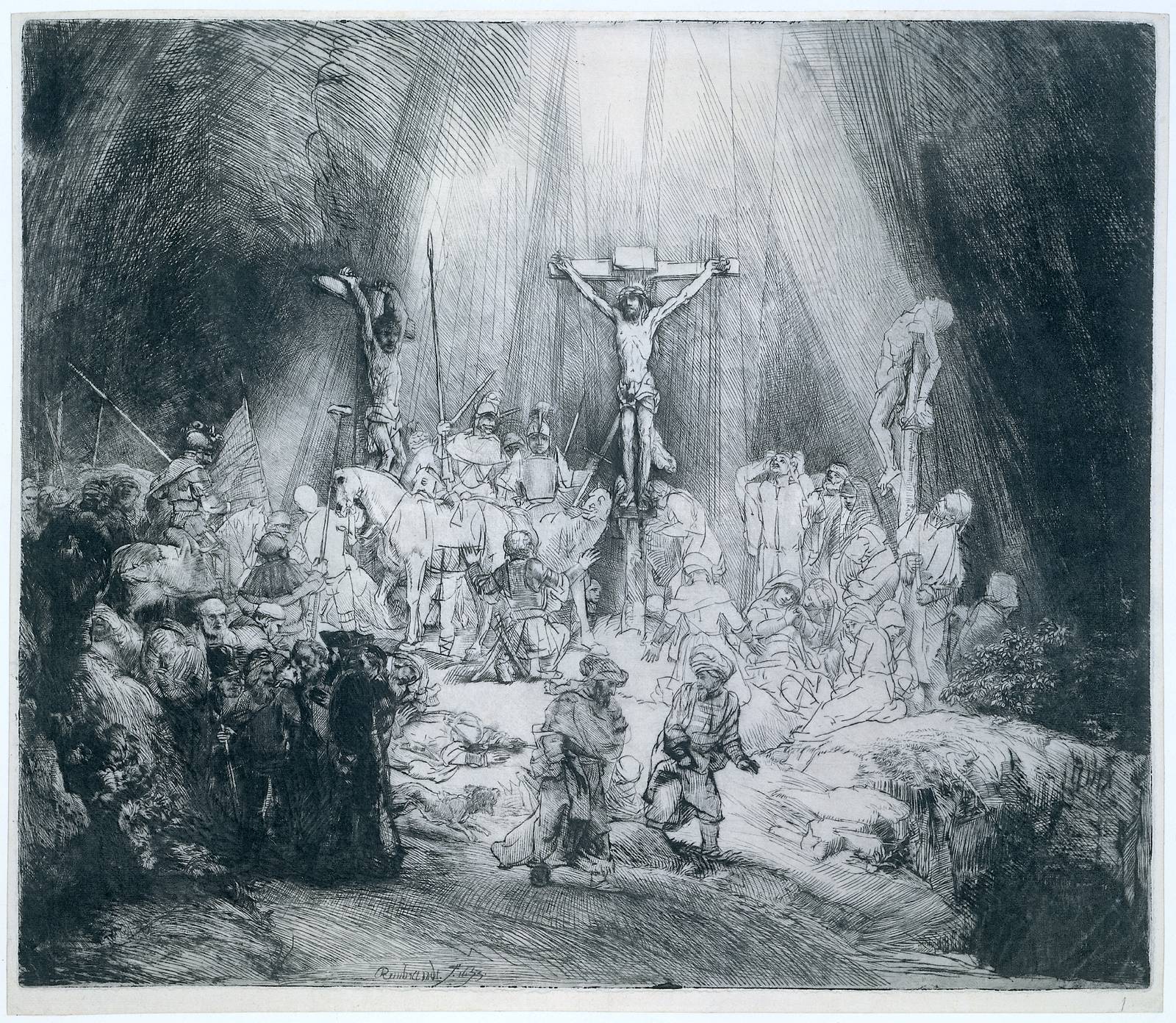
The Three Crosses by Rembrandt. 165311. Jesus is Nailed to the Cross
– Behold the new Tree of Knowledge of Good and Evil
– Jesus is showing us how much he loves us

12. Jesus Dies on the Cross
– Jesus extends his arms between Heaven and earth
– Our crucified God endures the problem of evil

13. Jesus is Taken Down from the Cross
– Love can require letting ourselves be a “burden”
– The world took all it could, but God had more to give

14. Jesus is Laid in the Tomb
– From a new womb to a new tomb, both freely offered
– The mustard seed is planted

Tips for Praying With the Psalms

March 28, 2014

The Book of Psalms contains 150 psalms (or sung prayers) which have been used in communal worship and private devotion by God’s people for thousands of years; first among the Jews and now by Christians as well.   The psalms are prayers inspired by the Holy Spirit  corresponding to the wide spectrum of human experience:  joy and sorrow; triumph and defeat; contrition, thanksgiving, and praise.

Is it OK to question God and complain to him in prayer? Is it acceptable to tell the Lord how unhappy or angry you feel? The psalms show that God welcomes such prayers. He knows our only alternative to coming to him for help and healing is to stuff or deny these feelings, letting them to embitter or depress us.

Sometimes a particular psalm may not resonate with my spirit at the moment. For example, how can I benefit from a psalm lamenting a betrayal when all is well in my own life? I can pray such psalms as an intercessor for those experiencing such trials and unite my heart to theirs. Another way to pray each psalm with a new richness comes from the realization that these prayers were well-known and often offered by Jesus and Mary. This Lent, try praying the psalms through their eyes.

Excuses Are Always Easy To Find — Thursday, 3rd Week of Lent

March 27, 2014

Readings: Jeremiah 7:23-28, Luke 11:14-23

One the easiest things in the world to find is an excuse. People can always find a seemingly good reason to do a bad thing, or a bad reason near at hand not to do something good. We like to rationalize and justify what we already desire.

Some in the crowd were made uncomfortable by Jesus, so they dismissed his obvious power to do good as a cunning trap of the devil: “By the power of Beelzebul, the prince of demons, he drives out demons.” Through the prophet Jeremiah, the Lord describes those too stubborn to turn to heed his voice or change their bad path as “stiffened-necked.”

Let us pray for those who “have stiffened their necks,” that they may have enlightened minds and open hearts, and for ourselves, to recognize and renounce our own weak excuses. “If today you hear his voice, harden not your hearts.”

The Two Mountains — Wednesday, 3rd Week of Lent

March 26, 2014

Readings: Deuteronomy 4:5-9, Matthew 5:17-19

[W]hat great nation is there that has gods so close to it as the LORD, our God, is to us whenever we call upon him? Or what great nation has statutes and decrees that are as just as this whole law which I am setting before you today?

The greatness of Israel among the nations consisted not merely in their moral law but in their intimacy with God. As C.S. Lewis once observed, “The road to the promised land runs past Sinai.” The morality of Mount Sinai is essential to the journey, but our goal is to worship on Mount Zion.

Immediately following today’s Gospel about fulfilling the Law, Jesus declares, “I tell you, unless your righteousness surpasses that of the scribes and Pharisees, you will not enter into the kingdom of heaven.” The Pharisees and scribes kept the commandments pretty well but they were often far from God.

This Lent, let us not only focus on growing in our moral practices, but also on our love and intimacy with the Lord.

Something God Can’t Do — March 25 — Annunciation

March 26, 2014

Despite God’s infinite power, he cannot force our free choice to love him. (It is a limitation of logic, not of power, that free-choices cannot be forced.) The Lord can invite and beckon, grant gifts of wisdom and liberation, but only we can give our “Yes.”

God accepts our sacrifices and offerings, but even more than what we have he desires the gift of what we are — that is, who we are — our very selves.

The Church is both Christian and Marian. The faithful say, “Not my will, Father, but yours be done” and “Let it be done unto me according to your word.”

God’s kingdom will come in its fullness even despite our stubborn “No” or, in part, because of our free “Yes.” However, let us answer, “Here I am, Lord; I come to do your will,” so that we may personally share his glory, like Mary and Gabriel do today.

Teddy Bear Annunciation

March 25, 2014

Nicodemus & the Woman at the Well — 3rd Sunday in Lent—Year A

March 22, 2014

A Water Well in the DesertNicodemus and the woman at the well could hardly be more opposite–but for the fact that in neighboring chapters of John’s Gospel they both encountered Jesus. He was a Pharisee and a member of the Sanhedrin. She was a simple Samaritan peasant. He was an educated “teacher of Israel.” She was, according to the Jews, a member of a heretical sect. He was at the center of the religious center. While she, as we will see, was an outcast among outcasts.

He came to Jesus at night, but she “about noon.” Both are odd times. Why wasn’t he traveling by the ease and safety of daylight, and why wasn’t she fetching water at a cooler time, before sunrise or after sunset? He feared the Jews who hated Jesus and so came under cover of darkness, while she was avoiding the townspeople who despised and judged her. While Nicodemus sought out Jesus to have his questions answered, the woman at the well had never heard of him. Rather, it was Jesus who sought her out to propose a relationship, meeting her (appropriately) at a well, like where many of the patriarchs first encountered their beloveds.

Jesus told Nicodemus that we “must be born of water and Spirit” and told the woman that we “must worship in Spirit and truth.” These are the components of the Christian life: sacraments and discipleship. We can tell that being “born [again] water and Spirit” is sacramental because, after the dialogue with Nicodemus, Jesus supervises his apostles baptizing in the Jordan. And we can see that Jesus is calling the woman to discipleship because Jesus spoke to her at the well seated, the posture of ancient teachers. The Christian life consists of sacraments and discipleship. Just going to church is not enough–our daily lives must be his, and if we try to be Christians without the power of the sacraments, we will find ourselves enfeebled and failing.

Amazingly, while Nicodemus left Jesus as discretely as he came, the Samaritan woman left convinced about Jesus and simply had to tell others, even those who disliked her. “Come see a man who told me everything I have done. Could he possibly be the Christ?” Nicodemus comes around slowly, first critiquing his Pharisaic peers who revile Jesus, “Does our law condemn a man before it first hears him and finds out what he is doing?” Then, after the death of Jesus, Nicodemus comes to full courage, “bringing a mixture of myrrh and aloes weighing about one hundred pounds” to prepare his body for burial. It is as if Nicodemus said, “I don’t care what anyone else says, this is good, and right, and true; Jesus was sent by God.” Nicodemus was at the center of the religious center while she was an outcast among outcasts, yet she responded more readily to Christ.

We can see Nicodemus as a natural audience for Jesus, but she would tend to make us question Jesus, “Why are you talking to her?” She was a sinner, yet so was Nicodemus, and so are we. Notice how Jesus does not ignore her sin but does not allow it to get in the way of her seeing that he loves her. “You are right in saying, ‘I do not have a husband.’ For you have had five husbands, and the one you have now is not your husband. What you have said is true.” Instead of condemning her for her sins, he compliments her for her honesty! “For,” as Jesus told Nicodemus, “God did not send his Son into the world to condemn the world, but that the world might be saved through him.”

Who is longing for God? Deep down, all people are. As St. Augustine wrote, “You have made us for yourself, O Lord, and our hearts are restless until the rest in you.” But who will be receptive to the Gospel when we share it? If we never try, we’ll never know. “I tell you, look up” Jesus says, “and see the fields ripe for the harvest.” Ask the Holy Spirit to give you opportunities to evangelize, to talk about the cause for your joy, and then bravely follow his promptings. “If today you hear his voice, harden not your hearts.”

Why is the Dead Sea dead? Nothing lives in it because of all the salt, but there’s another of explaining this. Living water flows from the Sea of Galilee, down the Jordan River, and into the Dead Sea constantly, day and night, yet it is dead because nothing ever flows out. So we must allow living waters to flow through as well. Everyone wants the truth like Nicodemus. Everyone thirsts for life-giving waters like the woman at the well. Everyone is looking for Jesus, and Jesus is asking you to help in the introductions.

Q&A on Indulgences

March 22, 2014

What is an indulgence?

An indulgence cancels before God the temporal punishment due for forgiven sins.

Forgiven sins can have punishments?

The forgiveness of sin absolves its eternal punishment; that is, restores our friendship with God and saves us from Hell. However, “temporal punishment” remains for sin for the purpose of the soul’s rehabilitation and to satisfy justice. This is why the priest in the confessional gives you a penance to do after you leave with all your sins absolved. Recall what Nathan told King David after the Lord forgave him (2 Samuel 12:9-14.) Even after forgiveness, there may be punishments to be paid.

What is the difference between a “plenary” & “partial” indulgence?

A plenary indulgence remits all temporal punishment due to sin, while a partial indulgence remits some of it. Note that sin’s temporal punishments are not synonymous with all of sin’s consequences. For instance, even after a plenary indulgence, we all still experience in our flesh the primeval consequence of sin: physical death.

How can the Church offer to do this?

The Church has authority from Christ to loosen and to bind, on earth and in Heaven. (Matthew 18:18) Thus, after sins are forgiven, she can satisfy remaining debts by drawing on and applying before God the superabundant merits won by Christ and his saints.

So the Church still grants indulgences?

In the 1500’s, some indulgences were granted for performing the charitable act of donating to the Church. The way some used the “sale” of indulgences as a fund-raising strategy scandalized many (including Martin Luther.) The Church abolished this means of gaining indulgences, but other means remain available.

How do I gain a plenary indulgence?

All plenary indulgences require the following:

  1. Go to confession.
  2. Receive the Holy Eucharist.
  3. Pray for the pope’s intentions (e.g., an Our Father & a Hail Mary)
  4. Do the indulgenced act in a state of grace and intending to gain the indulgence.
  5. And have no intention to sin again, even venially.

      (Note: One confession can be utilized for indulgences twenty days before or after, but each indulgence requires a distinct holy communion.)

What acts carry a plenary indulgence?

They include, among others:

  1. Visit the Most Blessed Sacrament for at least 30 minutes.
  2. Read the Bible for at least 30 minutes.
  3. Pray the Stations of the Cross.
  4. Pray one Rosary (five decades) in a church or as a family group.
  5. Pray the “Prayer Before a Crucifix” on a Friday in Lent after communion.
  6. Adore the crucifix liturgically on Good Friday.
  7. Visit a cemetery and pray for the dead on any day between November 1st and 8th.
  8. Worship at a First Communion Mass.
  9. Worship at a priest’s Mass of Thanksgiving (aka, “First Mass”)
  10. Hear sermons at a parish mission and be present for its solemn close.

Many other acts can also gain partial indulgences.

How often & for whom can I gain an indulgence?

One plenary indulgence can be gained daily and applied to oneself or to a deceased person. There is no limit for how many partial indulgences you can gain for yourself or a deceased person, and this type does not require the conditions of confession, communion, or prayers for the pope’s intentions. (Thanks to Pussywillowpress for the clarifying note below.)

The Seven Last “Words” of Christ

March 21, 2014

“Father, forgive them for they know not what they do.”  (Luke 23:34)

To the good thief:  “Amen, I say to you: this day you will be with me in paradise.”  (Luke 23:43)

To Mary:  “Woman, behold your son.” And to his beloved disciple:  “Behold your mother.”  (Luke 19:26-27)

“My God, my God, why have you forsaken me?”  (Mark 15:34)

“I thirst.”  (John 19:28)

“It is consummated.”  (John 19:30)

“Father, into your hands I commend my spirit.”  (Luke 23:46)

HHS Mandate Court Date Set

March 19, 2014

The Annunciation by Fra AngelicoThe Supreme Court has set the date for oral arguments for Hobby Lobby’s challenge to the Obama HHS mandate. The nation’s highest court will hear debate from attorneys representing the Christian-owned business and the Obama administration on Tuesday, March 25 at 10 a.m.”

March 25th is the Feast of the Annunciation, when the Blessed Virgin Mary conceived our Lord.

Reflections on St. Joseph — March 19 — St. Joseph

March 19, 2014
  • Joseph was probably the first person Jesus Christ called “Abba.”
  • As a carpenter, Joseph created things by his mind and hand, imaging God the Father, Creator of the universe.
  • Joseph never gave a stone, a snake, or a scorpion to Jesus when asked for a loaf of bread, a fish, or an egg.
  • Like God the Father, Joseph can seem quiet, but he never ceases in his love and action.
  • As God loved ancient Israel purely, so Joseph loved Mary—the icon of perfected Israel.
  • Joseph was the protector and provider in the household of the Son of God. Now he is the patron of the universal Church.

Servants, Students, & Sons — Tuesday, 2nd Week of Lent

March 19, 2014

Gospel: Matthew 23:1-12

As for you, do not be called ‘Rabbi.’ You have but one teacher, and you are all brothers.
Call no one on earth your father; you have but one Father in heaven.
Do not be called ‘Master’; you have but one master, the Christ.

Christ is our master and we must conform our lives to his will. Our flesh resists as if it were slavery, but in God’s will we find our greatest freedom and fulfillment.

The Lord is our teacher and we must learn from him. Unlike the scribes and the Pharisees, whose words we should heed but whose example we should ignore, all of Jesus Christ’s words and deeds are fit for our emulation.

Many people interpret “call no man on earth your father” as if it were about not addressing clergy as “Father.” Yet these persons call their dads their fathers, their teachers “teacher,” and forget that St. Paul wrote “I became your father in Christ Jesus through the gospel,” and “I urge you on behalf of my child Onesimus, whose father I have become in my imprisonment,” and often referred to “Father Abraham” (1 Corinthians 4:15, Philemon 10, Romans 4:16-17) However, Jesus is actually pointing to the importance of loving God as our good and loving Father. It is good for us to love the pope, but if we feel more fondness for our Holy Father than for God the Father then we very much need to develop and deepen our devotion to our Father in Heaven.

Measures of Mercy — Monday, 2nd Week of Lent

March 17, 2014

Gospel: Luke 6:36-38

Last year, a teenage posted a photo on the internet of an unrolled tape measure along side the 11-inch “footlong” sandwich he had bought. The corporate response was not one of the great moments in public relations history; they said that “footlong” was a trademark term, rather than a measurement of length. The negative consumer backlash to this went viral and the corporation pledged that every foot-long would henceforth be 12-inches.

In 12th century England, there were strict laws to punish bakers who sold undersized loaves. In response, the bakers would throw in an additional loaf with every dozen to safeguard their liberty.  The baker’s dozen (of 13) was born and their customers were happy. It is wiser to error on the side of generosity with others, in both the world of business and the realm mercy.

Commerce has been linked to mercy by the Lord in both Testaments. In Old Testament Israel, merchants would use cups and weights to measure out their products to customers. Sometimes, to increase their profits, unscrupulous sellers would manipulate these measures to their advantage, as the Lord describes through the prophet Amos:

“When will the new moon be over,” you ask, “that we may sell our grain, And the sabbath, that we may open the grain-bins? We will diminish the ephah, add to the shekel, and fix our scales for cheating! We will buy the destitute for silver, and the poor for a pair of sandals; even the worthless grain we will sell!”

Such cheating was especially abhorrent to the Lord because it most exploited the poor and vulnerable. Today, Jesus tells his disciples that they should be generous with their measurements of mercy if they do not wish to be condemned:

“Be merciful, just as your Father is merciful. Stop judging and you will not be judged. Stop condemning and you will not be condemned. Forgive and you will be forgiven. Give and gifts will be given to you; a good measure, packed together, shaken down, and overflowing, will be poured into your lap. For the measure with which you measure will in return be measured out to you.”

Without rejecting the truth, or declaring evil to be good, we need to be patient and forgiving with others if we wish to be shown mercy. As St. James says, “judgment is merciless to one who has not shown mercy; [but] mercy triumphs over judgment.”

Converting Sinners — Friday, 1st Week of Lent

March 14, 2014

Readings: Ezekiel 18:21-28, Matthew 5:20-26

Do I indeed derive any pleasure from the death of the wicked? says the Lord GOD. Do I not rather rejoice when he turns from his evil way that he may live?

Jesus said to his disciples: “I tell you, unless your righteousness surpasses that of the scribes and Pharisees, you will not enter into the Kingdom of heaven.

The scribes and Pharisees wrote off the tax collectors and prostitutes as having no hope of salvation, yet Jesus pursued and prayed for these sinners. In the first century, one of the Church’s greatest persecutors became one of its greatest apostles, Saul of Tarsus, also known as St. Paul. In the last century, Dr. Bernard Nathanson, who killed thousands as an abortionist and helped to mislead millions as a co-founder of NARAL, went on to become a powerful pro-life advocate. God still rejoices in sinners turning from their evil way, and for us today, part of surpassing the scribes and Pharisees in righteousness means praying for and pursuing the conversion of sinners.