3rd Sunday of Lent
By Fr. Victor Feltes
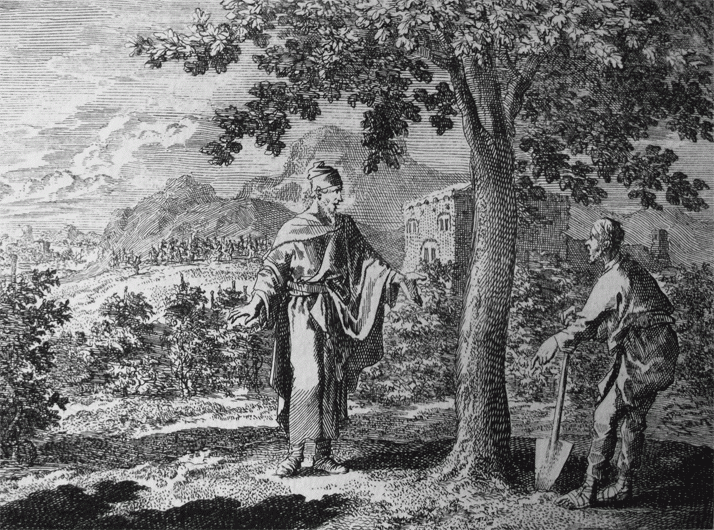
“There once was a person who had a fig tree planted in his vineyard, and when he came in search of fruit on it but found none, he said to the gardener, ‘For three years now I have come in search of fruit on this fig tree but have found none. So cut it down. Why should it exhaust the soil?’ He said to him in reply, ‘Sir, leave it for this year also, and I shall dig around around it and fertilize it; it may bear fruit in the future. If not you can cut it down.’”
The fig tree in Jesus’ parable was fruitless for three years and in danger of being chopped down. Who does this fig tree represent? The prophets Jeremiah and Hosea likened Old Covenant Israel to a fig tree, and the early Church Fathers commonly identified the barrenness of the parable’s fig tree with Israel’s refusal to accept their Messiah. Israel experienced three years of Christ’s public ministry and had still another season of opportunity to become fruitful by embracing Christ’s Church thereafter. But Jerusalem, its Temple, and all its towers were cut down, put to the sword and destroyed by the Romans in 70 A.D.. Parables, however, can have more than one valid and inspired interpretation. Beyond symbolizing an era of history now passed, what meaning does the barren fig tree hold for us today?
In today’s second reading, St. Paul warns the Christians at Corinth against presumption. The Hebrews during the Exodus all shared in a baptism with Moses when they passed through the Red Sea. In the desert, they all ate bread from heaven and drank a miraculously-given drink on their journey. “Yet God was not pleased with most of them, for they were struck down in the desert.” St. Paul says “these things happened as examples for us… as a warning to us,” lest we who are baptized into Christ and regularly consuming his Holy Eucharist think we do not need to reject all grave sins. Do not grumble or rebel like the Hebrews in the desert. Stop following your desires for evil things, or you will perish as they did. Instead, repent and follow our good and loving Lord. He will help and guide you to his Promised Land.
A fig tree may be lush with leaves, giving off a splendid appearance, and yet be barren within. A Christian may appear complete to others, and yet have a sickly soul. To help the barren fig tree, the gardener in our parable pleads to dig around it and add fertilizer. This describes root pruning and the application of manure. Root pruning as a method to make fig trees more fruitful is still recommended today. One article suggests this technique: at the end of winter before new growth begins, go about two feet away from the tree trunk and plunge a spade or shovel down, severing the roots. Skip over one shovel’s-width to the side and then repeat this pattern in a circle once around the tree. Cutting off some of its roots spurs the fig tree to divert its energies from growing foliage to creating fruit. The manure, for its part, provides nutrients (especially nitrogen) which plants require and benefit from. So, if you are a barren fig tree, Jesus the Gardener wishes to radically sever your connections to vices and distractions, in order to productively redirect your energies. He wants to introduce you to stuff which you may now find repellant (including regular confession and daily prayer) but which you need and will benefit from. You do not know how many seasons you have left. Jesus offers you this opportunity to change and become fruitful. Please let Christ the Gardener work with you.
But what if you already follow Christ closely and are aware of no grave sins? What if you have mature self-knowledge, a well-formed conscience, and cannot detect any mortal sins in yourself? Then praise God for that, and consider how our Lord wishes to glorify you through still greater fruitfulness. In the Old Testament Book of Leviticus, God commanded his people not to eat from any tree they planted in Israel throughout its first three growing years. In the fourth year, all of the tree’s fruit was to be dedicated to God as an offering of praise to the Lord. Only in the fifth year, and any years after that, could they eat its fruit. (Leviticus 19:23-25) So how would God dedicate your fruit as an offering to himself and grant you a greater enjoyment of his blessings ever after? A third interpretation of today’s parable suggests how.
Jesus’ parable begins: “A man had a fig tree planted in his vineyard…” (Our New American Bible translates that line’s last word as “orchard” but the Greek word St. Luke uses means “vineyard.”) A vineyard is for growing grapevines. This raises a question I found answered online: why would someone plant a fig tree in a vineyard? A “consulting viticulturist” from New Zealand who has worked fifty years in the vineyard and wine industry says some vineyards plant fig trees because “in some regions figs ripen at about the same time as grapes – birds seem to prefer pecking figs [and] so leave the grapes alone (more-or-less).” Another online commenter, a “cook for over sixty years,” adds that “some vineyards have a problem with small birds who peck at the grapes looking for the seeds and causing the grapes to rot. One solution is to plant fig trees around the vineyard. The birds prefer the figs because they have more seeds and the seeds are more accessible, they then leave the grapes alone.”
The reason a fig tree is planted by a vineyard is to offer up its fruits as a sacrifice for the good of the vineyard, to the delight of the vineyard owner. Who or what is this vineyard in the parable? Jesus teaches, “I am the true vine, and my Father is the vine grower,” and tells his Church, “I am the vine, you are the branches.” (In another parable, The Parable of the Wicked Tenants, Jesus identifies a vineyard as “the Kingdom of God.”) So the fig tree is called to self-sacrifice for the good of God’s vineyard, which is the Church, the Body of Christ, the Kingdom of God. But what does this look like?
 In the midst of the French Revolution, a community of Carmelite nuns in Compiègne felt moved to make an offering themselves to God as a sacrifice for their troubled nation and the Catholic Church in France. Almost two years later, after the state had closed and seized all the convents and outlawed the wearing of habits, the sisters were found, arrested, and condemned to death. On July 17th, 1794, sixteen chanting nuns ascended the scaffold one-by-one and were guillotined before a silenced crowd. Ten days after the Blessed Martyrs of Compiègne’s sacrifice the evil “Reign of Terror” ended.
More recently, Fr. John Hollowell, a diocesan priest about my age of the Archdiocese of Indianapolis, was diagnosed in February of 2020 as having a brain tumor. Though grave news, Fr. John saw in his illness an answer to his own prayer. He wrote on his blog at the time, “When the scandals of 2018 broke out, most of you know that they [] affected me deeply, as they have most of the Church. I prayed in 2018 that if there was some suffering I could undertake on behalf of all the victims, some cross I could carry, I would welcome that. I feel like this is that cross, and I embrace it willingly.” Following surgery and treatment, he continues serving today as a pastor in Indiana.
Now it’s natural to hesitate at making such a self-offering. Who wants to suffer – to have our roots cut or be surrounded by dung? Even Jesus prayed before his own self-sacrifice, “My Father, if it is possible, let this cup pass from me; yet, not as I will, but as you will.” Yet Jesus loved his Father and loved us, trusting that whatever his Father willed would be best for us all. The hour had come for the Son of Man to be glorified. Was not this most-difficult thing the greatest thing that Jesus did? Jesus tells us, “Whoever serves me must follow me, and where I am, there also will my servant be. The Father will honor whoever serves me.”
In its first years, a fig tree grows only for itself. A fig tree typically begins bearing fruit when it is three to five years old. So after three years of barrenness, it remains unknown whether the fourth year will witness the tree producing pleasing fruits. Jesus now offers you an opportunity to be fruitful and be glorified like himself. Please love and trust him enough to offer him your fruitful sacrifice.