5th Sunday of Easter
By Fr. Victor Feltes
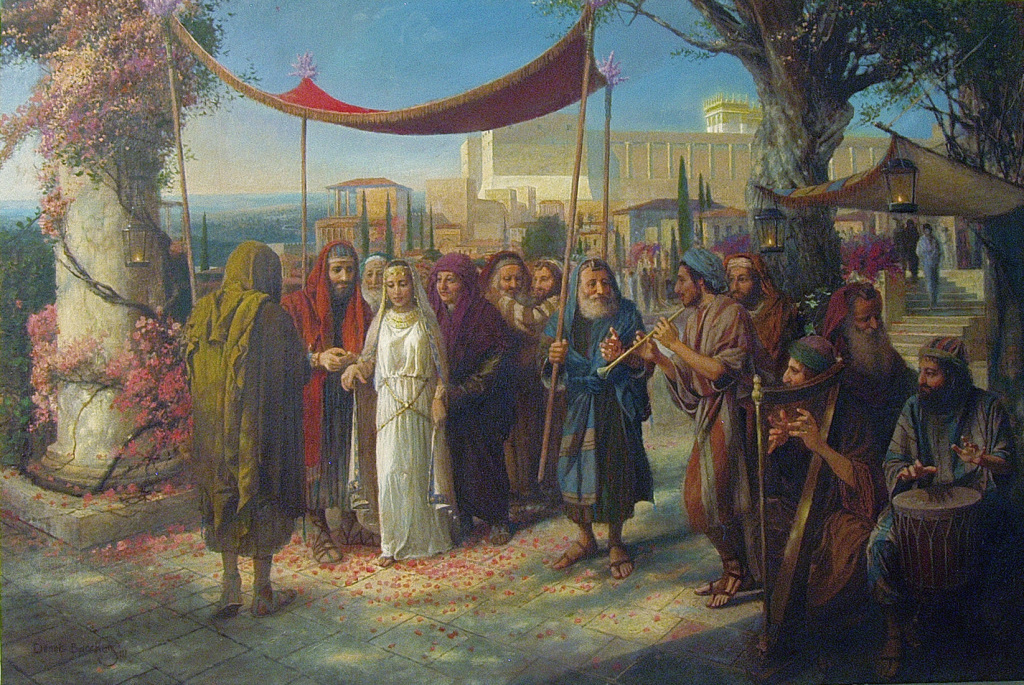
First century Jews had marriage customs different than ours today. When a Jewish man wished to marry a woman, he would journey from his father’s house to hers. There he would establish a covenant by paying the agreed-upon dowry price to the father. With this payment and a shared drinking of a cup of wine, their new covenant was established. This event was called “betrothal” and the man and woman were henceforth legally husband and wife. The bridegroom, however, would not yet begin living with his bride. To manifest the purity and honorableness of his love toward her, he would return to his father’s house, typically for twelve months. During this time, the bridegroom would build-on an addition or prepare a residence at his father’s house. The bride, meanwhile, would ready her wedding garments and jewelry and practice skills for their life together.
St. Matthew’s Gospel recounts the story of Joseph and Mary’s betrothal. When “Mary was betrothed to Joseph but before they lived together, she was found with child through the Holy Spirit. Joseph her husband, since he was a righteous man yet unwilling to expose her to shame, decided to divorce her quietly. Such was his intention when, behold, the angel of the Lord appeared to him in a dream and said, ‘Joseph, son of David, do not be afraid to take Mary your wife into your home. For it is through the Holy Spirit that this child has been conceived in her…’ When Joseph awoke, he did as the angel of the Lord had commanded him and took his wife into his home.”
When the separation time was over at the end of a Jewish betrothal, the bridegroom and his groomsmen would journey, usually at night in a torchlight procession, to where the bride lived. She would be expecting his return but would not know exactly when. That is why a friend of the bridegroom would run ahead to announce: “Behold, the bridegroom! Come out to meet him!” The bridegroom, reunited with his bride, would take her to his father’s house, to their new home together. There the couple would consummate their union and seven days of joyful wedding feasting would begin. I relate all of these details about ancient Jewish wedding customs because they provide insight into Jesus Christ’s words and works.
The Prophet Isaiah had foretold: “As a young man marries a virgin, your Builder shall marry you; and as a bridegroom rejoices in his bride so shall your God rejoice in you.” Through his Incarnation, Jesus descends from his Father’s house in heaven to where we live here on earth. Jesus declares and calls himself “the Bridegroom” and the New Testament subsequently calls his Church his “Bride.” St. John the Baptist was his forerunner-friend who testified, “I am not the Christ, but…I was sent before him,” adding, “The one who has the Bride is the Bridegroom; the friend of the Groom, who stands and listens to him, rejoices greatly at the Bridegroom’s voice.” Once, Jesus was asked why his disciples were not fasting. He replied, “Can the wedding guests mourn as long as the bridegroom is with them? The days will come when the Bridegroom is taken away from them and then they will fast.” Christ is the Bridegroom and looking back we can see he paid dowry price for the Church his Bride on the Cross with his blood and he invites us to partake with him of his chalice.
Having established his new covenant bond with us, Jesus ascends to his Father’s house until his Second Coming, a return which his Bride the Church expects and awaits, but of which we know neither the day nor the hour. This Bridegroom symbolism is why Jesus says at the Last Supper: “In my Father’s house there are many dwelling places. If there were not, would I have told you that I am going to prepare a place for you? And if I go and prepare a place for you, I will come back again and take you to myself, so that where I am you also may be.”
This betrothal and consummation of the union between Christ and his Church is like the coming of the Kingdom of God: it is already partially fulfilled but not yet fully complete. St. Paul told the Church at Corinth, “I betrothed you to one husband, so that I might present you as a pure virgin to Christ.” And Paul teaches the Ephesians that “husbands should love their wives as their own bodies… for no one hates his own flesh but rather nourishes and cherishes it, even as Christ does the church, because we are members of his body. … This is a great mystery, but I speak in reference to Christ and the Church.” And the Book of Revelation’s vision of Heaven says “the wedding day of the Lamb has come, his bride has made herself ready. She was allowed to wear a bright, clean linen garment. The linen represents the righteous deeds of the holy ones… Blessed are those who are invited to the marriage supper of the Lamb.”
The espousal of Jesus with his Church is a relationship with the Church as a whole but it also has meaning for our individual relationships with Christ as well. Consider what habits help a marriage to endure and be fruitful. One important habit for couples is to confide in each other daily. Jesus likewise wants us to pray to him every day. Another valuable marriage habit is sharing meals together. Jesus likewise invites us to his table, at minimum, every Sunday. Folks in troubled marriages grumble and see each other as the problem. Jesus wants us to be close allies and tackle our problems together. Successful marriages focus on gratitude, even during hard times. Jesus likewise wants us to have joy, even while bearing our crosses. Loving spouses must serve each other’s good. We can serve Jesus by serving his Body’s members around us. Renew your faithful devotion to Jesus Christ our Bridegroom who has loved and espoused himself to us, for he is our way, our truth, and our life.
 Parishable Items