Archive for the ‘Chrisitian Virtues’ Category

How Is Christ’s Peace Different Than The World’s?

May 24, 2025

6th Sunday of Easter
By Fr. Victor Feltes

Jesus tells his disciples at the Last Supper, “Peace I leave with you; my peace I give to you. Not as the world gives do I give it to you. Do not let your hearts be troubled or afraid.” If through his Gospel Jesus is speaking these words not only to his apostles but to us today, then we can conclude several things: Jesus would give us his peace. This gift of peace is different from how the world offers “peace.” And it should grant us calm consolation and courage. So how is peace from Jesus different from this world’s peace? How have previous popes and great saints answered this question?

Three years ago, Pope Francis said one difference is in the manner which Christ brings about his peace: “This is how Christ brings peace into the world: through meekness and mildness, symbolized by that tethered colt, on which no-one had ever sat. No-one, because God’s way of doing things is different to that of the world. … The peace Jesus gives to us at Easter is not the peace that follows the strategies of the world, which believes it can obtain it through force, by conquest and with various forms of imposition. That peace, in reality, is only an interval between wars…. The peace of the Lord follows the way of meekness and mildness: it is taking responsibility for others. Indeed, Christ took on himself our evil, sin and our death. He took all of this upon himself. In this way he freed us. He paid for us. His peace is not the fruit of some compromise, but rather is born of self-giving.”

St. Pope John Paul the Great shared similar reflections in 2004: “The world is longing for peace and needs peace, today as in the past, but often seeks it by inappropriate means, sometimes even with recourse to force or by balancing opposing powers. In these situations, people live with the distress of fear and uncertainty in their hearts. Christ’s peace, instead, reconciles souls, purifies hearts, and converts minds.”

St. Thomas Aquinas highlighted this internal/external distinction about peace in the 13th century, saying “the peace of the world is a pretended peace since it is only on the outside: ‘The wicked… speak of peace with their neighbors while malice is in their hearts.’ But the peace of Christ is true, because it is both on the outside and inside. …The peace of Christ brings tranquility both within and without.”

Aquinas also noted that worldly peace “is directed to the quiet and calm enjoyment of passing things, with the result that it sometimes helps a person to sin: ‘They live in strife due to ignorance and they call such great evils peace.’ But the peace of the saints is directed to eternal goods. … The world gives peace so that external goods can be possessed undisturbed; but [Christ gives] peace so that you can obtain eternal things.”

St. Augustine of Hippo said likewise in the 5th century: “For [the worldly,] their aim in giving themselves peace is so that, exempt from the annoyance of lawsuits and wars, they may find enjoyment—not in God, but in the friendship of the world. And although they sometimes give the righteous peace in ceasing to persecute them, there can be no true peace where there is no real harmony because their hearts are at variance.”

It is the alignment of our hearts with Jesus Christ’s heart which gives us harmony and true unity with one another and the Lord. As Jesus says, “Come to me … and learn from me, for I am meek and humble of heart; and you will find rest for yourselves. … My peace I give to you. … Do not let your hearts be troubled or afraid.” Go to Jesus and learn from him. Align your heart with his and rest.

As St. Augustine once concluded, “Let us, therefore, beloved, with whom Christ leaves peace and to whom he gives his own peace, not after the world’s way but in a way worthy of Him by whom the world was made, that we should be of one heart with himself, having our hearts run as one, that this one heart set on that which is above may escape the corruption of the earth.”

Love Like Christ

May 19, 2025

5th Sunday of Easter
By Fr. Victor Feltes

“The Lord is gracious and merciful, slow to anger and of great kindness. The Lord is good to all and compassionate toward all his works.” In times past, God spoke in partial and various ways through prophets (like in the previous psalm) validating his words with saving miracles. But at the beginning of this present age he spoke to us through his Son, through whom he has worked the greatest miracles of salvation.

We bow before the wonder of the Incarnation, that the Divine Person through whom all things were made would become man in the womb of the Virgin Mary and be born among his creatures. We are blessed that Jesus has revealed to us his way of Christian living, not only through the wisdom he preached but through his lived example. And greatest of all, we have access to peace, hope, and joy because of his willingness to suffer, die, and rise for us. Pause to consider where you would be if not for Christ’s love for you.

Now, Jesus gives us a new commandment: “Love one another. As I have loved you, so you also should love one another. This is how all will know that you are my disciples, if you have love for one another.” Now this love we are called to is not mere emotion. Oftentimes love is a warm, fuzzy, pleasure, but love will not always feel good. And this love we are called to is more than intellectual. The demons know that Jesus is Lord, but that does not save them, because they do not love him. We are called to love as Jesus has loved us.

This means we are called to love everyone like he does, the good and the wicked, our friends and foes. What this looks like will vary in life’s various circumstances, but we must will the good for everyone. And willing the good for others must lead to action. We are finite beings and cannot do everything for everyone all the time, but as St. James taught in his New Testament letter: “Faith by itself, if it does not have works, is dead.” And these loving works we are called to will not always feel good, but as Saints Paul and Barnabas preached: “It is necessary for us to undergo many hardships to enter the Kingdom of God.” Jesus entered his Kingdom’s glory through painful trials, and so must we.

“For the sake of the joy that lay before him, [Jesus] endured the cross, despising its shame, and has taken his seat at the right of the throne of God.” Supreme happiness also awaits Christ’s faithful followers as well. In his Revelation, St. John sees a New Heaven and a New Earth and a New Jerusalem coming down out of Heaven from God. “Behold,” John writes, “God will dwell with the human race… and will always be with them as their God. He will wipe every tear from their eyes, and there shall be no more death or mourning, wailing or pain, for the old order has passed away.”

Jesus Christ loves us. He offers us his peace and joy and has placed his hope before us. And Christ calls us to love like him by loving him and remaining close to him, for apart from him we can do nothing. Our Christian life begins with Baptism, but must continue with daily prayer, Sunday Mass, regular Confession, a life of true discipleship. You must remain close to—or return to—his grace to enter the Kingdom of God. Remember Christ’s love for you, hold onto his hope, peace, and joy, and love everyone as he has loved you.

Jesus’ Love Succeeds

April 18, 2025

Good Friday
By Fr. Victor Feltes

The story of Christ’s Passion is a chronicle of human failures. Simon Peter, chief of his disciples, denies being his friend three times. Caiaphas and Annas, the highest Jewish leaders, reject, condemn, and hand over their Messiah. Pilate and Herod, representing the world’s political powers, tolerate injustice, persecute, and execute the Innocent One. The mob of humanity chooses the violent rebel, Barabbas (whose name means “Son of the Father”) instead of God’s Son, the peaceful Savior.

It is poignant and fitting how our liturgy has us speak the mob’s words, “Crucify him! Crucify him! …Take him away! Crucify him!” since it was our sins too which sent Jesus to the Cross. And yet, even as we are humbled and convicted at Jesus being crucified because of us, remember that Jesus accepted humiliation, pain, and death because of his love of us.

Though we may fail, Jesus’ love succeeds. He said, “When I am lifted up from the earth I will draw everyone to myself.” He stretches out his arms between heaven and earth as the everlasting sign of his New Covenant to invite and embrace us. And from the Cross, he says, “I thirst,” because his love thirsts for you and me.

Half-Measures Or Full Devotion?

April 18, 2025

Easter Sunday
By Fr. Victor Feltes

St. Peter the Apostle proclaimed: “We are witnesses of all that [Jesus] did… They put him to death by hanging him on a tree. This man God raised on the third day and granted that he be visible…to us, who ate and drank with him after he rose from the dead.” Jesus went to his Passion and Cross after the Last Supper, and from death and his tomb to the Resurrection. His apostles witnessed these events and were willing to die to testify to them, and nobody ever dies for what he knows to be a lie. The first Christians had full devotion because Christ did not go halfway in his saving mission.

But what if our Lord, instead of enduring pain and death, had chosen to spare and save himself? Jesus had told the apostles he “must suffer many things and be rejected by the elders, the chief priests and the teachers of the law, and that he must be killed and after three days rise again.” He said he had come “to give his life as a ransom for many,” shedding his blood “for the forgiveness of sins.” How could we ever find forgiveness of our sins in Christian faith and the sacraments, like Baptism and Confession, if Jesus never suffered and died?

Or imagine if Jesus had just gone halfway with the Last Supper, which was the first Holy Mass. What if he had taken the bread and given it to his disciples saying, “This is like my Body. Do this with a thought of me”? Jesus said, “Amen, amen, I say to you, unless you eat the flesh of the Son of Man and drink his blood, you do not have life within you. Whoever eats my flesh and drinks my blood has eternal life, and I will raise him on the last day. … Whoever eats my flesh and drinks my blood remains in me and I in him.” What would become of us if we could not receive Jesus in the Eucharist?

Or what if instead of Easter, Jesus Christ had merely suffered and died and never rose again? St. Paul’s answer is emphatic: “If Christ has not been raised, your faith is vain; you are still in your sins. Then those who have fallen asleep in Christ have perished. If for this life only we have hoped in Christ,” Paul says “we are the most pitiable people of all!” Therefore, if Jesus had stopped at half-measures in his mission, we would not be saved!

At the beginning of Easter Sunday Mass we sang “Jesus Christ is risen today!” We celebrate him risen not like some celebrate the Easter Bunny hiding eggs or Santa Claus bringing gifts for Christmas. A savior of merely “once upon a time” cannot save us. We celebrate Jesus Christ who was truly risen on Easter morning in 33 AD, but who is also risen, living and active, in our world today. And in the face of sin of death, he is our only hope.

“This is the day the Lord has made; let us rejoice and be glad!” Embrace today’s good news, the joy of the Gospel, firmly resolved to go forward in such a way that you may be saved. Realize that you cannot safely clear a six-foot chasm by only taking three-foot hops. Half-measures are not enough.

In his suffering, in his sacraments, in his dying and his rising, Jesus shows us how far he goes in love to reach and save us. So in your daily prayers and weekly worship, in virtue and noble service, in Christian faith and fellowship, by your gratitude and love, walk with our Lord Jesus Christ with your full measure of devotion.
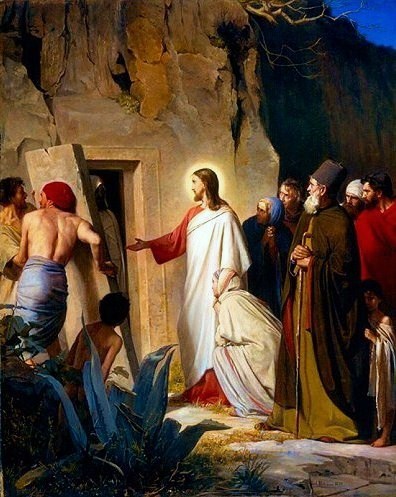
The Deaths of Lazarus

April 6, 2025

5th Sunday of Lent
By Fr. Victor Feltes

God does not do bad things, for “God is not subject to temptation to evil” and “what he hates he does not do.” However, God is all-knowing and all-powerful. There is nothing knowable that God does not know, and nothing good and doable that he cannot do. Therefore, when a bad thing happens, God has allowed that to happen. Yet we also “know that God causes all things to work together for the good of those who love him.” We see these truths reflected in today’s Gospel reading.

God clearly permitted Lazarus to fall ill. And when Jesus received the urgent message from Martha and Mary that their brother was sick, he remained in the place where he was and allowed Lazarus to die. “Now Jesus loved Martha and her sister and Lazarus.” So why did Jesus not come earlier, when he was told “the one you love is ill.” Or why did Jesus not heal his friend Lazarus’ sickness from a distance, like he cured the centurion’s servant or the royal official’s son? Jesus says the dying and rising of Lazarus was “for the glory of God, that the Son of God may be glorified through it,” and “that you may believe.”

Earlier in his public ministry, Jesus had raised Jairus’ daughter from the dead, having told mourners that the little girl was “asleep.” But that resurrection miracle was performed privately, shortly after death, and with strict orders to its witnesses that no one should know of it. By publicly raising Lazarus from the tomb in the presence of a crowd, Jesus manifests his power not only to heal the sick but to restore the dead to life.

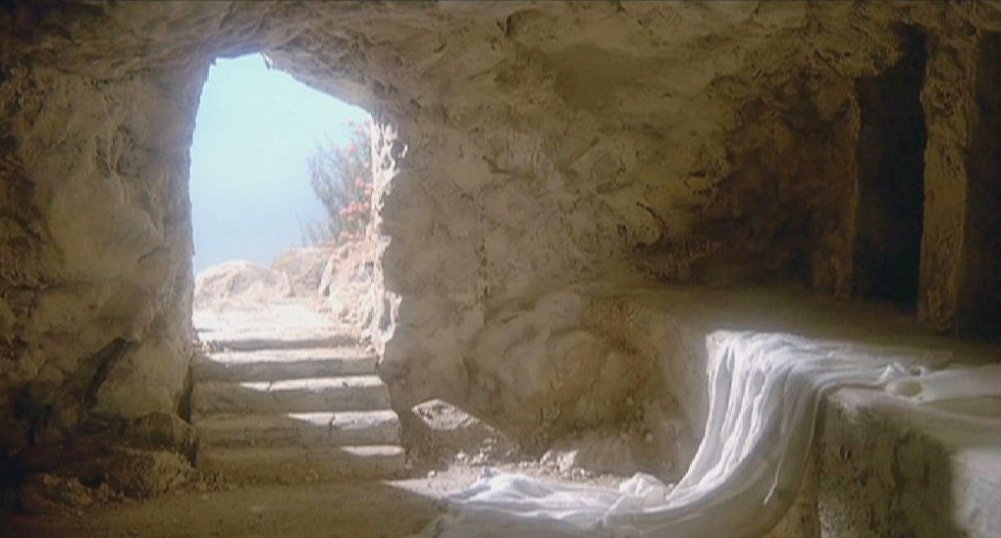
Picture this: One moment, Lazarus was ailing and fading out of consciousness on his deathbed. The next thing he knows, he wakes up wrapped in bandages inside of a cave, and comes out toward the light at the sound of his friend Jesus’ call. His sisters would have filled him in on what he missed when he was dead.

The Gospels tell us Lazarus later attended a dinner with Jesus the day before Palm Sunday at the house of Simon the Leper. Martha served the meal while Mary took costly perfumed oil and poured it on Jesus’ head as he reclining at table. “A large crowd of the Jews found out that he was there and came, not only because of Jesus, but also to see Lazarus… And the chief priests plotted to kill Lazarus too, because many of the Jews were turning away and believing in Jesus because of him.” After Holy Week, the New Testament tells us no more of what happened to Lazarus. But we can imagine what it was like, years after Easter Sunday, when Lazarus died again.

Knowing that Jesus died and was risen, and having personally experienced death and resurrection himself, must have given Lazarus great peace even during his final passion. Consider Martha or Mary watching their brother die once more; having to burying him again. There would naturally still be sadness and ache in that parting, but I imagine the sisters would feel different this time: ‘We know he will rise in the Resurrection on the Last Day. Jesus Christ is the resurrection and the life who has come into the world, and whoever believes in him, even if they die, will live.’ Our brother Jesus died and has risen from the dead “for the glory of God” and “that you may believe.” Knowing and embracing this reality changes our life and how we face death. Do you believe this?

Last week, April 2nd, marked the twentieth anniversary of the passing of Pope St. John Paul the Great. And if you are like me, having witnessed how he lived and died, is inspiring. Pope John Paul’s famous motto was “Be not afraid!” In this, of course, he was quoting Christ who frequently said, “Be not afraid!” “Be not afraid,” Jesus tells us, “If you believe you will see the glory of God.”

Loving Everyone, Our Enemies & Ourselves

February 23, 2025

7th Sunday in Ordinary Time
By Fr. Victor Feltes

Jesus never promised that we would not have enemies. Jesus says, “You will be hated by all nations because of my name. … No disciple is above his teacher, no slave above his master. … If they persecuted me, they will also persecute you. … Woe to you when all speak well of you,” for false prophets were treated in this way. But “blessed are you when they insult you and persecute you and utter every kind of evil against you falsely because of me. Rejoice and be glad, for your reward will be great in heaven.” Thus were true prophets and servants of God treated. The faithful will encounter enemies in this world, yet Christ commands us to love everyone.

He says to his disciples: “Love your enemies, do good to those who hate you, bless those who curse you, pray for those who mistreat you.” You will have enemies, but you must love them. Love sometimes has warm, fuzzy feelings, but not always. This is because love is choice, a choice to will the good of the other. You will not always like everyone, but you must always love everyone.

Jesus tells us, “To the person who strikes you on one cheek, offer the other one as well, and from the person who takes your cloak, do not withhold even your tunic.” Our love of enemies, however, does not mean we must permit grave harms to be done to ourselves or others. This is reflected in the examples Jesus cites. Losing one’s cloak and outer tunic would not leave someone naked, since people in those days also wore an inner tunic. And a slap on the cheek in those days—unlike a stab in the chest—wounds one’s dignity more than one’s long-term health.

We should oppose and resist grave evil, but we must not be undone by the sins and slights of life. Jesus wants us to be magnanimous, large-souled; merciful and forgiving others’ trespasses and debts, generous and giving to those who ask of us, patiently loving people and doing for them what we would have others do for us. Pray for those who mistreat you, bless those who curse you, and do good to those who hate you. Then you will be loving them like Jesus has loved us.

“God proves his love for us in that while we were still sinners Christ died for us.” Be like God, who is generous and kind and merciful towards the ungrateful and the wicked. Then your reward will be great, packed together, shaken down, and overflowing, for you will be godlike, children of the Most High. St. Paul declares, “Just as we have borne the image of the earthly one, we shall also bear the image of the heavenly one.” Then, as St. John writes, “we shall be like [God], for we shall see him as he is.” “God is love,” and to become like God it is important that we love and forgive like him. We must also extend this love and forgiveness to ourselves.

A person who believes that God can love and forgive everyone but themselves is singling themselves out as somebody super-extra special. Remember that our Lord is much more concerned with your future than your past. To Christians who are too hard on themselves, I suggest this thought experiment: Imagine somebody just like you, with the same past, the same strengths and weaknesses, the same loves and desires. What would you think of that person? Could you be friends with that person? How would you treat that person? If kindly, then love yourself like your neighbor. If God loves you, you should also love yourself. If God has forgiven you, you should also forgive yourself. And since God loves everyone, you should love everyone too.

Rejoice, The Lord Is Near – Have No Anxiety At All

December 14, 2024

3rd Sunday of Advent
By Fr. Victor Feltes

A story is told of an old American Indian speaking to his young grandchild seated at his feet. “Inside of me there are two wolves,” the grandfather explains. “One of these wolves is virtuous: patient, kind, chaste, generous, forgiving, and loving. But the other wolf is vicious: angry, cruel, lustful, greedy, unforgiving, and hateful. These wolves are battling within me in a fight to the death.” The child asks, “Which wolf is gonna win, Grandpa?” The grandfather replies, “The one that I feed.”

One bit of encouragement I often give in the confessional concerns the ideas, feelings, memories, or temptations which enter people’s minds. When people confess to having had bad thoughts or temptations, I ask, “Did you will them? Did you choose them? Did you welcome them? Did you say ‘Yes’ to them, or did you resist them?” Unhelpful thoughts and feelings can come to us against our will. We only sin or merit when we engage our will to accept or reject them. A saint is not someone who never feels temptation but someone who, even when tempted, choses what is good and true and loving. If we do not realize this, we will believe every temptation we think or feel is a sinful defeat when it is merely a call to battle.

Some people think temptations only attract us to pleasures, to set us up for a fall. However, some temptations draw us downwards, to grumbling, bitterness, unhappiness, and despair. In today’s second reading from the Letter to the Philippians, St. Paul presents an antidote. He says, “Rejoice in the Lord always. I shall say it again: rejoice!” A person rejoices when they have gratitude for the present and the past and have hope for the future.

Our days may be very challenging but even amidst our sufferings we have much to be grateful for. We can always find a reason to complain. (Somebody with nothing to complain about could even choose to complain about that!) But most of our complaints are completely unnecessary. Instead, count your blessings—perhaps literally on your ten fingers—especially in hard times, and remember that you have great cause for hope in good things to come. When I replace pointless complaining with rejoicing my blessing cup is no longer empty but full enough to overflow for others. Because of this, St. Paul says, “Your kindness should be known to all.”

Another of our common unpleasant temptations is to anxiety. One of the things Jesus says most in the Gospels is “be not afraid!” Realize that worry (which is the natural fruit of fear) is worthless; concern is enough. If I were totally unconcerned about this homily then I would have prepared nothing to say. But if I had been worried about this homily there would still be just as much work to do but with added stress besides. What can you do when you are showing proper concern and you are doing your part but still feel the burden of anxiety? St. Paul provides this prescription: Remember that “The Lord is near.” So “have no anxiety at all, but in everything, by prayer and petition, with thanksgiving, make your requests known to God. Then the peace of God that surpasses all understanding will guard your hearts and minds in Christ Jesus.”

We are called to zero anxiety, “to have no anxiety at all.” When you’ve done what you can, you can refer the rest to God. Lift up your prayers and petitions with a thankful heart. And then, even if nothing visibly changes in the situation immediately, the peace of God which surpasses our understanding will guard and protect your heart and mind from pointless worry. The Lord is near. Give thanks and rejoice. Have no anxiety at all. For the Lord is with you, fighting on your side in the battle.

The Widow’s Gift Was Love

November 9, 2024

32nd Sunday in Ordinary Time
By Fr. Victor Feltes

Jesus sat down opposite the temple treasury and watched how people gave money at God’s house. There were thirteen donation trumpets attached to sturdy chests into which people were dropping their contributions. Many rich people were donating large sums, causing loud commotions. But one poor widow’s two small coins went in quietly; a little click-click. Why did Jesus highlight her gift above everyone else’s that day?

Our Father in heaven is rich. He created the universe out of nothing. All things belong to him. Being the Almighty, he does not strictly need anything from us. In the 50th Psalm, God tells his people that he does not rebuke them for their animal sacrifices—he had commanded them to make them—but he notes “every animal of the forest is mine, beasts by the thousands on my mountains. I know every bird in the heights; whatever moves in the wild is mine. Were I hungry, I would not tell you, for mine is the world and all that fills it.” And yet, God insists upon our sacrifices for him.

God places us in a material world in which what we do matters. Whether and how we work and pray, learn and teach, plant and harvest, build and repair, save and donate, visit and invite, feed and clothe and care and love, these things really matter—for good or evil—for ourselves and others. It is true Almighty God could do everything all by himself, entrusting us with no mission and zero responsibility. But then, how would we ever mature and grow as glorious saints? Instead, God chooses to work through us, and with us, and in us. Our holy gifts and sacrifices, inspired and empowered by grace, advance God’s Kingdom while transforming us in Christ. Though, strictly speaking, God has no need of our gifts or praises, he insists upon them for our own good.

When Jesus saw that poor widow give God’s house just two coins worth only a few cents, he called his disciples to himself and said, “Amen, I say to you, this poor widow put in more than all the other contributors to the treasury; for they have all contributed from their surplus wealth, but she, from her poverty, has contributed all she had, her whole livelihood.”

Jesus condemns those who “devour the houses of widows,” but he celebrates this woman’s evident trusting, love for God. Jesus says to beware the scribes who love the robes, the titles, the honored seats at synagogues and feasts, who recite lengthy prayers in order to be seen by men. “They will receive a very severe condemnation,” Jesus says, because their focus is not on love of God and neighbor. That poor, loving widow, however, receives the praise of God. “The last shall be first, and the first shall be last.”

As I preached in a homily three weeks ago, hierarchies are normal and natural, though some are better than others. The secular world has hierarchies according to power, wealth, or status. Christ establishes a hierarchy for his Church on earth according to sacramental holy orders. But amongst the Church in heaven, a hierarchy exists according to love. In heaven, God reigns supreme and God is love pouring out for all. There is no money to be had there, the sacraments are no longer needed, and there is perfect, perpetual peace. Greatness above is according to one’s capacity to give and receive love. So whoever wishes to be great in God’s Kingdom must imitate the faithful, self-gifting love Jesus highlights in that widow and which we see modeled for us by Jesus Christ himself.

How you love and what you do matters. In the words of St. Paul, “Let us not become weary in doing good, for at the proper time we will reap a harvest if we do not give up.” “Whatever you do, do it with all your heart as for the Lord … knowing that you will receive an inheritance from the Lord as a reward.” For when Christ comes “he will bring to light what is hidden in darkness and will manifest the motives of our hearts, and then everyone will receive praise from God.”

Blessed are the Clean of Heart

November 3, 2024

31st Sunday in Ordinary Time
By Fr. Victor Feltes

On November 1st, Christ’s Church celebrated all the saints in Heaven. The Gospel reading for that solemnity was Jesus’ beatitudes from his Sermon on the Mount. The beatitudes describe God’s saints, and they describe Jesus Christ himself as well. We are made in God’s image and our Lord grows us into his likeness. This Sunday, I would like to highlight one of those beatitudes: “Blessed are the clean of heart…” Most Bible translations render this: “Blessed are the pure in heart…” What is purity of heart?

Our first thoughts perhaps may go to purity in regards to chastity. Obscene materials and obscene acts are commonly called the opposite of “clean.” Yet human sexuality can be a means of sanctity. The marital embrace is even a constitutive part of one of the seven sacraments Christ gave us. Rightly-ordered chastity is a source of joy and life and holiness. Chastity is part of being clean of heart, but it’s not the whole or deepest sense of this beatitude.

When one of the scribes came to Jesus and asked him, “Which is the first of all the commandments,” Jesus answered with words from Deuteronomy: “Hear, O Israel! The Lord our God is Lord alone! You shall love the Lord your God with all your heart, with all your soul, with all your mind, and with all your strength.” A pure heart does not contain the sludge of sin. It does not willfully coddle an affection for evil. A clean heart is receptive to receive and return holy love.

I believe the Venerable Bishop Fulton Sheen once noted that the Archangel Gabriel addressing and declaring the Virgin Mary “full of grace” points to her Immaculate Conception. For if there were sin present in Mary, like inches of mud in the bottom a bucket, she would not be full of grace. But she was clean of heart and full of grace and loved God with her whole self, because our loving God is good and the source of every good.

Now to prevent people from drawing the wrong conclusions, Jesus immediately follows up sharing the greatest commandment with another command from Leviticus. He declares the second greatest commandment is this: “You shall love your neighbor as yourself.” If Jesus had not cited this second commandment, some people would have misunderstood and thought loving God with all our heart, mind, soul, and strength prohibits the love of anyone else. (After all, Jesus said, “No man can serve two masters.”) Instead, we are to love our neighbor as ourselves (and by implication, love ourselves as our neighbors) even as we love God with our whole selves. When our loves are rightly ordered, in loving God fully we will love who and what he loves like he loves them. Contrary to what some might expect, we will love ourselves and other people best by first and fully loving God.

So renew your love for God, choose him first and fully, opposed to your sins or selfish lesser loves, like those saints who lived and died before us who are now in Heaven. Blessed are the clean of heart, for they will see God.

The Last Shall Be First

October 19, 2024

29th Sunday in Ordinary Time
By Fr. Victor Feltes

In today’s Gospel, James and John shoot their shot to move higher up in Christ’s Kingdom. They say, “Teacher, we want you to do for us whatever we ask of you. … Grant that in your glory we may sit, one at your right and the other at your left.” Jesus replies, “You do not know what you are asking.” The two brothers jump at the chance to drink from Jesus’ cup and be baptized in his baptism because they don’t realize these things mean sharing in Christ’s suffering. Jesus assures them, ‘You will drink of my cup and experience my baptism, but to sit at my right and my left is for those for whom it has been prepared.’ Where were the places at Christ’s sides at his glorious royal enthronement? St. Mark’s Gospel tells us: “With him they crucified two revolutionaries, one on his right and one on his left. … [And] the inscription of the charge against him read, ‘The King of the Jews.’”

James and John did not realize what they were asking. They sought places closer to Jesus in order to live earthly lives in a palace on Easy Street. They imagined reigning over a kingdom with Christ where they would be served like the rulers of the nations who made their dominance over other people felt. But Jesus gathered his disciples and said, “It shall not be so among you. Rather, whoever wishes to be great among you will be your servant; whoever wishes to be first among you will be the slave of all. For the Son of Man did not come to be served but to serve and to give his life as a ransom for many.”

Hierarchies are normal and natural, though some are better than others. The secular world has hierarchies according to power, wealth, or status. Christ establishes a hierarchy for his Church on earth according to sacramental holy orders. But amongst the Church in heaven, a hierarchy exists according to love. In heaven, God reigns supreme and God is love—pouring out for all. There is no money to be had, the sacraments are no longer needed, and there is perfect, perpetual peace. Greatness above is according to one’s capacity to give and receive love. So whoever wishes to be great in God’s Kingdom must practice the self-gifting, servant love modeled for us by Jesus Christ.

We can expect to see many surprises after this life. Reality will look very differently in the light of eternity. Some things which we once thought were valuable—even necessary—will be seen as nothing. And things once rejected as useless will be recognized for their true value—especially in people. Many unknown people will become recognized as great, while many rich, powerful, and popular people will be humbled. “Thus,” Jesus says, “the last shall be first, and the first shall be last.” So let us begin living life with more of that eternal vision now: by seeing with the eyes of Christ, by thinking with the mind of Christ, and by loving with the heart of Christ.

What Must We Do?

October 13, 2024

28th Sunday in Ordinary Time
By Fr. Victor Feltes

A man runs up to Jesus, kneels down, and earnestly asks him, “What must I do to inherit eternal life?” Jesus quotes to him commandments about loving our neighbors: “You shall not kill; you shall not commit adultery; you shall not steal; you shall not bear false witness; you shall not defraud; honor your father and your mother.” Why did Jesus add “you shall not defraud” after saying “you shall not steal [and] you shall not bear false witness?” What distinction is being made? In the Greek, “steal” here denotes taking, while “defraud” suggests withholding or keeping back what belongs to another. Both the street mugger (by unjustly taking) and the business owner (by unjustly holding back) can deprive someone of what is rightfully theirs. It is possible to sin by clinging on to what we should give.

Upon hearing Jesus’ list of commandments, the man replies, “Teacher, all of these I have observed from my youth.” The man is seeking something more from Jesus. Jesus had just cited several of the Ten Commandments but notice which commandments Jesus left out. The first three commandments are conspicuously absent, the ones specifically about our relationship with God. Jesus, looking at the man and loving him, desires to reveal how he is to love the Lord. He tells him, “You are lacking in one thing. Go, sell what you have, and give to the poor and you will have treasure in heaven; then come, follow me.” But at hearing these words, the man’s face fell because he had many possessions, and he went away sad. Did that man ever go on to have a change of heart before the end? We don’t know. Matthew, Mark, and Luke all record this encounter in their Gospels but none of them mention his name. Perhaps (unlike with Jairus, Zacchaeus, or Bartimaeus) the early Christians were unfamiliar with this man because he never joined their community.

The Book of Acts describes Jerusalem’s earliest Christian community as being “of one heart and mind” and generous towards one another. “There was no needy person among them, for those who owned property or houses would sell them, bring the proceeds of the sale, and put them at the feet of the apostles, and they were distributed to each according to need.” However, that sharing was not obligatory. Christians still owned property, they were free to decide whether to sell it or not, and they were free to share the sale proceeds or not. So it is not necessarily wrong to own things, but wealth can be an obstacle to heaven.

Jesus remarked to his disciples, “How hard it is for those who have wealth to enter the Kingdom of God!” The disciples were amazed at his words, because they held the idea that having great wealth was a strong sign of God’s approval. So Jesus again said to them in reply, “Children, how hard it is to enter the Kingdom of God! It is easier for a camel to pass through the eye of a needle than for one who is rich to enter the Kingdom of God.” So who among us qualifies as rich?

Compared to our immediate neighbors, our wealth is probably pretty average. Or at least most of us have less money than the richest folks in town. But how materially wealthy are we compared to those in other countries? Compared to the world, everyone here is rich. For instance, a two person household with an annual after-tax income of $40,000 makes more than about nine-out-of-ten people on earth. Even someone who lives alone with a post-tax income of $10,000 a year makes more than eight-tenths of the world. We are rich. So what must we do?

Again, not all Christians must give away all of their wealth, but our Lord insisted upon it for that man who came to him because Jesus knew he loved his riches more than God. The things we own are not absolutely ours to do with however we please, for we and what we have belong to God. We are his trusted servants, the stewards of his goods. That is why Jesus says that anyone “who does not renounce all of his possessions cannot be my disciple.” Even when it is his will for us to have possessions, we must do so with a healthy detachment, by being frugal and generous and truly open to doing God’s will.

One of the most memorable scenes from the 1993’s Best Picture winning film “Schindler’s List” comes at the end. Oscar Schindler, a German industrialist, has protected the lives of more than 1,100 Jews during the Second World War by listing them as his “essential workers” while producing defective ammunition for the Nazis. He looks at the people he has saved and reflects: ‘If only I’d made more money. I threw away so much money, you have no idea. … I didn’t do enough. This car. Why did I keep the car? Ten people right there, ten more people. This gold pin… two more people. At least one. One more person, for this. I could have got one more person, and I didn’t.’ It is Ok to have what we need and it can be Ok to buy things we want, but someday we all will have to stand before the Lord “to whom we must render an account” of our Christian stewardship.

There is a world of needs around us, needs abroad and needs nearby, material needs and spiritual needs. Though they all have importance, our local spiritual mission has a special claim on our care. To aid the success of Christ’s mission for the salvation of souls among us, in the words of St. Paul, “Each person must give as he has decided in his heart, not reluctantly or under compulsion [but freely], for God loves a cheerful giver.” And our Lord promises rewards for our sacrifices for him. Jesus declares, “Amen, I say to you, there is no one who has given up house or brothers or sisters or mother or father or children or lands for my sake and for the sake of the Gospel who will not receive a hundred times more now in this present age… and eternal life in the age to come.” So let us be generous, for God will not be outdone in generosity.

Two Parables, a Poll, & a Purpose

September 15, 2024

24th Sunday in Ordinary Time
By Fr. Victor Feltes

Once upon a time, many years ago, a man who knew nothing about food production resettled to the countryside. He saw a farmer tilling a field and thought, “What a waste of effort! He’s just turning over dirt!” Then he saw the farmer planting seeds and wondered, “What’s he burying? Pebbles?” When the plants began to sprout and grow, he thought, “Ah, I see now! He’s growing a garden.” But the man was shocked at harvest time, “He’s cutting down everything he grew!” And when the farmer and his wife began hand-threshing, the man was baffled, “Why are they beating the plants?” The farmer’s wife ground flour and made loaves, placing them inside an oven, and the man was dumbfounded, “Now they’re burning it in a fire!” The farmer, of course, was growing grain and his wife was baking bread, but the onlooker did not understand all this until he was invited over to their house for supper.

Once upon a time in another tale, a little girl sat on the carpet of her living room while her mother sat in a nearby chair weaving embroidery stitches. The girl looked up and saw the chaotic, mishmashed underside of the embroidery and asked her good, and wise, and loving mother why she would create something so ugly. Her mother turned over the cloth, revealing what she was weaving and the little girl saw a beautiful, half-completed work of art.

Our God is all-good, and wise, and loving, and he is currently fashioning a beautiful, meaningful, lasting masterpiece for us on a scale the size of the universe. But until its completion we will see and experience ugly, painful things we will not understand, like the sufferings of Christ on Good Friday. His thoughts are not our thoughts, nor are his ways our ways, for we “are thinking not as God does but as human beings do.” Following Jesus will mean picking up the difficult crosses which come to us, denying ourselves, and acknowledging Christ before others.

Did Jesus care about what other people thought of him? Yes and no. Jesus asks, “Who do people say that I am?” and “Who do you say that I am?” That question is important, for Jesus declares, “I am the way and the truth and the life,” and “No one comes to the Father except through me.” Jesus gives his Church our Great Commission because all people are called to receive his baptism and to embrace all that he has taught for human thriving and salvation. But in another sense, he did not care what people thought of him.

Jesus did not allow what other people thought prevent him from doing what he should. Not even his friend Peter could change Jesus’ mind to do something against God’s will. Jesus knew that he would “suffer greatly and be rejected by the elders, the chief priests, and the scribes and be killed” but he went up to Jerusalem anyway and testified that he is the Christ. Christians today are called to courage too.

This week, I created an online survey to which 135 self-identified Christians responded. The poll’s question was: “Do you suffer for Christ?” 67% answered, “Yes, a little.” 12% replied, “Yes, significantly.” And 21% said, “No.” Do you suffer because you are a Christian? I asked a pastor-friend of mine how a Christian might discern if we’re suffering for Christ “significantly” or just “a little.” He thought that if we’re not sure, then it’s probably just “a little” — suffering greatly for Christ would be unmistakable.

So most Christians seem to suffer only a little for Christ, if at all, and yet we’re so afraid. You pray before meals, and that is good. Do you also pray before your meals in public? Do your coworkers or neighbors know you are a Catholic Christian? Have you invited anyone to our worship, to share this precious treasure? (Our classes for becoming Catholic begin two weeks from today.) As St. James says, ‘A faith without works is dead.’ We are called to be courageous, like the Prophet Isaiah, ‘to set our faces like flint, knowing that we shall not be put to shame, for the Lord God is our help.’

I doubt the sufferings which flow from your Christian witness will be as severe as you might fear, but if sufferings do come your way know that you are not abandoned. When you suffer for Jesus and his Gospel, know that you are living out your faith with him. If you are faithfully carrying your Christian crosses, then you are following Christ.

The Importance of Obedience

August 24, 2024

21st Sunday in Ordinary Time
By Fr. Victor Feltes

Jesus agreed to come and cure the servant of a Roman centurion, but the centurion replied, “Lord, I am not worthy to have you enter under my roof; only say the word and my servant will be healed. For I too am a person subject to authority, with soldiers subject to me. And I say to one, ‘Go,’ and he goes; and to another, ‘Come here,’ and he comes; and to my slave, ‘Do this,’ and he does it.” This Roman centurion had commanding officers above him and soldiers and servants under his own command. He had carried out others’ orders and with authority he had given orders to others. This Roman centurion had faith that Jesus of Nazareth, this Jewish rabbi, was God’s servant and prophet — perhaps even the Christ — with authority over angels or the elements of creation. Jesus is under authority and possesses authority, through which God’s will is done. He told his Father, “Not my will but yours be done.” And he tells us, “You are my friends, if you do what I command.” We are called to obedience to legitimate authority and Jesus speaks to us in and through his Church.

During my ordination as a diocesan priest, I placed my wrapped hands inside the hands of my bishop in accordance with the rite. Bishop Listecki asked me, “Do you promise respect and obedience to me and my successors?” I responded, “I do.” I hold this obedience very seriously. In the areas of our bishop’s proper authority, what the bishop wants me to do is what Jesus wants me to do. Of course, I should share with the bishop my input and feedback because consultation helps him to make better decisions. And if the bishop were ever to command me to sin, that command would be unlawful and should be ignored. But I believe what the Church, or canon law, or our bishop commands me to do, that is what Jesus wants me to do.

The saints strongly advocate for holy obedience. Pope St. Gregory the Great taught, “Obedience is rightly placed before all other sacrifices, for in offering a victim as sacrifice one offers a life that is not one’s own; but when one obeys one is immolating one’s own will.” The Diary of St. Faustina Kowalska records Jesus telling her, “My daughter, know that you give me greater glory by a single act of obedience than by long prayers and mortifications.” And St. Francis de Sales said, “The Devil doesn’t fear austerity but holy obedience.” And there are many other quotes from the saints which commend holy obedience.

This brings us to our second reading from St. Paul’s Letter to the Ephesians. I have never been married, but as a priest and a pastor ‘I too am a person subject to authority, with persons subject to me,’ and I know that without obedience no house can function well. St. Paul writes, “Be subordinate to one another out of reverence for Christ. Wives should be subordinate to their husbands as to the Lord. For the husband is head of his wife just as Christ is head of the Church, he himself the Savior of the Body. As the Church is subordinate to Christ, so wives should be subordinate to their husbands in everything.” In other words, allow your husband to lead you and your family. Your input and feedback are very important in forming good decisions, and your husband has no authority to practice or command sin, but he does possess legitimate authority to lead. And “husbands, love your wives, even as Christ loved the Church and handed himself over for her to sanctify her… that she might be holy and without blemish.” In other words, you are commanded to love and serve, sacrificing for your wife and family, as Christ does for his Church.

Many of Jesus’ disciples listening in today’s Gospel said, “This saying is hard; who can accept it?” Jesus asked the Twelve, “Do you also want to leave?” And Simon Peter answered him, “Master, to whom shall we go? You have the words of eternal life.” And so it is for us. Sometimes what we are told may be difficult to hear, sometimes obedience or service will be hard, but to whom else shall we go if we are unwilling to trust and obey our Lord? He has the words of eternal life.

A Beautiful Death — Funeral Homily for Linda Dachel, 73

July 25, 2024

By Fr. Victor Feltes

The Book of Wisdom declares, “God did not make death… For God formed man to be imperishable; the image of his own nature he made him. But by the envy of the devil, death entered the world…” With an overflowing love, God created us for immortality with him. Satan, jealous of our glorious calling, misled us to misuse our freedom and suffer sin and death. Human death is unnatural. If it were natural for us it would feel normal to us; like eating, or sleeping, or bonding in pairs. Instead, we perceive death as unsettling, uncanny and dreadful. But, thanks be to God, Jesus Christ came to our aid with his divinity to achieve a remedy for us through mortality itself, so our downfall could become the means of our salvation. Jesus tells us to “be not afraid,” to pick up our cross and follow him, through our Passion to his Resurrection.

Linda faced her final trial when more than one doctor told her she had only six weeks to live. Her form of brain cancer was identified as the fasted growing kind. That was a year ago. She had fifteen radiation treatments in Eau Claire and one course of chemotherapy, yet every hospital visit brought more bad news. Each of us have our own personal strengths and weaknesses. Linda was married to Eugene for 50 years and he says she “never got angry, but worried about everything.” In years gone by she used to tell him, “When we retire, we’re not going to have money to buy bird food!” Yet Linda’s prognosis never bothered her. She wished to never go into to a nursing home, and providential opportunities and finances allowed her to have great care at home. God, who even feeds the sparrows, ensured she was provided for. She never lost weight and ate well until her final month. And amazingly, she never suffered. When people would ask, “Do you have any pain?” her response was always, “No.” Many people die suddenly, with no chance to say goodbye. Linda’s prolonged illness allowed her many friends and relatives to visit her and express their love, and for her to see and smile at them. She passed away on an early Sunday morning. Linda knew and trusted in Christ’s promises. She read the entire Bible twice and faithfully communed with Jesus in the Eucharist.

Death remains a sad and ugly thing, but Linda was blessed with a beautiful death. We pray for her soul, but the details of her passing point to the joyful fulfillment of her hopes and ours. She lived far longer than experts predicted and has embarked into life unending. She endured her illness without pain and in heaven there is no pain now. She faced her death without anxiety and in heaven there is perfect peace. She was lovingly cared for at her home and is going to the home of divine love. As her dear ones on earth said goodbye, the saints in heaven waited to greet her. And Linda’s Sunday morning passing is now joined to Our Lord’s Easter rising. So let us be “courageous,” as St. Paul writes, and let us all “aspire to please him, whether we are at home or away.”

How Would We Treat Jesus?

July 6, 2024

14th Sunday in Ordinary Time
By Fr. Victor Feltes

Jesus commanded the wind and waves of a storm and proved himself more powerful than nature. He told a twelve-year-old girl to arise and proved himself stronger than death. But when Jesus returned to his hometown he was not able to perform many mighty deeds. He did no mighty deeds in Nazareth “apart from curing a few sick people by laying his hands on them.” St. Matthew writes that Jesus “did not work many mighty deeds there because of their lack of faith.” They had listened to Jesus teach in their synagogue. He declared to them during his homily on a messianic passage in Isaiah, “Today this scripture passage is fulfilled in your hearing.” And “many who heard him were astonished,” yet this astonishment became outpaced by outrage.

‘Where did this guy get all this,’ they wondered. ‘Isn’t he just a carpenter? Don’t we know his mom and relatives, who all live around here?’ And “they took offense at him.” St. Luke records “they rose up, drove him out of the town, and led him to the brow of the hill on which their town had been built, to hurl him down headlong. But he passed through the midst of them and went away.” St. Mark tells us that Jesus “was amazed at their lack of faith.” Jesus’ neighbors at Nazareth had more personal knowledge of him in those early days than nearly anybody else on earth, yet they treated him very poorly. They were familiar with him and he was doing good things yet they treated him with contempt. If the boy Jesus had grown up here, if that young man had lived in our community or household, how would we have treated him? Well, how do we treat the people who live around us now?

In his great novel The Brothers Karamazov, Dostoevsky has one of his characters remark, “The more I love humanity in general the less I love man in particular. In my dreams, I often make plans for the service of humanity…. Yet I am incapable of living in the same room with anyone….” Dostoevsky observes it can be very easy to love “humanity,” because “humanity” is an abstract idea. Escapist daydreams are easy and pleasant, but the actual human beings around us require things of us. Not only at Mass and prayer with God but also in daily life with them, we must exercise our love and grow it, in good times, in bad times, and in ordinary times.

St. John writes in his first New Testament letter, “If anyone says, ‘I love God,’ but hates his brother, he is a liar; for whoever does not love a brother whom he has seen cannot love God whom he has not seen. This is the commandment we have from him: whoever loves God must also love his brother.” How do we treat our brothers and sisters, our neighbors and family members, at work, at home, at church? That’s our best clue for how we would treat Christ, for he tells us, “whatever you did [or did not do] for one of these least brothers of mine, you did [or did not do] for me.” So ask for Jesus’ powerful help, for his transforming grace which changes people and relationships, and remember him in how you treat others.