Archive for the ‘Christian Perfection’ Category

The Significance of Anna’s Age and Lifestyle — Sixth Day in the Christmas Octave

December 31, 2015

Readings: 1st John 2:12-17, Luke 2:36-40

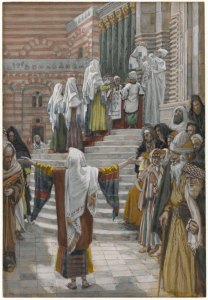
Whenever we read the Bible, it is profitable for us to remember that every detail is there for a reason. The sacred authors and the Holy Spirit chose to omit so many minor facts that “I do not think the whole world would contain the books that would be written” if they had described everything. (John 21:25) Instead, all that we find in Scripture has been purposely included for our benefit. (John 20:30-31) Consider the details mentioned in this encounter from the Presentation, when Joseph and Mary brought the baby Jesus to the temple in Jerusalem for the first time:

The Presentation of Jesus in the Temple by James Tissot

There was a prophetess, Anna, the daughter of Phanuel, of the tribe of Asher. She was advanced in years, having lived seven years with her husband after her marriage, and then as a widow until she was eighty-four. She never left the temple, but worshiped night and day with fasting and prayer. And coming forward at that very time, she gave thanks to God and spoke about the child to all who were awaiting the redemption of Jerusalem.

This is the only episode in the New Testament where the prophetess Anna appears. Why does St. Luke include Anna’s age and the length of her marriage? Let’s explore this obscure detail. The 84-year-old widow was married for seven years, and thus was unmarried for 77 years of her life. She is 7 x 12: the Jewish number symbolizing completeness and perfection times the number of the tribes of Israel. Anna personifies Old Testament Israel at her best. But of the twelve tribes, which tribe would correspond with Anna’s seven years of marriage?

After the death of Saul, all the tribes of Israel came to David (of the tribe of Judah) seeking to make him their king. They said: “Look! We are your bone and your flesh,” echoing the words of Adam towards Eve at the beginning of their marriage covenant, “This one, at last, is bone of my bones and flesh of my flesh.” (2nd Samuel 5:1, Genesis 2:23) Old Testament Israel had been wedded for a time to David, but now she awaited the kingship of a Son of David from the tribe of Judah. While David had once conquered Jerusalem from the Jebusites, Anna and others in her day were “awaiting the redemption of Jerusalem” by the Messiah/Christ. (1st Chronicles 11:4-5)

Living like a Christian nun veiled in anticipation of her bridegroom’s arrival, Anna “never left the temple, but worshiped night and day with fasting and prayer.” Why would Anna, or any woman, choose to live in this way? St. John’s first epistle offers this admonition:

Do not love the world or the things of the world. If anyone loves the world, the love of the Father is not in him. For all that is in the world, sensual lust, enticement for the eyes, and a pretentious life, is not from the Father but is from the world. Yet the world and its enticement are passing away. But whoever does the will of God remains forever.

Alexandrian World Chronicle (5th century) featuring Anna the ProphetessThough Anna understood the evil corruptions of “the world,” she was also well aware of the goodness of creation. She had known the blessings of marriage and the (at least occasional) pleasures of feasting, but Anna knew that these passing things could not fully satisfy her. Her deepest longings could only be met by the One to come, not only for her but for all Jews and Gentiles. When Jesus Christ came to the temple, Anna rejoiced, gave thanks, and “spoke about the child to all who were awaiting the redemption of Jerusalem.” Because she devoted herself to “the will of God,” Anna’s scriptural legacy and joy before the Lord ‘remain forever.’

The Temptations of the First Christmas

December 22, 2015

If I were a demon prowling about the world for the discouragement, confusion, and ruin of souls, how might I have tried to tempt God’s beloved ones in the year leading up to the first Christmas?

If I were a demon, I would say to St. Elizabeth, “Did people imagine that Zechariah had a vision while he was serving in the temple? He simply had a stroke and he will never speak again. You’re feeling sick every day and your abdomen is expanding. You clearly have a cancer. You will soon be dead. There is no hope.

If I were a demon, I would say to St. Mary, “You think you saw an angel? That’s crazy! You’re imagining things. Who are you to be the mother of God’s son? Who do you think you are! Don’t even bother going to visit Elizabeth. You’ll feel foolish when you arrive and see that nothing has changed. None of your family, friends, or neighbors will believe you. Joseph will divorce you and you will be all alone.

And if I were a demon, I would say to St. Joseph, “Do you really believe Mary conceived by God’s Spirit? She’s obviously lying. Even if it’s true, who are you to be a father to the Messiah? Either way, it is best for you to just get a divorce. Whatever you imagined when you married her, now you can see that you were so very wrong.

Mary & Joseph

Even with the coming of Christmas, my diabolical efforts would not cease. I would advise Bethlehem’s shepherds to steer safely-clear of the holy child and to keep to watching their flocks. I would urge the Magi to dismiss the starry signs as meaningless coincidences and not to risk a long journey. I would encourage Joseph to ignore the warning dream to take his family into Egypt and I would encourage Mary not to trust in her loving husband’s lead: “Surely, God would have told you this before telling Joseph.” Thankfully for us, none of them were prevented from doing God’s will through being tripped-up by such traps.

Some people think of temptation strictly as a prompting toward pleasurable, immoral action. But temptation can come in other forms. It can also pull us toward inaction and negative experiences like fear, doubt, sadness, and despair.

Some people assume that the saints do not know temptation like the rest of us. But did Mary, Joseph, and Elizabeth live oblivious to the thoughts and unassailed by the feelings realistically described above? In truth, the saints come to understand temptation well as they discern and persevere through the trials of life.

Some people believe that God loves and watches over a few favored saints while having less concern for the rest of us. But this is also a temptation. Even if our life takes a shocking turn and we don’t know what to do, even if we have a stroke, or cancer, or our mind begins to fail, even if we seem betrayed or abandoned by everyone, each and all of us are his dearly beloved ones. (And we shouldn’t listen to anyone telling us otherwise, even if they speak to us in our own voice.)

The Value of Humility: Living in the Truth Before God

December 14, 2015

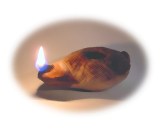
“Some [spiritual beginners] make little of their faults, and at other times become over-sad when they see themselves fall into them, thinking themselves to have been saints already; and thus they become angry and impatient with themselves, which is another imperfection. Often they beseech God, with great yearnings, that He will take from them their imperfections and faults, but they do this that they may find themselves at peace, and may not be troubled by them, rather than for God’s sake; not realizing that, if He should take their imperfections from them, they would probably become prouder An Ancient-Style Oil Lampand more presumptuous still. They dislike praising others and love to be praised themselves; sometimes they seek out such praise. Herein they are like the foolish virgins, who, when their lamps could not be lit, sought oil from others.”

—St. John of the Cross in The Dark Night of the Soul

How to Go to Confession in 9 Easy Steps!

December 12, 2015

1. Prepare for Confession by Examining Your Conscience

Consider the question, “Since my last confession, what did I chose to do even though I knew that it was wrong?” To help you know your sins, ask the Holy Spirit to give you insight. Then, perhaps review your personal relationships (God, family, etc.), the Ten Commandments, or the Seven Deadly Sins. You may want to write a list for yourself to bring into the confessional, if that would make you feel more comfortable.

2. Begin Confession with a Sign of the Cross, saying, “Bless me, Father, for I have sinned

Don’t worry. If you forget what to do, the priest will walk you through it.

3. Give the Priest Some Idea of how Long Ago Your Last Confession Was

Exact precision is not important here; it simply gives the priest some context.

The Confession by Giuseppe Molteni, 18384. Tell the Priest Your Sins

Confess what sins you committed and how many times (or with what frequency) you committed them. The most important thing is that you not intentionally withhold any serious sins. Avoid doing this and you’ll make a good confession. Let the priest know when you are finished.

5. Listen to the Priest’s Advice

Father will probably have some encouragement and advice to help you sin no more.

6. Make Note of Your Penance

The priest will give you a task (usually prayers) to perform to help repair the harms and brokenness that your sins have caused in yourself and the world. Though you can do your penance anytime after confession, sooner is probably better, so that you don’t forget.

7. Pray Your Act of Contrition

In essence, an Act of Contrition simply says, “Lord, I’m sorry for my sins. Please help me to sin no more.” You can pray this in your own words, or use a traditional Act of Contrition prayer like this one:

“O my God, I am heartily sorry for having offended you. I detest all my sins because of your just punishment, but most of all because they offend you, my God, who are all-good and deserving of all my love. I firmly resolve, with the help of Your grace, to sin no more and to avoid the near occasion of sin.”

8. Stay for Absolution

Listen to the priest’s Absolution prayer, which forgives your sins by the power of God through Jesus Christ.

9. Leave in Joy, with Your Sins Forgiven

How wonderful is that?!

On Praying with Separated Brethren

November 21, 2015

This evening, I received an email from a concerned parish visitor who was responding to a pair of area ecumenical Thanksgiving services being promoted in our bulletin:

Dear Father. I was severely shocked and disappointed to see this in a CATHOLIC  bulletin.   I am a devout Roman Catholic visiting family in the area. Not only is this confusing to to parishoners. It is outright contradicting to Church doctrine. You have beautiful homilies, and seem to be a devout priest ! Which is why I’m so confused and outright shocked !!!  I will also be emailing the Bishop to address this issue with him.  God bless [F]ather. And may the Sacred Heart [guide] us both !  [-Signed-]

In case there is wider confusion and concern on this subject, here is the reply I sent.

Dear —,

Thank you for your note. Properly representing our Catholic Faith and preventing scandal are important to me and I’m glad you wrote me.

The Catholic Church calls Protestants our “separated brethren.” This is because we are united as brothers and sisters in Christ though, at the same time, divided in non-trivial ways. (I hope this teaching of the Church is clearly reflected through my preaching, for I believe our Lord desires all of his disciples and all people to come into full communion with his Catholic Church.) While Catholics and Protestants are certainly not in full communion with each other, we share and revere many of the same elements of Christian Prayer, Scripture, and Tradition. Without compromising on the truth, the Church allows Catholics to come together with other Christians for ecumenical prayer events such as the upcoming Thanksgiving gatherings you saw advertised in the bulletin.

This evening, I spoke with Mr. Christopher Carstens, our (solidly orthodox) diocesan director of liturgy, regarding your concerns. He confirmed that these ecumenical events are not condemned by the Church. In fact, The Directory for the Application of Principles and Norms on Ecumenism promulgated by St. Pope John Paul II in 1993 states that, “In liturgical celebrations taking place in other Churches and ecclesial Communities [i.e, Protestant churches], Catholics are encouraged to take part in the psalms, responses, hymns and common actions of the Church in which they are guests. If invited by their hosts, they may read a lesson or preach.” (#118) The upcoming area Thanksgiving ecumenical services are celebrations of this sort, consisting of scripture readings, psalms, prayer responses, hymns, and talks (without common communion.) And so, Catholics may feel welcome to take part.

Through our participation in such ecumenical events and gatherings, while remaining firmly and unabashedly Catholic, I hope that our separated brethren may be drawn from (perhaps) prejudice against Catholicism, to curiosity, to understanding, to attraction, and finally into full communion with Mother Church. Sharing the truth with love and showing love informed by truth through encounters like these will be key to the reunion of all Christians.

Thanks again for writing me with your concerns, which are hopefully now relieved.

God bless,
Fr. Victor Feltes

Charles Dickens’ Otherworldly Visitor

November 17, 2015

Charles Dickens by Frith, 1859        One night in 1844, the year after he published A Christmas Carol, a 32-year-old Charles Dickens seemingly encountered a visitor from beyond while vacationing in Venice, Italy. Within this dream or vision, Dickens thought himself speaking to his dearly-beloved sister-in-law, Mary Hogarth, who had died in 1837, yet he also observed that the spirit “bore no resemblance to any one I have known.” Dickens recorded this experience soon afterward in a letter to a friend:

“Let me tell you of a curious dream I had, last Monday night; and of the fragments of reality I can collect, which helped to make it up. [I] had laid awake nearly all that night…. [W]hen I fell asleep and dreamed this dream. Observe that throughout I was as real, animated, and full of passion as [the English actor William Macready] in the last scene of Macbeth.

In an indistinct place, which was quite sublime in its indistinctness I was visited by a Spirit. I could not make out the face, nor do I recollect that I desired to do so. It wore a blue drapery, as the Madonna might in a picture by Raphael; and bore no resemblance to any one I have known except in stature. I think (but I am not sure) that I recognized the voice. Anyway, I knew it was poor Mary’s spirit. I was not at all afraid, but in a great delight, so that I wept very much, and stretching out my arms to it called it “Dear.”

At this, I thought it recoiled; and I felt immediately, that not being of my gross nature, I ought not to have addressed it so familiarly. “Forgive me!” I said. “We poor living creatures are only able to express ourselves by looks and words. I have used the word most natural to our affections; and you know my heart.” It was so full of compassion and sorrow for me—which I knew spiritually, for, as I have said, I didn’t perceive its emotions by its face—that it cut me to the heart; and I said, sobbing, “Oh! give me some token that you have really visited me!

“Form a wish,” it said. I thought, reasoning with myself: ‘If I form a selfish wish, it will vanish.’ So I hastily discarded such hopes and anxieties of my own as came into my mind, and said, “Mrs. Hogarth is surrounded with great distresses (observe, I never thought of saying ‘your mother‘ as to a mortal creature) will you extricate her?” “Yes.” “And her extrication is to be a certainty to me that this has really happened?” “Yes.”

But answer me one other question!” I said, in an agony of entreaty lest it should leave me. “What is the True religion?” As it paused a moment without replying, I said—Good God in such an agony of haste, lest it should go away! “You think, as I do, that the Form of religion does not so greatly matter, if we try to do good? or,” I said, observing that it still hesitated, and was moved with the greatest compassion for me, “perhaps the Roman Catholic is the best? Perhaps it makes one think of God oftener, and believe in him more steadily?” “For you,” said the Spirit, full of such heavenly tenderness for me, that I felt as if my heart would break; “for you, it is the best!” Then I awoke, with the tears running down my face, and myself in exactly the condition of the dream. It was just dawn.

I called up [my wife] Kate, and repeated it three or four times over, that I might not unconsciously make it plainer or stronger afterwards. It was exactly this. Free from all hurry, nonsense, or confusion, whatever.”

One’s Catholic imagination wonders if this tender, compassionate, glorious “Mary” who visited Charles Dickens that night was actually the Blessed Virgin. Like Our Lady of Lourdes responded to Bernadette’s initial requests for her name with a silent smile, this visitor holds back at first to finally reveal a climactic answer. Whether this was a true vision or merely a dream we cannot say, but this visitor’s answer to his religious question does not disqualify our Blessed Mother: the glorious woman told him, “For you, [the Catholic religion] is the best!”

Would this statement imply that Catholicism would not be the best religion for some? Dickens himself held that the form of one’s religion did not greatly matter if someone tried to do good, and his strong distaste for formal religion had drawn him to Unitarianism. If our Mother Mary, who knew Charles through and through, wished to lead him into full communion with the Catholic Church, she would speak truth to him in the way which he could best receive it. Indeed, for him the Catholic faith truly would be best, but he may have balked-outright at her teaching that it is best for everyone. If his was a vision of the Blessed Virgin sent from God, the plan was to bring him into the fullness of the truth over time, as we often see God patiently doing with others.

Charles Dickens never did become a Catholic during his lifetime, but after 1847 (three years after this experience) he began attending the Anglican church near his home and prayed each morning and night. A year before his death, he wrote in his 1869 last will and testament, “I commit my soul to the mercy of God through our Lord and Saviour Jesus Christ….” Today his body lies buried in Poets’ Corner of Westminster Abbey.

Our Holy Conspiracy & the End of the World — 33rd Sunday of Ordinary Time—Year B

November 16, 2015

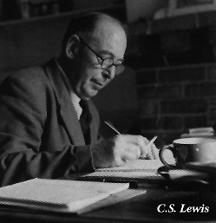
C.S. Lewis, 1898-1963A new liturgical Church year will begin in a couple of weeks with the first Sunday of Advent. As this Church year ends, our Mass readings (like today’s Sunday readings) focus on the Last Things and the end of the world as we know it. This weekend’s news reports, especially the terrible events in France, remind us that though the Kingdom of God is among us, we pray “thy Kingdom come” because it is not yet fully here in total, unveiled power. This weekend’s readings and news events remind me of passages from C.S. Lewis in excellent book Mere Christianity:

“Enemy-occupied territory—that is what this world is. Christianity is the story of how the rightful king has landed, you might say landed in disguise, and is calling us all to take part in a great campaign of sabotage. When you go to church you are really listening-in to the secret wireless [radio] from our friends: that is why the enemy is so anxious to prevent us from going.”

Why does Lewis say that our king has landed “in disguise?” Well, where would you expect a king to be born? The Magi sought the newborn king of the Jews in the palace at Jerusalem, but Jesus was born in a barn—a cave in Bethlehem—to a pair of poor parents. How would one expect the Jewish Messiah to enter into Jerusalem to claim his throne? Probably riding on a warhorse, but Jesus came meekly riding on a donkey, just as had been prophesied about him. Who would have thought that God would become a man, and then suffer and die as he did? After the vindication of the resurrection, one would have thought he would appear to the high priest and Governor Pilate, or to the Emperor Tiberius in Rome, to declare that he was indeed who he claimed to be. Instead, Jesus appeared discretely, to his disciples.

Lewis writes that God has landed in this enemy-occupied world in disguise and has started “a sort of secret society” to undermine the devil. This secret society he speaks of is the Church. But what is so secret about the Church? We have a sign in front with our Mass times. We don’t check ID’s at the door. And if anyone wants to know about what we do or what we believe, we will gladly inform them. But, in a sense, the Church is a secret society—for the world and even many Catholics do not recognize who and what we really are. We are a holy conspiracy. We are fighting the propaganda of the world and the devil with the truth of God. We are recruiting others to the side of the Lord. We are his special forces sabotaging evil with the weapons of love in preparation for the king’s arrival.

From where do we receive our power for this mission? The source of our power is the Holy Mass. Today’s second reading says that the Old Testament’s priests offered many sacrifices because those  could not truly achieve their purpose, but Jesus our High Priest offers his sacrifice once for all. At Mass we transcend space and time to personally encounter that sacrifice, and it’s power is applied to us here and now, providing all the graces we need to fulfill his will.

Lewis asks, “Why is [God] not [yet] landing in [total unveiled] force, invading [our world]? Is it that He is not strong enough? Well, Christians think He is going to land in force; [but] we do not know when.”

Indeed, as Jesus says in today’s Gospel, “of that day or hour, no one knows… but only the Father.”

We do not know when the Lord is going to land in force. “But,” Lewis continues, “we can guess why He is delaying. He wants to give us the chance of joining His side freely. I do not suppose you and I would have thought much of a Frenchman [during World War II] who waited till the Allies were marching into Germany and then announced he was on our side. God will invade.”

Why has God not yet invaded our world with his full, unveiled force? Why does he allow the wicked to use their freedom for evil, like the terrorism we saw in Paris?

Lewis writes, “I wonder whether people who ask God to interfere openly and directly in our world quite realize what it will be like when He does. When that happens, it is the end of the world. When the author walks on to the stage the play is over. God is going to invade, all right: but what is the good of saying you are on His side then, when you see the whole natural universe melting away like a dream and something else—something it never entered your head to conceive—comes crashing in; something so beautiful to some of us and so terrible to others that none of us will have any choice left?”

I think “the whole natural universe melting away” is an excellent reflection on today’s gospel. Jesus tells us that at the end:

“the sun will be darkened,
and the moon will not give its light,
and the stars will be falling from the sky,
and the powers in the heavens will be shaken…”

In the ancient world, the sun and moon, stars and planets, were considered the most stable and eternal things in the cosmos (and you can understand why.) But when even these things are passing, you know the universe as we know it is melting away. After this, the Lord Jesus comes with judgment. “And then they will see ‘the Son of Man coming in the clouds’ with great power and glory… (and his angels, like St. Michael from our first reading, along with him…)”
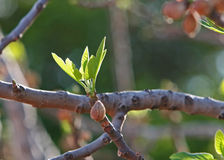
Sprouting Fig Tree in SpringtimePerhaps we may find it surprising that Jesus describes these events as a good thing to his disciples. He says:

“Learn a lesson from the fig tree. When its branch becomes tender and sprouts leaves, you know that summer is near. In the same way, when you see these things happening, know that [the Son of Man] is near, at the gates.”

We usually associate the end of things with the fall. Youth is called the springtime of life, while old age is the fall. In the Northern Hemisphere, every Church year ends in the fall. Yet Jesus presents an analogy for the end of the world as one of spring becoming summer: ‘When the tender branch sprouts leaves, you know that summer is near.’ A small thing, the branch, points to the arrival of a much greater reality, the summer. Why would we cling to the branch when the whole world is being renewed in glory? For friends of God, what is to come is better than what we see. The life we live now in this world is the winter. What is still to come for us is the spring and summer. Let us not hesitate to hope for it, envision it, and rejoice in it.

When the last day comes, “it will be God without disguise; something so overwhelming that it will strike either irresistible love or irresistible horror into every creature. It will be too late then to choose your side. … That will not be the time for choosing: it will be the time when we discover which side we really have chosen, whether we realized it before or not. Now, today, this moment, is our chance to choose the right side. God is holding back to give [people] that chance. [But it] will not last forever. We must take it or leave it.”

How long will it be until the Lord comes again? Jesus says in today’s gospel that, “This generation will not pass away until all these things have taken place.” But he said this a long time ago. Was Jesus wrong? No, for when you read these passages from Mark in full context, Jesus is responding to his disciples questions about two things side-by-side: the fall of Jerusalem and the end of the world. The Romans destroyed the great city and its temple in 70 A.D., during the lifespan of some of Jesus’ hearers, and to many Jews it felt like the end of the world. This event prefigured the passing away of all things. Like other prophesies in the Bible, Jesus’ prophesy has a near and distant fulfillment, one after a forty-year opportunity for conversion, and another at the end of time.

So when will the Lord come again? The answer for every generation before us has been “not yet.” If this world endures to the year 10,000 A.D., the Christians of that time will probably regard us as the early Christians. I personally think it will still be awhile before he comes, for it is still legal to be a Christian in too many places on earth. Yet, in a sense, it doesn’t matter when Jesus is coming, for the end of our individual lives is equivalent to the end of the world for us. If you’re ready for one, you’re ready for the other. But if you, or people that you know, are not ready for either, then now is the time for conversion.

The Lord our King has recruited us into his holy conspiracy, arming us with the weapons of truth and love. You and I are his advanced forces and, among other tasks, he is sending us on rescue missions to bring others to himself. Who do you know that is far from Christ? We are to draw on the power of this Mass for them. We are called to pray, fast, and sacrifice for them, and even to be so bold as to talk with them—inviting them to come to Jesus Christ and his Church. Seize this opportunity and do not let it pass away, for whether the Lord first comes to us or we go forth to him, each and all will encounter him soon, face-to-face, in his full, unveiled glory.
The Screwtape Letters, Illustrated

November 11, 2015

I have no intention of explaining how the correspondence
which I now offer to the public fell into my hands.

—C.S.  Lewis, in his preface to The Screwtape Letters
(A great book you should certainly read.)


What the Scribes Did Right — 32nd Sunday of Easter—Year B

November 8, 2015

Let me open with a joke:

The pastor of a big-city parish answered his rectory door to find a man wearing a face of great anxiety and concern. “Father, there’s a local family in dire need that could really use the church’s help.” The priest invited him inside and listened to the details. “The mother is a young widow with ten kids who lost her job last month. She’s been looking for work, but they’re barely keeping food on the table. Worst of all, unless they can scrape together $300 for rent by this Friday, they’ll be evicted and thrown out into the street.” The priest replied, “That’s a terrible and difficult situation. By the way, how do you know the family?” The man wiped a tear from the corner of his eye and said, “Oh… well, I happen to be their landlord.”

Hypocrisy is the pretense of holding beliefs, standards, behaviors, or virtues that one does not truly hold. Not many good things are usually said about hypocrisy, but I can say one. Usually, hypocrisy acknowledges (however insincerely) what is really true and truly good. Even a corrupt politician speaks the truth when he or she says that government should be transparent, politicians should be honest, and campaign promises should be kept. A wedding ring is a visible sign that proclaims marriage to be a sacred and lifelong bond even on the hand of an adulterer. Hypocrisy  is the homage, the respect, that vice shows to virtue.

The Widow's MitesIn today’s gospel, Jesus talks about the scribes and a poor widow. He praises her, but criticizes them. Jesus saw her at one of the Temple’s thirteen contribution trumpets in the court of the women. These were donation chests topped as with tall road cones, but made of metal, with an opening at the top for dropping in coins. The coins of large contributions would make a large racket, like how a slot machine pays out in a casino. But the poor widow’s two coins fell in with quiet: *click* *click*

Jesus called his disciples to himself to point her out to them. (Perhaps he saw in her an image of himself, the one who trusts in God and is willing to give everything  to him.) After criticizing scribes who “devour the houses of widows” as those who “will receive a very severe condemnation,” he praises this poor widow’s gift.

Most homilies preached around the world today will be about the poor widow’s trusting generosity. (You may have noticed that our lectionary gives the option of omitting the scribes from this reading entirely, making a brief gospel reading even shorter.) But today I will be preaching about the scribes and from an angle that I would bet you’ve never heard before: what we have to learn from what the scribes were doing right.

Woe unto You Scribes and Pharisees by James Tissot

Jesus condemns the scribes for their hypocrisy, and rightly so, but at least they acted like God and true religion were the most important things in their lives. Do our acquaintances at work or school have reason to think that God comes first in our lives? If it were illegal in this country to be a Catholic Christian, would there be enough public evidence to convict you? Our words and actions should reflect our faith in Jesus and his Church.

The scribes took seats of honor in synagogues, but at least they were faithfully there each week. God commands us to keep his days holy—every Sunday and Holy Day of Obligation. He commands this because he deserves our praise and thanks, but also because he knows how much we need this.

The scribes liked to go around in long robes, but at least they dressed up in a God-honoring way. Our clothing should always be modest and dignified, but especially at church. How would you dress for your boss at work, for an meeting with the president, or an audience with the pope? How much more then should we dress well to come before God at Mass.

The scribes accepted greetings in marketplaces and places of honor at banquets, but at least they were active and known in their community. We should not be mere homebodies, but involved in our own community.

The scribes recited lengthy prayers for show, but at least they were not afraid to acknowledge God before others. Do you pray before meals at restaurants? Do you talk about Jesus or your faith with anyone? When someone shares their burdens with you, do you offer to pray with them? (Try it sometime. They will probably be more receptive than you think.) We should not be afraid.

Why did Jesus say the scribes deserved a severe condemnation? Because they focused on externals and disregarded what was within. They cared about fancy clothes, and prayers and deeds that others would notice, but did not care whether widows became destitute. It’s fine to desire friendship—it’s one of life’s great blessings—but we must desire God’s friendship more. We naturally care what others think of us—no one wants to be hated—but we should care more about what God thinks about us. The scribes were attentive to appearances, but neglected the truth and love.

After the poor widow put her coins into the treasury, the gospel says that Jesus called his disciples to himself. He summoned his followers to physically draw nearer in order to teach them and highlight her deed. But in a deeper sense, Jesus was calling them to his very self, that they would come to resemble him like the widow did. Jesus is the man of integrity whose exterior words and actions perfectly align with his inner-self. He wants all of us to be like himself. Jesus wills that our secret selves would be as noble and admirable as our public personas, and that our interior faith would be reflected through all of our external words and actions. Like the landlord in the opening joke, whether or not Jesus is welcome to dwell and live with us as he desires, increasing our likeness to his, is entirely up to us.

Taking Jesus Too Literally

September 30, 2015

Jesus Facepalm

We do well to closely heed all that our Lord Jesus says, but we must also carefully understand what the Word of God Incarnate is really telling us. Using Scripture to interpret Scripture, let us consider two examples where some modern-day Christians misinterpret Jesus’ teaching by taking him too literally.


“Do not swear at all”

Jesus declares, “You have heard that it was said to your ancestors, ‘Do not take a false oath, but make good to the Lord all that you vow.’ But I say to you, do not swear at all; not by heaven, for it is God’s throne; nor by the earth, for it is his footstool; nor by Jerusalem, for it is the city of the great King. Do not swear by your head, for you cannot make a single hair white or black. Let your ‘Yes’ mean ‘Yes,’ and your ‘No’ mean ‘No.’ Anything more is from the evil one.” (Matthew 5:33-37)

Swearing an oath or vow invokes God as one’s witness to a claim or a promise and invites God’s just punishments if his name is taken in vain. It seems that people in Jesus’ day were trying to steal credibility without fearing divine retribution by swearing by lesser holy things. But Jesus warns that all good things belong to God, and condemns clever manipulations of the truth as coming from the devil. Instead, Jesus says, “do not swear at all,” but “let your ‘Yes’ mean ‘Yes.’”

So do any appropriate times and places remain for swearing oaths or vows in the New Covenant? God reveals that such exist through St. Paul. In Galatians 1:20 and 2nd Corinthians 1:23, God himself inspires St. Paul to swear oaths (for example, “I call upon God as witness, on my life, that it is to spare you that I have not yet gone to Corinth.“) And in Acts 18:18, we read that St. Paul “had taken a vow.” Thus, in rare, righteous, and serious situations a Christian may solemnly swear to things before God.


“Call no one on earth your father”

Jesus tells us, “Call no one on earth your father; you have but one Father in heaven.” (Matthew 23:9) Does this mean that we should not call priests (or our even own dads) “Father?” This is not how the first Christians understood Jesus’ words.

St. Stephen calls the Jewish leaders “fathers” in Acts 7:2, and St. Paul does similarly in Acts 22:1. God prompted St. John to address Christian community elders as “fathers.” (1st John 2:13-14) God also willed St. Paul to write of “our father Isaac” and to call Abraham “the father of us all.” (Romans 9:10, 4:16-17) God inspired St. Paul to regard and describe himself as a father to his spiritual children. (1st Corinthians 4:14-15, 1st Timothy 1:2, Titus 1:4, Philemon 10) Therefore, the true concern of our Lord is not with the label of “father,” but that our greatest devotion and love always be directed toward “our Father who art in Heaven.”

Pope Francis’ Great Americans

September 25, 2015

Pope Francis, during his visit to our country this week, elevated one figure from American history to sainthood, and spotlighted two other Catholics in his speech to the U.S. Congress. Who are they and what do they have to show and teach us?


St. Juniperro SerraSt. Junípero Serra
 (1713–1784)

This missionary was a Spanish Franciscan friar who founded nine missions for evangelizing the native people from San Diego to San Francisco in what is today California. In his homily for St. Junípero’s canonization on Wednesday, Pope Francis said of him:

“He was the embodiment of ‘a Church which goes forth,’ a Church which sets out to bring everywhere the reconciling tenderness of God. Junípero Serra left his native land and its way of life. He was excited about blazing trails, going forth to meet many people, learning and valuing their particular customs and ways of life. He learned how to bring to birth and nurture God’s life in the faces of everyone he met; he made them his brothers and sisters. Junípero sought to defend the dignity of the native community, to protect it from those who had mistreated and abused it. Mistreatment and wrongs which today still trouble us, especially because of the hurt which they cause in the lives of many people.

Father Serra had a motto which inspired his life and work, a saying he lived his life by: ‘Siempre adelante! Keep moving forward!’ For him, this was the way to continue experiencing the joy of the Gospel, to keep his heart from growing numb, from being anesthetized. He kept moving forward, because the Lord was waiting. He kept going, because his brothers and sisters were waiting. He kept going forward to the end of his life. Today, like him, may we be able to say: Forward! Let’s keep moving forward!”

© Copyright 2010 CorbisCorporationServant of God Dorothy Day
(1897–1980)

This Catholic social activist was an agnostic American journalist who converted and established the Catholic Worker Movement, Houses, and Newspaper. These advanced Catholic social teachings and provided direct aid for the poor and homeless. As a young woman, prior to her conversion, Day had an abortion and later gave birth to her daughter, though she never married. (A patron for repentance from sins like these seems much needed in our time.) The cause for her canonization has been opened by the New York Archdiocese since 2000, bestowing her the title “Servant of God.” In his (first of its kind) speech before Congress on Thursday, Pope Francis said, “Her social activism, her passion for justice and for the cause of the oppressed, were inspired by the Gospel, her faith, and the example of the saints.

Dorothy Day’s own famous quotes include, “The greatest challenge of the day is: how to bring about a revolution of the heart, a revolution which has to start with each one of us?” Of herself, in life she said, “Don’t call me a saint. I don’t want to be dismissed so easily.” And of Catholicism she said, “Our faith is stronger than death, our philosophy is firmer than flesh, and the spread of the Kingdom of God upon the earth is more sublime and more compelling.”

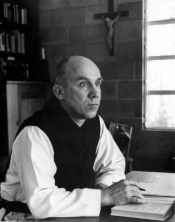
Thomas MertonThomas Merton  (1915–1968)

This monk lived a life as checked as Day’s prior his conversion to Catholicism during college in his mid-twenties. In December 1941, he joined the Trappist monetary in Gethsemani, Kentucky. Seven years later, he published an autobiography about his converion and spiritual journey called “The Seven Storey Mountain.” Though Merton wrote more than 70 books, this work spoke to his generation more than any other, inspiring many monastic vocations.

In his speech before Congress, Pope Francis said of Merton:

“He remains a source of spiritual inspiration and a guide for many people. In his autobiography he wrote: ‘I came into the world. Free by nature, in the image of God, I was nevertheless the prisoner of my own violence and my own selfishness, in the image of the world into which I was born. That world was the picture of Hell, full of men like myself, loving God, and yet hating him; born to love him, living instead in fear of hopeless self-contradictory hungers.’ Merton was above all a man of prayer, a thinker who challenged the certitudes of his time and opened new horizons for souls and for the Church. He was also a man of dialogue, a promoter of peace between peoples and religions.”

Thomas Merton own quotes include: “Pride makes us artificial and humility makes us real.” “We are not at peace with others because we are not at peace with ourselves, and we are not at peace with ourselves because we are not at peace with God.” “The beginning of love is to let those we love be perfectly themselves, and not to twist them to fit our own image.” And, “Faith is the total surrender to Christ, which places all our hope in Him and expects all strength and sanctity from his merciful love.”

The Catholic Catechism on Immigration

September 21, 2015

Paragraph 2241:

Catholic AmericanThe more prosperous nations are obliged, to the extent they are able, to welcome the foreigner in search of the security and the means of livelihood which he cannot find in his country of origin.  Public authorities should see to it that the natural right is respected that places a guest under the protection of those who receive him.

Political authorities, for the sake of the common good for which they are responsible, may make the exercise of the right to immigrate subject to various juridical conditions, especially with regard to the immigrants’ duties toward their country of adoption.  Immigrants are obliged to respect with gratitude the material and spiritual heritage of the country that receives them, to obey its laws and to assist in carrying civic burdens.

Preventable Tragedies

September 12, 2015

A Bolivian Family Riding a Bicycle, 1991

While studying for the priesthood, I spent a summer at our diocese’s mission in Bolivia. There I learned that South America’s poorest country has a death rate from tuberculosis 222-times higher than here. I was told the Bolivian government offers free TB medicine, but that many who take the pills start to feel better and quit before they’ve finished the prescription. Tragically, this allows the disease to resurge, and the patients are lost. Their half-measured approach to what would save them invites their death.

As our children soon return to CCD, I wish to emphasize the obvious truth that CCD alone is not enough to form a child into a mature Christian adult. Religious education must be paired with daily family prayer (beyond simply before meals) and family Mass attendance each week. Without these, children learn from their parents’ silent instruction that their Catholic faith may be carelessly discarded once their “last hoop” of Confirmation is cleared. This must not be so!

If you are already attending Mass and sharing family prayers, please keep it up. If not, please follow this powerful prescription of prayer and Sunday worship. Embrace it for your children’s sake and for your own. Our Catholic faith is not mere “fire insurance.” It is the path to abundant life for this life and the next. As Jesus says, “I came so that they might have life and have it more abundantly.” (John 10:10)

A True Story of Pain, Transformation, & Hope

August 20, 2015

My hometown friend, pro-life speaker Katie Stelter, spoke at our parish’s youth group this evening. Her story was made into this powerful docudrama, Metamorphosis:

Holy Aphorisms — August 4 — St. John Vianney

August 4, 2015

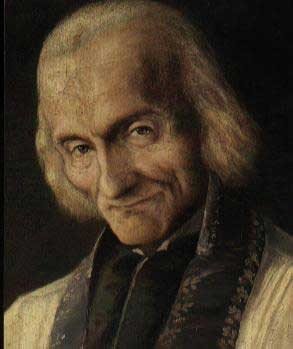
        St. John Vianney, the Curé of Ars and patron saint of priests, is well known as a confessor who could see into peoples’ souls and who took great penances upon himself for the conversion of sinners. Less known, though, is his wisdom. St. John Vianney may have had difficulties learning Latin and passing his seminary exams, but he preached beautiful spiritual insights such as these:

“To approach God you should go straight to Him, like a bullet from a gun.”

“Prayer is the conversation of a child with his Father.  Of a subject with his King.  Of a servant with his Lord.  Of a friend with the Friend to whom he confides all his troubles and difficulties.”

“A pure soul is with God, as a child with its mother.  The child caresses and embraces her, and its mother returns all its endearments.”

“God commands you to pray, but He forbids you to worry.”

“You must accept your cross.  If you bear it courageously it will carry you to heaven.”

However, “Our Lord takes pleasure in doing the will of those who love him.”

“Just as a mother holds her child in her hands to cover it with kisses, so does God hold the devout person.”

“Here is a rule for everyday life: Do not do anything which you cannot offer to God.”

And as we approach the Eucharist, let us recall this final thought: “To content his love, God must give Himself to us separately, one by one.”

(Originally published August 4, 2010;
edited & republished August 4, 2015)