Archive for the ‘Christian Perfection’ Category

3 Interpretations of the Parable of the Dishonest Steward

September 17, 2016

Luke 16:1-13

The Parable of the Dishonest Steward, Biblia Ectypa, 1695.#1: The previously-dishonest steward is merely writing-off his own commissions. Likewise, we must forgive our debtors’ debts (or sins) so that we may be shown mercy. (Matthew 6:12) But why would his commissions be 20% for one debt and 50% on another? Perhaps the dishonest steward is actually covering his thievery’s tracks. Which brings us to…

#2: The steward is giving away what belongs to the rich man, his boss. Likewise, everything that we possess belongs to God, but we win favor though sharing these blessings with others. Both Mercy and Generosity win welcome into eternal dwellings, for Jesus says ‘whatever you do for the least of these you do it for me’ and ‘the measure with which you measure will be measured out to you.’

#3: What would have become of the dishonest steward without his decisive plan and action? Disaster. Likewise, we must be intentional about our own religious/spiritual growth. “The children of this world are more prudent in dealing with their own generation than are the children of light.” What excuse do we have? More importantly, what is our plan?

How Many Will Be Saved?

August 19, 2016

In this Sunday’s gospel, someone asks Jesus from the crowd, “Lord, will only a few people be saved?” Jesus replies, “Strive to enter through the narrow gate, for many, I tell you, will attempt to enter but will not be strong enough.” (Luke 13:24) Instead of quoting some particular figure, like one million or ten billion souls, Jesus says, “Strive to enter through the narrow gate…” We are left to wonder: in the end, will the number saved be numerous or few?

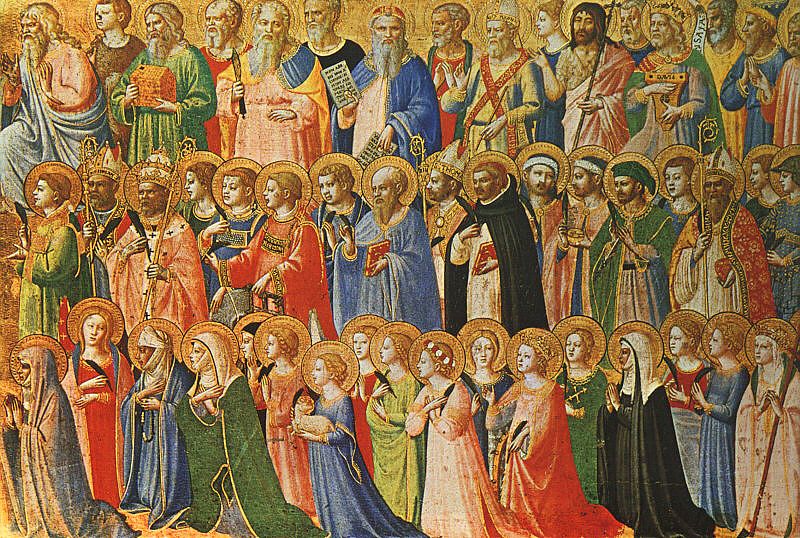
All-Saints by Fra Angelico, 1400's.In the Book of Revelation, St. John witnesses a vast number of saints worshiping God in heaven. He beholds “a vision of a great multitude, which no one could count, from every nation, race, people, and tongue.” (Revelation 7:9) Note that this ‘countless multitude’ is different and much larger than the “one hundred and forty-four thousand marked from every tribe of the Israelites” that St. John enumerates several verses before. Jesus came to save souls not only from the twelve tribes of Israel. As the Lord declares through the prophet in Sunday’s first reading, “I come to gather nations of every language; they shall come and see my glory.” (Isaiah 66:18) Based on this, we can confidently say that a great number will be saved.

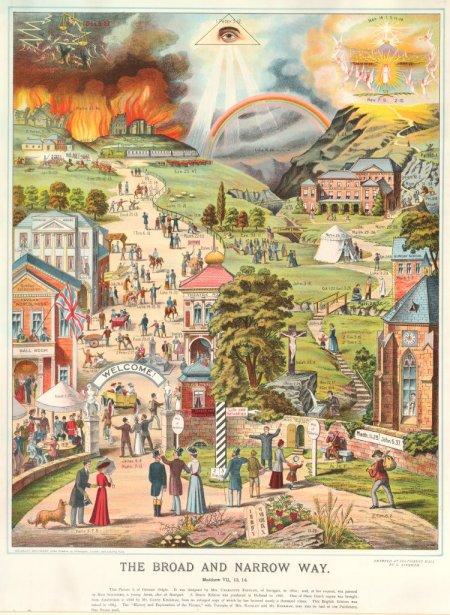
On the other hand, in our gospel’s parallel passage from St. Matthew, Jesus says, “Enter through the narrow gate; for the gate is wide and the road broad that leads to destruction, and those who enter through it are many. How narrow the gate and constricted the road that leads to life. And those who find it are few.” (Matthew 7:13-14) The ‘few’ who enter the narrow gate to life sounds smaller than the ‘many’ who do not. Based on this, it would seem that the number saved will be comparatively small.

However, “few” and “many” are relative terms which depend upon the context. For example, more than 18,000 Olympic medals have been awarded in the modern Summer and Winter Games and that is indeed many. But how many Olympic medalists have you personally ever met? Probably, at most, only a few. In a more tragic example, around 130,000 Americans die annually in accidents and that is awfully many. But at the same time, roughly 99.96% of Americans do not perish in accidents each year, making the 0.04% who do a relative few. The word “many” sometimes refers to a majority of people, but not always.

Jesus Christ suffered and died on the cross to redeem all mankind. Even if there were only one sinner on earth in all of human history, it seems that Jesus would have become man in order to offer himself for just him, or her, or you. Suppose that the number of human souls condemned on the last day turns out to be only a dozen. Knowing how much our Lord loves each and every person, will not those twelve feel like many in the heart of Jesus and those billions he saves seem too few? In any case, Jesus never reveals to us whether most human beings will be saved or lost. Either outcome is possible.

Why was Jesus not more clear about exactly how many people would be saved? Because he knew how such knowledge would be harmful for us. He knew that if we were told that most people would be saved in the end, it would lead us into dangerous presumption. If we were told that most people would be lost, he knew it would lead us into poisonous despair. Jesus “did not need anyone to testify about human nature. He himself understood it well.” (John 2:25)

Instead of providing us with some number or percentage, Jesus gives us some much more valuable and beneficial advice: “Strive to enter through the narrow gate (for whether you are saved or not depends, in part, upon you.)” God “wills everyone to be saved and to come to knowledge of the truth.” (1st Timothy 2:4) And to “as many as did accept him, [Jesus] gave power to become children of God.” (John 1:12) Let us strive to cooperate with God, let us accept the Lordship of Jesus Christ in our lives, so that we may be numbered among “the few” who are saved and enter into life.

The Braod and Narrow Way, 1883.

The Divided Household of Luke 12

August 12, 2016

In Luke 12:51-53, Jesus tells his disciples:

“Do you think that I have come to establish peace on the earth? No, I tell you, but rather division. From now on a household of five will be divided, three against two and two against three; a father will be divided against his son and a son against his father, a mother against her daughter and a daughter against her mother, a mother-in-law against her daughter-in-law and a daughter-in-law against her mother-in-law.”

What do the family dynamics within this divided household look like? For starters, exactly how many people are we talking about? St. Ambrose (337-397 AD) clarifies this point:

Though the connection would seem to be of six persons, father and son, mother and daughter, mother-in-law and daughter-in-law, yet are they five, for the mother and the mother-in-law may be taken as the same, since she who is the mother of the son, is the mother-in-law of his wife.”

Jesus describes these five persons as divided into two factions, “three against two and two against three.” We learn from his further details that the father opposes his son, while the mother opposes the other two females. Depending on whether this father and mother are allied or not, their household could be divided in two possible patterns.

Luke 12 Divided Households

Figure 1 shows the family split generationally, with the parents set against the children. In Figure 2, the fractures cut between the couples. (Jesus not mentioning marital strife suggests the first interpretation and this is the favored reading of St. Bede,1 yet the ambiguity of these passages may well be intentional.2) In any case, Jesus is the occasion for this household’s divisions. One side (either the blue or the orange) rejects him while the other acknowledges him as Lord. Sometimes one’s allegiance to Christ leads to interpersonal conflict, even within families.

This prompts St. Ambrose to ask:

“Are we to believe that [our Lord] has commanded discord within families? How is he our peace, who has made both one? How does he himself say, ‘My peace I give you, my peace I leave you,’ if he has come to separate fathers from sons and sons from fathers by the division of households? How is he cursed who dishonors his father and devout who forsakes him?”

St. Ambrose unknots the seeming paradox in this way:

“It is necessary that we should esteem the human less than the divine. If honor is to be paid to parents, how much more to your parents’ Creator, to whom you owe gratitude for your parents! … He does not say children should reject a father but that God is to be set before all. … You are not forbidden to love your parents, but you are forbidden to prefer them to God.”

People sometimes hesitate to commit to Christian lifestyle changes, pursue their God-given vocations, or enter Christ’s Catholic Church because they fear the reactions of family, friends, or others. But even if following Jesus Christ entails sacrifices, these persons should not be afraid to place God first. Notice how the Lord does not say “five will be divided, four against one and one against four.” When three unbelievers pit themselves against two faithful ones, the pair are blessed with each other’s support. Should your family disown you, the Lord will summon faithful friends to your side. Even if your friends should leave you, the Lord provides you with the household of believers in his Church. Even if your parish community should fail to welcome or support you, the Lord will not make you stand alone — for Jesus Christ is always at your side and will never abandon you.


Footnotes:

1. St. Bede (672-735 AD) assumes Figure 1 for his allegorical interpretation of the Divided Household:

“By three are signified those who have faith in the Trinity, by two the unbelievers who depart from the unity of the faith. But the father is the devil, whose children we were by following him, but when that heavenly fire came down, it separated us from one another, and showed us another Father who is in heaven. The mother is the Synagogue, the daughter is the Primitive Church, who had to bear the persecution of that same synagogue, from whom she derived her birth, and whom she did herself in the truth of the faith contradict. The mother-in-law is the Synagogue, the daughter-in-law the Gentile Church, for Christ the husband of the Church is the son of the Synagogue, according to the flesh. The Synagogue then was divided both against its daughter-in-law, and its daughter, persecuting believers of each people. But they also were divided against their mother-in-law and mother, because they wished to abolish the circumcision of the flesh.”


2. Perhaps our Lord (in preaching these words) and the Holy Spirit (in inspiring these Lucan passages) fully-intended this ambiguity. By providentially allowing for both readings (i.e., Figures 1 & 2) this teaching can reflect more varieties of interfamily conflict: spousal, sibling, in-law, parental and filial.


Perspective for Our Times

August 9, 2016

“It was the best of times, it was the worst of times, it was the age of wisdom, it was the age of foolishness, it was the epoch of belief, it was the epoch of incredulity, it was the season of Light, it was the season of Darkness, it was the spring of hope, it was the winter of despair, we had everything before us, we had nothing before us, we were all going direct to Heaven, we were all going direct the other way – in short, the period was so far like the present period, that some of its noisiest authorities insisted on its being received, for good or for evil, in the superlative degree of comparison only.”

So begins Charles Dickens’ A Tale of Two Cities. Our time is a mixture of good things and bad. In some ways we’re progressing, while in others we’re in decline. Some despair, but the trials of past generations were far worse than ours. As St. Augustine of Hippo (354-430 A.D.) observed:

“Is there any affliction now endured by mankind that was not endured by our fathers before us? What sufferings of ours even bears comparison with what we know of their sufferings? And yet you hear people complaining about this present day and age because things were so much better in former times. I wonder what would happen if they could be taken back to the days of their ancestors–would we not still hear them complaining?  You may think past ages were good, but it is only because you are not living in them.”

There has been no perfect “Golden Age” since Eden. We learn from the New Testament that even the first-century Christian communities had controversies within and persecutions from without. Yet pining for a romanticized past pairs with an opposite, pervasive error today: thinking that “old things” have nothing to teach or offer us. C.S. Lewis noted this modern disposition in 1955:

“…Chronological snobbery [is] the uncritical acceptance of the intellectual climate common to our own age and the assumption that whatever has gone out of date is on that account discredited. You must find why it went out of date. Was it ever refuted (and if so by whom, where, and how conclusively) or did it merely die away as fashions do? If the latter, this tells us nothing about its truth or falsehood. From seeing this, one passes to the realization that our own age is also ‘a period,’ and certainly has, like all periods, its own characteristic illusions. They are likeliest to lurk in those widespread assumptions which are so ingrained in the age that no one dares to attack or feels it necessary to defend them.”

The ignorant dismissal of the past leads to foolishness today. All advocate for change, but not all change is progress. For example, naively tearing down the wrong fences can permit evils to get in. G.K. Chesterton wrote in 1929:

“In the matter of reforming things, as distinct from deforming them, there is one plain and simple principle; a principle which will probably be called a paradox. There exists in such a case a certain institution or law; let us say, for the sake of simplicity, a fence or gate erected across a road. The more modern type of reformer goes gaily up to it and says, “I don’t see the use of this; let us clear it away.” To which the more intelligent type of reformer will do well to answer: “If you don’t see the use of it, I certainly won’t let you clear it away. Go away and think. Then, when you can come back and tell me that you do see the use of it, I may allow you to destroy it.”

We live in a time filled with serious problems and great blessings. We have grave reasons for concern, such as the present threats to religious liberty and the persistent Culture of Death, but we should not despair. Not only do we know Who wins in the end, but even today’s broken world has good things to offer. Computers are facilitating new technologies and improved communications. Healthcare advances are saving and enhancing lives. International economic development is helping billions rise from poverty. Imagine how these modern-day advances in communication, healthcare, economic wealth, and other fields could be utilized for the Kingdom of God. Jesus once asked his disciples:

“Do you understand all these things?” They answered, “Yes.” And he replied, “Then every scribe who has been instructed in the kingdom of heaven is like the head of a household who brings from his storeroom both the new and the old.” (Matthew 13:51-52)

To keep proper perspective today we must be neither naive nor despondent. We should be conscious of both the dangers and the opportunities around us. These present times will surely try us, but there has yet to be an era of the Church that has not tested the saints. Our generation is called to be faithful witnesses to Christ’s Church and Sacred Tradition. As Scripture says:

Anyone who is so ‘progressive’ as not to remain in the teaching of the Christ does not have God; [but] whoever remains in the teaching has the Father and the Son.”  (2nd John 1:9)

The world may refuse to heed us as it recklessly marches on but we can still benefit ourselves, for this life and the next, by holding on to  timeless truths. Our Church has persevered through controversies and persecutions from its beginning. It challenged the Roman culture while making use of the best things it had to offer to introduce and spread the Kingdom of God on earth. That Kingdom endures to our day. By keeping what is good and rejecting what is evil, let us remain ever-faithful to Jesus Christ in our times.

O Jerusalem by Greg Olsen

The Virgin Mary’s Wisconsin Apparition in 1859

August 4, 2016

This account is according to Sister Pauline LaPlant, to whom the visionary, Adele Brise, often told her story:

She [Adele] was going to the grist mill about four miles from here [Champion] with a sack of wheat on her head […]. As Adele came near the place, she saw a lady all in white standing between two trees, one a maple, the other a hemlock. Adele was frightened and stood still. The vision slowly disappeared, leaving a white cloud after it. Adele continued on her errand and returned home without seeing anything more. She told her parents what had happened, and they wondered what it could be — maybe a poor soul who needed prayers?

On the following Sunday, she had to pass here again on her way to Mass at Bay Settlement, about eleven miles from her home […]. This time, she was not alone, but was accompanied by her sister Isabel and a neighbor woman [Mrs. Vander Niessen]. When they came near the trees, the same lady in white was at the place where Adele had seen her before. Adele was again frightened and said, almost in a tone of reproach, “Oh, there is that lady again.”

adelebrise

The Visionary, Adele Brise, 1831-1896

Adele had not the courage to go on. The other two did not see anything, but they could tell by Adele’s look that she was afraid. They thought, too, that it might be a poor soul that needed prayers. They waited a few minutes, and Adele told them it was gone. It had disappeared as the first time, and all she could see was a little mist or white cloud. After Mass, Adele went to confession and told her confessor how she had been frightened at the sight of a lady in white. He [Father William Verhoef] bade her not to fear, and to speak to him of this outside of the confessional. Father Verhoef told her that if it were a heavenly messenger, she would see it again, and it would not harm her, but to ask in God’s name who it was and what it desired of her. After that, Adele had more courage. She started home with her two companions, and a man who was clearing land for the Holy Cross Fathers at Bay Settlement accompanied them.

As they approached the hallowed spot, Adele could see the beautiful lady, clothed in dazzling white, with a yellow sash around her waist. Her dress fell to her feet in graceful folds. She had a crown of stars around her head, and her long, golden, wavy hair fell loosely around her shoulders. Such a heavenly light shone around her that Adele could hardly look back at her sweet face. Overcome by this heavenly light and the beauty of her amiable visitor, Adele fell on her knees.

In God’s name, who are you and what do you want of me?” asked Adele, as she had been directed.

I am the Queen of Heaven, who prays for the conversion of sinners, and I wish you to do the same. You received Holy Communion this morning, and that is well. But you must do more. Make a general confession, and offer Communion for the conversion of sinners. If they do not convert and do penance, my Son will be obliged to punish them.”

Adele, who is it?” said one of the women. “O why can’t we see her as you do?” said another weeping.

Kneel,” said Adele, “the Lady says she is the Queen of Heaven.” Our Blessed Lady turned, looked kindly at them, and said, “Blessed are they that believe without seeing. What are you doing here in idleness…while your companions are working in the vineyard of my Son?

What more can I do, dear Lady?” said Adele, weeping.

Gather the children in this wild country and teach them what they should know for salvation.”

But how shall I teach them who know so little myself?” replied Adele.

Teach them,” replied her radiant visitor, “their catechism, how to sign themselves with the sign of the Cross, and how to approach the sacraments; that is what I wish you to do. Go and fear nothing. I will help you.”

The manifestation of Our Lady then lifted her hands, as though beseeching a blessing for those at her feet, and slowly vanished, leaving Adele overwhelmed and prostrate on the ground.

When the news spread about Adele Brise’s vision of the Blessed Virgin, most people believed the account and were astonished. Some considered the event a  demented delusion. Adele Brise, however, considered it a commission to catechize the children and admonish the sinners of the Bay Settlement. To honor the alleged apparition, Adele’s father erected a makeshift chapel near the spot of Adele’s vision.

Be Rich In What Matters — 18th Sunday of Ordinary Time—Year C

July 30, 2016

The Parable of the Rich Fool by Rembrandt, 1627.

The Parable of the Rich Fool by Rembrandt, 1627.

A large crowd surrounds Jesus as he preaches and teaches. During a brief pause, a man in the crowd says to Jesus, “Teacher, tell my brother to share the inheritance with me!” Presumably, his brother is there amongst them as well (otherwise how could Jesus reprove him?) Yet the Lord replies to the man, “Friend, who appointed me as your judge and arbitrator?” That seems like an odd response from Jesus. Is Jesus denying his own authority?  On a different occasion, Jesus stated, “If I should judge, my judgment is valid, because I am not alone, but it is I and the Father who sent me.” Imagine if the man in the crowd had answered Jesus’ rhetorical question, “Friend, who appointed me as your judge and arbitrator?” The man might say, “Well Teacher, we think you’re God’s prophet, so you speak for God.”

To this, Jesus could reply, “Indeed, the words that I speak to you I do not speak on my own. But if you accept that I am God’s prophet, that I speak for God, then listen and heed all that I teach, not just the things you want to hear. On the last day, when I return in my glory with all the angels with me, I will sit upon my glorious throne with all peoples assembled before me and I shall judge and separate the righteous and the unrighteous, one from another, as a shepherd separates the sheep from the goats. Yet, my Father God did not send me into this world to condemn the world, but that the world might be saved through me.

In our Gospel, Jesus goes on to tell the crowd (including those two feuding brothers): “Take care to guard against all greed, for though one may be rich, one’s life does not consist of possessions.” Jesus is warning the crowd, the brothers, and us that ‘personal bitterness and earthly greed will hinder you from entering the Kingdom.’ Rather, we must keep a heavenly perspective. As St. Paul urges in our second reading, “seek what is above, where Christ is seated at the right hand of God. Think of what is above, not of what is on earth.

Of course, we all have material needs as human beings here on earth —we’re not angels and we need our daily bread. So Jesus teaches us to practice prudent stewardship, marked by frugality, generosity, and a trust in the Lord that frees us from worthless worrying. However, both Jesus in our Gospel and King Solomon in our first reading note the futility of amassing riches for ourselves.

Jesus tells a parable of “a rich man whose land produced a bountiful harvest. He asked himself, ‘What shall I do, for I do not have space to store my harvest?’” (Notice how “He asked himself, ‘What shall I do?” The man does not look beyond himself for holy wisdom or guidance.)

And [then the rich man] said, ‘This is what I shall do: I shall tear down my barns and build larger ones.” (Why does he need to tear down his old barns? Does not the rich man, who just reaped a bountiful harvest, own plenty of land on which to build more barns? It seems his vanity desires to tear down the old barns so that his new barns may be huge and impressive.)

The rich man continues his conversation with himself, “[In my new barns] I shall store all my grain and other goods and I shall say to myself, ‘Now as for you, you have so many good things stored up for many years, rest, eat, drink, be merry!’” (He shows no thought for his family or friends, his neighbors or the needy, only his own personal pleasure.)

The rich man has made grand plans for himself, but God says to him, “You fool, this night your life will be demanded of you!” If this man is only interested in his own will, his own glory, and his own happiness in this life, then how will he love his neighbors, hallow God’s name, or desire God’s will in the next life?

To find ourselves at home in Heaven someday we should seek and follow God’s will for our time, talents, and treasure today. We should practice faithful stewardship, with prudence and trust, frugality and generosity. And this stewardship should include tithing and supporting worthy causes—not to buy Heaven (for God cannot be bribed or bought) but in order to become more virtuous and loving, to become more fit for Heaven. Those who store up treasure for themselves on earth profit nothing in the end. Let us not be foolish. Let us instead become rich in what matters to God by becoming more like Jesus, who has been so generous to us.

History’s Ten Wealthiest People and the Vanity of Riches

July 27, 2016

In estimated billions of present-day dollars

  1. Cornelius Vanderbilt ($185, died 1877)
    This railroad tycoon’s only large philanthropic gift gave about 1% of his fortune to build Vanderbilt University.
  1. Henry Ford ($199, died 1947)
    This deceased automaker’s name survives on vehicles seen upon every road and junkyard.
  1. Muammar Gaddafi ($200, died 2011)
    This dictator of Libya, after being discovered hiding in a desert culvert, was killed by his people.
  1. Jakob Fugger “the Rich ($221, died 1525)
    While he lived, this German merchant-financier declared, “The king reigns, but the bank rules!
  1. William The Conqueror ($229, died 1087)
    After killing many to capture England, this Duke of Normandy, France joined the dead.
  1. Mir Osman Ali Khan ($230, died 1967)
    As head of the state of Hyderabad, India, he used a 185-carat diamond as a paperweight.
  1. Czar Nikolas II ($300, died 1918)
    This Russian ruler was assassinated along with his family by communist revolutionaries.
  1. Andrew Carnegie ($310, died 1919)
    This steel magnate and philanthropist said, “The man who dies rich dies disgraced.”
  1. John D. Rockefeller ($340, died 1937)
    He sold oil drawn from Ohio’s earth and now lays buried in the same.
  1. Mansa Musa I ($400, died 1337)
    This African king of Mali was the richest man to ever live. But have you ever heard of him?

Psalm 49:7-12 :

“No man can buy his own ransom, or pay a price to God for his life. The ransom of his soul is beyond him. He cannot buy life without end, nor avoid coming to the grave. He knows that wise men and fools must both perish and must leave their wealth to others. Their graves are their homes for ever, their dwelling place from age to age, though their names spread wide through the land. In his riches, man lacks wisdom; he is like the beasts that are destroyed.”


Abraham’s Intercessions for Sodom & Gomorrah

July 23, 2016

A Mathematical Analysis of Genesis 18:22-33

Conversation
Exchange
Bid # for Innocents
# Decrease
% Decrease
Factional Decrease

1st

   50

   –

2nd

   45

5

10% 1/10

3rd

   40

10

11.111% 1/9

4th

   30

10

25% 1/4

5th

   20

10

33.333% 1/3

6th

   10

10

50% 1/2

Temptation Traps

July 16, 2016
The Devil Tempting a Young Woman by André Jacques Victor Orsel, 1832.

The Devil Tempting a Young Woman by André Jacques Victor Orsel, 1832.

We human beings are creatures of habit. For better or worse, we find it easier to think and act in the ways that we are accustomed to. Without self-awareness, it can feel natural to follow established modes of thinking into sinful action. However, once we examine and challenge these temptations we can recognize them as the distortions of truth and reality that they are. Then, with God’s ever-present grace, we can choose and act to reject them.

We experience temptations as the thoughts, feelings, and desires that, if not resisted, would lead us away from God’s will and our greatest human fulfillment. And from where do our temptations flow? They come, as the classic saying goes, from “the World, the Flesh, and the Devil.” The World, our culture and the people around us, can suggest sinful paths. Likewise our Flesh, our passions and psychological wounds, can give rise to temptation. Finally, the Devil, with the fallen angels allied with him, can prompt ideas and moods within us in order to lead us towards sin. If we are to resist temptations we must first detect them amidst our thoughts, feelings, and desires.

The distorted thinking of our temptations comes to us in many forms. Do you fall for any of these common temptation traps? Study these and enter your next battle prepared, forewarned and forearmed!


Overgeneralization reaches a general conclusion based upon a single incident or piece of evidence:

I just got dumped. I’ll never find love!

God didn’t grant my prayer. He doesn’t care.”

I never hire those people, one stole from me once.


All-or-Nothing Thinking has no tolerance or mercy for imperfection in ourselves or others:

I broke my Lenten penance, so I’ve given it up.”

I sinned, so my hours of resisting mean nothing.

I’ve never spoken to him since he was rude to me.”


Mental Filtering focuses on a situation’s negative details while dismissing all of the positive aspects:

Yes, Son, but what about this B- in Science?

When I look back on my day, all I see are sins.

They said they liked it, but what she said irks me.”


Labeling generalizes from a couple of traits or events to declare a universal negative judgment:

I need to lose some weight. I’m ugly.

I never do anything right; I’m worthless.

I’m taking more naps as I get older. I’m so lazy.”


Mind Reading presumes to know (without asking) how others feel or why they act as they do:

I know I promised, but the kids won’t mind.”

He’s late. He must not care about this team.”

Her eyes are closed. She’s not listening to me.”


Magnifying exaggerates the significance of problems or events:

I’ll never finish this paper by next week!

I did bad things in a dream. I’m so ashamed.

I prayed an hour, but I kept getting distracted!


Minimizing downplays serious concerns to insignificance:

A little peek at this website is no big deal.

This habit is a venial sin, so it’s OK if I do it.

Why are you complaining? My drinking is fine.”


Catastrophizing assumes the worst about the present and the future:

What if I lose my job, get sick, and die?

I’ll never conquer this sin—why even try?

He’s moody tonight. Is our marriage in trouble?


Personalization believes everything that happens is caused by, or is a reaction to, oneself:

I jinxed the team, I didn’t wear my hat.”

This happened because God is punishing me.”

I saw my two friends; why didn’t they invite me?”


False Shoulds condemn us for weaknesses or choices that are not actually sins:

I should always keep my family happy.”

I sinned by missing Mass when I had the flu.”

It still hurts, so I must not be forgiving them.”


Emotional Reasoning concludes that how we presently feel must be the true reflection of reality:

I feel so sad, I must be failing.”

This feels so good, how could it be wrong?”

I feel guilty; God must be unhappy with me.”


If this topic interests you, check out Cognitive Behavior Therapy and “cognitive distortions.” CBT is the most widely-used technique for the treatment of many psychological issues (such as depression and anxiety) and is proven to be often effective.

Captain America, St. Thomas More, & the Spirit of Truth

May 14, 2016

In the new blockbuster movie Captain America: Civil War the titular hero is discerning an important decision when he hears this message in a church:

“Compromise where you can. And where you can’t, don’t. Even if everyone is telling you that something wrong is something right, even if the whole world is telling you to move. It is your duty to plant yourself like a tree, look them in the eye and say, no. You move.”

Captain America - No, You MoveAs I watched in the movie theater, that bit about the tree struck me as odd. Trees bend and can be cut down, but pillars of iron or stone mountains don’t budge. I later discovered that these movie lines were adapted from a famous comic book speech Captain America once addressed to Spider-Man:

“When the mob and the press and the whole world tell you to move, your job is to plant yourself like a tree beside the river of truth, and tell the whole world — ‘No, you move.’”

Did you spot the difference? “Plant yourself like a tree beside the river of truth.” That’s not only more beautiful, it’s also an allusion to Old Testament imagery. Psalm 1:3 says:

“[The Just Man] is like a tree planted near streams of water that yields its fruit in due season, whose leaves do not wither, and whatever he does prospers.”

And Jeremiah 17:8 says:

“[Those who trust in the Lord] are like a tree planted beside the waters that stretches out its roots to the stream: It does not fear heat when it comes, its leaves stay green; In the year of drought it shows no distress, but still produces fruit.”

These verses teach that the just man who is rooted in the Law (or the Truth) of God prospers, and that those who trust in the Lord prevail against adversity.

I wish that Hollywood had included the fuller quote in the new Captain America movie—not only because it’s better writing, not only because it echoes Sacred Scripture, but because it better reflects the truth about where Truth comes from. My all-time favorite film disappoints me in a similar way.

A Man for All Seasons - St. Thomas More at TrialA Man for All Season won the 1966 Academy Award for Best Picture, but its depiction of its hero, St. Thomas More, falls short of perfection. In the movie, as in real life, Thomas More suffers unjust imprisonment for refusing to swear an oath recognizing King Henry VIII as the supreme head of the Catholic Church in England. The movie’s screenwriter, the agnostic Robert Bolt, drew on More’s own writings to craft some fantastic dialogues, but Bolt somewhat misrepresents the saint’s true motivations.

In one scene, Thomas More’s friend, the Duke of Norfolk, asks why he won’t just “give in.” Thomas answers, “I will not give in because I oppose it — I do — not my pride, not my spleen, nor any of my appetites, but I do — I!” The real St. Thomas More’s motivations are portrayed more accurately in the scene at his trial. He tells the court:

“The indictment [against me] is grounded in an act of Parliament which is directly repugnant to the law of God, and his Holy Church, the Supreme Government of which no temporal person may by any law presume to take upon [himself.] This was granted by the mouth of our Savior, Christ himself, to Saint Peter and the Bishops of Rome whilst He lived and was personally present here on earth. It is, therefore, insufficient in law to charge any Christian to obey it.”

The real St. Thomas More refused to sign the King’s oath because he saw in it a denial of Christ. He preferred to die rather than lose Heaven; and he did go on to die, thereby gaining Heaven. But Robert Bolt has his Thomas More conclude his courtroom speech like this:

“Nevertheless, it is not for [refusing the King’s] Supremacy that you have sought my blood, but because I would not bend to the [King’s re-marriage]!” (In other words, “No one is going to make me act contrary to my own self-will!”)

The real St. Thomas More was not standing up against the world for individually-chosen truth. (More opposed heretics when he served as King Henry’s High Chancellor.) He knew that Truth and right and wrong are not things we create for ourselves. We receive them, as water from a river. They do not flow from us as their source. The real St. Thomas More was a champion for the Truth which comes from God.

So how can we be faithful to the Truth which comes from God? How can we be planted like trees beside the River of Truth that flows from God? By prayerfully welcoming the Holy Spirit.

At his interrogation before the Roman Governor Pontius Pilate, Jesus says: “Everyone who belongs to the truth listens to my voice.” (In the Holy Trinity, the Father is the Speaker, Jesus is the Word, and the Holy Spirit is the Voice) But Pilate refuses to listen. He retorts to Jesus, “What is truth?” He rejects the Spirit of Truth and walks away.

Later, at his Ascension, Jesus instructs his disciples to remain in Jerusalem until they are clothed with power from on high with the Spirit of Truth who will teach them everything and remind them of all he has told them. Unlike Pilate, the disciples listen to Jesus and obey him. Some 120 persons (including the apostles, the Virgin Mary, some women, and some male relatives of Jesus) gather together and all devote themselves to prayer. They pray for nine days—the Church’s first novena, and on the tenth day, on the Jewish feast of first fruits called Pentecost, the Holy Spirit, the Spirit of Truth, comes and fills them.

St. Peter PreachingOnce the Spirit’s fire touches their heads, the disciples know what to say and they are unafraid to say it. Previously they had been hiding behind locked doors, but now they go out into Jerusalem’s crowded streets praising and preaching Jesus. This new-found wisdom and courage are gifts from the Holy Spirit, who empowers them to begin reaping the Church’s first fruits from the world. Observe well what the disciples do, for we are called to do the same: they listen to Jesus and obey him, they gather together and pray, they receive the Holy Spirit’s inspiration and gifts, and then they go forth to speak and act powerfully in the world.

In the Gospel of John, on the last and greatest day of one of the Jewish feasts, Jesus stands up in the temple area and exclaims, “Let anyone who thirsts come to me and drink. Whoever believes in me, as scripture says: ‘Rivers of living water will flow from within him.’” Here the Gospel writer adds: “He said this in reference to the Spirit that those who came to believe in him were to receive.”

The Holy Spirit is our River of Living Water. As trees planted beside him we will prosper, and by being rooted in him we will prevail against adversity. In Holy Mass let us pray to receive the Spirit wholeheartedly and to be clothed with his power. And then, filled with the Spirit of Truth, even if the whole world tells us to move, we will have the words and courage to stand our ground. By the Holy Spirit, we can be heroes for this world in desperate need of heroes, in the likeness of Captain America, St. Thomas More, and the apostles after Pentecost.

The Old Covenant’s (Surprising) Last Seven Prophets

May 6, 2016

A prophet is someone enlightened by God to reveal his message. Each Sunday, we familiarly proclaim that the Holy Spirit has “spoken through the prophets,” but the identities of the seven last Old Covenant prophets (as seen in the Bible) may well surprise you.

#7 :  The Author of 2nd Maccabees

Malachi is the last book in the Old Testament, yet the Bible’s books do not always appear in chronological order. Our separated Protestant brethren would identify Malachi as the last prophetic book in the Old Testament, but the Church’s Bible includes seven books which they exclude. The last of these is 2nd Maccabees, written during the 1st century BC.

The author of 2nd Maccabees, who chronicles the Jews’ successful rebellion against their Greek persecutors, does not seem to know he writes by divine inspiration. In his closing remarks he adds, “If [this story] is well written and to the point, that is what I wanted; if it is poorly done and mediocre, that is the best I could do.” (15:38) However, neither does St. Paul appear to grasp that his letters to the churches would be revered on the level of Genesis, Joshua, or Daniel. This shows that God can use us in amazing ways, in perfect accord with his will, even if we fail to recognize it at the time.

#6 & #5 :  St. Zachariah & St. Elizabeth

The Visitation by BlocZachariah and his wife, Elizabeth, are old and childless. But the Archangel Gabriel appears to Zachariah in the Temple and says that they shall have a son. Although he knows that God has blessed with children elderly and barren couples of old, Zachariah disbelieves the message. In response, he is put on a forty-week silent retreat. Zachariah becomes mute and apparently deaf as well (since his neighbors and relatives will later resort to making gestures to ask him the name of his newborn son.) Though he cannot tell his pregnant wife of their unborn son’s great mission, Elizabeth receives insights from the Holy Spirit.

When she hears the greeting of her visiting relative, Elizabeth is “filled with the holy Spirit” and cries out in a loud voice, “Most blessed are you among women, and blessed is the fruit of your womb!” The Blessed Virgin’s belly has not yet begun to grow, but Elizabeth prophesies and confirms to Mary that she is indeed pregnant with a boy who is “the Lord.” (Luke 1)

The Holy Spirit also seems to reveal to Elizabeth the name of her child: “John,” a name unfamiliar to her family. At the naming ceremony, Zechariah regains his voice, confirms her word, and “filled with the holy Spirit, prophesie[s]” through the canticle which bears his name. This holy, prophetic couple would ready their son for the great mission prepared for him by God.

#4 :  The Blessed Virgin Mary

The Annunciation by Henry Ossawa Tanner, Philadelphia, 1898.The Archangel Gabriel declared unto Mary that she would conceive the Son of God by the Holy Spirit. But is Mary a prophetess? Unlike Elizabeth and Zachariah, Luke’s Gospel does not say Mary, “filled with the Holy Spirit, prophesied,” or “filled with the Holy Spirit, cried out in a loud voice.” However, as Fr. Raymond Brown observed, the Annunciation to Mary shares the biblical form of a prophetic calling (like those of Moses, Gideon, Isaiah, Jeremiah, and Ezekiel before her):

(1) An Encounter with God or His Angel
(2) An Introductory Word
(3) A Call or Commission
(4) Objection(s) to the Message
(5) Reassurance by God or His Angel
(6) A Sign is Given

In her later canticle, Blessed Mary speaks a prophesy which remains fulfilled in our midst: “Behold, from now on all generations will call me blessed.” Mary is a prophetess, filled with the Holy Spirit, who bears God’s Word.

Simeon Holding the Baby Jesus in the Temple as His Parents Look On#3 & #2 :  St. Simeon & St. Anna

When the baby Jesus’ parents brought him to the Temple for the first time, they were met by Simeon and Anna; she was “a prophetess” and  “[t]he holy Spirit was upon him.” Simeon “came in the Spirit into the temple,” took Jesus in his arms, and declared him “a light for revelation to the Gentiles, and glory for your people Israel.” Anna likewise came forward at that very time and “gave thanks to God and spoke about the child to all who were awaiting the redemption of Jerusalem.” (Luke 2)

Simeon may have been advanced in years, but “it had been revealed to him by the holy Spirit that he should not see death before he had seen the Messiah of the Lord.” Anna, for her part, was an eighty-four-year-old widow who “never left the temple, but worshiped night and day with fasting and prayer.” Anna and Simeon show us how the old can bless the young through sharing the word of the Lord they have personally come to know.

#1 :  St. John the Baptist

St. John the Baptist PreachingWe do not know exactly how many Old Covenant prophets God inspired after the author of 2nd Maccabees. (A case might be made for the Bethlehem shepherds and the Magi as well.)  But we do know that John the Baptist represents the last Old Covenant prophet, the forerunner to the New Covenant Christ. He is “more than a prophet,” Jesus says. “All the prophets and the law prophesied up to the time of John. … Amen, I say to you, among those born of women there has been none greater than John the Baptist; yet the least in the kingdom of heaven is greater than he.” (Matthew 11)

At baptism, each Christian is entrusted with a prophetic mission. As those enlightened with God’s ultimate revelation, we are to share this Word. As great as it is to proclaim Christ’s coming, to proclaim his triumph is still greater.

The Eight Beatitudes at the Movies

May 2, 2016

At the start of his Sermon on the Mount (in Matthew 5) Jesus lists qualities which describe the blessed in his Kingdom. These eight Beatitudes are models for living our lives. On the silver screen, the fictional characters in these eight classic films manifest the Beatitudes:

Phil Connors in Groundhog Day: Blessed are the poor in spirit, for theirs is the kingdom of heaven. The arrogant self-sufficiency of Bill Murray’s character must be humbled before he can turn the corner towards living the perfect life by loving truly.

+  +  +  +  +  +  +  +

Most characters in The Sixth Sense: Blessed are they who mourn, for they will be comforted. In this film, both the living and the dead suffer great losses, but they ultimately receive their peace.

+  +  +  +  +  +  +  +

George Bailey in It’s a Wonderful Life:Blessed are the meek, for they will inherit the land.” Jimmy Stewart’s character repeatedly sacrifices his big dreams (of college, of riches & fame, of an around-the-world honeymoon) to save the little Building & Loan of Bedford Falls. By the end of the story, George realizes that he is truly “the richest man in town.”

+  +  +  +  +  +  +  +

“Juror 8” in 12 Angry Men: “Blessed are those who hunger and thirst for righteousness: for they will be filled. The eighth juror (played by Henry Fonda) shows how a principled advocacy for the truth can change minds and bring about true justice.

+  +  +  +  +  +  +  +

Jean Valjean in Les Misérables: “Blessed are the merciful, for they will be shown mercy.” Having received mercy, the former criminal Jean Valjean practices mercy, and so is saved.

+  +  +  +  +  +  +  +

Forrest in Forrest Gump: “Blessed are the clean of heart, for they will see God.” Forrest is “not a smart man, but [he] knows what love is.” His simple virtue and true devotion toward his friends blesses their lives together.

+  +  +  +  +  +  +  +

Mary & Bert in Mary Poppins: “Blessed are the peacemakers, for they will be called children of God. Julie Andrews’ Mary (with assistance from Dick Van Dyke’s Bert) delights in serious play to help heal the Banks Family.

+  +  +  +  +  +  +  +

Terry Malloy & Fr. Barry in On the Waterfront:  “Blessed are they who hunger and thirst for righteousness, for they will be satisfied.”  The courageous actions of Marlon Brando and Karl Malden’s characters prevail against the mob and manifest that ‘Jesus Christ is here on this waterfront.’

+  +  +  +  +  +  +  +

Pro-Life Women to be Honored on New $10 Bill

April 22, 2016

The U.S. Capitol Statue of Elizabeth Cady Stanton, Susan B. Anthony, & Lucretia Mott

The U.S. Capitol sculpture of Elizabeth Cady Stanton,
Susan B. Anthony, and Lucretia Mott

The U.S. Treasury recently announced plans to redesign the $5, $10, and $20 bills. The new ten-dollar bill will retain the portrait of Alexander Hamilton but its reverse side will feature Susan B. Anthony, Elizabeth Cady Stanton, Sojourner Truth, Alice Paul, and Lucretia Mott alongside the Treasury building. These five famous suffragists advocated for women’s right to vote, but lesser known are the pro-life convictions found among them and other feminists of their era.

Susan B. Anthony and Elizabeth Cady Stanton co-founded a weekly women’s rights newspaper called The Revolution. From its beginning the paper had a policy against accepting ads for abortifacients: “Quack medicine vendors, …Foeticides and Infanticides, should be classed together and regarded with shuddering horror by the whole human race.” Their rejection of such revenue was a principled sacrifice for their struggling publication, since “child murder both before and after birth [was] a regular and, terrible to tell, a vastly extensive business.” In an 1868 editorial, Stanton called abortion “Infanticide,” declaring, “We believe the cause of all these abuses lies in the degradation of women.” (As honored suffragist Alice Paul, author of the first Equal Rights Amendment, wrote, “Abortion is the ultimate exploitation of women.”)

An 1869 Revolution piece denouncing abortion is frequently attributed to Susan B. Anthony, though its signature (“A.” rather than “S.B.A.”) may well stand for some “Anonymous” author. However, there is no doubt that in an 1875 speech about “the evil of intemperance” Anthony listed abortion among the society’s worst evils: “The prosecutions on our courts for breach of promise, divorce, adultery, bigamy, seduction, rape; the newspaper reports every day of every year of scandals and outrages, of wife murders and paramour shooting, of abortions and infanticides, are perpetual reminders of men’s incapacity to cope successfully with this monster evil of society.

These five suffragists devoted many words and efforts to women’s equality at the voting booth and throughout society. By comparison, they said relatively little about abortion. Yet this is not because early feminists accepted the killing of the unborn as normal but because they acknowledged its great evil as a given. In the 1880’s, all U.S. states had laws against abortion and for early feminists opposition to abortion was a commonly held conviction.Alexander Hamilton Bill Portrait

It is especially fitting that the women to be honored on the ten-dollar bill will be sharing the company of Alexander Hamilton. As the sensational, new musical about him dramatically recalls, by Providence, Alexander Hamilton, the out-of-wedlock son of a prostitute, was born impoverished and in squalor yet grew up to be a hero and a scholar. In our day, baby Alexander quite likely would have been aborted but his remarkable life demonstrates how even an unwanted child can bless an entire nation.

In this conviction, as on the new ten-dollar bill,
the pro-life suffragists have Hamilton’s back.

The Centrality of Jesus — Monday, 4th Week of Easter—Year II

April 18, 2016

Readings: Acts 11:1-18, John 10:1-10

Detail of The Rich Young Ruler by Heinrich HofmannIn St. John’s Gospel, Jesus is the Good Shepherd, the Lamb of God, and the Gate for the flock.

Our Easter preface (V) for the Mass calls him “the priest, the altar, and the lamb of sacrifice.”

Jesus declares, “I am the way and the truth and the life. No one comes to the Father except through me.”

One may say Jesus is the road we travel, the vehicle we take, and the destination we long for.

The centrality and importance of Jesus Christ cannot be overstated.

Like Cornelius’ household at Caesarea, the God-fearing and truth-loving people amongst the nations need him, seek him, and perhaps (even if unknowingly) have a nascent love for him. As Jesus says, “I have other sheep that do not belong to this fold. These also I must lead, and they will hear my voice, and there will be one flock, one shepherd.” Jesus says to Pilate, “Everyone who belongs to the truth listens to my voice.”

Let us grow in our knowledge, relationship, and love of the Lord Jesus Christ at this Mass and every day, and labor to help others come to know and love him more deeply as well.


Tips for Raising Faith-Filled Children

April 13, 2016
  • Tell your children every day that you love them and that God loves them too.
  • Listen attentively and respectfully to what your child says.
  • Forgive frequently. Ask forgiveness when you have done wrong. Look for the humor in stressful situations and hug often.
  • Ask children to consider “what if…” when dealing  with challenging situations. Help them find creative, peaceful, and moral responses.
  • Tell your child that you pray for them every day and DO it. Thank God for the gifts they are.
  • Share your faith beliefs so your child can understand your hopes. Also share your doubts so they understand that doubts do not overwhelm faith.
  • Bless your child before bedtime by tracing the Sign of the Cross on their foreheads and saying: “God love you and keep you safe” or some other blessing. Teach your child to respond. “Amen.”
  • Encourage your child to value others for who they are – not what they have. Help them to develop Christian virtues and to treat others kindly and with respect.
  • Once a week, have a family night when you “unplug” to play board games, do crafts, read stories, or take time to talk together.
  • Honor family  dinner. The benefits are amazing and establish a sacred time to share the joys and trials of life with each other.
  • Pray before meals, before bed, during holidays and family celebrations, and any time when one needs guidance or comfort.
  • Have a family Bible and read the Gospel passages before Church.
  • Decorate your house for the liturgical seasons with an Advent wreath, purple during Lent, and a prominently placed crucifix.
  • Take time to ponder the beauty of creation with your child. Easter is a wonderful time to appreciate the new life of springtime.
  • During the fall and spring, help your child sort through their clothes and toys to donate to a shelter. Bring the child with you when you drop off your donations.
  • Select a patron saint to watch over your children when they become involved in a sporting activity. Pray to that saint every time they are at a practice or event.
  • Participate in the Catholic Relief  Services Rice Bowl program: read the prayers during Lent, look up the featured countries, and donate coins in the box provided.
  • Introduce your child to older people or those with disabilities in your neighborhood. Find out if they need assistance with chores or shopping.
  • When you can’t physically help someone, pray for them.
  • Choose sporting events that do not conflict with your Sunday Mass attendance.
  • Encourage “secret” good deeds.
  • Contribute to a food bank. Ask your child to help you with the collection and delivery.
  • Watch TV with your child and explain during commercials or afterward what you found to be good, wholesome, and valuable. If you find a program objectionable explain why when changing the channel.
  • Encourage your child to use their God-given talents to serve others.
  • Help your child find ways to participate in the of the parish, such as being an altar server, choir member, greeter, or reader.
  • Invite your parish priest over for dinner.
  • Volunteer in your child’s religious education program or Catholic school.
  • Have the sporting equipment your child uses get blessed.
  • Read stories from the Bible and biographies of saints to your child. Several great videos can also be found online.
  • Ask grandparents, godparents, and extended family to share stories about the family their faith lives.
  • On the anniversaries of your children’s Baptism, light their Baptismal candles and tell stories about that special day.
  • Display religious items in your home, such as a cross, artwork, or a picture of your child’s patron saint. Talk to your child about them.
  • By the way you live, let your child know that life is good, that your values and faith guide your decisions and how you interact with others, and that the happiness you experience is a direct result of your personal relationship with God.

Adapted from the pamphlet “Raising Your Child With Faith” by Cecilia P. Regan.