Archive for the ‘Feast Day Homilies’ Category

The New Adam

April 2, 2021

Good Friday

Last evening, on Holy Thursday, I spoke of how Jesus calls and welcomes us to share his Eucharistic feast. Like at the first Passover in Egypt, the sacrifice of Jesus Christ the Lamb of God frees his people from slavery and death. And his Church continues to renew and rejoice in our great deliverance at this holy meal he gives us. Today, on Good Friday, Jesus resembles and surpasses Adam from the Garden of Eden.

Eve was God’s gift to Adam, and he was a gift to her. The Lord God had cast a deep sleep on the man and while he slept fashioned a woman, a bride, from his side. They began a marriage covenant, became one flesh, and were naked without shame on account of their innocence. Though Adam and Eve could have lived forever by eating from the Tree of Life, they still had some concept of what death was. Otherwise, God’s warning ‘you shall die if you eat of the Tree of the Knowledge of Good and Evil‘ would be meaningless to them. And also realize that the wicked tempter did not approach them crawling on his belly in the dirt — that humiliation followed as part of his punishment from God. The devil would have appeared to them as a more imposing predator.

God had placed the man in the Garden “to tend and keep it.” Adam was not only to cultivate paradise, but also to watch over, guard, and protect it, including Eve. However, when the tempter comes seeking to separate her from God forever, Adam does not intervene. At the Tree of the Knowledge of Good and Evil, the first Adam does not lay down his life, he does not fight to the death against “the dragon, the ancient serpent, which is the Devil or Satan,” endangering his bride. So instead, she “took some of its fruit and ate it; and she also gave some to her husband, who was with her, and he ate it.” They failed, and sinned and fell together, with painful consequences for us all.

Jesus Christ is our New Adam “who has similarly been tested in every way, yet without sin.” Though tried in the Garden of Gethsemane, he chose to fulfill God’s will, and “Christ became obedient to the point of death, even death on a cross.” Despite his sinless innocence, they stripped him naked and crucified him. The Cross is the New Tree of the Knowledge of Good and Evil, where we see both his goodness and our evil on full display.

Once he had died, they pierced Jesus’ side, and blood and water flowed out. The Bride of Christ is his Church, fashioned from his side as he slept the sleep of death, born from baptismal water and eucharistic Body and Blood. And note Jesus’ last words quoted by St. John: they may be translated as “It is finished,” or “It is consummated.” Christ the Bridegroom, the New Adam, dies for his Bride, the Church; laying down his life in his victorious battle against the Evil One in another garden, and rising again to eternal life from a garden tomb, exulting her along with himself.

It can be a challenge for guys to identify with being the Bride of Christ, just as ladies are challenged to connect with their baptismal call to be priest, prophet, and king in Christ. There is a spousal mystery here, and we must not mistake every feature of earthly marriage for the fullness of the mystical reality with Christ. But realize that Jesus feels an impassioned love for you, a desire to be with you and be one with you, in a close covenantal bond. This relationship involves work and sacrifice – our daily decision to love him – but Jesus’ love for you is constant, always faithful, in good times and in bad. He rejoices in you as bone of his bone and flesh of his flesh, and offers you his whole self, on the Cross, from this altar, and for ever.

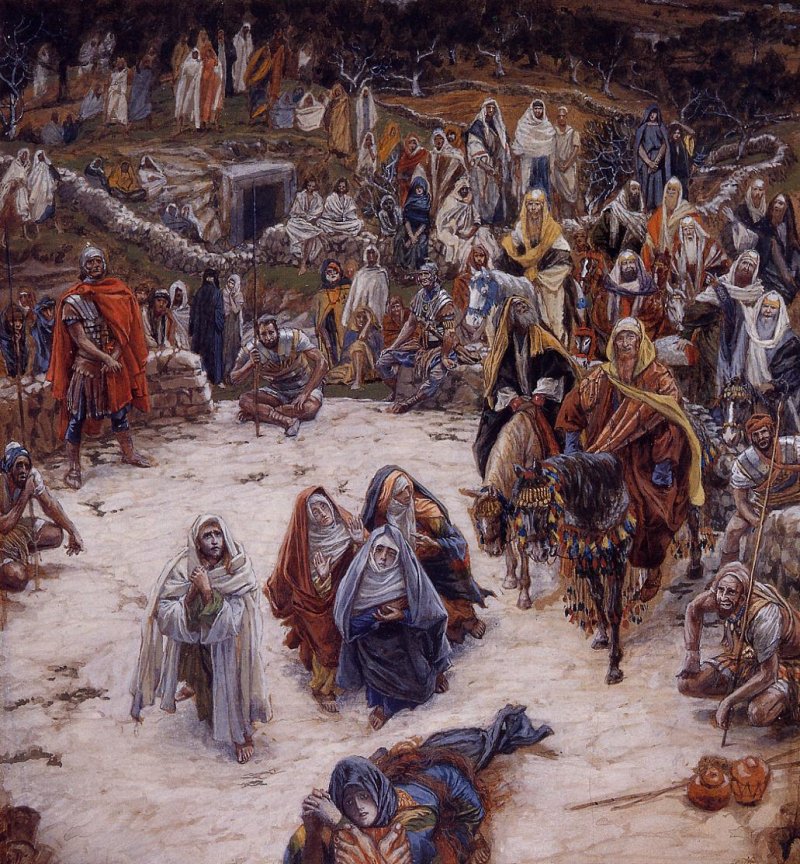
View From the Cross by Tissot

The New Passover Lamb

April 1, 2021

Holy Thursday

The Lord gave specific instructions to Moses and Aaron for the feast of Passover—commandments containing secret significance only later to be revealed. Every Hebrew family had to procure a lamb, a year-old male without blemish, one apiece for each household. If a family was too small for a whole lamb they were to join the nearest household in obtaining one and feast in the same house together. The lamb could not to be eaten raw nor boiled in water, but had to be roasted, baked whole and entire, once some of its blood had been taken to be dabbed on the house’s doorposts and lintel. The whole community of Israel was to celebrate this feast and no one was to go outdoors until morning.

The first Passover was held for the salvation of God’s people, so that deadly judgment would pass over their households and they would no longer be slaves in Egypt. Once they were freed, they continued keeping the Feast of Passover, renewing and celebrating their great deliverance by God’s power. All of these were signs and symbols of things to come, of the still-greater things which came with Christ.

At the Last Supper, Jesus told to his apostles, “I have eagerly desired to eat this Passover with you.” The Gospels note the bread and wine on the table, in accord with the Jewish Passover tradition, but where is the lamb at the center of the meal?

The Lord Jesus, on the night he was handed over, took bread, and, after he had given thanks, broke it and said, “This is my body that is for you. Do this in remembrance of me.” In the same way also the cup, after supper, saying, “This cup is the new covenant in my blood. Do this, as often as you drink it, in remembrance of me.

Jesus asked the apostles that night, “Do you realize what I have done for you?” Jesus is the Passover Lamb of God: an innocent young man, unblemished by sin, whose blood is poured out upon the vertical and horizonal beams of the Cross, to free and save all within his house. Tonight we gather in one house, Christ’s Church, as a family, joining with other households together at Mass, to really receive in the form of baked bread Jesus’ whole self. As St. Augustine once preached to newly baptized Christians: “Recognize in the bread what hung on the cross, and in the cup what flowed from his side. [T]hose old sacrifices of the people of God…represented…this single one that was to come.”

Jesus’ sacrifice saves us from deadly judgment and slavery to sin, and at this meal we renew and rejoice in our great deliverance through him. By God’s grace, may we always have priests and the freedom to offer the Mass on earth, and the grace to never wander off from God’s house into the outer darkness until the first light of the new dawn breaks—when Jesus Christ returns in glory.

Jesus asks his apostles, “Do you realize what I have done for you?” Do you realize what Jesus has done for you? Know that he has eagerly desired to share this Passover with you.

St. Patrick, the Moses of Ireland

March 17, 2021

Wednesday of the 4th Week of Lent

St. Patrick, the Apostle to Ireland, and Moses from the Exodus have a lot in common. Moses was targeted by the wicked as a baby; Pharaoh ordered that all newborn Hebrew boys be tossed into the Nile River to die. Patrick was also targeted by the wicked. Raiders kidnapped him from Roman Britain at the age of sixteen. Moses was separated from his family, growing up in Pharaoh’s palace. Patrick was separated from his family as a slave in Ireland for six years. Moses escaped Pharaoh and Patrick escaped his captors, and neither of them planned to ever go back again. But then, Moses had a vision at the Burning Bush calling him to return to Egypt. And Patrick had a vision in his sleep in which he heard the people of Ireland call out to him, “We appeal to you, holy servant boy, to come and walk among us!” Both men had worked as shepherds during their exiles, and this experience helped spiritually prepare them to become shepherds of men.

Moses was sent by God to free the Hebrews from slavery. Patrick was sent by God to free the Irish from their errors and sins. “Saying to the prisoners: Come out!” But the Egyptian and Irish leaders resisted. Pharaoh’s Egyptian gods and the druids’ Celtic gods were quite different from the Lord. Pharaoh thought killing babies in the river would please the god of the Nile while solving his problems, and the druids offered their gods many human sacrifices hoping that good things would come from them. By proclaiming mighty messages and performing mighty miracles, Moses and Patrick defeated these foes and freed the people. Both men are rightly celebrated for leading many people to God.

The Hebrews who left in Egypt and the Irish who lived in Ireland were introduced to a different and better way of life with the Lord our God. Yet amazingly, once they had been set free, the Hebrews often complained against Moses and said they wanted to return to Egypt and slavery. Today, after some 1,500 years of the True Faith in Ireland, more and more people there live as if Catholic in name only; not believing, not praying, not practicing. For example, in 2018 the people of Ireland voted 2-to-1 in a referendum to legalize more abortion. And in 2019, the first year under the new laws, Ireland’s Department of Health recorded exactly 6,666 abortions. “Can a mother forget her infant, be without tenderness for the child of her womb?” Isaiah suggests this as unthinkable thing – but that is how far we have wandered. Yet even if she should forget, God never forgets us. Even if we give up on God, he will not give up on us. “The Lord is gracious and merciful.” But you are free and you can choose to leave him.

Moses cared about the Hebrews, Patrick cared about the Irish, and I care about you, and we do not want any of you to be lost. But life in the desert is hard, and this world is seductive, and it is easy to be lost. Will you choose to follow the Lord, the God of Moses and St. Patrick, or not?

“Amen, amen, I say to you, whoever hears my word
and believes in the one who sent me
has eternal life and will not come to condemnation,
but has passed from death to life.”

As Moses said, “This day I call the heavens and the earth as witnesses… that I have set before you life and death, blessings and curses. So choose life, that you and your children may live.

You are Called to Read the Gospels

January 24, 2021

Word of God Sunday, The 3rd Sunday in Ordinary Time

When I was about thirteen years old, I remember once being in my living room thinking about death, until nature called, and I headed toward the bathroom on the other side of the house. Our entryway was the crossroads of my childhood home, with doorways and stairs leading to different rooms and levels. This would be the setting for a crossroads moment of my life. For as I set foot there I pictured myself standing before God’s judgement seat after my death. The Lord sat on a white stone throne. He didn’t look angry (that would have scared me off) but he seemed disappointed and frustrated, like I had promised to meet him somewhere and never showed up. And he asked me, “Why didn’t you live your life like I wanted you to live it?

I knew what he meant. I was a cradle-Catholic and not a terrible kid but I also wasn’t much of a disciple of Jesus Christ either. I still needed to use the bathroom but I knew this question would be wrong to ignore. So I stayed there, though pacing a bit, thinking with urgency what would I say, what could I say, in this situation? You only get one Last Judgment. So I replied, “Well God, I wasn’t even sure that you were really real. How could I entirely commit my one life to you while being so uncertain? How could you expect me to stand out on a cliff-ledge without me being sure that it would hold up my weight?

Once I had made my case, he promptly replied, “Did you ever really try to find out? Did you even read my book?” I laughed at that pithy line and said something slightly stronger than “Oh crud” because the Lord had called me out. If I were really looking for the truth, if I were truly seeking after him, I would be searching more seriously than I was. Soon after, I resolved to pray every day and read the whole Bible. I remember sneaking around my mother to fetch our big, family Bible from our dining room cabinet and quietly take it back to my room. I didn’t want her asking me, “What are you doing with that?” because then I’d have say, “Well, Mom, I may have had a vision and I need to read the Bible now.

I started regularly praying before bed and reading the Scriptures fifteen minutes a night, starting with the Book of Genesis. If I happened to miss one night, I’d read for thirty minutes the next. In this way I learned a lot more about the important and famous biblical characters and events I had previously only heard of. I saw the consistency of human nature throughout history and humanity’s need for a savior. I recognized Jesus Christ prefigured within the Old Testament, such as in the lambs of sacrifice at Passover and at the Temple. Somewhere in the midst of reading the books of the prophets I realized I didn’t want to risk dying without ever having read the gospels, so I skipped ahead. And reading the gospels changed my life.

The Sermon on the Mount in Matthew’s Gospel challenged me with a beautiful, new way of living: for instance, trusting in God rather than living in fear, generosity in giving rather than clinging to my every possession, and forgiveness with goodwill towards my enemies rather than nurturing poisonous hatreds. I did not wish to wind up someday on my deathbed without having given these teachings a try, so I did, and experienced their benefits. And Jesus Christ in the gospels inviting the fishermen to follow him opened me up to answering his calling for my life.

I recount these stories this morning because of today’s feast. In September of 2019, Pope Francis decreed the 3rd Sunday of Ordinary Time to be henceforth celebrated as “The Sunday of the Word of God”; a day “to be devoted to the celebration, study, and dissemination of the word of God.” Pope Francis wrote:

“As Christians, we are one people, making our pilgrim way through history, sustained by the Lord, present in our midst, who speaks to us and nourishes us. A day devoted to the Bible should not be seen as a yearly event but rather a year-long event, for we urgently need to grow in our knowledge and love of the Scriptures and of the Risen Lord, who continues to speak his word and to break bread in the community of believers. For this reason, we need to develop a closer relationship with Sacred Scripture; otherwise, our hearts will remain cold and our eyes shut, inflicted as we are by so many forms of blindness.”

The fifth century Doctor of the Church, St. Jerome once said, “Ignorance of Scripture is ignorance of Christ.” Since no books of Scripture reveal Jesus Christ better than the gospels of Matthew, Mark, Luke, and John, today I am urging you to begin reading these, the most important books within the most important book in history.

Have you ever read an entire gospel? If not, why not? There are many easily readable, modern translations these days, without any “thee’s” and “thou’s.” You can even read or listen to the Bible for free over the internet (though I would recommend choosing a Catholic edition with all seventy-three books.)

Let none of us claim that we don’t have time to read the gospels. Based on their word counts and a typical reading speed, Mark (the shortest gospel) can be read in a little more than an hour, and Luke (the longest gospel) can be read in less than two. To read all four gospels requires just slightly more than six hours’ time. To put that in perspective, six hours is two NFL football games, or two Major League baseball games, or three NCAA or NBA basketball games. How many sporting events have we seen in our lives, and how many complete gospels have we read or listened to in comparison? Even before this pandemic, the average American—at home, not at work—spent seventeen-and-a-half hours a week on the internet. So it’s not a question of time, but a question of our priorities.

If you read for fifteen minutes a day, or fifteen minutes a night, you can complete Matthew’s Gospel in a week and can finish all four gospels in twenty-five days. Of course, if you pause to ponder and to pray it will take you longer, but that’s OK, even preferable. I hope you’ll accept this gospel challenge and invitation.

As an epilogue to my first story, when my younger self finally reached the Book of Revelation at the end of Sacred Scripture, I found something of a confirming sign. When God judges the living and the dead—all people on the last day, the Scripture says he sits upon a “great white throne.” When you reach your deathbed, or when you stand before God’s judgment seat, will you have read the gospels and been blessed by the experience in life? “I tell you, brothers and sisters, the time is running out.” “This is the time of fulfillment. … Repent, and believe in the gospel.” And part of believing in the gospel means devoting our time and attention to it.

Who Conquers the World?

January 9, 2021

The Baptism of the Lord

I have a friend, Kathy, a former parishioner of mine now living in Michigan, whom I often call to converse about upcoming Sunday readings. She’s quite knowledgeable about the Scriptures and our Faith and, even now as she endures cancer, delights to discuss them. Talking with her always makes my homilies better. When we chatted this week I shared my hope, frustration, and challenge in preaching compellingly about the Baptism of the Lord. Virtually everyone who will encounter my homily is already baptized, a baptism they do not remember – they were baptized so young that they can’t remember any time in their lives when they were unbaptized. Getting people to appreciate having been baptized is like trying to get them excited about having once been born; or like getting an American to appreciate living their whole lives in a country where freedoms of religion, speech, and representative government are taken for granted. I didn’t know what message I was going to preach when I spoke with Kathy, but she encouraged me that God would give me something and promised to pray for me. Today I’d like to share with you some threads from other interesting conversations I’ve had this week and in the end I promise to tie their lessons together.

On Monday evening, my fortieth birthday, I spoke with my life’s longest friend. Josh is nine days older than me, we were in school together all the way from pre-K through college, and he grew up into a dynamic Christian businessman. Josh remarked that he is struck and bewildered by how much New Year’s matters to people – it’s far less big a deal for him than it seems to be for others. I likewise have memories of being underwhelmed by New Year’s Eve ever since I was a kid. Even though the ball that drops over Times Square is now covered with high-tech shimmering lights, the sight of that sphere’s slow descent still remains a disappointment to behold. A new year is just a change in number on our calendars and forms, a number whose only significance comes in reference to Jesus Christ. Maybe people like it in the way some of us have enjoyed watching a car’s mileage rollover to 100,000 on the odometer. Maybe people just like any excuse to party. But I think New Year’s appeal in popular culture owes greatly to the idea of a new time beginning, the start of a new chapter in our lives. Lots of people make New Years resolutions, typically related to health. They’re hoping for change, hoping this year will be different, yet their resolutions typically fail quickly because our human nature, by itself, is so very weak.

Thursday morning I did spiritual direction through Facebook for another past parishioner and friend of mine. I met Stephanie at my first priestly assignment, helped her become a Catholic, and today she is her parish’s Coordinator of Religious Education and Director of Youth Ministry in Neillsville. Stephanie’s family has an annual tradition of watching “It’s a Wonderful Life” and this year she saw it twice. I asked her if she took away any new insights from that rich film and indeed she had. The first time George Bailey goes to Martini’s Bar it’s a calm and friendly establishment where people show concern about him. George quietly prays there, “Dear Father in Heaven… Show me the way,” leaves, meets Clarence, and returns to the bar again in a world where he was never born. The bar is called “Nick’s” now and like the rest of town it has become more crowded and less wholesome, rude and cruel. These scenes impressed on her anew how much one life well-lived can make an extraordinary difference to all the lives around it.

On Thursday afternoon I partook of spiritual direction myself through Zoom with Fr. Bill Dhein, the thoughtful Chancellor of our diocese who sometimes celebrates Masses here for us. Father and I were both drawn by the Spirit to this passage from today’s second reading from the 1st Letter of John:

“Whoever is begotten by God conquers the world.
And the victory that conquers the world is our faith.
Who indeed is the victor over the world
but the one who believes that Jesus is the Son of God?”

Who indeed conquers the world? If the rioters at the Capitol this week or the rioters from this summer had succeeded, if they had prevailed and conquered, would they find peace in this world? History suggests not. Violence and death would continue to accompany them. In today’s first reading, the Lord tells us through the Prophet Isaiah:

“My thoughts are not your thoughts,
nor are your ways my ways, says the Lord.
As high as the heavens are above the earth
so high are my ways above your ways
and my thoughts above your thoughts.”

Fr. Bill told me one of his admired spiritual heroes is St. Mother Teresa of Calcutta. She was in the world but not of the world, and in Jesus Christ she conquered the world through a holy power which transforms this world for the better. Today’s gospel says:

“[Jesus of Nazareth] was baptized in the Jordan by John.
On coming up out of the water he saw the heavens being torn open and the Spirit, like a dove, descending upon him.
And a voice came from the heavens,
‘You are my beloved Son; with you I am well pleased.’”

Remember, Christian, that you have been baptized into Christ, the Holy Spirit rests on you, and the Father acknowledges you as his beloved child. Your human nature, by itself, is weak and frail, but you are clothed in Christ and ‘can do all things through Christ who strengthens you.’ Do you want to change yourself? Do you want to be a blessing to others? Do you want to change this world wonderfully for the better? Then ask God for his indispensable, gracious help; and also seek the support of Christian friends, for iron sharpens iron and coals stay hot when gathered.

As our culture becomes increasingly less Christian we can expect to see increasing examples of social decay and religious persecution. Just as you cannot remove the foundation of a house and expect its walls and ceiling to stand upright and level, so our nation will suffer in many ways from discarding its Christian faith. But when worse things come, do not fear and do not despair – ‘God works all things for the good of those who love him.’ Do not be afraid and do not give up. The good of this community depends on you and those around you. Who indeed is the victor over the world? Those who believe that Jesus is the Son of God, the children of God, whose faith shall conquer the world.

Meet the Holy Child

January 3, 2021

Feast of the Epiphany

In today’s Gospel, the Magi find the Holy Family now dwelling inside of a house in Bethlehem. This is not the same as Christmas night or Christmas day, but maybe weeks, or months, or even up to three years after. “On entering the house, they saw the child with Mary his mother. They prostrated themselves and did him homage.” Eastern cultures, especially Persians, would do homage by falling to their knees and touching their foreheads to the ground. Though this poor, tiny king’s only throne is his holy mother’s lap, these Magi love and honor him. He does not appear to them as a frightful overlord but as a little infant because his wish is not to be feared but loved. God the Father will have baby Jesus flee and hide from the wicked King Herod, but the Holy Child is happily revealed to these first foreigners from afar who seek him out as friends. The Magi were blessed to encounter Jesus as a little child, but they would not be the last to do so.

One day in the 16th century, St. Teresa of Avila was preparing to climb a stairway to the upper rooms of her Spanish convent when she was met at the stairs by a beautiful boy. He asked her “Who are you?” She replied, “I am Teresa of Jesus. And who are you?” The child responded, “I am Jesus of Teresa,” and vanished.

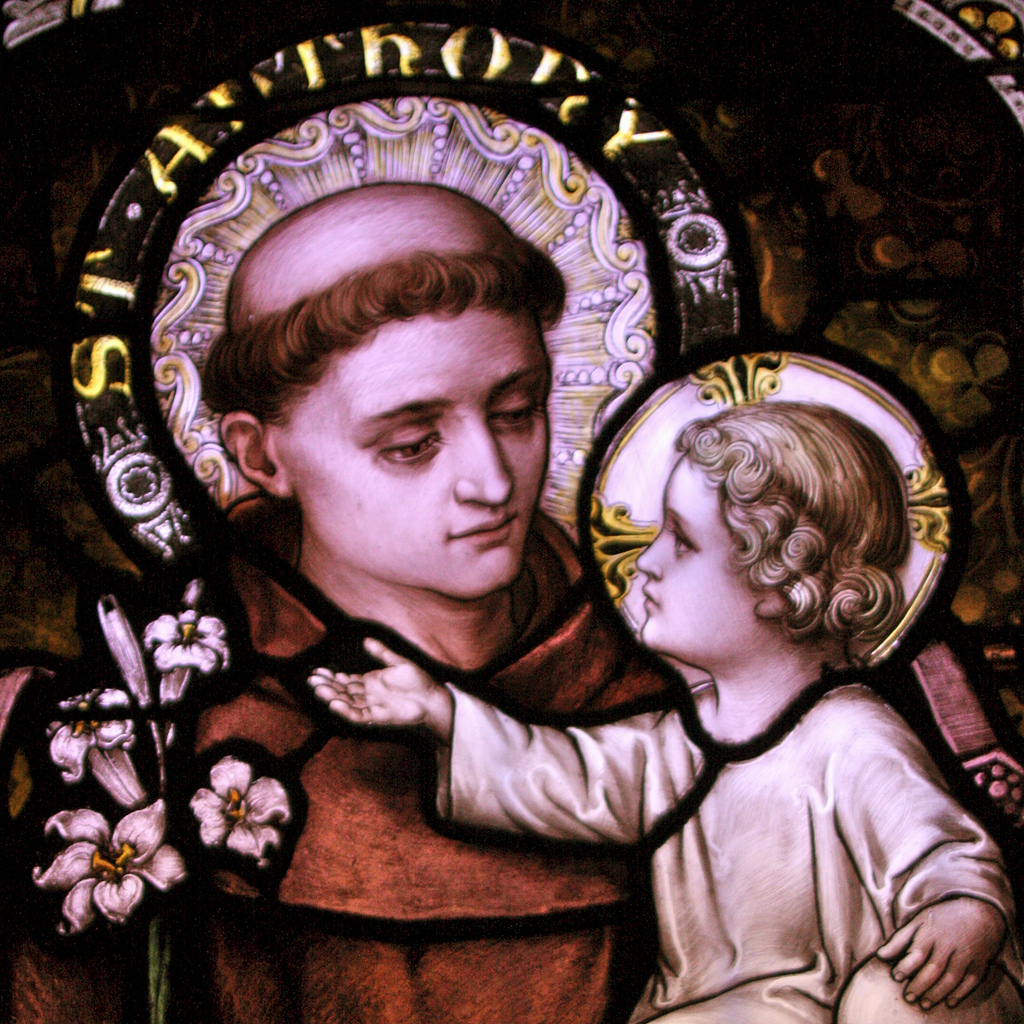
In the 13th century, while St. Anthony of Padua was traveling through France to preach against heresy, he was granted a quiet room for lodging. His host passed by the room one night and noticed an unusual light shining around the door. Peering inside, he saw Anthony kneeling and full of wonder, admiring a glorious child who hugged him. Seeing the boy’s supernatural beauty and hearing their conversation, the onlooker knew that this was Jesus visiting his saint. This encounter is why St. Anthony of Padua is depicted (as in our own stained-glass window of him) holding the Christ Child.

In the 1930’s, the Polish mystic St. Faustina Kowalska recorded in her diary, “I often see the Child Jesus during Holy Mass. He is extremely beautiful. He appears to be about one year old. Once, when I saw the same Child during Mass in our chapel, I was seized with a violent desire and an irresistible longing to approach the altar and take the Child Jesus. At that moment, the Child Jesus was standing by me on the side of my kneeler, and he leaned with his two little hands against my shoulder, gracious and joyful, his look deep and penetrating. But when the priest broke the Host, Jesus was once again on the altar, and was broken and consumed by the priest.

Even without miraculously beholding him, the great devotion of other saints toward the Christ Child is well-known. St. Francis of Assisi, having received permission from the pope, created the very first nativity scene in the year 1223; with hay and a manger along with a live ox and donkey in a cave. He then invited the Italian villagers to come and gaze upon it while he preached about “the Babe of Bethlehem” — Francis was too overcome by heartfelt emotion to say the name “Jesus.”

In the 12th century, Doctor of the Church St. Bernard of Clairvaux wrote this in a touching prayer:

“You have come to us as a small child…
Caress us with your tiny hands,
embrace us with your tiny arms
and pierce our hearts
with your soft, sweet cries.”

In the late 1800’s, the beloved St. Therese of Lisieux, also known as St. Therese of the Child Jesus and of the Holy Face, would pray this amidst her joys and trials:

“O Jesus, dear Holy Child, my only Treasure, I abandon myself to your every whim. I seek no other joy than that of calling forth your sweet smile. Grant me the graces and the virtues of your Holy Childhood, so that on the day of my birth into Heaven, the angels and saints may recognize your spouse, Therese of the Child Jesus.”

And for centuries, the Infant Child of Prague, a 19-inch statute of the Infant Jesus dressed in royal regalia, has been a beloved Czech devotion.

Despite all of these examples of mystical encounters and pious devotions with the Child Jesus, one might still wonder whether it is fitting to pray to a baby. Jesus does not even talk at that immature age, and he has since grown up beyond that phase of life. Yet even though he is a child, the Infant Jesus is still Almighty God who hears all of our prayers. If it would be wrong to pray across time to Our Savior in his manger, it would be wrong to now pray to Our Savior on his Cross as well. You and I were not born too late to adore the newborn King.

What benefits are there in praying to the Holy Infant? Jesus Christ is the same person yesterday, today, and forever, but some will find approaching the Baby Jesus less intimidating. His little form communicates his innocence, purity, gentleness, and tender affection; inviting us to share these virtues. In fact, Jesus tells us we must become as little children, like himself: “Amen, I say to you, unless you turn and become like children, you will not enter the Kingdom of Heaven. Whoever humbles himself like this child is the greatest in the Kingdom of Heaven.

During one Holy Hour, St. Faustina Kowalska was trying to meditate on Our Lord’s Passion, but her soul was filled with joy and she suddenly saw the Child Jesus. She writes, “His majesty penetrated me to such an extent that I said, ‘Jesus, you are so little, and yet I know that you are my Creator and Lord.’” And Jesus answered, “I am, and I keep company with you as a child to teach you humility and simplicity.

On another occasion, St. Faustina saw the Infant Jesus near her kneeler, once again appearing to be about one year old. She writes that, “He asked me to take him in my arms. When I did take him in my arms, he cuddled up close to my bosom and said, “It is good for me to be close to your heart… because I want to teach you spiritual childhood. I want you to be very little, because when you are little I carry you close to my Heart, just as you are holding me close to your heart right now.

So in conclusion, I encourage you to approach the Infant Jesus in your prayers; at this Mass, in this Christmas season, and throughout this year ahead. Picture and imagine him, speak and listen to him, and hold him close to your heart. The Holy Babe of Bethlehem has gifts of grace and consolation to offer you, and he awaits you with open arms.

“St. Luke, How’d You Know?”

December 31, 2020

Solemnity of Mary, Mother of God

Have you ever paused to wonder how St. Luke the Evangelist knows the things he writes about in his Gospel? For example, he tells us that when the Archangel Gabriel visited Mary at the Annunciation “she was greatly troubled at what was said and pondered what sort of greeting this might be.” Today, St. Luke also tells us that following the first Christmas, “Mary kept all these things, reflecting on them in her heart.” And later, after she and St. Joseph found the twelve-year-old Jesus in the Temple, Luke tells us “they did not understand what [Jesus] said to them…[but] his mother kept all these things in her heart.” How exactly does St. Luke know what Mary was thinking or feeling?

We believe that the entire Bible, both the Old and New Testaments, were written under the inspiration of the Holy Spirit, so that their human authors wrote everything and only those things which God desired to become Sacred Scripture. I suppose the Holy Spirit could have directly infused St. Luke with knowledge of hidden things like the Virgin Mary’s secret inner life, but Luke does not cite mystical experience as the source for his account. His gospel begins with a declaration that he has personally investigated the stories he recounts. He writes:

Since many have undertaken to compile a narrative of the events that have been fulfilled among us, just as those who were eyewitnesses from the beginning and ministers of the word have handed them down to us, I too have decided, after investigating everything accurately anew, to write it down in an orderly sequence for you, most excellent Theophilus, so that you may realize the certainty of the teachings you have received.

So, Luke probably learned of these stories in the most natural and human way; by being told by those who knew them well. And who would have originally known what Mary was feeling and holding and pondering in her heart but the Virgin Mary herself? This is why some have called the infancy narratives in the first chapters of Luke’s Gospel “the Memoirs of Mary.” St. Luke possibly heard these stories from Mary’s very own lips before writing them down for us.

Today we celebrate Mary as the Mother of God. Did Mary know that she was the Mother of God? Yes, for the Archangel Gabriel had announced her child would be the Son of God. Did Mary know that her baby boy would be the messianic king? Yes, for Gabriel had said “the Lord God will give him the throne of David his father, and he will rule over the house of Jacob forever, and of his kingdom there will be no end.” Did Mary know that her Son would come as Savior? Yes, for an angel had told St. Joseph “you are to name him Jesus, because he will save his people from their sins.” So when the pretty song asks “Mary Did You Know?” — Yes, Mary knew a lot, but there was still a lot that she did not know.

Much of what was still to come remained a mystery to her. What would it be like to be a mother to God? How would his royal reign on earth come to pass? How would Jesus save humanity? What trials would she herself face? What would become of her? Mary did not know these things, but she trusted in God who guides our lives and all of human history.

What does this new year hold for each of us? Like Mary, we do not know every particular, but Mary shows us that we don’t have to. We do not need to fully know our future in order to be richly blessed. We do not have to know tomorrow for the Almighty to do great things for us, “for nothing will be impossible for God.” At this turning of the year, let us trust in God and entrust ourselves to him, for if we were all to trust and entrust ourselves in this way, our perfection would be like that of Blessed Mary and the saints.

Echoing the words of the ancient priestly blessing, in this new year ahead, may the Lord bless you and keep you, as he did our Holy Mother Mary. May the Lord let his face shine upon you and be gracious to you, like he gazed upon Mary through the face of Jesus Christ. And may the Lord look upon you kindly and give you peace, as he did the Blessed Virgin Mary – the image and icon of his Holy Catholic Church.

God’s Divine Plan

December 26, 2020

Feast of the Holy Family
By Deacon Dick Kostner

Today I would like us to reflect on what the “Holy Family” really is. I want to begin by dissecting our definition of “family” and try to expand upon that definition to reveal the gift that God has given us. If I were to ask you to define “family” I believe most of us would say it’s a union of people consisting of a father, a mother and children. Now if I were to ask you to define what the “Holy Family” is, I believe most of us would say, “Well, that’s Joseph, Mary and Jesus.” But I think that if we reflect upon this a little bit we would realize there is something missing with our formula for “Holy Family”. How did all this begin? Well like everything its origins begin with the creator, with God. It was through a divine plan for the building of the kingdom, that God put together this relationship we call “family”.

Within the traditional family we have a “father”,  a head or lead person for this relationship. Let’s look at Joseph for some characteristics. Joseph was a humble person; a man who provided for his family; he was a listener to what God was saying to him, he was a listener to the concerns of the other family members. Joseph was trusting of what God had planned for him and his family even though he could not understand the details of the plan. Joseph was loving and cared deeply for Mary and for Jesus and was the primary teacher for his family for the laws of his Jewish faith. He was committed to obeying the laws of God and of his faith and in being the lead person to teach his family those laws.

Also within the traditional family there is a “mother”. a person committed to be the love glue of the family. Let’s look at Mary for some characteristics of this family member. Mary was a great listener. She had a tremendous faith that allowed her to trust in God; this faith allowed her much courage and she not only listened to God but was fearless in going out into uncharted waters. Mary was wise and loving and could read the will and needs of her family. She always put the welfare of her family first over her needs and desires.

Also within the traditional family there are children. Let’s look at Jesus to see what characteristics this family member has. Jesus was also a great listener. He listened to his parents and to his heavenly father. He was a student, a person thirsty to learn about his faith and his roots. Jesus was obedient to the will of his family and to the will of his heavenly father. Jesus was like the other family members, loving and caring about the welfare of his family and the welfare of others.

This relationship we call “family” was a creation of God with the purpose and design to help foster and grow the kingdom of God. So what is missing from our traditional definition of “Holy Family” is a very important member, that member being God, the Father, the creator of this entity. When God is so recognized we are no longer just a family we are now a “holy family” for we recognize that we were brought together through the divine plan of the Father!

Within our culture we see many attacks on the family. We find so called experts who are trying to re-define what a family is. We find a culture trying to re-define the roles of mother, father and children within a family, and even telling us that certain positions are not necessary to have a family. Whenever humans try to alter God’s divine plan there are going to be malfunctions and problems. If we remove for example certain parts of an automobile, we find that it does not run as good. Why, because we are altering what its creator intended. If certain key parts of a car are removed at some point it will no longer function or run. So it is with God’s creation of family. If we try and alter what the creator intended at some point it breaks down and will no longer function. Paul’s Letter to the Colossians today, tells it all, “Wives, be subordinate to your husbands, as is proper in the Lord. Husbands, love your wives, and avoid any bitterness toward them. Children obey your parents in everything, for this is pleasing to the Lord. Fathers, do not provoke your children, so they may not become discouraged.

As members of the Holy Family of God our spirits are joined so that we can receive the benefits of intimacy both in this life and in the next. That means death becomes non existent. Those of you who have experienced the loss of a loved one know what I am talking about. While body presence may be missing the spirit of Holy family members lives on and time is no longer relevant. Members of God’s Holy Family continue their presence with us even after death. During the Advent Season I pondered this point when I was feeling bad that our Churches could not be filled to capacity because of Covid limitations. But during Mass I realized that our Church’s are still filled to capacity not just on Christmas and Easter but at every Mass because our deceased Holy Family members are still here with us in Spirit filling our Churches with standing room only. You know I am a Student of the Spirit. I’m going to share a quote from a favorite website of mine, Spirit Daily. Jeannie Ewing is a Catholic spirituality writer who writes about the moving through grief, the value of redemptive suffering, and how to wait for God’s timing fruitfully. She says this about the mystery of the Holy Spirit:

When you’ve learned to attune yourself to the stirrings of the Holy Spirit, you will be aware of His presence in you at all times. Sometimes God chooses to sleep in us, and we don’t notice Him moving or working. Other times, we have a distant but keen awareness that God is accompanying us through a difficult decision or terrifying prognosis.

One day we come to a realization that all we do throughout our days are done in and with Him. Even when we do not consciously or formally make an offering to God, the union we share with Him is so obvious that we don’t need to speak but just be. In that being, we discover the place where we end and God begins is a very short thread.

We are told by our Church Leaders that it is believed that during Christmas that God releases the most family members from Purgatory and welcomes them into heaven. I believe that is because of our Prayers and Masses that are offered up for those Souls who have joined us to celebrate Eucharist. So to all of the deceased Holy Family spiritual members with us today we need to say “Merry Christmas” and thanks for joining our Holy Family celebrations.

Jesus Christ: The Word of God

December 24, 2020

Christmas Night

In the beginning was the Word,
and the Word was with God,
and the Word was God.

Have you ever wondered why Jesus Christ is the Word? How is Jesus Christ a Word; or, how are words like Jesus Christ? Spoken words have a speaker. Written words have an author. And the person these words come from is revealed through them. My words reveal what is hidden within me. The words I generate reveal my inner self to you. If I did not speak, you would not know my thoughts. If I were invisible to you as well, you could not see my presence or my activity; nor could you read any emotions from my face. I would remain a mystery to you.

If I were unheard, unseen, and unknown, you might look at the objects I have made to learn something more about me. A Renaissance artist’s masterpiece differs greatly from a child’s finger-painting; and if we were to place the two paintings side-by-side it would be easy for us to guess who made which. The creator is revealed through his creations. If I built a mountain you would know of my strength, but you might wonder if I am hard and unfeeling like rock. If I created an ocean you would know of my greatness, but you might wonder if you were of relatively small significance to me. If I fashioned a star you would know of my vast reach, but you might wonder if I am distant from you.

In times past, God spoke to our ancestors in partial and various ways; such as through his creation and through his Old Testament prophets. But in these last days, God speaks to us through a Son who reveals the Father’s knowledge, will, and love. God the Son is our Father’s Eternal Word.

And the Word became flesh
and made his dwelling among us,
and we saw his glory…

In what way does God choose to come to us? We knew he was strong, but he comes weak and vulnerable. We knew he was great, but he comes lowly and meek. We knew he was vast, but he comes as someone very small. He possesses all riches, but he comes to an unwealthy place and time. A stable is certainly not a palace, and the little town of Bethlehem is not the great city of Rome. In fact, our present modern world is far more rich and comfortable than those ancient times and places were. Yet the Son of God chose to be born there and then as a human baby.

Why does Jesus come to us in this way? Imagine yourself supremely happy in Heaven. Ask yourself: for what possible reason would you ever leave there? “For us men and for our salvation he came down from Heaven.” For love of you and me, he humbly descends to reveal for us what God is like, to win our love and save us.

The Virgin Mary wraps baby Jesus in swaddling clothes. His beaten, crucified body will later be wrapped in a linen burial shroud. Mary lays baby Jesus in a manger, a feedthrough for animals. He will go on to offer himself as food for us, the Bread of Life for the world. Delivered first in a cave, Jesus will go on to be delivered from a tomb. Jesus Christ descends down to the depths to bring us up with him to the heights.

In yet another surprise, the Son of God, our Prince of Peace, our God-Hero and Emmanuel, comes to us so quietly and subtly. Sometime after the first Christmas, when the Magi showed up in Jerusalem seeking “the newborn king of the Jews,” King Herod and his court are completely oblivious of what has occurred in Bethlehem just six miles down the road. If not for the angels, the shepherds in the fields would not have known. And if not for those shepherds sharing the message they were told by the angels, who else in Bethlehem would have known besides Joseph and Mary? Jesus Christ’s birth was heralded and celebrated by some, but dismissed and ignored by many.

Jesus did not force the world to pay him notice then, and it is similar today. Despite all that he has done for us, he allows himself to be ignored. The Word of God is among us, but we must decide to listen; not only on Christmas but throughout the whole year. “Behold, I proclaim to you good news of great joy… a Savior has been born for you who is Christ and Lord.” So heed this Word and rejoice in this Word, for he has revealed to you what God is like, to win your love and save you.

The New Eve

December 8, 2020

Solemnity of the Immaculate Conception

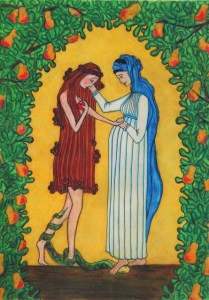
Eve was the first woman. God created her like Adam, a finite but flawless and sinless creature, destined to become the biological mother of the entire human race. But then an angel, a fallen angel, Satan in the form of a snake, visited her to suggest that she should disobey God’s will. Eve said yes to sin, and then Adam joined her, and through them the whole human race fell.

Their grave sin caused Adam and Eve to lose paradise, but their futures were not without hope, for God spoke in their hearing a prophesy toward that wicked, deceiving serpent, the devil. God declared, “I will put enmity (that is, I will put hostility) between you and the woman, and between your offspring and hers; he will strike at your head, while you strike at his heel.” Who is this offspring, this descendant, this son, who strikes back at the devil? It’s Jesus Christ who defeats the devil by dying on the Cross. Adam sinned, causing us to die. But St. Paul calls Jesus the second Adam, the new Adam, who obeys God and does not sin so that we may live forever.

If Jesus is the new and second Adam, then who is the new and second Eve? Who is the woman whom the devil hates most; the mother whose offspring crushes the serpent’s head; a woman created by God as a flawless, sinless creature? This New Eve was visited by angel too, a holy archangel named Gabriel, to ask that she would accept God’s will. And the Blessed Virgin Mary answered, “Behold, I am the handmaid of the Lord. May it be done to me according to your word.” The New Eve’s obedience was later echoed by the New Adam. In the Garden of Gethsemane, in his garden of temptation the night before he died, Jesus said, “Father… not my will but yours be done.” Eve said yes to sin, Adam joined her, and through them the whole human race fell. Mary and Jesus say yes to God, and through them the whole human race is redeemed.

Imagine if you could design, could create, your own mother. Wouldn’t you make her the sweetest, kindest, most lovely, and most loving woman that you could? Well, Jesus is God and he did create his own mother for himself, and Jesus shares his mom with us as well. Eve became the biological mother of all the living, but Mary is the spiritual mother of all who live in Christ. Through her sinless soul, completely filled with God’s grace, Mary knows and loves each one of us as her own children. So today, we her children rejoice and celebrate with holy Mary, that God chose her to be our New Eve, the Immaculate Conception.

Jesus or Barabbas?

November 23, 2020

The Solemnity of Our Lord Jesus Christ, King of the Universe

For the feast of Passover, the Governor Pontius Pilate observed a tradition of releasing to the crowds any one prisoner they wished. On Good Friday, in addition to holding Jesus of Nazareth, the Romans in Jerusalem had a notorious prisoner named Barabbas. When the crowd came forward and began to ask Pilate to do for them as he was accustomed the governor dryly asked, “Do you want me to release to you the king of the Jews?” The chief priests stirred up the crowd to have him release Barabbas for them instead.

Pilate asked, “Which of the two do you want me to release to you? Barabbas, or Jesus who is called Christ?” They answered, “Barabbas!” Pilate said to them in reply, “Then what do you want me to do with the man you call the king of the Jews?” They shouted again, “Crucify him!” Pilate said to them, “Why? What evil has he done?” But they only shouted the louder, “Crucify him!” So Pilate, wishing to satisfy the crowd lest they riot, released Barabbas to them and, after he had Jesus scourged, handed him over to be crucified.

This episode with Jesus and Barabbas is recounted each Palm Sunday and Good Friday when the Passion narratives are read at church. However, the Gospels’ Passion accounts are so lengthy and rich with themes to consider that the crowds’ choice between these two figures is rarely ever preached on. Today, I would like to show you the deeper significance in this rejection of Christ the King.

The first interesting detail is in the meaning of these two men’s names. “Jesus” was the name given through angelic messages to Mary and Joseph, a name chosen in Heaven for the Son of God on earth. “Jesus” or “Yeshuah” in Hebrew means “God saves.” The name Barabbas breaks down into the Aramaic words “Bar” and “Abba”; “Bar” means “the son of,” while “Abba” means “father.” And thus, the name Barabbas means “the son of the father.” So Pilate is proposing a question to the crowd more profound than they realize: “Which son of the father do you choose? Do you desire God’s salvation?

The New Testament tells us that Barabbas was a Jewish revolutionary who, along with other captured rebels, had committed murder in a rebellion against Roman rule. The Jews commonly hated the Romans and resented the occupation of their Promised Land by a foreign, Gentile power. Jews expected that the Christ, the Messiah, if he were to come in Jesus’ day, would drive out the Romans and their puppets using the force of arms. Then they imagined that this man, God’s Anointed One, would take his seat upon his ancestor King David’s throne, establishing a renewed Israeli kingdom of worldly glory, with international power, military strength, and overflowing wealth. So when Jesus came among them they failed to recognize him as the Christ.

Unlike Barabbas, Jesus did not promote hatred for the Romans but a love for enemies. Jesus did not raise an army nor a sword, but preached “blessed are the peacemakers.” On Palm Sunday, Jesus does not enter Jerusalem riding on a warhorse, but on a donkey, as the Old Testament prophet Zechariah had foretold: “Shout for joy, O daughter Jerusalem! See, your king shall come to you; a just savior is he, meek, and riding on a donkey.” But when presented with Jesus and Barabbas, the people rejected their true King and Savior, the Christ. St. Peter would go on to preach to the people of Jerusalem on Pentecost, “You denied the Holy and Righteous One and asked that a murderer be released to you.” The choice between Barabbas and Jesus is a choice between two sorts of saviors, two very different kinds of revolutionaries and kings; one whom the earth thinks would be most effective and the one whom Heaven has sent us. The Christ and an anti-Christ.

It was within Jesus’ power to have forcibly imposed his rule over the whole world. At Jesus’ arrest in the Garden of Gethsemane, Peter is ready to fight—he draws a sword and cuts off the ear of the high priest’s servant. But Jesus intervenes, “Put your sword back into its sheath, for all who take the sword will perish by the sword. Do you think that I cannot call upon my Father and he will not provide me at this moment with more than twelve legions of angels? But then how would the scriptures be fulfilled which say that it must come to pass in this way? Put your sword into its scabbard. Shall I not drink the cup that the Father gave me?” Jesus then heals to slave’s ear before he is led away by the guards.

Like a gentle lamb silently led to slaughter, Jesus endures his Passion and death. And who would have thought any more of him? But God raised him from the dead and he appeared to his disciples, who then courageously proclaimed to everyone that Jesus is the Christ. The Jews and Romans persecuted the early Christians. Though peaceful and innocent, Christians suffered indignities, imprisonments, and martyrdoms, yet the number of those saved by the Church continued to grow. Then, in 313 A.D. the Emperor Constantine legalized Christianity and ten years later gave it the most favored religious status throughout the Roman Empire. “Blessed are the meek, for they will inherit the land … Blessed are those who are persecuted for the sake of righteousness, for they will be satisfied.” Indeed, Jesus Christ and his Church succeeded where Barabbas failed: they conquered the Roman Empire not by destroying it but by converting it.

Today we celebrate Jesus Christ, the King of the Universe. Jesus the Almighty now reigns over us and over the whole world. But this knowledge, upon reflection, can raise troubling questions in our hearts. When we see the horrors of this world, grave evils throughout history and evil happening in our time, we may ask, “Lord, why aren’t you doing more?” Every year in our country, hundreds of thousands of unborn children are being legally murdered. Right now, millions of people in Asia are being held in concentration camps. How many billions of grave sins are being committed every day which cause innocents to suffer? Lord, why don’t you end this evil? Why don’t you force the world to bow down to your will?

We may wish Jesus and others to go violently into full Barabbas-mode against all the world’s evil, but this is not his way. Christ’s goal is the salvation of souls, as many souls as possible. Jesus the Good Shepherd shepherds the world subtly but in every place, speaking to the souls of both his friends and sinners, drawing them freely toward his salvation. But what about the grievous sufferings and injustices along the way? Jesus is not at all indifferent to these. Our loving shepherd is the best of shepherds because he has been a sheep like us, a lamb who was slain. He endured such sufferings and injustices personally as the lamb of God, and he still mystically suffers in and with the innocent. “Amen, I say to you, what you did [or did] not do for one of these least ones, you did [or did] not do for me.

The evil of this world is a heart-breaking scandal. But sin and death do not have the final word. The last word will belong to Jesus Christ. Trust in the crucified One, our suffering God who died and rose for us, the Shepherd of souls, the victorious Lamb, Christ our King. May his Kingdom come and his will be more fully done, on earth as it is in Heaven, in each and every soul.

Our Glorious Friends

October 31, 2020

Solemnity of All Saints

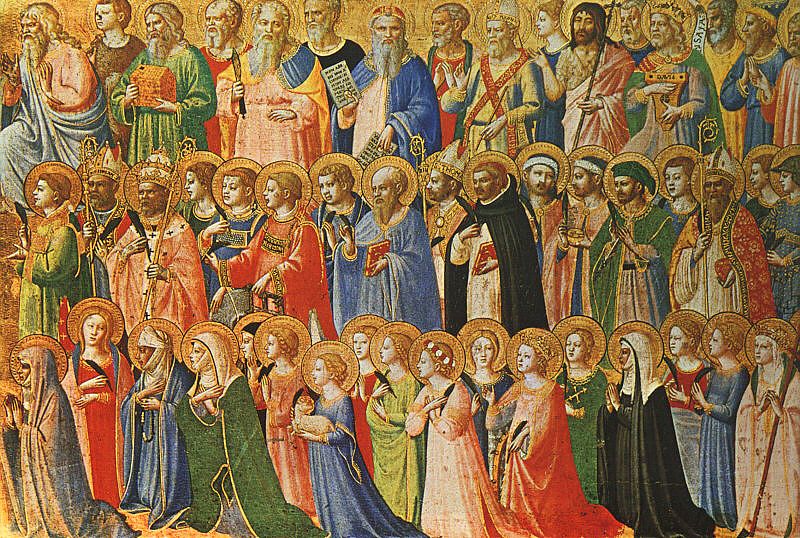
The saints who have died are not dead – they are more alive than we are now. The human saints in Heaven lived in times past, but they were made of the same stuff and faced similar struggles then as you and I today. Though the Catholic Church has canonized thousands of saints, when you consider the billions of Christians throughout history canonizations are relatively rare, yet there are more saints in Heaven than we can count. We know this because of St. John’s Revelation of Heaven: “I had a vision of a great multitude, which no one could count, from every nation, race, people, and tongue.” The Lord Jesus Christ wants you to be in that number. Unfortunately, common misconceptions about saints can keep us further from them. So, in this homily, I would like to help you to grow closer to them in friendship and in likeness.

First realize that the saints are not dead and gone but still living. This is why whenever I preach about the deceased I try to speak of them using the present tense whenever some fact about them remains true. For instance, if a kind and generous Christian father of three dies he is still a kind and generous father of three. Rather than saying “his name was David,” faithfully witness that “his name is David” even after he has died. Though deprived of their bodies for the moment, those who are in Heaven are more alive than we are here. There they experience God opening himself to them an inexhaustible way. This is called the beatific vision, an ever-flowing well-spring of happiness, peace, and mutual communion. The saints in Heaven see God face to face, and they have become like him for they see him as he is.

What is a glorified human being or exulted human nature like? Let’s consider the Blessed Virgin Mary. How much does she know us? How much does she love us? Does she hear each one of our prayers addressed to her? It is our sense of the Faith that our spiritual mother does indeed know us and loves us individually as her children. But consider this: if every Catholic in the world offers one Hail Mary a day, this means an average of more than fifteen thousand new prayers come her way each second. Therefore, if Mary hears all our prayers, her experience of time and/or the capacity of her glorified consciousness must far surpass our own.

The other glorified saints in Heaven, our brothers and sisters in Christ, know and care about you too. They understand you because they’ve walked in our shoes. Governments and borders and technologies change over time, but human nature is constant. The saints began with the same humanity as you and I, experienced challenges like our own, and prevailed. Lots of canonized saints have been priests, nuns, bishops, popes, or martyrs, but Heaven is certainly not limited to these backgrounds. Saints come from varied walks of life. Some canonized saints did extraordinary miracles or had visions here on earth, but even for these most of their days were ordinary, spent faithfully doing very ordinary things like us.

The saints in Heaven are our friends who lend us constant aid even if we do not know their names yet. In response, I encourage you to befriend them back. Which ones? Try doing this holy experiment: ask Jesus to introduce you to a saint and then keep your eyes open. Watch for a saint to providentially present him or herself to you, perhaps through an icon, a painting, or a photograph, a book or a film, or mentioned in a conversation thereafter. I look forward to hearing whom you’ll meet. Take these saints as teachers you learn from, role models you imitate, heroes to inspire you, and holy intercessors whose prayers before God for you are very powerful. I urge you to follow the saints, because those who follow them will embody the beatitudes, become more like Jesus, and become saints themselves.

Though it is unlikely any of us here will be officially canonized by the Church, we are all called to be saints. You are called to be a saint. St. Catherine of Siena said, “If you are what you should be, you will set the world on fire.” Do not say, “I have too sinful of a past to become a saint.” Recall that St. Paul had once persecuted Christians. There is no saint without a past and no sinner without a future. And do not say, “I’m too imperfect to become a saint.” Realize that even while St. Peter was serving as the first pope he sometimes made personal mistakes in his ministry. And do not say, “I’m too late in my life to become a saint.” Remember how the Good Thief on his cross next to Jesus made the most of the time he had left. As St. John Paul the Great preached, “Become a saint, and do so quickly.” Jesus is calling you to be a saint, so befriend the saints and they will help you on the way to Heaven.

The Saint Lawrence

August 10, 2020

The Feast of St. Lawrence

The Great Lakes (Superior, Michigan, Huron, Erie, and Ontario) comprise the largest body of freshwater in the world. All told, these five lakes contain one-fifth of all the freshwater on the surface of the earth, about six quadrillion gallons (that’s six million billions) a figure not fully fathomable for the human mind. Like all moving waters, these flow downhill from high to low. Near Buffalo, New York, between Lake Erie and Lake Ontario, they descend 167 feet with a mighty rushing sound at Niagara Falls. Leaving Lake Ontario, they become a river that flows past a “royal mountain” and city of the same name: Montréal. The name of this river in which whales swim, which empties into the world-spanning ocean, is the Saint Lawrence River.

The river is named for St. Lawrence, one of the Seven Deacons of Rome under St. Pope Sixtus II. (Both of these saints’ names are invoked at Mass in Eucharistic Prayer I.) In 258 A.D., the Roman Emperor Valerian issued an edict commanding that all bishops, priests, and deacons should immediately be put to death. The pope and many others were martyred, including St. Lawrence on his present feast day, August 10th. Back then, deacons managed the Church’s funds and charitable efforts. Though the tale is uncertain, St. Ambrose of Milan writes that when his persecutors demanded that Archdeacon Lawrence handover the Church’s treasures, he showed them the poor and the sick. This same source also recounts how during his slow death upon a gridiron over a fire St. Lawrence quipped, “I am cooked on that side; turn me over…

God’s graces are like The Great Lakes; vast, life-giving waters beyond our full comprehension. They flow down from above into a channel open to receive them, like the Saint Lawrence. Through such rivers, waters pour forth across the world in the sight of the Royal Mountain and the City of God to the delight of the angels. Let us imitate St. Lawrence and God’s other saints who by humble willingness became mighty streams of His goodness and glory.


Jesus’ Longing for You

June 14, 2020

Corpus Christi Sunday—Year A

After the suspension in March, our parish went eleven weekends without the public celebration of Sunday Masses. Throughout Salvation History, the number forty symbolizes times of purification, preparation, and longing. For most people, being away meant about eighty days (forty twice over) without physically receiving our Eucharistic Lord. For many, their yearning for Jesus in the Eucharist has never been greater. Feast of Corpus Christi homily usually focus (quite fittingly) upon the Real Presence, the beautiful truth that Jesus Christ is truly present, body and blood, soul and divinity, alive in the Holy Eucharist. As St. Paul says in our second reading, “The cup of blessing that we bless, is it not a participation in the Blood of Christ? The bread that we break, is it not a participation in the Body of Christ?” You are probably well-informed about this already; that’s why you have been longing for Him in the Eucharist. Today I feel moved to speak about Jesus Christ’s Eucharistic longing for you.

Jesus Christ’s desire for us is foreshadowed in the Old Testament; for instance, in The Song of Songs. There the beloved says of her spouse: “My lover speaks and says to me, ‘Arise, my friend, my beautiful one, and come! Let me see your face, let me hear your voice, for your voice is sweet, and your face is lovely.’” Later this same man, prefiguring Christ, declares: “I have come to my garden, my sister, my bride; … I eat my honeycomb with my honey, I drink my wine with my milk. Eat, friends; [and] drink!

In the Book of Proverbs, God’s personified wisdom speaks: “Let whoever is naive turn in here; to any who lack sense I say, Come, eat of my food, and drink of the wine I have mixed! Forsake foolishness that you may live; advance in the way of understanding.” The foolishness we must forsake is our sins, for what is freely-chosen sin if not harmful foolishness? Jesus seeks to bring about sinners’ salvation, in part, through drawing them to his meal, to share his presence, his food and drink. Jesus once responded to criticisms of his ministry saying: “The Son of Man came eating and drinking, and they say, `Behold, a glutton and a drunkard, a friend of tax collectors and sinners!’ Yet wisdom is vindicated by her deeds.

A Samaritan woman with many sins once asked Jesus, “How can you, a Jew, ask me, a Samaritan woman, for a drink?” He answered her, “If you knew the gift of God and who is saying to you, ‘Give me a drink,’ you would have asked him and he would have given you living water.” Later, on the last and greatest day of a Jewish feast, Jesus stood up in the temple area and exclaimed: “Let anyone who thirsts come to me and drink.” Before his miraculous multiplication of loaves of bread, Jesus called his disciples to himself and said, “I feel compassion for the people, because they have remained with me now three days and have nothing to eat; and I do not want to send them away hungry, for they might faint on the way.” Jesus wants to feed us (we who have remained with him) as well, to strengthen us on our way. The food and drink Jesus desires you and I to receive are not mere objects for bodily sustenance — it is his very self. “I am the living bread that came down from Heaven; whoever eats this bread will live forever… For my flesh is true food, and my blood is true drink. Whoever eats my flesh and drinks my blood remains in me and I in him.

At the Last Supper, which was the first Mass, Jesus told his disciples, “I have earnestly desired to eat this Passover with you… Take this, all of you, and eat of it, for this is my body, which will be given up for you.” Jesus earnestly desires to share his feast, this Mass, to unite with us today. “Behold, I stand at the door and knock. If anyone hears my voice and opens the door, I will enter his house and dine with him and he with me.” Jesus is divine, but he’s also human. He dwells in Heaven, but he has human desires for you and me and our world. If you have yearned for Jesus in the Eucharist, if you have desired to receive him these past months, consider how much more Jesus Christ longs and desires for you.

The Unity of the Trinity

June 8, 2020

Trinity Sunday—Year A

My favorite professor at seminary was a young, married, Catholic layman named Dr. Perry Cahall. He taught us several courses but his Church History class stands out in my mind. I took away two big insights from Church History.

First, in every age, century after century, it seemed like the Catholic Church was circling the drain, about to go down the tubes for good. There were Roman persecutions, Gnostic and Arian Heresies, barbarian invasions, Islamic conquests, Protestant rebellions, atheist revolutions, fascist and communist totalitarianisms. And yet, the Church endures because God is with her. Remembering this has been a reassuring consolation for me in the past, in our present circumstances, and will be in the future.

The second major insight was how heresies clarify the Church’s teachings. When some sect or movement would arise teaching some new heresy this would prompt a Church Council to more clearly define what we believe as Christians. Error prompts the profession of truth. This was especially so in our profession of the Holy Trinity.

Dr. Cahall is a pretty mild guy, so one of his most memorable lectures stands out in my mind. He said, “Gentlemen, if some day you are ordained and on Trinity Sunday you get into the pulpit and say, ‘The Trinity is a mystery and there’s nothing we can really say about it,’ I’ll hunt you down like the dogs you are.” Why? Because as the Catechism says, “The mystery of the Most Holy Trinity is the central mystery of Christian faith and life. It is the mystery of God in himself. It is therefore the source of all the other mysteries of faith, the light that enlightens them. It is the most fundamental and essential teaching in the hierarchy of the truths of faith. The whole history of salvation is identical with the history of the way and the means by which the one true God, Father, Son and Holy Spirit, reveals himself to men and reconciles and unites with himself those who turn away from sin.” Well, I don’t want to be a dog, so I’m not going to just going to tell you “it’s a mystery.

So what are some of the things we can we say with certainty about the Most Holy Trinity? In the words of the Athanasian Creed, this is what the Catholic Faith teaches:

We worship one God in the Trinity and the Trinity in unity.
Neither confounding the Persons, nor dividing the substance.
For there is one person of the Father, another of the Son, another of the Holy Spirit.
But the Father and the Son and the Holy Spirit have one divinity, equal glory, and co-eternal majesty.
What the Father is, the Son is, and the Holy Spirit is.
The Father is uncreated, the Son is uncreated, and the Holy Spirit is uncreated.
The Father is boundless, the Son is boundless, and the Holy Spirit is boundless.
The Father is eternal, the Son is eternal, and the Holy Spirit is eternal.
Nevertheless, there are not three eternal beings, but one eternal being.
So there are not three uncreated beings, nor three boundless beings, but one uncreated being and one boundless being.
Likewise, the Father is omnipotent (that is, all-powerful), the Son is omnipotent, the Holy Spirit is omnipotent.
Yet there are not three omnipotent beings, but one omnipotent being.
Thus the Father is God, the Son is God, and the Holy Spirit is God.
However, there are not three gods, but one God.
The Father is Lord, the Son is Lord, and the Holy Spirit is Lord.
However, there are not three lords, but one Lord.
For as we are obliged by Christian truth to acknowledge every Person singly to be God and Lord, so too are we forbidden by the Catholic religion to say that there are three Gods or Lords.
The Father was not made, nor created, nor generated by anyone.
The Son is not made, nor created, but begotten by the Father alone.
The Holy Spirit is not made, nor created, nor generated, but proceeds from the Father and the Son.
There is, then, one Father, not three Fathers; one Son, not three sons; one Holy Spirit, not three holy spirits.
In this Trinity, there is nothing before or after, nothing greater or less. The entire three Persons are co-eternal and coequal with one another.
So that in all things… the Unity is to be worshiped in Trinity and the Trinity in Unity.

How does the Church come to know such things? We learned them through Jesus Christ. “God so loved the world that he gave his only Son, so that everyone who believes in him might not perish but might have eternal life.” Jesus teaches there is one God, and that the Father and he are one, and that whoever has seen Jesus himself has seen the Father. He accepts Doubting Thomas declaring him “My Lord and my God,” and yet relates to his Father God as another person. When Jesus prays aloud in the Garden of Gethsemane, “My Father, if it is possible, let this cup pass from me,” he is not talking to himself, he’s not pretending or putting on a show for the apostles. The Lord Jesus is the Father’s only-begotten Son and reveals the mystery of the Trinity to us.

God is not a solitary individual, but a loving communion of persons – less like a hermit and more like a family. God is three who know, three who love, three who will and act. The divine persons each work uniquely and together, yet the Father did not die on the Cross, the Holy Spirit did not become man, and the Son did not descend as a dove or tongues of fire. However, each divine person’s works are done in harmonious concert with the others’. We have one “Father from whom all things are, and one Lord Jesus Christ through whom all things are, and one Holy Spirit in whom all things are.” We are made in the image and likeness of God not merely because we posses existence, intellect, freewill, and lordship over creation, but because we live to our fullest in loving communion with others.

St. Paul writes to “brothers and sisters, rejoice. Mend your ways, encourage one another, agree with one another, live in peace, and the God of love and peace will be with you. Greet one another with a holy kiss.” I am pleased that we are beginning the (likely gradual) return to fully gathering at Sunday Mass. Though we can do good apart, it is best for us to be together. I am also praying for our larger society’s coming together as a community of communities. Strife, violence, and destruction are not the path to unity. If Almighty God had wanted to destroy us all he could have, but “God did not send his Son into the world to condemn the world, but that the world might be saved through him.” True unity will come in the likeness of the Trinity. This is the life of Heaven that holy community can begin to know on earth. All of us are called to share in the life of the Holy Trinity, here and now into forever.