Archive for the ‘Feast Day Homilies’ Category

Uniting All Peoples

May 30, 2020

Pentecost Sunday—Year A

Did you know that the Feast of Pentecost actually predates Christianity? This solemn Jewish feast (called Shavuot in Hebrew and Pentecost in Greek) was established by God to celebrate and give God thanks for Israel’s wheat harvest. On this day, seven weeks after Passover, the Jews were to bring the first fruits of their harvests and present these in a basket at the Lord’s Temple. This is why “there were devout Jews from every nation under heaven” present in Jerusalem when the Holy Spirit descended on Pentecost. The Christians, who had been praying the first nine-day novena for His coming, were transformed by the Holy Spirit’s power and began proclaiming Jesus Christ in the streets. At the sound of it, a large crowd of these visiting Jews gathered, astonished and confused, because each one heard them speaking in his own language. In amazement they asked:

“Are not all these people who are speaking Galileans? Then how does each of us hear them in his native language? We are Parthians, Medes, and Elamites, inhabitants of Mesopotamia, Judea and Cappadocia, Pontus and Asia, Phrygia and Pamphylia, Egypt and the districts of Libya near Cyrene, as well as travelers from Rome, both Jews and converts to Judaism, Cretans and Arabs, yet we hear them speaking in our own tongues of the mighty acts of God.”

At this, St. Peter (suddenly emboldened by the Holy Spirit) proclaims the Good News about Jesus being the Resurrected Messiah that is the Christian Gospel. He urges the crowd: “Repent and be baptized, every one of you, in the name of Jesus Christ for the forgiveness of your sins; and you will receive the gift of the Holy Spirit. … Save yourselves from this corrupt generation.” Those who accepted his message were baptized and about three thousand persons were added that day.

Today, the solemn Christian feast of Pentecost celebrates the blessed gift of the Holy Spirit upon the earth and the harvest of the first fruits; men and women gathered from the nations and presented to God’s Church. As Jews and converts to Judaism, they were of many races and languages, they were of many cultures and countries of origin, but they were all called to be one in Christ. In time, the Holy Spirit led the apostles to see that this call to salvation was immediately accessible to non-Jews, to Gentile people, as well. Every person is created by God, loved by God, and called to close relationship with God through Jesus and his Church. In the words of St. Paul, “Through faith you are all children of God in Christ Jesus. For all of you who were baptized into Christ have clothed yourselves with Christ. There is neither Jew nor Greek, there is neither slave nor free person, there is not male and female; for you are all one in Christ Jesus.

Individuals are unique, one from another, so each person must be taken as they come. While we have differing backgrounds and talents, different material resources and gifts of the Spirit with which to serve, each person has equal worth before God. Yet a society apart from God will never fully honor that dignity. The people of Babel sought to build a great city reaching up to heaven. While working together apart from God’s truth and grace, however, they could bring about great evils in this world. (History is littered with such cultures and subcultures; you can know them by their fruits.) At Pentecost, the Lord undoes Babel. The peoples of many languages are reunited, becoming citizens and co-builders of the City of God. From where comes peace and true unity on this earth? Let us be led by the Holy Spirit and one with Jesus Christ that all peoples may be united in the one Kingdom of God.

The Questions & Answers of Easter Vigil

April 11, 2020

Easter Vigil

Tonight’s Easter Vigil Mass features many readings and accompanying psalms. The Church says the celebrant may chose to skip some of these readings, but tonight we are doing them all; seven from the Old Testament and two from the New, a journey from Genesis to the Gospel. But how does one preach about nine readings in one homily? As I pondered that question, I wondered, “What questions are asked in the readings themselves?

In the beginning in Genesis, when God created the heavens and the earth, there are no questions, only God’s declaring word. Thus the heavens and the earth and all their array were completed. God looked at everything he had made and they were very good. From the beginning, God knows his plan.

By the time of our next reading from Genesis, sin has entered our history. Humanity’s rejection of God, reflected in every sin, not only leads to death but creates injustices which must be rectified, hearts which must be converted, relationships which must be reconciled, and evils which must be undone, through sacrifice. “Father!” Isaac says, “Here are the fire and the wood, but where is the sheep for the holocaust?” “Son,” Abraham answers, “God himself will provide the sheep for the holocaust.

Isaac was spared but would God always provide? Generations later, Moses and the Hebrews are alarmed on the shores of the Red Sea when Pharaoh’s army threatens them. The Lord says to Moses, “Why are you crying out to me? Tell the Israelites to go forward. And you, lift up your staff and, with hand outstretched over the sea, split the sea in two, that the Israelites may pass through it on dry land.” God delivers his people, destroys their enemy, and leads them to his Promised Land.

How great is God’s love for his people? Isaiah proclaims that the Lord loves and desires Israel as a man does his bride: “The One who has become your husband is your Maker; his name is the Lord of hosts.” Yet Israel would often stray from him. Elsewhere Isaiah asks her, “Why spend your money for what is not bread, your wages for what fails to satisfy?” Later the Prophet Baruch asks, “How is it, Israel, that you are in the land of your foes, grown old in a foreign land, defiled with the dead, accounted with those destined for the netherworld? You have forsaken the fountain of wisdom!” Baruch asks “who has found the place of wisdom, who has entered into her treasuries? The One who knows all things knows her; he has probed her by his knowledge—the One who established the earth….

Through the Prophet Ezekiel, the Lord promises to bring his people to their true home, to wisdom, to holiness, to communion with himself: “I will take you away from among the nations, gather you from all the foreign lands, and bring you back to your own land. I will sprinkle clean water upon you to cleanse you from all your impurities, and from all your idols I will cleanse you. I will give you a new heart and place a new spirit within you, taking from your bodies your stony hearts and giving you natural hearts. I will put my spirit within you and make you live by my statutes, careful to observe my decrees. You shall live in the land I gave your fathers; you shall be my people, and I will be your God.”

How is all this to come about? Through Jesus Christ. St. Paul asks the Romans, “Are you unaware that we who were baptized into Christ Jesus were baptized into his death? We were indeed buried with him through baptism into death, so that, just as Christ was raised from the dead by the glory of the Father, we too might live in newness of life.

When Jesus Christ was so shockingly, so horrifically, so unjustly murdered, his heartbroken disciples were full of questions. Is there no reward for the just man? Is there no victory for righteousness? Is evil more powerful than goodness? Is God indifferent to our suffering? Does he not care? Is there no deliverance from sin? Do we have any reason to hope? God answers with Christ’s empty tomb.

Do not be afraid,” the angel says. “I know that you are seeking Jesus the crucified. He is not here, for he has been raised just as he said.” The women, fearful yet overjoyed, run to share this good news when they encounter Jesus on the way. They approach, embrace his feet, and do him homage. Then Jesus says to them, “Do not be afraid. Go tell my brothers to go to Galilee, and there they will see me.”

This was God’s plan from the beginning. That sin would be conquered through self-offering. That all would trust in God’s providence and love the perfect Bridegroom. Why spend yourself on what does not satisfy? Why live any longer away from the Lord in foolishness? You have access to a new and transforming Holy Spirit through your baptism, a baptism which has its power from the death and resurrection of Jesus. Jesus is God’s answer to our greatest questions. How will you respond to him? Answer with your faith and love.

Fasting from the Eucharist

April 10, 2020

Good Friday

St. Pope John Paul II and Joseph Cardinal Ratzinger, Lent of 1995

The Latin Rite of the Catholic Church, to which we and 98.6% of the world’s Catholics belong, has just one day each year when no Masses are to be celebrated. That day is today, Good Friday. After a reading of Christ’s Passion from the Gospel of John and reverencing his holy Cross, the Good Friday liturgy contains a Communion service in which presanctified (previously consecrated) Hosts are distributed and consumed. However, in the early Church, there was no reception of Holy Communion by the faithful on Good Fridays at all. This fact was once noted by Joseph Cardinal Ratzinger. Cardinal Ratzinger, this highly-esteemed theologian, would go on to be elected pope and take the more familiar name Benedict XVI. In his 1986 book “Behold the Pierced One,” he reflected upon the spiritual benefits that could be found by Catholics in full communion with the Church abstaining for a time from receiving our Lord in the Holy Eucharist. Obviously, these interesting passages are relevant to us now during this Long Lent of 2020.

Cardinal Ratzinger wrote:

“When [St.] Augustine felt his death approaching, he ‘excommunicated’ himself and took upon himself ecclesiastical penitence. In his last days, he set himself alongside, in solidarity, with the public sinners who seek forgiveness and grace through the pain of not receiving the Communion. He wanted to meet his Lord in humility of those who hunger and thirst for righteousness, for Him, the righteous and gracious One. Against the background of his sermons and writings, which describe the mystery of the Church as a communion with the Body of Christ and as the Body of Christ, on the basis of the Eucharist, in a really marvelous way, this gesture is quite shocking. It seems to me more profound and fitting, the more often I ponder it. Do we not often take things too lightly today when we receive the most Holy Sacrament? Could such a spiritual fasting not sometimes be useful, or even necessary, to renew and establish more deeply our relation to the Body of Christ?

In the early Church there was a most expressive exercise of this kind: probably since the time of the apostles, Eucharistic fasting on Good Friday was part of the Church’s spirituality of Communion. Not receiving Communion on one of the most holy days of the Church’s year, which was celebrated with no Mass and without any Communion of the faithful, was a particularly profound way of sharing in the Passion of the Lord: the sorrowing of the bride from whom the bridegroom has been taken away (see Mark 2:20). I think that a Eucharistic fast of this kind, if it were deliberate and experienced as a deprivation, could even today be properly significant, on certain occasions that would have to be carefully considered—such as days of penitence (and why not, for instance, on Good Friday once more?) […]

Such fasting — which could not be allowed to become arbitrary, of course, but would have to be consonant with the spiritual guidance of the Church — could help people toward a deepening of their personal relation to the Lord in the Sacrament; it could be an act of solidarity with all those who have a yearning for the Sacrament but cannot receive it. […] I would not of course wish to suggest by this a return to some kind of Jansenism: in biological life, as in spiritual life, fasting presumes that eating is the normal thing to do. Yet from time to time we need a cure for falling into mere habit and its dullness. Sometimes we need to be hungry—need bodily and spiritual hunger—so as once more to comprehend the Lord’s gifts and to understand the suffering of our brethren who are hungry. Spiritual hunger, like bodily hunger, can be a vehicle of love.”

During this dangerous Coronavirus pandemic, faithful shepherds charged by Christ to care for the fullness of persons entrusted to them have prescribed sad but necessary measures which have restricted access to Holy Communion. In doing this, our Church leaders follow in the prudential footsteps of past prelates who likewise suspended public Masses during times of deadly contagion, from the medieval plagues to the modern Spanish Flu. Although public liturgies with Communion have ceased it is important to remember that the Holy Mass continues to be offered by priests in our Catholic churches. The graces of Jesus’ sacrifice pour forth from these altars into Christians souls around the world. Do not doubt that our Lord will provide sufficient grace for all that you are called to do in this season of our lives. As the Lord once told St. Paul when the saint prayerfully begged for a certain trial to be taken away, “My grace is sufficient for you, for power is made perfect in weakness.”

When we cannot physically receive Jesus in the Eucharist we can still unite ourselves to him through a prayer for Spiritual Communion. Pope St. John Paul the Great wrote that the practice of Spiritual Communion “has happily been established in the Church for centuries and recommended by saints who were masters of the spiritual life. St. Teresa of Jesus wrote: ‘When you do not receive Communion and you do not attend Mass, you can make a Spiritual Communion, which is a most beneficial practice; by it the love of God will be greatly impressed on you.’” Once, in a 14th century vision, Jesus showed St. Catherine of Siena two chalices, one gold and one silver. He said her Sacramental Communions were preserved in the gold chalice and her Spiritual Communions in the silver one. When our sacramental reception of our Lord proves impossible, Jesus desires our Spiritual Communion. Until the day we are all safely reunited around his altar, I urge you to make acts of Spiritual Communion, such as this famous prayer of St. Alphonsus Liguori:

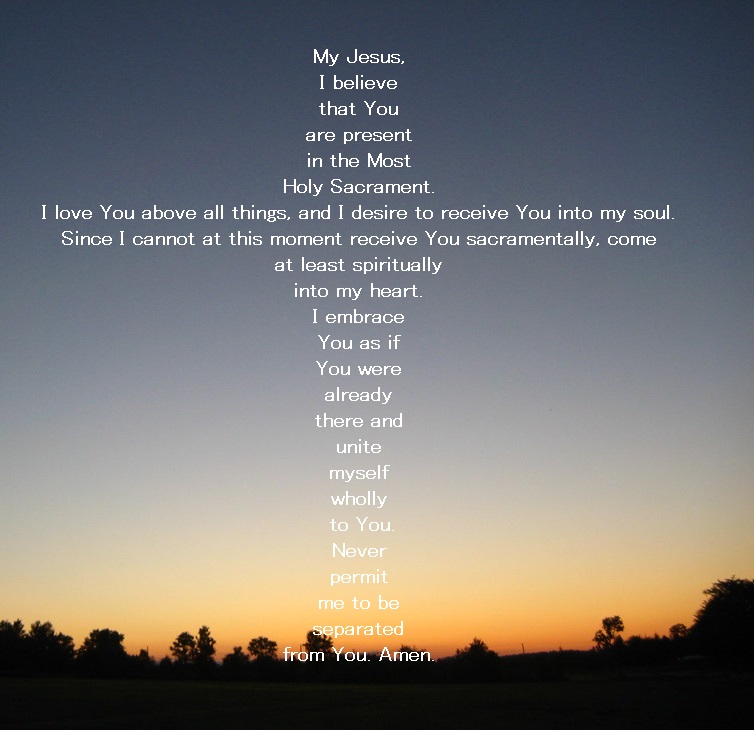
My Jesus,
I believe that You are present in the Most Holy Sacrament.
I love You above all things, and I desire to receive You into my soul.
Since I cannot at this moment receive You sacramentally,
come at least spiritually into my heart.
I embrace You as if You were already there
and unite myself wholly to You.
Never permit me to be separated from You.
Amen.

Just one month ago, when pews were full for the 2nd Sunday of Lent, we heard the Gospel story of the Transfiguration. On Mount Tabor, Jesus’ face shone like the sun and his clothes became white as light. Ecstatic, Simon Peter said in reply, “Lord, it is good that we are here! If you wish, I will make three tents here, one for you, one for Moses, and one for Elijah.” Peter wanted to never leave that euphoric time and place, but it was necessary that Jesus lead him down from that mountain top into the dark valley; from the Mount of Transfiguration to the Hill of Crucifixion.

It is a true sacrifice to fast from the Eucharist this Good Friday amidst this Long Lent. But our Christian sacrifice is not without purpose nor without hope. Like Jesus’ Passion, it is a sacrifice offered for the love of others. This is his Body given up to save many; we do this in memory of him. And like Jesus within his Passion, we can be confident that this arduous trial shall pass away and our suffering and obedience will soon yield great rewards, particularly a deepened love for our Eucharistic Lord. Being followers of the transfigured Christ takes us to Calvary, but the Passion is what leads us to his Resurrection. And the more we share in the likeness of Christ, the more we will share in his glory.

Christ Ordained

April 9, 2020

Holy Thursday


What the Old Testament foreshadowed, the New Testament reveals. What the Old Covenant prefigured, God’s New Covenant fulfills. What our Lord prepared in ancient times, he now bestows to his Church. The Holy Scriptures point to the gifts of God we particularly celebrate on this evening: the Holy Priesthood and the Holy Eucharist.

In the Book of Exodus, the Lord declares to Moses: “This is the rite you shall perform in consecrating [Aaron and his sons] as my priests. … Aaron and his sons you shall…bring to the entrance of the tent of meeting and there wash them with water.” On Holy Thursday, “[Jesus] rose from supper and took off his outer garments. He took a towel and tied it around his waist. Then he poured water into a basin and began to wash the disciples’ feet and dry them with the towel around his waist.

Peter said to the Lord, “You will never wash my feet.” But Jesus answered him, “Unless I wash you, you will have no inheritance with me.” The Book of Deuteronomy taught, “The levitical priests, the whole tribe of Levi, shall have no [landed] portion or [territorial] inheritance with Israel…. [T]he Lord set apart the tribe of Levi,” Deuteronomy says, “to carry the Ark of the Covenant of the Lord, to stand before the Lord to minister to him, and to bless in his name…. For this reason, Levi has no portion or inheritance with his relatives; the Lord himself is his inheritance….

When Jesus told Peter, “Unless I wash you, you will have no inheritance with me,” Simon Peter replied, “Master, then [wash] not only my feet, but my hands and head as well.” As part of the priestly ordination ritual in the Book of Exodus, the Lord commanded Moses: “[Sacrifice an unblemished male sheep and] some of its blood you shall take and put on the tip of Aaron’s right ear and on the tips of his sons’ right ears and on the thumbs of their right hands and the great toes of their right feet. Splash the rest of the blood on all the sides of the altar.” Jesus says Peter does not need to be washed all over, head and hand and foot, because whoever has bathed is clean. (This is likely a reference to his baptism.) But at the Last Supper, the Body of God’s perfect, unblemished Lamb is broken and his Blood is poured for the apostles.

As St. Paul wrote to the Corinthians: “[T]he Lord Jesus, on the night he was handed over, took bread, and, after he had given thanks, broke it and said, ‘This is my body that is for you. Do this in remembrance of me.’ In the same way also the cup, after supper, saying, ‘This cup is the new covenant in my blood.’” On Holy Thursday, the apostles receive the Blood of the Lamb and then, on Good Friday, this Blood marks the sides of the Lamb’s Altar, the vertical and horizontal beams of the Cross.

In Egypt before the Exodus, when the Lord instituted the Passover sacrifice, he commanded his people: “[E]very one of your families must procure for itself a lamb… The lamb must be a year-old male and without blemish…. It shall be slaughtered during the evening twilight. They shall take some of its blood and apply it to the two doorposts and the lintel of every house in which they partake of the lamb. That same night they shall eat its roasted flesh…. This day shall be a memorial feast for you, which all your generations shall celebrate… as a perpetual institution.” At the first Eucharist, Jesus commands his apostles, “Do this in remembrance of me,” thereby ordaining them as his priests of his New Covenant.

The apostles had been washed with water, sanctified by blood, bestowed an inheritance in the Lord, and entrusted with the mission of offering the unblemished Lamb. As the Catholic Church has always believed and taught, this memorial sacrifice, this Eucharist, re-presents, truly makes present, the sacrifice of the Cross, and applies its saving fruits among us. On Holy Thursday, Jesus gave his New Covenant Church the intertwined gifts of the Holy Eucharist and the Holy Priesthood.

The trial of this Long Lent of 2020 has made Catholics more appreciative of God’s precious gifts. This evening, we are blessed by the presence of the three seminarians from our local parishes assisting at Mass. We thank God for their vocations and urge them to press on. Eventually, this Long Lent of the Church will joyfully end and these young men will be (God willing) ordained to serve her, offering Christ’s sacrifice as loving servants for the good of us all. Pray for our seminarians, Eric, Matthew, and Isaac, that they may take up the cup of salvation; that they may offer the sacrifice of thanksgiving and call upon the name of the Lord; that they may fulfill ordination promises to the Lord in the presence of all his people. And with patient eagerness let us pray for the coming day when all of us, God’s priests and his people, can celebrate the Mass together again.

What We Should Do Now

March 25, 2020

The Solemnity of the Annunciation

The angel Gabriel was sent from God to a town of Galilee called Nazareth, to a virgin betrothed to a man named Joseph, of the house of David, and the virgin’s name was Mary. And coming to her, he said, “Hail, full of grace! The Lord is with you.” But she was greatly troubled at what was said and pondered what sort of greeting this might be. Then the angel said to her, “Do not be afraid, Mary, for you have found favor with God. Behold, you will conceive in your womb and bear a son, and you shall name him Jesus. He will be great and will be called Son of the Most High, and the Lord God will give him the throne of David his father, and he will rule over the house of Jacob forever, and of his Kingdom there will be no end.”

But Mary said to the angel, “How can this be, since I have no relations with a man?” And the angel said to her in reply, “The Holy Spirit will come upon you, and the power of the Most High will overshadow you. Therefore the child to be born will be called holy, the Son of God. And behold, Elizabeth, your relative, has also conceived a son in her old age, and this is the sixth month for her who was called barren; for nothing will be impossible for God.” Mary said, “Behold, I am the handmaid of the Lord. May it be done to me according to your word.” Then the angel departed from her.


What would it be like to be visited by an angel? Scripture tells us “some [people] have unknowingly entertained angels,” like Gideon or Tobiah, because angels can appear on earth in human disguise. But if you ever saw an angel in unveiled glory this spiritual creature would not be a winged Precious Moments character like some people imagine. As C.S. Lewis writes in the preface of his book The Screwtape Letters:

In the plastic arts [the symbolic representations of angels] have steadily degenerated. Fra Angelico’s angels carry in their face and gesture the peace and authority of Heaven. Later come the chubby infantile nudes of Raphael; finally the soft, slim, girlish and consolatory angels of nineteenth-century art… They are a pernicious symbol. In Scripture the visitation of an angel is always alarming; it has to begin by saying “Fear not.” The Victorian angel looks as if it were going to say “There, there.

When the Archangel Gabriel came and greeted the Virgin Mary in Nazareth, “she was greatly troubled.” He must calm and reassure her, “Do not be afraid, Mary, for you have found favor with God.” His message from Heaven is a weighty and mysterious one: you shall conceive and bear the Messiah, the Christ, who is both the heir to David’s kingdom and the Son of Almighty God. Mary has apparently made a prior vow to remain a virgin within her current marriage to Joseph, for she questions how she would ever conceive apart from relations with a man. Gabriel explains this will be through the power of God, for whom all things are possible. Even this answer leaves a great deal unrevealed.

It’s natural for Mary to feel anxious. She has heard God’s promises but much remains uncertain for her near and distant future: Will Joseph believe her? How should she parent such a Holy Child? How will Jesus become king? What will happen to her? How long or difficult will her life be? God’s full plan is unknown to Mary, but she knows what to do for that moment. She says, “Behold, I am the handmaid of the Lord. May it be done to me according to your word.” Through this faithful, trusting response, Jesus Christ saves his Church, the Virgin Mary becomes the Most Blessed, and every generation is blessed.

It’s natural to feel anxious now. We have received God’s promises but much remains uncertain about our near and distant future. Follow Mary’s example and entrust your life to God’s will, so that you may be the most blessed and a great multitude may be blessed through you.

Finding Jesus in the Temple

March 19, 2020

The Solemnity of St. Joseph

Each year Jesus’ parents went to Jerusalem for the feast of Passover, and when he was twelve years old, they went up according to festival custom. After they had completed its days, as they were returning, the boy Jesus remained behind in Jerusalem, but his parents did not know it. Thinking that he was in the caravan, they journeyed for a day and looked for him among their relatives and acquaintances, but not finding him, they returned to Jerusalem to look for him.

After three days they found him in the temple, sitting in the midst of the teachers, listening to them and asking them questions, and all who heard him were astounded at his understanding and his answers. When his parents saw him, they were astonished, and his mother said to him, “Son, why have you done this to us? Your father and I have been looking for you with great anxiety.” And he said to them, “Why were you looking for me? Did you not know that I must be in my Father’s house?” But they did not understand what he said to them.


Joseph and Mary feel great anxiety in these days. Jesus is missing and Jerusalem could be dangerous. Yet the young Lord Jesus is not lost. Retracing their steps they find him in the Temple. He’s dialoguing with the Jewish teachers, perhaps answering their replies with more probing questions of his own in the tradition of the rabbis.

Mary asks her Son, “Why have you done this to us?” Her anxiety, perhaps even touched by anger, is natural. Jesus has purposes in these events that his parents do not fully grasp, but they still love him and he loves them too. “Why were you looking for me? Did you not know that I must be in my Father’s house?” Jesus could have been found by his parents sooner; he was in the Temple the whole time.

You may feel great anxiety in these days. With the suspension of public Masses you could feel like Jesus is missing. Given the serious reports of disease the city could be dangerous. Yet we have not lost Jesus. Retracing your steps you can find him in the church.

What questions are you asking Jesus in prayer? What question does he pose you in reply? Perhaps you ask, “Why have you allowed this to happen to us?” Our feelings of anxiety or anger are natural. Jesus has purposes in these events that we do not fully grasp, but we still love him and he loves us too.

And Jesus can still be found nearby; he has been present in the tabernacle of the church this whole time. You can find Jesus in his Temple by visiting the Real Presence of our Eucharistic Lord. St. Paul’s Church is open daily, 7 AM to 7 PM and St. John the Baptist’s Church is open 8 AM to 7 PM on Saturdays, Sundays, Tuesdays, & Thursdays. These churches will be spray-disinfected for each day they are open, but use the cleaning materials located in the back of church to clean your seating area before and after use.

Follow these important safety tips as they might save your life or the lives of others’:

  • Realize that possibly 80% of confirmed cases of Coronavirus are contracted from people who did not realize they were sick and that symptoms typically take five days to manifest. Therefore, we must guard against this disease before we know it is among us. Practice social distancing.
  • If you have a cough or a fever, you might not be sick with the Coronavirus but please stay home; this virus can linger in the air and upon surfaces and infect others.
  • Remember that the virus can survive on surfaces (such as door handles, pews, and clothing) for one, two, or three days; so avoid touching your eyes, nose, or mouth. Treat unwashed hands as if they were infected and clean them often with soap and water.
  • Maintain at least a six-foot distance from other people.
  • No more than nine persons can be at the church at once (under emergency Wisconsin state law and by our bishop’s decree).
  • The most common place visitors sit in church is the back pews; so I suggest sitting in other, less-frequented, possibly-safer rows.


St. Joseph,
Patron of the Universal Church
and Protector of the Holy Family,
pray for us in our time of need


The Magi Sought Jesus — Epiphany of the Lord

January 7, 2020


The Magi from the east arrived in Jerusalem, saying, “Where is the newborn king of the Jews? We saw his star at its rising and have come to do him homage.” When King Herod heard this, he was greatly troubled, and all Jerusalem with him.

Why was King Herod greatly troubled? Because he saw this rumored, newborn king as a threat to his power and rule. No one ever mistook King Herod himself for being the Messiah or the Christ. Herod was not descended from David (as it was prophesied the great king of the Jews would be) and King Herod was not a godly ruler. The Roman Senate had installed him as king of Jerusalem and Judea, and he ruled as a brutal tyrant. Herod imposed harsh taxes, killed large numbers of his political opponents, and executed members of his family as well, including several of his wives and sons. The Magi, these wise astronomers from the east, had rightly interpreted the signs of heaven, but they badly misjudged Herod’s intentions. They had come, naturally enough, to Jerusalem to find the newborn King, but King Herod had no such son, so Herod hatched a wicked plan to murder any innocent child reputed to be the Christ.

Assembling all the chief priests and the scribes of the people, He inquired of them where the Christ was to be born. They said to him, “In Bethlehem of Judea, for thus it has been written through the prophet  [Micah]: And you, Bethlehem, land of Judah, are by no means least among the rulers of Judah; since from you shall come a ruler, who is to shepherd my people Israel.”

When King Herod was greatly troubled, all of Jerusalem was troubled with him because, knowing Herod, they knew the Magis’ message would likely lead to death and violence. Why did the Jewish religious leaders plainly-reveal to Herod where the Messiah might be born? They had reason to fear Herod, yet they could have demurred in Herod’s presence at responding to his inquiry. We must never tell lies, but we need not tell everything we know to everyone who asks us; for example, you don’t tell a killer where to find his next victim. The religious leaders could have replied to Herod, “Well, there are various disagreeing opinions about where the Christ will be born,” and that would have been true. The Jewish rabbis enjoyed theological debates about every question – and there was no need to let Herod know their best and most-accepted answer. Or, they could have replied, “Moses does not clearly tell us where the Christ will be born,” and that also could have been true – the prophet Micah provides that particular answer. Instead, the religious leaders tell Herod exactly where to look: “In Bethlehem of Judea,” they said to him. Without even realizing it, this was the Jewish religious leaders’ first betrayal, first denial, first rejection of Jesus Christ on earth.

Then King Herod called the magi secretly and ascertained from them the time of the star’s appearance. He sent them to Bethlehem and said, “Go and search diligently for the child. When you have found him, bring me word, that I too may go and do him homage.” After their audience with the king they set out [and found the fulfillment of their hearts’ hopes.]

If the Magi were “overjoyed at seeing the star,” imagine how they felt upon entering the house and finding Jesus with his mother. The Magi had traveled hundreds of miles to seek out the newborn king, to give him their precious gifts, and to show him their homage. But did any of Jerusalem’s priests or scribes travel the five miles to Bethlehem to do the same? Did any of them seek out the Magi or the Holy Family to privately warm them that they were in grave danger? Apparently not, for it required dreams from Heaven to warn the Holy Family and the Magi to flee from Herod. It is as if the religious leaders didn’t believe the Messiah, their Christ, would or could be born for them; like they did not believe that God was alive and active in their present day. Despite their vast religious knowledge, these men lacked faith. You and I profess to be Catholic Christians, and that is important. We have come to Mass today, and that is very well. But the Jewish leaders show us the danger of our faith being just a theory, an idea we hold without it prompting our full response to God.

The Magi sought out Jesus. Are we seeking a daily encounter with Christ? The Magi gave Jesus their precious gifts. Are we offering our Lord our time, talents, and treasures generously? The Magi prostrated themselves before Jesus and showed him their homage. Are we loving Jesus as merely an idea, or as the most important person in our lives? The beginning of this new year is a good time to take stock of ourselves and make resolutions to follow Christ better. Do not be afraid, for it will be the fulfillment of your heart’s hopes. If you are willing, he will lead and guide you on your journey.

Lord of wonder, Lord of light,
Lord with royal beauty bright,
Heaven leading, still proceeding,
guide us to thy perfect light.

Naming Jesus — January 1 — Mary the Mother of God

January 7, 2020

“When eight days were completed for his circumcision, he was named Jesus, the name given him by the angel before he was conceived in the womb.”

Who named Jesus? In one sense, it was his parents; Mary his mother and Joseph his adoptive-father. Yet this name was not their own idea. At the Annunciation, the Archangel Gabriel told Mary: “you will conceive in your womb and bear a son, and you shall name him Jesus.” And later on, an angel of God, likely Gabriel but perhaps another, told Joseph in a dream: “[Mary, your wife,] will bear a son and you are to name him Jesus, because he will save his people from their sins.” So this name was communicated to Jesus’ parents, and both parents were instructed to name him so, but the idea of this name and the commands to bestow it did not originate with the angels.

The word “angel” comes from the Greek and Latin words for “messenger,” and the angel spirits are messengers of God. The Archangel Gabriel was sent from God to Nazareth to announce to Mary the plan and will of God. So who named Jesus? First and foremost, God. The Letter of St. Paul to the Philippians declares, “[God] bestowed on him the name that is above every name, that at the name of Jesus every knee should bend, of those in heaven and on earth and under the earth”.

And what does the name of Jesus mean? The name “Jesus” (or “Iēsous” in Greek) is “Yeshua” in Hebrew, which means “Yahweh helps,” or “God saves.” The name of Jesus, given him by his Heavenly Father, denotes the message and the mission of the Son, And this message and mission was given him by the Father. Jesus declares, “I did not speak on my own, but the Father who sent me commanded me what to say and speak,” and “I came down from heaven not to do my own will but the will of the one who sent me.” The Father names his Son, and the Son is obedient to his Father’s authority.

Naming someone or something is to author its name, and authorship denotes authority over that person or thing. In the story of Creation, God creates and names the Day and the Night; the Sky, the Earth, and the Sea. Then the Lord forms man from the ground and settles him in the garden, with a mission to cultivate, protect, and care for it. Then God forms the animals from the ground, bringing each to the man to see what he would call them; and whatever the man called each living creature was then its name. Since none of these would be a suitable partner for the man the Lord formed another from the man’s rib, perhaps the bone closest to the core of man’s being, God’s last and ultimate creature. When the Lord brought her to the man, he rejoiced: “This one shall be called ‘woman,’ for out of man this one has been taken,” and the man gave his wife the name “Eve.” God blessed them and said to them: “Be fertile and multiply; fill the earth and subdue it. Have dominion over the fish of the sea, the birds of the air, and all the living things that crawl on the earth.

The man has sovereignty and dominion over the creatures he named. Parents, likewise, have authority over their children. As we heard last Sunday from the Book of Sirach, on the Feast of the Holy Family, “God sets a father in honor over his children; [and] a mother’s authority he confirms over her sons.” Both Joseph and Mary name Jesus on this eighth day after his birth and they exercise authority over the Child-God. “[Jesus] went down with them and came to Nazareth, and was obedient to them.” All legitimate authority (in a family, a workplace, a government, or the Church) is to be exercised in accord with God’s will. And when authority is exercised in this way, we can expect the household, business, nation, or Church to thrive—provided that legitimate, godly authority is likewise obeyed in accord with God’s will. ‘Jesus went down with Joseph and Mary, and was obedient to them; and his mother kept all these things in her heart. And Jesus advanced in wisdom and age and favor before God and man.’

Who have you been entrusted with authority over? For whom has God given you a mission to cultivate, protect, and care for as their Christ-like servant-leader? Recognize your mission, and exercise your authority in accord with God’s will as a blessing for others. And realize that those with spiritual authority over others (as you may have in your household) can literally bless them. Usually when we say “God bless you,” (that is, when we say this to a peer) we are not really blessing them ourselves but desiring, hoping, wishing, praying that God might bless them. As the Letter to the Hebrews says, “Unquestionably, a lesser person is blessed by a greater.” When we have spiritual authority for someone we can personally speak blessings upon them.

Words can not only encourage, but they also seem to have metaphysical power. Our first reading recounts how Aaron and his sons as priests of Israel were given authority to bless God’s people. The Old Testament patriarchs blessed their children and we see their words fulfilled. God creates and Jesus works miracles through spoken words; God said “let there be light” and there was light. Jesus said to the paralytic your sins are forgiven; stand up, pick up your mat, and go home, and the man was healed inside and out. Your words of blessing, in accord with God’s authority, can have great power, too.

[After preaching this homily last night, a parishioner shared with me that she and her husband learned about blessing and claiming dominion your household from friends a decade ago. They notice a difference in their family in their years of marriage before and after. For example, when she begins to fell minor health issues coming on, she asks for her husband’s blessing, and reports that she can “feel the power of his prayers.”]

So husbands, bless your wives and children, mothers bless your children, and bless your grandchildren, too. And on this first day of the year, ask God our Father and Holy Mary, the Mother of God and our spiritual mother too, to bless you and yours in this new year ahead.

The Visiting Shepherds — Christmas Mass

December 25, 2019

Early on the first Christmas Eve, in a field outside of Bethlehem, I imagine one of the shepherds complaining to his companions: “Wouldn’t you know it, we have to work on Christmas!” That’s just a joke, of course. The shepherds near Bethlehem, living in the fields and keeping watch over their flock, had no reason to expect that night would be anything special. Indeed, if not for Jesus’ birth into our world, today would be just another workday and there would be no reason to celebrate. But Jesus did come into our world to save us, and those shepherds were his first invited guests. “Do not be afraid; for behold, I proclaim to you good news of great joy that will be for all the people. For today in the city of David a savior has been born for you who is Christ and Lord.”

These shepherds would seem to be unlikely guests. Not rich, not powerful, not admired; but poor, dirty, and smelly. They lived apart from the community like outcasts. Shepherds were so little trusted that they could not give testimony in court. And yet, God’s Good News was offered to them. The Emperor Caesar Augustus, whose census brought the Holy Family to Bethlehem, was not given an angelic invitation. Perhaps the Roman Emperor was too proud to receive one; unwilling to admit that he was not a god over anything and that one God deserved his full worship, love, and obedience. But the shepherds were humble, humble enough to listen to the Heaven-sent message and act on it. “Let us go, then, to Bethlehem to see this thing that has taken place, which the Lord has made known to us.

The city of Bethlehem is to the south and west of Jerusalem. Bethlehem was only about 5½ miles away from the Jewish Temple, roughly the same direction and distance that St. John the Baptist Church in Cooks Valley is from here. Just as Bethlehem and Jerusalem are situated closely to each other, so Christmas points to Easter. The two are closely linked. It was specifically from Bethlehem’s flocks that sheep were provided to be sacrificed in Jerusalem for the peoples’ sins. In this region, the Lamb of God was born and to this region Jesus would return to die and rise to take away the sins of the world. Mary wrapped her little newborn snugly in swaddling clothes. Mary would later wrap his body in a linen burial shroud. Tradition says Joseph prepared a cave for the place of Jesus’ birth when other accommodations were unavailable. Later, another Joseph would make last-minute arrangements for Jesus to be buried in a rock-hewn tomb. Baby Jesus was born in Bethlehem, a city whose name means “House of Bread.” He was laid in a manger, a feed-box for grain. Later, on the day before he was to suffer, Jesus would take bread in hand and say, “Take this, all of you, and eat of it: for this is my body which will be given up for you.

The shepherds went in haste into Bethlehem and found Mary, Joseph, and the baby Jesus there. “When they saw this, they made known the message that had been told them about this child. … Then the shepherds returned, glorifying and praising God for all they had heard and seen, just as it had been told to them.” After Christmas, after that beautiful day, did the shepherds ever come back to visit the Holy Family? I doubt you could find two people more friendly and welcoming than holy Joseph and Mary, but did the shepherds ever take the opportunity to visit them and the Christ Child again? The Magi were soon to travel hundreds of miles to see Jesus just once, but these shepherds lived only a short, walking distance away. Did the shepherds ever take time come back and adore Jesus, to rest and to contemplate what he meant for their lives, to praise and thank the God for his presence in their midst? Did the shepherds ever get to know Mary and Joseph better, these holy saints and friends of God?

If the shepherds had spent a single hour each week in the presence of Christ and his holy family, imagine how it would have improved their daily lives; their work, their relationships, their whole outlook on life? Great graces flow from being close to Jesus. What do you think they should have done? What would you have done? We don’t know whether the shepherds ever came back again after Christmas, but if they didn’t, they really missed out. Living a life with Jesus Christ is better than a life neglecting him.

Christmas is a truly special day, a happy day and rightly so, but a day that points beyond merely itself to Easter and the fullness of Christ’s Gospel, Good News of great joy. For a Savior has been born for you who is Christ and Lord. Do not be too proud, do not be too busy, do not be afraid, make the short journeys to visit Jesus here again. Do not feel too unworthy to come, for even shepherds were his first guests. Feel welcome in this his dwelling place and find friends here among his family. Will you come back again after Christmas? I hope you will, but if you don’t, you’re really missing out; because living your life with Jesus Christ is better than life without him.

A Preview of our Future Glory – The Assumption of the Blessed Virgin Mary – August 15th

August 15, 2019

In the year 1950, with the world past beyond the deaths of World World II and rejoicing in the victory against evil, Pope Pius XII promulgated this joyful message:

“…For the glory of Almighty God who has lavished his special affection upon the Virgin Mary, for the honor of her Son – the immortal King of the Ages and the Victor over sin and death, for the increase of the glory of that same august Mother, and for the joy and exultation of the entire Church; by the authority of our Lord Jesus Christ, of the Blessed Apostles Peter and Paul, and by our own authority, we pronounce, declare, and define it to be a divinely revealed dogma: that the Immaculate Mother of God, the ever Virgin Mary, having completed the course of her earthly life, was assumed body and soul into heavenly glory.”

As Pope Pius detailed in the decree in which he proclaimed this dogma, the Church’s belief in Mary’s Assumption into Heaven is not something new. This is evidenced by the fact that no Church in East or West claims to have her body. You can find purported (and quite probable) relics of St. Peter or St. Paul, but you will encounter no bones of St. Mary. This is because Christians everywhere believed that her body no longer remained to be found anywhere on earth.

Some people say Catholics honor Mary too much, but this is an unfounded concern. Whatever we celebrate about Mary at the same time points to and glorifies her Son. The Lord’s Ark of the Covenant, his throne, and his mother are celebrated and glorious; but the One whom the ark, the throne, and the mother bear is greater still. While the mysteries of Mary point to and glorify Jesus, the mystery of Mary’s Assumption particularly points to our future glory in Christ.

For example, as I mentioned before, Mary’s body is no longer to be found on earth. In times past and present, some have doubted whether the bodily resurrection of the dead extends beyond Jesus from his tomb. Mary in her glory is not a disembodied spirit, but united in her body and soul. This is the future destined for our bodies as well. That is why we do not treat dead bodies as trash, like dirt swept up from the floor to be thrown outside to the wind. We reverence the bodies of the dead because those bodies will rise again.

We know more about Mary after her Assumption through the Church-approved apparitions of her; such as Our Lady of Guadalupe, Our Lady of Lourdes, Our Lady of Fatima, and other appearances. While we are not bound to believe in these apparitions, the Church – having investigated them thoroughly – has judged them to be true and worthy of belief. These apparitions indicate that Mary has been globe-traveling for nearly two thousand years.

The dogma of Mary’s Assumption leaves open the question of whether Mary ever actually died. There are traditions on both sides of the question, and Pope Pius XII merely proclaimed that she assumed after “having completed the course of her earthly life.” But in either case, whether she died or not, Mary now clearly shares in her Son’s victory over death. Death no longer has any power over her, and this will be true for all of us who rise in Christ.

A detail that seers of Mary’s apparitions agree on is that she is now exceedingly beautiful. During the years of her life on earth, Mary might not have been the most beautiful woman alive. We do not imagine that Jesus had to be the tallest or most muscular man who has ever lived, so likewise Mary need not have lived as history’s most beautiful woman either. If she had been that physically beautiful, I can easily imagine it impeding her God-given mission. But regardless, now there is no mismatch between Mary’s inner and outer beauty. This inner beauty is called holiness. Sometimes in this world the holy can look quite plain or even ugly, while the wicked can look very attractive. But after the resurrection, the abundance (or lack) of holiness we have cultivated within will be seen in our endless beauty (or ugliness) forever.

It seems that Mary, in her now-glorified body, can change aspects of her appearance. For instance, in her apparition to St. Juan Diego as Our Lady of Guadalupe in Mexico in 1531 she had darker skin and black hair, like the Native Americans. But at her first Church-approved apparition in the United States, to the Belgian-immigrant Adele Brise in 1859 here in Wisconsin near Green Bay, Mary had white skin and blonde hair. And on these occasions she did not speak to them in her own original language, in Hebrew or Aramaic, but in the familiar languages of those she was speaking to. She chose to look and speak this way to them because she is their spiritual mother. And she is our mother, too.

Mary may change her hair color, skin color, and age because these are relatively unimportant details of our person; but interestingly, she never appears as a different sex. She has never appeared as a bearded man declaring, “I am the Virgin Mary, who gave birth to Jesus.” God has created Mary as a female, just as the body he created for Jesus is forever male. God made them male and female, and what God has created is very good.

In none of her apparitions has Mary ever said, “I appreciate the sentiment, I really do, but could you please let up on all the prayers? I can’t keep up with all your Hail Marys!” Just imagine having an email account with an inbox receiving a billion new messages every day. For us this would be overwhelming, but Mary’s capacity to hear, and know, and act has been heightened in her glorified state. She hears you, she knows you, and she loves you personally. This foreshadows our life in the Kingdom to come. How many close friends can a person have? Five, ten, maybe twenty? But in Heaven we will have more than a billion such friends, and the capacity to profoundly know them all and to intensely love them all will be within our ability. The practice of love in this life is a preparation for that endless day.

What is Mary’s mission after her Assumption? It’s not that different from the Visitation we hear about in today’s Gospel. Mary encounters her extended family member, Elizabeth, and comes to serve her in love, for Elizabeth is up in age and pregnant with her first child. And Mary does not come alone, but with Jesus within her, and she helps to make him known. And then Mary and Elizabeth praise and rejoice in God together: “the Almighty has done great things for me and holy is his Name!” That is what she’s doing in her apparitions. And even after the Resurrection, that will continue to be her mission and ours; to encounter and love and serve our family in Christ, to praise and glorify God, and to rejoice with Christ and each other forever.

In conclusion, Mary’s Assumption points to our own bodily resurrection. Her beauty encourages us to pursue the beauty of holiness. She is our mother, and as long as we have God as our Father we will be their son or daughter forever. Mary knows and loves each one of us, helping us to grow in love. And her mission is our mission; to encounter and serve others, to walk with Jesus Christ, and to praise and rejoice in God. All of the mysteries of Mary point to and glorify Jesus, but the mystery of Mary’s Assumption particularly points to our future glory in Christ.

Lingering Wounds — Divine Mercy Sunday—2nd Sunday of Easter

April 15, 2018

Of all the apostles, it could be said that St. Thomas’ faith took him the farthest. Likely tradition says Thomas traveled more than 2,000 miles from Israel to evangelize India. From the seeds of his ministry and martyrdom there, tens of millions of Indians are Christians today. Yet, he’s not known as “Traveling Thomas” or “Faithful, Fruitful Thomas,” but famously as “Doubting Thomas” because of these passages:

Thomas, called Didymus, one of the Twelve, was not with them when Jesus came. So the other disciples said to him, “We have seen the Lord.” But he said to them, “Unless I see the mark of the nails in his hands and put my finger into the nailmarks and put my hand into his side, I will not believe.”

So why was Thomas so slow to believe? I would suggest three theories:

The first explanation would be that Thomas didn’t want it to be true. Many peoples’ lack of belief is due to an unwilling heart. They see no evidence for God because they have closed their eyes. If they were honest they would say, “I don’t want it to be true, because if it is then I’d have to change how I live my life.” Jesus says if we ask, we’ll receive; if we seek, we’ll find; and if we knock, the door will be opened to us. But this sort of person doesn’t ask because they don’t want good answers, they don’t seek because they’re afraid of what they’ll find, and they don’t knock because they don’t want to go in.

In the Book of Revelation, Jesus says, “Behold, I stand at the door and knock.” He knocks on the door of every human soul. But we can lock and block our door; with a big-screen TV of entertainment, or a bookshelf of learning, a trophy case of accomplishments, a heavy safe of accumulated wealth, or with several large-leafy plants so that a person may enjoy the beauty of creation while ignoring the Creator. If we insist upon self-centered ingratitude, the Lord will respect our freedom but we’ll be woefully unsatisfied forever.

But this is was not St. Thomas. He had sacrificed a lot to be Jesus’ apostle and had aspired to give him his all. On one occasion Jesus said, “Let us go back to Judea,” but the disciples replied, “Rabbi, the Jews were just trying to stone you, and you want to go back there?” When Jesus insisted on going, “Thomas, called Didymus, said to his fellow disciples, ‘Let us also go to die with him.’” At the Last Supper, when Jesus said, “Where I am going you know the way,” Thomas replied, “Master, we do not know where you are going; how can we know the way?” He was distressed because he loved Jesus and wanted to follow him anywhere. Thomas wanted the Resurrection to be true, but there was some other reason he wouldn’t or couldn’t believe.

A second theory for why Thomas was so slow to believe is that he was skeptically-minded. St. Thomas’ nickname, as you’ve heard it now a couple of times, was “Didymus.” In Greek, Didymus means “twin.” How was Thomas a twin? Scripture doesn’t say. Perhaps Thomas had a twin brother he had been mistaken for many times. In some icons of Jesus with his apostles, one of the apostles looks just like Jesus. Such art imagines that Thomas shared a twin likeness to the Lord. In either case, one could understand his initial skepticism about people seeing Jesus resurrected. “Nah. You guys saw somebody else.”

But Thomas has sufficient evidence to believe his friends. They are not claiming to have seen Jesus across the marketplace or walking through a field at dusk. (Neither Thomas nor we are expected to have blind faith, but to trust in trustworthy persons and things.) The other apostles are saying, “It’s true Thomas! He knew us, we saw his wounds!” Yet Thomas replies, “Unless I see the mark of the nails in his hands and put my finger into the nailmarks and put my hand into his side, I will not believe.” Why is Thomas so being obstinate?

The third (and I think most likely) explanation for why Thomas was so slow to believe in the Resurrection was that he hurt too much trust again. Who was Jesus to Thomas? He was Thomas’ hero, his admired teacher, his dearly beloved friend. Thomas thought Jesus would be the savior and messianic king of Israel, but Thomas’ great hope was murdered on Good Friday. Imagine Thomas’ prayer after experiencing that. “My God, how could you let this happen? He was innocent, he was so good! He was the best man I’ve ever known, and you let Him die! Why? How could do that to him? How could you do this to me?”

Jesus’ unexpected death broke Thomas’ heart, and perhaps having been so wounded once, he was resolved not to let his heart be taken-in again: ‘Unless I see the mark… put my finger in the nailmarks… put my hand in his side, I will not believe.’ Yet, though he doubts, notice where Thomas is one week after Easter. He’s with the other apostles in the upper room in Jerusalem, gathered behind locked doors for fear of those who killed Jesus. Now there are lots of other, safer places Thomas could have chosen to be. He could have returned to his hometown, back to the family and friends he left behind to follow Jesus a few years before. Though Thomas doubts, he does not leave this house of faith. He struggles with his questions, but he does not fully abandon Jesus. He seeks him here and because of it Thomas finds truth for his mind, healing for his heart, and peace for his soul.

The risen Lord appears in the upper room and how does Jesus respond to Thomas’ resistant unbelief? Not with anger. Not with condemnation. But with the same Divine Mercy we celebrate today. Jesus appears in their midst and says, “Peace be with you.” Then he says to Thomas, “Put your finger here and see my hands, and bring your hand and put it into my side, and do not be unbelieving, but believe.”

Curiously, Jesus still bears some of the wounds from his Passion: in his hands, feet and side. The cuts and swollen bruises are gone from his face, for the disciples respond to him with rejoicing rather than pity or horror, but he retains some marks from the evils that afflicted him. Jesus could heal or cover them—he’s God—but he choose not to. They are his trophies, the means of his glory, how he saved the world.

Our wounds, our losses, the sins and evils we suffer, they can scandalize us like Thomas was after the Passion. But through these things Jesus would glorify us, help to save others, and transform us into his more perfect twin. Jesus, having experienced wounds of his own, can relate and heal you.

Like St. Thomas, this Divine Mercy Sunday, you are gathered in this upper room with Jesus’ disciples. If there is any great wound or uncertainly in you, I invite you to be open to encounter Jesus anew like St. Thomas. Dare to ask, dare to seek, dare to knock. Jesus is not only your Lord and your God, he’s good and his love is everlasting.

The Name of Jesus

January 3, 2018

In Greek, the name “Jesus” is spelled “ΙΗΣΟΥΣ.” These first three Greek letters were Latinized into “IHS,” forming a symbol for the Holy Name of Jesus.

There is something surprising you probably don’t know about the name of Jesus. To set the stage, let us recount how Jesus’ Church developed and how different languages were incorporated into her worship of God and her proclamation of the Gospel.

The Church began in the Holy Land, Israel, where our Lord was born and lived, died and rose. Jesus probably ordinarily spoke Aramaic, a language related to Hebrew. Mark’s Gospel records Jesus calling God “Abba,” the Aramaic word for “Father.”

Christianity soon spread from there into Turkey and Greece. We see St. Paul ministering and writing to young Christian communities in these lands (including Ephesus, Colossae, Galatia, Corinth, Thessalonica, and Philippi.) Their language, like that of all the New Testament books, was Greek. Some vestiges of this era perdure in our liturgy: “Kyrie eleison… Christe eleison” means “Lord have mercy… Christ have mercy” in Greek.

Eventually, after years of terrible Roman persecution, Christianity prevailed. First officially tolerated in 313 A.D., Christianity then became the state religion of the Roman Empire in 380. Latin remains the official language of the Roman Catholic Church to this day – many of her most important documents are promulgated in Latin with all translations into other tongues being based upon those.

The Christian Faith has now come to every nation on earth, including our own. Today the Holy Mass is typically celebrated in the vernacular, that is, the local language of the faithful. For us, this is English.

Now we arrive at the surprising thing about the name chosen by God and communicated to Mary and Joseph by angelic messages to be given to the incarnate Son. “Jesus” is the Greek form of that name, but that’s probably not what his mother and foster-father called him around the house. In Hebrew/Aramaic, his name was “Yeshua.” (The English form of this being “Joshua.”) Jesus/Yeshua shares his name with the Old Testament’s most famous Joshua; which is fitting, for both men lead God’s people into (greater or lesser) Promised Lands. The name Yeshua/Jesus means “God saves,” and he would indeed “save his people from their sins.” (Matthew 1:21)

What is the value and power of a name? A relationship usually begins by knowing another person’s name. That name allows you to call upon them and to speak about them. Being on a first name basis with someone can develop an intimacy that gives you access to opportunities and good things you otherwise would not possess. So it is with Jesus’ name in whatever form it takes, “the name which is above every name” in power and glory. (Philippians 2:9)

You may have heard before of the four modes of prayer under the acronym of S.A.L.T.: Sorrow, Asking, Loving, and Thanking. Sometimes we might be too strained or suffering in body or spirit to compose long prayers to the Lord. At these and other moments, we may simply say, “Jesus, I’m Sorry,” “Jesus, Please,” “Jesus, I love you,” or “Jesus, thank you.” Even invoking the mighty, holy, and saving name of “Jesus” alone calls him to your side with a perfect knowledge of your heart. Such is the great gift of knowing the name of Jesus.

Jesus Christ, the Center of History

December 25, 2017

If you had walked through the streets Bethlehem or Rome asking people on the first Christmas Eve, “What year is this,” the answers you’d hear might vary. The Sun numbers our days, the Moon tracks our months, and the seasons indicate the passage of years, but answering what year it is requires people to make reference to some shared historical event.

If you had bumped into one of the ancient world’s many sports fans on the first Christmas Eve, they might have told you that it was 3rd year of the 194th Olympiad. Once every four years, famous athletic competitions were held in Olympia, Greece. Freeborn Greek men would compete in footraces, chariot races, wrestling matches, javelin tosses, discus throws, and other events; for the honor of the Greek god Zeus, for the pride of their home city-states, and for their own personal glory. The winners received crowns or wreaths made of green olive leaves that would fade. All that remains of some of those ancient sports superstars today are their names in texts read less often today than last month’s newspapers.

If you had run into a merchant on the first Christmas Eve who used the Roman coins and roads to trade goods, he might have said that it was 752nd year since the founding of the City of Rome. Considering the wealth and influence of Rome at that time, it might have seemed like that empire would live and reign in the world without end. However, from decay within and barbarian attacks from without, much of what that empire built remains today, if at all, only as ruins for tourists.

If you had encountered someone enamored with power and celebrity on the first Christmas Eve, they might have answered that it was 42nd year of the reign of Emperor Caesar Augustus. It was a census he decreed that sent Joseph and Mary to Bethlehem. Early in his reign, Caesar Augustus claimed that the passage of Halley’s Comet over Rome was the spirit of his predecessor, Julius Caesar, rising into heaven. And so, since Julius Caesar had been a god, Caesar Augustus, as his heir, presumed to call himself “the son of a god.” Caesar Augustus would go on to die at age seventy-five and never be heard from again.

If you had spoken on the first Christmas Eve to someone focused on the politics and current events of the land of Israel, they might have replied that it was 38th year of the reign King Herod the Great, the King of Judea under the Romans. Herod the Great was a very controversial figure, with some Jews praising him and still more despising him: he expanded and gloriously refurbished the Temple in Jerusalem but was also a murderous tyrant, like when he ordered the deaths of the innocent baby boys in Bethlehem. Because the Roman Senate had appointed him as “the King of the Jews,” and since he was not descended from King David, nobody mistook Herod for being the Christ.

On the first Christmas Eve, some two thousand and eighteen years ago, only a handful of people on earth had any clue of the world-changing significance of what was about to occur. The baby born that night was the source of the universe and the center of human history.

In the year we call 525, a new way of numbering years was introduced by a monk named Dionysius the Humble. Dionysius numbered years using this baby’s birth as the starting point, naming it “1 A.D.” A.D. stands for the Latin phrase “anno Domini / in the year of our Lord.” 1 A.D. was dubbed the first year of our Lord on earth, and this is currently the 2,017th year of our Lord, Jesus Christ. Now I should mention that Dionysius has reason to be humble here as well. He estimated the time of Jesus’ birth as best as he could, but he seems to have been a little bit off. The best evidence today points to Jesus being born in 2 or 3 B.C. But regardless, it is most fitting that we mark and celebrate the birth of Jesus Christ as the center of human history and the most important person who has ever lived.

  • Christ is the undefeated champion whose glory does not fade. Even when he seems to be down, he triumphs in overtime. (And, unlike Aaron Rodgers, “not one of his bones shall be broken.”)
  • Christ’s holy kingdom has outlasted the Romans. In fact, he conquered them peacefully by converting their hearts. And today, his kingdom extends to all lands and people through his Holy Catholic Church.
  • Christ is greater than Caesar, he is stronger than death. When Jesus died, he rose again. And now he reigns, because he is truly the Son of God.
  • Christ is the King of Kings and Lord of Lords. He is our leader untainted by sin, who is truly wise, and cares about me and you.

Even those without any Christian faith must acknowledge Jesus’ positive influence on the world: in children treasured; in women respected; in slaves freed; in strangers welcomed; in millions and millions fed, clothed, treated, or taught, around the world and across centuries, all because of the baby born on Christmas.

A.D. does not stand for an “Arbitrary Date.” Anno Domini is no accidental demarcation of before and after. Jesus Christ merits more than our apathetic dismissal. Jesus deserves to be at the center of our years and the center of our lives. As he, this Christmas night, so humbly gives himself to you, please give yourself to him anew. He is the Christ, yesterday and today, the beginning and the end, the Alpha and Omega, all time belongs to him and all the ages; to him be glory and power, through every age and forever, in you and in me. Amen.

Mary, the New Ark of the Covenant

September 4, 2017

Did you ever see Indiana Jones and The Raiders of the Lost Ark? You may recall seeing the movie’s replica of the Ark of the Covenant featured as the McGuffin artifact everyone was seeking out. This movie has been very helpful to preachers in providing a visual aid to everyone of what the Ark of the Covenant looked like.

Like Noah’s Ark, the Ark of the Covenant was a box constructed according to God’s design and command. It served as a portable throne bearing the presence of God on earth. The Ark held inside of it three important things: the two tablets of the Ten Commandments, the wooden staff of Moses’ brother Aaron the High Priest, and a gold jar containing some of the Manna God provided his people to eat in the desert. The reason I mention these things today is because the Ark of the Covenant in the Old Testament foreshadows the Blessed Virgin Mary in the New Testament.

The old Ark held the Ten Commandments, the word of God in stone; the Virgin Mary bears the Word of God in flesh. The old Ark held the priestly staff which on one occasion miraculously blossomed despite being dead; Mary conceives by the power of the Holy Spirit despite her perfect virginity. The old Ark contained Manna bread in a golden vessel; Mary’s holy womb contains the true Bread from Heaven, provided to us for our journey to Promised Land — Jesus Christ, our Prophet, Priest, and King.

At God’s command, the old Ark was made of natural wood overlaid with pure gold inside and out. Mary is a human woman who is made “full of grace.” King David once joyfully leaped and danced before the Ark of the Lord. At the Visitation, when Mary visits Elizabeth her relative, John the Baptist likewise leaps with joy within his mother’s womb. David once asked, “How can the Ark of the Lord come to me?” Elizabeth likewise asks, “And how does this happen to me, that the mother of my Lord should come to me?” On one occasion, the old covenant ark was kept for three months in the house of a man named Obed-edom outside Jerusalem, and Scripture records that God blessed his whole household. Mary likewise dwelt three months in the home of Zechariah and Elizabeth near Jerusalem and was surely a blessing to them.

No man was to touch the Old Covenant Ark, lest they be struck down dead. (God instructed his ministers to move that holy Ark only by means of two gilded poles which slid through rings on the sides of the Ark.) Joseph of Nazareth held a similar reverence towards Mary, his ever-virgin wife. In the Old Testament, the Lord was to be found wherever the old Ark dwelt, from the Sinai wilderness to the Temple in Jerusalem. In the New Testament, “on entering the house, [the Magi] saw the child with Mary his mother,” and, “standing by the cross of Jesus [was] his mother.”

In the movie, Indiana Jones and the Nazis were looking for the “lost” Ark because Scripture reports that the Old Covenant Ark was hidden soon before the Jewish Temple was destroyed by the Babylonians in 587 BC. Jeremiah the Prophet took the Ark and placed it in a secret cave. Unlike in the 1981 movie, the Lost Ark has never been recovered. Yet, in his revelations recorded at the end of the New Testament, John the Apostle sees the new Ark revealed. John writes: “God’s temple in Heaven was opened, and the ark of his covenant could be seen in the temple.” The next thing John describes is a glorious woman pregnant with the Christ child, “A great sign appeared in the sky, a woman clothed with the sun, with the moon under her feet, and on her head a crown of twelve stars.” This is Mary, the New Ark of the Covenant, whom at the end of her time on earth God lifted up body and soul into Heaven.

The old Ark was of central, though secondary, importance in the Old Covenant. Drawing physically nearer to it brought one closer to the presence of God on earth. Likewise, God gives the Blessed Virgin Mary, the new Ark, a central role in his New Covenant. If you draw closer in your relationship with her, you will surely draw closer to our Lord Jesus Christ.

Transfiguring Our Perception of Others

August 6, 2017

Today, Jesus hikes with his three closest apostles, Peter, James, and John, to the top of Mount Tabor in Israel. And there, Jesus is transfigured before them. His face shines and his clothes become intensely white. Then they hear God the Father speaking from a bright cloud that envelops them, declaring: “This is my beloved Son.”

In the Incarnation, some two thousand and seventeen years ago, the Eternal Word became Flesh, the Second Person of the Holy Trinity became Man, and the divinity of the Son of God became veiled within a human nature. It has long been my sense that Jesus is not changed or transformed at the Transfiguration so much as his apostles are allowed to glimpse him more deeply as he really, truly is: God from God, Light from Light. This light shines from his face as radiantly as the sun and from his body such that the fabric of his clothing is brightly illuminated like a thin lampshade.

When the disciples become frightened after hearing the Father’s voice and fall prostrate on the ground, burying their faces, Jesus comes over and touches them: “Rise, and do not be afraid.” And when the disciples raise their eyes, they see Jesus once more the same way as they had always seen him, and yet they see him differently now.

If we saw Jesus tomorrow while buying bread and milk at the store, or if Jesus visited our place of work, or came to our front door, do you think we would recognize him? I tend to doubt it. Many of the Jews in Jesus’ day noticed nothing extra special about him. “Is he not the carpenter’s son?” The Prophet Isaiah foretold of the Messiah that ‘there would be in him no stately bearing to make us look at him, nor appearance that would attract us to him.’ Even Jesus’ close friends sometimes had a hard time recognizing him after his Resurrection. The most famous example of this was on the Road to Emmaus. But by the gift of God’s grace, with the Breaking of the Bread, the eyes of Jesus’ disciples were opened and they recognized him in their midst. The reason I doubt that many would recognize Jesus amid their everyday lives tomorrow is because so few of us recognize him among us today.

In the very early Church, a man named Saul had a murderous hatred for the first Christians. One day, was traveling to Damascus, Syria to arrest any Christians he might find there and bring them back to Jerusalem in chains. As he was nearing Damascus, a light from the sky suddenly flashed around him. He fell to the ground and heard a voice saying to him, “Saul, Saul, why are you persecuting me?” Saul asked, “Who are you, sir?” And the voice replied, “I am Jesus, whom you are persecuting.” This man went on to be converted to a Christian. We know him today as St. Paul.

Note how Jesus does not say, “Saul, Saul, why are you persecuting my Church,” nor “Why are you persecuting my people.” He says, “Why are you persecuting me?” Jesus identifies himself with his people and his Church because he is personally present within them. At the Last Supper, Jesus tells his disciples, “In a little while the world will no longer see me, but you will see me… You will realize that I am in my Father and you are in me and I in you.” Jesus speaks of his mystical presence within us our and neighbors at other times in the Gospels as well.

At the Last Judgment, Jesus tells us he will say to his saved sheep: ‘Whatever you did for one of the hungry, or thirsty, or naked, or sick, or imprisoned little brothers or sisters of mine, you did it for me.’ And then Jesus will turn and declare to the condemned goats: “Amen, I say to you, what you did not do for one of these least ones, you did not do for me.” These goats, Jesus tells us, will go off to eternal punishment, but the righteous sheep to eternal life.

And so you see, recognizing, loving, and serving Jesus in other people must be a top and serious priority for us. Yet how many people do we interact with each day with so much thoughtless indifference? We speed past other people like so many unnoticed trees and cars as we drive along our way of life. Sometimes we even take the people living in our own home for granted, treating our family members worse than our mere acquaintances. Many failed to recognize Jesus’ importance in his day; while we overlook the importance of people in our midst today. As C.S. Lewis wrote:

“It is a serious thing to live in a society of possible gods and goddesses, to remember that the dullest and most uninteresting person you can talk to may one day be a creature which, if you saw it now, you would be strongly tempted to worship, or else a horror and a corruption such as you now meet, if at all, only in a nightmare.

All day long we are, in some degree, helping each other to one or other of these destinations. It is in the light of these overwhelming possibilities, it is with the awe and the circumspection proper to them, that we should conduct all our dealings with one another, all friendships, all loves, all play, all politics.

There are no ordinary people. You have never talked to a mere mortal. Nations, cultures, arts, civilization — these are mortal, and their life is to ours as the life of a gnat. But it is immortals whom we joke with, work with, marry, snub, and exploit — immortal horrors or everlasting splendors.”

So how can we begin to behold and relate to other people in the manner we ought, as Christ would have us do? Jesus himself was open and loving towards everyone. I would suggest two steps: First, ask for the gift of God’s grace at this Breaking of the Bread on the Feast of the Transfiguration, that your eyes may be opened to truly see others. And second, begin a habit of praying for, say, five or ten people every day whom you’ve never thought to pray for before. For example, the cashier who gave you change yesterday, that politician whom you dislike, the suffering people of North Korea, your child’s best friend, your quiet co-worker, and the person whom you heard just died. And then, the next day, chose another new collection of people to pray for. This practice will reveal to you your inter-personal, spiritual blinders, and help you to begin tearing them down. Let us ask Jesus to transfigure our perception of others so that we may see them more in the way that he beholds them, with love.