Our human knowledge and human awareness are limited and finite. Jesus Christ, however, is both fully human and fully divine. As the eternal, Second Person of the Trinity, his understanding and consciousness are unlimited. And so, amazingly and truly, he knew us and loved us even before time began.
At the beginning of creation, he foreknew you and loved you. He called Father Abraham in ancient times, in part, because he loves you. He freed the Hebrews from slavery in Egypt because he loves you. He settled his people in the Promised Land because he loves you. He established King David’s dynasty because he loves you. He commissioned all the prophets because he loves you. He brought his people back from exile because he loves you.
In the fullness of time, he became man because he loves you. He preached and ministered on earth because he loves you. He tolerated rejection and betrayal because he loves you. He endured whipping and mockery because he loves you. He accepted the Holy Cross because he loves you. He suffered and died because he loves you. But during this night upon the third day, he conquered death and rose again because he loves you.
In more recent days, he gave you life in your mother’s womb because he loves you. He encounters you in his Catholic Church because he loves you. He baptizes you to be his Father’s child because he loves you. He confirms you as the Holy Spirit’s temple and instrument because he loves you. He incorporates you into being a member of his mystical Body and Bride because he loves you. And he fills your life with more blessings than you can count because he loves you.
Each of us rightly celebrates this night because of Jesus Christ. You are here at Easter Vigil because you love him. But more importantly, you are here tonight because he loves you.
I have always been puzzled with the question of why an all loving God would ever will or direct that his Son be required to die in order for the door to heaven be unlocked so that we might enter into eternal life. I thought this would be an excellent reflection for us to enter into for this Good Friday Service. My research disclosed an informed reflection that was given by a Fr. Terrance Klein, a priest in the Diocese of Dodge City, last year on Good Friday as a homily he presented to his parish.
He indicated we must go back to our creation story in the Bible to find the answer to this question and it all goes back to the fact that the Father desires his children to love him and the fact that one can never order someone to love them. Love can only be obtained if someone has the free will to decide for themselves if someone deserves their love. Free will is a requirement for real love to exist.
God created humans in his image and likeness, but he also created them with a free will to accept or refuse his fatherly teachings and laws which was gifted to us to help us find happiness and yes eternal life with him in heaven. As Fr. Chinnappan told us at our Parish Mission, God does not send us to heaven or hell at the end of our earthly lives, we send ourselves to that place by and through our free will decision to live out our lives either believing and following the advice of our heavenly mentor Jesus, or by refusing that advice.
God sent his son to us in human form so that we might better understand his words and teachings. He sent Jesus with the mission to share salvation instructions so that we might not only be happy in this life but also join God in heaven after this life for all eternity. He did not send Jesus as death sacrifice for our salvation rather he sent Jesus to us with a mission to bring us into the heavenly family by and through use of the key to salvation which is love of God and neighbor. It was the tremendous love that Jesus has for each and everyone of us that he gave his life so that we could witness the fact that death does not trump God’s love for us, his children. The question for us to ponder is do we desire to love God and neighbor and accept his love for us, or not?
On behalf of our Parish I would like to thank Fr. Chinnappan for an insight on the last words of Jesus on the Cross which revealed to this Deacon as to why today is called “Good Friday.” So why is this day “Good?” Maybe it is because it was through Jesus’ Passion and Death that human death came to an end for all of us who have listened to the Word and obeyed His directives for happiness not only in this life but the life to come.
Did you know that a homily is different from a sermon? A sermon may be about whatever topic the preacher chooses, but a homily must be based upon the liturgy’s readings or prayers, or the particular feast celebrated that day. Rather than a sermon, the Catholic Church directs the preacher to give a homily at Mass, though she usually leaves it up to him to decide which specific theme or themes to highlight from the day’s readings, prayers, or celebration. The Mass of Holy Thursday is one rare exception.
For this evening, the Church requires in the current Third Edition of the Roman Missal: “after the proclamation of the Gospel, the priest gives a homily in which light is shed on the principal mysteries that are commemorated in this Mass, namely, the institution of the Holy Eucharist and the priestly Order, and the commandment of the Lord concerning fraternal charity.” In other words, tonight’s homily must be about Jesus beginning our celebration of the Holy Eucharist, his founding of the New Testament priesthood, and his commandment that we love one another. All three of these themes are reflected in Jesus’ words, “Do this in remembrance (or do this in memory) of me.”
On the first Holy Thursday, the night before he died for us, Jesus gathered his disciples for a meal, the Last Supper. While at table, he “took bread, and, after he had given thanks, broke it and said, ‘This is my body that is for you.’” After that, he took a chalice and said, “This cup is the new covenant in my blood.” Before being betrayed in the Garden of Gethsemane, Jesus hands himself over to his disciples. Before suffering his Passion, Jesus’ Body is broken and his Blood is poured. Before his death on the Cross, Jesus offers a sharing in his self-sacrifice. And Jesus says, “Do this in remembrance of me.”
Ever since, this “Breaking of the Bread,” this consecrating of the Holy Eucharist, this celebration of the Sacrifice of the Mass, has continued to our day. Read St. Justin Martyr’s Apology, an account from the 150’s A.D. describing how Christians worshipped together on Sundays. You will clearly recognize the elements and structure of the Mass. We have done this ‘in memory of him‘ from the era of the Acts of the Apostles to this very evening.
In commissioning his apostles to “do this in memory of me,” Jesus was ordaining them ministers of this new, Christian Sacrifice. He made them priests of the New Covenant, to lead, and teach, and sanctify his people. Without appointing clear shepherds for his Church on earth, Jesus knew his flock would inevitably scatter. Without priests, there would be no Eucharist to make us one in Christ. Please pray for your priests, please pray for more priests, and if Jesus may be calling you to ordination please do not ignore his call. The priesthood is that important for the salvation of souls.
Finally, in saying “do this in remembrance of me,” Jesus was not only telling his Church “do this sacrament until I come again.” And Jesus was not just telling his apostles “do this as my priests.” In saying “do this in remembrance of me,” Jesus was telling each of us to love like he does.
Did you know there are no words of consecration to be found in St. John’s Gospel? Jesus saying, ‘This is my body‘ and ‘This is my Blood‘ at the Last Supper is recounted by the other three gospel writers and by St. Paul in his 1st Letter to the Corinthians (as we heard tonight). So why does St. John leave this out? Perhaps, being the last gospel writer, he saw no need to repeat details others had already made well-known. Instead, John’s is the only gospel book which features the story of Jesus washing his disciples’ feet.
This humble, beautiful act of Jesus helps reveal more fully the meaning of his Eucharist Sacrifice. He, the Master and Teacher, washes feet. He, our God and Creator, gives himself as food. He, the King and Holy One, dies on a cross. Jesus does these things for us because he loves us. He says, “I have given you a model to follow, so that as I have done for you, you should also do… Love one another as I have loved you… Do this… do this… in memory of me.“
Today the Church is celebrating Palm Sunday, Palm Sunday reminds us of the glorious and triumphal entry of Jesus into Jerusalem. As Jesus entered Jerusalem the crowds greeted him with shouts of joy and proclaimed him as the messianic king. They spread their cloaks on the ground and placed the palm branches on the street and shouted “Hosanna to the Son of David” and “Blessed is he who comes in the name of the Lord.” The donkey was a symbol of peace and those who rode upon them proclaimed peaceful intentions. The laying of palm branches indicated that the king or dignitary was arriving at victory or triumph.
In the second reading of today. The hymn tells us that even though he was divine, he took willingly the human form for our sake. He is the new Adam who became obedient and did not cling to his divinity and, He is the servant of God who accepted sufferings for the sake of humanity. Finally, he died on the cross a death of shame and humiliation. That death became the sign of triumph and glory and the means of salvation for the world.
The Gospel tells us of his victory and reveals in painful detail the physical sufferings of Jesus. There is rejection, pain, misunderstanding, and Humiliation and yet through it, all Jesus stands firm, faithful to God till the end. In the process, there is a transformation. The leader becomes a servant, shame turns to honor, mockery becomes praise, fear turns to trust, abandonment becomes love, despair turns into hope, and above all death blossoms into new life.
In today’s Passion narrative, Luke builds up to five basic events that take place during the last few days of the earthly life of Jesus. The first is that Jesus shares his final meal with the disciples. Second, Jesus is arrested by his enemies. Third, Jesus is subjected to the so-called Jewish trial. Fourth, Jesus is subjected to the Roman trial and is condemned to death. Fifth, Jesus is crucified on the Cross. He dies on the Cross and is buried soon after.
We must be ready to surrender our lives to Jesus during this Holy Week and welcome Him into all areas of our life as our Lord and Savior, singing “Hosanna.” Today, we receive palm branches at the Divine Liturgy. Let us take them to our homes and put them in a place where we can always see them. Let the palms remind us that Christ is the King of our families, which Christ is the King of our hearts, and that Christ is the only true answer to our quest for happiness and meaning in our lives. And if we do proclaim Christ as our King, let us try to make time for Him in our daily life. Let us remember that He is the One with whom we will be spending eternity. Let us be reminded further that our careers, our education, our finances, our homes, and all of the basic material needs in our lives are only temporary. Let us prioritize and place Christ the King as the primary concern in our lives. It is only when we have done this that we will find true peace and happiness in our confused and complex world.
This week, let us reflect upon the mystery of the Passion of Jesus, our King, as we prepare ourselves to commemorate His glorious Resurrection. Let us remember that Jesus died for our sins, your sins, my sins. Let us be most thankful to the Lord Jesus in thoughts, words, and in actions. And may the Spirit of Jesus be with us during the coming week as we relive the last few days in the life of Jesus on earth. This is a perfect opportunity for us to learn about Divine love so we too may grow in the love of Jesus by the grace of the Heavenly Father.
Today, Jesus sends two of his disciples on a special mission. He tells them, “Go into the village opposite you, and as you enter it you will find a colt tethered [a young donkey] on which no one has ever sat. Untie it and bring it here.” Jesus rides that animal into Jerusalem in fulfillment of Zechariah’s ancient prophesy: “Shout for joy, O daughter Jerusalem! Behold: your king is coming to you, a just savior is he. Humble, and riding on a donkey, on a colt, the foal of a donkey.” Jesus does not approach with force upon a warhorse, but peaceably, humbly, a savior riding on a donkey.
Today, on Palm Sunday, his followers celebrate while his enemies complain. Later, on Good Friday, Jesus’ foes accomplish his murder while his friends mourn. A secret disciple of Jesus, St. Joseph of Arimathea, helps take the body of Jesus down from the Cross and wraps it in a linen cloth, laying him in a new tomb which Joseph had hewn from rock and “in which no one had yet been buried.” St. Luke notes how Jesus rides an animal “on which no one has ever sat” and is placed in a tomb “in which no one had yet been buried.” What is the significance of highlighting these details?
Both objects being never used before suggests them being set apart, consecrated for specific use by the Lord. In the Old Testament, God’s law sometimes required the sacrifice of heifers who had never worn a yoke. At times, the Ark of the Covenant was moved using brand new carts. And a Jewish tradition held that no one else could ride the animal upon which the king of Israel rode.
Providence had prepared that colt and that cave for Jesus Christ himself. Notice how neither the animal nor the grave was stolen; both of them were freely given to Jesus during Holy Week. And both these gifts were returned to their owners with added glory because of Christ. These things are symbols for us.
What does Jesus desire this Holy Week? He desires something made and meant for him, but which he will not steal. The gift can only be freely given, and the giver will share in his glory. What Jesus desires this Holy Week is you. Before you celebrate his Resurrection with him at Easter, join him at his table for Holy Thursday, and accompany him through his Passion on Good Friday. Jesus rode another’s colt, and he wishes to journey with you. Jesus laid in another’s cave, and he wishes to rest and live again in you. Gift yourself to Jesus Christ this Holy Week and he will share with you his glory.
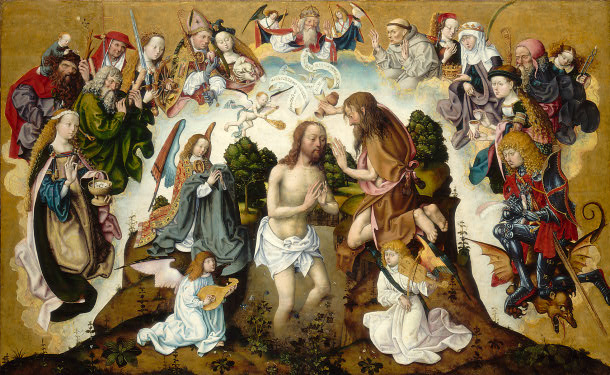
The Baptism of the Lord is a great event in the history of the Church because it is the first public manifestation of our Lord; the official revelation of Jesus as the Son of God to the world in the River Jordan by God the Father. John the Baptist was preaching and preparing in the wilderness and was baptizing all those who responded to his call of repentance. The purpose of his ministry of preaching and baptizing was to direct people towards Jesus who would baptize them with the Holy Spirit. Scripture tells us that Jesus came from Galilee to the River Jordan to be baptized by John the Baptist. Baptism is a call for the purification of sins, but Jesus is the Holy one of Trinity He does not need any purification. Though He is Son of God, He subjects himself to be baptized by another man to teach us the great virtue of humility.
The first reading taken from the Book of Isaiah tells us that the promised Messiah would be God’s chosen Servant in whom the divine soul would delight. The Messiah would have the Spirit of God upon Him bringing forth justice to all the nations, not just God’s chosen people. As the Servant of God, Jesus’ mission is modest and gentle in nature. He operates by His example and works. He brings a message of hope and consolation to all God’s people. Christ, the Anointed One of God is with us to bring us healing. Most importantly, He is here to restore our peace. Isaiah says in this way: “Console my people, console them…here is the Lord coming with power, his arm subduing all things to him, the prize of his victory is here with him…” This is exactly the ministry for which Christ was anointed and he empowered the human race for the entire salvation of God’s plan.
In the second reading, St. Paul invites us to recall our own Baptism — the gift of the Father, Son and the Spirit. He reminds us that the Lord has come to give us salvation and he gives us through the sacrament of baptism: “God saved us by the cleansing water of baptism and by renewing us with the Holy Spirit which he poured over us through Jesus Christ our Savior.” Through His own baptism, Christ sanctified and opened the fountain of baptism for us. He also initiated our redemptive process.
Today, the baptism of Jesus gives us our own identity. It reminds us who we are and to whom we are sent. By Baptism we become sons and daughters of God, brothers and sisters of Jesus, members of his Church, heirs of Heaven, and temples of the Holy Spirit. We are called to live as the children of God in thought, word and action. We are expected to lead a holy and transparent Christian life. The human body is the temple of the Holy Spirit and we belong to God who created us in his own image and likeness. Let us therefore grow and live in intimacy with God by personal and family prayers, by meditatively reading of the Word of God and fervently participating in the Holy Mass. Let us ask God to shower on us the divine graces to live out our baptismal life in a worthy manner. May the name of Jesus be glorified!
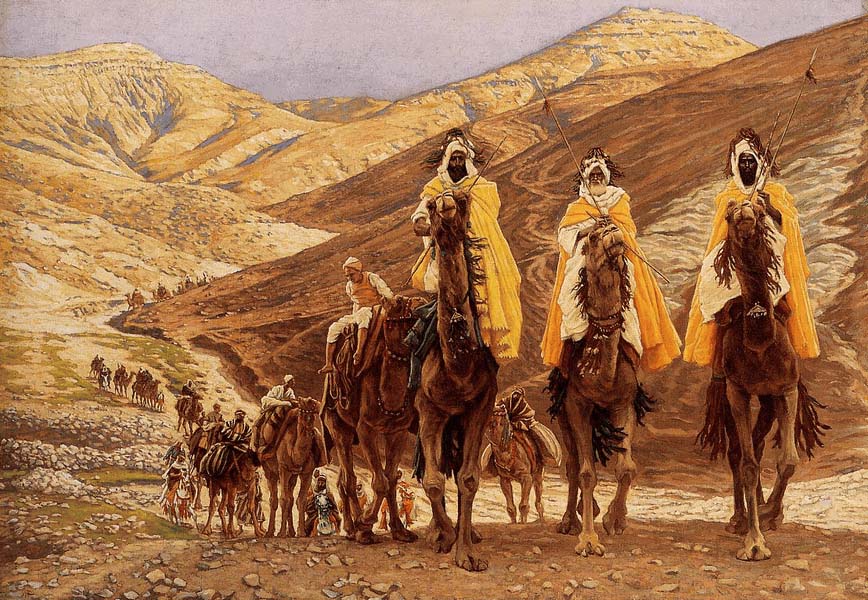
Did you notice that our three wise men statues arrived in our manger scene only on this Sunday of the Epiphany? That’s because the Magi were not in Bethlehem on Christmas Day. In many movies and imaginations, the visit of the shepherds and the arrival of the Magi get smushed together as events of the same night. St. Luke’s Gospel recalls Jesus being wrapped and laid in a feedbox and speaks about the shepherds, but St. Matthew’s Gospel tells us the Magis’ tale with several signs that the Magi came quite a bit later.
For starters, the Magi arrive in Jerusalem after their long journey from the east expecting that the new king has already been born. “Where is the newborn king of the Jews?” they ask. “We saw his star at its rising and have come to do him homage.” Once Herod had “ascertained from them the time of the star’s appearance” and had learned from the Jewish chief priests and scribes where the Christ was to be born, the wicked king sent the Magi to Bethlehem.
St. Matthew says “on entering the house they saw the child with Mary his mother.” There’s no mention of a cave or stable; it appears that the Holy Family has moved into better lodgings since Jesus’ birth. The Magi “prostrated themselves and did him homage. Then they opened their treasures and offered him gifts of gold, frankincense, and myrrh.” This happy encounter occurs at least forty days after Christmas. We know this because of a detail from the Gospel of Luke.
According to the Law of the Old Covenant, a Jewish woman who had given birth was required to wait a certain number of days and then provide sacrifices at the temple. For a baby boy, the mother had to wait at least forty days, then she was to bring the priest two animals for sacrifice; namely, a one-year-old lamb and either a turtledove or a pigeon. However, if she could not afford the lamb, God’s Law allowed her to just offer either two turtledoves or two pigeons instead.
St. Luke indicates that for Jesus’ Presentation at the Temple, after the completion of those forty days, Mary and Joseph were poor enough to take that second option, offering “a pair of turtledoves or two young pigeons in accordance with the dictate in the law of the Lord.” If the Magi had already visited, the Holy Family would have had some gold for buying a lamb. But Mary and Joseph did not have that gift because the Magi had not yet come. In fact, what King Herod goes on to do suggests it could have been more than a year later before the Magi arrived.
When Herod realizes the Magi have evaded him (for they were warned in a dream not to return to Herod) the paranoid and ruthless king does a horrifically evil thing. He orders that all the baby boys in Bethlehem – not just newborns but all those two years old and younger – be killed. This suggests King Herod thought the baby which the Magi sought could already be up to one or two years old.
The Magi arrive at our manger scene today on Epiphany Sunday because the Gospels show they celebrated the birth of Jesus Christ together with his Holy Family a time after Christmas Day. It’s interesting to learn about the Gospels and the life and times of Jesus, but collecting bits of biblical or historical trivia is not the point. What significance does the Magis’ later arrival have for our lives as Christians? One thing it means for Christ’s Church is that Christmas is not just a one day event but a whole season to celebrate.
What happens in our world on December 26th or 27th? Lots of people take down their decorations and throw out their Christmas trees. The Christmas songs played since before Thanksgiving disappear from the radio. Mentions of Christmas vanish from mass media because the opportunity to sell things to people has passed. Our secular culture uses Advent as its Christmas season, filling it with stressful hustling and hassles like Joseph and Mary experienced preceding Jesus’ birth. That birth is allowed one day of restful, spiritual, joyful peace and then the event is over. But for Catholics and Christians of times past, Christmas Eve is not the beginning of the end of Christmas, but the start of the Christmas Season. We are in that season now, decked in the liturgical color of white through the third Sunday after December 25th, the Feast of the Baptism of the Lord, which is next Sunday.
Beware of taking too many cues from the world of Herod, whose interests in Christmas are not pure. Let us learn instead from the Magi about celebrating this season. They come after Christmas day but are still “overjoyed” to celebrate his birth. They come to him, honor him, savor their time with him. They rest with him at Bethlehem. It appears the Magi did not come and leave in just one day, but were able to be warned in a dream not to return to Herod because they chose to rest with Christ and his Holy Family.
Living differently for Christ bears unexpected blessings and benefits. For instance, my good friend Katie told me yesterday that she gets a Christmas tree and puts it up on Christmas Eve. Doing it this way not only helps keep the whole season special but she gets a tree each year for free. (By that point, Christmas tree sellers are just happy to have her take one away.) Imagine no longer having to fit everything that is Christmas into the month of December. Like the Magi, you can plan trips and gatherings for after Christmas Day.
There’s still one week of Christmas left this year. Make a plan to keep it special. Play and sing your Christmas songs. Keep on feasting. Create some fun. And think of how next year you and yours can celebrate throughout the entire Christmas season. Like the Magi before you, let how you celebrate Christmas be guided by heavenly light.
“Mary, did you know that your baby boy is Lord of all creation? Mary, did you know that your baby boy would one day rule the nations? Did you know that your baby boy is Heaven’s perfect Lamb? That sleeping child you’re holding is the great “I Am“?
The answer to the lyrics just quoted from the popular Christmas Song “Mary did you know?” is “No! Not everything,” according to Pope John Paul II. She did not know everything at once and it is displayed in our gospel proclaimed in today’s Liturgy.
The morning I began to prepare for this homily I saw some very disturbing statistics from an article in The Wall Street Journal. Americans who pray daily was 58% in 2007, this dropped to 45% in 2021; Americans who identified themselves as Christians was 78% in 2007, in 2021 this dropped to 63%. This downward trend began long before COVID but increased during the pandemic. At our own parish we have experienced a substantial decline in attendance at Sunday Mass, especially family attendance. Other parishes have had similar declines.
So what’s going on? Our gospel displays to us the problem but it also gives us the answer to the problem. The problem is rooted in both mental and physical sufferings that are a part of the human experience. Sacred Scripture lays it out very well. Humans get sick, go blind, struggle with raising children, have disagreements with spouses and family, and yes the big one, death and when we pray for help we expect results not tomorrow but right now. All of these were experienced by Jesus the big question is: “Why?” The answer is a mystery we are incapable of understanding, but God did gift us with how we can get through these sufferings and anxieties when he sent His Son to experience these struggles and to supply us with the cure, and that is faith that the Father loves us, His Holy Family, and has a plan for us to follow and find happiness even while suffering, through His Holy Spirit and His Holy Family. The problem is our world has become secularized. Secularization is the process of removing religious and moral influence from our society. The significance of God and the Holy Family in our world is looked down upon and is been reduced.
Lets reflect on our Gospel this Feast of the Holy Family, and “Mary did you know?”. Humans are wired by our creator to care for and protect children we are blessed with. Mary was no exception and when her and Joseph realized Jesus was missing and days had passed panic hit them. They backtracked and found Jesus in the temple listening to the elders and conversing with them. They were upset and asked why Jesus had not told them where he was going. His reply was that he thought they would know that he was going to His fathers house. And then we are told that Mary and Joseph “did not understand what he said to them.” Thus we are given the answer to some of the songs questions of her that she did not know. But then we are told that Mary “kept all these things in her heart.” and thus she reflected upon her son’s words and she came to understand that Jesus had assumed she knew his vocation, to learn and be involved with public ministry. Jesus also realized they did not know this and felt sorry for not telling them his plans to visit his Fathers house, for we are told that “Jesus advanced in wisdom and age and favor before God and man and was there after obedient to them.”
Jesus made a mistake for causing anxieties to his Mother and his step father and corrected his behavior and honored his human parents. This is the guide line for human families becoming members of the Holy Family. They care for and correct mistakes they make within their Holy Family relationships and its members.
Being human will carry with it sufferings. There will be mistakes that we will make as members of the Holy Family that will cause not only us but other members of God’s family to suffer. We are called to reflect upon our mistakes and make corrections to assure those we have caused to suffer that this will not happen again. We are called by God to place other members of the family of Jesus ahead of ourselves when we realize that others need our help and support as Jesus, Mary and Joseph have taught us, by reflecting on our actions and praying to the Father for wisdom and direction in helping our brothers and sisters overcome their sufferings and anxieties of life.
Like Mary, there are many questions in life we don’t know answers to. It is faith that allows us to trust that the Father knows our fears and anxieties and will answer us through His Holy Family when the time is right, for as told to us by God we are to look to His Holy Family and the Word for help and guidance and as far as fear, He tells us: “Be still and know that I AM!”
It can be an alarming experience to encounter an angel. Their presence is typically veiled to us but once revealed to our human perception angels radiate such mightiness, holiness, and otherworldliness, that often the first thing they say upon appearing is: “Do not be afraid.” So it was on the first Christmas night in the fields outside the little town of Bethlehem where the shepherds kept watch over their flock.
A heavenly angel appeared to them, the Lord’s glory shone around them, and the shepherds were utterly terrified. But the herald angel said, “Do not be afraid… I proclaim to you good news of great joy that will be for all the people. …Today in the city of David a savior has been born for you who is Christ and Lord.” The angel then gave them a sign to look for, to know that they had found the newborn king: “You will find an infant wrapped in swaddling clothes and lying in a manger.” Suddenly, a whole multitude of angels appeared, praising God and saying: “Glory to God in the highest and on earth peace to those on whom his favor rests!” When the angels departed the shepherds were seemingly alone once more in the dark and quiet field.
Like the gospel two weeks ago about St. John the Baptist’s preaching, what strikes me about the angels’ proclamation is what the shepherds are not told to do. The Holy Family was very poor, but the shepherds are not told to bring them coins. The cave-stable in which Jesus laid was probably dirty like a barn, but the shepherds are not told to bring him a broom or clean blankets. Jesus’ parents had had a long day, but the shepherds are not told to bring them a meal. Any of these things would have been good gifts, but none of them were the most important thing. The angels invited the shepherds to bring themselves to Jesus; to approach him, see him, know him, love him, honor him; to come and encounter him, to come and adore him. This is the greatest gift.
Jesus Christ had only just been born on earth but the angels had already met the eternal Son of God in heaven. Through him all things were made, including the angels. The angels knew him from the start of their existence and in highest heaven they adored him constantly beholding his unveiled glory. In this, the angels seem to have an advantage compared to us. We see God’s creations, but they see the Craftsman. We see his effects, but they see the Source. We see his works which reflect his glory, but they see his glory directly. At Jesus’ birth, we see the Godhead veiled in flesh, lying in the manger. At his Holy Mass, we see Jesus Christ in the Eucharist, veiled in the appearances of bread and wine. Every good and beautiful thing you have ever enjoyed has its existence from him who is the most real, the most delightful, the greatest and best of all. And yet, for us human beings, God is easy to overlook.
If an angel had not visited the shepherds they would not have realized that they were within walking distance of their Savior, Messiah, and Lord. But once the angels had proclaimed the message and went away from them to heaven, the shepherds turned and said to one another, “Let us go, then, to Bethlehem to see this thing that has taken place, which the Lord has made known to us!” The shepherds left in haste, but imagine if… they had chosen not to go. The shepherds could have chosen not to go into Bethlehem. Nobody was forcing them to visit the Holy Family. They could have ignored Jesus and stayed away from him. Many people do.
The angels, in their beginning, once faced a choice like this themselves: would they love and adore and serve the Lord or would they disregard him, rejecting him and his reign? Would they love him or not? Would they worship God or themselves? The spirits who chose well are called the angels. The spirits who chose badly are called the demons. Ever since that decisive decision, the angels have loved and worshipped the Lord and been rightly ordered and thriving in his will, while the demons who refused to love and worship him have been disordered and depraved through and through.
Worship and love are linked. We worship what we love most, and that impacts our relationships to other things for good or ill. Imagine a child on Christmas morning who excitedly unwraps a new and coveted toy which, for a while, they love more than anything on earth. Will they remember to thank Mom and Dad who gifted it, or be too distracted to show gratitude? Will they be willing to share the toy with their brothers and sisters, or resent and fight against anyone who wants it? Will they draw closer to their family, or isolate to be alone with their most precious possession? Will they be delighted by that toy forever, or feel disappointment when it does not provide happiness unending? As adults, our coveted toys, our disordered loves, take different forms but lead to similar results. To love God as our greatest good and worship him with thanksgiving, praise, and openness to grace, are essential for us to love him and people and things like we should.
For the first Christmas, the angels’ gift to Jesus Christ was worship: “Glory to God in the highest!” And the angels’ gift to the human race was an invitation for us to do the same. As God’s messenger to you this sacred day, I invite and urge you to return to this church soon to faithfully encounter and adore your Savior, Christ, and Lord.
This December 8th unites two of our greatest saints: the Blessed Virgin Mary and St. Joseph. Today we celebrate both the Immaculate Conception and the conclusion to the Year of St. Joseph. Our Lady, under the title of “The Immaculate Conception,” is the patroness of our country. And Joseph, under the title of “St. Joseph the Workman.” is the primary patron of our diocese. Last year, our Bishop William Callahan proclaimed a year dedicated to St. Joseph beginning May 1st. Then, last December 8th, Pope Francis unexpectedly announced a Year of St. Joseph for the entire Church worldwide. As a result of this, our diocesan celebration of this Year of St. Joseph is the longest in the world: 19 months and 8 days in full. And this is very fitting, since our diocesan patron’s name, “Joseph,” means “he will increase.”
How beautiful it is that this date brings together Mary and Joseph! He, the noble head of the Holy Family; and she, the Immaculate Heart of their home He, her chaste guardian; and she, his loving spouse. Both are absolutely faithful and obedient, courageous and righteous. And both of them were chosen by God, chosen for each other, and chosen for Christ. Mary became Jesus’ loving mother and Joseph became Jesus’ nurturing foster-father. God chose them “before the foundation of the world, to be holy and without blemish before him.” Our Lord Jesus Christ chose them for himself and he also chose them for us.
Does Jesus get jealous at the Church celebrating Mary and Joseph? Does our Catholic devotion to Mary or Joseph detract from devotion we ought to have for Christ? In his recent book, “Consecration to St. Joseph,” Fr. Donald Calloway answers: “What brother would be offended if his younger siblings expressed love towards their mother and father? What man would be upset if another person wrote a song about his mother or placed roses at her feet? Likewise, what son would be disturbed if someone praised the virtues of his father? A person who honored a father would not receive condemnation from the father’s son. On the contrary, such a person would receive praise and tremendous favors from the son.” I would add that love in a family is not a zero-sum game, but that healthy love makes love grow larger. Devotion to Mary and Joseph does not make us love Jesus less, but helps us love him more.
Jesus has not diminished these parents who cared for him on earth. He has exalted and shared them with us. He has made his mother the mother of all Christians. Like the first Eve who “became the mother of all the living,” Mary is the spiritual mother to all those alive in Christ. He has made his foster-father Joseph, who successfully safeguarded the Holy Family through its trials, spiritual protector of the universal Church And ‘never was it known that anyone who fled to their protection, implored their help, or sought their intercession was left unaided.’ So be sure to befriend St. Mary and St. Joseph. Jesus loves them dearly and they aided him on earth. He wills that you would know them, and love them, and be helped by them through this life, too, by their powerful, loving care.
The first three evangelists, Saints Matthew, Mark, and Luke, all detail the same event from the Last Supper. In his First Letter to the Corinthians, St. Paul recounts it in these words:
“I received from the Lord what I also handed on to you, that the Lord Jesus, on the night he was handed over, took bread, and, after he had given thanks, broke it and said, ‘This is my body that is for you. Do this in remembrance of me.’ In the same way also the cup, after supper, saying, ‘This cup is the new covenant in my blood. Do this, as often as you drink it, in remembrance of me.’”
At every Mass, we recall how Jesus instituted the Holy Eucharist the night before he died. But the Gospel of John does not feature these words of institution. The Last Supper spans five full chapters in John’s Gospel—spending far more verses detailing Jesus’ words and deeds at table that night than is done by Matthew, Mark, and Luke combined—yet the phrase “This is my Body” is not included there. Why is this?
Both the early Church Fathers and modern scripture scholars agree that John’s was the last canonical gospel to be written. St. John probably thought it was unnecessary to retread again the same familiar ground as his predecessors, so he chose to omit the institution narrative. Instead, St. John shares with us the Bread of Life discourse. We’ve been listening to this chapter from John for the previous two weeks. Next Sunday presents the resolution of this story. And this Sunday, we would ordinarily be hearing the climax of Jesus’ teaching. Rather than being quoted saying “This is my body” at the Last Supper, in this gospel Jesus declares at the synagogue in Capernaum:
“Amen, amen, I say to you, unless you eat the flesh of the Son of Man and drink his blood, you do not have life within you. …For my flesh is true food, and my blood is true drink. Whoever eats my flesh and drinks my blood remains in me and I in him. …The one who feeds on me will have life because of me. …Whoever eats this bread will live forever.”
The other gospels include the eucharistic words of institution, but John particularly emphasizes Jesus’ real eucharistic presence.
As I said, we would ordinarily be hearing this climax to Jesus’ Bread of Life discourse this weekend, but it is preempted this year by the August 15th Solemnity of the Assumption of the Blessed Virgin Mary. Now I’m a very big fan of Mary but I also love that particular gospel reading from John 6, so I was a bit disappointed when I realized the first would be cancelling the second. But then I reflected upon Mary’s profound connections to Jesus’ Real Presence in the Eucharist, and there is actually great beauty in the convergence of these two holy days.
Consider: from where did Jesus receive the flesh he gives us in the Holy Eucharist? God ordained that Jesus Christ receive his human nature from his mother, Mary. At the Annunciation, Mary gave God her pure flesh and pure “yes,” saying “Let it be done to me according to your word,” on behalf of all humanity. That she might respond with a truly free “yes” and be a truly worthy source and vessel for her Son, the most Blessed Virgin Mary was preserved in flawless holiness by the grace of God from the first moment of her life. She lived all her days on earth in sanctity untainted by sin. The 16th psalm proclaims of God: “You will not allow your holy one to see decay.” And so, “the Immaculate Mother of God, the ever Virgin Mary, having completed the course of her earthly life, was assumed body and soul into heavenly glory.” This is the wonderful event which we remember and celebrate with Jesus and Mary today.
The sacred body and precious blood of Jesus we see held aloft at Mass come to us through the Blessed Virgin Mary. She is symbolically present on the altar as well. Consider the chalice. It is made from a precious metal and fashioned for a sacred purpose. It is traditionally veiled, denoting its dignity and sanctity. It is femininely curved, a vessel open to receiving and holding God’s gifts. The chalice is a symbol of the Virgin Mary, who is not to be adored as God and yet who is most profoundly close to him. Like Mary at the visit of the Magi, the chalice holds Jesus for all peoples to adore him.
At the Annunciation, after Mary responded, “Behold, I am the handmaid of the Lord. May it be done to me according to your word,” did she feel anything the instant the Word became flesh within her? Maybe she had the most enrapturing mystical experience ever known. Or maybe, when the angel departed from her, she felt nothing at the moment of the Incarnation. Either extreme seems possible, or it may have been something in between. When you receive the Holy Eucharist, you may or may not be graced to feel any different from the presence of Jesus within you. But consider how Jesus Christ has come to dwell in you at the center of your being as he did first within the Blessed Virgin Mary.
May Blessed Mary, the source of Christ’s flesh; the Lord’s holy chalice; the first Christian to commune with Jesus; intercede for you, helping you to know, love, and follow her Son. May you join them both in heaven one day so that all generations may call you blessed.
Nathan and Cassie’s wedding day lands upon this, the third Friday after the Feast of Pentecost, the eleventh day of June. God’s providence has arranged it that they be married on this special day – a feast day, the Solemnity of the Sacred Heart of Jesus, during a month especially dedicated to Jesus’ Sacred Heart. You can see depictions of the Sacred Heart inside this church. There is the statue of Jesus behind me, here in the sanctuary, and presently another statue in our devotional corner in the back. In artistic depictions, you may see Jesus’ Sacred Heart resting upon his chest, or maybe he holds it in his hand offering it to you, and sometimes his heart is depicted by all itself. In every depiction it is a human heart, crowned with thorns, pierced on the side, with flames and a cross emerging from the top. What is the meaning of these things? What do they reveal about Jesus? And what do they mean for Nathan and Cassie and us?
The heart is the organ within every human being which is most associated symbolically with emotion, devotion, and love. Since becoming man through his Incarnation two thousand years ago, the Eternal Son of God, Jesus Christ, has possessed a literal human heart in himself. And Jesus has personally experienced human feelings as well. But Jesus and his heart are not merely human, but divine. This reality is symbolized by the flames. As at the burning bush in Exodus, these flames do not consume his heart, but coexist with it and glorify it. Jesus feels and loves with a divine intensity, and this love leads him to sacrifice for love. This love gives rise to the Cross, upon which he suffered for us. This love occasions the crown of thorns, which he wore for us. And this love led to Jesus’ heart being pierced, the event we hear about in today’s Gospel. Jesus’ Sacred Heart is human and compassionate, divine and loving, long-suffering and glorious. And it is the will of Jesus, meek and humble of heart, to make our hearts like unto his, that you may endure suffering, be loving, and be made glorious.
You can see that this world is broken. Other people are broken. And you know, Nathan and Cassie, that though there is a great deal to like about you both, neither of you is yet perfect. Know that in your marriage, you will inevitably encounter suffering; sufferings caused by the world, sufferings caused by other people, and sometimes sufferings caused by each other. But when these thorns and small cuts come, do not let the fire of your love go out. Choose to keep loving, willing the good of each other. This is how Jesus loves us, and how he calls us to love.
This persistent decision to love is essential, but it is not enough. To love beyond human strength requires God’s strength; divine fire burning in your heart. You must love with Jesus’ love by connecting with him; praying daily, worshipping weekly, and communing with him constantly (spiritually or sacramentally) as you are able. Love each other by the love with which he loves you.
Choosing to love with the love of Christ in marriage is now your calling. This vocation together is to be for your joy, fruitfulness, and glory in the likeness of Christ. May Jesus Christ make your our hearts like unto his Sacred Heart, so that you may endure suffering, be loving, and be made glorious, like Jesus Christ himself.
Earlier this week was the last day of classes for another academic year at St. Paul’s Catholic School. This pandemic-impacted year posed challenges, but we prevailed. Our school met in-person throughout and gave our children a full education – focused on forming not only their minds but also their souls as well. This aspect is so important, it is the reason the Catholic Church has schools. A true education is not complete unless a person learns about God, about Jesus’ saving words and deeds, and how to live, both now and forever, as a Christian like him.
This is why I encourage any of you who have children attending public school to enroll them into Catholic school for this fall. Ask our school families about how excellent a school it is. They’ll tell you. Pray on this decision, ask the Lord where he wants your sheep to be. And realize that a great Catholic education for your children is much more possible than you might think.
My favorite part of being the pastor of a Catholic school is teaching and speaking with the children. Their openness to the things of God is beautiful. In their classroom or in church, you can teach these little ones holy truths and they joyfully believe them. This openness is part of why Jesus says, “Amen, I say to you, unless you turn and become like little children, you will not enter the Kingdom of Heaven,” and “Whoever humbles himself like this child is the greatest in the Kingdom of Heaven.”
Sometimes I’ll meet with a class of youngsters and their teacher in the church outside of the Mass. We remind the children how to use the Holy Water at the doors to bless themselves and to genuflect when they reach their pews. Then I love to teach them and ask them questions, questions like, “Where is Jesus here?”
Sometimes kids point to the big crucifix on the wall and I tell them, “That’s only a statue of Jesus. Seeing it reminds us of Jesus and can help us pray to him, but that’s just a statue which looks like him. Where is Jesus really, truly present in this room?”
The children then point to the golden box at the foot of the cross – the Tabernacle – inside of which, I explain, within a special container called a ciborium, is kept Sacred Hosts consecrated at previous Masses. At the priest’s words of consecration at Mass, these Hosts became Jesus Christ, his Body and Blood, Soul and Divinity, really and truly present, really and truly him.
In our Catholic churches, what is typically located front and center? Not the priest’s chair, not a donation box, not even the baptismal font, but Jesus’ Tabernacle and the altar. This is because Jesus Christ and his Holy Sacrifice are at the center of our Catholic Faith. At the Last Supper, Jesus said, “This is my Body,“ and “Do this in memory of me.” And his Bride the Church has listened, believed him, and obeyed him, celebrating his Real Presence at the Holy Mass throughout the centuries to this day.
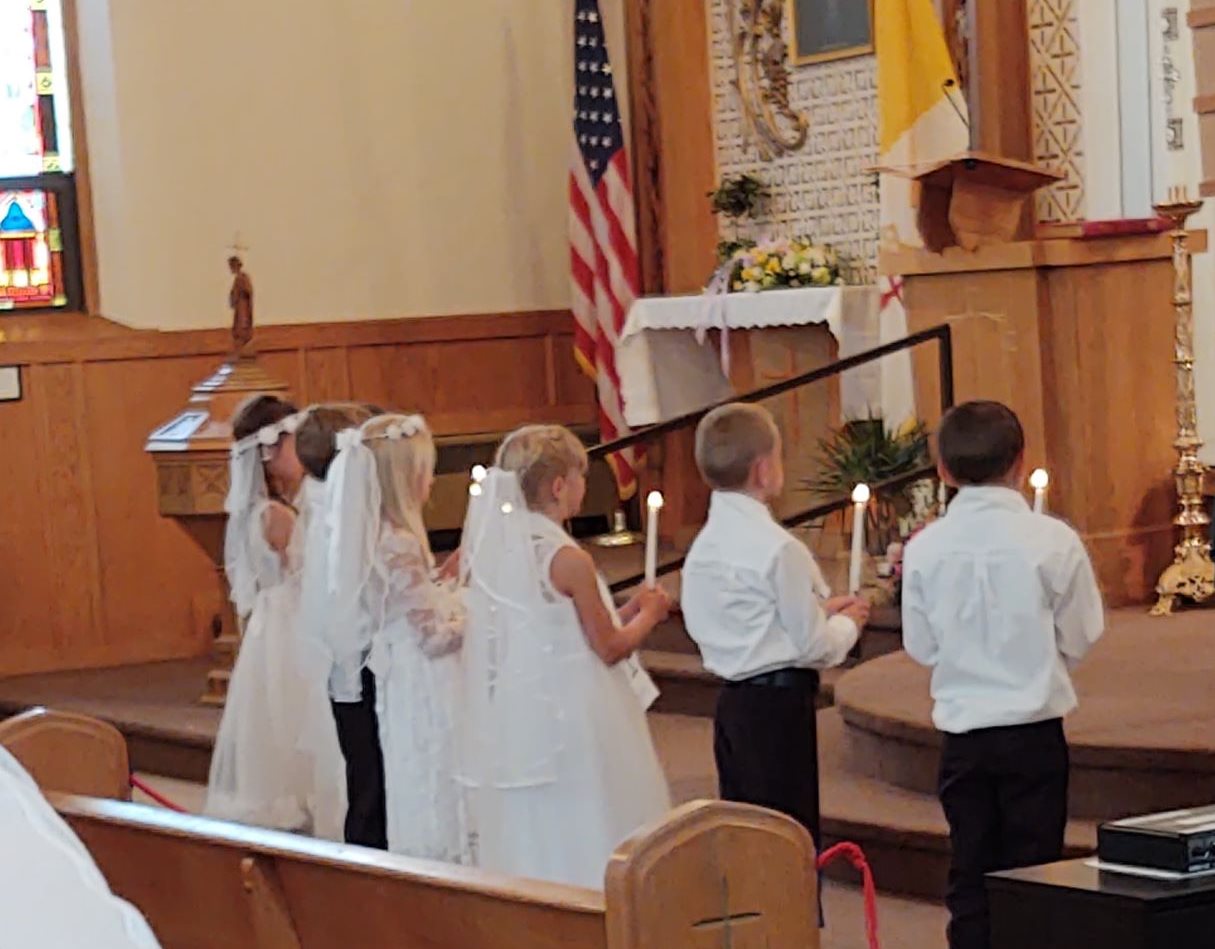
It has been humorously observed that for second graders preparing for and receiving their First Communion it can be harder for them to believe that the round, flat, unfluffy, Consecrated Host was ever bread to begin with than it is for them to believe it is Jesus. This is because they believe that Jesus can do, and does do, the things he says. On this feast of Corpus Christi, let’s humbly turn and become more like those children, who accept that their good and loving friend, our Lord Jesus Christ, is truly here before us.
St. Thomas the Apostle, a martyr for Jesus Christ, is famously nicknamed “Doubting Thomas.” He gets a lot of flack for being slow to believe because of today’s reading from the Gospel of John. One week after Easter Sunday, Jesus appears in the Upper Room once again. This time Thomas is there and Jesus says to him: “Put your finger here and see my hands, and bring your hand and put it into my side, and do not be unbelieving, but believe.” Yet the Gospels show that other disciples were slow to believe as well. The last chapter of St. Mark’s Gospel summarizes Jesus’ post-Resurrection appearances in this way:
“When he had risen, early on the first day of the week, he appeared first to Mary Magdalene, out of whom he had driven seven demons. She went and told his companions who were mourning and weeping. When they heard that he was alive and had been seen by her, they did not believe. After this he appeared in another form to two of them walking along on their way to the country. They returned and told the others; but they did not believe them either. But later, as [the apostles] were at table, he appeared to them and rebuked them for their unbelief and hardness of heart because they had not believed those who saw him after he had been raised.”
St. Luke records how at that first appearance in the Upper Room, even after Jesus had shown them his wounded hands and his feet, the disciples were “still incredulous for joy.” And later, when the eleven apostles went back up north to Galilee, to a mountain to which Jesus had ordered them, St. Matthew notes, “when they saw him, they worshiped, but they doubted.” There Jesus gave them The Great Commission to make disciples of all nations, even though their faith was not yet perfect.
After everything that the apostles had witnessed Jesus do during his ministry; including multiplying loaves and fishes to feed thousands of people, walking on water, and bringing at least three persons back to life, they still felt doubt. Jesus had raised Jairus’ 12-year-old daughter from the dead. He raised the only son of a widow of the city of Nain from the dead. And Jesus raised Lazarus, the brother of Martha and Mary of Bethany, from the dead. Yet the apostles still doubted, despite evidence, that Jesus himself had resurrected from his tomb. This seems senseless, but I can’t be very hard on them.
When I was in school, our science teacher once attached a bowling ball to a rope and attached that rope to the ceiling. The challenge was to hold the ball up to your nose (so that the rope was without slack) and then to release it, allowing the bowling ball to swing away and swing back toward your face, without flinching. Now I knew that if I didn’t push the ball away when I released it, and if no one touched the ball while it was in motion, if the whole thing held together and if I stood in place, there was no way that bowling ball could possibly hit my face. But when I saw it coming toward my face, I still flinched and stepped back. What we feel doesn’t always match what we think.
It’s like when you fly on an airplane. You know its the safest form of travel. But maybe you still get a bit anxious as you’re boarding, or when the jet accelerates faster and faster down the runway, and climbs thousands of feet up with nothing but empty air between you and the ground. You’re a little alarmed when you hear the aircraft make its mechanical sounds, or when you’re descending to land and you see everything on the ground getting closer and closer, hurtling by. You feel nervous flying, even though your car trips to and from the airports put your life in greater danger than the flight. I think this is just a part of our present human condition; we can doubt even the things we know with certainty. So how can you nurture and deepen your faith? First, in Christian community. Second, by asking and seeking. And third, by being it into being.
Christian community, both here at Mass and outside of Church, helps sustain our faith and grow it. We Christians are like lit charcoals inside of a cookout grill. If you were to dump and scatter these coals across your driveway, they would cool off entirely, achieving nothing but a mess. But by gathering these lit coals together, they become hotter and remain hot by sharing one another’s warmth. As the Letter to the Hebrews says, “We must consider how to rouse one another to love and good works. We should not stay away from our assembly, as is the custom of some, but encourage one another.” When St. Thomas was not yet fully convinced that Jesus had arisen, he still remained within the Christian community. Inside the Upper Room, where the first Eucharist was celebrated, Thomas went on to become convinced of the wonderful truth about our Lord and our God. So do not neglect, but prioritize in your life, your Christian friendships and our community.
Another important way to nurture and deepen your faith is by asking good questions about it and seeking out the truth. The two disciples on the road to Emmaus were discussing and debating with one another about Jesus’ life, death, and resurrection. Then, though they did not fully recognize his presence, Jesus himself drew near and walked with them. He opened their minds to understand the Scriptures and set their hearts burning with new faith and joy. Jesus calls us to be childlike but he wants our faith to be mature. He invited Doubting Thomas to investigate and probe him. Jesus says, “Whoever asks receives, and whoever seeks finds.” So ask mature, challenging questions about our Faith, in conversation, in study, and in prayer. Ask good questions and you will find solid answers to strengthen your faith.
And a third way to deepen your faith is by being it into being. What are the true and beautiful things we believe that you tend to doubt? What are some Christian truths you profess but sometimes have a hard time feeling or living out? Maybe it’s the belief that you’re loved. Maybe it’s the belief that you’re forgiven, or that you could be reconciled to God. Maybe it’s believing that you’re never truly alone. Or maybe it’s believing that Jesus is alive and active today in your life and our world. Ask God to show you your half-accepted Christian beliefs and reflect on them. Ask God for grace to accept these more fully and then be them into being, by which I mean, act as you would if you accepted these truths completely. Then you will begin living more like Jesus wills for you.
On one occasion, the apostles pleaded with Jesus, “Increase our faith!” And the Lord replied, “If you have faith the size of a mustard seed, you would say to this mulberry tree, ‘Be uprooted and planted in the sea,’ and it would obey you.’” Here Jesus is saying that even if your present faith is tiny, know that your small, imperfect faith is already enough for you to begin doing and becoming everything that he desires for you.
On Holy Thursday, I spoke about Jesus as the New Passover Lamb who calls us to his feast. On Good Friday, I preached about Jesus as the New Adam who begins a marriage covenant with us, the Church, his bride. Tonight, we celebrate Jesus’ Resurrection from the dead, the beginning of the New Creation. In the beginning, when God created the heavens and the earth, he created everything from absolutely nothing and yet he created everything according to a logic, a reason, a Logos, a wisdom, a Word.
“The Word was with God, and the Word was God. He was in the beginning with God. [And] all things came to be through him…” according to a plan.
This divine plan was not merely to create a vast, material universe of stars, planets, moons and comets in reflection of God’s glory, but also to create (at least on one planet) many living things as well. Plants and trees were added to the dry land. Swimming creatures were added to the sea. Winged birds were added to the sky. and cattle, creeping things, and of all kinds wild animals were added across the earth. But God’s the ultimate living creation would be “the only creature on earth that God has willed for its own sake”:
God created man in his image; in the image of God he created him; male and female he created them. And God blessed them, saying: “Be fertile and multiply; fill the earth and subdue it.”
“God looked at everything he had made, and he found it very good.” And then, the Book of Genesis says, “on the seventh day God was finished with the work he had been doing, [so] he rested on the seventh day from all the work he had undertaken.” But it would be a short rest. Because of human sins and the Fall of Creation, there would be much more work for God to do.
This work is the story of Salvation History reflected throughout tonight’s Old Testament readings: words and deeds across places and times to reconnect with our human race, to reclaim, redeem, and restore us. These many works of God culminated in Jesus Christ. “The Word became flesh, and dwelt among us.” He lives as the New Adam who passes the test. He dies as the New Passover Lamb who sets us free. Saturday was the Jewish Sabbath Day of Rest. And on Holy Saturday, the seventh day of the week, Jesus perfectly fulfills the law, his lifeless body resting in the tomb. When the Sabbath was over, on Easter Sunday (which is the first day of the week again, or what Early Christians called the eighth day) Jesus begins the New Creation in himself, by his Resurrection.
As proclaimed in our Easter Gospel, the tomb was emptied. “Do not be amazed!” an angel told the women there, “You seek Jesus of Nazareth, the crucified. He has been raised; he is not here. Behold the place where they laid him.” Not merely had Jesus’ spirit been raised, but his physical body too. Were it otherwise, when he appeared to his disciples on Easter, his dead body would still be in the tomb. The risen Jesus visits them in the Upper Room and says, “Look at my hands and my feet, that it is I myself. Touch me and see, because a ghost does not have flesh and bones as you can see I have.” He shows them his hands, his feet, and his side because these still bear the wounds he suffered during his Passion. It seems his many other cuts and bruises are healed and gone, but Jesus retains these wounds without pain as trophies of his triumph.
“He is the beginning, the firstborn from the dead.” He is the plan revealed, the pattern of what is to come, both for those in Christ and for our universe. For death is not the end of us and the Last Day is not the end of the world. The dead will live again and the universe will be glorified into “a new heavens and a new earth.” As St. Paul wrote:
“Creation waits with eager longing for the revealing of the children of God […] in hope because creation itself will be set free from its bondage to decay and share in the glorious freedom of the children of God. We know that the whole creation has been groaning in travail together until now; and not only the creation, but we ourselves who have the first fruits of the Spirit groan inwardly as we wait for […] the redemption of our bodies.”
In our lives we now struggle against evil and sin. This broken world causes painful wounds in us. But the glorious wounds which remain in the risen Savior’s body reveal something beautiful: that with Christ all our trials and sufferings will be weaved into the tapestry, into the New Creation, he is now fashioning. “He will wipe every tear from [our] eyes, and there shall be no more death or mourning, wailing or pain, the old order [will have] passed away.” In light of Jesus, St. Paul can say, “I consider that the sufferings of this present time are as nothing compared with the glory to be revealed for us.” The beginnings of that glory are revealed to us tonight, in the Easter resurrection of our Lord. “Behold,” Christ says, “I make all things new.”