Archive for the ‘Jesus Christ’ Category

Obstacles to Jesus — 31st Sunday of Ordinary Time—Year C

November 6, 2019

Last week, Jesus told us a parable about a penitential tax collector. This Sunday, St. Luke recounts for us a true story about real one. Jesus came to Jericho and a man there named Zacchaeus, a chief tax collector and a wealthy man, was seeking to see him. You just heard the ending of that story; Zacchaeus joyfully succeeds in to beholding and encountering Jesus, and Jesus happily succeeds in finding and saving Zacchaeus. But Zacchaeus’ story would have ended differently if he had allowed any earthly obstacle or any human excuse to stop him. What sort of things could have gotten in Zacchaeus’s way of seeing and encountering Jesus? Many of the same things that can get in our way.

For starters, Zacchaeus could have believed or claimed that he was too busy to devote time for Jesus. Zacchaeus was a chief tax collector, a busy man, and this appears to have been a working business day. Faithful Jews did not walk long distances on the Sabbath day of rest. The rabbinic tradition set the limit for Saturday travel at 2,000 cubits or about ¾ of a mile. (That’s not very far.) But Jesus walked to Jericho and had intended to pass through the town, suggesting that tolls and taxes from toilers and traders and travelers were there for the tax man’s taking. But Zacchaeus made time for Jesus in his busy day.

Are we busy? I’d bet that most people would say that they are, but busy with what? Last year, the average American adult spent 3 hours and 44 minutes a day watching television; that’s more than 28 hours per week, that’s a full 56 days in a year! Maybe you don’t watch TV at home (I don’t) but how much time do we expend with games and social media and entertainments online? Whether we have time or not for something is really a question of priorities.

We just celebrated All Saints’ Day’s. Have you ever considered, if you get canonized as a saint someday, what you would like to become the patron saint of? If I get canonized I’d like to be the patron saint of packing. I have a number of reasons for desiring this niche but needed patronage, but it all goes back to a lesson from my father. One time, for an Illinois trip, he taught me how to pack a car trunk. He said, “Put the big things in first, and then fit the smaller things in around them.” So it is with life; put the big things in first. Make time for weekly Mass, daily prayer, spiritual study, and spiritual growth. Make them your priority.

Another reality that could have made Zacchaeus give up on Jesus when they got in his way was other people. “Zacchaeus was seeking to see who Jesus was; but he could not see him because of the crowd, for he was short in stature.” (In other words, Zacchaeus wasn’t tall.) The crowd was not only an imposing physical barrier, but a hostile obstacle as well. They all knew him by sight and despised him as a sinner. Because of Zacchaeus’s small size, they could easily and effectively block him out or even push him away from Jesus.

On this occasion, the short of statue Zacchaeus was one of the “little ones” whom Jesus warns us not to despise: “It is not the will of your heavenly Father that one of these little ones be lost.” And Jesus warns of great woe for anyone who causes his little ones spiritual harm: “Whoever causes one of these little ones who believe in me to sin, it would be better for him to have a great millstone hung around his neck and to be drowned in the depths of the sea.” It is gravely wrong to push people away from Jesus through sin, but it is also a great error for us to allow others to push us away from Jesus. Jesus’ Church is holy but it’s the home of sinners, too. Do not let Judas’s betrayals or Peter’s denials, as horrible as these scandals are, keep you away from meeting Jesus here.

Zacchaeus did not let the obstacle of other people thwart him. When he was unable to penetrate the crowd, “he ran ahead and climbed a sycamore tree in order to see Jesus, who was about to pass that way.” It is debated within scripture commentaries whether is was considered undignified for a first century Jewish man to run apart from an emergency. But another embarrassing aspect of this story remains recognizable for us today. When was the last time you saw a grown man climb a tree for any reason other than to cut down a branch? Climbing trees is something kids do. When people saw Zacchaeus, the rich man, sitting in a tree on Main Street they probably pointed and laughed at him. But Zacchaeus ignored their gossip and mockery to do this for Jesus, and that made the difference for his soul.

Jesus expects us to be different from the world sometimes, both in the things we do and the things we don’t or refuse to do. And people will not always respect us or like us because of it. There are various reasons for this hostility, but a major one was noted in the second century by a Christian who wrote: “the world hates the Christians not because they have done it any wrong, but because they are opposed to its enjoyments.” Jesus tells his disciples at the Last Supper before his death: “If the world hates you, realize that it hated me first. If you belonged to the world, the world would love its own; but because you do not belong to the world, and I have chosen you out of the world, the world hates you.”

Do you sometimes avoid doing good things because you’re afraid of looking too pious or of being thought of as a goody-two-shoes? Do pray before meals to give thanks to God and ask him to bless your food at home but never at restaurants? Do you avoid receiving Jesus’ absolution in sacramental confession because you’re afraid of what the priest or others might think? When and where was the last time you mentioned the name of Jesus outside of church or apart from prayer? We need to be unashamed to be Christians, unashamed to be Catholics, not cowed by peer pressure but bold in doing what Jesus desires of us.

Let’s make a quick review of the things that might have prevented Zacchaeus, or might prevent us, from seeking and encountering Jesus: believing or saying we’re too busy; obstacles from other people, their sinfulness or peer pressure; and finally, our own resistance to full or true conversion.

When Jesus reached the tree he saw a fruit hanging in it for his harvest. Jesus looked up and said, “Zacchaeus, come down quickly, for today I must stay at your house.” And Zacchaeus came down quickly and received him with joy. Jesus was not content to simply exchange pleasantries and then go their separate ways. Jesus says, “I must stay at your house.” This more than merely a historical detail–this is a profound utterance; the Lord desires to dwell with Zacchaeus for all his days.

In encountering Jesus Christ, Zacchaeus realizes he must change the way he lives. He can’t play host to Jesus one day and then behave like it never happened. Well, he could, that’s the temptation. He can keep clinging to his sins, but his sins haven’t made him happy. If Zacchaeus had been content with his life he would not have been trying so hard to see Jesus. Now, Zacchaeus is free to change his life with Christ, and he’s excited by the new hope set before him. Zacchaeus declares: “Behold, half of my possessions, Lord, I shall give to the poor, and if I have extorted anything from anyone I shall repay it four times over.” The focus of Zacchaeus’ life has changed. No more defrauding. No more hoarding. Now, the Lord dwells in Zacchaeus’ house as his honored guest. And giving away one-half of all his wealth suggests his heart’s intention to love his neighbor as himself. And Jesus says to him, “Today salvation has come to this house.

The name Zacchaeus is a Hebrew name. It means “clean” or “pure.” While Zacchaeus was still imperfect, still unclean, still impure, Jesus called out to him by name and said “today I must stay at your house.” And Zacchaeus, by finding and knowing Jesus, became true to his name, realized his true identity, became his true self. The Lord desires the same for each of us. So allow nothing to get in your way of seeing and encountering Jesus.

Humility, Truth, & Love — 30th Sunday of Ordinary Time—Year C

October 28, 2019

Today’s second reading from the Second Letter to Timothy has St. Paul declaring near the end of his earthly life: “I have competed well, I have finished the race, I have kept the faith. From now on the crown of righteousness awaits me, which the Lord, the just judge, will award to me…” Recall how at the Visitation, after encountering her cousin Elizabeth, St. Mary declares about herself: “[God] has looked with favor on his lowly servant; from this day all generations will call me blessed.” Are these humble things for Mary and Paul to say about themselves?

Well, they’re both true statements, inspired by the Holy Spirit. Paul, having finished his race, is now a triumphant saint in Heaven, and the Church calls Mary the Blessed Virgin in every generation even to our day. True humility is not thinking that you’re dirt, it is being down-to-earth, well-grounded, and rooted in reality. Jesus says, “Let your light shine before others,” and the Blessed Virgin Mary pleases and honors God when she states, “The Almighty has done great things for me and holy is his name.” God has done good things for you as well, so thank and praise and glorify him for it!

But wait a minute, someone might object, wasn’t the Pharisee who went up to pray at the Temple in Jesus’ parable today also thanking God and declaring true statements about himself? What if this Pharisee did fast twice a week; what if he did pay tithes on his entire income; and was neither greedy, dishonest, nor adulterous? That is what’s implied by the parable, and those are all very good things! So why then does he incur our Lord and God’s displeasure?

Today’s gospel says “Jesus addressed this parable to those who were convinced of their own righteousness and despised everyone else.” Jesus says the Pharisee took up his position at the Temple and spoke this prayer to himself, “O God, I thank you that I am not like the rest of humanity – greedy, dishonest, adulterous – or even like this tax collector.” Imagine the Pharisee praying these words out loud, within earshot of this tax collector in front of everybody. Yet, even if the Pharisee prayed silently, or quietly to himself, and his neighbor did not hear him; the Pharisee despised the tax collector and the rest of humanity, and did not gain God’s pleasure. Like St. Paul once wrote, “If I give away everything I own, and if I hand over my body so that I may boast but do not have love, I gain nothing.” In order to gain Heaven; truth, love, and sacrifice all need to go together within us.

We see the truth, authentic love, and self-sacrifice combined in the inspiring life of the twentieth century saint, Edith Stein. She was born into a Orthodox Jewish family but renounced her faith by the age of thirteen and embraced atheism. She went on to become a respected PhD in philosophy. Then, one night while staying with friends on a vacation, she read the entire autobiography of St. Teresa of Avila. The following morning she put the book down and declared, “That is the truth,” and responded accordingly. She was baptized a Catholic at the age of thirty, became a Carmelite nun and took the name Teresa Benedicta of the Cross, like the Carmelite St. Teresa of Avila before her. During World War II, because of her Jewish ancestry, the Nazis came to arrest her along with her biological sister Rosa, who worked at the convent. Teresa Benedicta reportedly said to Rosa, “Come. Let us go and die for our people.” They were taken to Auschwitz where survivors of the death camp testified that the nun helped other sufferers with great compassion. A week after their arrest, she and her sister were killed in the gas chamber. St. Teresa Benedicta comes to my mind this Sunday because of one of her most famous quotes: “Do not accept anything as truth that lacks love and do not accept anything as love that lacks truth. One without the other is a destructive lie.

It could be said that the proud Pharisee in our parable had the truth without love, while our culture today has many (so called) loves apart from the truth. Through our friendship, our prayers, and our perseverance, the tax collectors we know today need to encounter love and the truth, that they might turn to Jesus and say “O God, be merciful to me a sinner,” and be saved. If you think you see someone seriously sinning; perhaps in your circles or our community, on TV or in the news; be sure—at very least—to pray for them. Maybe you’re right, which means that they are greatly in need of your prayer. Or perhaps you’re judging rashly or too harshly, in which case you are in need more prayer. In any case, you cannot both hate someone and pray for someone at the same time, because praying for someone is an act of love.

As Jesus tells us, “the one who humbles himself will be exalted.” Praying for and loving sinners makes you their servant in the likeness of Christ. Jesus came to us, he told us the truth, he prayed and interceded for us, and he even died for us – you and me and everyone. Jesus wants all of us to be like him, loving in truth and sharing the truth in love.

Catholic Twitter

October 16, 2019

Twitter.com is a social media website where both famous figures and less famous folks share their free thoughts of 280 characters or less. Pope Francis posts there daily (@Pontifex) alongside many other Catholics as well. There is a good deal of Catholic community, evangelization, and defenses of the Faith to be found on Twitter, depending on whom you follow. I recently came across a wonderful reflection by Fr. Dylan Schrader, a Catholic pastor in Missouri with a Ph.D. in systematic theology. @FrDylanSchrader wrote:

If the Catholic Church fulfills the figure of Noah’s Ark, then of course the Church is ridiculed and seems stupid, crazy, or like a waste of time to the world until all of a sudden we realize that it’s our only hope.” Like Jesus says in the Gospels, in the days before the Great Flood people were eating and drinking, marrying and given in marriage, up until the day that Noah entered the ark. They had disbelieved until the flood waters came, and it carried them all away. So it will be with the Second Coming of Christ.

Twitter allows threads of conversation and Fr. Schrader’s tweet was apparently replied to by a Protestant Christian who wrote: “CHRIST JESUS, alone, is the hope of a [C]hristian… if your hope is in a church, then your hope is misplaced.” Does the Church displace or minimize the Lord? To this, Fr. Schrader answered, “That’s like saying that it’s Noah who saves from the flood, not the Ark.” Indeed, Noah built his Ark and Jesus builds his Church. The Ark was God’s means to save a portion of humanity through Noah. Likewise, the Catholic Church is God’s means for saving the human race through Christ.

The Great Carpenter — Funeral for James “Jim” Rogge, 55

July 10, 2019

St. Matthew’s Gospel tells us that St. Joseph, the foster-father of Jesus, was a carpenter or craftsman by occupation. He supported his family, both wife and child, as a carpenter, a woodworker, or perhaps a mason, and a builder. And, as his son grew older, Joseph taught him his trade. We read in St. Mark’s Gospel that when Jesus returned to preach in his hometown, the people of Nazareth asked, “Is he not the carpenter, the son of Mary?” Odds are that Jesus the Nazarene was personally well-familiar with the work of preparing timber for his uses.

Every log comes to be from a once-living tree, from a natural canopy or tent of foliage over the earth. But every round log to become fit for the craftsman’s purpose, such as to become a portion of his dwelling place, must be transformed from its original, natural, unfinished state. Before the advent of modern sawmills, this difficult task was done up-close, by hand. First, the rough, brittle, dead bark must be stripped away. In life, this bark served as a protective layer against our imperfect, trial-some world, but in this stripping process this layer is removed and discarded into the craftsman’s fire. From there, the log of wood is hewn (perhaps flattened, notched, or whittled down) to fit its intended purpose. When the carpenter desires to erect a building, each piece, each log or plank, is made to fit with its neighbors, so that the builder’s structure may stand solidly and harmoniously as one. And the greater the carpenter the greater the perfection they desire in their work.

Our Lord Jesus Christ is a carpenter. He is the greatest carpenter. And his work material is the wood of humanity; that is, you, and me, and Jim. The Lord would shape us as he has done with others since ancient times: laboring personally, up-close. As King David said in the psalm: “He guides me in right paths for his name sake. I fear no evil; for you are at my side.” But we build up layers of bark against him and the world, because we’re afraid to trust or we love our faults, yet Jesus doesn’t give up. Our rough, brittle, dead bark must be stripped away, in this life or hereafter.

We must allow Jesus to befriend us – it is supremely important that we befriend him – for as Daniel writes in our first reading and St. Paul in our second, a resurrection and a judgment awaits us all. But if we do befriend the Lord, “we know that [when] our earthly dwelling, a tent, should be destroyed, we have a building from God, a dwelling not made with hands, eternal in Heaven.” As St. Paul told the Ephesians, “Through him the whole structure is held together and grows into a temple sacred in the Lord; in him you also are being built together into a dwelling place of God in the Spirit.

You probably know of Jim’s faith in Jesus, of his strengths and his weaknesses. Pray for him, that he may be hewn and perfectly fitted with our brothers and sisters in Heaven. And today at this altar, renew your commitment to Christ, so that we and he may remain in the house of the Lord, the master craftsman, forever.

Consoling the New Jerusalem — 14th Sunday of Ordinary Time—Year C

July 8, 2019

This word of the Lord regarding Jerusalem was spoken through the Prophet Isaiah in our first reading:

“Thus says the LORD: Rejoice with Jerusalem and be glad because of her, all you who love her; exult, exult with her, all you who were mourning over her! For thus says the LORD: Behold, I will spread prosperity over Jerusalem like a river. As a mother comforts her child, so will I comfort you; in Jerusalem you shall find your comfort. When you see this, your heart shall rejoice and your bodies flourish like the grass; the LORD’s power shall be known to his servants.”

When reading Old Testament prophesies, the tone can really widely vary. Depending upon the particular century, the Lord’s message directed towards Jerusalem or the Israelites can be consoling, encouraging, promising good things to come; or denouncing, woeful, declaring punishments to follow. I find it really difficult to place our country and our present time amongst these Old Testament messages. I can imagine the people of our land being pleasing the Lord in many respects and I can see us meriting his correcting chastisement for other reasons. So do the consoling words of Isaiah apply to us? Let me explain how I think that they can.

In Old Testament times, Jerusalem, the holy city, was the place of God’s temple, his dwelling place on earth. But in 70 A.D., the Romans sieged Jerusalem and destroyed the temple leaving not one stone upon another, as Jesus had proselytized and foretold. In New Testament times, Jesus is the Temple. In John’s Gospel, Jesus tells a crowd, “Destroy this temple and in three days I will raise it up,” and John notes Jesus “speaking about the temple of his body.” The Body of Christ is the New Temple. The Christian understanding of Jerusalem changes, too. In the Book of Revelation, St. John beholds “the holy city, a new Jerusalem, coming down out of heaven from God, prepared as a bride adorned for her husband.” John hears a loud voice from the throne say, “Behold, God’s dwelling is with the human race. He will dwell with them and they will be his people and God himself will always be with them as their God.” So the New Temple is the Body of Christ. And the New Jerusalem is the Bride of Christ. Where is the Body of Christ now and where is his Bride? As New Testament Scriptures tell us, they are present on earth and in Heaven, as his Holy Church.

There are wounds and sufferings in the Body of Christ. This was personally true for Jesus on earth, and it is true for his members. In our second reading, St. Paul writes: “From now on, let no one make troubles for me; for I bear the marks of Jesus on my body.” Paul composed his letter in Greek, and here the Greek word for “marks” is literally “stigmata.” In the ancient world, slaves and devotees of pagan deities were often branded by marks called “stigmata” to indicate to whom they belonged, who they served or who was their god. In a Christian context, “stigmata” has come to mean the miraculous sign or gift of receiving the wounds of Christ, in one’s hands, feet, or side. St. Francis of Assisi experienced the stigmata near the end of his life, and St. Padre Pio bore Christ’s wounds in his hands for fifty years. But what St. Paul is describing in this passage is not necessarily that. In 2nd Corinthians, he enumerates the sufferings he had endured: “Five times at the hands of the Jews I received forty lashes minus one. Three times I was beaten with rods, once I was stoned…” St. Paul greatly suffered in Christ, but many wounds are not physical.

I hate that wolves in sheep’s clothing have hurt and scarred members of the Body of Christ, the Church. I hate that the Bride of Christ I love is denounced as something evil. Perhaps it has never been easy to be a Catholic, but it is hard to be a Catholic today. How are we going to respond? In today’s gospel, Jesus says, “Beg the master of the harvest [that is, God his Father] to send laborers into his harvest.” In other words, we should ask God to raise up saints. In the worst and hardest times in Church history, God has supplied holy saints. And he still lifts up saints in our modern times as well.

In the year 2010, a baby boy was born in Illinois with neither breath nor pulse. The parents prayed for the intercession of another native son of Illinois. That man had grown up in El Paso, Illinois, become a priest and eventually an archbishop, was an excellent preacher and author, and even won an Emmy for his highly-rated, prime-time, national TV show called “Life is Worth Living.” Archbishop Fulton J. Sheen died in 1979, but after praying for his help in saving their son’s life, after sixty-one minutes of no signs of life, their boy began to breathe and show a pulse. Today, James Fulton Engstrom is a fully healthy eight-year-old, and yesterday the Vatican officially announced that his inexplicable healing was a miracle, which clears the way for Archbishop’s Sheen’s beatification in the near future.

Fulton Sheen was a twentieth century saint, but God desires to raise up twenty-first century saints as well. And not just among others elsewhere, but among we ourselves. You and I likely never be beatified or canonized, but we are all called to be saints because we are all called to Heaven, and to begin living the life of Heaven here and now.

Notice how in today’s gospel, Jesus does not send out his missionaries one-by-one but in pairs. He told them to stick together, “stay in the same house.” Why? He wanted them to be a help, encouragements to each other, to be faithful and fruitful. Likewise, we have the fellowship of one another to help us become saints. And we have holy friends who know and love us to help us, the saints in Heaven. And we have our greatest friend who provides the means for our sanctification in himself, Jesus Christ. Let us become saints together. Then the words of Isaiah will be fulfilled among us. All who were mourning over Jerusalem will exult and all who love her will rejoice. In holiness the Lord’s power shall be known to his servants. And we will be comforted and flourish, in the New Jerusalem here on earth and in Heaven without end.

Mass Apparitions of Our Lord

June 26, 2019

So there’s Our Lady of Guadalupe, Our Lady of Lourdes, Our Lady of Knock, Our Lady of Fatima, and Our Lady of lots of places. Our Lady of the Rosary, Our Lady of the Miraculous Medal, Our Lady of Good Counsel, Our Lady of Good Help, Our Lady of Sorrows, Our Lady of Victory, Our Lady of Grace, Our Lady of Peace, and Our Lady of lots of other good things, too. When I was a kid, I didn’t realize that all these ladies were the same lady. But eventually I figured out that these were all titles of the Blessed Virgin Mary. With that confusion cleared up, I went on to wonder why there seems to be so many apparitions of Mother Mary throughout Church history and so few of her Son, Jesus Christ.

Sure, there are famous exceptions. In the 18th century, Jesus appeared to St. Margaret Mary Alacoque to invite devotion to his Sacred Heart. The month of June is now dedicated to the Sacred Heart of Jesus. And in the 20th century, St. Faustina Kowalska had visions of Jesus encouraging devotion to his Divine Mercy. As a result, the first Sunday after Easter is celebrated as Divine Mercy Sunday. But it’s usually Mary who we hear about appearing here or there around the world, encouraging people to repent, to listen to her Son’s words, and be saved.

So I wondered, “Why aren’t there more apparitions of Jesus in the world?” Eventually I figured out the reason: there’s an apparition of Jesus Christ at every Holy Mass. At every Mass, Jesus’ words are proclaimed. At every Mass, he works a miracle for us. At every Mass, his Real Presence come to us by the Eucharist. Compared to how frequently Jesus appears before us at Mass, Marian apparitions are the rarity.

In today’s Gospel, Jesus multiplies five loaves and two fish to feed more than five thousand people (and that’s just counting the men.) He has them sit in groups of about fifty, blesses and breaks the food, and hands it to his disciples to serve the people. They all eat and are satisfied, and the leftovers are more than Jesus had started with. The day after this amazing event (a miracle recounted by all four Gospels) St. John tells us that Jesus was in Capernaum, teaching in the synagogue about the Bread of Life:

I am the bread of life,” he said, “whoever eats this bread will live forever; and the bread that I will give is my flesh for the life of the world.” At this the Jews quarreled among themselves, saying, “How can this man give us his flesh to eat?” And Jesus replied, “Amen, amen, I say to you, unless you eat the flesh of the Son of Man and drink his blood, you do not have life within you. Whoever eats my flesh and drinks my blood has eternal life, and I will raise him on the last day. …My flesh is true food, and my blood is true drink. Whoever eats my flesh and drinks my blood remains in me and I in him. …The one who feeds on me will have life because of me. …Whoever eats this bread will live forever.

The crowds were perplexed by this teaching and St. John notes that after this many of Jesus disciples left and no longer followed him. But Jesus doesn’t chase them down saying, “Come back, you misunderstood, I was only using a figure of speech.” Instead, he turns to his apostles and asks, “Do you also want to leave?” St. Peter, not understanding but trusting, replies, “Master, to whom shall we go? You have the words of eternal life.” After the Last Supper, recounted by St. Paul in today’s second reading, the Early Church understood Jesus’ teaching. Multiplying five loaves into enough bread to feed thousands is a miracle, but Jesus’ far greater miracle is feeding the world with bread transformed into himself.

If someone asked you, “Are you an object? Are you a thing?” how would you answer? If someone asked me if I was an object, I’d say that I do have many qualities and traits of an object; I have size, and shape, and color, and weight. But an object or a thing can be bought or sold, used and discarded, held cheaply and treated cheaply. You and I are not merely objects or things, but persons; persons meant to be loved and to recognized as worthy of love. So much about our devotion is set right when we recognize that the Holy Eucharist is not merely an object but a person.

When we dress up for Sunday Mass, we dress up for him. When we sing as Mass, we’re singing for him. Unlike Judas, who took the morsel and left the Last Supper before it was over, we remain until the end of Mass because he is here. Sunday Mass in not merely an obligation, but an opportunity for encounter with him. And when we visit him (on Sundays, or at a weekday Mass, or just stopping by the church) he is please that we are here. In love, Jesus offers us a communion with himself through the Eucharist more intimate and profound than that shared by spouses. Our Eucharistic Lord wants us to behold him, recognize him, and rejoice to receive him. So, if a Christian ever asks you, “Have you personally received Jesus?” you can answer, “Yes, in my hand, on my tongue, into my body and blood, in my soul and in my heart, through the Most Holy Eucharist, which is his very self.

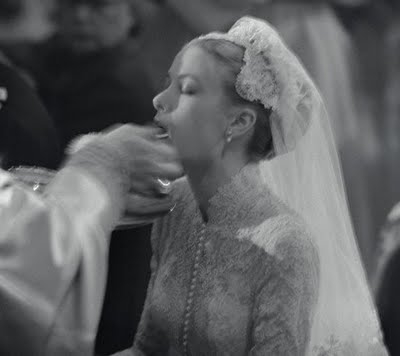
Princess Grace (née Kelly) of Monaco receives
the Holy Eucharist at her 1956 nuptial Mass


Returning to Dust & Rising From the Ashes

March 11, 2019

Funeral Homily for Daniel G. Zwiefelhofer
by Fr. Victor Feltes on March 7, 2019

The Fall of Mankind and Expulsion from Paradise
by Michelangelo on the ceiling of the Sistine Chapel

Remember that you are dust, and to dust you shall return.” These words were heard many times yesterday on Ash Wednesday as ashes were applied to foreheads. There is another phrase the ash-bestowing minister can say, but “remember that you are dust, and to dust you shall return” is the classic option. Where does this phrase come from? It’s from the story of Genesis, following the Original Sin, the Fall of Man.

When Adam and Eve sinned in the Garden, punishments were placed on them and their descendants. To the woman God said, “I will intensify your toil in childbearing; in pain you shall bring forth children.” And to the man God said, “In toil you shall eat the ground’s yield all the days of your life. Thorns and thistles it shall bear for you, and you shall eat the plants of the field. By the sweat of your brow you shall eat bread, until you return to the ground, from which you were taken; for you are dust, and to dust you shall return.” And God announced a punishment upon the wicked serpent too: “I will put enmity between you and the woman, and between your offspring and hers; he will strike at your head, while you strike at his heel.”

We still feel the consequences of sin and observe of the brokenness of our world. Birthing babies is painful and raising children is challenging. Daniel learned these truths firsthand alongside Marion. And, as a lifelong farmer, Daniel experienced firsthand that farming is hard work. Growing food, from beasts or fields, demands the sweat of one’s brow. And today, after eighty-one years of life on this earth, we gather for Daniel’s funeral; for we are dust, and to dust we return. If these things were all that we saw and knew we would be left in sad despair, but this is not the end of the story; for Genesis, for Daniel, or for us.

I mentioned earlier that there’s another phrase option for ash-distributors to say on Ash Wednesday: “Repent and believe in the Gospel.” The Gospel is a message of living hope and it was proclaimed from the beginning. The Church teaches that the Protoevangelium, or “First Gospel” promising salvation was announced in the Garden of Eden. Recall how God said to the serpent, in the presence of Adam and Eve: “I will put enmity between you and the woman, and between your offspring and hers; he will strike at your head, while you strike at his heel.” This is speaking to more than the natural hatred between humans and deadly snakes – it’s a prophesy. That “he,” the offspring of the woman, was to be Jesus. The ancient serpent, the devil, struck out at Jesus’ lowly flesh (as at Jesus’ heel) in the Passion. But Jesus the New Adam, triumphed through his Passion, death, and resurrection, crushing the enemy’s head.

Jesus is the New Adam. Tempted in a garden (the Garden of Gethsemane) Jesus did not falter. Called to lay down his wife for his bride (the Church) Jesus did not balk. And by the sweat of his brow (even sweating blood) he has provided her bread, in the Most Holy Eucharist, which is himself. He accepted a crown of thorns from a world turned against him, but by his toil of carrying his Cross Jesus has produced a fruitful yield on earth. Jesus was placed into the dust of the earth — entombed at death, but Jesus was not abandoned to the dustbin of history. The New Adam triumphs over death.

And the New Eve, his bride the Church, continues (with toil and pains, but also with joy) to bear forth children who live and die with faith in Christ, like Daniel. And, as Daniel’s prophetic namesake says in our first reading, “Those who sleep in the dust of the earth shall awake; and some shall live forever…” Likewise, in our second reading, St. Paul proclaims to the Thessalonians: “We do not want you to be unaware, brothers and sisters, about those who have fallen asleep, so that you may not grieve like the rest, who have no hope. For if we believe that Jesus died and rose, so too will God, through Jesus, bring with him those who have fallen asleep.” The first Adam, by sinning, and gave death to all his descendants. But Jesus Christ, the new faithful Adam, offers life to all who follow him.

On Ash Wednesday and at any funeral, we are reminded that are dust and to dust we shall return. But we must also remember to repent and believe in the Good News of the Gospel. As night lead to dawn and sleep to arising; as winter leads to spring and Lent leads to Easter, so the dying of friends of Jesus leads to joyful resurrection.

Christ Calls in Ordinary Time

January 16, 2019

As [Jesus] passed by the Sea of Galilee, he saw Simon and his brother Andrew casting their nets into the sea; they were fishermen. Jesus said to them, “Come after me, and I will make you fishers of men.” Then they left their nets and followed him.

— Mark 1:16-18

A remarkable thing about this calling of Simon Peter and Andrew is its ordinariness. The pair are not called through a vision or by angels. Mark mentions no miracles performed there on the shore. We know from John’s Gospel that they have met this rabbi before. Jesus simply tells them to follow him.

This call does not happen on a Jewish holy day, in the Temple, or in a palace, nor at Jerusalem or Rome. (The region of Galilee was an unesteemed place for the Jews and doubly so for the Romans.) Simon and Andrew are not clergy nor scholars, neither governors nor generals. They’re fishermen who work nights doing manual labor. They’re not on spiritual retreat or pilgrimage, they haven’t journeyed for days to a holy mountain of God. Yet Christ walks up to them and calls these two brothers during an ordinary day at their place of work.

Jesus Christ the God-Man does extraordinary things through the ordinary. He makes use of water for his baptism, bread for his Eucharist, and human pairing to reveal his loving union with the Church. He uses our human words to communicate God’s Word in the most published book on earth. He dwells (and waits) for us in every Catholic tabernacle. He makes himself so accessible that, if we are unattentive to him, we can disregard his presence and graces amidst familiar things.

Ordinary Time has returned in the Church. Though not a “special” season like Advent, Lent, Christmas, or Easter, its name does not derive from a lack of value but from the ordinal numbers which count its weeks (1st, 2nd, 3rd, etc.) The color of this time is green because it is a season for our ongoing growth. So let us follow the Christ who greets and calls us like Simon Peter and Andrew even in Ordinary Time.

A Christmas Funeral

December 29, 2018

Funeral Homily for Marie Clark

There is an understandable and natural sadness felt in the passing of a well-loved mother, sister, aunt, grandma, and  great-grandmother like Marie in any season of the year. But a funeral like this, so close to Christmas, can feel strange as well. Perhaps I have forgotten but I can’t remember — in almost a decade of priesthood — ever offering a funeral Mass so close to the celebration of Jesus’ birth, with Christmas trees still in the sanctuary. And yet, this is not so strange as it may seem, for the birth of Jesus the Christ bears many connections with and foreshadowings of his death:

Jesus’ birthplace, a stable, was actually a cave. His burial-place, his tomb, was a cave as well.

The first cave was prepared by Joseph, the poor carpenter from Nazareth. The second cave was also prepared by a Joseph, a rich man from Arimathea.

At his birth, Mary wrapped Jesus’ body tightly in cloths for swaddling clothes. At his death, Mary also wrapped Jesus’ body, in linen cloth, for a burial shroud.

She placed his body in a manger, a feed-box for grain. He would give his own body as food, feeding his flock with his flesh and blood.

Who first heard the news of Jesus’ birth? It was shepherds in the fields outside Bethlehem. From Bethlehem’s flocks the lambs were provided for sacrifice at the Temple in Jerusalem about 5½ miles away. Jesus is the Lamb of God who was born to die as a sacrifice to take away our sins.

The Christmas trees in our sanctuary are evergreen and gloriously-lighted. Contrast that to the wood of the Cross, stark and dead, where we see the starkness of death in Christ crucified. Yet the cross bears the Light of the World, for Jesus says, “I am the Light of the World.” Life flows from this tree.

The Church, in these days following Christmas, celebrates a series of martyrs. The day after Christmas is the feast of St. Stephen, the first martyr after Jesus’ Ascension. Tomorrow, it’s St. Thomas Becket, a bishop martyred more than a millennium later. Today, it’s the Holy Infants of Bethlehem, who died unknowingly for Christ, but who the Church has long-celebrated as martyrs. We can fittingly celebrate the martyrs or even a funeral so close to Christmas because the birth of Jesus Christ has great and vast implications for life and death.

As we heard in our first reading, “If before men, indeed they be punished, yet is their hope full of immortality. … They seemed, in the view of the foolish, to be dead; and their passing away was thought an affliction, and their going forth from us, utter destruction. But they are in peace.” So, even in the dark valleys of life, we are courageous (as St. Paul twice declares in the second reading) for the Lord who died and rose is our shepherd. “Even though I walk in the dark valley I fear no evil; for you are at my side.” And this is our Gospel: ‘this is the will of the Father, that everyone who sees the Son and believes in him may have eternal life, and Jesus shall raise them on the last day.’

Pray for Marie’s soul, as is fitting and right, but be courageous and even joyful through the sadness; for at Christmas we see:

Christ, by highest heaven adored,
Christ, the everlasting Lord.
Late in time behold he comes,
offspring of the Virgin’s womb.

Mild he lays his glory by,
born that we no more may die,
born to raise us from the earth,
born to give us second birth.

With the herald angels sing,
“Glory to the newborn King.”

Christ, the Peace Light, is Born

December 27, 2018

In the city of Israel that is called Bethlehem, the ancient Church of the Nativity marks the site of the first Christmas. There one can actually stoop and bend down beneath the central altar & touch the celebrated spot where Jesus Christ was born. It is fitting that the pilgrims bend low to do this, because the miracle of God becoming a human being — to live and die and rise for us — surely deserves humble reverence with everything that we are.

Earlier this year, as has happened for a number of years now, an Austrian child and their family was selected to travel to Bethlehem. Candles and lamps are always burning within the Church of the Nativity, and there this chosen child transferred their fire into two blast-proof lanterns. Then they all flew back to Austria, where this flame (called “The Peace Light”) has spread from lamp to lamp, light to light, candle to candle, into more than thirty European countries and to places around the world. On December 1st of this year, the Peace Light arrived at J.F.K. Airport in New York City and it has traveled from there across our country. This week, it providentially came to our parish.

Last Friday, a Hudson couple traveling with the Peace Light approached me after morning Mass at St. Paul’s. I had never heard of the Peace Light before, but I happily received it and kept it for this Christmas celebration. All the flames you see burning our sanctuary this Christmas were originally lit from Bethlehem’s flame. Now I carefully carried, protected, and preserved this light; especially when I only had one vigil candle. I realized that one error, one jostling of the liquid wax, could extinguish the fire; and then what would become of this, my Christmas homily? I’d be lost. But, thanks be to God, these candles are lit here today.

So why do we have candles at Mass? Since the early days of Christianity, when Catholic Mass was celebrated in hiding, underground in the catacombs, lamps have provided useful illumination. But these lights are not merely practical. In the late 300’s A.D., a heretic named Vigilantius criticized Christians in the East about many of their practices, including their lighting of great piles of candles while the sun was still shining in the sky. St. Jerome declared in answer to him that candles are lighted where the Gospel is proclaimed not merely to put darkness to flight, but as a sign of joy. As an added symbol, these candles on the altar (and the Easter Candle) are, by tradition, mostly made of beeswax. Because beeswax, which is the product of the virginal female bee, is like the flesh of Our Lord supplied by the Blessed Virgin Mary.

Of course, the celebrated Peace Light is not merely a symbol of some abstract notion or idea of peace; it’s a symbol of the very real person of Jesus Christ. The “Light of the World” entered our world from his mother’s womb in Bethlehem. And his light has spread across the world and throughout time to this place and our day. Today, our candles burn and shine for him.

Within you there is also candle, but it is a very vulnerable light. Through error or neglect its light can go out. And without this light we are in darkness without true joy. So Jesus commands us to regularly gather all our candles together here, to be re-lit from the Source, the Light of Christ. In conclusion, in case my symbolism has been too subtle: Have a very joyful Christmas, and know that Jesus Christ (who loves you) wishes you to return here again for his Holy Mass next Sunday.

Lingering Wounds — Divine Mercy Sunday—2nd Sunday of Easter

April 15, 2018

Of all the apostles, it could be said that St. Thomas’ faith took him the farthest. Likely tradition says Thomas traveled more than 2,000 miles from Israel to evangelize India. From the seeds of his ministry and martyrdom there, tens of millions of Indians are Christians today. Yet, he’s not known as “Traveling Thomas” or “Faithful, Fruitful Thomas,” but famously as “Doubting Thomas” because of these passages:

Thomas, called Didymus, one of the Twelve, was not with them when Jesus came. So the other disciples said to him, “We have seen the Lord.” But he said to them, “Unless I see the mark of the nails in his hands and put my finger into the nailmarks and put my hand into his side, I will not believe.”

So why was Thomas so slow to believe? I would suggest three theories:

The first explanation would be that Thomas didn’t want it to be true. Many peoples’ lack of belief is due to an unwilling heart. They see no evidence for God because they have closed their eyes. If they were honest they would say, “I don’t want it to be true, because if it is then I’d have to change how I live my life.” Jesus says if we ask, we’ll receive; if we seek, we’ll find; and if we knock, the door will be opened to us. But this sort of person doesn’t ask because they don’t want good answers, they don’t seek because they’re afraid of what they’ll find, and they don’t knock because they don’t want to go in.

In the Book of Revelation, Jesus says, “Behold, I stand at the door and knock.” He knocks on the door of every human soul. But we can lock and block our door; with a big-screen TV of entertainment, or a bookshelf of learning, a trophy case of accomplishments, a heavy safe of accumulated wealth, or with several large-leafy plants so that a person may enjoy the beauty of creation while ignoring the Creator. If we insist upon self-centered ingratitude, the Lord will respect our freedom but we’ll be woefully unsatisfied forever.

But this is was not St. Thomas. He had sacrificed a lot to be Jesus’ apostle and had aspired to give him his all. On one occasion Jesus said, “Let us go back to Judea,” but the disciples replied, “Rabbi, the Jews were just trying to stone you, and you want to go back there?” When Jesus insisted on going, “Thomas, called Didymus, said to his fellow disciples, ‘Let us also go to die with him.’” At the Last Supper, when Jesus said, “Where I am going you know the way,” Thomas replied, “Master, we do not know where you are going; how can we know the way?” He was distressed because he loved Jesus and wanted to follow him anywhere. Thomas wanted the Resurrection to be true, but there was some other reason he wouldn’t or couldn’t believe.

A second theory for why Thomas was so slow to believe is that he was skeptically-minded. St. Thomas’ nickname, as you’ve heard it now a couple of times, was “Didymus.” In Greek, Didymus means “twin.” How was Thomas a twin? Scripture doesn’t say. Perhaps Thomas had a twin brother he had been mistaken for many times. In some icons of Jesus with his apostles, one of the apostles looks just like Jesus. Such art imagines that Thomas shared a twin likeness to the Lord. In either case, one could understand his initial skepticism about people seeing Jesus resurrected. “Nah. You guys saw somebody else.”

But Thomas has sufficient evidence to believe his friends. They are not claiming to have seen Jesus across the marketplace or walking through a field at dusk. (Neither Thomas nor we are expected to have blind faith, but to trust in trustworthy persons and things.) The other apostles are saying, “It’s true Thomas! He knew us, we saw his wounds!” Yet Thomas replies, “Unless I see the mark of the nails in his hands and put my finger into the nailmarks and put my hand into his side, I will not believe.” Why is Thomas so being obstinate?

The third (and I think most likely) explanation for why Thomas was so slow to believe in the Resurrection was that he hurt too much trust again. Who was Jesus to Thomas? He was Thomas’ hero, his admired teacher, his dearly beloved friend. Thomas thought Jesus would be the savior and messianic king of Israel, but Thomas’ great hope was murdered on Good Friday. Imagine Thomas’ prayer after experiencing that. “My God, how could you let this happen? He was innocent, he was so good! He was the best man I’ve ever known, and you let Him die! Why? How could do that to him? How could you do this to me?”

Jesus’ unexpected death broke Thomas’ heart, and perhaps having been so wounded once, he was resolved not to let his heart be taken-in again: ‘Unless I see the mark… put my finger in the nailmarks… put my hand in his side, I will not believe.’ Yet, though he doubts, notice where Thomas is one week after Easter. He’s with the other apostles in the upper room in Jerusalem, gathered behind locked doors for fear of those who killed Jesus. Now there are lots of other, safer places Thomas could have chosen to be. He could have returned to his hometown, back to the family and friends he left behind to follow Jesus a few years before. Though Thomas doubts, he does not leave this house of faith. He struggles with his questions, but he does not fully abandon Jesus. He seeks him here and because of it Thomas finds truth for his mind, healing for his heart, and peace for his soul.

The risen Lord appears in the upper room and how does Jesus respond to Thomas’ resistant unbelief? Not with anger. Not with condemnation. But with the same Divine Mercy we celebrate today. Jesus appears in their midst and says, “Peace be with you.” Then he says to Thomas, “Put your finger here and see my hands, and bring your hand and put it into my side, and do not be unbelieving, but believe.”

Curiously, Jesus still bears some of the wounds from his Passion: in his hands, feet and side. The cuts and swollen bruises are gone from his face, for the disciples respond to him with rejoicing rather than pity or horror, but he retains some marks from the evils that afflicted him. Jesus could heal or cover them—he’s God—but he choose not to. They are his trophies, the means of his glory, how he saved the world.

Our wounds, our losses, the sins and evils we suffer, they can scandalize us like Thomas was after the Passion. But through these things Jesus would glorify us, help to save others, and transform us into his more perfect twin. Jesus, having experienced wounds of his own, can relate and heal you.

Like St. Thomas, this Divine Mercy Sunday, you are gathered in this upper room with Jesus’ disciples. If there is any great wound or uncertainly in you, I invite you to be open to encounter Jesus anew like St. Thomas. Dare to ask, dare to seek, dare to knock. Jesus is not only your Lord and your God, he’s good and his love is everlasting.

What if Jerusalem were in Western Wisconsin?

December 29, 2017

(Not all will personally resonate with the reference city
chosen for this reflection, but I share this article because
its device and style may be fruitfully employed by others.)

One thing I brought back with me from my first trip to Israel was a better grasp of its geography. A visit to the Holy Land yields a previously unknown sense of scale offering new insights to the Gospel. In lieu of flying everyone abroad, perhaps I can bring its holy places closer to home. Let’s allow Bloomer, Wisconsin to represent the location of ancient Jerusalem and examine where other sites in the region would be situated relative to it.

The town of Bethlehem is about five and a half miles (in a straight line, as the crow flies) south-southwest (SSW) from Jerusalem. So, allowing Bloomer to be Jerusalem, Jesus was born not far from St. John the Baptist’s Catholic Church in Cooks Valley, Wisconsin. If the Holy Family, retracing the steps of their Hebrew ancestors during their flight into Egypt, passed by the Great Pyramids of Giza (273 miles WSW from Jerusalem) they fled almost as far as Sioux Falls, South Dakota. After King Herod the Great’s death, Joseph and Mary brought Jesus to their hometown of Nazareth, 64 miles north of Jerusalem. Each year, Jesus’ parents would pilgrimage from Nazareth to Jerusalem, as from Hayward, Wisconsin to Bloomer and back, for the Jewish festival of Passover.

One of the things that struck me about seeing the Old City of Jerusalem in person is how very small it is. There is just 0.35 square miles – only twice the area of Vatican City – within its high stone walls. The locales of Jesus’ Passion, Resurrection, and Ascension are all reasonably short walks from each other.  If we take St. Paul’s Catholic Church in Bloomer as the location of the Jewish Temple, the Cenacle (or “Upper Room” where the Last Supper was celebrated) is located to the southwest at the intersection of Riggs Street & 19th Avenue. The site of Jesus’ crucifixion and tomb (the Church of the Holy Sepulcher) is almost due west of the church, in the middle of Bloomer’s Lake Como behind the A.J. Manufacturing building. And the traditional site of Jesus’ Ascension into Heaven from the Mount of Olives would be almost due east from the church, in the first field south of the Bloomer Public Elementary School.

As the young Church spread, a Pharisee named Saul of Tarsus obtained authority from the Jewish High Priest to arrest any Christians he might find in Damascus, 134 miles NNE from Jerusalem in Syria. However, the Lord Jesus enlightened him on his journey as to (quite fittingly) the Apostle Islands off of Wisconsin’s northern shore. This Saul, who became St. Paul, would go on to preach and win converts as in the Canadian provinces of Manitoba & Saskatchewan (i.e., Turkey & Greece.) Just like St. Peter, St. Paul was martyred for Christ far from home, 1,432 miles from Jerusalem in Rome, a distance like that of Seattle, Washington from Bloomer.

Following the Apostles, Jesus’ Church continued to grow through the centuries and around the world, winning new souls in new lands, including our own. Our Christian Faith has come to us today from ancient Jerusalem to St. Paul’s Catholic Church, wondrously spanning a distance equaling that of Bloomer, Wisconsin to Kyoto, Japan.


The two gray domes of the Church of the Holy Sepulcher appear behind the Islamic Dome of the Rock shrine atop the Temple Mount
in this photo I took in November 2016 from the western slope
of the Mount of Olives in Jerusalem.

Jesus Christ, the Center of History

December 25, 2017

If you had walked through the streets Bethlehem or Rome asking people on the first Christmas Eve, “What year is this,” the answers you’d hear might vary. The Sun numbers our days, the Moon tracks our months, and the seasons indicate the passage of years, but answering what year it is requires people to make reference to some shared historical event.

If you had bumped into one of the ancient world’s many sports fans on the first Christmas Eve, they might have told you that it was 3rd year of the 194th Olympiad. Once every four years, famous athletic competitions were held in Olympia, Greece. Freeborn Greek men would compete in footraces, chariot races, wrestling matches, javelin tosses, discus throws, and other events; for the honor of the Greek god Zeus, for the pride of their home city-states, and for their own personal glory. The winners received crowns or wreaths made of green olive leaves that would fade. All that remains of some of those ancient sports superstars today are their names in texts read less often today than last month’s newspapers.

If you had run into a merchant on the first Christmas Eve who used the Roman coins and roads to trade goods, he might have said that it was 752nd year since the founding of the City of Rome. Considering the wealth and influence of Rome at that time, it might have seemed like that empire would live and reign in the world without end. However, from decay within and barbarian attacks from without, much of what that empire built remains today, if at all, only as ruins for tourists.

If you had encountered someone enamored with power and celebrity on the first Christmas Eve, they might have answered that it was 42nd year of the reign of Emperor Caesar Augustus. It was a census he decreed that sent Joseph and Mary to Bethlehem. Early in his reign, Caesar Augustus claimed that the passage of Halley’s Comet over Rome was the spirit of his predecessor, Julius Caesar, rising into heaven. And so, since Julius Caesar had been a god, Caesar Augustus, as his heir, presumed to call himself “the son of a god.” Caesar Augustus would go on to die at age seventy-five and never be heard from again.

If you had spoken on the first Christmas Eve to someone focused on the politics and current events of the land of Israel, they might have replied that it was 38th year of the reign King Herod the Great, the King of Judea under the Romans. Herod the Great was a very controversial figure, with some Jews praising him and still more despising him: he expanded and gloriously refurbished the Temple in Jerusalem but was also a murderous tyrant, like when he ordered the deaths of the innocent baby boys in Bethlehem. Because the Roman Senate had appointed him as “the King of the Jews,” and since he was not descended from King David, nobody mistook Herod for being the Christ.

On the first Christmas Eve, some two thousand and eighteen years ago, only a handful of people on earth had any clue of the world-changing significance of what was about to occur. The baby born that night was the source of the universe and the center of human history.

In the year we call 525, a new way of numbering years was introduced by a monk named Dionysius the Humble. Dionysius numbered years using this baby’s birth as the starting point, naming it “1 A.D.” A.D. stands for the Latin phrase “anno Domini / in the year of our Lord.” 1 A.D. was dubbed the first year of our Lord on earth, and this is currently the 2,017th year of our Lord, Jesus Christ. Now I should mention that Dionysius has reason to be humble here as well. He estimated the time of Jesus’ birth as best as he could, but he seems to have been a little bit off. The best evidence today points to Jesus being born in 2 or 3 B.C. But regardless, it is most fitting that we mark and celebrate the birth of Jesus Christ as the center of human history and the most important person who has ever lived.

  • Christ is the undefeated champion whose glory does not fade. Even when he seems to be down, he triumphs in overtime. (And, unlike Aaron Rodgers, “not one of his bones shall be broken.”)
  • Christ’s holy kingdom has outlasted the Romans. In fact, he conquered them peacefully by converting their hearts. And today, his kingdom extends to all lands and people through his Holy Catholic Church.
  • Christ is greater than Caesar, he is stronger than death. When Jesus died, he rose again. And now he reigns, because he is truly the Son of God.
  • Christ is the King of Kings and Lord of Lords. He is our leader untainted by sin, who is truly wise, and cares about me and you.

Even those without any Christian faith must acknowledge Jesus’ positive influence on the world: in children treasured; in women respected; in slaves freed; in strangers welcomed; in millions and millions fed, clothed, treated, or taught, around the world and across centuries, all because of the baby born on Christmas.

A.D. does not stand for an “Arbitrary Date.” Anno Domini is no accidental demarcation of before and after. Jesus Christ merits more than our apathetic dismissal. Jesus deserves to be at the center of our years and the center of our lives. As he, this Christmas night, so humbly gives himself to you, please give yourself to him anew. He is the Christ, yesterday and today, the beginning and the end, the Alpha and Omega, all time belongs to him and all the ages; to him be glory and power, through every age and forever, in you and in me. Amen.

“The Ten Virgins & Wedding Party Prudence” — 32nd Sunday of Ordinary Time—Year A

November 13, 2017

Learning about first century Jewish marriage customs helps us understand the Gospels better, including the Parable of The Wise and Foolish Virgins. In Jesus’ day, when a young man wished to marry a woman, he would journey from his father’s house to hers. He and her father would agree upon a dowry and once this dowry price was paid the marriage covenant was established. This event was called “betrothal” and the man and woman thereafter were considered husband and wife. The groom, however, would not then begin to live with his bride. He returned to his father’s house for twelve months, manifesting his respectful self-restraint and honorableness toward her. (Betrothal was the situation St. Matthew described: “When Mary… was betrothed to Joseph, but before they lived together, she was found with child through the Holy Spirit.” So Mary was never an unwed mother, but she knows the experience of having a crisis pregnancy.) During their year apart, the man and woman would prepare for their new life together. One of the groom’s most important tasks in this period was to prepare living accommodations for them at his father’s house.

Once their time of separation was over, the groom would return to his bride’s house with his groomsmen, usually at night with a torchlight procession. She would be expecting him but not know the exact hour of his arrival. That is why the groom’s second coming would be preceded by his messenger’s shout. Then the bride and her female attendants and the groom and his groomsmen would return to his Father’s house (their new home) for a wedding feast with their other gathered friends, family, and neighbors. There the husband and wife would consummate their marriage, and seven days of feasting and merriment would begin.

In the Gospels, Jesus is declared and calls himself “the bridegroom.” The New Testament names the Church his “bride.” The relationship between Christ and his Church parallels a Jewish marriage. For instance, in the Incarnation, God the Son left his Father’s house in Heaven to journey to our dwelling place on earth. Jesus paid our dowry price with his own blood. And after establishing his covenant, Jesus ascends to his Father’s house for a time until his second coming. This is why Jesus says at the Last Supper:

In my Father’s house there are many dwelling places. If there were not, would I have told you that I am going to prepare a place for you? And if I go and prepare a place for you, I will come back again and take you to myself, so that where I am you also may be.”

This Sunday’s second reading describes this return.  As St. Paul tells the Thessalonians, “The Lord himself, with a word of command, with the voice of an archangel and with the trumpet of God, will come down from heaven…” Notice how the Lord’s angelic messenger announces to the bride that her bridegroom is at hand. St. Paul continues, “And then the dead in Christ will rise first. Then we who are alive, who are left, will be caught up together with them in the clouds to meet the Lord in the air. Thus we shall always be with the Lord.”

In the Book of Revelation we see this nuptial union of Christ and his Church continues above. St. John hears Heaven sing:

Let us rejoice and be glad and give him glory. For the wedding day of the Lamb has come, his bride has made herself ready. She was allowed to wear a bright, clean linen garment.” (The linen represents the righteous deeds of the holy ones.) Then the angel said to me, ‘Write this: Blessed are those who have been called to the wedding feast of the Lamb.‘”

The virgin, young women in today’s parable are the bride’s attendants awaiting the bridegroom. Five are called wise and five are called foolish. The important distinction between them is not one of I.Q.—of being naturally intelligent or unintelligent—but in being thoughtful versus thoughtless. In the 1994 Best Picture Winning film, Forrest Gump is a man of below-average intelligence who, by his simple virtue, lives an admirable and remarkable life. A couple of times he’s asked, “Are you stupid or something?” and Forrest replies, “Stupid is as stupid does, sir.” I didn’t know what this meant when I was a kid, so I asked my dad. He explained that if you’re blessed with intelligence, but keep doing bad or foolish things, then you’re stupid. On the other hand, even if you’re not that bright but you make good and smart choices, then you are wise.

What is the meaning of the oil lamps that play such a significant role in Jesus’ story? The consensus of the Church Fathers is that they represent good works. Elsewhere in Matthew’s Gospel, Jesus likens lamps to good deeds:

No one lights a lamp and then put its under a bushel basket; it is set on a lampstand, where it gives light to all in the house. Just so, your light must shine before others, that they may see your good deeds and glorify your heavenly Father.

(But doesn’t Jesus warn us, just a few verses before in his Sermon on the Mount, “Take care not to perform righteous deeds in order that people may see them; otherwise, you will have no recompense from your heavenly Father”? What reconciles these two teachings The answer is in whose glory is being sought. If I pray, fast, and give alms for my own glory, then some people may think well of me for a little while until they forget, and I will have received my reward. But if I do good works for the glory of God, then he will be glorified and he will reward me and I will share in his glory.)

The two types of virgins in the parable represent two types of people awaiting Christ the bridegroom. All the virgins fall asleep. Likewise, all of us (unless Jesus comes again first) will experience the falling asleep of death. The virgins are roused from sleep. Likewise we will be roused from sleep in the Resurrection. All of the virgins have at least a little oil, some light. At the Judgment, I suspect everyone will have some good deeds to point to – even murderous dictators have loved their dogs. But is that love sufficient? Are those good deeds enough? For the thoughtless, foolish virgins, their little oil is not enough.

They say, “Give us some of your oil, for our lamps are going out.” But the wise ones reply, “No, for there may not be enough for us and you.” (Apparently, their oil and abundance is not something that can be shared or transferred between persons.) “Go instead to the merchants and buy some for yourselves.” That’s where the wise virgins would have bought their oil in preparation, but remember what time it is. The bridegroom’s arrival was announced at midnight. All the stores are closed. Where are the foolish virgins going to find a merchant to sell them oil? They won’t. It’s too late.

Who are these merchants that we must buy our oil from now, before it is too late? These merchants are your neighbors in their need. At the judgment of the world, the Lord Jesus will say the righteous, “Come, you who are blessed by my Father. Inherit the kingdom prepared for you from the foundation of the world. For I was hungry and you gave me food, I was thirsty and you gave me drink, a stranger and you welcomed me, naked & you clothed me, ill and you cared for me, in prison and you visited me.’ Then these righteous ones will wonder when this happened. And our king will say in reply, “Amen, I say to you, whatever you did for one of these least brothers of mine, you did for me.” And elsewhere, Jesus tells us, “Whoever gives only a cup of cold water to one of these little ones to drink because he is a disciple — amen, I say to you, he will surely not lose his reward.” Our neighbors, near and far, are the merchants from whom we obtain the oil of good works now for our lamps of glory later. We pay our neighbors with our time, our talents, and our treasure to purchase our good deeds.

This opportunity to do good on earth will not last forever. In Charles Dickens’ “A Christmas Carol,” old man Scrooge is visited by the ghost of his old business partner, Jacob Marley.

[Standing in his bed chamber, Scrooge] became sensible of confused noises in the air; incoherent sounds of lamentation and regret; wailings inexpressibly sorrowful and self-accusatory. The [ghost of Jacob Marley], after listening for a moment, joined in the mournful dirge; and floated out upon the bleak, dark night. Scrooge followed to the window: desperate in his curiosity. He looked out. The air was filled with phantoms, wandering hither and thither in restless haste, and moaning as they went. Every one of them wore chains like Marley’s Ghost; some few…were linked together; none were free. Many had been personally known to Scrooge in their lives. He had been quite familiar with one old ghost, in a white waistcoat, with a monstrous iron safe attached to its ankle, who cried piteously at being unable to assist a wretched woman with an infant, whom it saw below, upon a doorstep. The misery with them all was, clearly, that they sought to interfere, for good, in human matters, and had lost the power for ever.”

We know the souls in Heaven can help effect good on earth – that’s why we pray for their intercession. The souls in Purgatory may or may not be able to pray and intercede for us – that’s an open question in Catholic theology. The souls in Hell definitely do not help us, but both they and those in Purgatory regret and lament having failed to do more good on earth when they had their chance in life.

When the foolish virgins finally arrive late to the wedding feast they find the door is locked. They cry, “Lord, Lord, open the door for us!” But the bridegroom says in reply, “Amen, I say to you, I do not know you.” This echoes what Jesus teaches elsewhere:

Not everyone who says to me, ‘Lord, Lord,’ will enter the kingdom of heaven, but only the one who does the will of my Father in heaven. Many will say to me on that day, ‘Lord, Lord, did we not prophesy in your name? Did we not drive out demons in your name? Did we not do mighty deeds in your name?’ Then I will declare to them solemnly, ‘I never knew you. Depart from me, you evildoers.’”

Jesus is teaching us that we are not saved by faith alone, by the mere acknowledgment that he is “Lord, Lord.” Nor are we saved by the vast accumulation of good works, for one could even prophesy, drive out demons, or do mighty deeds without having a saving relationship with him. We are saved by Jesus’ love for us and our loving him in return; by both faith in him and good works in him.

So what was the foolish virgins’ great sin? Who hasn’t accidentally forgotten to pack something on occasion? It’s hard to imagine Jesus condemning people for a mere accident. I think the virgins’ oversight in this parable suggests a far more serious fault. These young women heard there was going to be a big party and that a lot of people were going. They jumped on the bandwagon but were just going along for the ride. They did not really know the bride or groom and didn’t really care about them. If they had loved the couple, they would have put more thought into being their good guests and true friends, they would have been more serious in their personal preparations, and that prudent diligence would have saved them from being locked out in the end.

I do not wish to unsettle you, but Jesus preached this parable to the crowds and ensured that it was included in Matthew’s Gospel because he wanted us to consider this question: am I loving the bridegroom and his bride, am I loving the Church and her Lord? Are you dedicating your time, talents, and treasure to God and your neighbor? Are you striving for the narrow path and the narrow door that Jesus tells us few attain? Or are you, like many, just going with the flow in comfortable complacency? Jesus’ final warning in today’s gospel is, “Stay awake, (be vigilant, be diligent,) for you know neither the day nor the hour.” The bridegroom and bride request the honor of your presence at their banquet. So let us wisely be diligent, doing good works in Christ, while this precious daylight remains.

“Lord, Make Them Change!”

October 27, 2017

I recently noticed a pattern with Jesus Christ in the Gospels:

Martha once complained to him, “Lord, do you not care that my sister has left me by myself to do the serving? Tell her to help me.” Jesus refused to dismiss Mary from his presence but instead urged Martha not to be anxious and pointed her to the superiority of holy intimacy over hard labors.

A man in a crowd once said to him, “Teacher, tell my brother to share the inheritance with me.” Jesus declined to declare a verdict in the matter but warned, “Take care to guard against all greed, for though one may be rich, one’s life does not consist of possessions.

A pagan mother once begged Jesus to free her demon-tormented daughter. Christ’s annoyed followers said, “Send her away, for she keeps calling out after us.” Instead, Jesus engaged her in a challenging repartee, granted her wish, and showed his disciples that his mission extended beyond just the Jews.

On Palm Sunday, as Jesus rode into Jerusalem, his disciples loudly acclaimed him. Some of the Pharisees in the crowd demanded, “Teacher, rebuke your disciples.” But Christ replied, “I tell you, if they keep silent, the stones will cry out,” insisting that his critics’ recognize his supreme worthiness.

And so it seems, where we have been asking Jesus to change another person in our world, we would do well to consider what our Lord may be wishing to see changed in ourselves.