Archive for the ‘Saintly People’ Category

Hollywood’s Pope: Little Faith on the Small Screen

June 29, 2016

This fall, HBO will begin airing an eight-episode miniseries imagining the first American to be elected pope. While this drama may or may not attract viewers, I predict “The Young Pope” will fail to truly capture the Catholic Faith and Church. I had similar doubts when Showtime floated a similar premise in 2013. (“The Vatican” was to star the actor who played Adolf Hitler in the movie “Downfall” but none of its episodes ever aired.) The creator and director of “The Young Pope,” Paolo Sorrentino, describes what his new series will be about:

Jude Law stars as “the complex and conflicted” Pope Pius XIII in “The Young Pope

The clear signs of God’s existence. The clear signs of God’s absence. How faith can be searched for and lost. The greatness of holiness, so great as to be unbearable when you are fighting temptations and when all you can do is to yield to them. The inner struggle between the huge responsibility of the Head of the Catholic Church and the miseries of the simple man that fate (or the Holy Spirit) chose as Pontiff. Finally, how to handle and manipulate power in a state whose dogma and moral imperative is the renunciation of power and selfless love towards one’s neighbor.”

Though some are more optimistic, I have low hopes for this series. The Catholic Church has beautiful stories to tell, but “The Young Pope’s” trailer and the quote above telegraph brooding agnosticism free of Christian joy. “The Young Pope’s” Pius XIII is reportedlya conflicted man who must find a way to balance his ultra-conservative views with his immense compassion for the sick and the poor.” In other words, Catholic teachings will be falsely pitted against Christian love. Which one do you imagine will prevail in our hero?

A Vatican TV drama could be made with either the cynicism of “House of Cards” or the hopeful idealism of “The West Wing.” Which set of plot-lines below (“A” or “B”) do you think we could expect to see these days in a major miniseries about the papacy?

The Dinner Guest

A:  The pope invites to dinner a priest-friend from seminary. At table, the priest asks the pope to lift the “impossible burden” of celibacy. The pope sympathizes but he explains (citing solely pragmatic reasons) that there is nothing he can do. By the meal’s end, the priest is asking to be released from the priesthood so that he might marry a former nun with whom he has fallen in love (and sin.) The pope, sadly subdued, grants his second request.

B:  The pope invites to dinner a Roman beggar who once served as a priest. At dessert, the pope asks him to hear his confession. “I cannot do that,” the man replies, “I have renounced the priesthood. My priestly faculties have been taken away from me. I am no longer a priest.” The pope answers, “Once a priest, always a priest…  As Bishop of Rome and head of the Catholic Church I can restore your priestly faculties to you…” The man’s priesthood is restored and he hears the pope’s confession. The priest is then assigned to the church where he had previously begged with a special responsibility for the poor who seek alms at the church door.

The Persecuted Refugees

A:  As the cause advances to beatify Pius XII (the pope who reigned during the Second World War) the current pope personally investigates his predecessor’s record in the Vatican’s Secret Archives. When the pope concludes that Pius XII should have done more to save persecuted Jews from the Nazis, he places the entire beatification project on (permanent) hold.

B:  The pope intervenes to help when a religious minority is threatened by an evil state. He facilitates the safe escape of thousands, even housing refugees within Rome’s convents and monasteries and at the Vatican itself. When peace returns, a world-famous agnostic scientist declares, “Only the Catholic Church protested against this onslaught on liberty. Up till then I had not been interested in the Church, but today I feel a great admiration for the Church, which alone has had the courage to struggle for spiritual truth and moral liberty.”

A Target of Controversy

A:  After the pope describes the theory of evolution as being “more than just a hypothesis,” right-wing Catholic extremists plot to kill him for teaching heresy. After the nearly-successful bomb plot is thwarted, the pope laments the need to ‘lead our Church out of the Dark Ages.’

B:  A Muslim gunman critically-wounds the pope as he greets crowds of pilgrims in St. Peter’s square. After the pope’s recovery from four gunshot wounds, he visits his would-be assassin in prison, enters his cell, and forgives him.

Which of these plot-lines could more believably appear on television? While the “A” stories above are my own works of fiction, each “B” story relates a true incident. The episode of the dinner guest who heard Pope John Paul II’s confession is told in an article by K. D’Encer entitled “The Priest, the Beggar and the Pope.” It was Pope Pius XII who hid and helped thousands of Jews during WWII, and the agnostic scientist who praised the Catholic Church for defending his people was Albert Einstein. St. John Paul II did call evolution “more than just a hypothesis” but no reactionary Catholic extremists tried to kill him for expressing this non-heretical view. In 1983, Pope John Paul visited Mehmet Ali Ağca, the man who had tried to kill him two years prior, and forgave him face-to-face.

This is not to say that a truly great drama about the papacy would or should ignore the realities of darkness, sin, and division. But secular treatments of the Catholic Church in this world trace her shadows without acknowledging her light. As the Latin adage says,  “No one gives what he does not have.” (Nemo dat quod non habet.) Lacking a well-formed faith, no screenwriter can be expected to do justice to Jesus’ Church in its complex but saving reality.

St. Irenaeus of Lyon on Sacred Tradition

June 28, 2016

From Against Heresies, written around 180 AD:

“It is within the power of all… in every Church, who may wish to see the Truth, to contemplate clearly the Tradition of the apostles manifested throughout the whole world; and we are in a position to reckon up those who were by the apostles instituted bishops in the Churches, and [to demonstrate] the succession of these men to our own times; those who neither taught nor knew of anything like what these [heretics] rave about. …

[It] is a matter of necessity that every Church should agree with this Church [the very great, the very ancient, and universally known Church founded and organized at Rome by the two most glorious apostles, Peter and Paul] on account of its preeminent authority…”

Almost Nobody Hates the Church

June 22, 2016
Bishop Fulton Sheen

Bishop Fulton Sheen (1895-1979) was dubbed “the first televangelist” by TIME magazine in 1952. His Emmy-winning TV show, Life is Worth Living, was watched by up to 30 million people weekly. His cause for sainthood is currently being advanced by his home diocese of Peoria, IL.


The Venerable Fulton J. Sheen made this observation in his 1938 foreword to Radio Replies, a Catholic apologetics book:

“There are not over a hundred people in the United States who hate the Catholic Church. There are millions, however, who hate what they wrongly believe to be the Catholic Church — which is, of course, quite a different thing. These millions can hardly be blamed for hating Catholics because Catholics ‘adore statues’; because they ‘put the Blessed Mother on the same level with God’; because they say ‘indulgence is a permission to commit sin’; because the Pope ‘is a Fascist’; because the ‘Church is the defender of Capitalism.’ If the Church taught or believed any one of these things it should be hated, but the fact is that the Church does not believe nor teach any one of them. It follows then that the hatred of the millions is directed against error and not against truth. As a matter of fact, if we Catholics believed all of the untruths and lies which were said against the Church, we probably would hate the Church a thousand times more than they do.

If I were not a Catholic, and were looking for the true Church in the world today, I would look for the one Church which did not get along well with the world; in other words, I would look for the Church which the world hates… Look for the Church that is hated by the world, as Christ was hated by the world. Look for the Church which is accused of being behind the times, as Our Lord was accused of being ignorant and never having learned. Look for the Church which men sneer at as socially inferior, as they sneered at Our Lord because He came from Nazareth. Look for the Church which is accused of having a devil, as Our Lord was accused of being possessed by Beelzebub, the Prince of Devils. Look for the Church which, in seasons of bigotry, men say must be destroyed in the name of God as men crucified Christ and thought they had done a service to God. Look for the Church which the world rejects because it claims it is infallible, as Pilate rejected Christ because He called Himself the Truth. Look for the Church which is rejected by the world as Our Lord was rejected by men…

If then, the hatred of the Church is founded on erroneous beliefs, it follows that basic need of the day is instruction. Love depends on knowledge for we cannot aspire nor desire the unknown.

Our great country is filled with what might be called marginal Christians, i.e., those who live on the fringe of religion and who are descendants of Christian living parents, but who now are Christians only in name. They retain a few of its ideals out of indolence and force of habit; they knew the glorious history of Christianity only through certain emasculated forms of it, which have married the spirit of the age and are now dying with it. Of Catholicism and its sacraments, its pardon, its grace, its certitude and its peace, they know nothing except a few inherited prejudices. And yet they are good people who want to do the right thing, but who have no definite philosophy concerning it. They educate their children without religion, and yet they resent the compromising morals of their children. They would be angry if you told them they were not Christian, and yet they do not believe that Christ is God. They resent being called pagans and yet they never take a practical cognizance of the existence of God. There is only one thing of which they are certain and that is that things are not right as they are. It is just that single certitude which makes them what might be called the great “potentials,” for they are ready to be pulled in either of two directions. Within a short time they must take sides; they must either gather with Christ or they must scatter; they must either be with Him or against Him; they must either be on the cross as other Christs, or under it as other executioners. Which way will these marginal Christians tend?… Only this much is certain. Being human and having hearts they want more than class struggle and economics; they want Life, they want Truth, and they want Love. In a word, they want Christ.

It is to these millions who believe wrong things about the Church and to these marginal Christians, that this little book is sent. It is not to prove that they are ‘wrong’; it is not to prove that we are ‘right’; it is merely to present the truth in order that the truth may conquer through the grace of God.”

Rules for Spiritual Discernment

May 23, 2016

By St. Ignatius of Loyola (1491-1556)

Rules for becoming aware and understanding to some extent the different movements which are caused in the soul, the good, to receive them, and the bad to reject them…

First Rule. In persons who are going from mortal sin to mortal sin, the enemy is ordinarily accustomed to propose apparent pleasures to them, leading them to imagine sensual delights and pleasures in order to hold them more and make them grow in their vices and sins. In these persons the good spirit uses a contrary method, stinging and biting their consciences through their rational power of moral judgment.

Second Rule. In persons who are going on intensely purifying their sins and rising from good to better in the service of God our Lord, the method is contrary to that in the first rule. For then it is proper to the evil spirit to bite, sadden, and place obstacles, disquieting with false reasons, so that the person may not go forward. And it is proper to the good spirit to give courage and strength, consolations, tears, inspirations and quiet, easing and taking away all obstacles, so that the person may go forward in doing good.

Third Rule. The third is of spiritual consolation. I call it consolation when some interior movement is caused in the soul, through which the soul comes to be inflamed with love of its Creator and Lord, and, consequently when it can love no created thing on the face of the earth itself, but only in the Creator of them all. Likewise when it sheds tears that move to love of its Lord, whether out of sorrow for one’s sins or for the passion of Christ our Lord, or because of other things directly ordered to His service and praise. Finally, I call consolation every increase of hope, faith and charity, and all interior joy that calls and attracts to heavenly things and to the salvation of one’s soul, quieting it and giving it peace in its Creator and Lord.

Fourth Rule. The fourth is of spiritual desolation. I call desolation all the contrary of the third rule, such as darkness of soul, disturbance in it, movement to low and earthly things, disquiet from various agitations and temptations, moving to lack of confidence, without hope, without love, finding oneself totally slothful, tepid, sad and as if separated from one’s Creator and Lord. For just as consolation is contrary to desolation, in the same way the thoughts that come from consolation are contrary to the thoughts that come from desolation.

Fifth rule. The fifth is in time of desolation never make a change, but be firm and constant in the proposals and determination in which one was the day preceding such desolation, or in the determination in which one was in the preceding consolation. Because as in consolation the Good Spirit guides and counsels us more, so in desolation the bad spirit, with whose counsels we cannot find the way to a right decision.

Sixth rule. Although in desolation we should not change our first proposals, it is very advantageous to change ourselves intensely against the desolation itself, as by insisting more upon prayer, meditation, upon much examination, and upon extending ourselves in some suitable way of doing penance.

Seventh Rule. Let one who is in desolation consider how the Lord has left him in trial in his natural powers, so that he may resist the various agitations and temptations of the enemy; since he can resist with divine help, which always remains with him, though he does not clearly feel it; for the Lord has taken away from him His great fervor, abundant love and intense grace, leaving him, however sufficient grace for eternal salvation.

Eighth Rule. Let one who is in desolation work to be in patience, which is contrary to the vexations which come to him, and let him think that he will soon be consoled, diligently using the means against such desolation, as is said in the sixth rule.

Ninth Rule. There are three principal causes for which we find ourselves desolate. The first is because we are tepid, slothful or negligent in our spiritual exercises, and so through our faults spiritual consolation withdraws from us. The second, to try us and see how much we are and how much we extend ourselves in His service and praise without so much payment of consolation and increased graces. The third, to give us true recognition and understanding so that we may interiorly feel that it is not ours to attain or maintain increased devotion, intense love, tears or any spiritual consolation, but that all is the gift and grace of God our Lord, and so that we may not build a nest in something belonging to another, raising our mind in some pride or vainglory, attributing to ourselves the devotion or the other parts of the spiritual consolation.

Tenth Rule. Let the one who is in consolation think how he will conduct himself in the desolation which will come after, taking new strength for that time.

Eleventh Rule. Let one who is consoled seek to humble himself and lower himself as much as he can, thinking of how little he is capable in the time of desolation without such grace or consolation. On the contrary, let one who is in desolation think that he can do much with God’s sufficient grace to resist all his enemies, taking strength in his Creator and Lord.

Twelfth Rule. The enemy acts like [an unvirtuous] woman in being weak when faced with strength and strong when faced with weakness. For as it is proper to a woman, when she is fighting with some man, to lose heart and to flee when the man confronts her firmly, and, on the contrary, if the man begins to flee, losing heart, the anger vengeance and ferocity of the woman grow greatly and know no bounds. In the same way, it is proper to the enemy to weaken and lose heart, fleeing and ceasing his temptations when the person who is exercising himself in spiritual things confronts the temptations of the enemy firmly, doing what is diametrically opposed to them; and, on the contrary, if the person who is exercising himself begins to be afraid and lose heart in suffering the temptations, there is no beast so fierce on the face of the earth as the enemy of human nature in following out his damnable intention with such growing malice.

Thirteenth Rule. Likewise he conducts himself as a false lover in wishing to remain secret and not be revealed. For a dissolute man who, speaking with evil intention, makes dishonorable advances to a daughter of a good father or a wife of a good husband, wishes his words and persuasions to be secret, and the contrary displeases him very much, when the daughter reveals to her father, or the wife to her husband his false words and depraved intention, because he easily perceives that he will not be able to succeed with the undertaking begun. In the same way, when the enemy of human nature brings his wiles and persuasions to the just soul, he wishes and desires that they be received and kept in secret; but when one reveals them to one’s good confessor or to another spiritual person, who knows his deceits and malicious designs, it weighs on him very much, because he perceives that he will not be able to succeed with the malicious undertaking he has begun, since his manifest deceits have been revealed.

Fourteenth Rule. Likewise he conducts himself as a leader, intent upon conquering and robbing what he desires. For, just as a captain and leader of an army in the field, pitching his camp and exploring the fortifications and defenses of a stronghold, attacks it at the weakest point, in the same way the enemy of human nature, roving about, looks in turn at all our theological, cardinal and moral virtues; and where he finds us weakest and most in need for our eternal salvation, there he attacks us and attempts to take us.

Captain America, St. Thomas More, & the Spirit of Truth

May 14, 2016

In the new blockbuster movie Captain America: Civil War the titular hero is discerning an important decision when he hears this message in a church:

“Compromise where you can. And where you can’t, don’t. Even if everyone is telling you that something wrong is something right, even if the whole world is telling you to move. It is your duty to plant yourself like a tree, look them in the eye and say, no. You move.”

Captain America - No, You MoveAs I watched in the movie theater, that bit about the tree struck me as odd. Trees bend and can be cut down, but pillars of iron or stone mountains don’t budge. I later discovered that these movie lines were adapted from a famous comic book speech Captain America once addressed to Spider-Man:

“When the mob and the press and the whole world tell you to move, your job is to plant yourself like a tree beside the river of truth, and tell the whole world — ‘No, you move.’”

Did you spot the difference? “Plant yourself like a tree beside the river of truth.” That’s not only more beautiful, it’s also an allusion to Old Testament imagery. Psalm 1:3 says:

“[The Just Man] is like a tree planted near streams of water that yields its fruit in due season, whose leaves do not wither, and whatever he does prospers.”

And Jeremiah 17:8 says:

“[Those who trust in the Lord] are like a tree planted beside the waters that stretches out its roots to the stream: It does not fear heat when it comes, its leaves stay green; In the year of drought it shows no distress, but still produces fruit.”

These verses teach that the just man who is rooted in the Law (or the Truth) of God prospers, and that those who trust in the Lord prevail against adversity.

I wish that Hollywood had included the fuller quote in the new Captain America movie—not only because it’s better writing, not only because it echoes Sacred Scripture, but because it better reflects the truth about where Truth comes from. My all-time favorite film disappoints me in a similar way.

A Man for All Seasons - St. Thomas More at TrialA Man for All Season won the 1966 Academy Award for Best Picture, but its depiction of its hero, St. Thomas More, falls short of perfection. In the movie, as in real life, Thomas More suffers unjust imprisonment for refusing to swear an oath recognizing King Henry VIII as the supreme head of the Catholic Church in England. The movie’s screenwriter, the agnostic Robert Bolt, drew on More’s own writings to craft some fantastic dialogues, but Bolt somewhat misrepresents the saint’s true motivations.

In one scene, Thomas More’s friend, the Duke of Norfolk, asks why he won’t just “give in.” Thomas answers, “I will not give in because I oppose it — I do — not my pride, not my spleen, nor any of my appetites, but I do — I!” The real St. Thomas More’s motivations are portrayed more accurately in the scene at his trial. He tells the court:

“The indictment [against me] is grounded in an act of Parliament which is directly repugnant to the law of God, and his Holy Church, the Supreme Government of which no temporal person may by any law presume to take upon [himself.] This was granted by the mouth of our Savior, Christ himself, to Saint Peter and the Bishops of Rome whilst He lived and was personally present here on earth. It is, therefore, insufficient in law to charge any Christian to obey it.”

The real St. Thomas More refused to sign the King’s oath because he saw in it a denial of Christ. He preferred to die rather than lose Heaven; and he did go on to die, thereby gaining Heaven. But Robert Bolt has his Thomas More conclude his courtroom speech like this:

“Nevertheless, it is not for [refusing the King’s] Supremacy that you have sought my blood, but because I would not bend to the [King’s re-marriage]!” (In other words, “No one is going to make me act contrary to my own self-will!”)

The real St. Thomas More was not standing up against the world for individually-chosen truth. (More opposed heretics when he served as King Henry’s High Chancellor.) He knew that Truth and right and wrong are not things we create for ourselves. We receive them, as water from a river. They do not flow from us as their source. The real St. Thomas More was a champion for the Truth which comes from God.

So how can we be faithful to the Truth which comes from God? How can we be planted like trees beside the River of Truth that flows from God? By prayerfully welcoming the Holy Spirit.

At his interrogation before the Roman Governor Pontius Pilate, Jesus says: “Everyone who belongs to the truth listens to my voice.” (In the Holy Trinity, the Father is the Speaker, Jesus is the Word, and the Holy Spirit is the Voice) But Pilate refuses to listen. He retorts to Jesus, “What is truth?” He rejects the Spirit of Truth and walks away.

Later, at his Ascension, Jesus instructs his disciples to remain in Jerusalem until they are clothed with power from on high with the Spirit of Truth who will teach them everything and remind them of all he has told them. Unlike Pilate, the disciples listen to Jesus and obey him. Some 120 persons (including the apostles, the Virgin Mary, some women, and some male relatives of Jesus) gather together and all devote themselves to prayer. They pray for nine days—the Church’s first novena, and on the tenth day, on the Jewish feast of first fruits called Pentecost, the Holy Spirit, the Spirit of Truth, comes and fills them.

St. Peter PreachingOnce the Spirit’s fire touches their heads, the disciples know what to say and they are unafraid to say it. Previously they had been hiding behind locked doors, but now they go out into Jerusalem’s crowded streets praising and preaching Jesus. This new-found wisdom and courage are gifts from the Holy Spirit, who empowers them to begin reaping the Church’s first fruits from the world. Observe well what the disciples do, for we are called to do the same: they listen to Jesus and obey him, they gather together and pray, they receive the Holy Spirit’s inspiration and gifts, and then they go forth to speak and act powerfully in the world.

In the Gospel of John, on the last and greatest day of one of the Jewish feasts, Jesus stands up in the temple area and exclaims, “Let anyone who thirsts come to me and drink. Whoever believes in me, as scripture says: ‘Rivers of living water will flow from within him.’” Here the Gospel writer adds: “He said this in reference to the Spirit that those who came to believe in him were to receive.”

The Holy Spirit is our River of Living Water. As trees planted beside him we will prosper, and by being rooted in him we will prevail against adversity. In Holy Mass let us pray to receive the Spirit wholeheartedly and to be clothed with his power. And then, filled with the Spirit of Truth, even if the whole world tells us to move, we will have the words and courage to stand our ground. By the Holy Spirit, we can be heroes for this world in desperate need of heroes, in the likeness of Captain America, St. Thomas More, and the apostles after Pentecost.

The Old Covenant’s (Surprising) Last Seven Prophets

May 6, 2016

A prophet is someone enlightened by God to reveal his message. Each Sunday, we familiarly proclaim that the Holy Spirit has “spoken through the prophets,” but the identities of the seven last Old Covenant prophets (as seen in the Bible) may well surprise you.

#7 :  The Author of 2nd Maccabees

Malachi is the last book in the Old Testament, yet the Bible’s books do not always appear in chronological order. Our separated Protestant brethren would identify Malachi as the last prophetic book in the Old Testament, but the Church’s Bible includes seven books which they exclude. The last of these is 2nd Maccabees, written during the 1st century BC.

The author of 2nd Maccabees, who chronicles the Jews’ successful rebellion against their Greek persecutors, does not seem to know he writes by divine inspiration. In his closing remarks he adds, “If [this story] is well written and to the point, that is what I wanted; if it is poorly done and mediocre, that is the best I could do.” (15:38) However, neither does St. Paul appear to grasp that his letters to the churches would be revered on the level of Genesis, Joshua, or Daniel. This shows that God can use us in amazing ways, in perfect accord with his will, even if we fail to recognize it at the time.

#6 & #5 :  St. Zachariah & St. Elizabeth

The Visitation by BlocZachariah and his wife, Elizabeth, are old and childless. But the Archangel Gabriel appears to Zachariah in the Temple and says that they shall have a son. Although he knows that God has blessed with children elderly and barren couples of old, Zachariah disbelieves the message. In response, he is put on a forty-week silent retreat. Zachariah becomes mute and apparently deaf as well (since his neighbors and relatives will later resort to making gestures to ask him the name of his newborn son.) Though he cannot tell his pregnant wife of their unborn son’s great mission, Elizabeth receives insights from the Holy Spirit.

When she hears the greeting of her visiting relative, Elizabeth is “filled with the holy Spirit” and cries out in a loud voice, “Most blessed are you among women, and blessed is the fruit of your womb!” The Blessed Virgin’s belly has not yet begun to grow, but Elizabeth prophesies and confirms to Mary that she is indeed pregnant with a boy who is “the Lord.” (Luke 1)

The Holy Spirit also seems to reveal to Elizabeth the name of her child: “John,” a name unfamiliar to her family. At the naming ceremony, Zechariah regains his voice, confirms her word, and “filled with the holy Spirit, prophesie[s]” through the canticle which bears his name. This holy, prophetic couple would ready their son for the great mission prepared for him by God.

#4 :  The Blessed Virgin Mary

The Annunciation by Henry Ossawa Tanner, Philadelphia, 1898.The Archangel Gabriel declared unto Mary that she would conceive the Son of God by the Holy Spirit. But is Mary a prophetess? Unlike Elizabeth and Zachariah, Luke’s Gospel does not say Mary, “filled with the Holy Spirit, prophesied,” or “filled with the Holy Spirit, cried out in a loud voice.” However, as Fr. Raymond Brown observed, the Annunciation to Mary shares the biblical form of a prophetic calling (like those of Moses, Gideon, Isaiah, Jeremiah, and Ezekiel before her):

(1) An Encounter with God or His Angel
(2) An Introductory Word
(3) A Call or Commission
(4) Objection(s) to the Message
(5) Reassurance by God or His Angel
(6) A Sign is Given

In her later canticle, Blessed Mary speaks a prophesy which remains fulfilled in our midst: “Behold, from now on all generations will call me blessed.” Mary is a prophetess, filled with the Holy Spirit, who bears God’s Word.

Simeon Holding the Baby Jesus in the Temple as His Parents Look On#3 & #2 :  St. Simeon & St. Anna

When the baby Jesus’ parents brought him to the Temple for the first time, they were met by Simeon and Anna; she was “a prophetess” and  “[t]he holy Spirit was upon him.” Simeon “came in the Spirit into the temple,” took Jesus in his arms, and declared him “a light for revelation to the Gentiles, and glory for your people Israel.” Anna likewise came forward at that very time and “gave thanks to God and spoke about the child to all who were awaiting the redemption of Jerusalem.” (Luke 2)

Simeon may have been advanced in years, but “it had been revealed to him by the holy Spirit that he should not see death before he had seen the Messiah of the Lord.” Anna, for her part, was an eighty-four-year-old widow who “never left the temple, but worshiped night and day with fasting and prayer.” Anna and Simeon show us how the old can bless the young through sharing the word of the Lord they have personally come to know.

#1 :  St. John the Baptist

St. John the Baptist PreachingWe do not know exactly how many Old Covenant prophets God inspired after the author of 2nd Maccabees. (A case might be made for the Bethlehem shepherds and the Magi as well.)  But we do know that John the Baptist represents the last Old Covenant prophet, the forerunner to the New Covenant Christ. He is “more than a prophet,” Jesus says. “All the prophets and the law prophesied up to the time of John. … Amen, I say to you, among those born of women there has been none greater than John the Baptist; yet the least in the kingdom of heaven is greater than he.” (Matthew 11)

At baptism, each Christian is entrusted with a prophetic mission. As those enlightened with God’s ultimate revelation, we are to share this Word. As great as it is to proclaim Christ’s coming, to proclaim his triumph is still greater.

The Heights of Holiness

April 12, 2016
Tall G.K. Chesterton shakes a girl's hand

Servant of God G.K. Chesterton

How tall have the famous Catholic men and women of past and present been? Precise figures can be hard to find, but here is a sampling:

6’ 4” — Servant of God G.K. Chesterton

6’ 0” — Venerable Pope Pius XII

5’ 10” — Our Lord Jesus Christ (based upon the Shroud of Turin) , Pope St. John Paul II

5’ 9” — Pope Francis

5’ 8½” — Servant of God Bishop Fulton Sheen  (or 5’ 7” according to his niece )

5’ 8” — Blessed Pope Paul VI

5’ 7” — St. Peter the Apostle (based on the bones found beneath St. Peter’s Basilica’s high altar) , Pope Emeritus Benedict XVI

5’ 6” — Pope St. John XXIII

5’ 5” — Servant of God Pope John Paul I

5’ 4” — St. Therese of Lisieux

5’ 2½”— St. John Neumann

5’ 2” — St. Joan of Arc , St. Junipero Serra

5’ 1½”— St. Ignatius Loyola

5’ 0” — Blessed Mother Teresa of Calcutta

Pope St. Gregory the Great’s Reflections on John 21

April 10, 2016

From the Catena Aurea or Golden Chain, St. Thomas Aquinas’ collection of Church Father quotes.

  • It may be asked, why Peter, who was a fisherman before his conversion, returned to fishing, when it is said, “No man putting his hand to the plow, and looking back, is fit for the kingdom of God.” The craft which was exercised without sin before conversion, was no sin after it. Wherefore after his conversion Peter returned to fishing; but Matthew sat not down again for the receipts of custom. For there are some businesses which cannot or it can hardly be carried on without sin; and these cannot be returned to after conversion.
  • The [disciples’] fishing was made to be very unlucky, in order to raise their astonishment at the miracle after: “And that night they caught nothing.”
  • It may be asked, why after His resurrection He stood on the shore to receive the disciples, whereas before He walked on the sea? The sea signifies the world, which is tossed about with various causes of tumults, and the waves of this corruptible life; the shore by its solidity figures the rest eternal. The disciples then, inasmuch as they were still upon the waves of this mortal life, were laboring on the sea; but the Redeemer having by His resurrection thrown off the corruption of the flesh, stood upon the shore.
  • To Peter was the holy Church committed; to him is it specially said, “Feed my sheep.” That then which is afterwards declared by word, is now signified by act. He it is who draws the fishes to the firm shore, because he it was who pointed out the stability of the eternal country to the faithful. This he did by word of mouth, by epistles; this he does daily by signs and miracles.
  • By holding this last feast with seven disciples, [Jesus] declares that they only who are full of the seven-fold grace of the Holy Spirit, shall be with Him in the eternal feast. Time also is reckoned by periods of seven days, and perfection is often designated by the number seven. They therefore feast upon the presence of the Truth in that last banquet, who now strive for perfection.

Jesus Asks, “Do You Love Me?”

April 9, 2016

Christ Handing the Keys to St. Peter by Pietro Perugino (detail)In St. Peter along the shore of Galilee, Jesus is asking this question of us: “Do you love me?” We each have a choice to make in how we respond.

You can answer like Simon Peter in the high priest’s courtyard, with blasphemous denials and lingering regret. Or you can answer like St. Peter the Rock, who said, “Yes Lord, you know that I love you,” and then lived a life which proved that love.  How are you going to answer?

I do not know the particulars of Christ’s will and plan for you, but I know it consists at least in this: to pray every day, to attend Mass every week, and to strive to do His will for the rest of your days.

Jesus as an Undercover Boss

April 7, 2016

During the seven week span from Easter to Pentecost, the apostles were firsthand witnesses to Christ’s resurrection, but they lacked their mission. In those days, Jesus was not always visibly with them and the Holy Spirit was not prompting them to preach the Good News. And so, the apostles had extra spare time on their hands. But even if you’re a person who has seen Jesus Christ risen from the dead you still need to eat. Therefore, Peter says, “I am going fishing,” and six others decide to go along with him. Fishing the Sea of Galilee was Peter’s line of work before Jesus called him to become a ‘fisher of men.’

Jesus Appears on the Shore in John 21In today’s Gospel, Peter goes back to his old job. And then, unexpectedly, Jesus shows up at Peter’s workplace. Like an “undercover boss” on TV, Jesus comes in disguise. Jesus’ glorified and resurrected body allows him to conceal or change his appearance. At first, amid the routine of their work, the disciples fail to recognize him. But after catching their huge catch of (153!) fish, they realize “it is the Lord” and begin acting differently. How would you respond if the Lord appeared at your workplace as a customer, co-worker, or boss?
Sometimes we Christians slip into mentally separating our life at church from our life in the world; for example, working in the world without thinking of our faith. But we must remember to honor and serve Jesus Christ always and everywhere. You have probably heard of the importance of ‘seeing Christ in others.’ Seeing Christ in others means treating them like you would treat Jesus Christ himself. Now, of course, a Christian should not worship anything or anyone other than God, but Jesus wants you to love other people through the love you have for him.

As Jesus says in the Gospel of Matthew, when he comes in his glory with all the holy angels with him, Jesus will sit upon the throne of his glory and all the nations shall be gathered before him. And Jesus, the king and judge, shall declare to them, “Amen, I say unto you, inasmuch as you did it to one of these least of brethren of mine, you did for me.” Therefore, recognize Jesus encountering you, unexpectedly and disguised, at the place where you work—in your customers, your coworkers, and your bosses—and love them with your love for Christ.

Rejecting Reincarnation

April 6, 2016

G.K. ChestertonA friend once told me his flirtations with belief in reincarnation ended by reading two good points by G.K. Chesterton. If all people were (re)born into the blessings or curses of their present lives on account of their good or bad actions in the past, then:

  1. We could expect nearly all well-born persons to be honest, given their long track records of virtue.
  2. Those who are born into bad circumstances would merit their own suffering and unhappiness.

Buddhist reincarnation beliefs may vary, but Hindus in India have traditionally believed that their top castes merit their nobility (and the untouchables their servitude) due to reincarnation’s Karmic justice.

However, as Hebrews 9:27 says, “it is appointed that men die once, and after this the judgment…”

He Proved Faithful — Good Friday Homily

March 25, 2016

Few proved faithful to Jesus on Good Friday, but on Good Friday Jesus proved himself faithful to us.

The political leaders were supposed to serve justice, but Pilate and Herod failed to protect Jesus as an innocent man. Jesus protected us when we were guilty.

The religious leaders were supposed to serve holiness, but the High Priests and the Sanhedrin failed to accept Jesus as their Messiah. Jesus accepted us so that we might become holy.

The disciples were supposed to serve their teacher and lord, but Judas betrayed him, Peter denied him, and the others abandoned him. By enduring his suffering and death, Jesus proved himself faithful to us.

Jesus’ mother Mary was faithful. She stood with him at the foot of the cross. It was a consolation for Jesus to have her there. Two of his beloved disciples were also there: Mary Magdalene and the apostle John. Jesus was grateful to have them close by.

Today, on this Good Friday, by the grace of God, we are at the foot of the cross. Let us pray for mercy, for ourselves and for others. Despite our past unfaithfulness, let us honor his faithfulness to us. Jesus is pleased that we are here with him, and he is grateful for our gratitude.

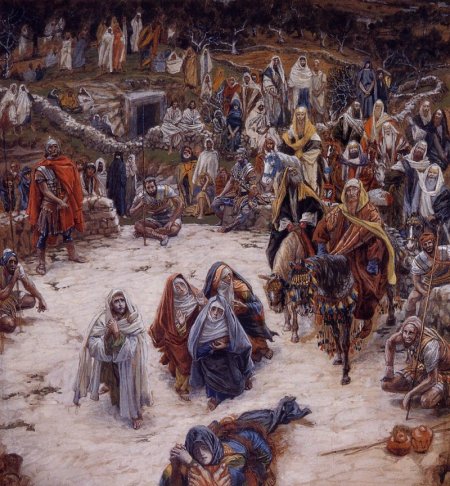
View From the Cross by Tissot

Returning the Favor — Holy Thursday Homily

March 24, 2016

St. Augustine wrote a famous reflection on Proverbs 23:1 :

“If you sit down to eat at the table of a ruler,
observe carefully what is set before you.”

Why? Because you will be expected to provide the same kind of meal for him. This proverb is a practical tip of worldly wisdom, but St. Augustine goes deeper; what is its spiritual meaning for the Christian?

Who is our ruler?  It is Jesus our Lord.
Where is his table? It is here, his altar.
Now carefully observe the food he sets before us: it is the Eucharist, his very self.

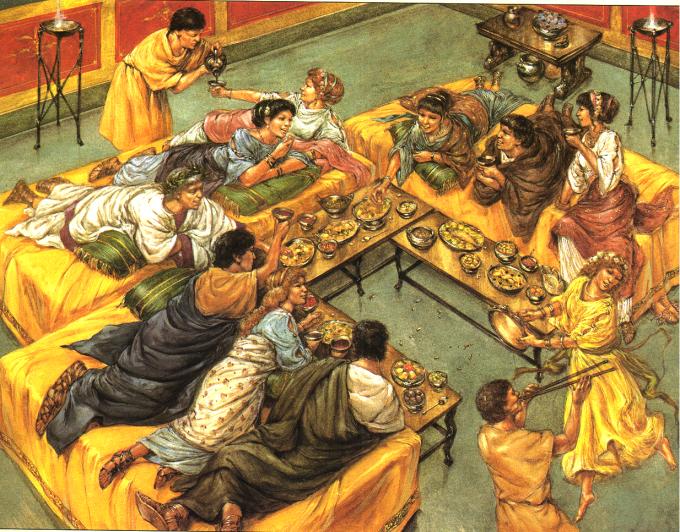
Jesus, like others in the ancient world, reclined at table.Jesus calls us to prepare the same kind of meal for him. He says, “This is my body, given up for you. Do this in memory of me.” We must make a gift of ourselves by living our lives for him, and we are to serve him in others for he tells us, “Amen, I say to you, whatever you did for one of these least brothers of mine, you did for me.”

After washing his disciples feet at the Last Supper where he institutes the Eucharist, Jesus says to his disciples, and to us: “Do you realize what I have done for you? … I have given you a model to follow, so that as I have done for you, you should also do.

Our Lady of Champion

February 12, 2016

Bishop Rickens at the Shrine of Our Lady of Good Help, Dec 8, 2010In 2010, on the Feast of the Immaculate Conception at the Shrine of Our Lady of Good Help (about sixteen miles northeast of Green Bay, Wisconsin) Bishop David Ricken formally endorsed our country’s first Church-approved Marian apparition:

“I declare with moral certainty and in accord with the norms of the Church that the events, apparitions and locutions given to Adele Brise in October of 1859 do exhibit the substance of supernatural character, and I do hereby approve these apparitions as worthy of belief (although not obligatory) by the Christian faithful.”


This is the account of that Marian apparition according to Sr. Pauline LaPlant, to whom Adele Brise often told her story:

She was going to the grist mill about four miles from here [Champion, WI] with a sack of wheat on her head … As Adele came near the place, she saw a lady all in white standing between two trees, one a maple, the other a hemlock. Adele was frightened and stood still. The vision slowly disappeared, leaving a white cloud after it. Adele continued on her errand and returned home without seeing anything more. She told her parents what had happened, and they wondered what it could be—maybe a poor soul who needed prayers?

On the following Sunday, she had to pass here again on her way to Mass at Bay Settlement, about eleven miles from her home … This time, she was not alone, but was accompanied by her sister Isabel and a neighbor woman. When they came near the trees, the same lady in white was at the place where Adele had seen her before. Adele was again frightened and said, almost in a tone of reproach, “Oh, there is that lady again.”

Adele had not the courage to go on. The other two did not see anything, but they could tell by Adele’s look that she was afraid. They thought, too, that it might be a poor soul that needed prayers. They waited a few minutes, and Adele told them it was gone. It had disappeared as the first time, and all she could see was a little mist or white cloud. After Mass, Adele went to confession and told her confessor how she had been frightened at the sight of a lady in white. He bade her not to fear, and to speak to him of this outside of the confessional. Father Verhoef told her that if it were a heavenly messenger, she would see it again, and it would not harm her, but to ask in God’s name who it was and what it desired of her. After that, Adele had more courage. She started home with her two companions, and a man who was clearing land for the Holy Cross Fathers at Bay Settlement accompanied them.

As they approached the hallowed spot, Adele could see the beautiful lady, clothed in dazzling white, with a yellow sash around her waist. Her dress fell to her feet in graceful folds. She had a crown of stars around her head, and her long, golden, wavy hair fell loosely around her shoulders. Such a heavenly light shone around her that Adele could hardly look back at her sweet face. Overcome by this heavenly light and the beauty of her amiable visitor, Adele fell on her knees. “In God’s name, who are you and what do you want of me?” asked Adele, as she had been directed.

I am the Queen of Heaven, who prays for the conversion of sinners, and I wish you to do the same. You received Holy Communion this morning, and that is well. But you must do more. Make a general confession, and offer Communion for the conversion of sinners. If they do not convert and do penance, my Son will be obliged to punish them.”

“Adele, who is it?” said one of the women. “O why can’t we see her as you do?” said another weeping.

“Kneel,” said Adele, “the Lady says she is the Queen of Heaven.” Our Blessed Lady turned, looked kindly at them, and said, “Blessed are they that believe without seeing. What are you doing here in idleness…while your companions are working in the vineyard of my Son?

“What more can I do, dear Lady?” said Adele, weeping.

Gather the children in this wild country and teach them what they should know for salvation.”

“But how shall I teach them who know so little myself?” replied Adele.

Teach them,” replied her radiant visitor, “their catechism, how to sign themselves with the sign of the Cross, and how to approach the sacraments; that is what I wish you to do. Go and fear nothing. I will help you.”

The manifestation of Our Lady then lifted her hands, as though beseeching a blessing for those at her feet, and slowly vanished, leaving Adele overwhelmed and prostrate on the ground.


Sister Adele Brise, Visionary of ChampionWhen word spread about Adele Brise’s vision of the Blessed Virgin some believed the account with astonishment, while others judged it a demented delusion. Adele, however, considered it a commission to catechize the children and admonish the sinners of the Bay Settlement. Adele’s father erected a makeshift chapel near the spot of Adele’s vision.


Peshtigo Fire Map

Twelve years later, on October 8th, 1871, disaster came. The Great Peshtigo Fire remains the largest and deadliest forest fire in U.S. history. Between 1,200 and 2,400 lives were lost in Green Bay region. Hundreds fled to the shrine for refuge, beseeching Mary’s help. They lifted a statue of Mary and carried it around the grounds. When the wind and fire threatened suffocation in one direction, they turned in another direction to pray. Hours later, rain began to extinguish the raging fire. The shrine grounds were a green island in an ocean of smoldering ashes in every direction, and all those who fled to Mary’s shrine were saved.

The Temptations of the First Christmas

December 22, 2015

If I were a demon prowling about the world for the discouragement, confusion, and ruin of souls, how might I have tried to tempt God’s beloved ones in the year leading up to the first Christmas?

If I were a demon, I would say to St. Elizabeth, “Did people imagine that Zechariah had a vision while he was serving in the temple? He simply had a stroke and he will never speak again. You’re feeling sick every day and your abdomen is expanding. You clearly have a cancer. You will soon be dead. There is no hope.

If I were a demon, I would say to St. Mary, “You think you saw an angel? That’s crazy! You’re imagining things. Who are you to be the mother of God’s son? Who do you think you are! Don’t even bother going to visit Elizabeth. You’ll feel foolish when you arrive and see that nothing has changed. None of your family, friends, or neighbors will believe you. Joseph will divorce you and you will be all alone.

And if I were a demon, I would say to St. Joseph, “Do you really believe Mary conceived by God’s Spirit? She’s obviously lying. Even if it’s true, who are you to be a father to the Messiah? Either way, it is best for you to just get a divorce. Whatever you imagined when you married her, now you can see that you were so very wrong.

Mary & Joseph

Even with the coming of Christmas, my diabolical efforts would not cease. I would advise Bethlehem’s shepherds to steer safely-clear of the holy child and to keep to watching their flocks. I would urge the Magi to dismiss the starry signs as meaningless coincidences and not to risk a long journey. I would encourage Joseph to ignore the warning dream to take his family into Egypt and I would encourage Mary not to trust in her loving husband’s lead: “Surely, God would have told you this before telling Joseph.” Thankfully for us, none of them were prevented from doing God’s will through being tripped-up by such traps.

Some people think of temptation strictly as a prompting toward pleasurable, immoral action. But temptation can come in other forms. It can also pull us toward inaction and negative experiences like fear, doubt, sadness, and despair.

Some people assume that the saints do not know temptation like the rest of us. But did Mary, Joseph, and Elizabeth live oblivious to the thoughts and unassailed by the feelings realistically described above? In truth, the saints come to understand temptation well as they discern and persevere through the trials of life.

Some people believe that God loves and watches over a few favored saints while having less concern for the rest of us. But this is also a temptation. Even if our life takes a shocking turn and we don’t know what to do, even if we have a stroke, or cancer, or our mind begins to fail, even if we seem betrayed or abandoned by everyone, each and all of us are his dearly beloved ones. (And we shouldn’t listen to anyone telling us otherwise, even if they speak to us in our own voice.)