Archive for the ‘Saintly People’ Category

Jesus as an Undercover Boss

April 7, 2016

During the seven week span from Easter to Pentecost, the apostles were firsthand witnesses to Christ’s resurrection, but they lacked their mission. In those days, Jesus was not always visibly with them and the Holy Spirit was not prompting them to preach the Good News. And so, the apostles had extra spare time on their hands. But even if you’re a person who has seen Jesus Christ risen from the dead you still need to eat. Therefore, Peter says, “I am going fishing,” and six others decide to go along with him. Fishing the Sea of Galilee was Peter’s line of work before Jesus called him to become a ‘fisher of men.’

Jesus Appears on the Shore in John 21In today’s Gospel, Peter goes back to his old job. And then, unexpectedly, Jesus shows up at Peter’s workplace. Like an “undercover boss” on TV, Jesus comes in disguise. Jesus’ glorified and resurrected body allows him to conceal or change his appearance. At first, amid the routine of their work, the disciples fail to recognize him. But after catching their huge catch of (153!) fish, they realize “it is the Lord” and begin acting differently. How would you respond if the Lord appeared at your workplace as a customer, co-worker, or boss?

Sometimes we Christians slip into mentally separating our life at church from our life in the world; for example, working in the world without thinking of our faith. But we must remember to honor and serve Jesus Christ always and everywhere. You have probably heard of the importance of ‘seeing Christ in others.’ Seeing Christ in others means treating them like you would treat Jesus Christ himself. Now, of course, a Christian should not worship anything or anyone other than God, but Jesus wants you to love other people through the love you have for him.

As Jesus says in the Gospel of Matthew, when he comes in his glory with all the holy angels with him, Jesus will sit upon the throne of his glory and all the nations shall be gathered before him. And Jesus, the king and judge, shall declare to them, “Amen, I say unto you, inasmuch as you did it to one of these least of brethren of mine, you did for me.” Therefore, recognize Jesus encountering you, unexpectedly and disguised, at the place where you work—in your customers, your coworkers, and your bosses—and love them with your love for Christ.

Rejecting Reincarnation

April 6, 2016

G.K. ChestertonA friend once told me his flirtations with belief in reincarnation ended by reading two good points by G.K. Chesterton. If all people were (re)born into the blessings or curses of their present lives on account of their good or bad actions in the past, then:

  1. We could expect nearly all well-born persons to be honest, given their long track records of virtue.
  2. Those who are born into bad circumstances would merit their own suffering and unhappiness.

Buddhist reincarnation beliefs may vary, but Hindus in India have traditionally believed that their top castes merit their nobility (and the untouchables their servitude) due to reincarnation’s Karmic justice.

However, as Hebrews 9:27 says, “it is appointed that men die once, and after this the judgment…”

He Proved Faithful — Good Friday Homily

March 25, 2016

Few proved faithful to Jesus on Good Friday, but on Good Friday Jesus proved himself faithful to us.

The political leaders were supposed to serve justice, but Pilate and Herod failed to protect Jesus as an innocent man. Jesus protected us when we were guilty.

The religious leaders were supposed to serve holiness, but the High Priests and the Sanhedrin failed to accept Jesus as their Messiah. Jesus accepted us so that we might become holy.

The disciples were supposed to serve their teacher and lord, but Judas betrayed him, Peter denied him, and the others abandoned him. By enduring his suffering and death, Jesus proved himself faithful to us.

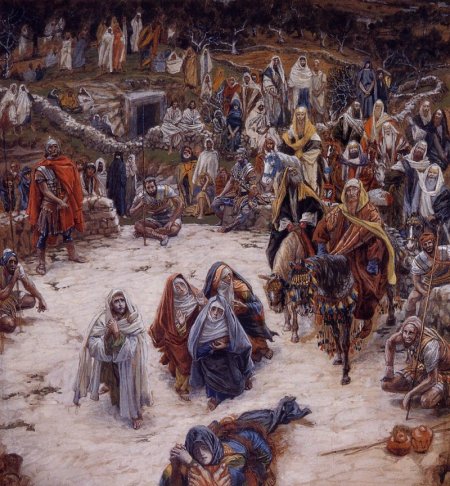
Jesus’ mother Mary was faithful. She stood with him at the foot of the cross. It was a consolation for Jesus to have her there. Two of his beloved disciples were also there: Mary Magdalene and the apostle John. Jesus was grateful to have them close by.

Today, on this Good Friday, by the grace of God, we are at the foot of the cross. Let us pray for mercy, for ourselves and for others. Despite our past unfaithfulness, let us honor his faithfulness to us. Jesus is pleased that we are here with him, and he is grateful for our gratitude.

View From the Cross by Tissot

Returning the Favor — Holy Thursday Homily

March 24, 2016

St. Augustine wrote a famous reflection on Proverbs 23:1 :

“If you sit down to eat at the table of a ruler,
observe carefully what is set before you.”

Why? Because you will be expected to provide the same kind of meal for him. This proverb is a practical tip of worldly wisdom, but St. Augustine goes deeper; what is its spiritual meaning for the Christian?

Who is our ruler?  It is Jesus our Lord.
Where is his table? It is here, his altar.
Now carefully observe the food he sets before us: it is the Eucharist, his very self.

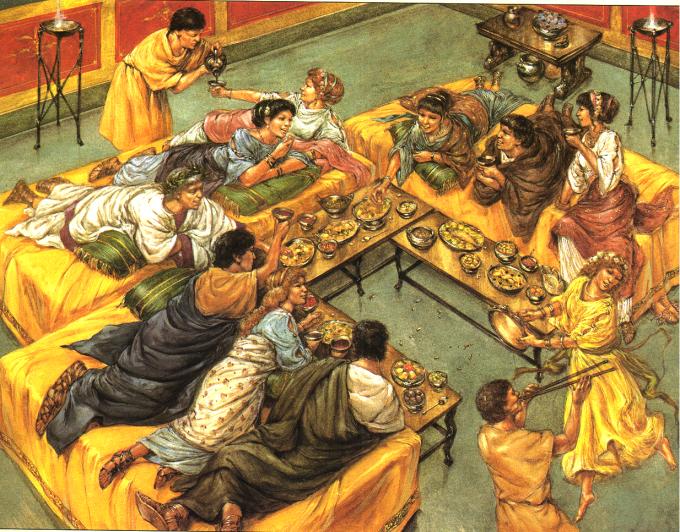
Jesus, like others in the ancient world, reclined at table.Jesus calls us to prepare the same kind of meal for him. He says, “This is my body, given up for you. Do this in memory of me.” We must make a gift of ourselves by living our lives for him, and we are to serve him in others for he tells us, “Amen, I say to you, whatever you did for one of these least brothers of mine, you did for me.”

After washing his disciples feet at the Last Supper where he institutes the Eucharist, Jesus says to his disciples, and to us: “Do you realize what I have done for you? … I have given you a model to follow, so that as I have done for you, you should also do.

Our Lady of Champion

February 12, 2016

Bishop Rickens at the Shrine of Our Lady of Good Help, Dec 8, 2010In 2010, on the Feast of the Immaculate Conception at the Shrine of Our Lady of Good Help (about sixteen miles northeast of Green Bay, Wisconsin) Bishop David Ricken formally endorsed our country’s first Church-approved Marian apparition:

“I declare with moral certainty and in accord with the norms of the Church that the events, apparitions and locutions given to Adele Brise in October of 1859 do exhibit the substance of supernatural character, and I do hereby approve these apparitions as worthy of belief (although not obligatory) by the Christian faithful.”


This is the account of that Marian apparition according to Sr. Pauline LaPlant, to whom Adele Brise often told her story:

She was going to the grist mill about four miles from here [Champion, WI] with a sack of wheat on her head … As Adele came near the place, she saw a lady all in white standing between two trees, one a maple, the other a hemlock. Adele was frightened and stood still. The vision slowly disappeared, leaving a white cloud after it. Adele continued on her errand and returned home without seeing anything more. She told her parents what had happened, and they wondered what it could be—maybe a poor soul who needed prayers?

On the following Sunday, she had to pass here again on her way to Mass at Bay Settlement, about eleven miles from her home … This time, she was not alone, but was accompanied by her sister Isabel and a neighbor woman. When they came near the trees, the same lady in white was at the place where Adele had seen her before. Adele was again frightened and said, almost in a tone of reproach, “Oh, there is that lady again.”

Adele had not the courage to go on. The other two did not see anything, but they could tell by Adele’s look that she was afraid. They thought, too, that it might be a poor soul that needed prayers. They waited a few minutes, and Adele told them it was gone. It had disappeared as the first time, and all she could see was a little mist or white cloud. After Mass, Adele went to confession and told her confessor how she had been frightened at the sight of a lady in white. He bade her not to fear, and to speak to him of this outside of the confessional. Father Verhoef told her that if it were a heavenly messenger, she would see it again, and it would not harm her, but to ask in God’s name who it was and what it desired of her. After that, Adele had more courage. She started home with her two companions, and a man who was clearing land for the Holy Cross Fathers at Bay Settlement accompanied them.

As they approached the hallowed spot, Adele could see the beautiful lady, clothed in dazzling white, with a yellow sash around her waist. Her dress fell to her feet in graceful folds. She had a crown of stars around her head, and her long, golden, wavy hair fell loosely around her shoulders. Such a heavenly light shone around her that Adele could hardly look back at her sweet face. Overcome by this heavenly light and the beauty of her amiable visitor, Adele fell on her knees. “In God’s name, who are you and what do you want of me?” asked Adele, as she had been directed.

I am the Queen of Heaven, who prays for the conversion of sinners, and I wish you to do the same. You received Holy Communion this morning, and that is well. But you must do more. Make a general confession, and offer Communion for the conversion of sinners. If they do not convert and do penance, my Son will be obliged to punish them.”

“Adele, who is it?” said one of the women. “O why can’t we see her as you do?” said another weeping.

“Kneel,” said Adele, “the Lady says she is the Queen of Heaven.” Our Blessed Lady turned, looked kindly at them, and said, “Blessed are they that believe without seeing. What are you doing here in idleness…while your companions are working in the vineyard of my Son?

“What more can I do, dear Lady?” said Adele, weeping.

Gather the children in this wild country and teach them what they should know for salvation.”

“But how shall I teach them who know so little myself?” replied Adele.

Teach them,” replied her radiant visitor, “their catechism, how to sign themselves with the sign of the Cross, and how to approach the sacraments; that is what I wish you to do. Go and fear nothing. I will help you.”

The manifestation of Our Lady then lifted her hands, as though beseeching a blessing for those at her feet, and slowly vanished, leaving Adele overwhelmed and prostrate on the ground.


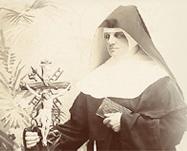
Sister Adele Brise, Visionary of ChampionWhen word spread about Adele Brise’s vision of the Blessed Virgin some believed the account with astonishment, while others judged it a demented delusion. Adele, however, considered it a commission to catechize the children and admonish the sinners of the Bay Settlement. Adele’s father erected a makeshift chapel near the spot of Adele’s vision.


Peshtigo Fire Map

Twelve years later, on October 8th, 1871, disaster came. The Great Peshtigo Fire remains the largest and deadliest forest fire in U.S. history. Between 1,200 and 2,400 lives were lost in Green Bay region. Hundreds fled to the shrine for refuge, beseeching Mary’s help. They lifted a statue of Mary and carried it around the grounds. When the wind and fire threatened suffocation in one direction, they turned in another direction to pray. Hours later, rain began to extinguish the raging fire. The shrine grounds were a green island in an ocean of smoldering ashes in every direction, and all those who fled to Mary’s shrine were saved.

The Temptations of the First Christmas

December 22, 2015

If I were a demon prowling about the world for the discouragement, confusion, and ruin of souls, how might I have tried to tempt God’s beloved ones in the year leading up to the first Christmas?

If I were a demon, I would say to St. Elizabeth, “Did people imagine that Zechariah had a vision while he was serving in the temple? He simply had a stroke and he will never speak again. You’re feeling sick every day and your abdomen is expanding. You clearly have a cancer. You will soon be dead. There is no hope.

If I were a demon, I would say to St. Mary, “You think you saw an angel? That’s crazy! You’re imagining things. Who are you to be the mother of God’s son? Who do you think you are! Don’t even bother going to visit Elizabeth. You’ll feel foolish when you arrive and see that nothing has changed. None of your family, friends, or neighbors will believe you. Joseph will divorce you and you will be all alone.

And if I were a demon, I would say to St. Joseph, “Do you really believe Mary conceived by God’s Spirit? She’s obviously lying. Even if it’s true, who are you to be a father to the Messiah? Either way, it is best for you to just get a divorce. Whatever you imagined when you married her, now you can see that you were so very wrong.

Mary & Joseph

Even with the coming of Christmas, my diabolical efforts would not cease. I would advise Bethlehem’s shepherds to steer safely-clear of the holy child and to keep to watching their flocks. I would urge the Magi to dismiss the starry signs as meaningless coincidences and not to risk a long journey. I would encourage Joseph to ignore the warning dream to take his family into Egypt and I would encourage Mary not to trust in her loving husband’s lead: “Surely, God would have told you this before telling Joseph.” Thankfully for us, none of them were prevented from doing God’s will through being tripped-up by such traps.

Some people think of temptation strictly as a prompting toward pleasurable, immoral action. But temptation can come in other forms. It can also pull us toward inaction and negative experiences like fear, doubt, sadness, and despair.

Some people assume that the saints do not know temptation like the rest of us. But did Mary, Joseph, and Elizabeth live oblivious to the thoughts and unassailed by the feelings realistically described above? In truth, the saints come to understand temptation well as they discern and persevere through the trials of life.

Some people believe that God loves and watches over a few favored saints while having less concern for the rest of us. But this is also a temptation. Even if our life takes a shocking turn and we don’t know what to do, even if we have a stroke, or cancer, or our mind begins to fail, even if we seem betrayed or abandoned by everyone, each and all of us are his dearly beloved ones. (And we shouldn’t listen to anyone telling us otherwise, even if they speak to us in our own voice.)

The Two (Old & New) Arks of God

December 17, 2015

Remember Raiders of the Lost Ark? The Ark that Indiana Jones and the Nazis were pursued in that entertaining film was the most precious object in the entire Old Testament. But what is lost on many is how that holy artifact is related to the most important woman in the New Testament and its New Covenant.

The Old Testament Ark of the Covenant was a box built in the days of Moses according to God’s instructions at Mount Sinai. It was made of wood overlaid with pure gold, inside and out. No man was allowed to touch God’s Holy Ark—lest they die—so it was designed to be carried about using a pair of poles. The Ark was the throne for God’s presence on earth. The wings of two, golden Cherubim angel statues atop the Ark’s lid served as his “mercy-seat.” The Ark itself contained within several interesting items from the time of the Exodus: the two stone tablets of the 10 Commandments, the wooden staff of Aaron (which miraculously blossomed to confirm his divinely-ordained priesthood), and a gold container holding some of the Manna from heaven which God provided to feed his people on their desert pilgrimage.

Ark

About 450 years after its construction, around 1000 BC, King David reigned over all of Israel. He tried to bring the Ark up to his royal city, Jerusalem, until one of the priests (who should have known better) touched the Ark and fell down dead. David exclaimed, “How can the Ark of the Lord come to me?” He arranged for it to be kept at the house of Obed-edom in the Judean countryside. The Ark remained there for three months and manifestly blessed the whole household. When it was reported to the king how richly Obed-edom was being graced, King David decided to try transporting the Ark into Jerusalem once more. David himself led that procession, dancing and leaping before the Lord with joyful abandon.

The Ark would eventually reside in the Jerusalem Temple built by David’s son, King Solomon. It is written that before that Temple was destroyed by the Babylonians in 587 BC, Jeremiah the Prophet took the Ark and hid it in a secret cave, saying, “No one must know about this place until God gathers his people together again and shows them mercy.”Unlike in the 1981 film, the Lost Ark has never been found, but a new Ark of God did appear.

The Blessed Virgin Mary is the New Ark of the Covenant because she bears Jesus Christ, God’s fullest presence on earth. By God’s design, the first Ark was made of wood and covered with gold; Mary is a human being full with grace. The former Ark carried the word of God in stone; Mary’s womb carries the Word become flesh. Aaron’s dead staff miraculously flowered; Mary’s virgin womb blossomed with a bud from the stump of Jesse. The Ark held Manna from heaven; Mary bore the true bread from heaven. Mary’s womb holds Jesus Christ, our Prophet, Priest, and King.

The Visitation by Albertinelli, 1503.As the Gospel of Luke tells us, after she was visited by St. Gabriel the Archangel at the Annunciation, “Mary set out and traveled to the hill country in haste to a town of Judah, where she entered the house of Zechariah and greeted Elizabeth. When Elizabeth heard Mary’s greeting, the infant leaped in her womb, and Elizabeth, filled with the holy Spirit, cried out in a loud voice and said, ‘Most blessed are you among women, and blessed is the fruit of your womb. And how does this happen to me, that the mother of my Lord should come to me?’” And Mary would bless them with her help and companionship, staying at their house in the Judean hill country about three months.

Like King David, St. Elizabeth questions and St. John the Baptist leaps for joy before the Ark of the Lord. St. Joseph, regarding the inviolable sanctity of his wife with reverent fear, never touched her virginity. Mary would also go on to literally serve as God’s throne, his mercy-seat; “On entering the house [the Magi] saw the child with Mary his mother.”

In the Book of Revelation, St. John’s vision of heaven includes a sighting of the Lost Ark: “Then God’s temple in heaven was opened, and the Ark of his Covenant could be seen in the temple.” Then John beholds “in the sky, a woman clothed with the sun, with the moon under her feet, and on her head a crown of twelve stars.” We soon discover that this  glorious woman is pregnant with “a son, a male child, destined to rule all the nations….” This is the Christ, and she is his Holy Ark.

Now the Lord’s Ark is not meant to be worshiped. (Though among God’s most holy creations, an Ark of God is not divine.) Yet, as one draws nearer to the Holy Ark, one inevitably draws nearer to God’s presence. Just as the old Ark of the Covenant was of central (though secondary) importance in the Old Covenant, so God gives the Blessed Virgin Mary an essential role in his New Covenant. All who come to her are drawn nearer to her Son.

Imagine daring to enter the old Jewish Temple’s the Holy of Holies where the Ark of God was kept. What awe and reverence would you feel before the all-holy presence of God? Now consider drawing near to the even greater Ark, Mary the Mother of all Christians, who reaches out to each of us with love and takes away our fear. And now reflect upon the great privilege we have in approaching and even touching the Christmas Gift of God she bore, Jesus Christ himself. Mary is blessed among women and blessed is the fruit of her womb, Jesus. But blessed are we who would believe in all that the Lord has revealed to us.

The Value of Humility: Living in the Truth Before God

December 14, 2015

“Some [spiritual beginners] make little of their faults, and at other times become over-sad when they see themselves fall into them, thinking themselves to have been saints already; and thus they become angry and impatient with themselves, which is another imperfection. Often they beseech God, with great yearnings, that He will take from them their imperfections and faults, but they do this that they may find themselves at peace, and may not be troubled by them, rather than for God’s sake; not realizing that, if He should take their imperfections from them, they would probably become prouder An Ancient-Style Oil Lampand more presumptuous still. They dislike praising others and love to be praised themselves; sometimes they seek out such praise. Herein they are like the foolish virgins, who, when their lamps could not be lit, sought oil from others.”

—St. John of the Cross in The Dark Night of the Soul

The Real St. Nicholas

December 6, 2015

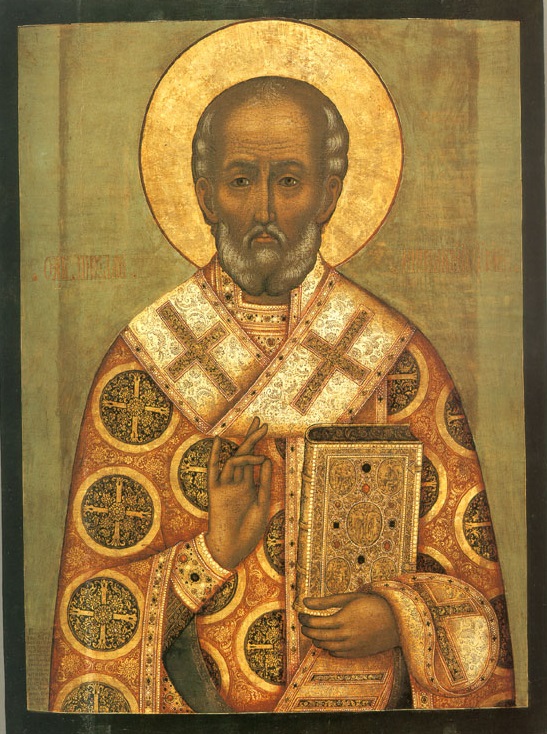
St. Nicholas by Fyodor ZubovSt. Nicholas (270-343 A.D.) was the bishop of Myra, a city on the southwestern corner of Turkey along the Mediterranean coast. He attended the Council of Nicaea in 325 A.D., opposed the Arian heresy, and signed the Nicene Creed (an early version of the creed that we profess at every Sunday Mass.) However, St. Nicholas is most well-remembered for his generous, secret alms-giving.

In one window in the back of St. Wenceslaus Church, St. Nicholas is depicted holding three sacks. This recalls how he once helped a family in serious need. There was a poor man who could not afford dowries for his three daughters to get married. (In those days, being without husbands would doom the women to lives of destitution, or worse.) Under the cover of night, St. Nicholas tossed three bags of gold coins through their window. (Alternate-tellings of the story have St. Nicholas dropping them down their chimney or leaving them in the daughters’ drying stockings.) We can imagine the family awaking the next morning, finding the gifts he had left, and celebrating the arrival of their salvation.

St. Nicholas’ feast day is celebrated December 6th

Related Link: How St. Nicholas of Myra became associated with Santa Claus

Consoling Words

December 4, 2015

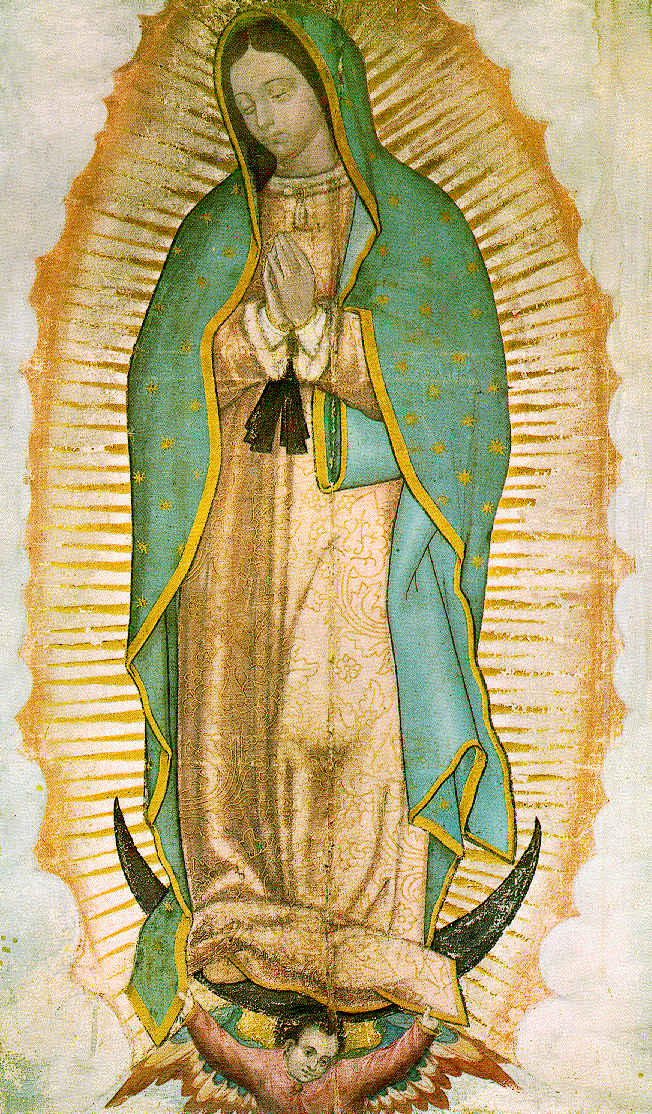
Our Lady of Guadalupe Tilma“Listen, put it into your heart, my youngest and dearest son, that the thing that disturbs you, the thing that afflicts you, is nothing. Do not let your countenance, your heart be disturbed. Do not fear this sickness of your uncle or any other sickness, nor anything that is sharp or hurtful. Am I not here, I, who am your Mother? Are you not under my shadow and protection? Am I not the source of your joy? Are you not in the hollow of my mantle, in the crossing of my arms? Do you need anything more? Let nothing else worry you, disturb you. Do not let your uncle’s illness worry you, because he will not die now. You may be certain that he is already well.”

Words of Mary, Our Lady of Guadalupe, to St. Juan Diego in 1531

Charles Dickens’ Otherworldly Visitor

November 17, 2015

Charles Dickens by Frith, 1859        One night in 1844, the year after he published A Christmas Carol, a 32-year-old Charles Dickens seemingly encountered a visitor from beyond while vacationing in Venice, Italy. Within this dream or vision, Dickens thought himself speaking to his dearly-beloved sister-in-law, Mary Hogarth, who had died in 1837, yet he also observed that the spirit “bore no resemblance to any one I have known.” Dickens recorded this experience soon afterward in a letter to a friend:

“Let me tell you of a curious dream I had, last Monday night; and of the fragments of reality I can collect, which helped to make it up. [I] had laid awake nearly all that night…. [W]hen I fell asleep and dreamed this dream. Observe that throughout I was as real, animated, and full of passion as [the English actor William Macready] in the last scene of Macbeth.

In an indistinct place, which was quite sublime in its indistinctness I was visited by a Spirit. I could not make out the face, nor do I recollect that I desired to do so. It wore a blue drapery, as the Madonna might in a picture by Raphael; and bore no resemblance to any one I have known except in stature. I think (but I am not sure) that I recognized the voice. Anyway, I knew it was poor Mary’s spirit. I was not at all afraid, but in a great delight, so that I wept very much, and stretching out my arms to it called it “Dear.”

At this, I thought it recoiled; and I felt immediately, that not being of my gross nature, I ought not to have addressed it so familiarly. “Forgive me!” I said. “We poor living creatures are only able to express ourselves by looks and words. I have used the word most natural to our affections; and you know my heart.” It was so full of compassion and sorrow for me—which I knew spiritually, for, as I have said, I didn’t perceive its emotions by its face—that it cut me to the heart; and I said, sobbing, “Oh! give me some token that you have really visited me!

“Form a wish,” it said. I thought, reasoning with myself: ‘If I form a selfish wish, it will vanish.’ So I hastily discarded such hopes and anxieties of my own as came into my mind, and said, “Mrs. Hogarth is surrounded with great distresses (observe, I never thought of saying ‘your mother‘ as to a mortal creature) will you extricate her?” “Yes.” “And her extrication is to be a certainty to me that this has really happened?” “Yes.”

But answer me one other question!” I said, in an agony of entreaty lest it should leave me. “What is the True religion?” As it paused a moment without replying, I said—Good God in such an agony of haste, lest it should go away! “You think, as I do, that the Form of religion does not so greatly matter, if we try to do good? or,” I said, observing that it still hesitated, and was moved with the greatest compassion for me, “perhaps the Roman Catholic is the best? Perhaps it makes one think of God oftener, and believe in him more steadily?” “For you,” said the Spirit, full of such heavenly tenderness for me, that I felt as if my heart would break; “for you, it is the best!” Then I awoke, with the tears running down my face, and myself in exactly the condition of the dream. It was just dawn.

I called up [my wife] Kate, and repeated it three or four times over, that I might not unconsciously make it plainer or stronger afterwards. It was exactly this. Free from all hurry, nonsense, or confusion, whatever.”

One’s Catholic imagination wonders if this tender, compassionate, glorious “Mary” who visited Charles Dickens that night was actually the Blessed Virgin. Like Our Lady of Lourdes responded to Bernadette’s initial requests for her name with a silent smile, this visitor holds back at first to finally reveal a climactic answer. Whether this was a true vision or merely a dream we cannot say, but this visitor’s answer to his religious question does not disqualify our Blessed Mother: the glorious woman told him, “For you, [the Catholic religion] is the best!”

Would this statement imply that Catholicism would not be the best religion for some? Dickens himself held that the form of one’s religion did not greatly matter if someone tried to do good, and his strong distaste for formal religion had drawn him to Unitarianism. If our Mother Mary, who knew Charles through and through, wished to lead him into full communion with the Catholic Church, she would speak truth to him in the way which he could best receive it. Indeed, for him the Catholic faith truly would be best, but he may have balked-outright at her teaching that it is best for everyone. If his was a vision of the Blessed Virgin sent from God, the plan was to bring him into the fullness of the truth over time, as we often see God patiently doing with others.

Charles Dickens never did become a Catholic during his lifetime, but after 1847 (three years after this experience) he began attending the Anglican church near his home and prayed each morning and night. A year before his death, he wrote in his 1869 last will and testament, “I commit my soul to the mercy of God through our Lord and Saviour Jesus Christ….” Today his body lies buried in Poets’ Corner of Westminster Abbey.

Our Holy Conspiracy & the End of the World — 33rd Sunday of Ordinary Time—Year B

November 16, 2015

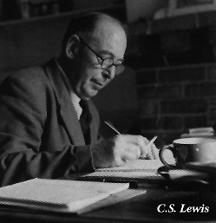
C.S. Lewis, 1898-1963A new liturgical Church year will begin in a couple of weeks with the first Sunday of Advent. As this Church year ends, our Mass readings (like today’s Sunday readings) focus on the Last Things and the end of the world as we know it. This weekend’s news reports, especially the terrible events in France, remind us that though the Kingdom of God is among us, we pray “thy Kingdom come” because it is not yet fully here in total, unveiled power. This weekend’s readings and news events remind me of passages from C.S. Lewis in excellent book Mere Christianity:

“Enemy-occupied territory—that is what this world is. Christianity is the story of how the rightful king has landed, you might say landed in disguise, and is calling us all to take part in a great campaign of sabotage. When you go to church you are really listening-in to the secret wireless [radio] from our friends: that is why the enemy is so anxious to prevent us from going.”

Why does Lewis say that our king has landed “in disguise?” Well, where would you expect a king to be born? The Magi sought the newborn king of the Jews in the palace at Jerusalem, but Jesus was born in a barn—a cave in Bethlehem—to a pair of poor parents. How would one expect the Jewish Messiah to enter into Jerusalem to claim his throne? Probably riding on a warhorse, but Jesus came meekly riding on a donkey, just as had been prophesied about him. Who would have thought that God would become a man, and then suffer and die as he did? After the vindication of the resurrection, one would have thought he would appear to the high priest and Governor Pilate, or to the Emperor Tiberius in Rome, to declare that he was indeed who he claimed to be. Instead, Jesus appeared discretely, to his disciples.

Lewis writes that God has landed in this enemy-occupied world in disguise and has started “a sort of secret society” to undermine the devil. This secret society he speaks of is the Church. But what is so secret about the Church? We have a sign in front with our Mass times. We don’t check ID’s at the door. And if anyone wants to know about what we do or what we believe, we will gladly inform them. But, in a sense, the Church is a secret society—for the world and even many Catholics do not recognize who and what we really are. We are a holy conspiracy. We are fighting the propaganda of the world and the devil with the truth of God. We are recruiting others to the side of the Lord. We are his special forces sabotaging evil with the weapons of love in preparation for the king’s arrival.

From where do we receive our power for this mission? The source of our power is the Holy Mass. Today’s second reading says that the Old Testament’s priests offered many sacrifices because those  could not truly achieve their purpose, but Jesus our High Priest offers his sacrifice once for all. At Mass we transcend space and time to personally encounter that sacrifice, and it’s power is applied to us here and now, providing all the graces we need to fulfill his will.

Lewis asks, “Why is [God] not [yet] landing in [total unveiled] force, invading [our world]? Is it that He is not strong enough? Well, Christians think He is going to land in force; [but] we do not know when.”

Indeed, as Jesus says in today’s Gospel, “of that day or hour, no one knows… but only the Father.”

We do not know when the Lord is going to land in force. “But,” Lewis continues, “we can guess why He is delaying. He wants to give us the chance of joining His side freely. I do not suppose you and I would have thought much of a Frenchman [during World War II] who waited till the Allies were marching into Germany and then announced he was on our side. God will invade.”

Why has God not yet invaded our world with his full, unveiled force? Why does he allow the wicked to use their freedom for evil, like the terrorism we saw in Paris?

Lewis writes, “I wonder whether people who ask God to interfere openly and directly in our world quite realize what it will be like when He does. When that happens, it is the end of the world. When the author walks on to the stage the play is over. God is going to invade, all right: but what is the good of saying you are on His side then, when you see the whole natural universe melting away like a dream and something else—something it never entered your head to conceive—comes crashing in; something so beautiful to some of us and so terrible to others that none of us will have any choice left?”

I think “the whole natural universe melting away” is an excellent reflection on today’s gospel. Jesus tells us that at the end:

“the sun will be darkened,
and the moon will not give its light,
and the stars will be falling from the sky,
and the powers in the heavens will be shaken…”

In the ancient world, the sun and moon, stars and planets, were considered the most stable and eternal things in the cosmos (and you can understand why.) But when even these things are passing, you know the universe as we know it is melting away. After this, the Lord Jesus comes with judgment. “And then they will see ‘the Son of Man coming in the clouds’ with great power and glory… (and his angels, like St. Michael from our first reading, along with him…)”
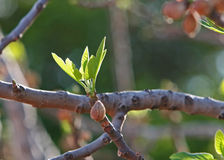
Sprouting Fig Tree in SpringtimePerhaps we may find it surprising that Jesus describes these events as a good thing to his disciples. He says:

“Learn a lesson from the fig tree. When its branch becomes tender and sprouts leaves, you know that summer is near. In the same way, when you see these things happening, know that [the Son of Man] is near, at the gates.”

We usually associate the end of things with the fall. Youth is called the springtime of life, while old age is the fall. In the Northern Hemisphere, every Church year ends in the fall. Yet Jesus presents an analogy for the end of the world as one of spring becoming summer: ‘When the tender branch sprouts leaves, you know that summer is near.’ A small thing, the branch, points to the arrival of a much greater reality, the summer. Why would we cling to the branch when the whole world is being renewed in glory? For friends of God, what is to come is better than what we see. The life we live now in this world is the winter. What is still to come for us is the spring and summer. Let us not hesitate to hope for it, envision it, and rejoice in it.

When the last day comes, “it will be God without disguise; something so overwhelming that it will strike either irresistible love or irresistible horror into every creature. It will be too late then to choose your side. … That will not be the time for choosing: it will be the time when we discover which side we really have chosen, whether we realized it before or not. Now, today, this moment, is our chance to choose the right side. God is holding back to give [people] that chance. [But it] will not last forever. We must take it or leave it.”

How long will it be until the Lord comes again? Jesus says in today’s gospel that, “This generation will not pass away until all these things have taken place.” But he said this a long time ago. Was Jesus wrong? No, for when you read these passages from Mark in full context, Jesus is responding to his disciples questions about two things side-by-side: the fall of Jerusalem and the end of the world. The Romans destroyed the great city and its temple in 70 A.D., during the lifespan of some of Jesus’ hearers, and to many Jews it felt like the end of the world. This event prefigured the passing away of all things. Like other prophesies in the Bible, Jesus’ prophesy has a near and distant fulfillment, one after a forty-year opportunity for conversion, and another at the end of time.

So when will the Lord come again? The answer for every generation before us has been “not yet.” If this world endures to the year 10,000 A.D., the Christians of that time will probably regard us as the early Christians. I personally think it will still be awhile before he comes, for it is still legal to be a Christian in too many places on earth. Yet, in a sense, it doesn’t matter when Jesus is coming, for the end of our individual lives is equivalent to the end of the world for us. If you’re ready for one, you’re ready for the other. But if you, or people that you know, are not ready for either, then now is the time for conversion.

The Lord our King has recruited us into his holy conspiracy, arming us with the weapons of truth and love. You and I are his advanced forces and, among other tasks, he is sending us on rescue missions to bring others to himself. Who do you know that is far from Christ? We are to draw on the power of this Mass for them. We are called to pray, fast, and sacrifice for them, and even to be so bold as to talk with them—inviting them to come to Jesus Christ and his Church. Seize this opportunity and do not let it pass away, for whether the Lord first comes to us or we go forth to him, each and all will encounter him soon, face-to-face, in his full, unveiled glory.

Who is St. Michael the Archangel?

November 12, 2015

(Based on his 1911 Catholic Encyclopedia entry)

St. Michael is one of the principal angels. His name (translated from Hebrew, “Who is like God?“) is the war-cry of the good angels in the battle fought in heaven against the devil and his followers. His name is recorded four times in Scripture:

Daniel 10 — Gabriel says to Daniel, when he asks God to permit the Jews to return to Jerusalem: “The Angel of the kingdom of the Persians resisted me … and, behold Michael, one of the chief princes, came to help me … and none is my helper in all these things, but Michael your prince.

Daniel 12 — An angel speaking of the end of the world and the Antichrist says: “At that time shall Michael rise up, the great prince, who stands for the children of your people.

Jude 1 — St. Jude alludes to an ancient Jewish tradition of a dispute between Michael and Satan over the body of Moses: “[The archangel Michael] did not venture to pronounce a reviling judgment upon [Satan] but said, ‘May the Lord rebuke you!’”

Revelation 12 — St. John speaks of the great conflict at the end of time, which reflects also the battle in heaven at the beginning of time: “Then war broke out in heaven; Michael and his angels battled against the dragon. The dragon and its angels fought back, but they did not prevail and there was no longer any place for them in heaven. The huge dragon, the ancient serpent, who is called the Devil and Satan, who deceived the whole world, was thrown down to earth, and its angels were thrown down with it.

Following these Scriptural passages, Christian tradition gives to St. Michael four offices:

(1)  To fight against Satan.

(2)  To be the champion of God’s people, the Jews in the Old Law, the Christians in the New Testament; therefore he was the patron of the Church, and of the orders of knights during the Middle Ages.

(3)  To rescue the souls of the faithful from the power of the enemy, especially at the hour of death.

(4)  To call men’s souls away from earth and bring their souls to judgment.

Regarding his rank in the celestial hierarchy opinions vary; St. Basil and other Greek Fathers place St. Michael over all the angels; they say he is called “archangel” because he is the prince of the other angels; others believe that he is the prince of the seraphim, the first of the nine angelic orders. But, according to St. Thomas Aquinas he is the prince of the last and lowest choir, the angels.

A Chalice Reflection

October 13, 2015

Virgin Mary by the Host by Jean Auguste Dominique Ingres, 1854.     How could we possibly celebrate the Holy Mass without the chalice? Without the chalice, how would we adore the Precious Blood? The chalice holds the Lord and it gives form to his presence. He is not lifted up in sacrifice without its close collaboration. Perhaps our Lord could have chosen another means but this is the one He chose. The chalice at Mass is not divine, but when our Lord is adored it shares in His glory.

The chalice at Mass is an icon of a person. The chalice of Jesus Christ is the Blessed Virgin Mary. She held the Lord within her and from her He received his human form. He was not lifted up in sacrifice without her close collaboration. Perhaps our Lord could have chosen another means, but she is the one He chose. Mary is not divine, but when our Lord is adored she shares in His glory.

Taking Jesus Too Literally

September 30, 2015

Jesus Facepalm

We do well to closely heed all that our Lord Jesus says, but we must also carefully understand what the Word of God Incarnate is really telling us. Using Scripture to interpret Scripture, let us consider two examples where some modern-day Christians misinterpret Jesus’ teaching by taking him too literally.


“Do not swear at all”

Jesus declares, “You have heard that it was said to your ancestors, ‘Do not take a false oath, but make good to the Lord all that you vow.’ But I say to you, do not swear at all; not by heaven, for it is God’s throne; nor by the earth, for it is his footstool; nor by Jerusalem, for it is the city of the great King. Do not swear by your head, for you cannot make a single hair white or black. Let your ‘Yes’ mean ‘Yes,’ and your ‘No’ mean ‘No.’ Anything more is from the evil one.” (Matthew 5:33-37)

Swearing an oath or vow invokes God as one’s witness to a claim or a promise and invites God’s just punishments if his name is taken in vain. It seems that people in Jesus’ day were trying to steal credibility without fearing divine retribution by swearing by lesser holy things. But Jesus warns that all good things belong to God, and condemns clever manipulations of the truth as coming from the devil. Instead, Jesus says, “do not swear at all,” but “let your ‘Yes’ mean ‘Yes.’”

So do any appropriate times and places remain for swearing oaths or vows in the New Covenant? God reveals that such exist through St. Paul. In Galatians 1:20 and 2nd Corinthians 1:23, God himself inspires St. Paul to swear oaths (for example, “I call upon God as witness, on my life, that it is to spare you that I have not yet gone to Corinth.“) And in Acts 18:18, we read that St. Paul “had taken a vow.” Thus, in rare, righteous, and serious situations a Christian may solemnly swear to things before God.


“Call no one on earth your father”

Jesus tells us, “Call no one on earth your father; you have but one Father in heaven.” (Matthew 23:9) Does this mean that we should not call priests (or our even own dads) “Father?” This is not how the first Christians understood Jesus’ words.

St. Stephen calls the Jewish leaders “fathers” in Acts 7:2, and St. Paul does similarly in Acts 22:1. God prompted St. John to address Christian community elders as “fathers.” (1st John 2:13-14) God also willed St. Paul to write of “our father Isaac” and to call Abraham “the father of us all.” (Romans 9:10, 4:16-17) God inspired St. Paul to regard and describe himself as a father to his spiritual children. (1st Corinthians 4:14-15, 1st Timothy 1:2, Titus 1:4, Philemon 10) Therefore, the true concern of our Lord is not with the label of “father,” but that our greatest devotion and love always be directed toward “our Father who art in Heaven.”