Archive for the ‘Saintly People’ Category

St. John the Baptist Parish Patronal Feast Vespers

July 1, 2010

John answered and said… “You yourselves can testify that I said (that) I am not the Messiah, but that I was sent before him. The one who has the bride is the bridegroom; the best man, who stands and listens for him, rejoices greatly at the bridegroom’s voice. So this joy of mine has been made complete. He must increase; I must decrease.” (John 3:27-30)

Have you ever realized that Jesus could have done His saving work without involving anybody else, but didn’t? He included others, like John the Baptist, to prepare His way. John taught the Gospel, ministered in love, and suffered with Christ. Of him Jesus said, “…Among those born of women there has been none greater than John the Baptist; yet,” He added,”the least in the kingdom of heaven is greater than he.” (Matthew 11:11)

John was priviledged to share in the saving work of Christ, and so are we.

Our parish can be ranked among the greatest in our diocese.  It is both one of the largest and most beautiful. Yet, like our namesake, this Church’s greatness is not for the sake of our own glory, but for Christ’s, the Bridegroom, who loves us as His bride.

As St. John the Baptist’s parish, let us live up to our name. Let us rejoice greatly not in ourselves, but that the Bridegroom is among us, in the Eucharist and in our souls. We hear His voice, in the Scriptures and in our prayers. Let us rejoice in His increase and that He has given us the priviledge to share in His work of salvation.

Pushing Boulders — 13th Sunday in Ordinary Time—Year C

July 1, 2010

Once upon a time, there was a hermit who lived in a cabin in the woods.  Each day, he would spend a good deal of time in prayer. One day at prayer he quieted himself, opened himself receptively to God, and heard Jesus speak to him. It’s wasn’t that he heard Jesus externally, speaking from across the room, but within his own thoughts. The hermit knew from experience that the Lord sometimes sends us an image, a memory, a song, or words in times of prayer to communicate with us.

The Lord said, “Go outside to the large boulder in your yard.” The man got up and went. Then the Lord said, “I want you to push this boulder for at least 30 minutes every day.” The man went about pushing the boulder every day, exerting his body in every way, but even months later he could not discern having moved the stone a single inch.

The man thought to himself, “Am I doing something wrong? Am I failing because of my sins or my lack of faith? The Gospels say that if I had faith the size of a mustard seed I could move mountains, but I can’t even move this stupid boulder.  Am I failing because this isn’t really God’s will? Did the Lord really tell me to do this, or did I just imagine it myself? No I heard Him, as surely as the other times when I heard Him speak. But why does He give me a task that He knows I can’t do? Does He want me to fail?” At this the man became very angry and (wisely) took his frustration to God. 

The man heard the Lord speak to Him, “Do you have reason to be angry? I told you to push the boulder, but I never told you to move it. Look at your arms, look at your legs, you have become strong because of your faithfulness and now you are ready for my next mission for you. You thought you were failing, but you succeeded in doing my will.”

In today’s gospel, Jesus turns resolutely toward His final journey to Jerusalem. He sends out advance teams to visit the towns ahead of Him and prepare His way. One of these villages is a Samaritan town and when they learn that Jesus’ destination is Jerusalem they refuse to welcome Him. James and John see this and ask, “Lord, do you want us to call down fire from heaven to consume them, like Elijah did back in the day?” Jesus turns and rebukes them; the fire of the Holy Spirit is meant for the salvation of people, not their destruction.

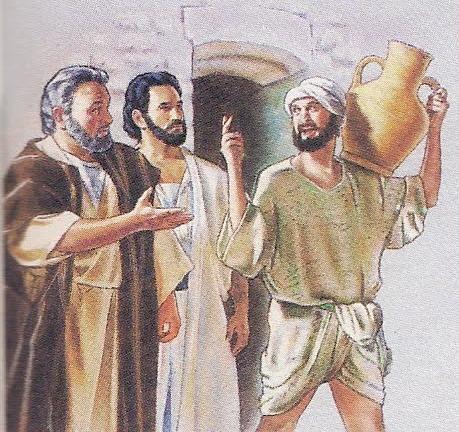
Why did Jesus send His disciples to that Samaritan town, instead of just instructing them to pass it by? Jesus knew what was going to happen when they went to that village–He knew by His divine insight that they wouldn’t accept Him. Remember when Jesus needed a donkey to ride on into Jerusalem? He sends two disciples to find and untie a donkey who had never been ridden before and He tells them what to say if anyone asks what they are doing. They go into the city and find everything as Jesus had described. Remember when Jesus needed a place to celebrate the Last Supper? He tells Peter and John to go into the city and to follow a man they will see carrying a jar of water, when they come to the house he leads them to, they are to ask if there is a place for the master to celebrate the Passover. They go and find everything a Jesus described, including an upper room already prepared for a Passover. Jesus knew that the Samaritan town would not welcome Him, so why did He send disciples there?

The mission may have seemed like a failure, but Jesus’ plan succeeded. Jesus knew that His Apostles would soon be preaching the Gospel to the whole world and He knew that not everyone would welcome them or their message. Jesus wanted to give them some experience in rejection to teach them how to respond; not with anger and violence, but with patience and peace. James and John learn a lesson about divine mercy. They may have thought their mission to the Samaritan town was a total failure, but the Lord was successfully achieving His goals in them.

So what does all this have to do with us? In our lives we often experience weakness, setbacks and apparent failures. In response, we often blame ourselves, even when we are innocent, or we conclude that we must not have been doing God’s will, or we get angry with God for frustrating or not helping our efforts. Yet, as long as we are faithfully following Christ, nothing we attempt is ever truly a failure.

The only true failure in the Christian life is sin, but if we repent of our past sins even these can be used to benefit God’s great plan. Scripture says, “God works all things for the good of those who love Him,” this even includes our repented sins. We are obsessed with success, but as Blessed Mother Teresa reminds us, “God does not ask us to be successful; He asks us to be faithful.”

Sometimes you will feel like you are failing, or that your efforts have been useless, but by your faithfulness you will be succeeding in doing God’s will. Let us remember that at the center of our faith is a man nailed to a cross; an appearent failure who was actually succeeding in saving the world. Jesus rolls away stones in ways we wouldn’t expect.

Real Presence — Corpus Christi

June 7, 2010

I once came across a story on the internet that went something like this: A Catholic man is giving his Muslim friend a tour of his Catholic Church. He shows him the holy water at the door and how we bless ourselves with it. He points out the stained glass windows and the stations of the cross, explaining how these present the majore events of Jesus’ life, death, and resurrection. He shows him the statues and the crucifix and finally the tabernacle.

“That’s the tabernacle. Inside that box is the Eucharist. It looks like flat, white bread, but it is truly the Body, Blood, Soul and Divinity of Jesus Christ, our Savior and God.”

The Muslim man looks at the tabernacle, pauses in thought, looks at his friend, and says, “If I believed that God was really present in that box, I wouldn’t let my face come off of the floor.”

Whose approach towards God is the right one: the Catholic’s or the Muslim’s? When we come up to receive communion we do not crawl up on our faces, but should we?

Christians relate to God as we do because of the way Jesus Christ related to us. With the incarnation, God came to us on our level, as one of us. Jesus did not want his disciples to regard him with terror. He invited them to be His friends, and to relate to Him as their Brother. He taught us to call His Father “our Father,” and he made us temples the Holy Spirit. Jesus gives us unprecedented intimacy with God and we are “free to worship Him without fear.”

Yet, there is some truth in the saying that familiarity breeds contempt. When we come to Mass and receive the Eucharist, how well do we prepare ourselves to receive Him? How much do we do to appreciate this priceless gift? This morning I would like to give some ways we can do this better.

Before we even leave home there is a way for us to prepare ourselves. Think of it this way: if you were going to be on TV and seen by a millions, what would you wear? If the president of the United States (whoever he happened to be) were coming to your town, and you were chosen to officially welcome him, how would you dress? At Mass we are not seen by millions, but by billions of angels and saints, and we more than just the president of the greatest country in the world, we meet the King of the universe. When we come to Mass we should wear our Sunday best.

When you arrive at church before Mass begins resist the temptation to just wait out the time until the priest comes out. Take the opportunity to prepare yourself with prayer. At the beginning of the liturgy there are some things we do to tune us into the liturgy, such as the penitential rite and the opening prayer, but if you have not prepared yourself before the Mass begins these will probably just flash by you.

When you get to your pew, say to Jesus, “Lord, I’m sorry for my sins. Please have mercy on me. Please help me to be as fully present as you are present. Help me to receive everything you want me give me in this Mass. I raise up my intention for this Mass you along with all I love and everything I am. Thank you for calling me to know you, and for everything.”

During the Mass, especially when Jesus is on the altar, his throne, we should give Him our full attention. Religious devotion is about more than mere appearances, but shouldn’t we expect a fervent devotion inside to be reflected on the outside?

When I was growing up and beginning to look at my faith more critically, I wondered if we really believed in the Real Presence. I mean, the symbolic understanding, that’s easy—like how the flag reminds us of America, but do we really, really think that’s Him? My CCD teachers insisted that’s what we believed and I found scriptural and historical evidence that Christians had always believed it.  Yet, when I looked around at other people at Mass it didn’t seem like they believed they were in the presence of God. Then an important thing happened. A new pastor came to our parish and when he celebrated the Mass you could tell that he believed he held something (Someone) precious in his hands. That priest was Father Paul Gitter, whom you know well.

During the Mass, give God your whole self. Express your devotion. Whenever you sing, don’t just do it because that’s what everyone else is doing—make it an offering, a gift, a prayer. When you are praying to the Father, raise you eyes to Him. When you are speaking to Jesus, turn you eyes to Him. Smile at Him in the cup and on the paten. Celebrate every Mass as if it were your first, your last, and your only.

After you receive Jesus in the Eucharist, open yourself to receive everything that He wants to offer you. In His private revelations to St. Faustina Kowaska (through whom we received the Divine Mercy devotion celebrated throughout the Church) Jesus said many people receive Him and then forget about Him. “My great delight is to unite Myself with souls,” He said. “When I come to a human heart in Holy Communion, My hands are full of all kinds of graces which I want to give to the soul. But souls do not even pay any attention to Me; they leave Me to Myself and busy themselves with other things. Oh, how sad I am that souls do not recognize Love! They treat Me as a dead object” (Diary of St. Faustina, #1385) After you receive Him, and kneel down in the pew, ask that you would receive from Him every grace He wants to give you with Himself. And remember to tell Him, “Thank you,” and, “I love you.” It’s the least that we can do.

When we leave church after Mass, let us not think that we have left Gift we have received behind us. Jesus also told St. Faustina that when we receive the Eucharist He remains in our souls until we receive Him again, provided that we do not cast Him out through serious, grave sin. He remains with us and provides what we need to serve Him.  We only have to remain open and mindful towards Him.

Jesus feeds us His Body and Blood because He wants us to be extensions of Himself. We the Body of Christ. We are His arms, His hands, and His eyes, ears, and mouth in the world. First, He transforms the bread and wine. Next, He transforms us. And then, He transforms the world. When ‘the Mass is ended,’ that’s just the beginning.

In a few moments we are going to receive the Body, Blood, Soul and Divinity of Jesus Christ in the Eucharist. Let us prepare ourselves and open ourselves to receive this most incredible Gift.

An Original Marian Hymn

June 3, 2010
Hail Mary, with God You Found Favor
by Father Victor Feltes
 

Set to the tune Rendez a Dieu, (audio, sheet music ) as in “Father, We Thank Thee who has Planted,” or “When John baptized by Jordan’s River.” For use with permission only.

Hail Mary, with God you found favor,
preserved from sin and filled with grace;
prepared as gate for our Creator,
and new Eve for our human race.
“Let it be done to me as you say,”
you told the angel God had sent;
becoming mother of our Savior,
and new ark of the covenant.
 
Hail Mary, mother of all Christians,
you stood by Christ the day He died.
Now you reign as our queen in heaven,
enthroned beside Him glorified.
Blessed are you among all women
and blessed is your fruit adored.
Pray for us Mary, now and always,
to ever love your Son, our Lord.

Approved for use in the Mass in the Diocese of La Crosse by (then) Bishop Jerome Listecki in August 2009.

Rejoice, Daughter Zion! — The Visitation

June 2, 2010

The Blessed Virgin Mary is the Icon of Israel and the Icon of the Church. Mary is the bridge between the Old and New Testaments and we can discover her in both. Whenever we encounter positive descriptions of “Jerusalem,” “Zion,” “Daughter Zion,” or “Israel” in the Old Testament, or praises of “Mother Church” today, these words often apply quite fittingly to Mary as well. Today’s first reading is a great example of this. But before returning there, let me share with you this interesting detail. Even though we traditionally pray, “Hail Mary, Full of Grace,” the Archangel Gabriel’s greeting to Mary at the Annunciation [“Chaire” in Greek] literally means , “Rejoice… Full of Grace!” Now hear again the words from the Book of Zephaniah:

Shout for joy, O daughter Zion!
Sing joyfully, O Israel!
Be glad and exult with all your heart,
O daughter Jerusalem!

In today’s Gospel, Mary fulfills these words, glad and exulting with all her heart:

My soul proclaims the greatness of the Lord
My spirit rejoices in God my savior

Zephaniah says:

The LORD has removed the judgment against you,
he has turned away your enemies;
The King of Israel, the LORD, is in your midst,
you have no further misfortune to fear.

And Mary agrees:

He has mercy on those who fear Him
In every generation.
He has shown the strength of his arm,
he has scattered the proud in their conceit.

Earlier, at the Annunciation, when the angel Gabriel came to Mary, He said to her:

“Hail, [Rejoice,] full of grace! The Lord is with you.” But she was greatly troubled at what was said and pondered what sort of greeting this might be.

As Zephaniah foretells,

On that day, it shall be said to Jerusalem:
Fear not, O Zion, be not discouraged!
The LORD, your God, is in your midst,
a mighty savior;

And the angel says to her, “Do not be afraid, Mary, for you have found favor with God. Behold, you will conceive in your womb and bear a son, and you shall name him Jesus,” a name which means, “God saves.”

Zephaniah foretold of the Lord’s pleasure in Mary,

He will rejoice over you with gladness,
and renew you in his love,
He will sing joyfully because of you,
as one sings at festivals.

The Lord rejoices over Mary, and Mary in her Lord. Let us always remember, that the Lord rejoices over us as well. Despite our sins and failings, we are the Church, the new Israel, and whatever one can say of Mary usually applies quite fittingly to us as well. Mary is the icon of the Church, the sign of who we are, and who we are called to be with Christ.

Fatima Rosary Reflections

May 31, 2010

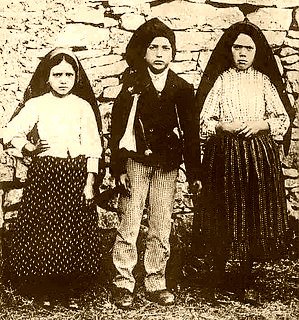
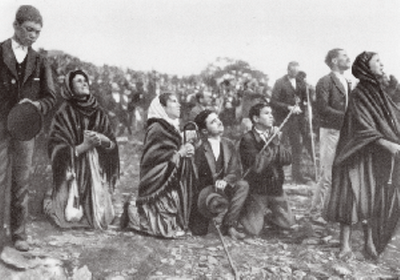
We celebrate May as the month of Mary, but we gather this particular day because 93 years ago Mary appeared to three children outside a small village in Portugal named Fatima. We will now pray the rosary and I will share with you just some of this story of Mary, Our Lady of Fatima.

[Pray the usual introductory Rosary Prayers]

In the year before Mary appeared to them, Lucia age 10, and her cousins Francisco and Jacinta, ages eight and seven, were grazing their sheep in a field. A dazzlingly beautiful young man, seemingly made of light, appeared to them and identified himself as the Angel of Peace. He invited them to pray with Him, and taught them a simple prayer.  I will pray this prayer three times and I invite you to join with me.

“My God, I believe, I adore, I trust and I love You! I beg pardon for all those who do not believe, do not adore, do not trust and do not love You. Amen.”

In the 1st Luminous Mystery we encounter “Jesus’ Baptism in the Jordan.” Jesus was not a sinner, He did not need baptism for himself, but He was baptized to become an advocate and intercessor for others. Likewise, let us pray as advocates and intercessors for all those who do not believe, do not adore, do not trust, or do not love God throughout the world.

[Pray the First Luminous Mystery]

On another occasion, the Angel of Peace appeared before them holding a chalice in his hands. Above it was suspended a host from which drops of blood were falling into the chalice. The Angel left the chalice suspended in the air, prostrated himself before it, and taught the children this prayer:

“O Most Holy Trinity, Father, Son and Holy Spirit, I adore Thee profoundly. I offer Thee the most precious Body, Blood, Soul and Divinity of Jesus Christ present in all the tabernacles of the world, in reparation for the outrages, sacrileges and indifferences by which He is offended. By the infinite merits of the Sacred Heart of Jesus and the Immaculate Heart of Mary I beg the conversion of poor sinners. Amen.”

In the 2nd Luminous Mystery we encounter “Jesus’ Miracle at the Wedding Feast of Cana.” For them, Jesus changed water into wine. For us, He changes wine into His blood. Are we indifferent to this miracle in our midst, or does it really matter to us? Let us pray that the Eucharist would transform us.

[Pray the Second Luminous Mystery]

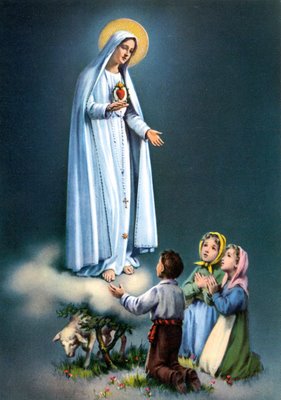
On May 13, 1917, after lunch on a clear blue day, the children were praying the rosary. Suddenly, they saw two bright flashes. They looked up and saw, in Lucia’s words, “a lady, clothed in white, brighter than the sun…”

The Lady smiled and said: “Do not be afraid, I will not harm you.” Lucia asked her where she came from. The Lady pointed to the sky and said: “I come from heaven.” Lucia asked what she wanted. She said, “I have come to ask you to come here for six months on the 13th day of the month, at this same hour.” They tried to keep it to themselves, word of the children’s encounter with the Heavenly Lady got out. Though they were met with the townspeople’s skepticism and mockery, the children would not deny what they had seen and heard.

In the 3rd Luminous Mystery we encounter “Jesus’ Proclamation of the Kingdom of God.” Let us pray to be irresistibly led to proclaim what we have experienced in Christ.

[Pray the Third Luminous Mystery]

On July 13th, the incredibly beautiful Lady appeared to them again. Lucia asked her who she was, and for a miracle so everyone would believe. She answered, “Continue to come here every month. In October, I will tell you who I am and what I want, and I will perform a miracle for all to see and believe.” And the Lady taught them this prayer:

“Oh my Jesus, forgive us our sins, save us from the fires of hell. Lead all souls to Heaven,  especially those in most need of Thy Mercy.”

In the 4th Luminous Mystery we encounter “Jesus’ Transfiguration.” Sometimes we look at other people and think that they can’t change what they are. The apostles thought like this, but Jesus opened their eyes with His Transfiguration. Let us pray for the grace of transformation; in our family members, in our friends, and especially among those in most need of God’s Mercy.

[Pray the Fourth Luminous Mystery]

At noon on the 13th of October, 1917, some 70,000 people were gathered in the field. With a flash of light the Lady appeared to the children, and Lucia, for the last time, asked her what she wanted. The Lady answered, “I want to tell you that a chapel is to be built here in my honor. I am the Lady of the Rosary. Continue always to pray the Rosary every day. The war is going to end, and the soldiers will soon return to their homes.” And the Blessed Virgin Mary urged the conversion of hearts, as she had many times before, “Do not offend the Lord our God any more, because He is already so much offended.”

What happened next was reported at the time in an anti-religious Portuguese newspaper, by a reporter who had previously written dismissively about the goings-on at Fatima:

“…One could see the immense multitude turn towards the sun, which appeared free from clouds and at its zenith. It looked like a plaque of dull silver and it was possible to look at it without the least discomfort. It might have been an eclipse which was taking place. But at that moment a great shout went up and one could hear the spectators nearest at hand shouting: “A miracle! A miracle!” Before the astonished eyes of the crowd… the sun trembled, made sudden incredible movements outside all cosmic laws – the sun “danced” according to the typical expression of the people.”

In the 5th Luminous Mystery we encounter “Jesus’ Institution of the Eucharist.” What the masses saw in the heavens that day was a great miracle. But what we encounter at every Mass is an even greater wonder. Let us pray that we would always have the eyes to see it.

[Pray the Fifth Luminous Mystery, followed by the usual closing Rosary Prayers]

(Primary Source)

Preparing for Tests — Friday, 8th Week of Easter

May 31, 2010

Today were heard from the first encyclical of the first pope. Today’s first reading came from the First Letter of St. Peter. And what he said applies to you: “The end of all things is at hand.” Originally, St. Peter meant that Christians should always be ready for the end of their lives or the end of the world (whichever comes first.) But this morning I think we can hear the Holy Spirit speaking to us about the coming end of this school year.

At Columbus, the end of all things is at hand: that means finals week, with all of its due dates, studying, and exams. Don’t be surprised that this trial by fire is occurring among you, as if something strange were happening to you. Finals week happens every year. I know that finals time is a challenge and that it takes some hard work, but why should this trial overwhelm us or make us behave ugly towards each other? If we have Jesus Christ in our lives we should face difficulties differently than the world does. The beauty of a soul at peace in Christ, is seen through the person’s  graceful actions.

So how should we face our finals? First of all, have faith in God, and remain at peace, confident that no matter what, everything is going to be ok.  Second, be serious and sober-minded. You’ve worked for the whole semester. Now keep going just one more week to maintain or even improve those grades you’ve worked for all semester. And third, above all and through it all, let your love for one another be intense, be hospitable to one another without complaining, and as each of you has received gifts. Use them to help one another.

At this Mass, prepare yourself. Ask Jesus for constant peace, for steady focus, and for generous love throughout finals week so that you may perform at your best in every respect. It’s nice to get good grades in school, but that’s not the most important thing. The most important thing is to be prepared for the final exam which awaits us all.

God’s Favorite Instrument — Tuesday, 6th Week of Easter

May 11, 2010

What is God’s favorite musical instrument? Harps? Organs? Bongos? I believe it is the instrument He created Himself, the one which He loved so much that He gave one to each of us for free–the human voice.

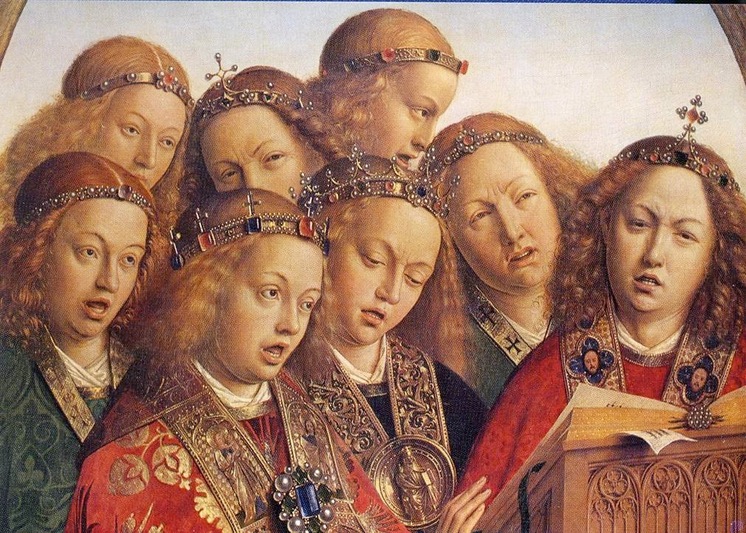
God is pleased when we sing for Him. St. Augustine said, “The person who sings prays twice.” Some people say this is because singing adds melody to our words of prayer. But it could be that a person sings twice because singing enlists the heart to join in the prayer of the mind. Singing lifts up our hearts to the Lord.

In today’s first reading, the missionaries St. Paul and Silas get beaten and stripped. They are locked in prison with their ankles placed in stocks. Things are at their darkest and most difficult time, but the night finds them not only praying, but singing hymns. This lifts their spirits, shakes loose their bonds, and pours out grace on that place. Singing makes a difference.

Maybe you feel like coming to our weekly school Masses is like being led somewhere in shackles. But if you must be here either way, why not make the most of it? Singing at Mass (and I mean really singing) is liberating, and a gift to God. 

If God has blessed you with a beautiful voice, sing strongly, as if to say to God, “You gave me this gift, and I offer it back to you.” If He has not blessed you with a good voice, you should still sing boldly, as though to say, “You gave me this voice, and I’m going to let you have it.” Your voice is God’s favorite instrument. So at this Mass and at every Mass, let Him hear it.

3 What If’s — Tuesday, 5th Week of Easter

May 4, 2010

Before today’s Mass, I would like you to imagine three “what if” scenarios. How would you respond in the three situations I’m about to describe?

First:  Imagine, what if, at this morning’s school Mass, the great apostle St. Paul was going to preach to you? How interested are you in whatever he has to tell you?

A second scenario: What if there were a book out entitled, Actual Prayers of Jesus and Mary, and what if there was strong archeological evidence to support that these really were prayers which Jesus and Mary prayed frequently during their lives on earth? How interested are you in discovering these prayers? How powerful would it be for you to pray their prayers?

The third and final scenario: What if I were to tell you, calmly and with firm conviction, that I had received a message for you, a revelation, from Jesus Christ, which He wanted you to hear through me at this Mass? How interested and open are you to receiving such a message?

Of these three scenarios, which one would you most desire to be true?Now listen closely…. All three of these scenarios will be realized, will be true, at this Mass.

The first scenario will be realized: St. Paul will indeed preach to you–in this morning’s first reading. Perhaps St. Paul did not realize it when he first spoke these words, nor perhaps did the sacred author who wrote them down in the Book of Acts, but the Holy Spirit was inspiring, was guiding these words.

And the Holy Spirit did not only have the first-century Christians of Lystra, Iconium, and to Antioch in mind when He prompted these words. St. Paul’s inspired message is meant for us today just as much as they. So this morning, St. Paul will preach a message (though only one sentence long) which is truly intended for you.

As to the second scenario, where is this book containing Actual Prayers of Jesus and Mary? We read from it at almost every Mass, as we will today. This book is the Book of Psalms. In the day of Jesus and Mary, all devout Jews prayed these 150 psalms and they usually knew them by heart. Jesus and Mary prayed the Psalms too. These prayers were inspired by the Holy Spirit to be prayed by all God’s people, including us today, but one could say that the Psalms find their fullest voice through Jesus and Mary. In today’s responsorial psalm, we will join Jesus and Mary in one of their powerful prayers in praise of the Lord.

The third scenario will also be true at this Mass: I have indeed received a message from Jesus Christ which He wants you to hear through me this morning. You will hear His message addressed to you in the proclaimation of the Gospel. At the Last Supper, Jesus was not only speaking to the disciples seated around Him. With His divine sight, Jesus saw all of us here then, and He speaks intending His words for us this morning just as much as they. How much will you allow Jesus’ message to you to affect and change you?

We believe that, “When the Scriptures are read in the Church, God himself is speaking to his people and Christ, present in his own word, is proclaiming the Gospel.” At this and at every Mass, let us come to the Scriptures expecting much, so that we may find much, and receive in from them in abundance.

Hearing Him — Friday, 3rd Week of Easter

April 23, 2010

Jesus says, “Whoever eats my Flesh and drinks my Blood,” as we are about to do in at this Mass, “remains in me and I in him.” After we receive Him, He remains with us and we with Him.  And He stays with us, provided we do not cast Him out through committing serious sin, until we receive Him again.

Jesus remains close to us throughout our day. Wouldn’t it make sense, that time to time, He would occasionally have something to tell us? Maybe we don’t hear Him because He knows we would refuse to listen. Perhaps He knows we would dismiss hearing Him speak to us out of hand, or maybe He knows we don’t trust Him enough to go out on a limb. For example, if you got the feeling that the Lord wanted you to relay to a message, a message you didn’t really understand, to particular person what would you do?

In the first reading, the Lord speaks to Ananias and Ananias answers, “Here I am.” Then the Lord gives Him an entirely wholesome, but very counter-intuitive task: lay your hands on Saul and heal him. Ananias hesitates a little. Ananias might be wondering if this is really coming from the Lord, or maybe he’s not sure he wants to risk this much for the Lord. But in the end, Ananias listens, and because of it, Saul became St. Paul.

If we would like the Lord to do such things with us let us be faithful in little things, faithful to the commands of our consciences and to the gentle nudges of the Holy Spirit throughout our daily lives. If we are willing to trust Him, Jesus will ask us to be His chosen instrument in greater matters too. So let’s listen, let’s be docile, and see what He does with us.

For One’s Friends — Tuesday, 3rd Week of Easter

April 20, 2010

Jesus said, “No one has greater love than this, [than] to lay down one’s life for one’s friends.” Have you ever wondered if that’s true? Is that really the greatest love? Wouldn’t it be greater for someone to lay down their life for their enemies? No, for I tell to you that no one can do this. It is impossible to lay down your life for an enemy. You can only lay down your life for people you love.

St. Stephen, like the Savior he followed, loved those who killed him. Stephen’s murders hated him, but he did not hate them in return. He was their enemy, but they were not his. Stephen loved them enough to challenge and correct them, but this made them very angry. Before dying, Stephen said, “Lord, do not hold this sin against them.” He was acting with mercy, generosity, and prayer in imitation of Jesus Christ, his role-model.

In this community, I do not feel that we are plagued with the disease of hatred: hatred for others, hatred for classmates, or hatred for God. But I do fear that we are infected by indifference: indifference towards each other, indifference towards those in need, and indifference towards God. I challenge you: in the past week what have you done to be more merciful, more generous, or more prayerful?

St. Stephen had mercy, generosity, and prayers for those who hated him. St. Augustine wrote that if it had not been for this, that young man named Saul who was guarding the cloaks, consenting to the execution, would not have later converted to become St. Paul, the great apostle. If St. Stephen overcame hatred and did this, imagine what overcoming our indifference could do?

We may not necessarily have to die as bloodied martyrs, like St. Stephen did, but Jesus asks each of us to lay down our lives for our friends.

Peter’s New Season — 3rd Sunday of Easter

April 20, 2010

Once, when Jesus was preaching as he stood on the shore of the Sea of Galilee, a large and eager crowd was pressing in on Him.  So Jesus got into a fisherman’s boat and asked him to put out aways so that He could sit and teach the crowds. The tired fisherman complied. And after Jesus had finished speaking, He said to this fisherman, “Put out into deep water and lower your nets for a catch.” The fisherman said, “We have worked hard all night and have caught nothing, but at your command I will lower the nets.” When they had done this, they caught an incredible number of fish such that their nets were tearing. And Jesus said to the startled man, “Do not be afraid. From now on you will be catching men.” As you probably remember, the fisherman was Simon Peter, and from that day on his life entered a new season. For the next few years Simon Peter would follow Jesus and evangelize towns on His behalf.

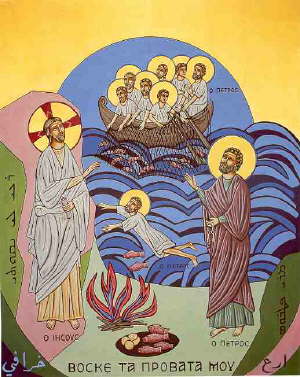
In today’s gospel, from the days after the resurrection, Peter is fishing again. And once again, Jesus is there on the shore. They have caught nothing, but Jesus says to try once more, and they catch an incredible number of fish. When Simon Peter realizes it is Jesus he eagerly comes to Him as fast as he can. He finds Jesus beside a charcoal fire. This should be familiar to Peter, too, calling to mind  another charcoal fire in the dark courtyard of the high priest.

After sharing a meal, Jesus says, “Simon, son of John, do you love me more than these? Do you love me?  Do you love me?” Simon Peter says, “Yes, Lord, you know that I love you. Yes, Lord, you know that I love you. Lord, you know everything; you know that I love you.” Jesus has given Peter the opportunity to undo his triple denial of Jesus with a triple confession of his love. And after each time, Jesus speaks of a new season for Peter’s life: “Feed my lambs. Tend my sheep. Feed my sheep.”

Now it is one thing to catch fish, but it is another thing to shepherd a flock. Up to now, Peter has been following Jesus and bringing others to Him. But now Jesus is asking Peter to do something new, to shepherd His flock for Him. Do you think Peter nervous? Is he concerned about whether he is up to the task? Is he worried about being led where he doesn’t want to go? I bet he is, but Jesus would have him ‘not be afraid,’ for he won’t be doing it alone. Jesus says to Peter, “Follow me.”

Our lives are often entering new seasons. Maybe you’re moving into a new town or a new school. Maybe you’re transitioning from engagement to marriage, welcoming new children, or living for the first time without children in the house. Maybe you have a new job, or don’t have a job for the first time. But whatever season of our life Jesus calls us into, His calling and our mission remain the same. Jesus said, ‘”I give you a new commandment; love one another as I have loved you,” and ” “There is no greater love than this, than to lay down your life for a friend.” Every new season of life offers us the unique opportunity to deepen our love for Christ and each other more than ever before.

Maybe you feel nervous? Maybe you’re concerned about whether you are up to the task? Maybe you’re worried about being led where you don’t want to go? But remember Simon Peter and don’t be afraid.  Jesus gives lots of second chances and He does not expect us to do it alone.

Rabbi Gamaliel’s Wisdom — Friday, 2nd Week of Easter

April 16, 2010

The apostles were brought before the Sanhedrin, the Jewish High Council, to be questioned for why they continued to teach in “that name.” At hearing the apostles’ answers, the Jewish leaders “became infuriated and wanted to put them to death,” but a Pharisee in the Sanhedrin stood up and had the apostles put outside. This was Gamaliel, a great teacher of the law who was respected by all the people. (It was at this rabbi’s feet that St. Paul received his Pharisaical training.)

Gamaliel said, “Fellow children of Israel, be careful what you are about to do to these men.” Now his form of address here is interesting and revealing. He could have addressed his peers in the Sanhedrin in many different ways, but by calling them “fellow children of Israel” he recalls Jacob (whose name God changed to Israel) and his twelve sons.

Now of all those sons, Joseph was Jacob’s favorite. This made the others so jealous that they sold Joseph into slavery. But through suffering this dishonor Joseph would go on to become the instrument of their salvation. Even though they meant to destroy him, they failed. God intended this for good, to achieve the salvation of many.

Gamaliel concluded his speech to the Sanhedrin wisely observing, “If this endeavor or this activity is of human origin, it will destroy itself. But if it comes from God, you will not be able to destroy them…”

Evil endeavors or activities are destroyed in time. But what is of God endures, even if it is sometimes setback by evil and sins. In these beleaguering times, for our country, for our Church, and for our pope, this lesson from Rabbi Gamaliel gives us good reason for hope.

Faithful Despite Doubts — Divine Mercy Sunday—2nd Sunday in Easter—Year C

April 11, 2010

Thomas, called Didymus, one of the Twelve, was not with them when Jesus came. So the other disciples said to him, “We have seen the Lord.” But he said to them, “Unless I see the mark of the nails in his hands and put my finger into the nailmarks and put my hand into his side, I will not believe.”

Why is “Doubting” Thomas so slow to believe. Why is Thomas so reluctant to trust? A clue might be found in the gospel’s interesting inclusion of Thomas’ Greek nickname: Didymus. Didymus means “twin,” but in relation to whom was Thomas a twin? Some speculate that Thomas the Apostle bore a striking resemblance to Jesus Himself. This tradition is sometimes reflected in iconography where Thomas is the apostle who looks a lot like Jesus.

If this is why Thomas was the apostle called “the twin” then we can understand his rational skepticism. How many times during Jesus’ ministry had people come up to Thomas and said, “O Jesus, we’re so happy to see you! We’ve walked for miles to see you again!” Then, with some annoyance, Thomas might have answered, “We’ll you’ll have to walk a little bit further. Jesus is over there.” So now, when the other disciples come up to Thomas after Easter and say, “We have seen the Lord,” Thomas replies, ‘I’ll need more evidence than that.’

Thomas’ resistance to believing the good news about Jesus might not only be coming from his mind, but also from his heart. Jesus was Thomas’ hero, his teacher, and his close, beloved friend. Thomas thought that Jesus was going to be the savior and messianic king of Israel. But their close relationship and all of Thomas’ great hopes were destroyed for him at the crucifixion. Imagine how Thomas might have prayed then: “My God, why have you let this happen? How could you let Him be taken instead of me? Jesus was so good! He was completely innocent, and you let Him be die! Why?”

The unexpected death of Jesus broke Thomas’ heart, and having been so hurt once, Thomas was resolved not to let his heart be taken in again: “Unless I see the mark of the nails in his hands and put my finger into the nailmarks and put my hand into his side, I will not believe.”

Yet, though he doubts, notice where Thomas is one week after Easter. He is with the other apostles in the upper room in Jerusalem, gathered behind locked doors for fear of the authorities who killed Jesus. Now there are lots of other places Thomas could have chosen to be. There were safer places he could have gone, like back to his hometown and to the extended family and friends he had left behind to follow Jesus a few years before. Though Thomas doubts, he does not leave this house of faith. He struggles with his faith, but does not abandon it. He seeks within this house of faith, this Church, and because of it, Thomas finds sufficient evidence for his mind and healing for his heart.

The risen Lord appears in the upper room and how does Jesus respond to Thomas’ resistant unbelief? Not with anger.  Not with condemnation.  But with the divine mercy we celebrate today. Jesus appears in their midst and says, “Peace be with you.” Then he says to Thomas, “Put your finger here and see my hands, and bring your hand and put it into my side, and do not be unbelieving, but believe.”

In our lives we too will struggle with our faith and our doubts, with our emotions and with our thoughts, in our hearts and in our minds. Jesus does not condemn our honest struggles. But Jesus wants us to sincerely seek within this house of faith; this, His apostles’ Church, where the truth and healing is found by all those who seek Him.

11 Absent Students — March 25 — Annunciation

March 28, 2010

You have probably wondered why our school chapel’s icon, statues, and crucifixes are veiled with purple cloth. Covering of religious images is a tradition for the last two weeks of Lent, a period we call Passiontide. So why do we have this tradition?

One explanation recalls that Jesus’, when His enemies sought to kill Him, hid Himself prior to His final days: “Jesus left and hid from them.” (John 12:36) Others see in this veiling a symbol for how Jesus’ divinity was veiled within His humble and vulnerable humanity. He was God incarnate, but none of the rulers of His age knew, “for if they had known it, they would not have crucified the Lord of glory.” (1 Corinthians 2:8) But behind all of this I think there is a very human reason for why we veil the holy images of Jesus and the saints at Passiontide. “Absence makes the heart grow fonder.”

During Lent we deprive ourselves of luxuries and pleasures for our personal conversion and growth in holiness, but we also do this so that we can celebrate the Christ’ Easter triumph with an even greater feeling of joy. This is why we normally don’t sing as much (or say the Gloria or the “A”-word before the Gospel) during Lent—so that we can enjoy pulling out all the stops at Easter.

Veiling our statues of Mary and Joseph, our wall icon of Elizabeth Ann Seton, and our crucifixes causes a little pain of separation within us. But what if this chapel had never been furnished? What if our chapel had always been bare of religious art? Then their absence would not affect us at all because we would not know that we were missing them.

There are not as many students here today as there should be. Now I’m not saying that this should have been a whole school Mass, and I’m not begrudging anyone who may have stayed in study hall this hour to work on homework.  This is a great turn out and every seat is filled. But still, there are not as many students here as should be here today.

In the early nineties, when most of you were born, for every three live births in our country there was one boy or girl who was intentionally killed. (CDC) I counted roughly 33 students here today. That means we are missing 11 of your classmates who were not allowed to be born.

Today we recall the Annunciation, which some people call “Pro-Life Christmas,” for even though Jesus will be born nine months from now, today is the day of the Incarnation, when God became a human being like us in the womb of the Virgin Mary. After the angel Gabriel departed, Mary went in haste to see her relative. Elizabeth exclaimed, “Who am I that the mother of my Lord should come to me,” and John the Baptist leapt for joy in his mother’s womb in the presence of our microscopic Savior, Jesus Christ. (Luke 1:43-44)

Imagine if 11 of your classmates were to die in a bus accident. You would you feel terrible from the loss, and our whole school would be in mourning. But we have never known the 11 who are missing here today, so we do not feel our loss.

At this Mass and henceforth, let us keep the following things in mind regarding the past, present, and future. As to the past, remember these absent classmates and pray for them. They never received a name, they never had a funeral, and few people have ever prayed for them. Pray for their parents, too. 

In the present, perhaps you honestly find yourself not feeling much emotion one way or the other towards the reality of one million innocents being murdered in our country every year. If so, then ask God to give us His heart and His sight to love what He loves and to hate what He hates. God loves us all, but He hates our sins. He hates our sins because they are bad for us, and the worse they are for us the more He hates them. His love for us and His hatred for our sins are two sides of the same coin. Blessed Mother Teresa of Calcutta said “the greatest destroyer of peace today is abortion.” The Lord’s heart is certainly not indifferent to this evil, and neither should ours be.

And finally, for the future, keep hope that this evil of abortion will come to an end in our time. We can have this hope, for as the angel Gabriel said to Mary, “nothing will be impossible for God.”