Archive for the ‘Salvation History’ Category

Tempting the Messiah — 1st Sunday in Lent—Year A

March 7, 2014

Gospel: Matthew 4:1-11

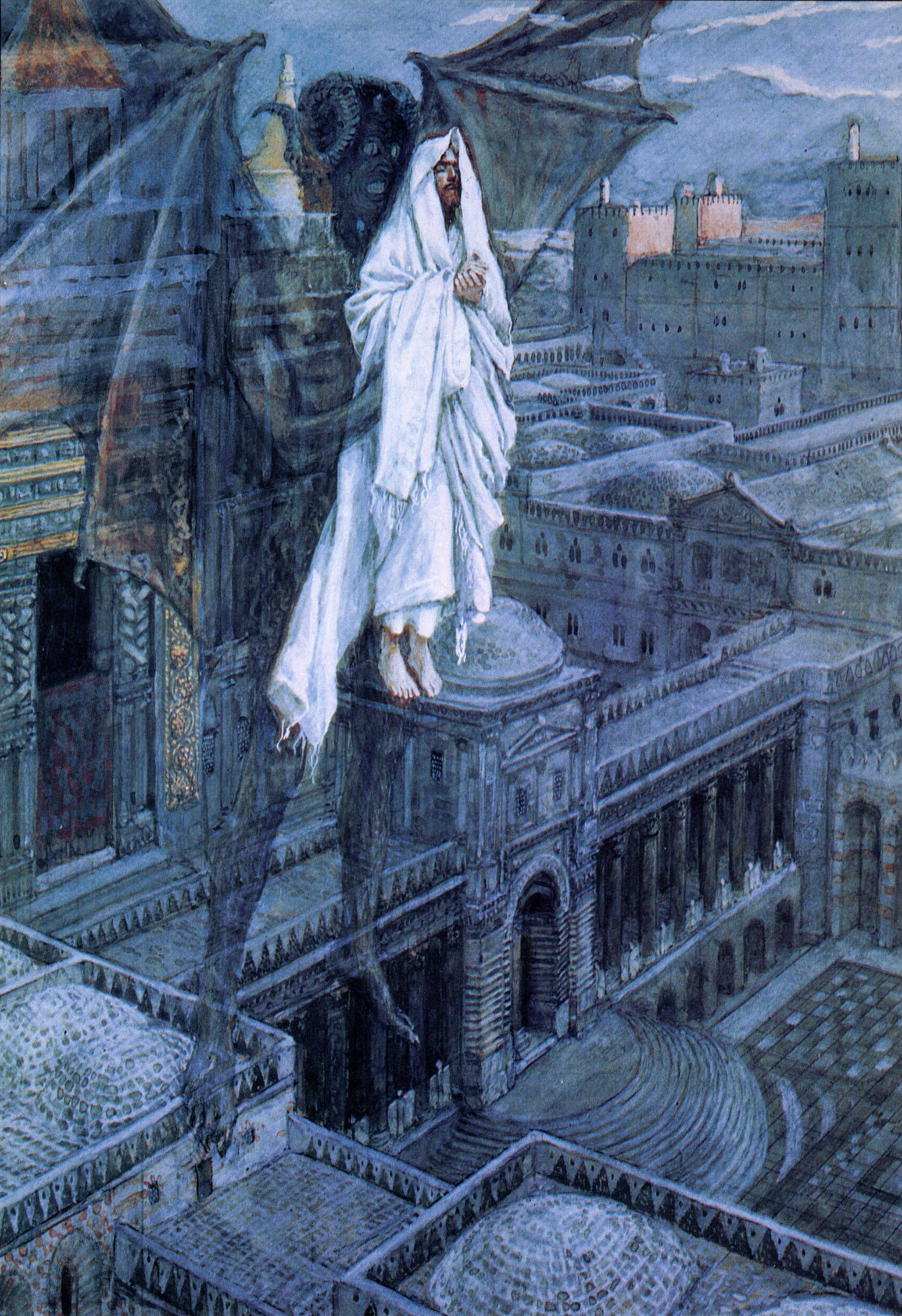
Jesus Tempted in the Wilderness by James Tissot 1886-1894.The devil suggests Jesus should change stones into bread. He wants Jesus to be a materialistic Messiah who will focus on nourishing bodies to the neglect saving souls. Jesus replies that “one does not live on bread alone, but on every word that comes forth from the mouth of God.” Christ shall change bread into himself at the Last Supper “for the life of the world.” (John 6:51)

A depiction of Jesus being tempted at the temple by James Tissot, 1895The devil takes Jesus to a precipice atop the temple in Jerusalem and challenges him to throw himself down. He wants Jesus to be a Messiah who will hope to never suffer. Jesus responds that “you shall not put the Lord, your God, to the test” by trying to force him into doing our will. Christ shall be tested and condemned by the Sanhedrin in Jerusalem and be made a suffering Savior according to God’s plan. (Isaiah 53)

The devil takes Jesus up to a very high mountain, shows him all the kingdoms of the world, and promises to bestow them all if Jesus would simply prostrate himself and worship him. He wants Jesus to be a compromised Messiah who will pursue good by doing (or serving) evil. Jesus replies that “Lord, your God, shall you worship and him alone shall you serve.” By unwavering obedience to his heavenly Father, Christ shall become the king of all nations, enthroned high upon a cross on Mount Calvary. (Matthew 20:21)

Four Cheeks Turned — 7th Sunday in Ordinary Time—Year A

February 22, 2014

Gospel: Matthew 5:38-48

When attacked, our natural response is “fight or flight,” but Jesus suggests a  supernatural response: “When someone strikes you on your right cheek, turn the other one as well.” Since the Jews regarded the left hand as unclean, they would reflexively strike with the right hand. If the right cheek were hit, then one had been backhanded with contempt. Responding by turning the other cheek neither attacks not retreats, but insists on being regarded as an equal, whom one must strike (if at all) with an open hand. Jesus wants us to stand our ground in the face of injustice, assertively but lovingly, in hopes that the offender will reconsider his ways. Jesus modeled this response when he was struck during his trial before Annas:

The high priest questioned Jesus about his disciples and about his doctrine. Jesus answered him, “I have spoken publicly to the world. I have always taught in a synagogue or in the temple area where all the Jews gather, and in secret I have said nothing. Why ask me? Ask those who heard me what I said to them. They know what I said.” When he had said this, one of the temple guards standing there struck Jesus and said, “Is this the way you answer the high priest?” Jesus answered him, “If I have spoken wrongly, testify to the wrong; but if I have spoken rightly, why do you strike me?” (John 18:19-24)

Another saintly example was shown by Blessed Mother Teresa of Calcutta. Though reports vary, Mother Teresa was once begging bread from a baker for her orphanage. When the baker responded by spitting into her hand, she replied to effect, ‘I will keep this for me, but please give something for my children.’

In Victor Hugo’s Les Miserables, a bishop welcomes an impoverished convict to join his table and sleep at his home. However, that night, Jean Valjean steals his host’s silverware and goes away. The police catch him and take him to the bishop. Looking at Jean Valjean, the good bishop exclaims, “Ah! here you are! I am glad to see you. Well, but how is this? I gave you the candlesticks too, which are of silver like the rest, and for which you can certainly get two hundred francs. Why did you not carry them away with your forks and spoons?” Jean Valjean opens his eyes wide and stares at the venerable Bishop “with an expression which no human tongue can render any account of.” The bishop’s turn of the cheek spares the thief’s freedom and saves his soul.

And finally, a true story from a modern marriage: A woman’s husband had a terrible temper and every time it flared she would say, “That’s just like you to lose your temper!” But then, following a stroke of insight, she began responding differently. The next time he began to fly of the handle she told him, “That’s not like you to lose your temper,” and he nearly fell out of his chair. Even the kids looked at her funny, but she stuck with her new resolution. Months later, while at a restaurant together, he became irritated by the slow service. He started to fume about it, but then he suddenly stopped, turned to her, and said, “That’s not like me to lose my temper, is it?” This time, it is said, she nearly fell on the floor.

Was it true the first time the woman declared that it was not like her husband to lose his temper? The claim did not match his previous behavior, but perhaps he changed because she revealed to him that his uncontrolled anger was quite unlike the father, husband, and Christian man he truly and deeply wanted to be. This is the sort of realization and conversion we are to hope for in turning the other cheek.

Plus, a fifth story: “If a teen mugs you for your wallet…

Stained Glass Symbols — The Holy Cross

February 20, 2014

Holy Cross - Sacred Heart Catholic Church -  Wauzeka WIA Symbol of Christ’s Triumph

Jesus Christ’s cross is holy because it is the instrument he uses to save the world. The Roman Empire, in a demonstration of worldly wisdom and power, used crucifixion to humiliate, torture, and terrorize whoever would dare to oppose them. Jesus takes the cross, the worst evil the spiritual and human rulers of this world could wield against him, and employs it to achieve his victory.

Stained Glass Symbols — Mount Calvary’s Cross

February 18, 2014

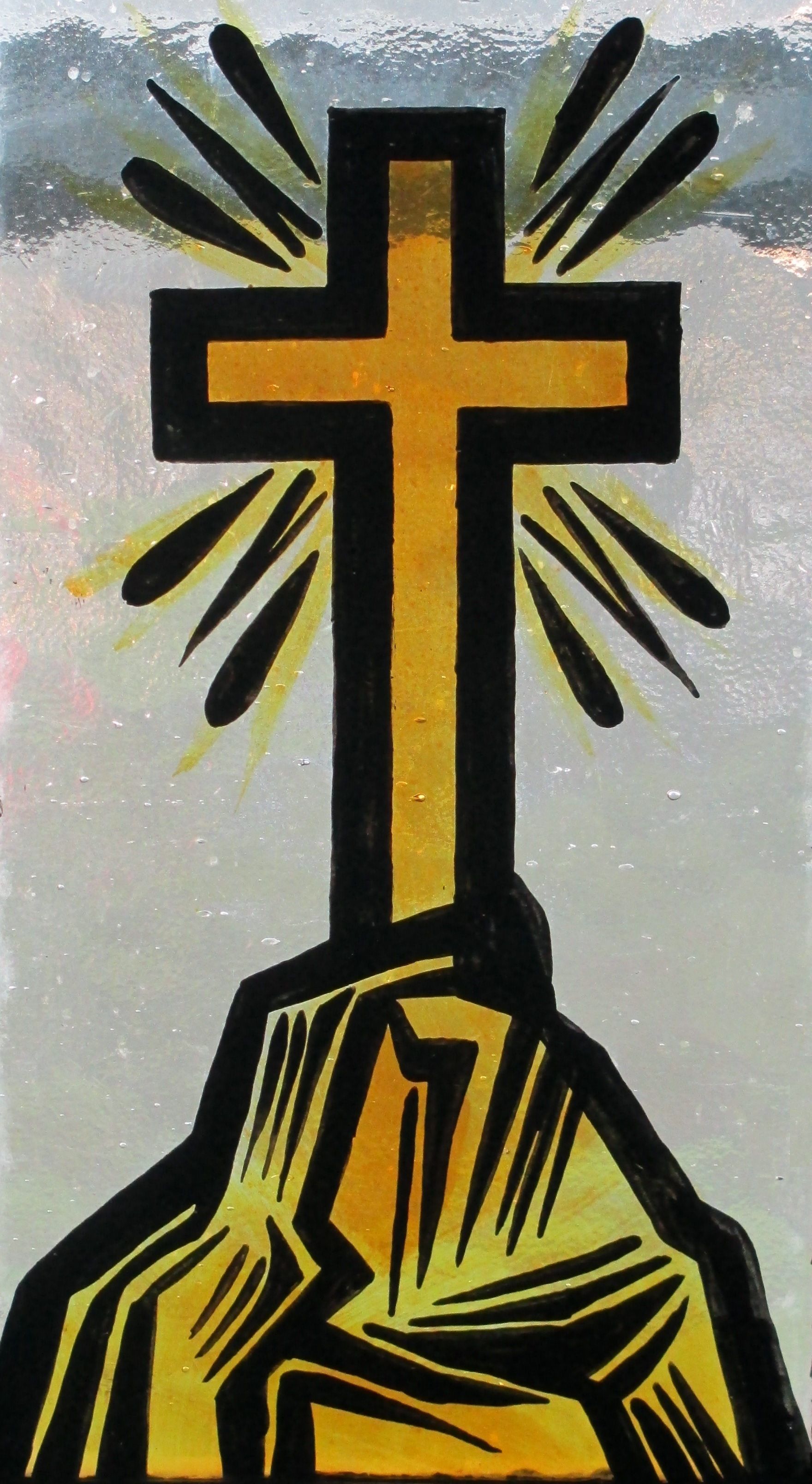
Mount Calvary's Cross - Sacred Heart Catholic Church -  Wauzeka WIA Symbol of the Source & Summit of the Christian Life

Jesus Christ’s sacrifice on Mount Calvary’s cross was offered in love of God and man. It is the source or fount for all saving grace, and the summit or pattern to which all Christians are called.

Refusing Signs — Monday, 6th Week of Ordinary Time—Year II

February 17, 2014

Readings: James 1:1-11, Mark 8:11-13

The Pharisees came forward and began to argue with Jesus, seeking from him a sign from heaven to test him. He sighed from the depth of his spirit and said, “Why does this generation seek a sign? Amen, I say to you, no sign will be given to this generation.

Yet, soon before this scene in Mark’s Gospel, Jesus took seven loaves and a few fish and miraculously fed about 4,000 people with them. That is a sign as surely as his resurrection will be, so how can Jesus say “no sign will be given to this generation”? Perhaps because there was no sign that his critics would accept.

The Pharisees sought “a sign from heaven.” If Jesus had performed some meteorological sign for them they may well have judged him as more evil than they had thought, in union with the demons of the air, just as they had condemned his manifest power to cast out demons. (Mark 3:21-30) They asked for proof but refused to accept evidence in his favor–they were of people of two minds, like St. James describes in the first reading:

But if any of you lacks wisdom, he should ask God who gives to all generously and ungrudgingly, and he will be given it. But he should ask in faith, not doubting, for the one who doubts is like a wave of the sea that is driven and tossed about by the wind. For that person must not suppose that he will receive anything from the Lord, since he is a man of two minds, unstable in all his ways.

Let us pray for those who do not believe; for the sincere, that they may be given sufficient evidence to change their minds, and for the obstinate, that their hardened hearts may be opened. And let us who believe in God (as even the Pharisees did) not cause Jesus to “[sigh] from the depth of his spirit.” Let us be trusting and docile in following him.

Stained Glass Symbols — The Dove

February 9, 2014

Holy Spirit Dove - Sacred Heart Catholic Church -  Wauzeka WIA Symbol of the Holy Spirit

From the Ark, at the time of the Flood, Noah released a dove three times to scout for land. The bird’s return with a fresh olive leaf in its beak signaled an end to the deadly judgment and the beginning of new life. Noah’s dove revealed that peace was restored between heaven and earth. When Jesus was baptized in the Jordan River by John the Baptist, they saw the Holy Spirit descend in bodily form, like a dove, and land upon Christ. By receiving Christ’s baptism, the Holy Spirit comes to rest on us, pouring into us the new life and graces of the Trinity.

Stained Glass Symbols — The Host & Chalice

February 8, 2014

Host and Chalice - Sacred Heart Catholic Church -  Wauzeka WIA Symbol of Christ’s Death

Jesus Christ is really and truly present in the Eucharist Host and chalice, yet the Host and chalice are symbolic as well. At the Last Supper, Jesus took bread, broke it, and said, “This is my body, which will be given up for you.” Then he took a chalice of wine and said, “This is the chalice of my blood… which will be poured out for you…” When a living creature’s blood is separated from its broken body, death naturally follows. Though Christ’s Body, Blood, Soul, and Divinity are fully present in every fragment of the Host and in every drop of the chalice, the symbolic separation of Jesus’ body and blood points to his sacrificial death.

Stained Glass Symbols — The Temple Menorah

February 6, 2014

Temple Menorah - Sacred Heart Catholic Church -  Wauzeka WIA Symbol of Christ

Menorah is the Hebrew word for “Candlestick.” You may be familiar with the nine-branched menorahs Jews employ to celebrate Hanukah, the “Festival of Lights,” however the menorah above features seven branches. This is the design God gave to Moses when commanding him to have a lampstand fashioned to stand within His tabernacle in the desert. (Exodus 25) Later, this pure gold lampstand lit the sanctuary of the Jewish Temple in Jerusalem. Christians see in the temple menorah a sign of Christ, the Light of the World, who is always in the Father’s presence.

It is from a story about the temple menorah that the feast of Hanukah comes. In the second century BC, the Greeks profaned the temple with pagan sacrifices and tried to force the Jews to abandon their faith. One family, called the Maccabees, rose up against their Greeks oppressors, defeated them, and rededicated the Jerusalem Temple in 165 BC. When those Jews relit the temple’s sanctuary lamp they could supply it with only one-day’s worth of olive oil and it would take a week to prepare more. Yet, the temple menorah kept miraculously burning for eight days until the new oil was ready. Rather than olive oil, Hanukah menorahs burn nine candles: one for each of the eight nights and one central candle from which the others are lit.

The “In Brief” Catechism On God “The Creator” (CCC #315-324)

September 6, 2013

● In the creation of the world and of man, God gave the first and universal witness to his almighty love and his wisdom, the first proclamation of the plan of his loving goodness, which finds its goal in the new creation in Christ.

●  Though the work of creation is attributed to the Father in particular, it is equally a truth of faith that the Father, Son and Holy Spirit together are the one, indivisible principle of creation.

●  God alone created the universe, freely, directly and without any help.

●  No creature has the infinite power necessary to “create” in the proper sense of the word, that is, to produce and give being to that which had in no way possessed it to call into existence “out of nothing.”

●  God created the world to show forth and communicate his glory. That his creatures should share in his truth, goodness and beauty—this is the glory for which God created them.

●  God created the universe and keeps it in existence by his Word, the Son “upholding the universe by his word of power” (Hebrews 1:3), and by his Creator Spirit, the giver of life.

●  Divine providence consists of the dispositions by which God guides all his creatures with wisdom and love to their ultimate end.

●  Christ invites us to filial trust in the providence of our heavenly Father, and St. Peter the apostle repeats: “Cast all your anxieties on him, for he cares about you.” (1st Peter 5:7)

●  Divine providence works also through the actions of creatures. To human beings God grants the ability to co-operate freely with his plans.

●  The fact that God permits physical and even moral evil is a mystery that God illuminates by his Son Jesus Christ who died and rose to vanquish evil. Faith gives us the certainty that God would not permit an evil if he did not cause a good to come from that very evil, by ways that we shall fully know only in eternal life.

The “In Brief” Catechism on the Revelation of God (CCC #68-73)

August 17, 2013

● By love, God has revealed himself and given himself to man. He has thus provided the definitive, superabundant answer to the questions that man asks himself about the meaning and purpose of his life.

●  God has revealed himself to man by gradually communicating his own mystery in deeds and in words.

●  Beyond the witness to himself that God gives in created things, he manifested himself to our first parents, spoke to them and, after the fall, promised them salvation (Genesis 3:15) and offered them his covenant.

●  God made an everlasting covenant with Noah and with all living beings (Genesis 9:16). It will remain in force as long as the world lasts.

●  God chose Abraham and made a covenant with him and his descendants. By the covenant God formed his people and revealed his law to them through Moses. Through the prophets, he prepared them to accept the salvation destined for all humanity.

● God has revealed himself fully by sending his own Son, in whom he has established his covenant forever. the Son is his Father’s definitive Word; so there will be no further Revelation after him.

The Pentecost Project — Pentecost—Year C

May 18, 2013

Before Pentecost was a Christian celebration, it was an ancient Jewish observance. In the Old Covenant, in the Law of Moses, God commanded his people to bring some of the first grain harvested from their fields to Jerusalem be sacrificed as a burnt offering. This is the reason why Jews from so many distant countries were gathered in Jerusalem on this fiftieth day after Passover. Each Pentecost, the world’s first fruits were gathered and consecrated to the Lord. On one unique Pentecost, the Pentecost seven weeks after Jesus’ resurrection, Jews from every land were gathered by the Holy Spirit, and consecrated to God the Father, through Jesus Christ. By the end of Old Testament era, God had scattered the seeds of his chosen people across the world. On this Pentecost, the first fruits of his harvest are brought into his barn, the Church.

Pentecost can be seen as the beginning of the end of God’s project of salvation because we are now living in the world’s final era. And yet, Pentecost can also be seen as the start of a new divine project that will perdure forever. At the Tower of Babel, mankind endeavors to build a city reaching all the way to heaven. In other words, they attempt to become as gods while rejecting God. The Lord knows that this recurring human tendency leads to self-destruction, for both individuals and societies, so he thwarts their project by confusing their language. On Pentecost, God undoes Babel by allowing all peoples to understand the Apostles’ words, uniting and ennobling them. On this day, God begins in earnest to build up the Church, a new great city in communion with God that reaches all the way to heaven. Though heaven and earth pass away, this city of God, the Church, shall continue forever.

Why did the Holy Spirit come down in the form of fire? God the Holy Spirit, like the angels, is pure spirit and has no physical body. To be seen by human beings they must assume an appearance. Why did the Holy Spirit appear in the likeness of flames? Consider a different question: How many matches does it take to burn down a forest? The fire from just one small match is enough. As the small fire spreads, while remaining itself, it transforms everything around it. The holy fire that descended on Pentecost did not harm or destroy like natural fire would. The apostles may have been alarmed to see flames sailing towards their heads, but they were not burnt. The fire of the Holy Spirit is like the fire of the burning bush that Moses beheld in Exodus. Divine fire does not consume, but glorifies its hosts. Jesus once declared, “I have come to set the earth on fire, and how I wish it were already blazing!” (Luke 12:49) On Pentecost, a fire is lit in Jerusalem that spreads and transforms the world. This fire is the Holy Spirit at work.

All of salvation history was a preparation for Jesus Christ and Pentecost. Now we live in the last age of the world, the age of the Church, the city of God which shall last forever. Each of us is called to play an active part in this project of the Holy Spirit. On Pentecost, just as important as the gift of tongues given to the apostles was the Holy Spirit’s gift of fearless joy. Even after they had seen Jesus resurrected, the apostles timidly hid behind locked doors “for fear of the Jews.” But the reception of the Holy Spirit gave them a happy courage that allowed them to talk about Jesus in public to anyone who would listen. We have received the Holy Spirit also. Then why are we so timid? Why are we shy to introduce others to Jesus, our friend?  Why are we hesitant to welcome others to the Church, our community?  It seems that the Holy Spirit declines to act with power within us until we give him our free consent. Like he waited upon Mary’s response at the Annunciation, so the Holy Spirit awaits our invitation. Open yourself to the Holy Spirit’s will.  Ask him to give you new, powerful gifts. Give him permission to utilize you in the great project of salvation. And then, let us watch what he does through us.

Antes de Pentecostés era una fiesta cristiana, fue una celebración judía antigua. En el Antiguo Testamento, en la Ley de Moisés, Dios ordenó a su pueblo para llevar a algunos de los primeros granos cosechados de sus campos a Jerusalén ser sacrificado como ofrenda quemada. Esta es la razón Judios de muchos países lejanos se reunieron en Jerusalén en este quincuagésimo día después de la Pascua. Cada Pentecostés, las primicias del mundo se reunieron y se consagraron al Señor. Por un Pentecostés especial, siete semanas después de la resurrección de Jesús, Judios de todos los países se reunieron por el Espíritu Santo, y se consagraron a Dios Padre por medio de Jesucristo. Para el final de la época de del Antiguo Testamento, Dios había esparcido las semillas de su pueblo elegido a través del mundo. En este Pentecostés, los primeros frutos de su mies se llevan a su granero, la Iglesia.

Pentecostés se puede considerar como el comienzo del fin del proyecto de salvación de Dios porque estamos ahora viviendo en la época final del mundo. Y, sin embargo, Pentecostés se puede también ser visto como el comienzo de un nuevo divino proyecto que va a perdurar para siempre. A la Torre de Babel, la humanidad se esfuerza por construir una ciudad llegar al cielo. En otras palabras, ellos intentan convertirse en dioses mientras que rechazando a Dios. El Señor sabe que esta tendencia humana recurrente conduce a la auto-destrucción, tanto para los individuos y las sociedades. Por lo tanto, Dios frustra su proyecto a través de confundir su idioma. En Pentecostés, Dios deshace Babel a través de permitir que todos los pueblos a comprender las palabras de los apóstoles. Dios une a las gente y les ennoblece. En este día, Dios comienza en serio la edificación de la Iglesia, una nueva gran ciudad en comunión con Dios, que llega a todo el camino al cielo. Aunque el cielo y la tierra pueden pasar, esta ciudad de Dios, la Iglesia, continuará para siempre.

¿Por qué el Espíritu Santo descendió en forma de fuego? Dios el Espíritu Santo, como los ángeles, es espíritu puro y no tiene cuerpo físico. Para ser visto por los seres humanos deben asumir una apariencia. ¿Por qué el Espíritu Santo aparece en la imagen de las llamas? Considere una pregunta diferente: ¿Cuántas fósforos se necesitan para quemar un bosque? El fuego de un solo fósforo es suficiente. Como los pequeños fuego se extiende, sin dejar de ser ella misma, se transforma todo a su alrededor. El fuego sagrado que descendió en Pentecostés no dañar o destruir como el fuego natural. Los apóstoles pueden haber sentido la ansiedad a ver las llamas que vuelan hacia sus cabezas, pero no fueron quemados. El fuego del Espíritu Santo es como el fuego de la zarza ardiente que vio Moisés en Éxodo. Fuego divino no consume, pero glorifica a su moradas. Jesús una vez declaró: “Yo he venido a traer fuego sobre la tierra y ¡cuánto desearía que ya estuviera ardiendo!” (Lucas 12:49) En el día de Pentecostés, el fuego se enciende en Jerusalén, se extiende y transforma el mundo. Este fuego es el Espíritu Santo en el trabajo.

Toda la historia de la salvación fue una preparación para Cristo y Pentecostés. Ahora vivimos en la última época del mundo, la era de la Iglesia, la ciudad de Dios que durará para siempre. Cada uno de nosotros está llamado a desempeñar un papel activo en este proyecto delEspíritu Santo. En el día de Pentecostés, tan importante como el don de lenguas dadas a los apóstoles fue el don del Espíritu Santo de la alegría sin miedo. Aun después de que habían visto a Jesús resucitado, los apóstoles se escondían tímidamente detrás de puertas cerradas “por miedo de los Judios”. Sin embargo, la recepción delEspíritu Santo les dio un coraje feliz que les permitió hablar de Jesús en público a cualquier persona que escucharía. Hemos recibido el Espíritu Santo también. Entonces ¿por qué estamos tan tímido? ¿Por qué evitamos introducir a otros a Jesús, nuestro amigo? ¿Por qué estamos renuentes a dar la bienvenida a otros a nuestra Iglesia, nuestra comunidad? Parece que el Espíritu Santo se niega a actuar con el poder dentro de nosotros hasta que le demos nuestro consentimiento libre. Como él esperó a la respuesta de María en la Anunciación, del mismo modo el Espíritu Santo espera nuestra invitación. Ábrase a la voluntad delEspíritu Santo. Pídele que le dará nuevos, poderosos dones. Dará el Espíritu Santo permiso usarte más en su gran proyecto de salvación. Y luego, velemos lo que hace a través de nosotros.

Why Didn’t Jesus Stay? — The Ascension—Year C

May 11, 2013

Today, Jesus ascends with his human nature into heaven. He takes his seat at the right hand of the Father. There Jesus enjoys the greatest honor and intimacy with his Father and from heaven he reigns and intercedes for us. Yet I wonder on this Feast of the Ascension, “Why didn’t Jesus remain visibly with us, here on earth? Why not lead us as our king down here so that we could see and hear him?”

Some would argue that Jesus was limited by his humanity—that Jesus’ human nature prevented him from being at more than one place at a time. They would say that Jesus could preach today in Chicago or heal the sick in Rio de Janeiro, but he cannot do both simultaneously—reigning from heaven allows Jesus to be more present to every place and every person. However, Jesus is not limited in this way by his glorified human nature. Several saints have manifested the gift of bi-location during their lifetimes. Most recently and famously, St. Padre Pio was often at more than one place at the same time. Surely, if Jesus’ saints can possess this power then the Lord Jesus would as well. Furthermore, Jesus demonstrates that his humanity can be more than one place simultaneously through his Real Presence in the Eucharist. Though veiled under the appearances of bread and wine, the entire living person of Jesus (including his body and blood, soul and divinity) is truly present in the Eucharist.

So if Jesus can be physically present in as many places as he wishes, why is he not visibly reigning in millions of places in roles here on earth? For instance, why isn’t Jesus the pastor at every parish church and the bishop in every diocese? One major reason why Jesus rejects this approach is that he wants us to share in his work, his mission, and his glory. Jesus wants you and I to have a part in saving our family and friends and the world. Jesus prayed to his Father at the Last Supper, “As you sent me into the world, so I sent them into the world,” (John 17:18) and Jesus told his disciples after his resurrection, “As the Father has sent me, so I send you” (John 20:21). You and I are sent to do and continue the works that we have seen Jesus do. As Jesus once said, “Amen, amen, I say to you, whoever believes in me will do the works that I do, and will do greater ones than these, because I am going to the Father” (John 14:12). It is not easy to live as Jesus Christ in the world, but this is our great vocation. For this reason, we must receive the force from on high. Pray for the deeper gifts that the Lord wants to give you through the Holy Spirit, whose coming in power we will celebrate next Sunday.

Hoy, Jesús asciende con su naturaleza humana al cielo. Jesús se sentó a la derecha del Padre. Allí Jesús disfruta del mayor honor y la intimidad con su Padre y él reina e intercede por nosotros desde el cielo. Sin embargo, me pregunto en esta fiesta de la Ascensión: “¿Por qué Jesús no permanecen visiblemente con nosotros, aquí en la tierra? ¿Por qué no quedarse aquí como nuestro rey para que nosotros pudiéramos verlo y escucharlo?”

Algunos podrían argumentar que Jesús estaba limitado por su humanidad-que la naturaleza humana de Jesús no poder estar en más de un lugar al mismo tiempo. Dirían que Jesús pudo predicar hoy en Chicago o curar a los enfermos en Río de Janeiro, pero lo no puede hacer ambas cosas al mismo tiempo—reinante desde el cielo permite que Jesús sea más presente a todo lugar y persona. Sin embargo, Jesús no se limita de esta manera por su naturaleza humana glorificada. Varios santos han manifestado el don de la bilocación durante sus vidas. Más recientemente y famosamente, San Padre Pio fue visto a menudo en más de un lugar al mismo tiempo. Seguramente, si los santos de Jesús pueden poseer este poder, entonces el Señor Jesús lo haría también. De hecho, Jesús demuestra que su humanidad puede haber más de un lugar al mismo tiempo a través de su presencia real en la Eucaristía. Aunque velado bajo las especies del pan y del vino, toda de la persona viva de Jesús (incluyendo su cuerpo y sangre, alma y divinidad) está realmente presente en la Eucaristía.

Si Jesús puede estar presente físicamente en tantos lugares como él desea, ¿por qué Jesús no reinando visiblemente en millones de funciones aquí en la tierra? Por ejemplo, ¿por qué Jesús no es el pastor en cada parroquia y el obispo en cada diócesis? Una gran razón Jesús rechazado este método es que él quiere que compartamos en su trabajo, su misión y su gloria. Jesús quiere que ustedes y yo tener una parte en salvando a nuestras familias, y nuestros amigos, y nuestro mundo. Jesús oró a su Padre en la Última Cena: “Como tú me enviaste al mundo, yo los envío también al mundo,” (Juan 17:18) y Jesús dijo a sus discípulos después de su resurrección: “Como el Padre me envió a mí, así yo los envío a ustedes,” (Juan 20:21). Ustedes y yo estamos envió a hacer y continuar los trabajos que hemos visto hacer a Jesús. Como Jesús dijo una vez: “Ciertamente les aseguro que el que cree en mí las obras que yo hago también él las hará, y aun las hará mayores, porque yo vuelvo al Padre,” (Juan 14:12). No es fácil vivir como Jesús Cristo en el mundo, pero este es nuestro gran vocación. Por esta razón, debemos recibir la fuerza de lo alto. Ore por los dones más profundos que el Señor Jesús quiere darte a través delEspíritu Santo, cuya venida en el poder vamos a celebrar el próximo domingo.

His Merciful Greetings — 2nd Sunday of Easter—Year C

April 6, 2013

On the evening of the first Easter Sunday, Jesus appears to the disciples in the locked room where they are hiding and says to them, “Peace be with you.” Then he shows them his hands and his side and says to them again, “Peace be with you.” A week later, when his disciples are together and Thomas is with them, Jesus comes and stands in their midst and says, “Peace be with you.” Three times in this Gospel, our Lord Jesus says, “Peace be with you.”

This greeting of Jesus may seem like a small thing, but it is not. Imagine a Jesus who is a radically different person compared to the actual Jesus we know. This imaginary Jesus appears to his disciples, looks at them, and says, “I condemn you all.” This Jesus castigates the apostles for their desertion. He shows his wounded hands to them as a reproach. “I have these wounds because you abandoned me.” Then this Jesus turns to Peter and says, “You denied me. Now I deny you.” I doubt this unforgiving Jesus would come back to encounter Thomas or the other disciples ever again.

How terrible that would be? But of course, this Jesus is not the real Jesus. (Thanks be to God.) The real Jesus Christ we know says, “Peace be with you.” His words are patient, not angry. His words are loving, not rejecting. His words are merciful, not condemning. His words are from the boundless ocean of divine mercy within him and the mercy of the Lord is eternal. “Peace be with you.” Jesus speaks these words to us today. Let these words of Jesus go deeply within you, and you will always have the peace of Christ.

Al anochecer del primer domingo de Pascua, Jesús se aparece a los discípulos en el cuarto cerrado donde se esconden y les dice: “La paz esté con ustedes”. Luego les muestra sus manos y su costado y les dice otra vez: “La paz esté con ustedes”. Una semana más tarde, cuando sus discípulos están juntos y Tomás está con ellos, Jesús viene y ponte en medio de ellos y dijo: “La paz esté con ustedes.” Tres veces en este Evangelio, el Señor Jesús dice: “La paz esté con ustedes”.

Este saludo de Jesús puede parecer una cosa pequeña, pero no lo es. Imagine un Jesús que es una persona radicalmente diferente en comparación con el real Jesús que conocemos. Este imaginario Jesús se aparece a sus discípulos, los mira y dice: “Condeno todos ustedes.” Este Jesús castiga a los apóstoles por su deserción. Él muestra sus manos heridas a ellos como un reproche. “Tengo estas heridas porque me has abandonado”. Entonces esto Jesús se dirige a Pedro y le dice: “Usted me negó. Ahora yo te negaré”. Dudo que esto Jesús volvería a encontrarse con Tomás y los otros discípulos nunca más.

¡Qué terrible que sería? Pero, por supuesto, este Jesús no es el Jesús real. (Demos gracias a Dios.) El verdadero Jesucristo sabemos dice: “La paz esté con ustedes”. Sus palabras son pacientes, no enojado. Sus palabras son cariñosos, no rechazar. Sus palabras son misericordiosos, no condenar. Sus palabras son del océano infinito de la misericordia divina en su interior, y la misericordia del Señor es eterna. “La paz esté con ustedes”. Jesús dice estas palabras para nosotros hoy. Entonces, permita que estas palabras de Jesús de ir profundamente dentro de usted, y usted siempre tendrá paz de Jesucristo.

All Because He Loves You — Easter Vigil

April 2, 2013

As human beings, our knowledge and motivations are limited.

Jesus Christ, however, is human and divine.

He is the eternal second person of the Trinity.

His knowledge is unlimited and his motivations are countless.

And so, truly and amazingly, Jesus Christ has known you and loved you since before time began.


In the beginning of creation, Jesus foreknew you and loved you.

He calls the Patriarchs in ancient times; in part, because he loves you.

He frees the Hebrews from slavery, because he loves you.

He settles them in the Promised Land, because he loves you.

He establishes David’s kingdom, because he loves you.

He commissions the prophets, because he loves you.


In the fullness of times, he becomes man, because he loves you.

He ministers and preaches on earth, because he loves you.

He is rejected, because he loves you.

He is whipped, because he loves you.

He is crucified, because he loves you.

He suffers and dies, because he loves you.

On third day, he resurrects and conquers death, because he loves you.


In more recent times, he gives you life in your mother’s womb, because he loves you.

He grants you countless blessings, because he loves you.

He encounters you in his Catholic Church, because he loves you.

He baptizes you as the Father’s child, because he loves you.

He confirms you as the Spirit’s coworker, because he loves you.

He incorporates you as a member of his body, because he loves you.


You are blessed in more ways than you can count because of him.

You are here today because of Jesus Christ.

You are here on Easter because you love Jesus Christ but, more importantly, because he loves you.


Como seres humanos, nuestros conocimientos y motivaciones son limitados.

Jesucristo, sin embargo, es humano y divino.

Él es la segunda persona de la Trinidad.

Su conocimiento y sus motivos son ilimitadas.

Verdaderamente, y sorprendentemente, Jesucristo te conoce y te ama desde antes de los siglos.


En el principio de la creación, Jesús te preconoce y te ama.

Él llama a los Patriarcas en la antigüedad, en parte, porque él te ama.

Él libera a los hebreos de la esclavitud, porque él te ama.

Él les instala en la tierra prometida, porque él te ama.

Él establece el reino de David, porque él te ama.

Él comisiona a los profetas, porque él te ama.


En la plenitud de los tiempos, se convierte en el hombre, porque él te ama.

Él ministra y predica en la tierra, porque Él te ama.

Él es rechazado, porque él te ama.

Él es azotado, porque él te ama.

Él es crucificado, porque él te ama.

Él sufre y muere, porque él te ama.

En el tercer día, él vence la muerte, porque él te ama.


En nuestro tiempo, él te da la vida en el vientre de tu madre, porque él te ama.

Él le concede innumerables bendiciones, porque él te ama.

Él le encuentra en su Iglesia Católica, porque él te ama.

Él le bautiza como un hijo del Padre, porque él te ama.

Él le confirme como compañero de trabajo del Espíritu, porque él te ama.

Él le incorpora como miembro de su cuerpo, porque él te ama.


Eres bendecido de muchas maneras que usted puede contar por su culpa.

Estas aquí hoy debido a Jesucristo.

Estas aquí en la Pascua porque amas a Jesús Cristo, sino, más importante aún, porque él te ama.

Looking Forward to Heaven — 2nd Sunday of Lent—Year C

March 3, 2013

In Genesis, God promises descendants and a land to Abraham.  However, Abraham and his wife are very old, and Abraham feels uncertainty about whether they will have children. Therefore, God says to Abraham: “Look at the sky and count the stars, if you can. So shall your descendants be.” You may imagine this happening at night, but perhaps God has Abraham look during the day. We cannot see the stars in the daylight, but we know that they are there. Likewise, God’s promises to Abraham will be fulfilled even though Abraham cannot see it.

Like Abraham, we hope in God’s promises about things we cannot see. While Abraham wants to have children so that his legacy continues, we want eternal life. He hopes that his descendants someday get the Promised Land. We hope for the Promised Land of Heaven. I think we should feel hope in these things more.

In the Gospel, Peter is euphoric about seeing Jesus with Moses and Elijah and says something very silly. “Master, it is good for us to stay here and build three tents: one for you, one for Moses and one for Elijah.” How could Moses and Elijah prefer to live in tents on a mountain top on earth rather than return to paradise? Yet, sometimes we behave like our greatest hope isn’t heaven but to live here on earth forever.

Saint Paul says about sinners:  “… Just think of earthly things. We, however, are citizens of heaven, and from it we also await a savior, the Lord Jesus Christ. He will change our lowly body to conform with his glorified body… ” We all have a natural fear of death, and this is healthy and good. And we feel sad when persons depart from us, and this is understandable. But we should look forward to going to heaven. We should feel at least as much excitement about going to heaven as we would in winning an around-the-world vacation.

Have you encountered beauty here on earth? There is greater glory in heaven. Have you felt happiness and contentment here? There is overflowing joy in heaven. Have you known love? Every person loves perfectly in heaven. Which friends and family do you want to see again in heaven? Which saints or angels do you want to meet there? What will it be like to see Jesus face to face? Reflect on these things, and let this hope inspire you.

En el Génesis, Dios promete descendientes y una tierra a Abraham. Sin embargo, Abraham y su esposa son muy viejo, y Abraham se siente incertidumbre acerca de si van a tener hijos. Por lo tanto, Dios le dice a Abraham: “Mira el cielo y cuenta las estrellas, si puedes. Así sera tu descendencia.” Usted puede imaginar que esto ocurra por la noche, pero tal vez Dios ha Abraham mirar durante el día. No podemos ver las estrellas en la luz del día, pero sabemos que están ahí. Del mismo modo, las promesas de Dios a Abraham se cumplirá aunque Abraham no lo puede ver.

Como Abraham, esperamos que en las promesas de Dios acerca de cosas que no podemos ver. Mientras Abraham quiere tener hijos, para que su legado continúa, queremos la vida eterna. Él espera que sus descendientes algún día obtener a la Tierra Prometida. Esperamos que recibimos la tierra prometida de los Cielos. Creo que deberíamos sentir esperanza en estas cosas más.

En el Evangelio, Pedro es eufórico de ver a Jesús con Moisés y Elías y le dice algo muy tonto: “Maestro, sería bueno que nos quedarámos aquí y hiciéramos tres chozas: una para ti, una para Moisés y otra para Elías” sin saber lo que decía. ¿Cómo pudo Moisés y Elías prefieren vivir en tiendas de campaña en la cima de una montaña en la tierra en lugar de regresar al paraíso? Sin embargo, a veces nos comportamos como nuestra mayor esperanza no es el cielo sino a vivir aquí en la tierra para siempre.

San Pablo dice acerca de los pecadores: “…Sólo piensan en cosas de la tierra. Nosotros, en cambio, somos ciudadanos del cielo, de donde esperamos que venga nuestro salvador, Jesucristo. El transformará nuestro cuerpo miserable en un cuerpo glorioso, semejante al suyo…” Todos tenemos un temor natural de la muerte, y esto es sano y bueno. Y nos sentimos tristes cuando las personas salen de nosotros, y esto es comprensible. Pero debemos mirar hacia adelante para ir al cielo. Debemos sentir excitación cerca de ir al cielo como ganar unas vacaciones alrededor del mundo.

¿Se ha encontrado la belleza aquí en la tierra? Hay una mayor gloria en el cielo. ¿Se ha sentido la felicidad en la tierra? Hay mas alegría en el cielo. ¿Ha conocido el amor? Cada persona ama perfectamente en el cielo. ¿Lo que amigos y familiares qué quieres volver a ver en el cielo? ¿Que los santos y ángeles te quiero conocer allí? ¿Qué se sentiría al ver a Jesús cara a cara? Reflexiona sobre estas cosas que esta esperanza os inspire.