Archive for the ‘Salvation History’ Category

The Significance of Standing — Tuesday, 3rd Week of Easter

May 10, 2011

There’s a curious detail about Stephen’s vision of Heaven in our first reading today:

“Stephen, filled with the Holy Spirit, looked up intently to heaven and saw the glory of God and Jesus standing at the right hand of God, and Stephen said, ‘Behold, I see the heavens opened and the Son of Man standing at the right hand of God.’”

Stephen looks up to Heaven and sees Jesus standing at the Father’s right hand, but both the Apostles’ Creed and Nicene Creed (which we say each Sunday) describe Jesus as “seated at the right hand of the Father.” What are we to make of this?

In the ancient world, to be seated at someone’s right hand gave you the place of higher honor. At a meal, this favored seat granted a special closeness to the host. In a kingdom, the one seated at the right hand of the throne would share in the king’s authority and rule. Of course, describing Jesus as “seated at the right hand of the Father” is only an image (God the Father is unlimited, pure spirit and doesn’t have a right hand.) But this phrase from our creeds does describe a reality: that Jesus is now in the intimate presence of God the Father, sharing supremely in His glory and rule. In his vision, Stephen beholds Jesus in the place of honor, at the Father’s “right hand,” but Stephen sees Jesus standing. So why is Jesus standing?

Did you know that whenever the President of the United States enters a room, everybody stands up? It doesn’t matter if it is a room full of Democrats or Republicans, members of the press, or ordinary citizens, everyone stands up for the President. The same goes for a judge in his courtroom: “All rise, the Honorable Judge So-and-so presiding.” And a gentleman knows that he ought to stand up whenever he greets a lady. Why do they stand? Because it is a sign of respect. If you think about it, whenever we’re offering prayers in the Mass, provided we’re not kneeling, we’re standing up to pray. We stand to pray as a sign of respect to God.

Sometimes, people stand as a sign of respect not so much for the individual but for the greatness of the office they possess. Even a U.S. President’s most hostile critics in Congress, political opponents who couldn’t say one good thing about him, will stand up when he arrives to give his State of the Union address out of respect for the office he holds. It wasn’t for this reason that Jesus stood. No one on earth could have demanded Jesus’ respect by holding an office higher than his.

Jesus stood up because he wanted to show Stephen a sign of His respect. Jesus stood up because he was proud of Stephen. I think that we forget that Jesus is a real human being, with human feelings and emotions about the human events he sees. At the same time, He is also God; and therefore, He sees us all.

When you’re alone, and overcome temptation to do what you know is good, Jesus sees you and He’s proud of you. When you give an anonymous contribution or do a secret kindness, Jesus sees it and He’s proud of you. When you are opposed like Stephen, by people who hate you, or that just don’t understand you, when all the while you’re trying act with love, you do not stand alone. Remember that when you do what’s hard for Jesus, He sees it, and He sees you and He’s proud of you for it.

The Emmaus Travelers — 3rd Sunday in Easter—Year A

May 7, 2011

Let’s start off with a riddle… Once, a father and his son were driving along in the country together when they got into a terrible car crash. They were both seriously injured and ambulances rushed them to two different hospitals. But when the boy was brought into the Emergency Room, the surgeon on duty saw him and declared, “I can’t operate on him. He’s my son.” How can this be…? The trick of the riddle is that we tend to assume that surgeons will be male. The answer is that the surgeon is the boy’s mother.

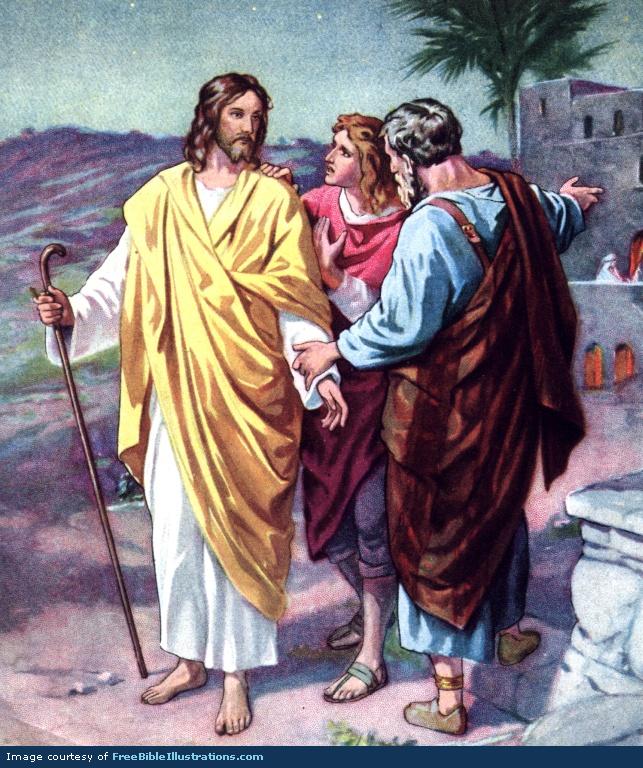
There is a similar trick of the mind at work when we hear the story of the two travelers on the road to Emmaus; we always assume that they were two men. It’s not wonder, since virtually every painting of the encounter on the road to Emmaus will show Jesus with two men. For example, look at the relief on the front of our altar. Many people assume that this is a depiction of the Last Supper (but that there are only two apostles shown because we had to crop it down to size.) Actually, this scene is from after His Passion—you can see crosses on the hill in the distance and there are wound marks in Jesus’ hands. What we have here is to two men at the house in Emmaus, shocked to recognize Jesus in the breaking of the bread.

The artistic depictions always show two men [the picture on the right being the only possible exception I could find], however the original Greek does not call them “two men,” or even “two disciples.” It only says there were “two of them” and that one of them was a man named Cleopas. As to the name and gender of the other traveler, the gospel text is silent. Perhaps the second person’s identity is left as a mystery so as to invite any of us to imagine ourselves in their place in this story. This may be the extent of what we can know for certain, but there is an interesting clue from another Gospel that suggests more detail.

In Gospel of John, it says that “standing by the cross of Jesus were his mother and his mother’s sister, Mary the wife of Clopas….” (John 19:25) So we have a Clopas and Cleopas both associated with Jesus. Perhaps these similar names are merely a coincidence, but perhaps Clopas and Cleopas are variations of the same person’s name. If Clopas and Cleopas are one in the same person, then the other traveler on the road was probably his wife, Mary. This Mary was most likely either Jesus’ aunt and the sister of St. Joseph, or one of the cousins of the Blessed Virgin Mary. What we do know for certain is that this Mary stood with Jesus’ mother at the foot of the cross.

Admittedly, it is speculation to say the other traveler was Cleopas’ wife, but if it was, then this Resurrection episode has a much greater poetry. In the Garden of Eden, a husband and wife ate from a tree. “Then the eyes of both of them were opened, and they realized that they were naked.” They felt ashamed and afraid. But in the house at Emmaus, a husband and wife ate the Eucharist, the fruit of the tree of the cross. “With that their eyes were opened and they recognized Him.” They felt joyful and unafraid. In Eden, God moved about the garden with the man and the woman. After the resurrection, Jesus walks with us, both men and women, along our road.

But whether that second traveler on the road was a woman or not, it would be a remain mistake to think that only men were important in the early Church. That would be at least as mistaken as thinking that every surgeon is a male. Jesus Christ chose some men to be the Church’s leaders, and much is said about them in the Scriptures, but He chose to spread the good news about Himself through the witness of women as well.

Though we sing of the “Faith of Our Fathers,” the faith of our mothers has been just as important, if not more, through time. Today,  it is oftentimes mom who takes the forefront in fostering faith in the family, in leading her children to Christ and His Church; through bedtime prayers and Bible stories, by bringing them to Mass and to CCD, in seeing to it that they receive the graces of the sacraments. If you feel like you’re alone in witnessing to the faith in your family, I commend you, and Jesus is proud of you.

There is another trick of the mind when it comes to celebrating Mother’s Day. On Mother’s Day we remember our mothers, who gave us birth and nurtured us, who raised us and put up with us, but we tend to forget about the greatest gift, the gift of our faith. At the Easter vigil the Exultet asks: “What good would life have been to us, had Christ not come as our redeemer?” Indeed, what good would life be to us if after our births we had not also been brought to Christ through the witness of holy women. Who were these holy women in your life? At this Mother’s Day Mass, let us remember and pray not only for our mothers in the natural order, but for each of our spiritual mothers as well.

They Ran For Him — Easter Morning

April 24, 2011

When Mary Magdalene came to the tomb early Easter morning, she found the stone removed and the body of Jesus gone. She ran to Peter and John, because her love demanded that something must be done. “They have taken the Lord from the tomb,” she said, “and we don’t know where they put him!” So Peter and John went out and ran to the tomb. They both ran, but John ran faster and arrived at the tomb first; not because he loved Jesus more, but because he was younger than Peter.

Some adults run for exercise, but they are the odd exception. Generally, grown-ups just don’t run; except under special circumstances. For instance, my mother doesn’t jog, but she’ll sprint to answer a ringing phone. She loves her friends and doesn’t want to leave them hanging on the line. So, love can make a grown person run.

One time, when I was a boy, I saw my mother run outside in her nightgown and dive into our swimming pool. My mother saved the life of my younger sister, who was floating there facedown.

In all my life, I can only remember ever seeing my father run once. A few years later, during a family walk around a camping resort in my hometown, where we had never walked before, we came upon a tragic emergency. While Mom did CPR, Dad and I ran for the phone at the front office to call for an ambulance. I ran as hard as I could, but Dad was much faster than my ten-year-old legs. I remember seeing his back, his arms rapidly pumping, and thinking to myself, ‘I had no idea he could move that fast.’ And so, from my youth, I’ve known that for the love of another, or in matters of life and death, adults will run. If something is important to them, they’ll run for it.

Mary Magdalene, Peter and John ran to and from an empty tomb out of concern for a dead man’s corpse. So great was their love for Jesus, so great was their admiration for Him, that they ran for Him, even though they thought He had nothing more to offer them. But we are here this morning because Jesus wasn’t dead. He is risen and still active in peoples’ lives today. (To the latter, I am an eyewitness.) He has much to offer to us, our families, our children. But do we run to Him? Do we run to His Church, His sacraments, worship and teachings; or do we run from them? Whether we run is a question of love, and in a world subverted by sin and temptation in so many ways, it’s a matter of life and death. Jesus is risen. So let’s run to Him.

“He Is Not Here” — Easter Vigil

April 23, 2011

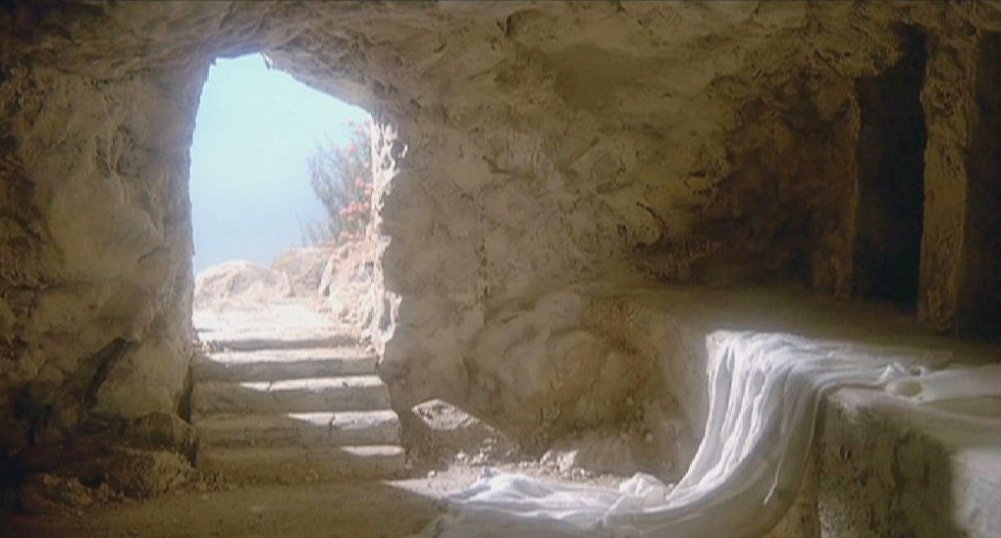
When the women came to the tomb they did not find Jesus, but a radiant messenger. He told them, “Do not be afraid! I know that you are seeking Jesus the crucified. He is not here.…” The tomb was empty, Jesus was not there.

Jesus was present at the beginning of creation, for through Him all things were made. Going forth from the Father’s mouth, He was at hand on earth throughout the ages, achieving His purposes.

He was mystically with Noah, who saved his family from death by building a ship, just as Jesus built the Church to save us.

He was mystically with Isaac, who, though bound and led to sacrifice, was not to be lost forever.

He was mystically with Moses, who freed God’s people from Pharaoh’s demonic slavery by leading them through miraculous waters.

He was mystically with all the prophets, in proclaiming a law to be written on hearts instead of stones, in promising the gift of a Holy Spirit from Heaven, in suffering at the hands of those who refused to hear wisdom.

He has been in His saints, from the least to the greatest, throughout the centuries to this very night. He is present here in all of us who are ‘living for God in Christ Jesus.’

By the all foreshadowings that proceeded His coming, and by the fruitful witness of all His saints ever since, we can confirm the angel’s words, “he has been raised just as he said.”

Jesus is not there in the empty tomb. He is here,  tonight, with us.

“I Thirst” — Good Friday

April 22, 2011

Shortly before He died on the cross, Jesus said, “I thirst.” Why did He say, “I thirst”? He was certainly physically dehydrated. As Psalm 22 foretells, His throat was as dry as broken pottery and His tongue stuck to His palate, but there was more reason for His words than just this.

Last night, at the Last Supper, Jesus had postponed drinking the traditional fourth and final cup of Passover. He said “I thirst” so that they would bring Him wine, so that He could drink, and unite the Last Supper and His Passion as one event. However, there is even more reason for His words than this.

Beside the crucifixes, in all of the chapels, in all of her religious houses around the world, Blessed Mother Teresa had written the words, “I thirst.” She understood that what Jesus thirsts for on the cross is us. Mother Teresa wrote, “Jesus is God, therefore His love, His Thirst, is infinite. He the Creator of the universe, asked for the love of His creatures. He thirsts for our love…” 

As we come to Him on the cross today, let us satisfy His thirst with the refreshment we can give to Him.

“Do This…” — Holy Thursday

April 21, 2011

At the Last Supper, the night before he suffered for us, Jesus took some bread. He thanks to God for it and He broke it. And He declared it to be His body which would be given up for others. Then He offered it to those He loved. When the supper was ended, Jesus took a cup of wine. Again He gave thanks and praise to the Father. And He declared it to contain His blood, blood to be shed for all. Then He offered the cup to His disciples and said, “Do this in remembrance of me.”

At the Last Supper, Jesus ordained His apostles the first priests of the New Covenant. They and their successors would do this in remembrance of Him, throughout the centuries, up to this very night, and until He comes again. When you and I celebrate the Mass we remember Him and what He did, and more than just recalling it, we re-encounter it as that same sacrifice is offered in front of us. But Jesus’ words, ‘to do this in memory of Him’ means more than just coming to Mass.

Jesus is calling and commanding us to do the thing that He is doing. We must give God thanks and praise for what He has given us. We must take our bodies and give them up. We must take our life’s blood and pour it out. And we can do this, for God and for each other, in as many ways as there is to love. The sacrifices of your daily life, at home, at work, and at prayer; the work of washing feet; may not seem significant to you now, but these sacrifices shall your glory in Heaven forever.

As Jesus washed His apostles’ feet He said, “What I am doing, you do not understand now, but you will understand later.” And when He had finished He said, “If I, … the master and teacher, have washed your feet, you ought to wash one another’s feet.  I have given you a model to follow, so that as I have done for you, you should also do.” At the Last Supper, Jesus said to His disciples, “Do this in remembrance of me.” Tonight, He says the same to us as well.

Our Triduum Crowd — Palm Sunday—Year A

April 20, 2011

On Palm Sunday, the crowds welcomed Jesus into Jerusalem as a hero.  On Good Friday, the crowds will clamor for His death. How do we explain this dramatic switch from love to hate? It might be that the mob had become infatuated with Jesus, thinking that He was going to be the earthly messiah of their dreams, the one who would force the hated Romans out of their land and reign as a new and greater King David. Perhaps the crowd realized that this wasn’t Jesus’ plan, and then angrily turned on Him like a lover spurned, hating Him for disappointing their high hopes.

Another possibility is that we are seeing two different crowds, made up almost entirely of different people. Perhaps the chief priests and the Pharisees had assembled a mob around them of those they knew they could easily manipulate. They had arrested Jesus late in the night and brought Him to Pilate early the next morning. Perhaps many of Jesus’ the Palm Sunday supporters had no idea what was happening until Jesus was already in the tomb. Perhaps the next day many of them said, “I wish I had known! I would have been there for Jesus!” Or perhaps they did hear about what was afoot, but had already disowned Jesus for disappointing their messianic dreams. Maybe some people said, “Jesus of Nazareth? I’m too busy to be bothered with Him anymore. I’ll keep my distance, and see how this thing plays out in the end.” Whatever the reason, the crowd that turned-up for Jesus’ trial was short on those who loved Him.

The liturgy of Holy Thursday, Good Friday, and Easter Vigil (what we call the Easter Triduum) is our greatest celebration in the Church. It’s bigger than Christmas and Jesus invites you to be there. Jesus invites you to attend his last meal and to keep watch with Him Thursday night, to accompany Him through His Passion and to reverence Him on the cross, and to keep vigil at His tomb Saturday night and to be the first witnesses to His resurrection. If you truly cannot make it, Jesus understands, but if you would come here to join this crowd accompanying Jesus throughout these holy days, it would please Him, very much.

We Owe Him Big — Tuesday of Holy Week

April 20, 2011

When I was your age, there was a popular show on TV that I liked to watch that maybe you’ve heard of, the show was called The Simpsons. And though it was 20 years ago, I still remember my favorite episode: “Bart Gets an F.” This episode happens to be the most highly-rated Simpsons of all-time and Entertainment Weekly once picked it as the “31st Greatest Moment in Television [History].”

Bart Simpson was failing the fourth grade, and Mrs. Krabappel told him that if he failed his next exam he would forced to repeat the year. Bart tries to prepare by teaming up with Martin to study, but Martin abandons him. And so, the night before the exam, Bart has run out of time. Bart goes to his bedside, kneels down, and prays.

“I know I haven’t always been a good kid, but, if I have to go to school tomorrow, I’ll fail the test and be held back.  I just need one more day to study, Lord.  I need Your help! A teachers strike, a power failure, a blizzard… Anything that’ll cancel school tomorrow.  I know it’s asking a lot, but if anyone can do it, You can!  Thanking You in advance, Your pal, Bart Simpson.” Bart turns off the light, goes to bed, and outside, snowflakes begin to fall.

The next day, the whole world is white and deep. Kids are throwing snowballs, building forts, and riding sleds downhill. Even the adults are joining in the fun. Mayor Quimby solemnly proclaims, “I hereby declare this day to be Snow Day, the funnest day in the history of Springfield!” Bart grabs his sled and makes to rush out the front door, but when arrives at the door, Lisa’s ominous shadow blocks the way.

“I heard you last night, Bart.  You prayed for this.  Now your prayers have been answered.  I’m no theologian; I don’t know who or what God is exactly, all I know is He’s a force more powerful than Mom and Dad put together, and you owe Him big.”

Bart pauses and says, “You’re right.” He removes his goggles from his head and hands them to Lisa. “I asked for a miracle, and I got it.  I gotta study, man!” He goes up stairs and studies like he’s never studied before, or probably since. The next day Bart passes his exam, and the fourth grade, with a D—, and mother Marge puts his test proudly on the fridge.

This weekend, we are going to have a lot of days off from school. Let us remember whom we have to thank for that, what he did for us, and what this long weekend is for. I know you will all be in church on Easter. Everybody’s in church on Easter. But Holy Thursday evening, and Good Friday afternoon, Jesus would enjoy your company at church then, too. If you can’t come at least think of Him then, and of what He’s done for us. Let’s not be like Judas, who was without gratitude, and was the first one out the door. Let us be like Bart Simpson, at least in this much, in showing our thanks to the God who saved our butts, because we owe Him big.

Penance Service Rosary Meditations

April 20, 2011

The First Sorrowful Mystery: The Agony in the Garden

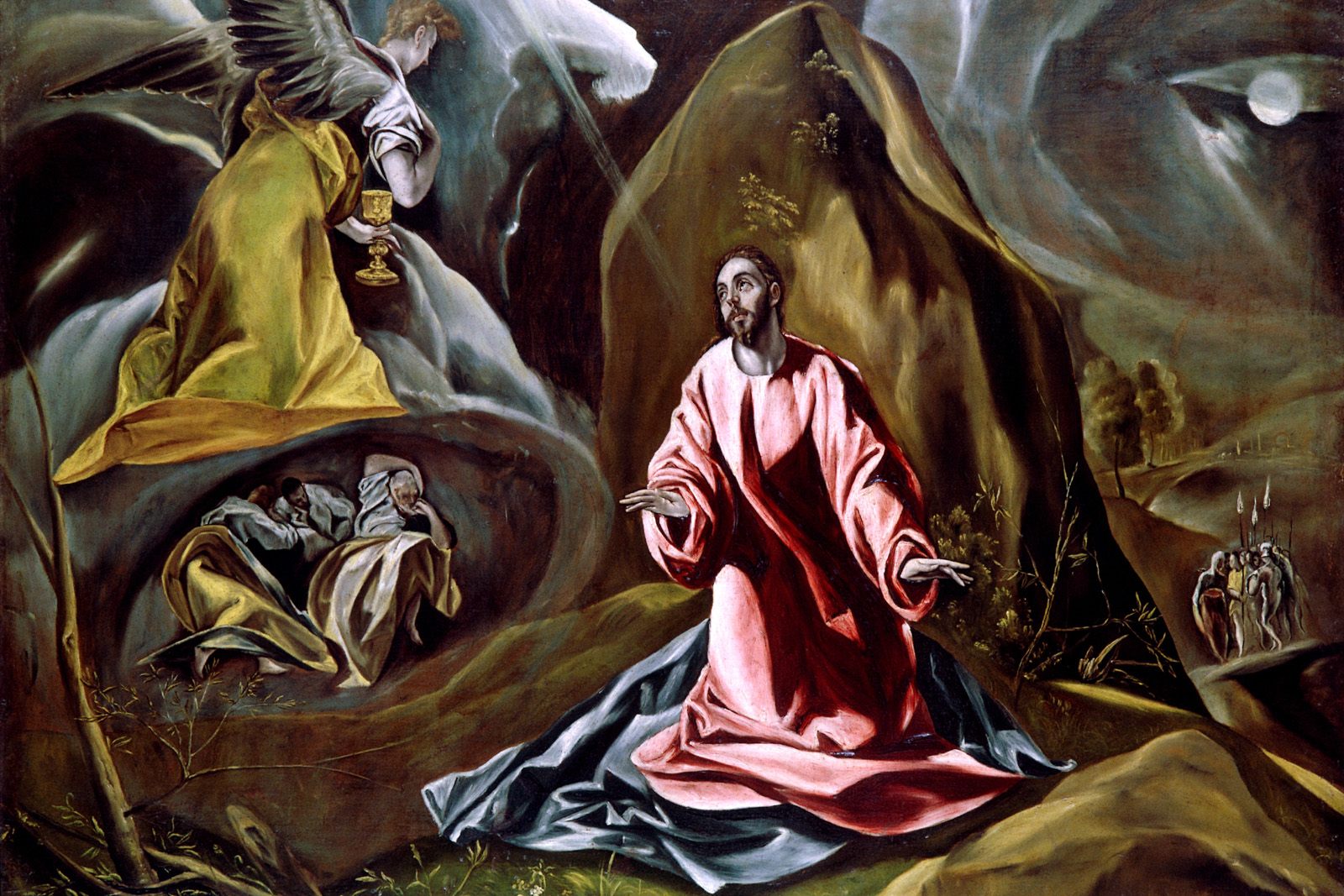
Jesus went out with his disciples across the Kidron Valley. There was a garden there and he and his disciples entered it. He took along Peter and Zebedee’s two sons, and began to experience sorrow and distress. Then he said to them, “My heart is nearly broken with sorrow. Remain here and stay awake with me.” He advanced a little and fell prostrate in prayer. “Father, if it is possible, let this cup pass me by. Yet not my will, but yours be done.” In his anguish he prayed with all the more intensity, and his sweat became like drops of blood falling to the ground. Then he rose from prayer and came to his disciples, only to find them sleeping. He said to Peter, “Simon, are you asleep? Could you not keep watch for one hour? ”

When Peter, James and John fell asleep that hour in the garden, they let Jesus down, but Jesus still loved them. When we sin, we also let Jesus down, but Jesus still loves us, too. Let us all make good confessions, and pray attentively, in this hour with Jesus.

The Second Sorrowful Mystery: The Scourging at the Pillar

When it was morning, those who had arrested Jesus bound him, led him away, and handed him over to Pilate, the governor. Now for Passover, the governor was accustomed to release to the crowd one prisoner whom they wished. At that time they had a notorious prisoner, a revolutionary, a robber and a murderer, called Jesus Barabbas. (The name Barabbas means “son of the father.) When they had assembled, Pilate said to the crowd, “Which one do you want me to release to you, Jesus Barabbas, or Jesus called Christ?” They answered, “Barabbas!” Then he released Barabbas to them, but after he had Jesus scourged, he handed him over to be crucified.

Whenever we sin, we choose a Barabbas instead of Christ. Jesus promises us that choosing Him will make us the most happy, but when we choose to do what’s wrong, we disbelieve Him, and choose someone or something else to make us happy. With our confession and these prayers, let us recommit ourselves to always choosing Jesus Christ, who suffered whips for love of us.

The Third Sorrowful Mystery: The Crowning with Thorns

Then the soldiers of the governor took Jesus inside of their fortress and gathered the whole army around him. They stripped off his clothes and threw a scarlet military cloak about him. Weaving a crown out of thorns, they placed it on his head, and put a reed in his right hand. And kneeling before him, they mocked him, saying, “Hail, King of the Jews!” They spat upon him and took the reed and kept striking him on the head. And when they had mocked him, they stripped him of the cloak, dressed him in his own clothes, and led him off to crucify him.

For as much as those soldiers mocked Jesus, let us now honor Jesus sincerely through this decade of the Rosary, with our hearts full of sorrow and thanks.

The Fourth Sorrowful Mystery: The Carrying of the Cross

They took Jesus, and carrying the cross himself he went out to what is called the Place of the Skull, in Hebrew, Golgotha. As they led him away, they laid hold of a man named Simon who was coming in from the country. They put a crossbeam on Simon’s shoulder for him to carry behind Jesus. A great crowd of people followed him, including women who beat their breasts and lamented over him.

During this decade of the Rosary, let us imagine ourselves helping Jesus to carry His cross. By being with Him and knowing how He felt, this will help us to love Him more. And who knows, perhaps our prayer will travel through space and time to help lighten, even just a little, the burden that He carried.

The Fifth Sorrowful Mystery: The Crucifixion

They brought Jesus to the place of Golgotha (which is translated Place of the Skull) and crucified Him there. At noon, darkness came over the whole land until three in the afternoon. And at three o’clock Jesus cried out in a loud voice, “My God, my God, why have you forsaken me?” Finally, Jesus cried out in a loud voice, “Father, into your hands I commend my spirit”; and when he had said this he breathed his last.

The forgiveness of our sins is so easy for us. When we go to confession and it is brief and painless. But let us always remember this: the forgiveness of our sins is so easy for us in the confessional because Jesus let the forgiveness of our sins be so hard on Him on the cross. Let us thank Him and honor Him for this great gift.

Lenten Penance Service Homily

April 15, 2011

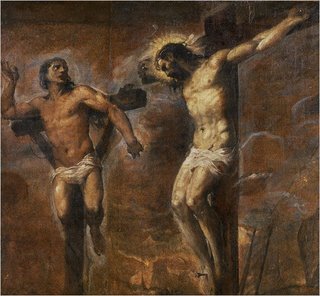
When they came to the place called the Skull, they crucified him and the criminals there, one on his right, the other on his left. Now one of the criminals hanging there reviled Jesus, saying, “Are you not the Messiah? Save yourself and us.” The other, however, rebuking him, said in reply, “Have you no fear of God, for you are subject to the same condemnation?  And indeed, we have been condemned justly, for the sentence we received corresponds to our crimes, but this man has done nothing criminal.” Then he said, “Jesus, remember me when you come into your kingdom.” He replied to him, “Amen, I say to you, today you will be with me in Paradise.”

Sadly, all of us have sinned. Each of us is guilty. Now a sin is more than just an innocent mistake or a misunderstanding. (There is in guilt in those things.) The truth is that each of us at times have sinned by knowingly choosing to do what is wrong instead of doing what is right. With every sin, we hurt each other. We also hurt our relationship with Jesus, who is entirely good, and the most deserving of our love. All of us are guilty. We have all committed crimes against God and our neighbors. So what shall we do?

Like the two criminals in the gospel we just heard, this morning we have the opportunity to encounter Jesus Christ, in the sacrament He gives us. But like which of those two criminals will we be in His presence? The first criminal didn’t acknowledge or care about his own sins. He tried to ignore his terrible situation and treated Jesus on the cross like a joke. However, the second criminal, who tradition calls the Good Thief, acted wisely and well. He recognized in Jesus Christ the one person in the whole world who could really help him. This guilty man praised Jesus for his goodness and asked for Him for His mercy. And Jesus forgave him and promised him great things.

On behalf of Jesus Christ, I beg you this morning to make a good confession, heartfelt confession of your all sins. Jesus said to the Good Thief, “Amen, I say to you, today you will be with me in Paradise.” Like the Good Thief, Jesus wants you to know the blessings of His complete forgiveness today.

3 Mountains / 3 Montañas — 2nd Sunday in Lent—Year A

March 20, 2011
In the life of Jesus, he climbs three significant mountains; The mountain of the sermon on the mount, the mountain of Transfiguration (in today’s reading) and the mountain of the crucifixion. In the Christian life, we must also visit these three mountains. 
 
The three mountains are united. The wisdom of the sermon on the mount, on the first mountain, brings the pleasures and pains of the other mountains. The life of the Gospel brings the joys of the light and the suffering of the cross. Wisdom, glory and sacrifice; the three are a trio here on this earth. Our glories without sacrifice pass quickly. Our sacrifices without wisdom we regret quickly. And our wisdom will be without glory forever if we do not follow Christ in sacrifice. Which mountain should visit more this season of Lent?
 
Do you lack wisdom? Do you not know well that Jesus and his Church teaches? Go to the first mountain to learn, like the disciples at the Sermon on the Mount, with the Bible, or the Catechism or many popular resources available in audio or visual forms.
 
Do you need consolation? Do you not feel well that Jesus is your beloved friend? Go to the second mountain, to feel like Jesus and his disciples at the Transfiguration, through time in a quiet place with God.
 
Do you need perfection in your love? Do you not carry the cross well? Go to the last mountain to practice it, like Jesus at the crucifixion, through good works for others.
 
Jesus climbed the mountains of wisdom, glory and sacrifice. To be with him, we must climb these also.
 

En la vida de Jesús, él sube tres montañas notables. La montaña del sermón del monte, la montaña de la transfiguración (en la lectura de hoy) y la montaña de la crucifixión. En la vida cristiana, debemos visitar estas tres montañas también.

Las tres montañas están unidas. La sabiduría del sermón del monte, de la primera montaña, trae los placeres y dolores de las otras montañas. La vida del Evangelio trae las alegrías de la luz y los sufrimientos de la cruz.  Sabiduría, gloria y sacrificio; los tres son un trío unido en esta tierra.

Nuestras glorias sin sacrificio pasan rápidamente. Nuestros sacrificios sin sabiduría lamentamos rápidamente. Y nuestra sabiduría será sin gloria para siempre si no nos siga a Cristo en sacrificio. ¿Qué montaña deben visitar más esta temporada de Cuaresma?

¿Faltas de sabiduría? ¿No sabes bien lo que Jesús y su Iglesia enseñan? Vaya a la primera montaña para aprender como los discípulos al sermón del monte, con la Biblia, o el catecismo o muchos recursos populares disponibles en formularios visuales o de audio.

¿Necesitas consuelo? ¿No te sientes bien que Jesús es tu amigo amado? Vaya a la segunda montaña para sentirlo como Jesús y sus discípulos a la transfiguración, con tiempo con Dios en un lugar tranquilo.

¿Necesitas perfección en tu amor? ¿No llevas bien la cruz? Vaya a la última montaña para practicarlo como Jesús a la crucifixión, con buenas obras para otros.

Jesús subió las montañas de sabiduría, de gloria y de sacrificio. Para estar con él, debemos subir estas también.

Tobiah Prefigures Jesus

March 3, 2011

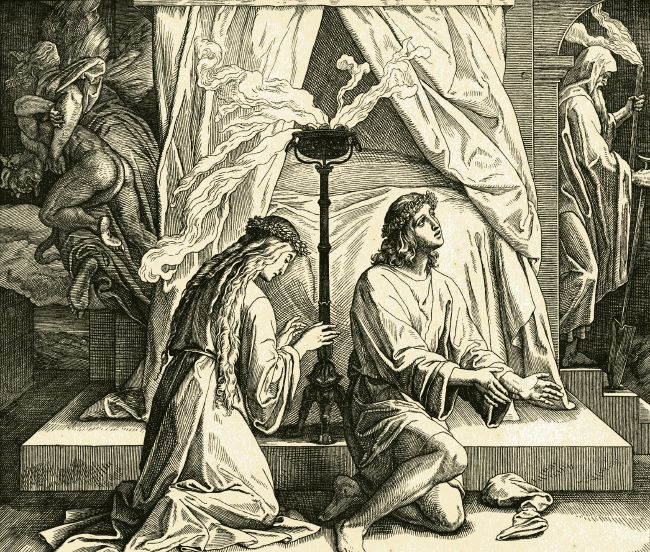
In the Gospels of Matthew, Mark, and Luke, Jesus declares to his disciples at the Last Supper, ‘I shall not drink again the fruit of the vine until the day when I drink it new in the kingdom of God.’ (Mt 26:26, Mk 14:25, Lk 22:18) This is as Tobiah says to the father of Sarah—his rightful and would-be bride: “I will eat or drink nothing until you set aside what belongs to me.” (Tobit 7:11)

In Matthew, Mark, and John, almost the final thing Jesus does on His cross before He dies is to consume some wine from a sponge. (Mt 27:48, Mk 15:36, Jn 19:29) Jesus drinks because the kingdom has come and His marriage to His bride, the Church, is sealed. He loves us as Tobiah loved Sarah, not out of lust (to control and exploit) but “for a noble purpose” (out of love.)  Like Tobiah, Jesus is willing to face death to gain His beautiful bride.

Be Not Afraid — 8th Sunday in Ordinary Time—Year A

February 28, 2011

This morning, I would like to recall events from the life of a great man. When he is eight years old his mother dies. When he is twelve years old, his older brother (a physician) also dies, having contracted scarlet fever from a patient. At nineteen years old, the Nazis invade his homeland and inflict much suffering on those he loves. With his father’s death, he becomes the last survivor of his immediate family, at only twenty years of age. After five years of war and occupation, the Nazis are driven out, but the Soviet communists replace them. They will later try to murder him, but they will (just barely) not succeed. At age seventy-three, he is diagnosed with an incurable disease that will slowly weaken him and kill him, and eleven difficult years later, he dies.

These are events from the life of a great man, a man the Church will declare “blessed” this May 1st. He is Karol Wojtyla, better known as Pope John Paul II. Throughout his papacy, over and over again, he repeated this message: “Do not be afraid.” He is well-known for saying this, but these words were not originally his. They come from another man, also a man of suffering—accustomed to infirmity, who knew both poverty and exile, one who experienced the deaths of loved ones, a man who was also targeted for death himself. This man is Jesus Christ, who first said, “Do not be afraid. Be not afraid.” In fact, in the Gospels, Jesus says this more than just about anything else.

I recall the trials of John Paul the Great and the sufferings of Jesus Christ lest anyone think their words come from naivety about life and the world, or that their Gospel is not grounded in reality. Jesus knows what he is talking about when teaches us, when He commands us, “Do not worry about your life, what you will eat or drink, or about your body, what you will wear. …Seek first the kingdom of God and his righteousness, and all these things will be given you besides. Do not worry about tomorrow; tomorrow will take care of itself. Sufficient for a day is its own evil.” Jesus never denies that evils exist in this world, but tells us that none of them should make us fear. This is why the Church asks God the Father at every Mass, “Deliver us Lord from every evil and grant us peace in our day, in your mercy keep us free from sin and protect us from all anxiety….” We really mean it when we pray this, that we may be free from all anxiety. Christians should care about many things, but not one of these things should make us anxious.

Of what should we be afraid? Poverty? Jesus lived it. Suffering? He experienced that, too. Sin? Jesus has conquered it, and He offers us restoration. Death? Jesus has defeated it, and He promises us resurrection. With Jesus Christ, we can have the peace that, in the end, everything will be ok. Yet, many people feel crushed by their worries, about matters large and small. How are we to overcome these anxieties and experience the peace Christ wants for our lives? We conquer anxiety with these two things: prayer, and confidence in God’s love for us.

As Saint Paul wrote the Philippians, “The Lord is near. Have no anxiety at all, but in everything, by prayer and petition, with thanksgiving, make your requests known to God. Then the peace of God that surpasses all understanding will guard your hearts and minds in Christ Jesus.” Jesus will never forsake us, and He will never forget us. Even if a mother should forget her infant, or be without tenderness for the child of her womb, Jesus will never forget you. So, “Do not be afraid.” The next time you feel worry, the fruit of fear, remove it from your mind and place it on an altar before the Lord. Make a sacrifice of it, a burnt-offering before God, and say, “Jesus, I trust in you. I’ll show up and do my part, but I’m relying on you to take care of this. I sacrifice my fears to you.” It is a high compliment to Him when we trust in Him to be our God, and opens us up to receive His peace.

Always be confident in Jesus Christ’s love for you. The next time you feel worry coming on, this is your cue to pray. Do not be afraid. With Jesus Christ, we can have the peace that everything will be ok.

Peter Our Rock — February 22 — Chair of St. Peter

February 22, 2011

If you claim Jesus Christ as your Lord, then listen to His words. To those He sent to preach for Him, Jesus said this, “Whoever listens to you listens to me. Whoever rejects you rejects me.” (Luke 10:16) Today there are many people preaching many different things about what they think Jesus would have us believe and do. These varying opinions are well-intentioned and shared in good faith, by ministers from pulpits and in conversations between friends, but they cannot all be right. Unless it doesn’t matter what we believe or what we do, then this is a big problem. To whom should we listen? Is there anyone today for whom Jesus’ words are still true, “Whoever listens to you listens to me”?     Does anyone teach with authority, such that ‘whoever rejects their teaching rejects Christ?’ If not, we are lost; but if there is, where do we find this person?

On another occasion, Jesus spoke to the crowds and to his disciples, saying, “The scribes and the Pharisees have taken their seat on the chair of Moses. Therefore, do and observe all things whatsoever they tell you, but do not follow their example. For they preach but they do not practice.” (Matthew 23:1-3) Today teachers usually stand in front of their classes to teach them, but teachers in the ancient world would teach sitting down. Their chairs symbolized their authority, like the “chairman of the board” or the “chair of the English department.” Jesus spoke of the Chair of Moses, the position of the authoritative teaching for old Israel. For His new Church, Jesus establishes a new chair, the chair that we celebrate today, the chair of St. Peter and of his successors the Popes.

St. Peter, like every Pope after him, was only a man. He wasn’t perfect and he was weak in many ways. But Jesus has built His Church upon this rock. When the Pope, as the supreme pastor and teacher of all the faithful, proclaims by a definitive act a doctrine pertaining to faith or morals, he teaches it infallibly. For the good of the Church, the Pope is empowered by the Holy Spirit to teach the faith of Christ without error. Can popes sin? Yes, infallible does not mean impeccable, as various popes in history have shown, yet even these bad popes prove the faithfulness of God in preserving them from teaching errors. Of them Jesus would have said, “Do as they teach, but do not follow their example.”

Jesus knew that living the fullness of Christianity on earth required that He provide us with an infallible guide. Some Christians have held that the Bible alone is this guide, but the Scriptures do not interpret themselves, nor did the Bible books put themselves in the canon. Even the infallible Scriptures require an infallible Church, and an infallible Church requires an infallible voice.

Mark Twain is believed to have remarked, “When I was a boy of fourteen, my father was so ignorant I could hardly stand to have the old man around. But when I got to be twenty-one, I was astonished at how much the old man had learned in seven years.” Of course, it was not the father but the child who had changed, when he finally recognizing the wisdom of his father. Some people reject or ignore Catholic teachings as stupid, like those on the sacred dignity of all human life, or the teachings on human sexuality. Some people neglect the sacraments of the Church for years of their lives. Then, after gaining painful experience, they return with a new love and respect for our Holy Father’s wisdom, and the ways of our Mother, the Church. As wonderful as it is whenever people to come back to the Catholic faith, I would much prefer that you would know the greater joy and peace of remaining ever united to the rock of truth found only in our Church.

Set To Heaven — 6th Sunday in Ordinary Time—Year A

February 13, 2011

This morning, consider this important question: Are you a thermometer or a thermostat? In this life, we can live like either thermometers or thermostats. A thermometer (as you know) accepts whatever temperature, hot or cold, that happens to surround it. A thermometer acts passively to the world’s influence. A thermostat, on the other hand, does not submit to the world around it. A thermostat is set to an ideal temperature and strives to attaint its goal.  As Christians, we should be as thermostats, and we should all be set on Heaven.

Do you think about Heaven much? Do you ever meditate on what it will be like? I think many of us get so drawn in by the here and now that we fail to give Heaven much thought. Yet, I think we would all be strengthened by meditating on it more; on what it promises and what it requires.

The next life is a mystery about which we can know a great deal. As Saint Paul says, “What God has prepared for those who love him, this God has revealed to us through the Spirit.” For example, we know that there will be no suffering or death in Heaven. The Book of Revelation says God ‘will wipe every tear from our eyes, and there shall be no more death or mourning, wailing or pain, for the old order (the way of this world) will have passed away.’

There shall also be no hatred in Heaven. No one with hatred in his or her heart will be able to enter. The Book of Wisdom teaches that God hates none of the persons he has made. He does not always like all the things that they do, but it is His love for each one that continues to hold them in being, and will hold them in existence forever. In order to see God in Heaven, we must become like Him. This is why Jesus forbids not only murder, but hatred in the heart as well. Consider how wonderful it will be to live in Heaven at peace with everyone.

After the resurrection, when our dead bodies are reconstructed from the dust, those who are just will be remade, stronger, handsomer, more incredibly beautiful, than they have ever looked before. Will their perfect bodies have any flaws? If glorified bodies do have “flaws,” they shall be as the wounds that remain in Jesus’ hands and side, beautiful and glorious forever. In this life, the beauty of one’s soul has little relationship to the beauty of one’s flesh; but in Heaven, the holiness of the saints shines out for all to see. 

In Heaven, in this midst of this overwhelming beauty, no one shall lust and none shall exploit another. Lust and exploitation go hand in hand. There is a good reason for the expression “to lust for power,” for lust is about manipulating another for one’s pleasure. Instead of lust, everyone in Heaven shall desire the true good of one another from their hearts.

In this life, temptations will come whether we want them or not, but remember that temptations in themselves are not sins—it is only when we say “yes” to temptation, when we choose to sin as temptations suggest, that we can be guilty of a sin such as lust. Until we can refuse temptation’s invitations, until all lust is driven from our hearts, we are not yet ready for Heaven. This is why Jesus teaches not only against adultery, but against lust in the heart as well. How wonderful it will be to full of love for all, purely, from our hearts, and to receive that same overflowing love in return.

Our lives on earth we are full of questions. But in Heaven, every question which has answer will be answered for us. As St. Paul told the Corinthians, “At present we see indistinctly, as in a [cloudy] mirror, but then face to face. At present I know partially; then I shall know fully, as I am fully known.” Heaven is a place of transparent truth. There, the barriers to communication disappear. In Heaven, we shall know others fully, and be fully known ourselves. No lies nor concealments are possible there, “for there is nothing hidden that will not become visible, and nothing secret that will not be known and come to light.” Until we are free of lies, until we are people whose ‘Yes’ means ‘Yes,’ and whose ‘No’ mean ‘No,’ we are not yet ready to live in Heaven.

If we die in God’s grace and friendship, we may still have some attachments to sin, and be unprepared for Heaven. But, thanks be to God, there is Purgatory, to clean us up and make us perfect, so that we may enter the Father’s house and join the feast of Heaven. Though there is Purgatory, we must always aim for Heaven. If you shoot a bow and arrow and aim carefully for the bull’s-eye, you will probably miss but still hit the target. If you shoot only aiming at the target in general, you will probably miss and hit the ground. So aim for Heaven, lest any of us miss entirely.

Jesus said to his disciples, “I tell you, unless your righteousness surpasses that of the scribes and Pharisees, you will not enter the kingdom of heaven. So let us not default to world’s standards. Do not be a thermometer. Set your thermostat to the perfection of Heaven. Meditate on it and strive for it, and you will experience the joys and blessings of Heaven beginning in this life.