Archive for the ‘Salvation History’ Category

Running to the Empty Tomb

April 17, 2022

Easter Sunday
By Fr. Victor Feltes

There is a joke about how John ran faster than Peter on Easter. John wins the footrace to the tomb and shouts, “I won, I won!” But Peter taunts him, “Who will ever know?” And John says under his breath: “Everyone will know.

St. John’s Gospel records how when Mary Magdalene told them about the empty tomb, “Peter and [John] went out and came to the tomb. They both ran, but [John] ran faster than Peter and arrived at the tomb first.” When Peter arrives, they both enter in to experience signs and results of Jesus’ Resurrection. If St. John is not highlighting his faster foot speed in order to brag, if his purpose is not to rub it in “Slow-Poke Peter’s” face, why include the detail about arriving before Peter?

Part of this is due to St. John accurately describing his firsthand experience of the empty Easter tomb of Christ. Who did what, when and with whom, are important facts when providing eyewitness testimony. Documenting that the tomb was empty before his disciples saw him alive again clarifies that Jesus’ Resurrection is a physical, historical event. The Risen Jesus is not a ghost, he’s not a vision, he’s not a fantasy. His body is not in the tomb. Christ has died, Christ is risen, and Christ will come again.

Like other verses in Sacred Scripture, the detail about John running faster and Peter arriving after contains a spiritual meaning for us. One disciple arrives earlier, another disciple comes later, but they both meet together at the same holy place on Easter morning. They enter in together and see signs and results of Christ’s Resurrection inviting them to believe and accept that the world has changed. Sin and death do not have the last word. Jesus Christ is Lord.

Today, those of us here are like those two disciples. Maybe you’re a disciple who ran here faster. Or maybe you’re one who has arrived more slowly. Maybe you’ve been waiting here, preparing to enter into Easter, since the beginning of Lent. Or maybe you have not come to this holy place for months or years, until today. Either way, whether you came here first or last, all of us are called and blessed to be here together now.

How shall we respond to Easter? With faith or faithlessness? On the first Easter morning, St. Peter could have chosen to leave the tomb and return to his former life of commercial fishing. St. John, the newly-entrusted guardian of Jesus’ Mother Mary, could have abandoned her and fled far away, never to return. But both men chose to remain with the other disciples and soon experienced Christ alive among them.

I hope we all, from this day forward, will be here together each Sunday. Prioritize your faith above the world, like St. Peter did. Draw nearer to Mary and the saints, like St. John did. Remain with us here at St. Paul’s, as fellow disciples of Christ, to experience Jesus Christ alive among us. Christ is risen. He is risen indeed. So believe in him, accepting how he has changed our world.

Because He Loves You

April 17, 2022

Easter Vigil
By Fr. Victor Feltes

Our human knowledge and human awareness are limited and finite. Jesus Christ, however, is both fully human and fully divine. As the eternal, Second Person of the Trinity, his understanding and consciousness are unlimited. And so, amazingly and truly, he knew us and loved us even before time began.

At the beginning of creation, he foreknew you and loved you. He called Father Abraham in ancient times, in part, because he loves you. He freed the Hebrews from slavery in Egypt because he loves you. He settled his people in the Promised Land because he loves you. He established King David’s dynasty because he loves you. He commissioned all the prophets because he loves you. He brought his people back from exile because he loves you.

In the fullness of time, he became man because he loves you. He preached and ministered on earth because he loves you. He tolerated rejection and betrayal because he loves you. He endured whipping and mockery because he loves you. He accepted the Holy Cross because he loves you. He suffered and died because he loves you. But during this night upon the third day, he conquered death and rose again because he loves you.

In more recent days, he gave you life in your mother’s womb because he loves you. He encounters you in his Catholic Church because he loves you. He baptizes you to be his Father’s child because he loves you. He confirms you as the Holy Spirit’s temple and instrument because he loves you. He incorporates you into being a member of his mystical Body and Bride because he loves you. And he fills your life with more blessings than you can count because he loves you.

Each of us rightly celebrates this night because of Jesus Christ. You are here at Easter Vigil because you love him. But more importantly, you are here tonight because he loves you.

What Makes Good Friday Good?

April 14, 2022

Good Friday
By Deacon Dick Kostner

I have always been puzzled with the question of why an all loving God would ever will or direct that his Son be required to die in order for the door to heaven be unlocked so that we might enter into eternal life. I thought this would be an excellent reflection for us to enter into for this Good Friday Service. My research disclosed an informed reflection that was given by a Fr. Terrance Klein, a priest in the Diocese of Dodge City, last year on Good Friday as a homily he presented to his parish.

He indicated we must go back to our creation story in the Bible to find the answer to this question and it all goes back to the fact that the Father desires his children to love him and the fact that one can never order someone to love them. Love can only be obtained if someone has the free will to decide for themselves if someone deserves their love. Free will is a requirement for real love to exist.

God created humans in his image and likeness, but he also created them with a free will to accept or refuse his fatherly teachings and laws which was gifted to us to help us find happiness and yes eternal life with him in heaven. As Fr. Chinnappan told us at our Parish Mission, God does not send us to heaven or hell at the end of our earthly lives, we send ourselves to that place by and through our free will decision to live out our lives either believing and following the advice of our heavenly mentor Jesus, or by refusing that advice.

God sent his son to us in human form so that we might better understand his words and teachings. He sent Jesus with the mission to share salvation instructions so that we might not only be happy in this life but also join God in heaven after this life for all eternity. He did not send Jesus as death sacrifice for our salvation rather he sent Jesus to us with a mission to bring us into the heavenly family by and through use of the key to salvation which is love of God and neighbor. It was the tremendous love that Jesus has for each and everyone of us that he gave his life so that we could witness the fact that death does not trump God’s love for us, his children. The question for us to ponder is do we desire to love God and neighbor and accept his love for us, or not?

On behalf of our Parish I would like to thank Fr. Chinnappan for an insight on the last words of Jesus on the Cross which revealed to this Deacon as to why today is called “Good Friday.” So why is this day “Good?” Maybe it is because it was through Jesus’ Passion and Death that human death came to an end for all of us who have listened to the Word and obeyed His directives for happiness not only in this life but the life to come.

“Do This in Memory of Me”

April 14, 2022

Holy Thursday
By Fr. Victor Feltes

Did you know that a homily is different from a sermon? A sermon may be about whatever topic the preacher chooses, but a homily must be based upon the liturgy’s readings or prayers, or the particular feast celebrated that day. Rather than a sermon, the Catholic Church directs the preacher to give a homily at Mass, though she usually leaves it up to him to decide which specific theme or themes to highlight from the day’s readings, prayers, or celebration. The Mass of Holy Thursday is one rare exception.

For this evening, the Church requires in the current Third Edition of the Roman Missal: “after the proclamation of the Gospel, the priest gives a homily in which light is shed on the principal mysteries that are commemorated in this Mass, namely, the institution of the Holy Eucharist and the priestly Order, and the commandment of the Lord concerning fraternal charity.” In other words, tonight’s homily must be about Jesus beginning our celebration of the Holy Eucharist, his founding of the New Testament priesthood, and his commandment that we love one another. All three of these themes are reflected in Jesus’ words, “Do this in remembrance (or do this in memory) of me.

On the first Holy Thursday, the night before he died for us, Jesus gathered his disciples for a meal, the Last Supper. While at table, he “took bread, and, after he had given thanks, broke it and said, ‘This is my body that is for you.’” After that, he took a chalice and said, “This cup is the new covenant in my blood.” Before being betrayed in the Garden of Gethsemane, Jesus hands himself over to his disciples. Before suffering his Passion, Jesus’ Body is broken and his Blood is poured. Before his death on the Cross, Jesus offers a sharing in his self-sacrifice. And Jesus says, “Do this in remembrance of me.

Ever since, this “Breaking of the Bread,” this consecrating of the Holy Eucharist, this celebration of the Sacrifice of the Mass, has continued to our day. Read St. Justin Martyr’s Apology, an account from the 150’s A.D. describing how Christians worshipped together on Sundays. You will clearly recognize the elements and structure of the Mass. We have done this ‘in memory of him‘ from the era of the Acts of the Apostles to this very evening.

In commissioning his apostles to “do this in memory of me,” Jesus was ordaining them ministers of this new, Christian Sacrifice. He made them priests of the New Covenant, to lead, and teach, and sanctify his people. Without appointing clear shepherds for his Church on earth, Jesus knew his flock would inevitably scatter. Without priests, there would be no Eucharist to make us one in Christ. Please pray for your priests, please pray for more priests, and if Jesus may be calling you to ordination please do not ignore his call. The priesthood is that important for the salvation of souls.

Finally, in saying “do this in remembrance of me,” Jesus was not only telling his Church “do this sacrament until I come again.” And Jesus was not just telling his apostles “do this as my priests.” In saying “do this in remembrance of me,” Jesus was telling each of us to love like he does.

Did you know there are no words of consecration to be found in St. John’s Gospel? Jesus saying, ‘This is my body‘ and ‘This is my Blood‘ at the Last Supper is recounted by the other three gospel writers and by St. Paul in his 1st Letter to the Corinthians (as we heard tonight). So why does St. John leave this out? Perhaps, being the last gospel writer, he saw no need to repeat details others had already made well-known. Instead, John’s is the only gospel book which features the story of Jesus washing his disciples’ feet.

This humble, beautiful act of Jesus helps reveal more fully the meaning of his Eucharist Sacrifice. He, the Master and Teacher, washes feet. He, our God and Creator, gives himself as food. He, the King and Holy One, dies on a cross. Jesus does these things for us because he loves us. He says, “I have given you a model to follow, so that as I have done for you, you should also do… Love one another as I have loved you… Do this… do this… in memory of me.

God’s Love Among Us — Funeral Homily for Cecilia Jenneman, 100

April 11, 2022

By Fr. Victor Feltes

When Cecilia was born one hundred years ago the First World War had only recently ended. Some had hoped it would be ‘a war to end all wars,’ but this would not be so. There were millions more horrors, murders, and atrocities to follow. Religious demographers find there were more Christians martyrs in the 20th century than in all previous centuries combined. The news reports from the Russian war in Ukraine show us that innocents are still suffering and being murdered in our time. Seeing such grave evils in the present and the past, even the faithful may understandably question, “Where is God?

Last week, a Dominican Catholic priest in Ukraine was asked about this in light of the wicked war crimes revealed in the town of Bucha near Kiev. Fr. Petro Balog replied, “Today we must recall the words of Christ from the 25th chapter of Matthew, where he says that ‘whatever you did for one of the least of these brothers and sisters of mine, you did for me.’ When we talk about Bucha… Christ was killed, Christ was deprived of his home, his hands were tied, and he was shot. All this was done to those with whom Christ identifies himself. …God is being crucified again, tortured again.” Fr. Balog emphasizes that God is not above it all. God is in the midst of the suffering and on the side of those suffering.

During Holy Week we remember how Christ’s love led him to offer his painful and sorrowful Passion to save us. Jesus’ innocent suffering, his death and resurrection, changes Christians’ view of this life, death, and the life to come. Though we naturally mourn the passing of Cecilia, we need “not grieve like [others] who have no hope,” for “the Lord God will wipe away the tears from all faces.” On the Last Day, his faithful will say, “let us rejoice and be glad that he has saved us!

Jesus teaches us at the Last Supper and today, “Do not let your hearts be troubled… In my Father’s house there are many dwelling places. I am going to prepare a place for you… I will come back again and take you to myself, so that where I am you also may be.” Christ declares to us, “As the Father loves me, so I also love you. … Love one another as I love you. This is how all will know that you are my disciples, if you have love for one another.” And the lives of his present-day disciples, at our best, help others to believe in Jesus too. A faithful Christian life reflects the faithful love of Christ for his Spouse, the Church, and for each of us individually.

Like Jesus, Cecilia taught many gathered around her. Like Christ, she could “be kind, but be firm.” Some called her, “The best teacher I ever had.” Like our heavenly Father, there were many dwelling places in Cecilia’s house. In addition to family she excellently fed farm hands and friends, and opened her doors to host relatives in need (including her own aged mother, two aunts, and two nephews who had lost their own mother). And after her beloved husband, Bill, became severely debilitated, her faithful love cared for him too through their last two decades together. When asked to imagine living her life over again, she answered, “I would walk the aisle at St. Paul’s with the same man, welcome the birth of each child, grandchild, and greatgrand.” Like God loves each of his children, Cecilia wrote, “I loved each child dearly – perhaps in a different way as each is an individual, but 100% love for each one. …Remember my love for children; my seven, all grandchildren, and the great grands also.

And throughout her life, Cecilia’s Catholic Faith came first. She was known to say, “Without faith in God you have nothing.” She recalled her 1st (“Solemn”) Communion, receiving Jesus Christ in the Holy Eucharist in 8th grade, as a highlight moment of her life, and pointed to the nuns and priests at St. Paul’s as one of her life’s greatest inspirations. Cecilia wrote in her funeral preparation notes: “I hope I instilled a strong faith in God in my own seven children, grandchildren, and every child I was close to in my life. [I want my family to remember me for] whatever I did to help them to be better Christians.

In St. Augustine’s book The Confessions, the oldest autobiography in Western history, he writes about the death of his mother, St. Monica, whose prayers and lived example were so important for his conversion and salvation. As she was dying, St. Monica told her children “Bury my body wherever you will…. Only one thing I ask of you, that you remember me at the altar of the Lord wherever you may be.” Monica was a saint, but she was not presumptuous. She desired the help of her loved ones’ prayers, just like we should pray for Cecilia. But Monica desired something more; not only for her dearest ones to pray for her soul but to draw near to the altar of the Lord Jesus themselves. God, like water, is all around us; but to drink we come to the font of Christ.

Human events are often gravely wrong and death is a heartbreaking scandal. But knowing Jesus Christ and his saints reveals the reality and strength of God’s love. The Easter resurrection of our Lord Jesus Christ remains our hope and consolation, for Cecilia, ourselves, and all the world.

Entering Holy Week

April 9, 2022

Palm Sunday
By Fr. Chinnappan Pelavendran

Today the Church is celebrating Palm Sunday, Palm Sunday reminds us of the glorious and triumphal entry of Jesus into Jerusalem. As Jesus entered Jerusalem the crowds greeted him with shouts of joy and proclaimed him as the messianic king. They spread their cloaks on the ground and placed the palm branches on the street and shouted “Hosanna to the Son of David” and “Blessed is he who comes in the name of the Lord.” The donkey was a symbol of peace and those who rode upon them proclaimed peaceful intentions. The laying of palm branches indicated that the king or dignitary was arriving at victory or triumph.

In the second reading of today. The hymn tells us that even though he was divine, he took willingly the human form for our sake. He is the new Adam who became obedient and did not cling to his divinity and, He is the servant of God who accepted sufferings for the sake of humanity. Finally, he died on the cross a death of shame and humiliation. That death became the sign of triumph and glory and the means of salvation for the world.

The Gospel tells us of his victory and reveals in painful detail the physical sufferings of Jesus. There is rejection, pain, misunderstanding, and Humiliation and yet through it, all Jesus stands firm, faithful to God till the end. In the process, there is a transformation. The leader becomes a servant, shame turns to honor, mockery becomes praise, fear turns to trust, abandonment becomes love, despair turns into hope, and above all death blossoms into new life.

In today’s Passion narrative, Luke builds up to five basic events that take place during the last few days of the earthly life of Jesus. The first is that Jesus shares his final meal with the disciples. Second, Jesus is arrested by his enemies. Third, Jesus is subjected to the so-called Jewish trial. Fourth, Jesus is subjected to the Roman trial and is condemned to death. Fifth, Jesus is crucified on the Cross. He dies on the Cross and is buried soon after.

We must be ready to surrender our lives to Jesus during this Holy Week and welcome Him into all areas of our life as our Lord and Savior, singing “Hosanna.” Today, we receive palm branches at the Divine Liturgy. Let us take them to our homes and put them in a place where we can always see them. Let the palms remind us that Christ is the King of our families, which Christ is the King of our hearts, and that Christ is the only true answer to our quest for happiness and meaning in our lives. And if we do proclaim Christ as our King, let us try to make time for Him in our daily life. Let us remember that He is the One with whom we will be spending eternity. Let us be reminded further that our careers, our education, our finances, our homes, and all of the basic material needs in our lives are only temporary. Let us prioritize and place Christ the King as the primary concern in our lives. It is only when we have done this that we will find true peace and happiness in our confused and complex world.

This week, let us reflect upon the mystery of the Passion of Jesus, our King, as we prepare ourselves to commemorate His glorious Resurrection. Let us remember that Jesus died for our sins, your sins, my sins. Let us be most thankful to the Lord Jesus in thoughts, words, and in actions. And may the Spirit of Jesus be with us during the coming week as we relive the last few days in the life of Jesus on earth. This is a perfect opportunity for us to learn about Divine love so we too may grow in the love of Jesus by the grace of the Heavenly Father.

Holy Week Gifts to Jesus

April 9, 2022

Palm Sunday
By Fr. Victor Feltes

Today, Jesus sends two of his disciples on a special mission. He tells them, “Go into the village opposite you, and as you enter it you will find a colt tethered [a young donkey] on which no one has ever sat. Untie it and bring it here.” Jesus rides that animal into Jerusalem in fulfillment of Zechariah’s ancient prophesy: “Shout for joy, O daughter Jerusalem! Behold: your king is coming to you, a just savior is he. Humble, and riding on a donkey, on a colt, the foal of a donkey.” Jesus does not approach with force upon a warhorse, but peaceably, humbly, a savior riding on a donkey.

Today, on Palm Sunday, his followers celebrate while his enemies complain. Later, on Good Friday, Jesus’ foes accomplish his murder while his friends mourn. A secret disciple of Jesus, St. Joseph of Arimathea, helps take the body of Jesus down from the Cross and wraps it in a linen cloth, laying him in a new tomb which Joseph had hewn from rock and “in which no one had yet been buried.” St. Luke notes how Jesus rides an animal “on which no one has ever sat” and is placed in a tomb “in which no one had yet been buried.” What is the significance of highlighting these details?

Both objects being never used before suggests them being set apart, consecrated for specific use by the Lord. In the Old Testament, God’s law sometimes required the sacrifice of heifers who had never worn a yoke. At times, the Ark of the Covenant was moved using brand new carts. And a Jewish tradition held that no one else could ride the animal upon which the king of Israel rode.

Providence had prepared that colt and that cave for Jesus Christ himself. Notice how neither the animal nor the grave was stolen; both of them were freely given to Jesus during Holy Week. And both these gifts were returned to their owners with added glory because of Christ. These things are symbols for us.

What does Jesus desire this Holy Week? He desires something made and meant for him, but which he will not steal. The gift can only be freely given, and the giver will share in his glory. What Jesus desires this Holy Week is you. Before you celebrate his Resurrection with him at Easter, join him at his table for Holy Thursday, and accompany him through his Passion on Good Friday. Jesus rode another’s colt, and he wishes to journey with you. Jesus laid in another’s cave, and he wishes to rest and live again in you. Gift yourself to Jesus Christ this Holy Week and he will share with you his glory.

Who is the Fig Tree? Three Interpretations

March 19, 2022

3rd Sunday of Lent
By Fr. Victor Feltes

“There once was a person who had a fig tree planted in his vineyard, and when he came in search of fruit on it but found none, he said to the gardener, ‘For three years now I have come in search of fruit on this fig tree but have found none. So cut it down. Why should it exhaust the soil?’ He said to him in reply, ‘Sir, leave it for this year also, and I shall dig around around it and fertilize it; it may bear fruit in the future. If not you can cut it down.’”

The fig tree in Jesus’ parable was fruitless for three years and in danger of being chopped down. Who does this fig tree represent? The prophets Jeremiah and Hosea likened Old Covenant Israel to a fig tree, and the early Church Fathers commonly identified the barrenness of the parable’s fig tree with Israel’s refusal to accept their Messiah. Israel experienced three years of Christ’s public ministry and had still another season of opportunity to become fruitful by embracing Christ’s Church thereafter. But Jerusalem, its Temple, and all its towers were cut down, put to the sword and destroyed by the Romans in 70 A.D.. Parables, however, can have more than one valid and inspired interpretation. Beyond symbolizing an era of history now passed, what meaning does the barren fig tree hold for us today?

In today’s second reading, St. Paul warns the Christians at Corinth against presumption. The Hebrews during the Exodus all shared in a baptism with Moses when they passed through the Red Sea. In the desert, they all ate bread from heaven and drank a miraculously-given drink on their journey. “Yet God was not pleased with most of them, for they were struck down in the desert.” St. Paul says “these things happened as examples for us… as a warning to us,” lest we who are baptized into Christ and regularly consuming his Holy Eucharist think we do not need to reject all grave sins. Do not grumble or rebel like the Hebrews in the desert. Stop following your desires for evil things, or you will perish as they did. Instead, repent and follow our good and loving Lord. He will help and guide you to his Promised Land.

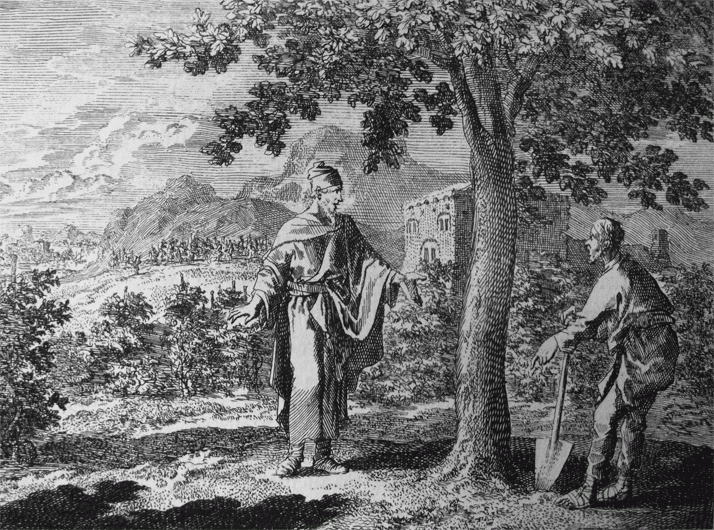
A fig tree may be lush with leaves, giving off a splendid appearance, and yet be barren within. A Christian may appear complete to others, and yet have a sickly soul. To help the barren fig tree, the gardener in our parable pleads to dig around it and add fertilizer. This describes root pruning and the application of manure. Root pruning as a method to make fig trees more fruitful is still recommended today. One article suggests this technique: at the end of winter before new growth begins, go about two feet away from the tree trunk and plunge a spade or shovel down, severing the roots. Skip over one shovel’s-width to the side and then repeat this pattern in a circle once around the tree. Cutting off some of its roots spurs the fig tree to divert its energies from growing foliage to creating fruit. The manure, for its part, provides nutrients (especially nitrogen) which plants require and benefit from. So, if you are a barren fig tree, Jesus the Gardener wishes to radically sever your connections to vices and distractions, in order to productively redirect your energies. He wants to introduce you to stuff which you may now find repellant (including regular confession and daily prayer) but which you need and will benefit from. You do not know how many seasons you have left. Jesus offers you this opportunity to change and become fruitful. Please let Christ the Gardener work with you.

But what if you already follow Christ closely and are aware of no grave sins? What if you have mature self-knowledge, a well-formed conscience, and cannot detect any mortal sins in yourself? Then praise God for that, and consider how our Lord wishes to glorify you through still greater fruitfulness. In the Old Testament Book of Leviticus, God commanded his people not to eat from any tree they planted in Israel throughout its first three growing years. In the fourth year, all of the tree’s fruit was to be dedicated to God as an offering of praise to the Lord. Only in the fifth year, and any years after that, could they eat its fruit. (Leviticus 19:23-25) So how would God dedicate your fruit as an offering to himself and grant you a greater enjoyment of his blessings ever after? A third interpretation of today’s parable suggests how.

Jesus’ parable begins: “A man had a fig tree planted in his vineyard…” (Our New American Bible translates that line’s last word as “orchard” but the Greek word St. Luke uses means “vineyard.”) A vineyard is for growing grapevines. This raises a question I found answered online: why would someone plant a fig tree in a vineyard? A “consulting viticulturist” from New Zealand who has worked fifty years in the vineyard and wine industry says some vineyards plant fig trees because “in some regions figs ripen at about the same time as grapes – birds seem to prefer pecking figs [and] so leave the grapes alone (more-or-less).” Another online commenter, a “cook for over sixty years,” adds that “some vineyards have a problem with small birds who peck at the grapes looking for the seeds and causing the grapes to rot. One solution is to plant fig trees around the vineyard. The birds prefer the figs because they have more seeds and the seeds are more accessible, they then leave the grapes alone.”

The reason a fig tree is planted by a vineyard is to offer up its fruits as a sacrifice for the good of the vineyard, to the delight of the vineyard owner. Who or what is this vineyard in the parable? Jesus teaches, “I am the true vine, and my Father is the vine grower,” and tells his Church, “I am the vine, you are the branches.” (In another parable, The Parable of the Wicked Tenants, Jesus identifies a vineyard as “the Kingdom of God.”) So the fig tree is called to self-sacrifice for the good of God’s vineyard, which is the Church, the Body of Christ, the Kingdom of God. But what does this look like?

In the midst of the French Revolution, a community of Carmelite nuns in Compiègne felt moved to make an offering themselves to God as a sacrifice for their troubled nation and the Catholic Church in France. Almost two years later, after the state had closed and seized all the convents and outlawed the wearing of habits, the sisters were found, arrested, and condemned to death. On July 17th, 1794, sixteen chanting nuns ascended the scaffold one-by-one and were guillotined before a silenced crowd. Ten days after the Blessed Martyrs of Compiègne’s sacrifice the evil “Reign of Terror” ended.

More recently, Fr. John Hollowell, a diocesan priest about my age of the Archdiocese of Indianapolis, was diagnosed in February of 2020 as having a brain tumor. Though grave news, Fr. John saw in his illness an answer to his own prayer. He wrote on his blog at the time, “When the scandals of 2018 broke out, most of you know that they [] affected me deeply, as they have most of the Church. I prayed in 2018 that if there was some suffering I could undertake on behalf of all the victims, some cross I could carry, I would welcome that. I feel like this is that cross, and I embrace it willingly.” Following surgery and treatment, he continues serving today as a pastor in Indiana.

Now it’s natural to hesitate at making such a self-offering. Who wants to suffer – to have our roots cut or be surrounded by dung? Even Jesus prayed before his own self-sacrifice, “My Father, if it is possible, let this cup pass from me; yet, not as I will, but as you will.” Yet Jesus loved his Father and loved us, trusting that whatever his Father willed would be best for us all. The hour had come for the Son of Man to be glorified. Was not this most-difficult thing the greatest thing that Jesus did? Jesus tells us, “Whoever serves me must follow me, and where I am, there also will my servant be. The Father will honor whoever serves me.”

In its first years, a fig tree grows only for itself. A fig tree typically begins bearing fruit when it is three to five years old. So after three years of barrenness, it remains unknown whether the fourth year will witness the tree producing pleasing fruits. Jesus now offers you an opportunity to be fruitful and be glorified like himself. Please love and trust him enough to offer him your fruitful sacrifice.

Our God of Second Chances

March 19, 2022

3rd Sunday of Lent
By Fr. Chinnappan Pelavendran 

On this third Sunday of Lent, the Church provides us with another moment of grace to straighten us on our journey. Today, we celebrate the Lord who frees us from our slavery to sin, if only we listen to His warning to repent. Repentance is, feeling sorry for the sin we committed and a firm resolve not to deliberately commit it again. Sincere repentance provokes God’s compassion, mercy, and love.

The first reading taken from the Book of Exodus, tells us about the deep concern of God towards his people suffering in Egypt. He sees the hardships experienced by his chosen people and observes their misery. God had heard their cries of misery and takes initiative to liberate them from the Egyptian masters. God shows His mercy to His chosen people by giving them Moses as their leader and liberator. The God of Abraham, Isaac, and Jacob reveals Himself to Moses from the burning bush and assures Moses of His Divine presence with His people and of His awareness of their sufferings in Egypt. He declares His intention to choose Moses as the leader who will rescue His enslaved people. Then God reveals to Moses His name as Yahweh (“I AM Who AM”) and renews the promise He made to the patriarchs to give them a “land flowing with milk and honey.

In the second reading, St. Paul warns us that our merciful God is also a disciplining God. Paul reminds the Christians of Corinth that they must learn from the sad experience of the Israelites who were punished for their sins by a merciful but just God. The merciful and gracious God is also just and demanding.

In today’s Gospel, Jesus informs us that those who do not repent will perish. On the other hand, Jesus tells us a parable about the patience of God. As the fig tree is given one last chance to produce fruit before it is cut down, so Jesus is giving His people one final opportunity to bear good fruits as evidence of its repentance. Through this parable, we are reminded of the patience of a God who is willing to give sinners a chance to reform their lives and to seek reconciliation. Just as the farmer tended the barren fig tree with special care, so God affords sinners whatever graces they need to leave their sinful ways behind and return to God’s love and embrace.

Divine grace is expressed as justice with compassion and judgment with mercy. However, we cannot draw strength and sustenance from God without producing fruit. Our fruit should consist of repentance, confession, and firm commitment to change our lives. Let us produce good fruit when we can, Let us repent while we have the chance. Let us turn to Christ, acknowledge our faults and failings, and receive from his mercy, forgiveness, and the promise of eternal life. There is no better way to take these words of Jesus to heart than to go to sacramental confession. There is no better time to go to confession than during Lent. Repentance helps us in life and in death. It helps us to live as forgiven people and helps us to face death without fear.

Our merciful Father always gives us a second chance. The prodigal sons returning to the father was welcomed as a son, not treated as a slave. The repentant Peter was made the head of the Church. The persecutor Saul was made Paul, the apostle to the Gentiles. During Lent, we, too, are given another chance to repent and return to our Heavenly Father’s love.

The Seven Last Words of Christ

March 19, 2022

The seven last words (or statements) Jesus said from his Cross are a classic reflection for Lent. This year, Fr. Chinnappan Pelavendran preached on this theme throughout a four evening parish mission retreat at held St. Paul’s, March 14-17. His four talks are below.

Monday’s Talk
“Father, forgive them, for they don’t know what they’re doing”
“Truly, I say to you, today you will be with me in paradise.”

Tuesday’s Talk
“Jesus said to his mother: ‘Woman, this is your son.’ Then he said to the disciple: “This is your mother.”
“My God, my God, why have you forsaken me?”

Wednesday’s Talk
“I thirst.”
“It is finished.”

Thursday’s Talk
“Jesus cried out in a loud voice, ‘Father, into your hands I commend my spirit!’”

A Time for Transformation

March 13, 2022

2nd Sunday of Lent
By Fr. Chinnappan Pelavendran

As we now enter the Second Week of Lent, our task is to continue to examine our hearts and change ourselves to be worthy of the Lord’s glorious paschal mystery. As human beings, we do not like change and we resist any change as much as we can. However, change is a part of our life, and we cannot just depend on our past glory and achievements. We know that we are pilgrims on a journey to a more permanent dwelling place, a place of total union with our God of Truth and Love. The readings for today invite us to reflect on the paradox of our Christian faith that we belong here but at the same time, we do not belong here. It is in this world that we are to find a home with God in the world to come.

Today’s first reading describes Abraham’s journey of faith. He had been asked to leave his homeland and to go and live in a strange place if he did so, he was promised a great future for his family and descendants. Without any further guarantees, Abram sets out. His readiness to put his trust in God’s word was rewarded by becoming our father in faith. At this time Abraham had no children and expresses his desire to the Lord. God had assured him of a great dynasty as numerous as the stars of heaven. He shows it to Abraham through a covenant. From this experience, Abraham knew his trust in God was justified.

In the second reading taken from the Letter of St. Paul to the Philippians, we heard St. Paul tell the new Christians that our citizenship is in Heaven, that is, the goal and destination of our lives are to be one with God. St. Paul explains to them the Lord Jesus Christ and how the Lord will transfigure our wretched bodies into copies of His glorious body. He will do that by the same power with which he can subdue the whole universe. At the same time, we do not belong to this world because Christ died for us so that we may be made righteous through Him. Through His death on the Cross as the sacrificial Lamb, we inherit the salvation that awaits all those who persevere in their living faith. Jesus will come to save us and will transform our lowly bodies to be like his own glorious body.

In today’s Gospel, we see the blessing for Peter and James and John to witness Jesus transfigured. They got a preview of the glory of Jesus risen from the dead. It was also a preview of the glory we all hope to share in heaven. This was a very special grace for Peter and James and John. Through the Mystery of his Transfiguration in the presence of Moses and Elijah, Jesus wanted to show his apostles, ahead of time, the glory of his Resurrection. Having had this experience they would keep these words to undergo the trial of the Cross and the Passion of their Master. We, too, can receive within us the risen Jesus to carry our daily cross. Jesus was accompanied by Moses and Elijah; two pillars of the Old Testament, representing the Law and the Prophets.

The Transfiguration mystery of Jesus defies all explanations. It is an encounter with the divine that is briefly experienced in the context of prayer. The Transfiguration of Jesus that the disciples witnessed was not simply something they were to see and experience only to the Lord Jesus to him alone. It was also an invitation for them to undergo a transformation of their own. By listening to Jesus, listening to all that he invites us to be and to do, It means especially listening to those words of Jesus; It means having total trust in walking in His Way; it means a total trust that only His Way brings us into full union with God, the source of all Truth, Love, Happiness, and Peace.

His Glorious Light Overcomes the Darkness

March 13, 2022

2nd Sunday of Lent
Fr. Victor Feltes

Once upon a time, little Billy’s grade school teacher was teaching her class about outer space. She said, “In 1969, the American astronaut Neil Armstrong became the first person to walk on the Moon.” Little Billy raised his hand and asked, “Teacher, has anyone ever walked on the Sun?” “Oh, no,” she said, “the Sun is far too hot for that.” But Billy replied with confidence, “I know how I can be the first.” Curious and bemused, she asked him how. “Easy. I’ll go at night!

The Sun, of course, does not turn off at night like a lamp on a switch. The Sun still blazes and shines with incredible heat and light even when the Earth obscures it from our sight. And even on the darkest, stormiest day the Sun remains in the heavens above us even though clouds prevent us from perceiving it clearly.

In this Sunday’s first reading from Genesis, Abram (before God changed his name to Abraham) seems discouraged. He’s lamenting to the Lord: “Look, you have given me no offspring.” Though God has promised him descendants, he and his wife have become very old without having any children together. The Lord God guides him outside and says, “Look up at the sky and count the stars, if you can. Just so, shall your descendants be.” We can easily picture this as a nighttime scene: Abram exits his dwelling and sees a billion stars in the Milky Way. Indeed, more than that number of people today recognize him as our spiritual ancestor, “our Father in Faith.” But this episode strikes as even more profound if, instead of during nighttime, it happened during the day.

‘Look up at the blue sky and count the stars, if you can. Just so, shall your descendants be. You know the stars are up there, Abram. You know they don’t stop being real each morning, it’s just that you can’t see them. Your many descendants will exist, though you cannot see them now, though you do not yet know how. I assure, you my promises to you will be kept.’ And “Abram put his faith in the Lord, who credited it to him as an act of righteousness.

Then God reaffirms his promises to Abram in a strange and mysterious way. The Lord directs him to sacrifice five animals. Abram slays them and lays them out, and then.. nothing happens. Birds of prey, scavengers, swoop down upon the carcasses to pick them over. Yet Abram does not give up; he patiently remains there. As the sun is about to set, a deep, terrifying darkness envelops Abram. And when the sun has set and it is dark, Abram sees a flaming torch and a smoking fire pot appear and pass between the sacrifices. This is a sign from God against any discouragement, doubt, and fear; it is the Lord’s light overcoming the darkness.

Christ’s Church pairs this reading from Genesis today with Jesus’ Transfiguration. After telling the disciples of his coming death, Jesus manifests to them his glory; a divine glory which is always present but which they cannot always see. This event seems to take place in the dark of night since Peter, John, and James were overcome by sleep while Jesus prayed. But upon becoming fully awake, their eyes are opened: they see Jesus’ face shining like the sun and his clothing now dazzling white, as he speaks with Moses and Elijah. These two, great prophets after their trials share in Christ’s radiant glory and speak of the exodus he will accomplish in Jerusalem (that is, they speak of his approaching paschal sacrifice which will set God’s people free).

In his Transfiguration, Jesus reveals his glory to the disciples to strengthen them for the scandal of the Cross. He wants to prepare them to accept, even by the testimony of the law and the prophets, that the Passion leads to the glory of the Resurrection. Christ’s glory shines forth from a body like our own, to show that we, his Church, the body of Christ, can likewise share his glory.

The stories of little Billy, Father Abraham, and Christ’s Transfiguration teach important truths believers will be blessed to remember and hold on to. Even more so than the Sun or stars, our good God endures unchanging. Though this world obscures the light of heaven, heaven’s light remains undimmed. Birds of prey may swoop down and impiously scavenge as enemies of Christ, but we are not forgotten. The innocent one may suffer like Christ, but he is not abandoned. Our times may be dark and frightening, but we need not be afraid: God’s promises will be kept. This is our faith: that despite doubt, discouragement, and distress, the glory of our Lord will overcome the darkness.

Timeless Temptation Tactics & Traps

March 6, 2022

1st Sunday of Lent
By Fr. Victor Feltes

The Book of Revelation identifies “the ancient serpent” who “deceived the whole world” as the one called the Devil and Satan. In the Garden and the desert, his tactics against human beings were similar.

For instance, Satan points out a desirable, material good and encourages grasping for it against God’s will. In the Garden, the serpent told Eve to eat fruit from the Tree of the Knowledge of Good and Evil, and she saw the tree was “good for food, pleasing to the eyes, and desirable for gaining wisdom.” But God had commanded, “You shall not eat it or even touch it, lest you die.” Jesus in the desert had eaten nothing for forty days and he was hungry, so the Devil encouraged him to break his fast by conjuring a stone into bread. This was apparently against God the Father’s will, for Jesus responded, “One does not live by bread alone, (but by every word that comes forth from the mouth of God.)

Another thing Satan does is promise power and happiness separate from God. The serpent told Eve in the Garden, “God knows well that when you eat of it your eyes will be opened and you will be like gods, who know good and evil.” And the Devil told Jesus in the desert, “I shall give to you all this power and glory; for it has been handed over to me, and I may give it to whomever I wish. All this will be yours, if you worship me.”

And a third tactic Satan tries is to say that sinful decisions will have no painful consequences. The serpent said to Eve before her Fall: “You surely will not die!” And the Devil told Jesus atop the temple, “throw yourself down from here, for it is written: ‘He will command his angels concerning you, to guard you,’ and: ‘With their hands they will support you, lest you dash your foot against a stone.’

Our Father knows how to give good gifts to his children. He wills to glorify us through and with and in himself. And he commands us not to sin because he knows it’s bad for us. The Devil, however, urges us to grasp after forbidden things, promises power and happiness apart from God, and lies to us that our sins will cause no harm or pain. Satan tries the same tricks on us today as he did in ancient times.

What if the Devil and all his demons were to suddenly cease existing? Would all our sinning end and disappear tomorrow? Sadly, no. Ever since the Fall, we human beings experience concupiscence; we feel unwieldy passions and misdirected desires. So, even absent demonic temptations, some sinning would still occur on earth. When we sin, how much is due to our wounded human brokenness and how much is instigated by demonic activity? Whatever the mix or mixture of the two, regardless of whether a particular temptation is coming from inside us or outside us — from inner wounds or external enemies, Jesus’ temptations in the desert reflect the ways we are tempted.

For example, in today’s gospel when does Jesus’ first temptation come? When Jesus is very hungry from extreme fasting. Temptation often attacks us in our weakness. Alcoholics Anonymous has an acronym called “HALT.” They observe that someone is more likely to fall off the wagon of sobriety when they are “Hungry, Angry, Lonely, or Tired.” I’ve noted this in the confessional as well. For instance, when parents confess to having lost patience with their children I commonly ask them if they’re tired. The answer is almost always “yes.” Now this doesn’t mean we should never make loving sacrifices which might leave us hungry or fatigued, but it does mean that we need to be aware of our vulnerability at such times and be extra careful in our actions.

Do you find that the sins you bring to the Sacrament of Confession are often much the same? This is common and can discourage some people, but thank goodness it’s not something totally different each time (gossip one day and arson the next)! As creatures of habit, the times and places and ways in which we will be tempted should not be total mysteries to us. Be conscious that you are most likely to be tempted again when and where and how you were before. Realizing this, make any necessary changes in your life, and live with your eyes wide open on the lookout for your known stumbling blocks.

In his second temptation today, Jesus is shown “all the kingdoms of the world in a single instant,” to tempt him toward idolatry. This seems to describe a vision, perhaps within Jesus’ imaginative faculty – a very real experience perceived within his mind. Our temptations often play upon our imaginations. Jesus responds to this temptation abruptly: “It is written: ‘You shall worship the Lord, your God, and him alone shall you serve.” Like a snowball beginning to roll at the top of a mountain, Jesus shows us that it is best to resist temptation early and firmly, before the snowball becomes an avalanche which brings disaster. Though we should not give our imaginations free rein to present us sinful shortcuts falsely-promising happiness, examining our daydreams can be revelatory. Consider: “I could fantasize about absolutely anything, so why am I fantasizing about this?” What is the good desire behind it which God wishes to ultimately fulfill for you somehow? Allow me to share a story about what I mean.

I once met a seminarian who felt strongly called to be a Roman Catholic priest but also felt drawn to marriage. Obviously, these two vocations were incompatible and this tension greatly vexed him. When he shared this internal conflict with his spiritual director, that priest asked him, “Could it be that what you are longing for isn’t actually marriage, or sex, but intimacy?” The young man then realized that he had simply always associated and identified deep intimacy – knowing and being known, loving and being loved – with marriage. He came to realize God was calling him to greater intimacy with himself. Through seriously examining his desire he discerned the deeper, holy desire behind it. Notice, too, how this seminarian gained a helpful perspective by sharing what he was experiencing with a wise and spiritual person. If he hadn’t, he might have made a grave mistake and missed out on his life’s calling.

In the gospel’s third and final temptation, we witness the Devil challenge Jesus’ identity and attempt to confuse him: “If you are the Son of God, [observe this is the third time the tempter says this phrase] throw yourself down from here.” The Devil then quotes two passages from Scripture to argue that Jesus should do something which would be wrong. When someone is going from good to better, our demonic foes often seek to confuse and confound us. Where the demons cannot make us wicked, they will seek to discourage and impede us.

For example, for a couple weeks in college, I continued going to Mass but refrained from receiving the Holy Eucharist. I worried that I lacked sufficient faith to receive our Lord worthily. But then I was enlightened in prayer with an (in retrospect) obvious insight: people who don’t believe in God don’t worry about whether they believe enough in God – that’s something believers do. My anxiety was relieved and my regular Communion was restored when the misleading illusion was dissolved.

When I started learning more about our Catholic Faith as a teenager, I would come across some seeming contradiction in the Bible or a Church teaching I didn’t understand and become greatly troubled, for if the Bible or the Church were wrong about this then how could they be trusted? But then I would learn how the bible passages were not actually in conflict, or that there were actually good reasons for the Catholic teaching. I experienced this cycle enough times that I learned to handle it with confident, trusting patience. I reflected, “There are good answers to my questions, but I don’t have to find them immediately, right this second. It’s going to be fine.” Don’t fall for the temptations to doubt and self-doubt which would rob you of your peace.

Challenges to our identity are another common temptation trap. The Devil says, “If you are the Son of God, throw yourself down from here,” implying, “If you don’t jump, then you don’t believe your Father’s word can be trusted, or you don’t really believe that you are his Son.” The Devil is attacking Christ’s identity and Jesus’ relationship with his Father. Temptation tells us, “You’re a fake, you’re a phony, you’re a hypocrite, you’re a failure, you’re an embarrassment, you’re worthless, you’re shameful, you’re rejected, you’re unlovable, you’re unloved.” Don’t fall for that garbage. Instead, ask our Father, Jesus, and the Holy Spirit to show you who you are to them and live in that beautiful truth.

To be forewarned is to be forearmed. Through knowing these timeless temptation tactics and traps, may you prevail in the spiritual battles ahead of you this Lent.

The Lover’s Return — Funeral Homily for Richard “Dick” Aubert, 85

February 24, 2022

Dick was swept off his feet and went head over heels on his first date with Michele. It was during the winter which spanned 1959 and 1960. They were both quite young. He had just returned from service in the U.S. army She was piously contemplating becoming a nun. Facilitated by mutual friends, Dick and Michele decided to go ice skating together.

There were a lot of people at the rink that night. Many skaters going to-and-fro on the ice. Suddenly, during a moment while Michele was either distracted or not nearby, Dick slipped, and fell, and smacked his head on the ice. Michele later saw somebody sitting on the ice, a crowd of people gathered around him, but she did not realize that that young man was her date.

Having suffered a concussion, Dick was brought off the emergency room. But Michele thought he had ghosted her. She assumed he had abandoned her, without even saying goodbye. Surely this must have seemed like the end of their relationship. How could a relationship continue after that? Well, Dick soon returned, explained what he had happened and where he had gone, and they booked a second date.

After a year of dating, they committed their hearts to each other, entering a marriage covenant in the Sacred Heart of Jesus Catholic Church in Eau Claire in 1961. And their love bore fruit, particularly in three daughters; Catherine, Lori, and Heather, in their grandchildren and great grandchildren.

We are gathered here on this day, rather than gathered elsewhere, because of one man more than any other. For love, he pursued a holy and beautiful bride. He was painfully struck down, and they were separated for a time. She did not understand why they were parted and had not hoped to see him again. But then he rose again and returned to her, and their love has borne fruit since. I speak of Jesus Christ and his Church. Behold, he makes all things new, renewing his mysteries within our lives.

The holy love of a husband and wife reflects the holy love Christ and his Church. Dick and Michele have been married for sixty years, even throughout the past three years of his mental decline, living together at home until just three months ago.

On a day like there are tears from sadness due to parting and tears from beholding the beauty of faithful love. Jesus will one day wipe every tear from our eyes, and there shall be no more death or mourning, wailing or pain, when this world is finally set free from slavery to corruption and this old order has passed away, replaced by the new. St. Paul urges us to “consider that the sufferings of this present time are as nothing compared with the glory to be revealed for us.

The Lord Jesus, who makes us children of God the Father; Christ, the lover of our souls, who proposes to us an everlasting covenant with himself; Jesus Christ, who suffered with us but rose again, he is the reason we are here today for Dick’s funeral. In this broken world of suffering and beauty, Jesus is our cause for hope and our greatest consolation.

God Chooses People Like You

January 29, 2022

4th Sunday of Ordinary Time
By Fr. Chinnappan Pelavendran

“Isn’t this the son of a carpenter?” —Luke 4:22

God chooses and uses ordinary people to do extraordinary things. He doesn’t need our ability, but rather our availability. He uses ordinary people who have nothing of their own to offer except their faithfulness and willingness to say “Yes” to God. One important point to note is that God does not call anyone by accident. Instead, He carefully considered before calling us. He knew each one of us personally. He also knows what he wants us to do for him. He calls us by our own names, with a plan in His mind.

We see this in the First Reading, which speaks of the calling of Jeremiah to be a prophet who will communicate God’s Word to his people. It was a calling that went back to the time before he was born. “Before I formed you in the womb I knew you, before you were born I dedicated you, a prophet to the nations I appointed you.” All of us have actually been called in this way. But our reaction is often similar to Jeremiah’s: “‘Ah, Lord God!’ ‘I know not how to speak; I am too young.’” But the Lord responded, “Say not, ‘I am too young’. To whomever I send you, you shall go; whatever I command you, you shall speak…” Then the Lord extended his hand and touched his mouth, saying: “See, I place my words in your mouth.” An ordinary youth called by God to do His Mission.

Look at the Apostle Paul. Whose feast day we celebrated on January 25th. St. Paul was one of the most educated men of his day and yet God brought him down in Acts 9. God opened his eyes to the beauty and glory of Jesus. Once Paul knew Jesus, all of his education, gifts, and talents were directed towards the Gospel. The Lord uses those humbled by a vision of His greatness and glory to testify to the proud and religious. The Lord humbled the Apostle Paul and used him mightily to plant churches, preach the Gospel, write more than a dozen New Testament letters, and so much more. God used educated people for His glory but often humbled them because of their pride so they will rely on Him.

Peter was a fisherman by trade, along with his brother Andrew. He grew into a gifted preacher and bold leader. Jesus told Peter that he would deny Him three times, but Peter didn’t believe Him. Imagine Peter, the leader of the Apostles and a member of the inner circle of the Son of God, denied him three times. Peter felt devastation, shame, and guilt. He may have thought “I’m such a failure that God could never use me again,” but that isn’t true. God uses our failures, hardships and trials for His glory. He turns what was meant for bad to testify to His grace. You say that you are a failure and yet God says because of the finished work of Christ you are victorious. The Apostle Peter went on to be mightily used by God because He was broken. You may be broken right now but in due season God will build you up and use you for His glory. Don’t run from Him, run to Jesus. God uses ordinary people for His glory.

Jesus is a good manual worker from a small village. He is just another person in the town. But the rumors being spread about his actions in Capernaum and the words he has just spoken seem to indicate a special connection with God. On the one hand, his origins are well-known, but on the other hand his origin is completely unknown. Who is Jesus really? The ordinary carpenter, Jesus, is the Son of God who has become man in order to redeem us from our sins.

How could God use you? Look at your situation and your surroundings. Perhaps God has placed you in your school, your job, your family, or your neighborhood to do something special for the Lord Jesus Christ. God is calling you right now; all you have to do is say, “Yes, Lord!” Will you make yourself available to Him? Remember, God uses ordinary people to do extraordinary things for His glory!