Archive for the ‘Salvation History’ Category

Good News Needed by Each & All

December 24, 2022

Christmas Mass
By Fr. Victor Feltes

I proclaim to you good news of great joy!” Today is born our Savior, Christ the Lord. Why is his birth such good news? Well, why do people still need Jesus Christ today?

Would you say we presently live in a time of great wisdom? A time of advanced technology? Certainly. A time with more wealth than previous centuries? Sure. But is this a time of great wisdom? Relatively few know how to live rightly, anchored firmly in hope, and thrive. Would you say we live in a time of great heroes? Who would be our heroes now beyond paid athletes or fictional characters with superpowers? No U.S. politician in national office today has an approval above 50%. And even the best leaders among us are flawed. Would you say we live in a time of strong fatherhood? Rather, families are increasingly strained or broken. And many people have never had a good father. Would you say we live in a time of great peace? Bombs are not exploding around us like in Ukraine, but is there peace in our culture and peace in all our souls?

The good news of Christmas, as the Prophet Isaiah foretold in our first reading, is that ‘the people who walk in darkness see a great light; upon those who dwell in the land of gloom a light shines.’ “A child is born to us, a son is given us… They name him Wonder-Counselor, God-Hero, Father-Forever, Prince of Peace.” In our foolish world, Jesus is the wisest teacher whose counsel wondrously changes lives. In our unvirtuous world, Jesus is the only flawless hero; he is God among us. In our world lacking fatherhood, Jesus says he “only [does] what he sees his Father doing”— so Jesus acts and loves like his Good Father forever. And in our troubled world, Jesus is the Lord who would bring us peace, both around us and within us.

In the days of the birth of Jesus, St. Matthew’s Gospel notes a decree had gone out from the Roman Emperor that the whole world should be enrolled in a census. (This brought the Holy Family to Bethlehem.) Caesar Augustus wanted everybody grouped and tallied for his worldly purposes: to tax more efficiently, to draft more men for war, and to dominate more effectively. Beginning with the birth of Jesus at the center of history, God decrees for all the people of the world to be gathered into his Church for his holy purposes. It is not to tax us, but to give us his gifts. It is not for waging wars, but to bring about his peace. It is not to dominate us, but to share with us the freedom of his Kingdom. Like St. Paul says in our second reading, the grace of God has appeared in Christ to save and train us all to reject godless ways and worldly desires and to live temperately, justly, and devoutly in this age, as we await our blessed hopes: the return of Christ, the resurrection of the dead, and everlasting life with him.

On Christmas Day, Divine Providence brought the Holy Family (Jesus, Mary, and Joseph) and the shepherds all together. God’s Providence has likewise brought you and all of us together this morning with the Lord Jesus in this Church. Will you be here next Sunday? I pray the joyful news of Christmas will bring you back again. The Lord who loves you calls you. Our world needs Jesus Christ profoundly and so do you.

Make Room for the Child Jesus

December 24, 2022

Christmas Mass
By Fr. Chinnappan Pelavendran

Once up a time there was a class of small children who wanted to have a nativity play. One of the children, a very tall boy wanted to be a shepherd and carry the sheep on his shoulders, but the teacher decided that he should be the innkeeper who would drive away Mary and Joseph away from the inn. When Mary and Joseph came to the inn, the little innkeeper told them loudly that there was no room for them. Mary turned to Joseph and began to cry. The little innkeeper turn back to them and said, there is no room here in the inn but you can take my room. He showed the spirit of Christmas that there is room for everyone.

Christmas is the feast of God sending us a Savior. The Incarnation of Jesus as the True God and true man was to save us from our sins. As our Savior, Jesus freed us from the slavery of sin and atoned for our sins through his suffering, death, and Resurrection. Every Christmas reminds us that we need a Savior every day of our lives.

Christmas is the Feast of God’s sharing his love with us. Jesus, as our Savior, brought the Good News that our God is a loving, forgiving, and merciful God. He demonstrated by his life and teaching how god our heavenly father loves us and forgives us. All of His miracles were signs of His divine love. At the end, Jesus gave his life and died on the cross to atone for our sins and make us children of God. Each Christmas reminds us that sharing love with others is our Christian privilege and duty. Let Jesus be reborn in our hearts and lives, not only during Christmas but every day. His presence within us will allow us to share our love in words and deeds.

Christmas is the feast of Emmanuel, God living with us and within us. The New Testament begins with the birth of Christ. He has now come to live with us and continues to live with us during our entire life. He lives in us in the sacraments, especially in the holy Eucharist.

Christmas reminds us that we are to bring God to those around us by loving them as Jesus did. This is the best Christmas gift we can give or receive today.

Today the new king is born to us and He is not like any secular king. The first people to find out about his birth are not the royal officials, religious officials, military leaders, or the wealthy elite. The first people to be informed are the shepherds whose social and political status would be among the lowest ranks. The angels announced the birth of Jesus and declared he is the Messiah and the lord. There is no palace or royal household for him, he is wrapped in swaddling clothes and laid in the manger. There is no celebration, only silence. We are aware that Christmas is the birthday of Jesus and we share it too since we are reborn as children of God at our baptism. This is the news of great Joy and he is the great light that has appeared in the world.

When Jesus first came into the world over two thousand years ago, His arrival was to fulfill the promise of God. The Bible tells us that from the Fall of Adam and Eve, God promised to send a redeemer. The people waited eagerly for him. Sometimes they were faithful to God and sometimes they were not. The birth of Jesus is a reminder that God is faithful forever and has not forgotten us. It is a reminder of how much God loves us. It is a reminder that God has reached down to us, so we may reach up to Him with praises and glory in thanksgiving for our salvation.

Let us enjoy the true spirit of Christmas by accepting Jesus the Christmas Baby as our Savior – God. Let us invite him to rule our lives and ask him for the strengthening power of his Holy Spirit to do God’s will every day of our lives. Let us be like the little innkeeper that we talked about earlier, and make room for the Child Jesus in our hearts.

Immanuel: God Among Us

December 22, 2022

Advent Retreat Reflection
By Fr. Chinnappan Pelavendran

Emmanuel means God is with us. From the beginning even today God is with His people through His presence, He Strengthens us, comforts us, guides us, cares for us, and loves us. First, God is with us always. Secondly, he is coming every day, every hour to those who believe in him and those who do not believe in him. Third, he will come again in his glorified body, the same Jesus who was here two thousand years ago. He will be coming to judge the living and the dead.

In the beginning, God created Adam and Eve in His Image and likeness, which means God lives with everyone. God lives in you, God lives in me and God lives in each and every human being in the world. God was with Adam and Eve in the Garden of Eden. He wanted to care for them and be with them. He created us with love because he wanted to be with us.

When Abram was 75 years old, God told him to move out of his country and to go land that God would lead him to. He told Abram:

I will make of you a great nation,
And I will bless you;
I will make your name great
so that you will be a blessing.
I will bless those who bless you
And curse those who curse you.
All the communities of the earth
Shall find blessing in you.” (Genesis 12:2–3)

Abram had a strong faith in God. He knew that God would always be with him. He gathered his family together and they left his country just as the lord told him. Abram was 75 years old when he left the country, Abram trusted God to lead him. He didn’t know where they were going, so a map or GPS would not have helped. Everything was unknown. God was with Abram and led him to the land of Canaan. God was with him in a strange land among strangers.

God heard the cries of His people. They were slaves of the Pharaoh of Egypt. They were being treated with much cruelty. They called out to God to save them. God appeared to Moses from a burning bush and called him, “Moses! Moses!” He answered, “Here I am.” And God said to him, “I have witnessed the affliction of my people in Egypt and have heard their cry of complaint against their slave drivers, so I know well what they are suffering. I have come down to rescue them and lead them out of that land into a good and spacious land, a land flowing with milk and honey.” (Exodus 3:7–8)

The suffering they endured is unimaginable to us. The Israelites worked long hard days, were frequently beaten and all male children were killed at birth. Through all their suffering the lord was always with them.

Moses was a shepherd, a common man, and not eloquent in speech. He led his people out of Egypt. They were in the desert for forty years and Moses was able to take care of all their needs (food, and shelter, Clothing and water) because God was with him.

Judith was a widow and a member of the Israelites. God was with her. They knew that they were going to be attacked by the Assyrian army led by a chief general, Holofernes. He had 120,000 soldiers and also 12,000 archers on Horseback. He took provisions to provide for his entire army. Judith’s people found safety on top of a mountain. The army camped at the base of the mountain cutting of the water supply for the Israelites that was located there. Judith came down from the mountain to meet with the captain of the enemy. She had prayed to God to help her save her people. God enabled her to take the head of Holofernes back to her people. God was with Judith.

In the New Testament, God continued to be with his people. A good example is the Blessed Mother. She was conceived without original sin because she was chosen by God. She was a single young girl when the Angel came to her and said, “Behold, you will conceive in your womb and bear a son, and you shall name him Jesus. He will be great and will be called Son of the Highest, and the Lord God will give him the throne of David his father, and He will rule over the house of Jacob forever, and of his kingdom, there will be no end.” (Luke 1:31-33) And Mary said yes to God. Mary was well aware of the possible difficulties she could encounter, pregnant and single. If she were found out, she could be stoned to death. It would cause embarrassment to her and her entire community.

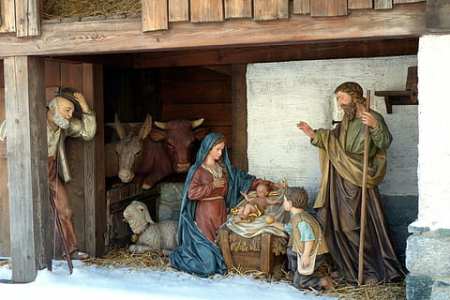
During the birth of Jesus, there was no one to deliver her baby. They did not have a place to stay. They finally found a barn and when Jesus was born he was placed in a manger.

St. Joseph was a just man and the earthly father of Jesus. When Jesus was born, King Herod issued a command to kill all the male children under the age of two. He was afraid that Jesus was an earthly king and would overthrow him. “Angel of the Lord appeared to Joseph in a dream and said Rise and take the child and his Mother, flee to Egypt, and stay there until I tell you. Herod is going to search for the child to destroy him.” (Matthew 2:13) In their life with Jesus, God was with them.

Jesus was very good friends with Martha, Mary and Lazarus and frequently stayed at their home. When Lazarus was sick, Mary and Martha sent word to Jesus. “When Jesus heard this He said, this illness is not to end in death, but is for the glory of God, that the Son of God may be glorified through it.” (John 11:4) Jesus came after the death of Lazarus. Martha was disappointed and told Jesus that Lazarus would not have died if Jesus had been there. Jesus went to the tomb of Lazarus and prayed, “Father, I thank you for hearing me. I know that you always hear me; but because of the crowd here I have said this, that they may believe that you sent me.” (John 11:41–42) Then He called Lazarus out of the tomb and told them to remove the burial bands. God was with his people through their pain and suffering.

Saul was a Jew, educated under Gamaliel a teacher of the law. Saul received permission to kill the Christians that were following Christ. On his way to Damascus, he met the Lord. “On his journey, as he was nearing Damascus, a light from the sky suddenly flashed around him. He fell to the ground and heard a voice saying to him, Saul, Saul, why are you persecuting me? He said, who are you, Sir? The reply came, I am Jesus whom you are persecuting.” (Acts 9:3-5) Saul then continued his journey to Damascus, then became a believer in Jesus. Saul became Paul. After his conversion, He traveled to many countries spreading the Good News of Jesus. He also wrote many of the letters in the New Testament.

During his ministry, he suffered a lot. St. Paul told the people of his suffering, “Five times at the hands of the Jews I received forty lashes minus one. Three times I was beaten with rods, once I was stoned, three times I was shipwrecked, I passed a night and a day on the deep; on a frequent journey in dangers from rivers, dangers from robbers, dangers from my own race, dangers from gentiles, dangers in the city, dangers in the wilderness, dangers at sea, dangers among false brothers; in toil and hardship, through many sleepless nights, through hunger and thirst, through frequent fasting, through cold and exposure.” (2nd Corinthians 11:24–27). Through all of his sufferings, God was with him.

The first time God spoke the promise of Emmanuel was to Judah’s king Ahaz. The Assyrian forces occupied the land and the king was afraid. God said if you do not stand firm in the faith, you will not stand at all. (Isaiah 7:9) Ahaz refused what God offered him. God then gave his own sign, one that would be fulfilled long after Ahaz. “The virgin will be with child and will give birth to a Son, and you will call Him Emmanuel. He will eat curds and honey when He knows enough to reject the wrong and choose the right.” (Isaiah 7:14)

In the Gospel of Matthew, we are told of the fulfilled prophecy. It is fulfilled through Mary with the birth of Jesus. The Angel appeared to Mary, a young woman from Nazareth, who was betrothed to a man named Joseph. The Angel appeared to him in a dream telling him that the child Mary was expecting was from God. Joseph then took Mary as his wife. “All this took place to fulfill what the Lord said through the prophet Isaiah; ‘The virgin will be with child and will give birth to a Son, and they will call Him Emmanuel – which means God with us.’” (Matthew 1:20–23)

The New Testament makes it clear, that Jesus God’s Son was the fulfillment of the Old Testament prophesy. He was the long-promised Emmanuel, sent by God to save His people. He came as the mediator between God and man, as our Redeemer, Savior, and Friend.

From the beginning of creation, even today and in the future, God is always with His people. Because of Jesus, Emmanuel, we never have to be alone. We never have to wonder how to please God or worry if our efforts are not enough. We know that Jesus is with us, in us, loves us, and will never leave us.

The Openness, Obedience, & One Word of St. Joseph

December 18, 2022

4th Sunday of Advent
By Fr. Victor Feltes

Our Gospel this final Sunday of Advent centers on St. Joseph. It recounts how St. Joseph received the stunning revelation of Mary’s pregnancy. We can learn from the great saint’s response — from his openness, his obedience, and his one word.

Mary was already Joseph’s wife when she conceived her child. In their Jewish culture, a newlywed couple would live apart for the first year of marriage. Thereafter, the husband would bring his betrothed into his home to live with him. When Mary conceived a child (whom Joseph knew was not his) why did he decide to divorce her? Was Joseph heartbroken because he believed she had betrayed him? Or was Joseph frightened, because he believed her story of the Annunciation and thought himself unworthy of this holy woman and her holy child? Whatever the case, Joseph was a righteous man and unwilling to expose Mary to shame, so he intended to divorce her quietly.

Then an angel of the Lord appeared to him in a dream and said, “Joseph, son of David, do not be afraid to take Mary your wife into your home because it is through the Holy Spirit that this child has been conceived in her. She will bear a son and you are to name him Jesus, because he will save his people from their sins.” Once Joseph awoke, he did as the angel of the Lord had commanded him and took Mary into his home.

I used to fret very much about precisely discerning God’s will. “What if the Lord wants me to do a specific thing but I can’t figure it out?” During my college and seminary years, I thought I had a vocation to the priesthood but how could I be sure? I worried, “What if I get this discernment terribly, terribly wrong?” Then a holy friend gave me peace of mind by pointing to St. Joseph. When Joseph was about to make a terrible mistake by separating himself from Mary and Jesus, it only took one night’s dream to get him back on the right track because Joseph desired to do whatever God willed. God can easily redirect a willing heart.

People sometimes complain, “I wish God would just tell me what to do!” But unless we are open to doing God’s will, what good would his directions do us? Imitate St. Joseph in his openness. Like with the Blessed Virgin Mary, Joseph’s openness allowed God to do great things through him. So resolve your will and pray for the grace to always be open to God’s will like St. Joseph. Another St. Joseph trait of we can imitate and profit from is his simple obedience.

St. Matthew’s Gospel records, “When Joseph awoke, he did as the angel of the Lord had commanded him and took his wife into his home… and he named [the boy] Jesus.” On this occasion, like later when told to flee to Egypt or told to return to Israel, Joseph does point-by-point what God commands. Like Moses in the Old Testament, whenever God instructs Joseph to do (A) and (B) and (C), the author notes how Joseph then does (A) and (B) and (C).

Moses and Joseph’s duties were different from ours today. We will not construct an Ark of the Covenant, nor protect and provide for the Holy Family, but each of us has persons and tasks entrusted to us by God; people to care for and works to be done. You already know a great deal of what God has commanded you to do; your own (A) and (B) and (C) according to your state in life. You will not fulfill your missions perfectly—and that’s OK—but imitate St. Joseph in his simple obedience because your basic, God-given duties are more important than you realize.

A third and final feature of St. Joseph reflected in today’s Gospel is his single word. Did you ever hear that in all of Scripture there are no recorded quotes from St. Joseph? It’s true: Jesus has many, Mary has several, but Joseph has none. Now there is no evidence that St. Joseph lacked the ability to speak or ever took a vow of silence.  Joseph probably said many things that were simply not written down. Yet today’s Gospel contains the strongest evidence of his having said any one particular word. What was that word?

The angel in Joseph’s dream said of the unborn child: “You are to name him Jesus.” And when Joseph awoke, he did as the angel of the Lord had commanded him. Joseph named him Jesus. The name of Jesus was St. Joseph’s greatest and most important word. Ever after, the name of Jesus defined his life.

Learn from St. Joseph, the husband of Mary and foster-father of Jesus. Imitate his openness to doing God’s will whatever it may be. Benefit from practicing his obedience in your daily duties. “And whatever you do, in word or in deed, do everything in the name of the Lord Jesus,” like St. Joseph did.

“God Is With Us”

December 17, 2022

4th Sunday of Advent
By Fr. Chinnappan Pelavendran

Over 100 years ago Fr. Damien, a Belgian priest, began working with lepers on a small Hawaiian island. Fr. Damien wanted to help the colony of lepers. He found a source of fresh water in the mountains and built the first sanitation system and clinic for them. He and the lepers constructed a chapel for worship. Each Sunday Father Damien would begin his sermon with these words: ‘You lepers know that God loves you.’ He did this for many years. Finally, one Sunday Fr. Damien began his sermon this way: “We Lepers know that God loves us.” Fr. Damien now had leprosy. He went on loving and serving until his death in 1898. We know him more commonly, as St. Damian of Molokai. St. Damien came to Molokai to be one with the people.

The story of the Virgin birth is at the heart of our Christmas celebrations. In the first reading, we are reminded that God promised an unending dynasty to David. Assyria was the dominant power in the region and Ahaz was king of Judah. The prophet Isaiah told Ahaz to have faith in Yahweh, and not to become an ally with Assyria. Ahaz would not listen, and replaced the altar in the temple with an Assyrian altar. The prophet Isaiah wanted king Ahaz to ask for a sign from God but Ahaz refused. Isaiah announced God’s sign, the birth of a son from a Virgin, whose name was Immanuel, “God is with us,” and would assure everyone that God was really with His people.

The reading from St. Paul’s letter emphasizes that Jesus was a descendant of David and that He was the Messiah. St. Paul tells us two things, one is that Jesus is the only begotten Son of God, and became incarnate as Jesus – and second that Jesus was revealed and established by the Father as the Son of God in power by his Resurrection from the dead. Jesus’ birth is important because of his death and resurrection for our salvation.

Our readings today talk about Ahaz and St. Joseph. These two men were very different from each other. Ahaz did not trust in God. Joseph completely trusted and relied on God. St. Joseph was a just and righteous man. He was also faithful, and always obedient to God. St. Joseph’s obedience allows Jesus to be adopted as a true Son of David; it is Mary’s role that allows Jesus to be born the Son of God. After the angel appeared in his dream and told St. Joseph that the Child was from the Holy Spirit, St. Joseph obediently took Mary as his wife. St. Joseph nurtured, protected, watched over, and loved both Mary and Jesus.

We are here in this Church, one week before Christmas, because, like Joseph, we are faithful, and we trust in God, His power, and His mercy. Let us remain faithful and prayerful, imitating Joseph and Mary, the humblest of the humble, the kindliest of the kind, and the greatest–ever believers in God’s goodness and mercy, as we welcome Jesus into our hearts and lives this Christmas.

God who entered our world through Jesus some two thousand years ago is at work in the world. The Good news is that the Child Jesus still waits today, to come into our hearts, your heart, and mine, and to change us and the world around us with the beauty of God’s love, kindness, mercy, and compassion. Let us take some time to let the Christ Child enter our hearts and lives this week, so that He may change our world with the beauty of that love.

Prepare for Christmas

December 4, 2022

2nd Sunday of Advent
By Fr. Chinnappan Pelavendran

On my way to Bloomer, I see pretty lights in windows and houses, in the trees, and even Christmas trees through windows. The streets in Bloomer and the stores are beautiful as well. We are preparing for Christmas. St. John the Baptist is also telling us to prepare for the coming of Christ. All the pretty decorations are getting us ready externally for Christmas, so we must prepare ourselves internally.

Sin entered into the world through Adam and Eve. In the beginning, God was already preparing to send His Son for our salvation. “I will put enmity between you and the woman and between your seed and her seed.” (Gen 3: 15) God knew our weaknesses but loved us so much that He did not want to lose us.

God prepared Joachim and Anne for the birth of our Blessed Mother. Her Immaculate Conception occurred in their later years, but their faith in God was strong, and they prayed for a child. God was forming them.

Mother Mary was free from original sin as part of God’s plan for the redemption of humanity. The Blessed Mary was living an ordinary life as a young girl and did not know man. The Angel of the Lord appeared to Mother Mary and said “Do not be afraid, Mary, for you have found favor with God. And behold, you will conceive in your womb and bear a son, and you shall call his name Jesus.” (Luke 1: 30) Through their conversation, the Angel of the Lord prepared Mother Mary to receive Jesus. God was preparing her.

St. Joseph was a just man and he was betrothed to Mother Mary. Before they came together she was found to be with child. He did not want to cause her any shame or embarrassment and planned to send her quietly. “The Lord appeared in a dream to Joseph saying, Joseph, son of David, do not fear to take Mary for your wife, for that which is conceived in her is of the Holy Spirit.” ( Matthew 1:20) When Joseph awoke, he knew that he was OK to take Mother Mary as his wife. God was preparing him.

In Luke, we have the prodigal son, who collected all his inheritance from his father and left home. He squandered all of his wealth. A great famine arose in that country and he had nothing. He realized that he needed to go back home and ask for his father’s forgiveness. “Father I have sinned against heaven and before you, I am no longer worthy to be called your son; treat me as one of your hired servant’s.” (Luke 15:19) The prodigal son prepared himself to meet his father.

Zacchaeus was a rich tax collector. He wanted to see Jesus. “He ran on ahead and climbed up into a sycamore tree to see him, for he was to pass that way.” (Luke 19: 4)He was not embarrassed by climbing the tree in spite of his high position in society. Zacchaeus prepared himself to meet Jesus.

We prepare ourselves for so many material things in life, like for school tests, for our jobs, for parties, for marriages, for building homes, and for raising children. We are so busy getting ready for Christmas with gifts and decorations. More important than these are our spiritual needs.

St. John the Baptist asks us to prepare a way for the Lord and make his paths straight. What does this mean for us today? When people heard John speak, they confessed their sins and were baptized. An important part of our Advent Journey is acknowledging sins and confessing them. Let us not forget to prepare a place in our hearts to welcome Jesus!

God made sure to prepare for the birth of Jesus Joachim and Anne, Mother Mary and St. Joseph for their roles in the Incarnation of God’s only begotten Son. The prodigal son and Zacchaeus had to focus their lives towards God and His Mercy. These are all internal preparations to meet the Lord. What are your internal preparations? If you have not started, maybe it’s time for you to prepare to meet the Lord.

The Allegory of the Jordan River

December 4, 2022

2nd Sunday of Advent
By Fr. Victor Feltes

Preceding Jesus’ public ministry, St. John the Baptist appeared preaching in the Judean wilderness. People from Jerusalem, all Judea, and the Jordan River region were going out to see him. John said, “Repent, for the kingdom of heaven is at hand!” The crowds regarded him as a prophet and were being baptized by him as they acknowledged their sins. Like a bath which cleanses one’s outer self of dirt and odor, John’s baptism was an appeal to God for an inner self cleansed from sin. John’s ministry prepared for Jesus Christ and foreshadowed Christian baptism. The Jordan River in which John baptized embodies an allegory whose symbolism remains important for us today.

The fresh waters of the Jordan River originate in the north from the living Sea of Galilee, a large lake full of fish and ringed by trees. The Jordan’s waters flow south and come to one of either two notable ends. Most of the river’s water just goes with the flow. It flows downhill (as all rivers naturally do) ultimately descending seven hundred vertical feet. These waters remain on the edge of the Promised Land without entering in. And at the end of their journey, they empty out into the Dead Sea. The Dead Sea is the lowest place on the face of the earth. After the river drains there, the water has nowhere else to go. As it evaporates to nothingness, the water leaves behind trace amounts of salt which over many, many millennia has made that sea ten times saltier than the oceans. In this oppressive saltiness, no plants nor fish can live. The Dead Sea is thoroughly dead.

Some of the Jordan River’s water, however, does not simply go with the flow downhill. This water escapes the fate of the Dead Sea, by giving itself to the Promised Land. This water enables life and generates fruit among many trees in an otherwise arid place. Jeremiah the Prophet writes of a tree planted beside the stream: “It does not fear heat when it comes; its leaves stay green. In the year of drought it shows no distress, but still produces fruit.” And the 1st Psalm likewise says: “a tree planted near streams of water… yields its fruit in due season; its leaves never wither.” These baptismal waters are willed by God to give life and bear fruit for the Promised Land.

Most of John the Baptist’s contemporaries were convinced he was a prophet, yet the Jewish religious leaders disbelieved. When John saw many Pharisees and Sadducees coming to his baptism, he admonished them: “Produce good fruit as evidence of your repentance! … Every tree that does not bear good fruit will be cut down and thrown into the fire!” It would not be enough (for them or us) to just say the right things and go through the motions. Our faith and repentance must be real, producing of good fruit.

As the life-giving Sea of Galilee is the River Jordan’s source, so God above is the source of every spiritual grace and good thing in creation here below. Having received Christian baptism, we can respond in one of two ways on this life’s journey. In this world, we can go with the natural flow of things, descending more and more, ending in the dead abyss without entering the Promised Land. But that is not Jesus’ will for us. As G.K. Chesterton once observed: “A dead thing can go with the stream, but only a living thing can go against it.” Jesus wills for us to cooperate with him, to be changed, and to change the world around us. So believe in the Lord, acknowledge your sins and repent, and bear good fruit with Christ. What is one area — just one thing — one habit or virtue, you can acknowledge today and grow in throughout this Advent season with the grace of God?

“Keep Watch!”

November 27, 2022

1st Sunday of Advent
By Fr. Chinnappan Pelavendran

Today we begin the season of Advent. The Church invites us to be ready and prepared to receive the Lord. The word Advent means waiting. The 1st Sunday of Advent gives us the warning to be watchful, waiting, and prepared.

The Titanic was the world’s largest ship when it was built. It was considered unsinkable. During the night of April 14–15, 1912 it struck an iceberg, ripping a three–hundred-foot hole in the ship. The crew received many warnings that they were speeding into an ice field, but the messages were ignored. The crew was preoccupied with dinner menus and other unimportant matters. They disregarded the danger of the weather and there were not enough lifeboats on board. It sank in two and a half hours killing 1,513 people. Sometimes we believe that our ‘ship’ is unsinkable, our life is all well planned, and the unthinkable can never happen to us. We need to pay attention to the warning signals.

Jesus is coming again and He is coming whether we are ready or not. Today’s Gospel tells the story of what happened in the time of Noah. In the days leading up to the flood, people were very naughty, not keeping the commandments and they did not care. They did not heed the warnings of God. God sent the flood. Only Noah and his family were safe inside the Ark. Everyone else was destroyed by the flood. No one knows when the end will come, ONLY GOD KNOWS!

Jesus gives us another example “Two men will be in a field; one will be taken and the other will be left. Two women will be grinding their meal; one will be taken and the other will be left behind.” Jesus then says to his listeners: “Stay awake! You do not know the day your Lord is coming. Be sure of this, if the owner of a house knew when a thief was coming, he would be watchful and prepared. You also must be prepared. The Son of Man is coming when you least expect it.

To be ready means to be awake. It means that we live in the present moment with God. Always be aware of His presence in our life. Everything we do, work, rest, eat and drink, we give glory to God. Today we celebrate the Sunday of Hope in God, and His Son, Jesus Christ, through whom God has promised to save and redeem us.

What is the pattern of your life? Do you share your time, talents and love with your family, your neighbor or even people you do not know? if we choose to do these things, we are preparing to welcome Christ. Shouldn’t we pray every day Lord, Show me someone today with whom I am to share your love, mercy, and forgiveness. St. Mother Teresa said, “Whatever you do in your family, for your children, for your husband, for your wife, you do for Jesus.” Every night let’s ask ourselves, where have I found Christ today? The answer will be God’s Advent gift to us that day. By being alert and watchful, we will be getting an extra gift: Christ Himself.

Ready for Christ’s Coming? Then & Now

November 26, 2022

1st Sunday of Advent
By Fr. Victor Feltes

Our season of Advent has now begun — a season of Christian preparation. Throughout Advent, we the Church are getting ready in two different respects: we are preparing to celebrate and commemorate the historical birth of Christ at Christmas and, at the same time, we are preparing for the day Jesus will return to this world in unveiled glory. In today’s Gospel, Jesus recalls the story of the days of Noah’s Ark, in which a few were prepared for the flood and saved while most were unprepared and swept away. “So too, you also must be prepared,” Jesus tells us, “for at an hour you do not expect, the Son of Man will come.” Will we be prepared for the day of Jesus’ return? How well prepared and open were people for Christ’s first arrival and what can their examples teach us?

Local shepherds of Bethlehem were the first to hear of Christ’s birth on Christmas. An angel of the Lord appeared to them and said, “[B]ehold, I proclaim to you good news of great joy… a savior has been born for you who is Messiah and Lord!” Now these shepherds were working, keeping night watch over their flock. They could have claimed they were too busy to accommodate Christ into their schedules. Instead they said, “Let us go… to see this thing… which the Lord has made known to us!” They went in haste and found Mary and Joseph, and their Lord lying in the manger.

Sometime later, word of Christ’s birth came to King Herod in Jerusalem, but he did not welcome this good news into his heart. This man loved to reign in his own domain and did not wish to share control. So the king sent soldiers to kill the children who could be Jesus. King Herod refused to change for Christ.

Where had Herod learned of Christ’s birth? Through Magi from the east who came to Jerusalem in good faith expecting to find the newborn king of the Jews. “We saw his star at its rising,” they said. They came with their gifts to honor him. Now most had missed the important sign from heaven (they were focused on other things) but the Magis’ attentions were not distracted, and based on what they saw, they acted. They too found the Lord amidst his Holy Family.

The examples of the shepherds, King Herod, and the Magi show us ways of either being ready and open for Christ or not. So ask yourself this Advent, will I allow work and responsibilities to crowd out my time for Jesus, or will I be like the shepherds who came to him and his Holy Family with joy? Will I cling to my own control, my wealth and my sinful pleasures like King Herod did, or will I offer and sacrifice these things to Christ? Will be distracted by the many diversions of this world and overlook what really matters, or will I be attentive like the Magi to act for the Lord?

At the start of this Advent season, St. Paul tells us, “You know the time; it is now the hour for you to awake from sleep. For our salvation is nearer now than when we first believed; the night is advanced, the day is at hand.” Let us prepare to celebrate and commemorate the historical birth of Christ at Christmas, while at the same time preparing for the day Jesus will return to this world in unveiled glory.

David’s Kingdom Prefigures Christ’s Kingdom

November 20, 2022

Solemnity of Christ the King
By Fr. Victor Feltes

When the ancient Romans would crucify someone they displayed upon the cross the person’s name and the reason they were punished. For the Holy Cross on Good Friday, Governor Pilate had a sign inscribed in Hebrew, Latin, and Greek with Christ’s identity and the why he was condemned. It read: “Jesus the Nazorean, the King of the Jews.” (The famous first letters of this phrase in Latin were “I.N.R.I.”) The Jewish chief priests told Pilate, “Do not write ‘The King of the Jews,’ but that he said, ‘I am the King of the Jews.’” But Pilate replied, “What I have written, I have written.” Pilate did not have faith in Jesus — he wrote what he did to troll the Jewish leaders — but what he had written was true. Jesus was condemned, suffered, and rose again as the King of the Jews and King of the Universe. This Sunday, we celebrate Christ the King, but where is Christ’s Kingdom today?

During his public ministry, Jesus preached, “Behold, the Kingdom of God is among you!” And at the Last Supper, Jesus prophesied, “Amen, I say to you, I shall not drink again the fruit of the vine until the day when I drink it new in the Kingdom of God.” The next time Jesus drinks “the fruit of the vine,” (that is to say, wine) is on his Cross, when he drinks it from a sponge held up to his lips. From these passages, we can gather that the Kingdom of God has arrived. Yet we can also see that his Kingdom has not yet reached every place and every heart in every way. This is why the world was able to hand Jesus over to death and why Christians still pray to our Father above: “thy Kingdom come, thy will be done, on earth as it is in Heaven.” So where are we to find Christ’s Kingdom on earth? There are clues for us present in Sacred Scripture and history.

In our first reading, all the tribes of Israel become joined to David as their king. The Jews believed that the coming Messiah, their Christ, would be the King of Israel. And Jesus in the Gospels is repeatedly called the Son of David (that is, King David’s descendant, the heir to David’s throne). As St. Augustine taught, the Old Testament is the New Testament concealed, and the New Testament is the Old Testament revealed. The old foreshadows and points to the new. And though imperfect, the Old Testament Kingdom of David and his successors prefigures Jesus’ New Testament Kingdom. Several aspects of the old Davidic Kingdom help us to identify Jesus’ Kingdom in our midst; in particular, the Queen Mother, the Chief Steward, and the royal eunuchs.

One flawed feature of the old Davidic dynasty was that the kings each had multiple wives. From the beginning, God intended marriage to be a union of one man and one woman, but the kings of Israel — believing blood is thicker than water — used multiple marriages to seal their peace treaties and alliances with other lands. However, this creates a problem: when the king has many wives, who is the queen? You can imagine the rivalry and discord this question could cause. The Davidic dynasty’s solution to this problem was for the mother of the king to hold that prominent place as Queen Mother. The Queen Mother had a throne of honor at the king’s right hand and she served as an intercessor for the kingdom. If people had a request, they might bring it to her to present to the king. And if her request were pleasing to her son and served the kingdom’s good, the king would happily grant it to please his beloved mother.

Like in other kingdoms of past and present, the Davidic Kingdom had many royal ministers serving the king. But there was one prime minister among them: the king’s chief steward, the master of the royal household. The Davidic king’s chief steward bore on his shoulders a large wooden key as a sign of his office and authority. Today we honor citizens by giving them a symbolic key to the city; but this chief steward carried a symbolic key to the kingdom. His power was that of the king, on whose authority and with whose authority he acted, to open or to close, to permit or to forbid. However, any chief steward acting contrary to the king’s will would soon find himself replaced by another.

In the courts of ancient kingdoms like Israel’s, one would find royal eunuchs. A eunuch is a male who is either born or made physically incapable of marrying and having children. Kings preferred eunuchs for practical reasons: first, these men were safe to be around the king’s harem; and second, since they had no wife or children of their own, these eunuchs were fully-focused on the work of the kingdom.

The trusted eunuch’s mission, personal success, and legacy were wedded to that of the king and his kingdom. Perhaps you may already realize how the old Davidic kingdom foreshadows the Kingdom of God among us now. Jesus calls disciples who are willing and able to be “eunuchs for the sake of the Kingdom of Heaven.” Today, in his Church, celibate clergy and consecrated religious are dedicated to serving Christ’s Kingdom. Jesus told St. Peter, “I give you the Keys to the Kingdom of Heaven. Whatever you bind on earth shall be bound in Heaven, and whatever you loose on earth shall be loosed in Heaven.” Jesus made Peter his prime minister, the first Pope, his chief steward and master of his household on earth Pope Francis is St. Peter’s successor in that office today.

Jesus has sealed his peace treaty and alliance with peoples of all lands through a single marriage: his marriage to his bride, the Church, bone of his bone and flesh of his flesh. But among the Church’s many members, is anyone the queen? As before, our queen is the mother of our King. Christ the King has raised up his Blessed Mother Mary to a throne at his right hand where she intercedes for his Church. We can ask her to present any request to her Son, and if it is pleasing to him and serves his Kingdom’s good, Christ our King will happily grant it, because he loves his mother and us so much.

The beginning of the Kingdom of God on earth is the one Church of Jesus Christ. Let us remain loyal to Christ our King, and remain loyal to his Kingdom, a Kingdom that is among us now, his Holy Catholic Church.

He is not God of the Dead, but of the Living

November 5, 2022

32nd Sunday in Ordinary Time
By Fr. Chinnappan Pelavendran

My first funeral as a priest was for a baby who was two weeks out of the womb. How does one talk to the family? They are a devout, Catholic family, but they asked, why is God allowing this? I listened to them and cried with them. I later responded to them by saying that when I ask why I look at a crucifix. Why did God allow His own son to die? Our salvation and redemption come from the cross. Through the death of that baby, God wants to say something to us; resurrection is what comes out of Christ’s death.

When God revealed Himself to Moses in preparation for bringing His people out of Egypt, He called Himself “the God of Abraham, the God of Isaac, and the God of Jacob.” (Exodus 3:6) When God told this to Moses, centuries had passed after these forefathers had died. However, God acknowledged their existence even after their death. Though the verse did not specify the resurrection of the dead, it implied their survival after death.

Today’s first reading describes a Jewish family, consisting of a mother and her seven sons, who refuse their king’s command to eat pork, forbidden as “unclean” by Jewish Law. Because of their obedient Faith in God, they endure suffering and accept martyrdom. During their torture, three of the brothers speak, and each of them finds strength in the belief that he will eventually be raised and rewarded by God.

The second reading encourages the Thessalonians, who were waiting for the second coming of Christ, to trust in the fidelity of God who would strengthen their hearts in every good work and word.

In today’s Gospel, Jesus is challenged by a group of Sadducees concerning the resurrection of the dead. Just before this, Jesus had been challenged by Pharisees and Scribes, whether to pay taxes to Caesar or not. Jesus had dealt effectively with them and reduced them to silence. Again they raised a question this time about the imaginary story of seven brothers marrying one woman, and their relationship with each other in the next life. Their question in the Gospel is certainly an insincere and impossible example, they want to ridicule a belief in the resurrection.

Hands Lifted up to Heaven

October 16, 2022

29th Sunday in Ordinary Time
By Fr. Victor Feltes

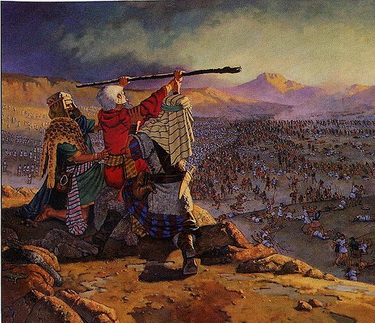
After God’s people, the descendants of Israel, crossed the Red Sea in the Exodus, an army of Amalekites came to battle them in the Sinai desert. So Moses instructed his servant Joshua: “Pick out certain men, and tomorrow go out and engage Amalek in battle. I will be standing on top of the hill with the staff of God in my hand.” The next day, while Joshua led Israel’s soldiers in fighting the foe on the battlefield, Moses stood upon an adjacent hill along with Aaron and Hur.

As long as Moses kept his hands raised up, Israel had the better of the fight, but when he let his hands rest, Amalek had the better of the fight.” Moses wielding this staff at God’s command triggered the plagues in Egypt, parted the Red Sea, and now brought Israel’s victory on the battlefield. But this raises a reasonable question: why would God condition his people’s success in combat upon an old man holding a piece of wood above his head? Moses lifting up this staff of God was a sign for God’s people which preserved them from a spiritual disaster.

God knew that if Israel had won apart from this sign they would have ascribed the victory to themselves. “We won this battle because we’re so smart, and strong, and brave! Maybe we don’t need God’s help after all.” Such pride in their success could be their downfall, in this life and the next. So instead, through the sign of an up-lifted staff, the Lord showed Israel, “I am the vine, you are the branches. Whoever remains [with] me and I [with] him will bear much fruit, because apart from me you can do nothing.”

Similarly today, our Lord desires us to pray without ceasing for the good things we want or need. Otherwise, if and when his blessings come, we shall attribute these things to mere luck, coincidence, or to our own personal abilities, with no growth in our relationship with God. He is the source from whom all good things come. By asking and then receiving, we come to see and know the Lord is near and cares for us. And in the end, that is the most valuable gift of all.

God not only wants us to know and to love him, he desires us to glorify us as well. God is all-powerful, omnipotent, he could do everything without us. But by God accomplishing his will through us, as he did with Moses, the Lord makes us more like himself and causes us to share in his glory.

Holding the staff of God in his hands throughout the day made Moses’ hands and arms grow tired. (If you cannot understand why, try holding an object above your head for just ten minutes sometime.) When Moses’ body grew tired, his friends came to his aide. “They put a rock in place for him to sit on. … Aaron and Hur supported his hands, one on one side and one on the other, [one on his right and the other on his left,] so that his hands remained steady till sunset.” With this help from his friends, Moses kept his arms raised-up and God’s people prevailed against their foe. All of this was a foreshadowing of greater things to come.

On Good Friday, when Jesus was condemned to death, he took the cross into his hands and carried it to the top of a hill. There his hands were nailed to the wood above his head. And Jesus was not there alone. All four Gospels note he was crucified between two others, “one on his right and the other on his left.”

Our Lord was mocked as he hung for hours upon the Cross: “Are you not the Messiah? … If you are the King of the Jews, save yourself!” But in the Garden of Gethsemane, Jesus had said, “Do you think that I cannot call upon my Father and he will not provide me at this moment with more than twelve legions of angels? But then how would the Scriptures be fulfilled…?” Christ had the power to come down from the Cross, but if he had done that—if Jesus had released his hands from the wood—if he had refused to die for us, how would we have been saved from our enemies, sin and death?

Love kept Jesus on his Cross: love for his friends gathered nearby. love for the criminals on his right and left, and love for you and me. Consider what a precious consolation it was for Jesus in his suffering to have his Mother Mary, John the Beloved, and Mary Magdalene there supporting him. “But,” Jesus asks, “when the Son of Man comes [again], will he find faith on earth?” Will Jesus return to a world where everyone imagines they can get along just fine without him?

Let us continue being God’s humble people, recognizing our dependence on him. Let us ask of him our wants and needs so that we can know and experience his blessings. Then we shall share his deeper friendship and share in his great works, increasing in his likeness and increasing in his glory. By relying on God and the holy friends and loved ones his providence places near to help us, we shall share in our Lord’s great victory.

Gratitude for our Healer

October 8, 2022

28th Sunday in Ordinary Time
By Fr. Chinnappan Pelavendran

My dear brothers and sisters, God is the creator of every human being. He has given life to all of us. He continually gives us sustenance, His protection and care. What is expected of us is to be grateful to Him and become more aware of how much we have been given. Gratitude is an expression of the heart, counting our blessings and acknowledging everything that we receive. Giving thanks makes people happier, it strengthens relationships, it improves health, and reduces stress. The readings of today present the theme of gratitude, showing that it should come spontaneously from the heart of every individual.

In today’s first reading, we heard the story of Naaman, the military general of the king of Aram. He was a great man in high favor with his master because, by him, the Lord had given victory to Aram. The man, though a mighty warrior, suffered from leprosy. The king sends him to the Kingdom of Israel for his healing. The king of Israel, however, misunderstands the entire motive of his coming and shows his anger. This anger is countered by the Prophet Elisha. In the name of Yahweh, Elisha sends a message to Naaman to cleanse himself in the River Jordan. Even though Naaman refuses at first, he carries out the order given by the prophet and is healed. Here we see the conversion of a pagan into believing in the true God. St. Paul, in the second reading, advises Timothy to be grateful to God even in his physical suffering and amid the dangers associated with spreading the word of God. Why? Because God will always be faithful to His people. And in today’s Gospel, we have the narrative of Jesus healing the ten lepers. The incident of the ten lepers happened when Jesus was on his way to Jerusalem, where he was to receive His cross and suffer for us.

The Gospel reminds us of the love, kindness, and mercy of Jesus to all classes of the people. Even lepers are not excluded from it. Jesus said to the lepers “go and show yourself to the priest.” While on their way they were gradually healed, one of them, the moment he realized that he was healed, knew that Jesus had healed him and returned to him before going to the priest to fulfill the obligation. He came and prostrated before Jesus, a sign of deepest respect and honor. This act of the Samaritan leper pleased Jesus but was He surprised and sad at the ingratitude of others.

The word of God today tells us that we all need to be grateful to God every day of our life for the graces and good gifts we have received in and through him. He has not only given us our life with all its joys and sorrows, but he has prepared for us a future life of joy and happiness. We often fail to acknowledge the good he has done to us. What is needed in our life is the recognition of these goods and the acknowledgment of gratitude towards God and all persons who come to us as instruments of God.

Also, let us realize the truth that we all need healing from our spiritual leprosy. Although we may not suffer from physical leprosy, the ‘spiritual leprosy’ of sin makes us unclean. Jesus is our Savior who wants to heal us from this leprosy of sin. Since Jesus is not afraid to touch our deepest impurities, let us not hide them. Just as the lepers cried out to Jesus for healing, let us also ask him to heal us from the spiritual leprosy of sins, including all kinds of impurity, injustice, and hatred.

Essential Conversation — Funeral Homily for Marcel Sobotta, 86

July 11, 2022

By Fr. Victor Feltes

Marcel’s family moved here to Bloomer when he was just three years old. And back then, starting out, the only language he knew was Polish. Marcel had to learn how to speak English here, partly from his friends, who reportedly taught him how to say useful words like “potato.” Consider how essential practicing this new language was for his life. How isolated would his more than eighty years of life on earth have been, if Marcel had never practiced such conversation?

About Marcel, Beverly and their children have shared many memories. Of his love for his wife and kids, grandkids and great grandkids. Of his delight in farming and gardening. Of his work ethic at the dairy and driving school bus. Of his raising the beagles and rabbits. Of his joy in fishing and hunting in God’s creation. Of his frustration with The Green Bay Packers. But the particular aspect which stood out to me most is what his family shared about Marcel’s life of prayer.

Marcel prayed at every meal time and prayed every single night. He would kneel down by his bedside and was not ashamed to let his children see it. In fact, he taught his children to do the same. They tell me he was very faithful to God. Prayer, it seems, was a constant throughout Marcel’s life. When I visited him with Beverly, just days before he died, to give him the Holy Eucharist and the anointing for the sick, he joined us in the prayers as he was able, and he was happy. Marcel had learned and practiced the language of prayer.

Prayer is simply a conversation with our friends in heaven. Prayer is how we talk to God. And through the important practice of prayer, a Christian becomes more and more conformed to Christ and shares in his blessedness. The Christian who prays recognizes their poverty in spirit, that they need God. The Christian who prays will mourn the evils of this world, for Jesus will share with them his heart, and there is much to mourn. The Christian who prays meekly asks the Lord to intervene with his wise solutions, for “man’s wrath does not accomplish the righteousness of God” and “his ways are above our ways.” The Christian who prays increasingly hungers and thirsts for righteousness, within themselves and others, for Christ calls us all to be holy saints. The Christian who prays grows merciful, because they know they have received great mercy. The Christian who prays is clean of heart, desiring one thing, God, above all. And the Christian who prays is a peacemaker, nurturing peace within themselves and for all around them.

Connected to Christ in daily prayer, we no longer live an isolated human life, cut off from deeper meaning and purpose, settling for small potatoes. Our Lord has a purpose for you and has prepared a feast for you. Jesus says in the Book of Revelation, “Behold, I stand at the door and knock. If anyone hears my voice and opens the door, I will come to him and dine with him and he with me.” Behold, he stands at your door and knocks. He knocks at the door of your soul, and prayer is how you open the door to him. Blessed is he who opens that door, for consolation, the Kingdom, and the vision of God await. May we learn this valuable lesson from Marcel’s lived example.

Patterns in Christian Dying — Funeral Homily for Ione Seibel, 84

June 6, 2022

By Fr. Victor Feltes

As a priest, I encounter many people in their dying days. And though every life is different, I have noticed often-repeated patterns. Three of these gracious elements are seen in Ione’s story.

Something I often find is the phenomenon of “a last good day.” The dying persons may or may not know they are in their final week of life, yet they are blessed to have a last good day. Sometimes they love being outside, and there’s a rare day in their final week when they feel well enough to go on a walk or do gardening. Sometimes it’s the day of a family reunion, where they delight to see their family and to say goodbye. Ione, despite her Alzheimer’s condition, had a last good day the Wednesday of her final week. Vernie, her husband of nearly 65 years, who was visiting her at her nursing home with a pair of their daughters, says Ione was “grinning, smiling, shining.” He and the staff described it as Ione’s “best day in two years.”

Jesus also had a good day before he died. When he took his place at table for the Last Supper he told his friends, the apostles, “I have eagerly desired to eat this Passover with you before I suffer, for, I tell you, I shall not eat it again until there is fulfillment in the Kingdom of God.” Such blessings are bestowed upon us in this life as signs to us of God’s goodness before we enter into the next life.

A second phenomenon I often see is an alertness for the anointing of the sick and last rites. Vernie let me know Ione was dying and I was soon able to visit her on Saturday. When I arrived, he and their children were gathered around her. Now the sacrament of anointing is like the sacrament of baptism in that a receptive person may receive this sacrament even in an unconscious state. Some babies, for instance, sleep through their baptism yet receive the graces of baptism nonetheless. Her family tells me Ione had been unresponsive, but when I greeted her, as I told her who I was and why I had come, she opened her eyes at me. Ione’s family was struck by this but it’s something I commonly see—a providential alertness to receive this sacrament. The Lord often wills for his beloved to consciously experience this gift.

Jesus himself was anointed upon his head with precious perfumed oil in his final days and said, “She has done a good thing for me. … She has anticipated anointing my body for burial.” He was consoled and strengthened by this gift of love, and Jesus desires to console and strengthen us as we enter into his Passion and death.

A third thing I commonly encounter in my ministry is the bittersweetness of a beautiful death. Suffering and death are painful signs of this world’s brokenness from sin. Yet the circumstances which accompany many Christians’ passings are poetic signs to us that death is not our end. As we heard in our gospel reading, on the first Good Friday, a darkness came over the whole land until three in the afternoon. Then our Lord breathed his last, near those who loved him most. The centurion who beheld how Jesus breathed his last said, “Truly this man was the Son of God!” And the curtain in the Temple, which veiled its holiest place, was torn in two from top to bottom, from heaven down to earth.

Ione died on a Sunday, Christ’s day of Resurrection. And she died during Easter, the season of Jesus’ victory over death. Like him, she breathed her last in the afternoon’s third hour. And Ione passed away from us on the Feast Day of Jesus’ Ascension, when he passed through the veil from this world into heaven.

A Christian is never truly alone because the Lord Jesus is always with us through life and death. He makes our life story a part of his story, and makes our story like his own. Today is a day of grieving and joy, because we can see this truth anew in the life and death of Jesus’ servant and sister and friend, Ione.