Archive for the ‘Passion’ Category

The People at the Passion (Part 2 of 3)

March 30, 2023

By Fr. Victor Feltes

Hopeful for the help of the Holy Spirit, I will share with you meditations about people personally present for Jesus’ Passion. In particular, I will reflect on those persons featured in the Fifth, Sixth, and Eighth Stations of the Cross; Simon of Cyrene, who helped carry Jesus’ Cross; Veronica, who wiped Jesus’ face with her veil; and the women of Jerusalem, who followed and openly wept for Jesus along the Way of the Cross. While considering these reflections, I encourage you to look for two or three golden nuggets that sparkle for you. Tuck them into the pocket of your mind or into your notes and later bring them to prayer for meditation.

Prologue – Pontius Pilate and the Roman Soldiers

Good Friday morning, the hostile crowd cried out for Jesus’ blood. Like Joseph’s brothers in the Old Testament, this crowd intended evil for Jesus, but God intended this for good, in hopes of achieving the salvation of these sinners and the whole world. Governor Pontius Pilate, even after having Jesus gruesomely whipped, was unable to placate the mob. So Pilate washed his hands and sentenced Jesus to death despite admitting that he had committed no crime. Much evil in the world is not only from active hatred like the crowds but from the callous indifference of people like Pilate. “Blessed are those who hunger and thirst for righteous, for they shall be satisfied.”

Then, St. John records in his Gospel, the soldiers “took Jesus, and carrying the Cross himself he went out to what is called the Place of the Skull, in Hebrew, Golgotha.” The Romans would compel men condemned to death to bear the instrument of their own torture, a cross. This was an added psychological punishment and humiliation. It is like having to tie your own noose before they use it to hang you. It is like being forced to dig your own grave before they kill and bury you. It is akin to modern totalitarian states that have executed people by a gunshot to the back of the head and then sent the family a bill for the bullet. The correction and punishment of wrongdoing may be necessary both in nations and in households, but we must never do either without respect for others’ dignity.

Jesus was forced to carry his own Cross, a Cross he carried for us sinners. He carried his Cross towards a place called Golgotha, or Calvary. Golgotha was a rock mound within a limestone quarry alongside a road leading to and from Jerusalem. The Romans chose this execution site a short distance outside one of the city gates for its high-visibility to many passersby. The guards with Jesus had orders to crucify him there along with two other condemned men. But after Jesus’ violent scourging, he was in agony, dehydrated, and physically weakened. He had already fallen down at least once under the Cross’s weight.

Perhaps his guards grew impatient because Jesus was progressing so slowly. The soldiers also may have feared that Jesus would collapse from exhaustion and be unable to be made to stand up and continue. And they might get in big trouble with their superiors if Jesus died on the way to Golgotha without receiving the sentence the governor had decreed. We may feel discouraged by the power of wicked people and groups in our world but I think we underestimate their inherent weaknesses, like those reflected in these Roman soldiers. “The foolishness of God is wiser than human wisdom, and the weakness of God is stronger than human strength.” About three hundred fifty years after the mighty pagan Romans executed Christ and began persecuting his peaceful Church, Christ conquered the Roman Empire; Christianity became its official state religion. “Blessed are the meek, for they will inherit the land.”

The 5th Station – Simon of Cyrene

Saints Matthew, Mark, and Luke all note in their Gospels that the Roman guards found a helper for Jesus. As they were going out, they met a passer-by who was coming in from the country. They took hold of him and pressed him into service to carry his Cross. By law, a Roman soldier could compel a man in a conquered land to carry a load for him for as much as one mile. Daring to refuse would bring on a beating, so this traveler to Jerusalem submitted. Laying the Cross on him, they made him carry it behind Jesus. This man’s name was Simon, a Cyrenian from Cyrene. Cyrene was a region in Northern Africa. It had a Roman colony and a sizable population of Jews.

Perhaps Simon the Cyrene, like so many other Jews, was on pilgrimage to Jerusalem for Passover. But however far his previous journeying had been, that day Simon had a place to be and things to do before the feast. Having to carry the Cross that Friday felt like a major inconvenience for Simon, but it was most likely the greatest thing he ever did. Some of the greatest things you have done in your life were probably unpleasant and inconvenient, too. Mentally, let us reframe the interruptions which arise during our days and within our lives as providential opportunities. This way we can make the most of them and engage them at our best.

One can imagine Simon feeling very reluctant to bear a stranger’s cross. Since Simon was a freeman who had not been found guilty of any crime, he may have viewed this forced servitude to be doubly degrading. Simon may have also dreaded that insults, spitting, dirt, and stones would be hurled at him by ignorant bystanders while he made his way through the streets in the procession of the condemned. Yet, even if unwillingly, Simon picked up the Cross and followed Jesus. Simon did not freely choose this burden but, because of it, Simon was probably physically closer to Jesus for most of the journey to Golgotha than Mother Mary, John the Beloved, or Mary Magdalene. We will not choose many of our life’s burdens, especially our illnesses or personal losses, but these can be God’s providential means to bring us closer to the Lord.

I find it interesting that Simon of Cyrene was chosen to carry Jesus’ Cross on the morning after another Simon, Simon Peter, denied Jesus three times and withdrew for a time out of shame. Perhaps this was just a coincidence, another apostle, Simon the Zealot, shared that name as well. But I wonder if Simon of Cyrene was a fill-in substitute for Peter. If Simon Peter had not denied the Lord, or had returned to him more rapidly, would he have been the one to carry Jesus’ Cross? How beautiful and inspiring would that have been! I do not mention this possibility to encourage you ruminate, to lament the unchangeable past and any good things left unrealized on account of your sins. I mention this so that in a moment of testing you might consider how taking the next good step makes many good paths possible.

God providentially allowed Simon to take part in Jesus’ glorious work for the salvation of the world on Good Friday. The Lord likewise invites you and me to play a role in salvation and entrusts a share in his saving work to us today. St. Pope John Paul the Great noted this in 2001 during his meditation on the Fifth Station of the Cross at the Coliseum in Rome:

Jesus could bear his Cross alone, did he so will; but he permits Simon to help him, in order to remind us that we must take part in his sufferings, and have a fellowship in his work. His merit is infinite, yet he condescends to let his people add their merit to it. The sanctity of the Blessed Virgin, the blood of the martyrs, the prayers and penances of the saints, the good deeds of all the faithful, take part in that work which, nevertheless, is perfect without them. He saves us by his blood, but it is through and with ourselves that he saves us.”

If Simon did not know or believe in Jesus before, it appears that this experience of carrying his cross helped lead to Simon’s Christian conversion and the conversion of his family as well. Amongst the four Gospels, only St. Mark notes that Simon of Cyrene was “the father of Alexander and Rufus.” Scripture scholars believe that the names of Simon’s sons were mentioned here because the first audience Mark’s Gospel was written for knew who Alexander and Rufus were. Church tradition reports that St. Mark the Gospel writer was the scribe for St. Peter the Apostle, the first bishop of Rome. And St. Paul in his Letter to the Romans writes, “Greet Rufus, chosen in the Lord, and his mother, who has been a mother to me, too.” Simon’s endurance through a trial with Christ grew his faith in Christ. Simon shared this testimony with his family. And by his faithful example, they became faithful Christians too. Your non-practicing children already know that you believe, but have they heard you say why you believe and the difference that religious faith has made in your life? Be sure to tell them.

The 6th Station – Veronica

The Sixth Station of the Cross recounts an event unrecorded in the Gospels. Despite the crowd and the soldiers, a woman approaches Jesus. His face is covered with blood, sweat, dust, and spit. Moved with compassion, she removes the veil covering her head, and offers it for Jesus to wipe his face. We know this woman as St. Veronica. The Western Church calls her Veronica, while the Eastern Church calls her Berenike. Providence may have arranged that this reflects her proper name, but it seems more likely that we know her by a title which the Church has given her. We see this with other people at the Passion. The name of St. Longinus, the soldier who pierced Jesus’ side, means “Long, Extended,” suggesting “Spearman.” And the name of the Good Thief crucified with Jesus, St. Dismas, means “Sunset” or “Death.” For her part, the name Veronica is Latin for “True Image,” while the name Berenike is Greek for “Bearer of Victory.” May the good deeds we do be so impactful on earth as hers, so that long after the world forgets our names our fruits will still be seen.

Veronica is a female counterpart to Simon of Cyrene in the Stations of the Cross. They both helped Jesus along the way according to their feminine and masculine traits. Simon served Jesus with his physical strength, while Veronica served him with her beautiful tenderness. St. Pope John Paul the Great shared this meditation on Veronica and the Sixth Station of the Cross on Good Friday in 2003:

As a woman, she could not physically carry the Cross or even be called upon to do so, yet in fact she did carry the Cross with Jesus: she carried it in the only way possible to her at the moment and in obedience to the dictates of her heart: she wiped his Face.

Though our traits may differ, both men and women have valuable gifts to offer. Consider sometime what are your unique gifts as a woman or a man.

When Veronica held out her veil to Jesus, he pressed it to his face. The blood, sweat, dust, and spit on Jesus’ face wiped off on her cloth, leaving a likeness of his face, a self-portrait of Jesus. Today several places claim to possess this relic, or else an early copy of the Holy Face. Veronica’s gift of her veil to the Lord resulted in a greater gift in return. Veronica got back what she had given and received still more besides, for God will not be outdone in generosity. As Jesus says:

Give and gifts will be given to you; a good measure, packed together, shaken down, and overflowing, will be poured into your lap. For the measure with which you measure will in return be measured out to you.”

With this in mind, how generous should we be?

The holy veil is a memento of Veronica’s good deed which reveals Jesus Christ. All of our good deeds in Christ leave behind an impression of our Lord. In the words of St. Pope John Paul the Great meditation on Veronica from the year 2000’s Good Friday Stations:

[E]very act of goodness, every gesture of true love towards one’s neighbor, strengthens the likeness of the Redeemer of the world in the one who acts that way. Acts of love do not pass away. Every act of goodness, of understanding, of service leaves on people’s hearts an indelible imprint and makes us ever more like the One who ‘emptied himself, taking the form of a servant.’ This is what shapes our identity and gives us our true name.

The 8th Station –  The Women of Jerusalem

Finally, we come to the Eighth Station. St. Luke’s Gospel records how a large crowd of people followed Jesus, including many women who mourned and lamented him. Jesus turned to them and said:

Daughters of Jerusalem, do not weep for me; weep instead for yourselves and for your children, for indeed, the days are coming when people will say, ‘Blessed are the barren, the wombs that never bore and the breasts that never nursed.’ At that time people will say to the mountains, ‘Fall upon us!’ and to the hills, ‘Cover us!’ for if these things are done when the wood is green what will happen when it is dry?’”

(This is to say, ‘The evil you see now occurs while I am with you; what terrible evils will come later when I am no longer visibly here?’) Jesus prophetically speaks of how, forty years after the beginning of his public ministry, Jerusalem would be destroyed. The Romans conquered the rebellious city in 70 A.D., destroyed its temple, and put her people to the sword. Before Jesus entered Jerusalem on Palm Sunday, Jesus had wept over the city, saying:

If this day you only knew what makes for peace—but now it is hidden from your eyes. For the days are coming upon you when your enemies will raise a palisade against you; they will encircle you and hem you in on all sides. They will smash you to the ground and your children within you, and they will not leave one stone upon another within you because you did not recognize the time of your visitation.”

People rejecting Christ naturally leads to personal and national consequences.

Jesus had been falsely condemned as a religious heretic, he had been falsely condemned as a political rebel, but these women did not fear to publicly mourn for him. Some of these women had accompanied him during his public ministry. As Jesus “journeyed from one town and village to another, preaching and proclaiming the good news of the Kingdom of God… some women who had been cured of evil spirits and infirmities (accompanied him. For instance), Mary, called Magdalene, from whom seven demons had gone out, Joanna, the wife of Herod’s steward Chuza, Susanna, and many others who provided for [Jesus and his apostles] out of their resources.

An interesting observation is that throughout the Gospels Jesus has no female enemies. Surely, there were some women in Nazareth or Jerusalem who despised Jesus, but the Gospels do not introduce us to any of them. Even the wife of Pilate advocates for Jesus, calling him a “righteous man!” This reflects that both men and women are called to be close to Christ. Though Jesus reserved the Sacrament of Ordination for men alone, without the prayers and works of holy women the mission of Christ and his Church would be hobbled, if not impossible. Just try to imagine the Gospels or the Catholic Church without them.

On Good Friday, the women of Jerusalem now saw Jesus struggling. They watched him fall down more than once. They openly wept for him and wished they could do more. Though grateful for and encouraged by the women’s outpouring of loving support, Jesus expressed his concern for them instead:

Daughters of Jerusalem, do not weep for me; weep instead for yourselves and for your children…

The openness of a woman’s heart for others is beautiful, but Jesus reminds them that it is not selfish to attend to the wellbeing of yourself and your own. Even Jesus took naps. Even Jesus accepted help. Even Jesus took time away, to commune with the Father. Wives and husbands are called to prioritize the salvation their spouses and their children before the world’s affairs. And if you do not take care for yourself, you cannot care for others very well.

In the days ahead into Holy Week, I invite you to meditate on these reflections that stick with you. Contemplate the lessons of Simon of Cyrene, Veronica, and the women of Jerusalem on the way of the Golgotha.

The People at the Passion (Part 1 of 3)

March 30, 2023

By Fr. Chinnappan Pelavendran

For God so loved the world, that He gave His only begotten Son, so everyone who believes in Him might not perish but might have eternal life.” (John 3:16) God loves everyone with everlasting love. He is our Father. We are His Children. He loves each one of us individually and wants us to know and love Him.

Jesus came to the world with a mission, to serve, redeem by being the sacrifice for our sins, and to establish the church through His apostles. The Church began with Jesus and spread with by His many disciples including the apostles.
Let us now begin, with courage, as we begin meditating on the people that were present during the Passion and Death of Jesus Christ. I came upon a book titled Pieta, which listed the sufferings, indignities, and wounds that Jesus received during His passion and death. The number of armed soldiers were 150. The followers of Jesus, 23. Those in charge of putting Jesus to death were 83. The blows received on His head were 150, and on His stomach were 108, and kicks on His shoulders were 80. He was led, bound with cords by the hair, 24 times; spit in the face, 180. He was beaten on the body 6,666 times; beaten on the head, 110 times, He was pushed and lifted up by His hair; pricked with thorns and pulled by the beard 23 times; 20 wounds on the head; wounds from thorns in the head were 110; mortal wounds in the forehead were 3. He was whipped and mocked as a king and received 1000 wounds in the body. There were 608 soldiers who led Jesus to Calvary. Those who mocked Him were 1008. The drops of blood He lost were 28,430. Jesus Christ endured this for all of us.

Let us look more closely at some of the people that were there during the passion and death of Jesus Christ. After the Last Supper, Jesus took three of His closest Apostles to the garden of Gethsemane. Jesus prayed alone to do the will of His father. While they were there, the betrayer, Judas came with the soldiers to arrest Jesus.

Judas Iscariot

Who was Judas? He was one of the twelve apostles. He was the treasurer and trustworthy with the moneybag. After a time, he began to steal money. He betrayed Jesus with a kiss for thirty pieces of silver. After Jesus was condemned to die, he went out and hung himself.

Judas was greedy. Judas was possessed by the devil. Judas had to fulfill the prophecy. Judas had a political motive, he thought Jesus would become a King. We can learn from Judas, it does not matter to God how bad we are; He loves us and wants us to come back to him. Don’t judge yourself by what you have done, don’t think that you are unforgivable, and come back to the Lord like Peter did.

King Herod

Herod was a rich and important man. He had been hearing stories about Jesus. He knows the tax collectors and others of ill–repute are drawn to Jesus and repent for their sins. Jesus draws crowds of people where ever He goes, and he knows that when Jesus was 12 years old He amazed the rabbis with His knowledge of the scriptures. He is excited to meet Jesus and hopes to see a miracle.

Herod is the one who beheaded St. John the Baptist. He was captivated by St. John the Baptist and did not want to kill him, but he had no choice. He had a party, and his new stepdaughter, Salome. danced for him. Her dancing pleased him very much and he promised to give her anything she wanted. Her mother told her to ask for St. John the Baptist’s head.

His father was also named Herod. It was he who had all of the boy babies under the age of two killed when he heard about the birth of Jesus. Herod continued to question Jesus, but Jesus did not answer. Herod had hoped that Jesus would answer some of the difficult questions that his wise men could not. He was frustrated with Jesus because he had been so hopeful to see miracles performed, but it didn’t happen. The Jewish leaders were hoping that Jesus would not perform any miracles, so they were pleased.

Herod sent Jesus back to Pilate, and he and Pilate became friends. Both the king and the Governor consider Jesus to be a criminal. Oh, how wrong they are! For He is the innocent One. Like them, we also twist reality, making the guilt innocent and the innocent guilt. Every time we blame others for what is wrong with us, we are at fault, blaming others for our sins.

Oh, how tragic, except we are not our own! God calls us by the Gospel and gives us faith. The Spirit works in our lives, bringing us to seek Jesus. Unlike Herod, we want to be in his presence for the right reason, to receive His Salvation!

Pontius Pilate

He was a Roman citizen and he ruled over all non-Roman citizens in Judea and Samaria. He lived in Caesarea. Pilate did not want to pass judgment on Jesus. He did not think that Jesus was guilty of anything and wanted to release Him. His wife also wanted him to release Jesus because of a dream she had. It was customary at Passover to release a prisoner to the people. There was a murderer named Barabbas in jail at the time. Pilate asked the people whom they wanted to be released, and they shouted Barabbas. He asked them what he should do with Jesus, and they shouted, crucify Him. Pilate again said, “I see no wrong in this man,” and they shouted again, “Crucify Him!” When he saw that his attempts to free Jesus only provoked the crowd to call his crucifixion louder, he washed his hands and said, “I am innocent of this man’s blood; see to it yourself.” (Matthew 27:24)

Pilate released Jesus because he wanted to please the crowd. Pilate was a people-pleaser more than a God-pleaser. How often do we want to please people, so they like us? Our human respect goes beyond our respect for God.

Pharisees, Scribes, and Sadducees

The Pharisees, Scribes, and Sadducees were the ones who brought Jesus to Pilate. They were highly educated and knowledgeable of the scriptures. Jesus was humble and a carpenter from Nazareth. He was like a magnet, drawing many people to Him by His words and deeds. The Pharisees, Scribes, and Sadducees were jealous and envious of Jesus, and that blinded them from being able to see and accept Jesus as their Lord and Savior. How many people today are blinded from knowing and accepting the truth because of their pride?

The Mocking of Jesus

The Mocking of Jesus involved not only the soldiers but crowds of people. They shouted: Hail, king of the Jews, as they made fun of Jesus. They put a purple robe on Him, the type worn by the soldiers. They put a crown of thorns on His head causing wounds and much bleeding. They spit at Him, His body, and in his face. They struck Him on his body and on the crown of thorns, driving it deeper into his scalp. Who of us would be able to endure what Jesus suffered for us? The brutality, the mocking? Jesus did this for us, to redeem the world by taking our sins upon himself on the cross. He died for you and me.

The Passion of Christ

After Jesus has been severely beaten, and crowned with thorns, he is ordered to carry the cross to Calvary. Jesus picks up His cross and begins His journey through the streets of Jerusalem to the hill of Golgotha. On His Journey, He falls three times. Each time he falls, he is beaten and pulled up by his hair or arms and also beaten and spit upon. He has lost a lot of blood and is very tired. When they finally reach Golgotha, he is brutally nailed to the cross, where he will soon die.

The hour has finally come. The Son of God whom we call Jesus Christ and believed as the savior of the world is arrested, and crucified as a criminal. At about three in the afternoon of Good Friday, God the Son died and was buried.
Jesus gave His whole life to serve the people. At the last supper, He gave away His body and blood as food for His disciples. His last breath while hanging on the cross was offered to His Father. Is there any better example of a life dedicated to service and the prize for doing it is utter humiliation, condemnation, and crucifixion?

Jesus lived His life in total surrender to the will of God. The plan of salvation is to be fulfilled in Him and through Him. How does this divine plan be carried out without the participation of Judas Iscariot, Pontius Pilate, Caiaphas, Herod, and the countless nameless Jews who arrested, mocked, slapped, kicked, and beat Him? These people did the worst things to Jesus and their names and actions are remembered by generations after generations of Christians. Yet they are part of the divine plan although they were unaware of it.

We are all disciples of Jesus. Jesus is not the victim in this account. He willingly lays down his life for our sins.
Peter has the courage to use his sword at Jesus’ arrest and to be in the high priest’s inner court where there are people who may have seen him in the garden. But his courage fails and he denies Jesus. I think the lesson for disciples is to realize our own weakness, and rely on our own strength, but in humility rely on the Lord.

Jesus presents himself as the king of truth, with a mission to testify to the truth. We also must testify to the truth, some people will listen. Jesus is scourged brutally and then mocked mercilessly as king of the Jews, which he actually is! Jesus put up with this because he had a higher mission, to endure the Cross.

Pilate wants to avoid crucifying Jesus and tries several times to release him because he believes Jesus is innocent.
The Jewish leaders try to manipulate Pilate with fear, fear of punishing the son of God, Pilate is also afraid of losing his job. We as disciples need to make sure that fear is not controlling us rather than faith.

Behold the Tree of Life

February 26, 2023

1st Sunday of Lent
By Fr. Victor Feltes

God grew many lovely, fruit-bearing trees in the Garden of Eden, but only two trees are mentioned by name. In the middle of the Garden the Lord God placed the Tree of Life and the Tree of the Knowledge of Good and Evil. Tempted by the Devil, Eve ate from the forbidden tree and “gave some to her husband—who was with her—and he ate it.” If only Adam had been willing to confront the dragon-serpent and protect his bride, perhaps even to lay down his life for her! But the first man did not do this and the whole human family fell. (Let men called to lead and protect their families take note.)

Then our Triune God said: “Behold! The man has become like one of us, knowing good and evil! What if he now also reaches out his hand to take fruit from the Tree of Life, and eats of it and lives forever?” For this reason, God banished our first parents from the Garden. This was not from divine jealousy, but from divine concern for us. Imagine everlasting human lives lived in unending sinfulness; that would be a hell on earth. “Through one man, sin entered the world, and through sin, death, and thus death came to all men…” But God promised Adam and Eve a redeemer who would crush the serpent’s head and save us from sin and death.

In today’s Gospel, that Savior undergoes the Devil’s temptations not in a paradise but in a desert. The ancient tempter approaches Jesus and says, “If you are the Son of God, command that these stones become loaves of bread… If you are the Son of God, throw yourself down (from this temple rooftop)… All (the kingdoms of the world in their magnificence) I shall give to you, if you will prostrate yourself and worship me.” Jesus refuses each of these diabolical suggestions.

If the Christ conjures bread for himself when hungry, then how can he refuse to fill every hungry mouth? But what good would our filled stomachs be if we are never delivered from sin and death? And if the Christ demands that God his Father protect him from every harm, then how could he ever offer his life’s blood as our saving sacrifice? And if the Christ submits to our enemy’s rule over this world, then how could we ever be free? Jesus Christ understands his messianic mission and where it will lead him. It will lead him to the Cross.

Jesus calls himself the Bridegroom, and St. Paul calls him the second and final Adam. Unlike the first Adam, Jesus Christ the New Adam willingly and courageously lays down his life in battle with the Devil to save us, the Church, his Bride.

“[T]hrough one transgression
condemnation came upon all,
so, through one righteous act,
acquittal and life came to all.

[T]hrough the disobedience of the one man
the many were made sinners,
so, through the obedience of the one,
the many will be made righteous.”

One beautiful Mass preface for Sundays in Ordinary Time praises God with these words: “[W]e know it belongs to your boundless glory, that you came to the aid of mortal beings with your divinity and even fashioned for us a remedy out of mortality itself, that the cause of our downfall might become the means of our salvation…

St. Paul’s tells the Galatians, “Christ ransomed us from the curse… by becoming a curse for us — for it is written, ‘Cursed be everyone who hangs on a tree…’” In the tree that is his Holy Cross, we now see the Tree of the Knowledge of Good and Evil and the Tree of Life combined.

During this Lent, contemplate the crucifix. Meditate upon the crucifix to know goodness, to behold God’s love for us. And gaze upon the crucifix to know evil, to see our sins at work. And ever-faithfully eat the fruit from this Tree of Life, which is Jesus Christ himself given us at Holy Mass. As Jesus taught in the synagogue at Capernaum, “Whoever eats my flesh and drinks my blood has eternal life… For my flesh is true food, and my blood is true drink. …Whoever eats this bread will live forever.” God once said in the Garden: ‘You shall not eat of the Tree or even touch it, lest you die.’ But now Jesus invites us, provided we are well-prepared: “Take this, all of you, and eat of it, for this is my Body… given up for you.”

Hands Lifted up to Heaven

October 16, 2022

29th Sunday in Ordinary Time
By Fr. Victor Feltes

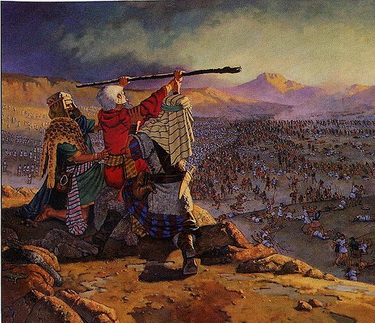
After God’s people, the descendants of Israel, crossed the Red Sea in the Exodus, an army of Amalekites came to battle them in the Sinai desert. So Moses instructed his servant Joshua: “Pick out certain men, and tomorrow go out and engage Amalek in battle. I will be standing on top of the hill with the staff of God in my hand.” The next day, while Joshua led Israel’s soldiers in fighting the foe on the battlefield, Moses stood upon an adjacent hill along with Aaron and Hur.

As long as Moses kept his hands raised up, Israel had the better of the fight, but when he let his hands rest, Amalek had the better of the fight.” Moses wielding this staff at God’s command triggered the plagues in Egypt, parted the Red Sea, and now brought Israel’s victory on the battlefield. But this raises a reasonable question: why would God condition his people’s success in combat upon an old man holding a piece of wood above his head? Moses lifting up this staff of God was a sign for God’s people which preserved them from a spiritual disaster.

God knew that if Israel had won apart from this sign they would have ascribed the victory to themselves. “We won this battle because we’re so smart, and strong, and brave! Maybe we don’t need God’s help after all.” Such pride in their success could be their downfall, in this life and the next. So instead, through the sign of an up-lifted staff, the Lord showed Israel, “I am the vine, you are the branches. Whoever remains [with] me and I [with] him will bear much fruit, because apart from me you can do nothing.”

Similarly today, our Lord desires us to pray without ceasing for the good things we want or need. Otherwise, if and when his blessings come, we shall attribute these things to mere luck, coincidence, or to our own personal abilities, with no growth in our relationship with God. He is the source from whom all good things come. By asking and then receiving, we come to see and know the Lord is near and cares for us. And in the end, that is the most valuable gift of all.

God not only wants us to know and to love him, he desires us to glorify us as well. God is all-powerful, omnipotent, he could do everything without us. But by God accomplishing his will through us, as he did with Moses, the Lord makes us more like himself and causes us to share in his glory.

Holding the staff of God in his hands throughout the day made Moses’ hands and arms grow tired. (If you cannot understand why, try holding an object above your head for just ten minutes sometime.) When Moses’ body grew tired, his friends came to his aide. “They put a rock in place for him to sit on. … Aaron and Hur supported his hands, one on one side and one on the other, [one on his right and the other on his left,] so that his hands remained steady till sunset.” With this help from his friends, Moses kept his arms raised-up and God’s people prevailed against their foe. All of this was a foreshadowing of greater things to come.

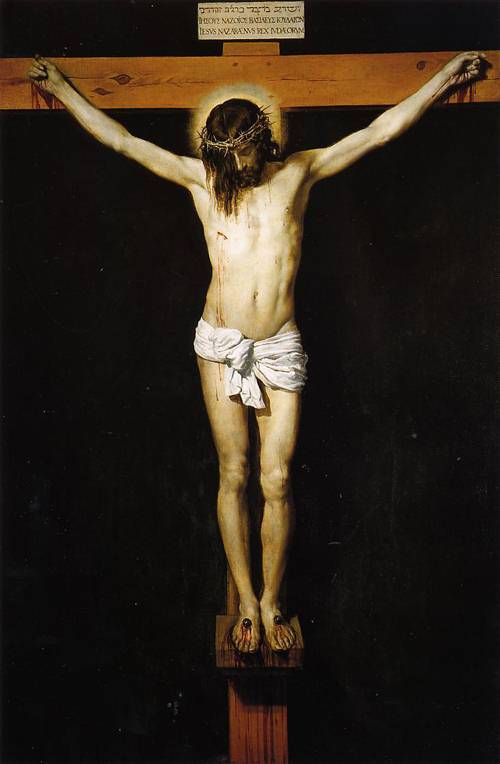
On Good Friday, when Jesus was condemned to death, he took the cross into his hands and carried it to the top of a hill. There his hands were nailed to the wood above his head. And Jesus was not there alone. All four Gospels note he was crucified between two others, “one on his right and the other on his left.”

Our Lord was mocked as he hung for hours upon the Cross: “Are you not the Messiah? … If you are the King of the Jews, save yourself!” But in the Garden of Gethsemane, Jesus had said, “Do you think that I cannot call upon my Father and he will not provide me at this moment with more than twelve legions of angels? But then how would the Scriptures be fulfilled…?” Christ had the power to come down from the Cross, but if he had done that—if Jesus had released his hands from the wood—if he had refused to die for us, how would we have been saved from our enemies, sin and death?

Love kept Jesus on his Cross: love for his friends gathered nearby. love for the criminals on his right and left, and love for you and me. Consider what a precious consolation it was for Jesus in his suffering to have his Mother Mary, John the Beloved, and Mary Magdalene there supporting him. “But,” Jesus asks, “when the Son of Man comes [again], will he find faith on earth?” Will Jesus return to a world where everyone imagines they can get along just fine without him?

Let us continue being God’s humble people, recognizing our dependence on him. Let us ask of him our wants and needs so that we can know and experience his blessings. Then we shall share his deeper friendship and share in his great works, increasing in his likeness and increasing in his glory. By relying on God and the holy friends and loved ones his providence places near to help us, we shall share in our Lord’s great victory.

Patterns in Christian Dying — Funeral Homily for Ione Seibel, 84

June 6, 2022

By Fr. Victor Feltes

As a priest, I encounter many people in their dying days. And though every life is different, I have noticed often-repeated patterns. Three of these gracious elements are seen in Ione’s story.

Something I often find is the phenomenon of “a last good day.” The dying persons may or may not know they are in their final week of life, yet they are blessed to have a last good day. Sometimes they love being outside, and there’s a rare day in their final week when they feel well enough to go on a walk or do gardening. Sometimes it’s the day of a family reunion, where they delight to see their family and to say goodbye. Ione, despite her Alzheimer’s condition, had a last good day the Wednesday of her final week. Vernie, her husband of nearly 65 years, who was visiting her at her nursing home with a pair of their daughters, says Ione was “grinning, smiling, shining.” He and the staff described it as Ione’s “best day in two years.”

Jesus also had a good day before he died. When he took his place at table for the Last Supper he told his friends, the apostles, “I have eagerly desired to eat this Passover with you before I suffer, for, I tell you, I shall not eat it again until there is fulfillment in the Kingdom of God.” Such blessings are bestowed upon us in this life as signs to us of God’s goodness before we enter into the next life.

A second phenomenon I often see is an alertness for the anointing of the sick and last rites. Vernie let me know Ione was dying and I was soon able to visit her on Saturday. When I arrived, he and their children were gathered around her. Now the sacrament of anointing is like the sacrament of baptism in that a receptive person may receive this sacrament even in an unconscious state. Some babies, for instance, sleep through their baptism yet receive the graces of baptism nonetheless. Her family tells me Ione had been unresponsive, but when I greeted her, as I told her who I was and why I had come, she opened her eyes at me. Ione’s family was struck by this but it’s something I commonly see—a providential alertness to receive this sacrament. The Lord often wills for his beloved to consciously experience this gift.

Jesus himself was anointed upon his head with precious perfumed oil in his final days and said, “She has done a good thing for me. … She has anticipated anointing my body for burial.” He was consoled and strengthened by this gift of love, and Jesus desires to console and strengthen us as we enter into his Passion and death.

A third thing I commonly encounter in my ministry is the bittersweetness of a beautiful death. Suffering and death are painful signs of this world’s brokenness from sin. Yet the circumstances which accompany many Christians’ passings are poetic signs to us that death is not our end. As we heard in our gospel reading, on the first Good Friday, a darkness came over the whole land until three in the afternoon. Then our Lord breathed his last, near those who loved him most. The centurion who beheld how Jesus breathed his last said, “Truly this man was the Son of God!” And the curtain in the Temple, which veiled its holiest place, was torn in two from top to bottom, from heaven down to earth.

Ione died on a Sunday, Christ’s day of Resurrection. And she died during Easter, the season of Jesus’ victory over death. Like him, she breathed her last in the afternoon’s third hour. And Ione passed away from us on the Feast Day of Jesus’ Ascension, when he passed through the veil from this world into heaven.

A Christian is never truly alone because the Lord Jesus is always with us through life and death. He makes our life story a part of his story, and makes our story like his own. Today is a day of grieving and joy, because we can see this truth anew in the life and death of Jesus’ servant and sister and friend, Ione.

What Makes Good Friday Good?

April 14, 2022

Good Friday
By Deacon Dick Kostner

I have always been puzzled with the question of why an all loving God would ever will or direct that his Son be required to die in order for the door to heaven be unlocked so that we might enter into eternal life. I thought this would be an excellent reflection for us to enter into for this Good Friday Service. My research disclosed an informed reflection that was given by a Fr. Terrance Klein, a priest in the Diocese of Dodge City, last year on Good Friday as a homily he presented to his parish.

He indicated we must go back to our creation story in the Bible to find the answer to this question and it all goes back to the fact that the Father desires his children to love him and the fact that one can never order someone to love them. Love can only be obtained if someone has the free will to decide for themselves if someone deserves their love. Free will is a requirement for real love to exist.

God created humans in his image and likeness, but he also created them with a free will to accept or refuse his fatherly teachings and laws which was gifted to us to help us find happiness and yes eternal life with him in heaven. As Fr. Chinnappan told us at our Parish Mission, God does not send us to heaven or hell at the end of our earthly lives, we send ourselves to that place by and through our free will decision to live out our lives either believing and following the advice of our heavenly mentor Jesus, or by refusing that advice.

God sent his son to us in human form so that we might better understand his words and teachings. He sent Jesus with the mission to share salvation instructions so that we might not only be happy in this life but also join God in heaven after this life for all eternity. He did not send Jesus as death sacrifice for our salvation rather he sent Jesus to us with a mission to bring us into the heavenly family by and through use of the key to salvation which is love of God and neighbor. It was the tremendous love that Jesus has for each and everyone of us that he gave his life so that we could witness the fact that death does not trump God’s love for us, his children. The question for us to ponder is do we desire to love God and neighbor and accept his love for us, or not?

On behalf of our Parish I would like to thank Fr. Chinnappan for an insight on the last words of Jesus on the Cross which revealed to this Deacon as to why today is called “Good Friday.” So why is this day “Good?” Maybe it is because it was through Jesus’ Passion and Death that human death came to an end for all of us who have listened to the Word and obeyed His directives for happiness not only in this life but the life to come.

God’s Love Among Us — Funeral Homily for Cecilia Jenneman, 100

April 11, 2022

By Fr. Victor Feltes

When Cecilia was born one hundred years ago the First World War had only recently ended. Some had hoped it would be ‘a war to end all wars,’ but this would not be so. There were millions more horrors, murders, and atrocities to follow. Religious demographers find there were more Christians martyrs in the 20th century than in all previous centuries combined. The news reports from the Russian war in Ukraine show us that innocents are still suffering and being murdered in our time. Seeing such grave evils in the present and the past, even the faithful may understandably question, “Where is God?

Last week, a Dominican Catholic priest in Ukraine was asked about this in light of the wicked war crimes revealed in the town of Bucha near Kiev. Fr. Petro Balog replied, “Today we must recall the words of Christ from the 25th chapter of Matthew, where he says that ‘whatever you did for one of the least of these brothers and sisters of mine, you did for me.’ When we talk about Bucha… Christ was killed, Christ was deprived of his home, his hands were tied, and he was shot. All this was done to those with whom Christ identifies himself. …God is being crucified again, tortured again.” Fr. Balog emphasizes that God is not above it all. God is in the midst of the suffering and on the side of those suffering.

During Holy Week we remember how Christ’s love led him to offer his painful and sorrowful Passion to save us. Jesus’ innocent suffering, his death and resurrection, changes Christians’ view of this life, death, and the life to come. Though we naturally mourn the passing of Cecilia, we need “not grieve like [others] who have no hope,” for “the Lord God will wipe away the tears from all faces.” On the Last Day, his faithful will say, “let us rejoice and be glad that he has saved us!

Jesus teaches us at the Last Supper and today, “Do not let your hearts be troubled… In my Father’s house there are many dwelling places. I am going to prepare a place for you… I will come back again and take you to myself, so that where I am you also may be.” Christ declares to us, “As the Father loves me, so I also love you. … Love one another as I love you. This is how all will know that you are my disciples, if you have love for one another.” And the lives of his present-day disciples, at our best, help others to believe in Jesus too. A faithful Christian life reflects the faithful love of Christ for his Spouse, the Church, and for each of us individually.

Like Jesus, Cecilia taught many gathered around her. Like Christ, she could “be kind, but be firm.” Some called her, “The best teacher I ever had.” Like our heavenly Father, there were many dwelling places in Cecilia’s house. In addition to family she excellently fed farm hands and friends, and opened her doors to host relatives in need (including her own aged mother, two aunts, and two nephews who had lost their own mother). And after her beloved husband, Bill, became severely debilitated, her faithful love cared for him too through their last two decades together. When asked to imagine living her life over again, she answered, “I would walk the aisle at St. Paul’s with the same man, welcome the birth of each child, grandchild, and greatgrand.” Like God loves each of his children, Cecilia wrote, “I loved each child dearly – perhaps in a different way as each is an individual, but 100% love for each one. …Remember my love for children; my seven, all grandchildren, and the great grands also.

And throughout her life, Cecilia’s Catholic Faith came first. She was known to say, “Without faith in God you have nothing.” She recalled her 1st (“Solemn”) Communion, receiving Jesus Christ in the Holy Eucharist in 8th grade, as a highlight moment of her life, and pointed to the nuns and priests at St. Paul’s as one of her life’s greatest inspirations. Cecilia wrote in her funeral preparation notes: “I hope I instilled a strong faith in God in my own seven children, grandchildren, and every child I was close to in my life. [I want my family to remember me for] whatever I did to help them to be better Christians.

In St. Augustine’s book The Confessions, the oldest autobiography in Western history, he writes about the death of his mother, St. Monica, whose prayers and lived example were so important for his conversion and salvation. As she was dying, St. Monica told her children “Bury my body wherever you will…. Only one thing I ask of you, that you remember me at the altar of the Lord wherever you may be.” Monica was a saint, but she was not presumptuous. She desired the help of her loved ones’ prayers, just like we should pray for Cecilia. But Monica desired something more; not only for her dearest ones to pray for her soul but to draw near to the altar of the Lord Jesus themselves. God, like water, is all around us; but to drink we come to the font of Christ.

Human events are often gravely wrong and death is a heartbreaking scandal. But knowing Jesus Christ and his saints reveals the reality and strength of God’s love. The Easter resurrection of our Lord Jesus Christ remains our hope and consolation, for Cecilia, ourselves, and all the world.

Entering Holy Week

April 9, 2022

Palm Sunday
By Fr. Chinnappan Pelavendran

Today the Church is celebrating Palm Sunday, Palm Sunday reminds us of the glorious and triumphal entry of Jesus into Jerusalem. As Jesus entered Jerusalem the crowds greeted him with shouts of joy and proclaimed him as the messianic king. They spread their cloaks on the ground and placed the palm branches on the street and shouted “Hosanna to the Son of David” and “Blessed is he who comes in the name of the Lord.” The donkey was a symbol of peace and those who rode upon them proclaimed peaceful intentions. The laying of palm branches indicated that the king or dignitary was arriving at victory or triumph.

In the second reading of today. The hymn tells us that even though he was divine, he took willingly the human form for our sake. He is the new Adam who became obedient and did not cling to his divinity and, He is the servant of God who accepted sufferings for the sake of humanity. Finally, he died on the cross a death of shame and humiliation. That death became the sign of triumph and glory and the means of salvation for the world.

The Gospel tells us of his victory and reveals in painful detail the physical sufferings of Jesus. There is rejection, pain, misunderstanding, and Humiliation and yet through it, all Jesus stands firm, faithful to God till the end. In the process, there is a transformation. The leader becomes a servant, shame turns to honor, mockery becomes praise, fear turns to trust, abandonment becomes love, despair turns into hope, and above all death blossoms into new life.

In today’s Passion narrative, Luke builds up to five basic events that take place during the last few days of the earthly life of Jesus. The first is that Jesus shares his final meal with the disciples. Second, Jesus is arrested by his enemies. Third, Jesus is subjected to the so-called Jewish trial. Fourth, Jesus is subjected to the Roman trial and is condemned to death. Fifth, Jesus is crucified on the Cross. He dies on the Cross and is buried soon after.

We must be ready to surrender our lives to Jesus during this Holy Week and welcome Him into all areas of our life as our Lord and Savior, singing “Hosanna.” Today, we receive palm branches at the Divine Liturgy. Let us take them to our homes and put them in a place where we can always see them. Let the palms remind us that Christ is the King of our families, which Christ is the King of our hearts, and that Christ is the only true answer to our quest for happiness and meaning in our lives. And if we do proclaim Christ as our King, let us try to make time for Him in our daily life. Let us remember that He is the One with whom we will be spending eternity. Let us be reminded further that our careers, our education, our finances, our homes, and all of the basic material needs in our lives are only temporary. Let us prioritize and place Christ the King as the primary concern in our lives. It is only when we have done this that we will find true peace and happiness in our confused and complex world.

This week, let us reflect upon the mystery of the Passion of Jesus, our King, as we prepare ourselves to commemorate His glorious Resurrection. Let us remember that Jesus died for our sins, your sins, my sins. Let us be most thankful to the Lord Jesus in thoughts, words, and in actions. And may the Spirit of Jesus be with us during the coming week as we relive the last few days in the life of Jesus on earth. This is a perfect opportunity for us to learn about Divine love so we too may grow in the love of Jesus by the grace of the Heavenly Father.

The Seven Last Words of Christ

March 19, 2022

The seven last words (or statements) Jesus said from his Cross are a classic reflection for Lent. This year, Fr. Chinnappan Pelavendran preached on this theme throughout a four evening parish mission retreat at held St. Paul’s, March 14-17. His four talks are below.

Monday’s Talk
“Father, forgive them, for they don’t know what they’re doing”
“Truly, I say to you, today you will be with me in paradise.”

Tuesday’s Talk
“Jesus said to his mother: ‘Woman, this is your son.’ Then he said to the disciple: “This is your mother.”
“My God, my God, why have you forsaken me?”

Wednesday’s Talk
“I thirst.”
“It is finished.”

Thursday’s Talk
“Jesus cried out in a loud voice, ‘Father, into your hands I commend my spirit!’”

Why They Rejected Christ

January 29, 2022

4th Sunday in Ordinary Time

When Jesus preached at Nazareth near the start of his public ministry, his own hometown neighbors rose up, filled with fury against him. They drove him out of their village intending to toss him head first off a cliff. Later, near the end of Jesus’ public ministry, one his own twelve apostles, after spending years in his close company, chose to betray Jesus to his enemies. And sometimes in our present day, lifelong Christians experience painful events and give up on their commitment to Christ. Why did Jesus’ neighbors in Nazareth reject him? Why did his apostle, Judas Iscariot, betray him? And why do Christians sometimes abandon him in hard times? All of these expected our Lord to do certain things for them but were disappointed. In each case, Jesus failed to do for them what they desired.

Part of the problem at Nazareth was that Jesus was too familiar to them. He grew up there as a little kid playing in their streets, he worked locally as a carpenter’s son, and he quietly attended their small-town synagogue for years. So when they heard him preaching they asked, “Where did this man get all this?” How could this guy be someone foretold of in the Scriptures? As Jesus acknowledges, “No prophet is accepted in his own native place.”

They wanted him to prove he was somebody special by working miracles before them. A sick doctor should be able to apply his talents for his own recovery and prove he is a real doctor; so the Nazoreans would say to Jesus, “Physician, cure yourself! Do here in your native place the things that we heard were done in Capernaum.” But God’s prophet does not owe them miracles. Jesus notes that neither Elijah nor Elisha, two of the Old Testament’s greatest prophets, worked miracles for Israel’s individual widows or lepers, respectively. St. Mark’s Gospel reports that Jesus did not perform many mighty deeds in Nazareth, apart from curing a few sick people by laying his hands on them. Their lack of faith and lack of openness seems to have limited the gifts of God they could receive. So Jesus failed to match their expectations, and they took great offense at him.

Why did Judas Iscariot betray our Lord for thirty silver pieces? St. John tells us in his gospel that Judas “was a thief and held [Jesus and the apostles’] moneybag and used to steal the contributions.” Those thirty coins represented thirty days’ wages back then, something akin to $3,000 today. Was Judas so greedy for that relatively-modest amount of money that he couldn’t resist? When Judas saw that Jesus had been condemned to death he felt deep regret at what he had done. He tried to return the money to the high priest and elders saying, “I have sinned in betraying innocent blood.” He wishes to undo his deed, but the Jewish leaders brush him off: “What is that to us? Look to it yourself.” Judas goes away in despair and foolishly kills himself. If Judas did not wish for Jesus to die, then why did he sell him out? It seems that this apostle was disappointed by Jesus’ public ministry.

Most Jews expected the Messiah to come as a warrior-king like David. They imagined the Christ would drive out their pagan overlords, conquer Jerusalem, and lead an earthly kingdom of vast power, prestige, privilege, and wealth. But Jesus was not pursuing that popular dream. He devoted his efforts instead to teaching and healing the lowly and poor. When, after feeding thousands with five loaves and two fish, Jesus perceived “they were going to come and carry him off to make him king,” he firmly sent that crowd away and withdrew up the mountain alone. Judas had run out of patience waiting for Jesus’ Kingdom to come. Maybe Judas had given up on Jesus, and took that money to start a new life without him. Or maybe he hoped that Jesus—with his back to the wall—would finally wield his mighty, miraculous power to claim his royal throne, with Judas at his side. Either way, Judas’ disappointed expectations led this disciple to betray Jesus Christ and lose everything.

In our own day, some Christians leave the Lord Jesus after following him for decades. Oftentimes, this happens after a painful tragedy: a terrible diagnosis, a failed marriage, a Church scandal, a child’s tragic death. It is not the Christian life they had envisioned. They likely asked God for a particular miracle but it was not given. I know a man from a previous parish who attends Mass with his wife every Sunday, but he stopped receiving Holy Communion many years ago after their teenage daughter died in a car crash. I know of another long-time Catholic who reportedly became embittered at losing his good health and refused a Catholic funeral. How should a follower of Jesus Christ respond to life’s profound and painful trials?

On the first Good Friday, when Jesus died on the Cross, the Gospel of St. Luke tells us “all his acquaintances stood at a distance, including the women who had followed him from Galilee and saw these events.” St. John’s Gospel highlights that the Blessed Virgin Mary was there at the Cross of Christ along with his beloved disciple. What did they feel like amid that horror? What miracles did they plead for that day? Their prayers to heaven seemed to go unheard. The next day, in shock and grieving on Holy Saturday, they may have questioned in their hearts, “Where was God? How could he let this happen? Does he not care? Where is his faithfulness to his faithful ones? How could this be part of a loving plan?” But the next day, on Easter Sunday, they witnessed the joyful resurrection Jesus had promised, and God’s loving, mysterious purposes became clearer.

Jesus told his disciples and says to us, “Whoever wishes to come after me must deny himself, take up his cross, and follow me.” Jesus does not promise us a life exactly as we would plan it for ourselves. Not every prayer for a miracle will be granted exactly as we would imagine. But remember, the Kingdom of Jesus Christ will come for his faithful ones.

The Cup Jesus Drank

October 17, 2021

29th Sunday in Ordinary Time

James and John, the sons of Zebedee, approach Jesus asking for a favor: “Grant that in your glory we may sit one at your right and the other at your left.” Jesus says to them, “You do not know what you are asking. Can you drink the cup that I drink…?” They respond, “We can!” Jesus answers them, “The cup that I drink, you will drink… but to sit at my right or at my left is not mine to give but is for those for whom it has been prepared.

Jesus told James and John, “You do not know what you are asking,” but how well do we understand what Jesus is saying here? What was the cup that Jesus would drink? How would Jesus be enthroned in glory? And who got those places at his right and his left? The answers are found in the gospel accounts of the Passion.

Jesus, the night before he died, prayed in the Garden of Gethsemane: “My Father, if it is possible, let this cup pass from me; yet, not as I will, but as you will.” And again, “My Father, if it is not possible that this cup pass without my drinking it, your will be done!” Earlier that same evening, at the Last Supper, Jesus told his disciples, “from this time on I shall not drink of the fruit of the vine until the kingdom of God comes. … Amen, I say to you, I shall not drink again the fruit of the vine until the day when I drink it new in the kingdom of God.” So when is the next time we see Jesus drink “the fruit of the vine”? All four gospels record that Jesus was given wine on his Cross. In his suffering, Jesus said, “I thirst.” Someone soaked a sponge in a vessel filled with sour wine and put it up to his mouth. Once Jesus had taken the wine, he said, “It is finished,” and then he died.

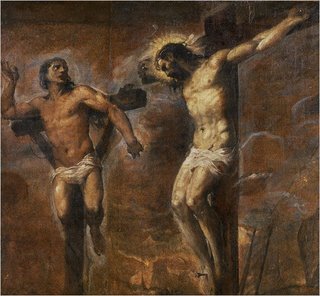
Alongside the cross of Jesus a pair of guilty criminals were also crucified; one on his right and the other on his left. Both of them had mocked Jesus at first, but then one of them repented. Acknowledging Christ’s innocence and lordship, he asked: “Jesus, remember me when you come into your kingdom.” And Jesus replied to him, “Amen, I say to you, today you will be with me in Paradise.

So what is the cup which Jesus drank? His cup is a cup of suffering. When and where was Jesus first enthroned in the kingdom of God? He is enthroned in glory upon his Cross. And who received the places at his right and left? Those places close to Jesus went first to two crucified criminals. Indeed, James and John in today’s gospel did not know what they were asking. Yet these apostles would go on to be glorified through their own shares in Christ’s sufferings: including martyrdom for St. James and exile for St. John “the Beloved Disciple.”

Many people struggle to reconcile the reality of suffering with the power and love of God. Some Christians even mistakenly preach a “Prosperity Gospel,” saying that if you believe in God and love him, he will bless you so that bad things never happen to you. But this view is incomplete. There are true blessings which flow from following Jesus Christ and his Gospel, but the worldview of the “Prosperity Gospel” sets believers up for a fall. When painful hardship or tragedy eventually come, those Christians will either blame themselves for not having had enough faith or blame God for seeming to fail them. This latter group wonders, “If God is not dependable, why should I keep faith in him?” And then, feeling wounded, confused, and abandoned, they abandon God.

We do not completely understand the mystery of evils in our world; why a devastating earthquake happens to some particular city, why a particular healthy adult gets cancer, or why a particular young person perishes in a car wreck. We do know that God’s thoughts are higher than our thoughts, that his plans see farther than our sight. And we know that God, who is the highest good, would not permit evils to exist unless his omnipotence and goodness were such as to bring good even out of evil. In Jesus Christ we see that God intimately knows and deeply cares about all the things we suffer. So what is the Lord up to?

It’s no coincidence that all four gospels mention how Jesus is crucified between two criminals, one on his right and the other on his left, with one who repents and one who appears not to repent. All of humanity is similarly suffering as a result of our original or personal sin. We too begin as guilty rebels condemned. But on the Cross, Jesus Christ the Son of God, though divine and innocent, joins us in our suffering.

The Letter to the Hebrews observes that in him “we do not have a high priest who is unable to sympathize with our weaknesses, but one who has similarly been tested in every way…” This divine plan for Christ to be a suffering servant was foretold through the Prophet Isaiah centuries before: “If he gives his life as an offering for sin… the will of the Lord shall be accomplished through him. …Through his suffering, my servant shall justify many, and their guilt he shall bear.

This Good Shepherd intimately understands the sufferings of the flock. He comes down from his high mountain into our dark valley and calls us to himself. We can respond to him with faith, acknowledging his goodness and lordship as sheep on his right. Or we can remain as faithless goats on his left, unrepentant for our sins and rejecting Christ forever. Realize that Jesus Christ desires not merely to forgive our sins, but that you and I would become children of God the Father just like himself.

Why do evils and sufferings continue to afflict those who follow Christ? As I said before, we do not know the answer to every painful question. (I believe we will understand God’s plan and purposes far better in heaven when he ‘wipes away every tear from our eyes.’) But we do know that Jesus Christ wants us to share in his own greatness and glory.

In today’s gospel, Jesus tries to help his disciples see that the path to true greatness and glory are not what they imagine. “Those who are recognized as rulers over the Gentiles,” Jesus notes, “lord it over them, and their great ones make their authority over them felt. But it shall not be so among you. Rather, whoever wishes to be great among you will be your servant; whoever wishes to be first among you will be the slave of all. For the Son of Man did not come to be served but to serve and to give his life as a ransom for many.

In our loving service and in our faithful suffering, we become more like Jesus. With Jesus, our sacrifices and sufferings are redemptive, helping to make us saints while helping to save the world. This is the precious, challenging, saving cup our Lord offers us. But can we drink it? With the grace and love of Jesus Christ strengthening us, we can!

Hearts Like His — The Nathan & Cassandra Hagenbrock Wedding

June 12, 2021

Solemnity of the Most Sacred Heart of Jesus

Sacred Heart of JesusNathan and Cassie’s wedding day lands upon this, the third Friday after the Feast of Pentecost, the eleventh day of June. God’s providence has arranged it that they be married on this special day – a feast day, the Solemnity of the Sacred Heart of Jesus, during a month especially dedicated to Jesus’ Sacred Heart. You can see depictions of the Sacred Heart inside this church. There is the statue of Jesus behind me, here in the sanctuary, and presently another statue in our devotional corner in the back. In artistic depictions, you may see Jesus’ Sacred Heart resting upon his chest, or maybe he holds it in his hand offering it to you, and sometimes his heart is depicted by all itself. In every depiction it is a human heart, crowned with thorns, pierced on the side, with flames and a cross emerging from the top. What is the meaning of these things? What do they reveal about Jesus? And what do they mean for Nathan and Cassie and us?

The heart is the organ within every human being which is most associated symbolically with emotion, devotion, and love. Since becoming man through his Incarnation two thousand years ago, the Eternal Son of God, Jesus Christ, has possessed a literal human heart in himself. And Jesus has personally experienced human feelings as well. But Jesus and his heart are not merely human, but divine. This reality is symbolized by the flames. As at the burning bush in Exodus, these flames do not consume his heart, but coexist with it and glorify it. Jesus feels and loves with a divine intensity, and this love leads him to sacrifice for love. This love gives rise to the Cross, upon which he suffered for us. This love occasions the crown of thorns, which he wore for us. And this love led to Jesus’ heart being pierced, the event we hear about in today’s Gospel. Jesus’ Sacred Heart is human and compassionate, divine and loving, long-suffering and glorious. And it is the will of Jesus, meek and humble of heart, to make our hearts like unto his, that you may endure suffering, be loving, and be made glorious.

You can see that this world is broken. Other people are broken. And you know, Nathan and Cassie, that though there is a great deal to like about you both, neither of you is yet perfect. Know that in your marriage, you will inevitably encounter suffering; sufferings caused by the world, sufferings caused by other people, and sometimes sufferings caused by each other. But when these thorns and small cuts come, do not let the fire of your love go out. Choose to keep loving, willing the good of each other. This is how Jesus loves us, and how he calls us to love.

This persistent decision to love is essential, but it is not enough. To love beyond human strength requires God’s strength; divine fire burning in your heart. You must love with Jesus’ love by connecting with him; praying daily, worshipping weekly, and communing with him constantly (spiritually or sacramentally) as you are able. Love each other by the love with which he loves you.

Choosing to love with the love of Christ in marriage is now your calling. This vocation together is to be for your joy, fruitfulness, and glory in the likeness of Christ. May Jesus Christ make your our hearts like unto his Sacred Heart, so that you may endure suffering, be loving, and be made glorious, like Jesus Christ himself.

The New Adam

April 2, 2021

Good Friday

Last evening, on Holy Thursday, I spoke of how Jesus calls and welcomes us to share his Eucharistic feast. Like at the first Passover in Egypt, the sacrifice of Jesus Christ the Lamb of God frees his people from slavery and death. And his Church continues to renew and rejoice in our great deliverance at this holy meal he gives us. Today, on Good Friday, Jesus resembles and surpasses Adam from the Garden of Eden.

Eve was God’s gift to Adam, and he was a gift to her. The Lord God had cast a deep sleep on the man and while he slept fashioned a woman, a bride, from his side. They began a marriage covenant, became one flesh, and were naked without shame on account of their innocence. Though Adam and Eve could have lived forever by eating from the Tree of Life, they still had some concept of what death was. Otherwise, God’s warning ‘you shall die if you eat of the Tree of the Knowledge of Good and Evil‘ would be meaningless to them. And also realize that the wicked tempter did not approach them crawling on his belly in the dirt — that humiliation followed as part of his punishment from God. The devil would have appeared to them as a more imposing predator.

God had placed the man in the Garden “to tend and keep it.” Adam was not only to cultivate paradise, but also to watch over, guard, and protect it, including Eve. However, when the tempter comes seeking to separate her from God forever, Adam does not intervene. At the Tree of the Knowledge of Good and Evil, the first Adam does not lay down his life, he does not fight to the death against “the dragon, the ancient serpent, which is the Devil or Satan,” endangering his bride. So instead, she “took some of its fruit and ate it; and she also gave some to her husband, who was with her, and he ate it.” They failed, and sinned and fell together, with painful consequences for us all.

Jesus Christ is our New Adam “who has similarly been tested in every way, yet without sin.” Though tried in the Garden of Gethsemane, he chose to fulfill God’s will, and “Christ became obedient to the point of death, even death on a cross.” Despite his sinless innocence, they stripped him naked and crucified him. The Cross is the New Tree of the Knowledge of Good and Evil, where we see both his goodness and our evil on full display.

Once he had died, they pierced Jesus’ side, and blood and water flowed out. The Bride of Christ is his Church, fashioned from his side as he slept the sleep of death, born from baptismal water and eucharistic Body and Blood. And note Jesus’ last words quoted by St. John: they may be translated as “It is finished,” or “It is consummated.” Christ the Bridegroom, the New Adam, dies for his Bride, the Church; laying down his life in his victorious battle against the Evil One in another garden, and rising again to eternal life from a garden tomb, exulting her along with himself.

It can be a challenge for guys to identify with being the Bride of Christ, just as ladies are challenged to connect with their baptismal call to be priest, prophet, and king in Christ. There is a spousal mystery here, and we must not mistake every feature of earthly marriage for the fullness of the mystical reality with Christ. But realize that Jesus feels an impassioned love for you, a desire to be with you and be one with you, in a close covenantal bond. This relationship involves work and sacrifice – our daily decision to love him – but Jesus’ love for you is constant, always faithful, in good times and in bad. He rejoices in you as bone of his bone and flesh of his flesh, and offers you his whole self, on the Cross, from this altar, and for ever.

View From the Cross by Tissot

The New Passover Lamb

April 1, 2021

Holy Thursday

The Lord gave specific instructions to Moses and Aaron for the feast of Passover—commandments containing secret significance only later to be revealed. Every Hebrew family had to procure a lamb, a year-old male without blemish, one apiece for each household. If a family was too small for a whole lamb they were to join the nearest household in obtaining one and feast in the same house together. The lamb could not to be eaten raw nor boiled in water, but had to be roasted, baked whole and entire, once some of its blood had been taken to be dabbed on the house’s doorposts and lintel. The whole community of Israel was to celebrate this feast and no one was to go outdoors until morning.

The first Passover was held for the salvation of God’s people, so that deadly judgment would pass over their households and they would no longer be slaves in Egypt. Once they were freed, they continued keeping the Feast of Passover, renewing and celebrating their great deliverance by God’s power. All of these were signs and symbols of things to come, of the still-greater things which came with Christ.

At the Last Supper, Jesus told to his apostles, “I have eagerly desired to eat this Passover with you.” The Gospels note the bread and wine on the table, in accord with the Jewish Passover tradition, but where is the lamb at the center of the meal?

The Lord Jesus, on the night he was handed over, took bread, and, after he had given thanks, broke it and said, “This is my body that is for you. Do this in remembrance of me.” In the same way also the cup, after supper, saying, “This cup is the new covenant in my blood. Do this, as often as you drink it, in remembrance of me.

Jesus asked the apostles that night, “Do you realize what I have done for you?” Jesus is the Passover Lamb of God: an innocent young man, unblemished by sin, whose blood is poured out upon the vertical and horizonal beams of the Cross, to free and save all within his house. Tonight we gather in one house, Christ’s Church, as a family, joining with other households together at Mass, to really receive in the form of baked bread Jesus’ whole self. As St. Augustine once preached to newly baptized Christians: “Recognize in the bread what hung on the cross, and in the cup what flowed from his side. [T]hose old sacrifices of the people of God…represented…this single one that was to come.”

Jesus’ sacrifice saves us from deadly judgment and slavery to sin, and at this meal we renew and rejoice in our great deliverance through him. By God’s grace, may we always have priests and the freedom to offer the Mass on earth, and the grace to never wander off from God’s house into the outer darkness until the first light of the new dawn breaks—when Jesus Christ returns in glory.

Jesus asks his apostles, “Do you realize what I have done for you?” Do you realize what Jesus has done for you? Know that he has eagerly desired to share this Passover with you.

Recreating the Way of the Cross

March 21, 2021

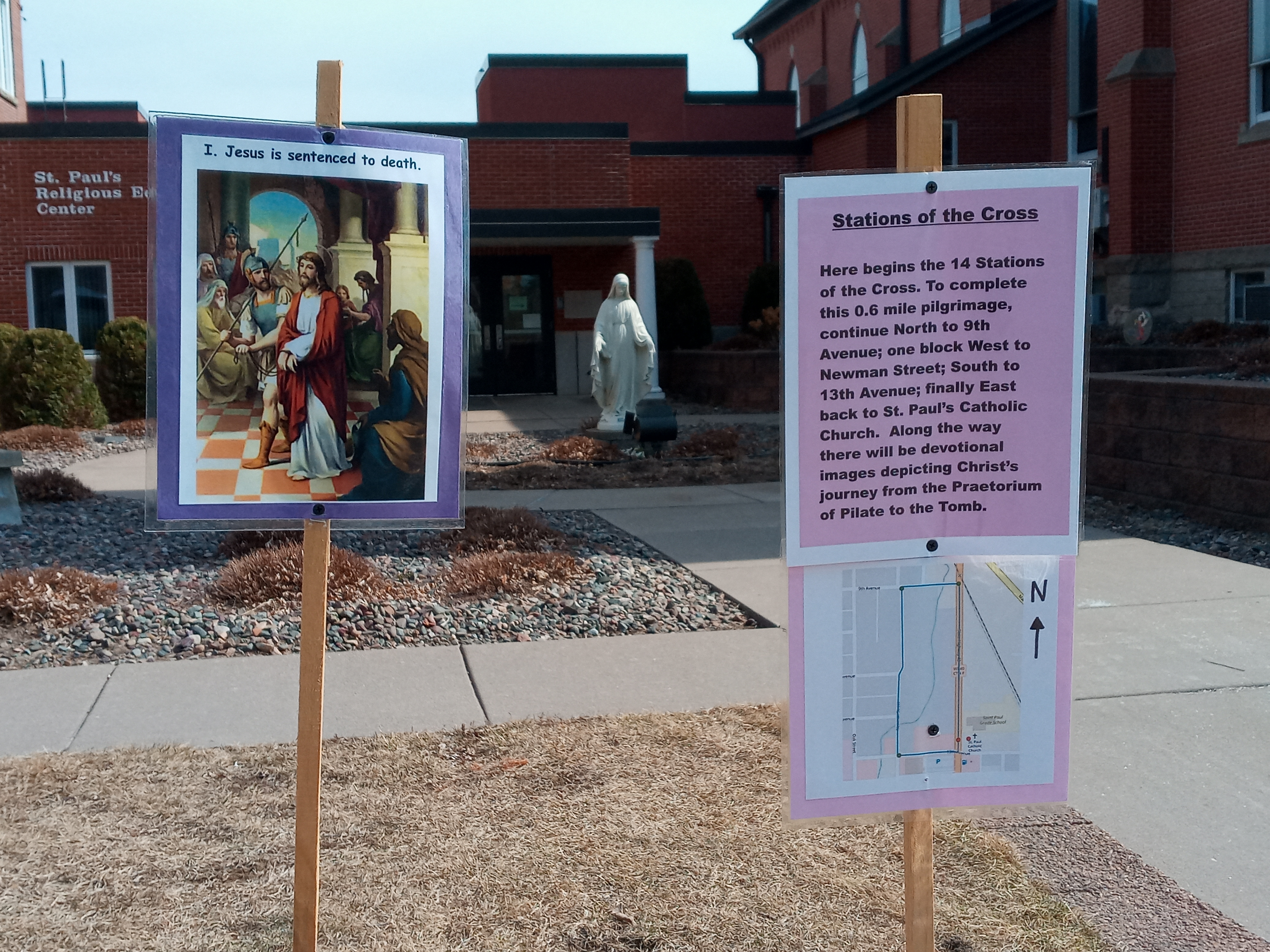
Our 1st Station, with an introduction and a map of our Way of the Cross

The experience of visiting the Holy Land (as I did in 2016) gives a person lasting impressions. One is a deepened sense that the Gospel stories were not “once upon a time” but events of a real time and place. Another takeaway is a better sense of the region’s scale – which is smaller than what you would think. The size of the nation of Israel is less than New Jersey, and the area enclosed by the walls of Jerusalem’s Old City (0.35 square miles) is that of only one-and-a-half Vatican City’s. The Way of the Cross, from where Governor Pilate sentenced Jesus to death to the place of Christ’s death and burial, is about 600 meters or 2,000 feet, less than half a mile.

Remember in the film “The Passion of the Christ,” when Jesus falls and Mary rushes to him? This is my photo of the 3rd and 4th Stations in Jerusalem.

In the Holy Land I also learned that Christian tradition not only preserves details about Jesus’ Passion (such as his three falls and St. Veronica’s veil) but also commemorates the locations at which these sad moments occurred. These fourteen Stations of the Cross are still venerated and prayerfully walked by pilgrims in Jerusalem today. It is a powerful, beautiful experience which I wanted to recreate in the streets of my community, and which you might wish to offer yours.

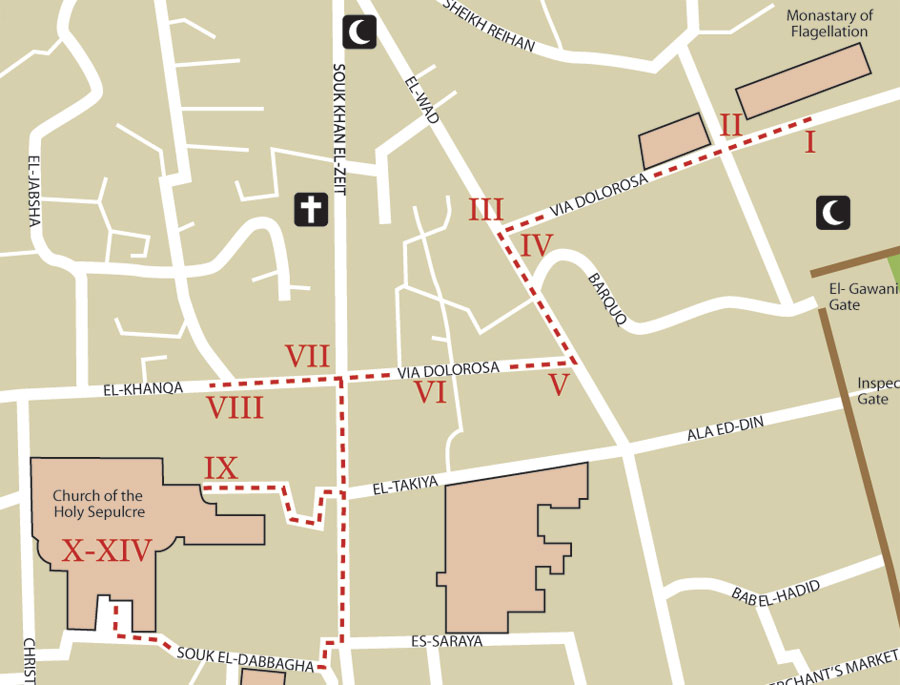
A present-day map of the fourteen Stations on Way of the Cross in Jerusalem

This Lent, we’ve created an outdoor Way of the Cross. It begins in front of our church and school and loops one time around the city block opposite them. After measuring maps and receiving permission from the various landowners, we posted the traditional fourteen Stations along a path which approximates the actual Way of the Cross, both in its length and its distances between the Stations. Walking it takes about twelve minutes (if one does not pause to pray) and we plan to keep the Stations up until Easter Sunday. Our small-town, local newspaper even ran a story about them.

The final five Stations, commemorating Jesus’ crucifixion and burial, are grouped closely together near the end. This is because the locations of Jesus’ Cross and Tomb were situated only about 150 feet away from each other. Both sites are now housed within the Church of the Holy Sepulchre. On Good Friday, the Roman soldiers led Jesus west outside the walls of Jerusalem to a white limestone quarry. St. John’s Gospel records that many people read the sign posted above our Lord’s head on the Cross indicating the “crime” for which he was condemned (“Jesus the Nazorean, the King of the Jews”) because the place where he was crucified was near the city. It was also apparently alongside a road, since St. Matthew notes “those who passed by hurled insults at him.” Christ was crucified atop a rock formation there called Golgotha in Hebrew and Calvary in Latin, which laborers had cut around and left behind. As Psalm 118:22 had foretold, “the stone which the builders rejected has become the cornerstone.”

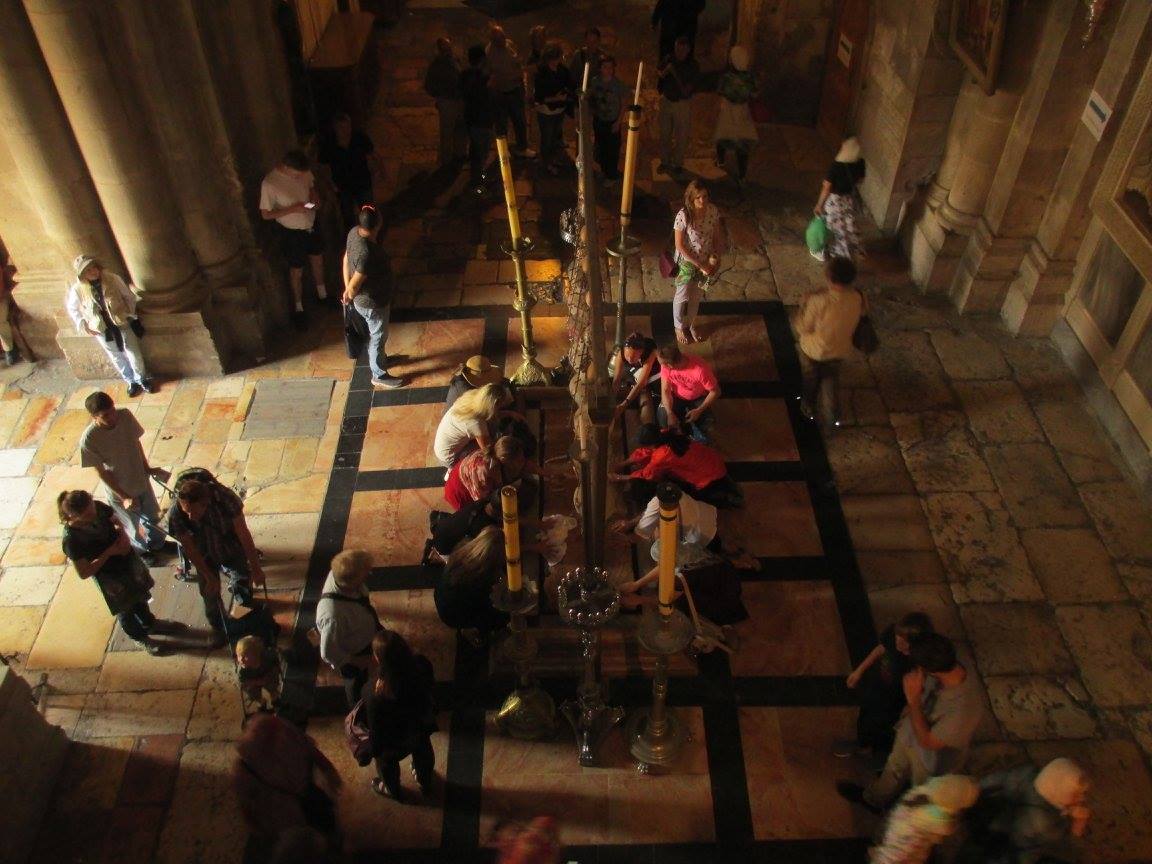
A view from Calvary of the Stone of Unction in The Church of the Holy Sepulchre

The new tomb which St. Joseph of Arimathea gave to Jesus had been cut into a rock face amidst a garden nearby. Midway between these two places, the Church of the Holy Sepulchre now displays a stone venerated as the slab upon which Jesus’ body was prepared for burial by his mother and his friends. In whatever ways you accompany Christ through his sufferings this Lent, may you come to share more greatly in the graces and joys of his Easter Resurrection.