Hearts Like His — The Nathan & Cassandra Hagenbrock Wedding

June 12, 2021

Solemnity of the Most Sacred Heart of Jesus

Sacred Heart of JesusNathan and Cassie’s wedding day lands upon this, the third Friday after the Feast of Pentecost, the eleventh day of June. God’s providence has arranged it that they be married on this special day – a feast day, the Solemnity of the Sacred Heart of Jesus, during a month especially dedicated to Jesus’ Sacred Heart. You can see depictions of the Sacred Heart inside this church. There is the statue of Jesus behind me, here in the sanctuary, and presently another statue in our devotional corner in the back. In artistic depictions, you may see Jesus’ Sacred Heart resting upon his chest, or maybe he holds it in his hand offering it to you, and sometimes his heart is depicted by all itself. In every depiction it is a human heart, crowned with thorns, pierced on the side, with flames and a cross emerging from the top. What is the meaning of these things? What do they reveal about Jesus? And what do they mean for Nathan and Cassie and us?

The heart is the organ within every human being which is most associated symbolically with emotion, devotion, and love. Since becoming man through his Incarnation two thousand years ago, the Eternal Son of God, Jesus Christ, has possessed a literal human heart in himself. And Jesus has personally experienced human feelings as well. But Jesus and his heart are not merely human, but divine. This reality is symbolized by the flames. As at the burning bush in Exodus, these flames do not consume his heart, but coexist with it and glorify it. Jesus feels and loves with a divine intensity, and this love leads him to sacrifice for love. This love gives rise to the Cross, upon which he suffered for us. This love occasions the crown of thorns, which he wore for us. And this love led to Jesus’ heart being pierced, the event we hear about in today’s Gospel. Jesus’ Sacred Heart is human and compassionate, divine and loving, long-suffering and glorious. And it is the will of Jesus, meek and humble of heart, to make our hearts like unto his, that you may endure suffering, be loving, and be made glorious.

You can see that this world is broken. Other people are broken. And you know, Nathan and Cassie, that though there is a great deal to like about you both, neither of you is yet perfect. Know that in your marriage, you will inevitably encounter suffering; sufferings caused by the world, sufferings caused by other people, and sometimes sufferings caused by each other. But when these thorns and small cuts come, do not let the fire of your love go out. Choose to keep loving, willing the good of each other. This is how Jesus loves us, and how he calls us to love.

This persistent decision to love is essential, but it is not enough. To love beyond human strength requires God’s strength; divine fire burning in your heart. You must love with Jesus’ love by connecting with him; praying daily, worshipping weekly, and communing with him constantly (spiritually or sacramentally) as you are able. Love each other by the love with which he loves you.

Choosing to love with the love of Christ in marriage is now your calling. This vocation together is to be for your joy, fruitfulness, and glory in the likeness of Christ. May Jesus Christ make your our hearts like unto his Sacred Heart, so that you may endure suffering, be loving, and be made glorious, like Jesus Christ himself.

Believe Like Children

June 5, 2021

Solemnity of Corpus Christi

Earlier this week was the last day of classes for another academic year at St. Paul’s Catholic School. This pandemic-impacted year posed challenges, but we prevailed. Our school met in-person throughout and gave our children a full education – focused on forming not only their minds but also their souls as well. This aspect is so important, it is the reason the Catholic Church has schools. A true education is not complete unless a person learns about God, about Jesus’ saving words and deeds, and how to live, both now and forever, as a Christian like him.

This is why I encourage any of you who have children attending public school to enroll them into Catholic school for this fall. Ask our school families about how excellent a school it is. They’ll tell you. Pray on this decision, ask the Lord where he wants your sheep to be. And realize that a great Catholic education for your children is much more possible than you might think.

My favorite part of being the pastor of a Catholic school is teaching and speaking with the children. Their openness to the things of God is beautiful. In their classroom or in church, you can teach these little ones holy truths and they joyfully believe them. This openness is part of why Jesus says, “Amen, I say to you, unless you turn and become like little children, you will not enter the Kingdom of Heaven,” and “Whoever humbles himself like this child is the greatest in the Kingdom of Heaven.”

Sometimes I’ll meet with a class of youngsters and their teacher in the church outside of the Mass. We remind the children how to use the Holy Water at the doors to bless themselves and to genuflect when they reach their pews. Then I love to teach them and ask them questions, questions like, “Where is Jesus here?

Sometimes kids point to the big crucifix on the wall and I tell them, “That’s only a statue of Jesus. Seeing it reminds us of Jesus and can help us pray to him, but that’s just a statue which looks like him. Where is Jesus really, truly present in this room?

The children then point to the golden box at the foot of the cross – the Tabernacle – inside of which, I explain, within a special container called a ciborium, is kept Sacred Hosts consecrated at previous Masses. At the priest’s words of consecration at Mass, these Hosts became Jesus Christ, his Body and Blood, Soul and Divinity, really and truly present, really and truly him.

In our Catholic churches, what is typically located front and center? Not the priest’s chair, not a donation box, not even the baptismal font, but Jesus’ Tabernacle and the altar. This is because Jesus Christ and his Holy Sacrifice are at the center of our Catholic Faith. At the Last Supper, Jesus said, This is my Body, and Do this in memory of me. And his Bride the Church has listened, believed him, and obeyed him, celebrating his Real Presence at the Holy Mass throughout the centuries to this day.

It has been humorously observed that for second graders preparing for and receiving their First Communion it can be harder for them to believe that the round, flat, unfluffy, Consecrated Host was ever bread to begin with than it is for them to believe it is Jesus. This is because they believe that Jesus can do, and does do, the things he says. On this feast of Corpus Christi, let’s humbly turn and become more like those children, who accept that their good and loving friend, our Lord Jesus Christ, is truly here before us.

Trivia Question Archive

June 4, 2021


I invite you to use these questions I authored for your own Trivia Night events. But if you do, I ask that you would mail some donation to my parish:

St. Paul’s Catholic Parish
1222 Main St.
Bloomer WI 54724


Advertising
Ad Slogans (Answers)
Corporate Logos (Answers)
Food People (Answers)
TV Commercials (Answers)

Christianity
Catholic Stats (Answers)
Gospel Writers (Answers)
Grace States (Answers)*
Saints (Answers)
Scripture Cities (Answers)
Scripture Specifics (Answers)
Selected Scriptures (Answers)

History
20th Century History (Answers)
20th Century Quotes (Answers)
2015 A.D. (Answers)
2019 A.D. (Answers)
Burial Sites (Answers)
U.S. Disasters (Answers

Literature & Language
Acronyms (Answers)
Comic Characters (Answers)
Famous First Words (Answers)
Famous Last Words (Answers)
Language Arts (Answers)
Languages (Answers)
Latin Phrases (Answers)
NATO Alphabet (Answers)
Shakespeare or Scripture (Answers)

Movies & TV
80’s Movie Quotes (Answers)
Disney Dialogue (Answers)
Fictional Addresses (Answers)
Fictitious Pets (Answers)
Film Franchises (Answers)
Game Show Quotes (Answers)
Leading Lady Lines (Answers)
Out on a Date (Answers)
Sidekicks (Answers)
TV Jobs (Answers)
TV Leads (Answers)

Music
Christmas Lyrics (Answers)
Lead Singers (Answers)
Musicals (Answers)
The Beatles (Answers)
“Weird Al” Songs (Answers)
Work Songs (Answers)

Object Identification
Candies (Answers)
Cereals (Answers)
Game Pieces (Answers)
Noodles (Answers)
Seeds (Answers)

People
American Idol or U.S. Senator (Answers)*
Caesar, Luther, or Bieber (Answers)
Famous Mates (Answers)*
Gandhi, Lincoln, or Joan (Answers)
Past Presidents (Answers)
Ten Toms (Answers)

Places
Famous Buildings (Answers)
Island Silhouettes (Answers)
Largest Cities (Answers)*
Plant Places (Answers)
State Silhouettes (Answers)
State Nicknames (Answers)
U.S. States (Answers)
Wisconsin Attractions (Answers)

Science & Tech
Animals (Answers)
Car Models (Answers)
Inventions (Answers)
Medical Facts (Answers)
Meteorology (Answers)
Scientific Claims (Answers)
Weighty Questions (Answers)*

Sports
Athlete Nicknames (Answers)
Second Place Sports (Answers)*
The Green Bay Packers (Answers)

Tie-Breakers
Tie-Breaker Examples*

Uncategorized
Child Psychology (Answers)
Colors (Answers)
Days of the Week (Answers)
Famous Paintings (Answers)
Holidays (Answers)
Key Food Ingredients (Answers)
Left or Right (Answers)
Search Results (Answers)

Note: Answer sheets tagged above with an “*”
may need updating with the passage of time.

The Trinity is a Communion of Love

May 29, 2021

Solemnity of the Most Holy Trinity
By Deacon Matthew Bowe

The Holy Trinity

Today we celebrate the Solemnity of the Most Holy Trinity, one of the Church’s most profound and deepest mystery. One thing to know about the Trinity, even if it is the only thing that you remember today about the Trinity, is this – the Trinity is a communion of Love. The Trinity is Love, for God is Love. As St. Augustine said long ago in the fourth century, the Father is the Lover, the Son is the Beloved, and the Holy Spirit is the shared Love between the Father and the Son. That is the mystery that dwells deeply within our prayers and meditations.

Throughout the centuries, many great theologians, mystics, and spiritual masters have meditated and contemplated upon the mystery of the Holy Trinity. They wrote treaties titled On the Trinity, of which there are many, and the reason for this desire to understand this mystery is that this is one of the mysteries that a person must believe in order to be a Christian.

Now the word “mystery” comes from the Greek word “mysterios,” meaning secret. “Mystery” does not mean something to be solved by following clues nor does it mean “secret” as in it is not meant to be known, for the mystery of the Holy Trinity is inexhaustible, and cannot be fully known or explained, and is therefore unsolvable, but it has been revealed to us, something to be known through faith. God wants us to know who He is in his infinite mysteriousness and greatness.

So what do we know about the Holy Trinity? I would like to use a lesser-known source. It is a Creed, like the Nicene or Apostle’s Creed that we profess during the Mass. It is attributed to St. Athanasius, who is known as the Doctor of Orthodoxy. The first part of this creed explains who the Trinity is.

The first truth is that we worship one God in Trinity, or Three Persons, and the Trinity in unity. There is one God, who is a Trinity, Three Persons who are in unity, hence the name, and we know the Three Persons are the Father, the Son, and the Holy Spirit.

The second truth is that God is one substance, or one Being. There are not three gods, only one, but a Being in Three Persons. The Father, the Son, and the Holy Spirit are God, but they are not each other. The Father is neither the Son nor the Holy Spirit, the Son is neither the Father nor the Holy Spirit, and the Holy Spirit is neither the Father and the Son, yet God is a Trinity of Three Persons who are in unity. Within the Godhead, there are what are called two processions. The Father begets the Son who is begotten, and the Holy Spirit proceeds from the Father and the Son.

The third truth is that each Person is equal, in majesty and glory. Each Person is uncreated, incomprehensible, eternal, and almighty. Each Person is God and Lord, yet we do not say that there are three gods and three lords. What we say about the Godhead can be said about each Person of the Trinity, again, not as three separate gods but each Person sharing in the attribute infinitely. This is the truth of the Catholic faith about the Trinity. As this part of the Athanasius Creed finishes, the belief of “the Unity in Trinity and the Trinity in Unity is to be worshipped. He therefore that will be saved must thus think of the Trinity.”

In fact, St. Caesarius of Arles stated that “the faith of all Christians rests on the Trinity” (CCC #232). The Trinity is the most real thing. Yet, the mystery of the Trinity cannot be known by reason. God needed to reveal this truth about Himself for us to know Him as a Trinity. It cannot be known by reason that the Godhead is a Trinity and that each Person is in relation to each other, of which there are four relations. The Father relates to the Son, and vice versa, and the Father and the Son to the Holy Spirit, and vice versa. The Three Persons are in an intimate communion with each other, and this communion of Persons is an archetype of the communion God desires with His people.

This is why Jesus commands His disciples to “Go, therefore, and make disciples of all nations, baptizing them in the name of the Father, and of the Son, and of the Holy Spirit.” God, Who is a communion of Three Persons, desires also to commune with His people and for His people to commune with Him. According to the Catechism, “Baptism signifies and actually brings about death to sin and entry into the life of the Most Holy Trinity through configuration to the Paschal mystery of Christ” (CCC #1239). This is why Baptism is so important and why the Church seeks newborns to be baptized within a short time after birth.

Next, the Holy Trinity, as a communion of Three Persons, is also an archetype of the family. The Catechism states that “the Christian family is a communion of persons, a sign and image of the communion of the Father and the Son in the Holy Spirit” (CCC #2205). Families are called to be missionaries and to evangelize to others. They are called to be witnesses to the Gospel message to other families and people who need Jesus in their lives. As members of the Mystical Body of Christ, of the Church, of the People of God, we should desire that other people come into communion with God and His Church, to experience His love. God is a Trinity because God is love.

How does someone pray to the Holy Trinity? First, simply sit in His presence. Have you ever sat with someone who is dear to you and you did not have to say anything? You simply enjoyed each other’s presence. This is good way to pray to God, especially when our words fail us. Simply sit silently in God’s love. Second, learn about the Holy Trinity (as I said, there are many treatises on it). In order to love something or someone, you must first know about it. The more you learn about the Holy Trinity the more that you will be capable of loving the Trinity. Third, pray to each Person of the Trinity, to the Father, Jesus the Son, or the Holy Spirit as persons, as you would speak to your friends and family.

The Trinity, although inexhaustible in mystery, is something that can be known and is accessible to us. The Trinity is near us. We remember both the Trinity and our Baptism when we sign ourselves with holy water. Just as the Trinity lives in intimate communion and relation with each other, the Trinity desires for us to do the same, for us to live in communion and unity with each other, and more importantly, for us to dwell in communion, relationship, and unity with the Most Holy Trinity. And if you remember nothing else from this homily, remember this: the Trinity is a communion of Love.

Trinity Symbol

Protected: Hosting Parish Trivia Nights

May 29, 2021

This content is password-protected. To view it, please enter the password below.

You are Called to Service

May 22, 2021

Pentecost Sunday


You have hands and arms, feet and legs, ears and eyes, a mouth and a nose. They are all valuable parts of your body. But without the presence of your animating soul extending throughout them, these parts would just lie around, inactive, achieving nothing. God has likewise fashioned his Church as the Body of Christ with an animating Spirit. The Holy Spirit is like the soul of the Church, extending through all its members. St. Paul teaches the Corinthians in our first reading:

As a body is one though it has many parts, and all the parts of the body, though many, are one body, so also Christ. For in one Spirit we were all baptized into one body… and we were all given to drink of one Spirit.”

As your soul moves your body to achieve your works and purposes, so the Holy Spirit moves God’s Church to achieve his good works and purposes with us. St. Paul also tells us:

There are different kinds of spiritual gifts – but the same Spirit; there are different forms of service – but the same Lord; there are different workings – but the same God who produces all of them in everyone. To each individual the manifestation of the Spirit is given for some benefit.”

So each baptized person in communion with Christ has the Holy Spirit, and has gifts of the Spirit, and important works to do, and is called to Christian service.

I’ve heard people remark recently that their lives now feel like a clean and open slate. So many routines were cancelled by the pandemic that we now get to decide what worthwhile things to refill our lives and schedules with. I believe this is a important time and an opportunity for our parish. This season must begin a new springtime for the Church, otherwise our “new normal” could be an unchecked decline into decades of winter. How we respond will impact the salvation of souls for generations.

A week ago, I urged you to ask, “Lord, what do you want me to do?” What gifts are you being called to use? What new works are you being called to do? What service are you being called to begin? Let’s contemplate the gifts and desires the Holy Spirit has given you, and consider different works of service you may be called to in our parish.

► Are you a friendly person who knows our community and can make strangers feel welcome? You might be called to be an usher-greeter at our church.

► Can you appreciate the sense and mood of a sacred text, and read it well for others? You might be called to be a lector/reader.

► Are you a good singer or musician? You might be called to sing or play your instrument at Mass.

► Do you want to be close to God at his altar? You might be called to be an altar server, deacon, or priest.

► Do you have a heart for the homebound or those in nursing homes and desire to bring Jesus Christ to them? You might be called to be an Extraordinary Minister of the Holy Eucharist for them.

► Do you desire to be closer to Christ and appreciate that without prayer the Church’s efforts will not be fruitful? You might be called to be an adorer at St. John’s 24-hour Eucharistic Adoration (which precedes the 1st Fridays of each month), or called to join our parish prayer chain, or called to begin attending weekday Masses.

► Do you desire fellowship with other Catholic men or women and want to support charitable works? You might be called to join our Parish Council of Catholic Women or the Knights of Columbus.

► Do you enjoy reading great books and discussing them with friends? You might be called to start a parish book club here.

► Do you love a Catholic video series, like Jeff Cavins’ “The Great Adventure Bible Series,” or Bishop Barron’s “Catholicism” series, or Steve Ray’s “The Footprints of God”? You might be called to host a parish viewing and discussion group for it.

► Do you want to help the poor, the environment, and our church and school while having a fun time? You might be called to join our Thrift Sale volunteers, who do great work.

► Are you good with numbers and a person of integrity? You might be called to be collection counter or to help selling Scrip.

► Are you good with social media or data entry? You might be called to create posts for our parish Facebook page, or called to update our parishioner and school alumni databases.

► Do you care deeply about children, their education and well-being? You might be called to be a mentor, or a tutor, or a playground supervisor, or a school librarian, or even a teacher’s aide at St. Paul’s Catholic School.

► Do you want to help hand-on our Catholic faith to young people? You might be called to be a CCD teacher. After years of good and faithful service, Jenny Hoecherl is stepping down this summer as St. Paul’s CCD and youth ministry coordinator. You may be called to take this important, salaried position.

That’s about two dozen different roles and missions to which you may be called, and I’m sure the Holy Spirit could show you others. So what does the Lord want you to do? To what holy service are you being called? Before Pentecost, the disciples were uncertain and hesitant, hiding behind locked doors. But on Pentecost the Holy Spirit showed them what to do and gave them the courage to do it. Jesus says in today’s Gospel: “When he comes, the Spirit of truth, he will guide you to all truth.” So ask him what you are called to do. Sometimes God uses other people to show us his will. Tell your friends and family members what gifts of God you see in them and encourage them to put them to good use. Jesus sent his disciples on mission in pairs, two-by-two. Perhaps ask a friend or relative to join you in some holy endeavor so that neither of you need go alone. Who could you invite to what? As members of Christ’s Body you, are called to faithful service. So allow the Holy Spirit to enlighten and empower you to achieve God’s works and purposes in this important time.

So what do we do now?

May 16, 2021

Ascension Sunday

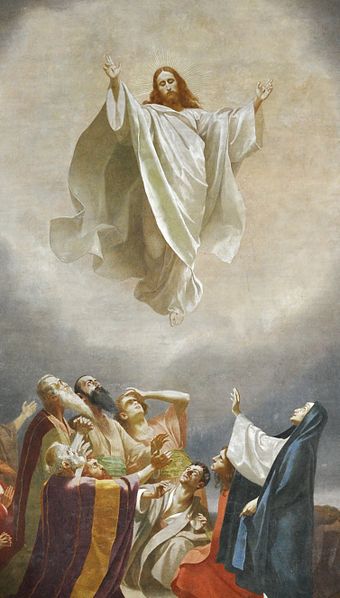
Christ's Ascension by Fresken von Gebhard Fugel, 1893-1894.Where are we now in the Easter season? Let’s recap. Jesus resurrects and first appeared to his disciples on Easter Sunday. And for forty days, he is with them off and on, appearing and disappearing, teaching them about the Kingdom of God and preparing them for their important work ahead: that of sharing the Good News and shepherding his Church. On the last of those forty days, Jesus ascends to his Father in heaven. And for the next nine days, his disciples (as per Christ’s instructions) remain in Jerusalem praying for and awaiting the promise of the Father about which they had heard Jesus speak. Finally, on the fiftieth day, on the Jewish feast of Pentecost, the disciples are intensely filled with the Holy Spirit. They become empowered to begin sharing their stories about who Jesus is and what he has done, inviting others to know him, love him, serve him, and be saved through him. Today we celebrate the Feast of the Ascension, looking forward to the Feast of Pentecost next Sunday.
But wait a second… didn’t I just mention that there were nine days in between the Ascension and Pentecost? Indeed, the Feast of the Ascension is traditionally observed on Ascension Thursday, a few days ago earlier this week. But in our diocese and the vast majority of dioceses in the U.S., the bishops officially transfer the feast to today, the following Sunday, so that more of the faithful will encounter and celebrate this feast. Another quirky thing about today’s Mass is how the story of Jesus’ Ascension is recounted more thoroughly by our first reading, from the beginning of the Acts of the Apostles, than by our Gospel reading, which briefly mentions the event.

The Acts of the Apostles says, when Jesus’ disciples had gathered together they asked him, “Lord, are you at this time going to restore the kingdom to Israel?” In other words, ‘Will you now forcefully make your kingdom come, restoring the earthly kingdom of David and Solomon, or perhaps now even impose a still greater kingdom where God’s will is done as fully on earth as it is in heaven?’ Jesus answered them, “It is not for you to know the times or seasons that the Father has established by his own authority.” When Jesus comes again in manifest, unveiled glory, with all his angels with him, no one will be able to ignore Christ the King or harass his flock any longer, but regarding the time of that return, no one knows the day or the hour except God. In the meantime, Jesus says, “you will receive power when the Holy Spirit comes upon you, and you will be my witnesses in Jerusalem… and to the ends of the earth.”

When he had said this, as the disciples were looking on, Jesus was lifted up and a cloud took him from their sight. So there they were, looking intently at the sky, not quite exactly sure what they were supposed to do now. I wonder how many hours they would have stood gapping at the sky if not for what happened next. Suddenly, two men dressed in white garments stood beside them. (Though not explicitly stated, these seem to be angels in human appearance. Well-informed young men in white had also been at the tomb on Easter Sunday morning, announcing and helping the disciples understand Jesus having risen from the dead.) At the Ascension, the messengers said, “Men of Galilee, why are you standing there looking at the sky? This Jesus who has been taken up from you into heaven will return in the same way as you have seen him going into heaven.” With this reassuring redirection, the disciples return from the Mount of Olives into the city of Jerusalem to pray and prepare for the Holy Spirit’s next move. The Apostles had received the Holy Spirit before in some measure. On Easter Sunday evening, Jesus had breathed on them and said, “Receive the Holy Spirit.” But they required a further gift of the Spirit to know and act on what God specifically wished them to do.

Today, we are in similar circumstances as those first Christians. We each first received the Holy Spirit at our baptisms and entered a deeper, more extensive relationship with him through our confirmations. Now, as we anticipate the Feast of Pentecost, I urge you to pray for the Holy Spirit to enlighten and empower you for what God wants you to do next. Our community is now happily returning nearer to normal, but what will our new habits and endeavors be? This post-pandemic world needs God—it always has—and the people in your world you need Jesus Christ and his Church. By your words and actions, Jesus wants you to show and share with others who Jesus is for you and what he has done for you, inviting others to know him, love him, serve him, and be saved through him. Jesus Christ is not forcibly imposing his Kingdom but sharing and advancing it subtly, intricately, mysteriously, and most wonderfully, especially through persons who are open to doing his will.

I believe God wants to begin one or more new things with you. So I urge you to ask him in these days, “Lord, what do you want me to do?” To ask the question is the start of saying “Yes” to him, but to refuse to ask the question is to answer him “No.” So ask, and seek, and see what new and great things the Lord would do through you during this new springtime for the Church.

We Become Like Our Friends — Funeral Homily for Marcella “Marcy” Pecha, 97

May 13, 2021

Who does Jesus say is blessed? Jesus tells us in the Beatitudes. He says:

“Blessed are the poor in spirit…
those who mourn…
the meek…
those who hunger and thirst for righteousness…
the merciful…
the clean of heart…
the peacemakers…
those who are persecuted for the sake of righteousness.”

When you think about it, all these traits are present in Jesus Christ. Jesus is gentle, merciful, and pure. He cares about others and is moved by their sufferings. He’s the servant of God, of peace and righteousness, and for all this he endures trials. The Beatitudes describe Jesus Christ himself, but they also describe his friends as well, because Jesus’ friends come to resemble him.

Marcella (Marcy) PechaI know Marcy from celebrating Masses at Dove nursing home. I was blessed to give her the Last Rites (consisting of Holy Anointing, the Apostolic Pardon, and her final Holy Communion – which is called Viaticum) two days before she passed. Today, her own St. John the Baptist Parish is honored to offer our greatest prayer, the Holy Mass, for her soul. I found her to be a faithful and pleasant person, as did the staff and residents at Dove, who I am told cherished her as a sweet and motherly lady. Her family has told me a number of interesting stories about her and I would like to share some of these various stories with you.

Before coming to live in a series of nursing homes herself, she volunteered at nursing homes in Bloomer and Chippewa for some three decades. Being a social person, she loved being with the residents. She helped transport people to-and-fro in their wheel chairs. She danced with the residents – Marcy loved to dance. And she would sit with those with Alzheimer’s, chatting about old memories, so they would not feel alone.

Marcy had many memories to share. Being born in 1924, she grew up as a child of The Great Depression. And because of this, she had an understandable personality quirk: Marcy hated wasting food. Her children were always expected to finish their plates at meals, and wherever she went—sometimes to a fault—Marcy tried to save whatever food would otherwise go into the trash.

When Marcy was pregnant with each of her three children (Betty, John, and Barb) she appears to have taken on the spirit of the personalities each of them would have. While carrying Betty, Marcy’s natural timidity disappeared and she wasn’t afraid of anything. While carrying John, she always wanted to be outdoors. And while carrying Barb, she became especially empathic and tenderhearted.

Though not highly educated, Marcy also displayed a supernatural intuition. Once, her oldest adult daughter Betty was leaning over a car engine, attempting to change the oil while it was still running. Betty’s braided hair got caught, apparently pulled by a belt, violently injuring her scalp and requiring 125 stitches at the hospital. The next day, she called her mother, but before Betty could share her story Marcy asked, “What’s wrong with your head? What happened to your head?” When Betty told the story of her accident, Marcy said, “I knew it! I knew it!

Though Marcy could experience anxiety attacks she was not afraid to die. At times she would remark, even years ago, “Why won’t God take me? I what to go home.” (And by home, of course, she meant heaven.) On one occasion decades ago, Marcy nearly died and a defibrillator was used to get her heart back into rhythm. When they revived her, Marcy was very upset with the nurses saying that the previous moments on the cusp of the next life had been the most peaceful experience of her lifetime.

Pretty much all these things, I think, her special love and care for the elderly and infirm, her supernatural intuitions, her eagerness for heaven, were rooted in her deep Christian Faith in Jesus Christ. Marcy was frequently praying, attending Mass, or watching the Holy Sacrifice on television. On the Saturday evening of her death, Marcy’s family members offered to pray the Rosary with her and for her at her bedside, and they could see this gave her great consolation.

Does not Jesus have a special concern for the infirm and forgotten? Did he not volunteer to spend three decades physically dwelling among us? Jesus possesses a profound empathy and supernatural insight into others, with which he understands and loves us profoundly. Like Marcy with those precious food leftovers, Christ the Good Shepherd goes to seemingly unreasonable lengths in hopes that not one lost sheep would go to waste. And Jesus and Marcy were not unwilling to die, they trusted their Heavenly Father, were comforted by family, and were aided by the prayers of the Blessed Virgin Mary.

As I said before, the Beatitudes describe Jesus Christ himself, but also they describe his friends as well, because Jesus’ friends come to resemble him. If you love Marcy, and I do not doubt you do, then renew today your love for the One whom Marcy loves most. Jesus Christ, our Savior, Lord, and God, is the one who makes all his friends great and glorious by making them more and more like himself.

Watch “The Chosen” Season 2

May 11, 2021

The Chosen” is a truly excellent dramatized series about Jesus and his disciples now in its second season. Four new episodes have been released so far (with the most recent only available on YouTube until Wednesday evening). These episodes can also be seen through this free app.

“As the Father Loves Me, so I Also Love You”

May 8, 2021

6th Sunday of Easter

Who was the first person on earth to know you in your lifetime? Upon reflection, you realize it was your mother. Your mother knew you long before you knew her. And I would wager that she loved you as herself, even willing perhaps to lay down her life for you with the greatest love.

An unborn baby’s understanding of things, of its mother and of itself, is limited. But the mother surrounds the baby. She is responsible for and behind the child’s entire universe. The little one is totally dependent upon her, and experiences everything in the midst of mom. Though the sound is quiet and somewhat muffled with distracting noises, the listening little child can hear the mother’s voice and feel her pulse. Imagine an unborn baby doubting and asking, “Does Mom really exist? Is there really a mother at all?

It is right that we love our mothers, though we ought not to make them into idols. When Cornelius met St. Peter, the Roman centurion fell at his feet to do him homage, but Peter raised him back to his feet, saying, “Get up. I myself am also a human being.” Only one mother in human history has been perfect, but our parents present us with our first living image and icon of God.

The Holy TrinityAs much as a baby receives from his or her mother, the Son of God receives still more so from his Father. How does God the Father give life to his Son? The Son is eternally begotten of the Father; “God from God, Light from Light, true God from true God.” The Father gives his whole being to the Son, and his Son, so loved, receives everything with joy. In today’s Gospel, Jesus says, “As the Father loves me, so I also love you.” How does God love you and me like the Father loves the Son?

For starters, God loves us first. The Father and Son are coeternal, but the self-gifting of the Father is the source of the Son, who then loves the Father, self-gifting himself in return. Likewise, God loves us and gives himself to us first, before inviting us to do the same. “In this is love,” St. John writes in our second reading, “not that we have loved God, but that he loved us and sent his Son as expiation for our sins.” And St. Paul tells the Romans, “God proves his love for us in that while we were still sinners Christ died for us.

Another way we are loved like the Father loves the Son is in how we receive every good thing from God. Like an unborn child receives from its mother, and the eternal Son receives from the Father, you receive everything from God through Jesus Christ. St. Paul speaks of the importance of the Son to the Colossians: “In him everything in heaven and on earth was created, things visible and invisible… all things were created through him… He is before all things, and in him everything continues in being.” For us, Jesus Christ is the one through whom all good things come.

Now would it make any sense for an unborn child, who is cherished by its mother, to see his or her mommy as an enemy? Or could God the Father and God the Son ever be rivals? Of course not! And yet we are guarded against Jesus. We hesitate to share our time with him, we hesitate to give our money for him, we hesitate to forsake our habitual sins for him. So I challenge you, I dare you, to trust more in him who loves you.

When Jesus says, “Remain in my love. If you keep my commandments, you will remain in my love,” he is not threatening to stop loving us. No—we must keep Christ’s commandments, doing his loving will, to fully receive everything he wants to give us. Jesus, who is first loved by God, who receives everything from God, who does God’s will, who rejoices and remains in God, who loves God and self-gifts himself fruitfully in return to God, desires you and me to experience the same blessedness. “If you keep my commandments,” he says, “you will remain in my love just as I have kept my Father’s commandments and remain in his love. I have told you this so that my joy may be in you and your joy might be complete. … It was not you who chose me, but I who chose you and appointed you to go and bear fruit that will remain.”

This Sunday, let us love, honor, and pray for the mothers from whom we were born on earth; while we love, honor, and trust all the more the eternal Son through whom we are born again from above.

HABITS Produce Much Fruit

May 1, 2021

5th Sunday of Easter
By Deacon Dick Kostner

Descending VineyardOur Gospel from John has Jesus telling his disciples, telling us, how we can survive and be happy not only in this life but gain for us everlasting life if we but realize our dependence for success and life depends on our acceptance of the fact that we cannot succeed without help from the “Vine,” without Jesus. In preparing for this homily, I went to Formed to get their take on today’s gospel. The minister who reflected upon the Gospel said that we need “HABITS” to allow us to produce fruits from the vine of God, who is Jesus, in order to deal with the challenges that we will face if we wish to be followers of Christ and find peace and experience a successful life as we journey to the Father’s house.

H” stands for Holy Time. We need to commit and schedule within our busy life “time” to communicate with Jesus. Many refer to this communication as prayer. I like to think of it as conversation with Jesus about challenges that we are facing as we journey as well as pleasures and great happiness gifts that we appreciate and recognize as being given to us by God, the “dog treats” God graces us with for being fruitful branches of His divine vine. The minister suggested starting with a commitment of ten minutes a day to communicate with Jesus and letting it grow from there.

A” stands for Accountability. The minister said this stands for us having at least one close friend that we can confide in and request guidance, when we need help and direction. I would suggest that this be a person who has already established a close relationship with Jesus and who is a healthy branch of the vine of Jesus. I can remember when shortly after I was ordained I met with our new priest, Fr. Norm Boneck, and asked him if I could develop a per-baptism class at St. Paul’s as we had no program at that time and he responded by saying, “NO! I want you to start an RCIA program for the parish!” Panic hit me. I had absolutely no experience or knowledge of how that could happen. I thought to myself, “Man, you picked the wrong dude to tackle that job.” Barb remembered that one of my deacon friends had mentioned that he and his wife had done a program at their parish, and she suggested I call him and yell “help!” I did that and he invited us to go to Wisconsin Rapids and met with him for some advice. The first thing he said to me is to not worry and that he had experienced the same panic and that the Holy Spirit would not let be get into too deep of water so as to drown. With His help and guidance St. Paul’s began an RCIA program which has produced much fruit from this Branch.

B” stands for Bible. We need to get to know Jesus as a person and that can best be accomplished by reading about him and living a life based on the Gospel messages. Through Scripture we learn that Jesus was given to us to shepherd his followers. We discover that there does exist an evil one who uses the tools of confusion, deception, and fear to control us and lead us away from the protection of the Good Shepherd and his guard dog His Church. We have witnessed this first hand this last year where the world has become afraid and confused by the Covid. We see how evil has attacked our guardian the Church and the faith it teaches to leave us feeling helpless. All this helps separate us from truth and the protection our faith gives us to suppress and overcome the evil in this world.

I” stands for Investing and supporting the parish we are assigned too. The message from Jesus is that we not only read his Word but also live his Word by example. Good fruit requires commitment in the form of financial support of our parish as well as a commitment of our time and talents to our parish so that it may remain healthy and fruitful. Our parish needs your commitment of time, talent, and treasures to be a successful and healthy branch of God that will produce much fruit. Statistics show that only about 30% of a parish membership support their church with their commitment. Only 30% of the people are helping to keep the branch of Christ active and healthy. That percentage needs to increase if we are to produce a good crop of fruit during our lives.

T” stands for Tell Others. We need to share with others the benefits that we will be gifted with if we are productive branches of Christ. We need to share with others the “dog treats” the graces that God has bestowed upon us for being active followers of Jesus. Jesus tells us to spread the Good Word.

Finally, “S” stands for Sacraments. The Church of Jesus is one that is based on Sacrament. Sacrament bestows upon us graces which can and will produce super natural powers that will be gifted upon those who celebrate the Sacraments. These gifts from Jesus will provide us with energy and powers of accomplishment beyond human capabilities. Through the spiritual graces gifted us through participation in the Sacraments the Branches are fed nutrients from the Vine that will allow us to accomplish tasks that would otherwise be humanly impossible.

Bottom line is that we are all dependent upon the Vine for protection from the storms of life and production of fruit. Let us all form HABITS that will make us healthy branches that will produce much fruit from the vine for all who wish to enter the Kingdom of God.

A Treasured & Entrusted Child — Funeral Homily for Adelaide Marie Borofka

April 26, 2021

The dominant culture in the days of Jesus’ public ministry oftentimes did not treasure children. A firstborn baby boy might have value to a Roman father, but a baby who was a girl, or malformed or disabled, or simply unwanted might be killed or abandoned in the woods, exposed to die. The early Christians, however, rejected infanticide and adopted foundlings, raising them as their own. This is reflected by a first century Christian text called The Didache (also known as “The Lord’s Teaching Through the Twelve Apostles to the Nations”) which commands: “You shall not procure an abortion, nor destroy a newborn child…” From where did the Christians get this countercultural concern for all children, born and unborn? From our Lord Jesus Christ, of course.

Adelaide Borofka feetThough children are small and weak, Jesus says, “See that you do not despise one of these little ones, for I say to you that their angels in heaven always look upon the face of my heavenly Father.” They have no wealth or worldly power, but Jesus says, “Unless you turn and become like children, you will not enter the kingdom of heaven.” Jesus, calling a child over and putting his arms around it, says, “Whoever humbles himself like this child is the greatest in the kingdom of heaven.” Jesus says that children are to be treasured and loved like himself: “Whoever receives one child such as this in my name receives me.” Jesus says, “Let the children come to me, and do not prevent them; for the kingdom of heaven belongs to such as these.” In just the same way as a good shepherd hates to lose even one of his many sheep, Jesus says, “it is not the will of your heavenly Father that one of these little ones be lost.” Indeed, ‘Jesus loves the little children, all the little children of the world.’

So even when a child dies without baptism, we can entrust them to God’s mercy with great hope, that the love of God which has brought us into being will transform the painful mysteries of the Cross into a reunion of Easter joy. In the midst of any tragedy, we always have a general Christian hope that God will bring good out of what is bad. But in regards to little Adelaide it appears that God has granted us a special, particular consolation. This is Veronica’s story, which she has given me permission to tell you, and which she wants me to share for your benefit.

On Easter Sunday, Veronica began to feel severe abdominal pain. She was admitted to Sacred Heart Hospital in Eau Claire with a blood pressure so high that she was in grave danger of suffering a stroke, even dying. Then, through an ultrasound, it was discovered that the child within her, the child she lovingly carried for seven months, no longer had a heartbeat. Around 2 AM on Monday, April 5th, while she was in great physical and emotional pain, her husband Zach and their gathered family members were praying a Rosary with her. Veronica was praying along with them, off-and-on, as she could manage. And in the midst of all this painful suffering, as she paused with her eyes closed, she saw something. Even though Veronica is certain that she was awake at that moment, she beheld something remarkable. Before I describe Veronica’s experience and what she saw, I will speak briefly about private revelation.

As Catholics we believe that Jesus is not dead, but risen and living. We believe that his saints in heaven are all alive with him. We believe that Jesus and his saints and angels know us, that they care about us, and that they continue to lovingly help us here on earth. We believe visions, messages, and miracles still happen in our day. And sometimes instances of these phenomena are judged by the Church’s authority to be “worthy of belief.” However, unlike public revelation (which consists of Sacred Scripture and the apostolic teachings in the Deposit of Faith), private revelation, even when officially recognized by the Church, is not binding to be believed by all the faithful. I am not personally qualified to make any official judgment for the Church about private revelations, but I tell you: if I did not personally believe that what Veronica saw was of a heavenly origin, I would not be about to share it with you.

Veronica, with her eyes closed during that Rosary in the hospital, saw a woman standing before her bed. There were pretty, puffy, white clouds behind the woman and to each side of her. And rays of sunlight from the left peaked through gaps in the clouds. The woman wore a dazzling, bright white gown. The fabric of her beautiful, full-length dress looked like satin. It had a modest scoop neckline and sleeves that went down to her wrists. The woman also wore a blue, cathedral-length veil of traditional lace, which extended down to the floor. She was dressed similarly to a statue of the Blessed Virgin Mary from Germany which Veronica’s grandfather had given her years before; a statue Veronica used to play with as a girl.

The woman had long, curly, dark hair, snow white skin, and beautiful blue eyes which gazed at Veronica. The expression on the woman’s face was very pleasant, calming and peaceful, concerned for Veronica and reassuring. Veronica says “she looked absolutely beautiful and gorgeous,” such that “no model could compare.” The woman’s lips moved as she slowly spoke with a very feminine, light and calming, beautiful voice, which echoed with some reverberation. And this is what she said: “Veronica, do not be afraid. I will take care of this child as I have taken care of my Son, Jesus. Do not worry and do not cry.

In this vision, Veronica held in her hands her swaddled baby, wrapped in the gray swaddling cloth she had bought for its birth. (Veronica did not yet know whether she had a girl or a boy, since Adelaide had not yet been delivered.) Hearing the Virgin Mary’s words gave Veronica great relief, for who could be better than the Blessed Mother to care for her lost child? Veronica raised up her arms in the vision, completely entrusting her child to Mary. Mysteriously, Mary remained where she stood but seemed to come closer. Veronica says, “I handed her my child and then she was gone.” The entire vision was very brief, perhaps just ten or fifteen seconds, about the length of one Hail Mary prayer.

Veronica was left with feelings of peace, calm, reassurance that everything was OK, and wonder that the Blessed Mother would make herself known to her. Veronica did not share her story right away—she was worried people might think she was crazy—but after this vision she began comforting those gathered around her bedside. When her mother began to cry, Veronica told her, “Don’t cry, you don’t have to cry.” As St. Paul told the Corinthians, “[God] encourages us in our every affliction, so that we may be able to encourage those who are in any affliction with the encouragement with which we ourselves are comforted by God.

Veronica is saddened, of course, still grieving and mourning, but not crushed or depressed like one might expect. She always had faith in God and Jesus Christ, but this experience has reinforced it, and she desires the same growth in Christian faith for you. “There’s beauty in the suffering,” she told me, adding, “I just want everyone to know what I know and to feel the peace that I feel with God and his love.” This is the Lord Jesus Christ’s wish for you, too. Clouds may limit our vision in this world, preventing us from seeing all that God is up to, but even in the hardest times rays of light still shine through. This light comes from the Lord Jesus who loves us, who treasures little Adelaide and who also treasures you.

Jesus Christ our Cornerstone, Shepherd, & Brother

April 24, 2021

4th Sunday of Easter

We are here today because of our Lord and Savior, Jesus Christ. And as truly today as when St. Peter first preached these words, “There is no salvation through anyone else, nor is there any other name under heaven given to the human race by which we are to be saved.” Jesus Christ is the Cornerstone, he is the Good Shepherd, he is the Son of God.

St. Peter is quoting today’s psalm when he proclaims Jesus as the stone rejected by the builders which has become the cornerstone. Christ is foreshadowed in the Old Testament by passages about holy stones: cornerstones, keystones, and capstones. A cornerstone is the foundational basis of a building which makes the whole structure possible. A keystone is found at the top of an arch—maintaining its shape alongside its fellow stones. And a capstone is a building’s top-most stone, its crowning glory.

In his new Temple, the Church he builds, Jesus Christ is “the beginning and the end”: he is the cornerstone which makes all this possible, he is the capstone—our crowning glory, and he is our keystone, working alongside us. St. Peter would later write to Christians about Christ:

Come to him, a living stone, rejected by human beings but chosen and precious in the sight of God, and, like living stones, let yourselves be built into a spiritual house … to offer spiritual sacrifices acceptable to God through Jesus Christ.”

In today’s Gospel, Jesus Christ also declares, “I am the Good Shepherd.” He is our Good Shepherd. Unlike others who act for self-interest and profit, he deeply cares about us. He knows us and we can know him. If we recognize his voice and follow after him he leads us to lush pastures and cool waters, to true rest with him and to the fruitfulness in good works and holiness his care makes possible: much wool and much milk produced for his pleasure. If we become lost, he seeks us out, and brings us back rejoicing. And Jesus protects us, offering his life to save his flock from evil and death. Jesus says:

This is why the Father loves me, because I lay down my life in order to take it up again. No one takes it from me, but I lay it down on my own. … This command I have received from my Father.”

Jesus Christ is the Son of God the Father. It would have been enough for him to save us. (We were never in a position to demand even that.) But Christ goes further still, allowing us to be his Father’s children too. “See what love the Father has bestowed on us,” St. John writes, “that we may be called the children of God. Yet so we are. Beloved, we are God’s children now…” We are not kept as strangers, as slaves, or as mere subjects to him, but welcomed as precious and beloved sons and daughters.

In each of these true, biblical titles, Jesus the Cornerstone, the Good Shepherd, and Son of God, Christ is preeminent, most important among us; our foundation, our leader, and our divine Lord. Yet notice how Jesus in each of these realities offers a place for us with him: as stones within his Temple, as sheep within his flock, as children within his family. Jesus wants to be with us and wants you to be with him always, here at Holy Mass, in your daily times of prayer, and throughout your daily life. Will you respond to his invitation with the dedication of your time and devotion? We are here today because of Jesus Christ our Savior and Lord. Let him be your cornerstone, your shepherd, and your brother, for there is no other name under heaven by which we can be saved.

“You Have Nothing to be Ashamed of”

April 17, 2021

3rd Sunday of Easter

When I was 26 years old, in my second year of major seminary, I was bothered by a worrisome question or doubt. “Of course, God loves me,” I thought to myself. “He loves everyone – even those in hell. But does he like me? Even the eternally damned are loved by God though they don’t love him back. I know that God loves me, but is he pleased with me?” I was burdened by this question for several weeks until, I believe, God personally addressed my concern.

During the summer of 2007 near the end of an hour of prayer (which is called a “Holy Hour”) sitting in a chapel before Jesus in the tabernacle, I heard him say in my thoughts: “You have nothing to be ashamed of.” I replied that I would love for him to say that, but how could it possibly be true? I knew my sins, and he knew them far better than I. So he would have to convince me.

He asked me, again in my mind, “When you sin in a big way, you always try to get to Confession, right?

Yes,” I answered.

And when you sin in a small way, once you realize you’re doing it, you try to stop, right?

Yes, that’s true.”

And then he said, “You’re for me.”

I recognized in this an echo of a verse from the Letter to the Romans: “If God is for us, who can be against us?” Jesus was telling me, “If you’re for me, how could I possibly be against you?” The nagging doubt I had carried for a couple of months he resolved in a couple of minutes by highlighting my concern over the very sins which had made me feel ashamed.

On Pentecost Sunday, fifty days after Easter, St. Peter preaches to the crowd in Jerusalem:

[Jesus the Christ] you handed over and denied in Pilate’s presence when [the governor] had decided to release him. You denied the Holy and Righteous One and asked that a murderer be released to you. The Author of life you put to death, but God raised him from the dead; of this we are witnesses.

Peter is charging them as accessories to deicide. He is declaring them guilty accomplices in the murder of God. And this crime is ours as well, because the sins of all humanity sent Jesus to the Cross. But Peter is preaching not to condemn the world to hopeless shame, but so that the world might be saved through Christ. “Repent, therefore, and be converted,” Peter proclaims, “that your sins may be wiped away.

In our Gospel, Jesus shows his disciples the wounds in his hands and feet not as a bitter reproach but that they may share his joy. The greeting of the risen Lord is not “I condemn you,” but rather, “Peace be with you.

As St. John writes in our second reading:

My children, I am writing this to you
so that you may not commit sin.
But if anyone does sin,
we have an Advocate with the Father,

Jesus Christ the righteous one.
He is expiation for our sins,
and not for our sins only
but for those of the whole world.

In conclusion, know and remember that guilt is different than shame. We should feel guilt for the sins we commit. When I sin, guilt says, “I have done foul, ugly, and unlovely things, and I must repent.” But shame says, “I am foul. I am ugly. I am unlovable. And I cannot be saved.” The feeling of guilt can be a gift from God, but the Evil One wants you to feel ashamed. Shame is unhealthy, causing us to despair and hide from God. Guilt, on the other hand, is useful when it spurs us to conversion, to spiritual health and our salvation.

Jesus loves you and he likes and is pleased by every good thing about you. Repent, therefore, and be converted that your sins may be wiped away and your love of God may be truly perfected in you.

The Meticulous Leveler — Funeral Homily for David Zwiefelhofer, Sr., 93

April 15, 2021

On behalf of St. John the Baptist Parish, I wish to express our sympathies to you at David’s passing. At 93 years old, he is among our parish’s longest, faithful members. Today, St. John’s is honored to offer our greatest prayer, the Holy Mass, to aid his eternal soul on his journey, and to aid your souls on the path ahead of you. If you are one of David’s siblings, children, nieces, nephews, grandchildren, or great grandchildren, you have known him your entire life. Perhaps it is hard for you to imagine life without him. I know I can’t tell you much more about David’s life than you already know well. And no funeral homily could capture the fullness of a person. But the facets of a faithful Christian’s life will the reflect mysteries of Christ.

One of the interesting things I learned about David is his being a skilled excavator. He had a reputation for being the best bulldozer operator around. Even in retirement, people called upon the Brahma Bull to bulldoze for their projects. David is a perfectionist, attentive to detail. He possessed the uncanny ability to know—without instruments—when a plowed surface was level. “That’s not level,” an onlooker might say. They couldn’t convince him, or course. And when the surface was measured, David would be proven right. I was also surprised to learn that his line of work once nearly killed him. While David was operating his machine through a deep trench, a dirt wall collapsed and sand flowed in around him from the side like water. His coworkers rushed in to keep the sand away from his head so he could breathe, and they dug him out, saving his life.

We can see some of Jesus Christ being reflected through David. Realize that Jesus is very meticulous, too. We are his handiwork, and he cares a great deal about his work. Jesus’ insistence on his teachings is not mere human stubbornness. Our Lord knows that he knows what he is talking about. Jesus is a skilled leveler, making our neighbors as important as ourselves, even declaring that any good or evil done to them will one day be judged as having been done to him. Jesus’ profession and work put his life on the line for us; he was buried but rose again from the earth. In life and death, we are called to follow Christ. We must follow him, that we may share in his victory.

In the words of the Old Testament prophet Isaiah, in accord with the New Testament proclamation of St. John the Baptist, our patron:

Every valley shall be filled
and every mountain and hill shall be made low.
The winding roads shall be made straight,
and the rough ways made smooth,
and all flesh shall see the salvation of God.

The ways of the just the Lord makes smooth, path of the just he makes level, if we would only hand him the keys, and allow him bulldoze and level in our lives whatever he must. Jesus’ current project in our world is great and beautiful: building “a new heaven and a new earth.” And he desires and invites you, his beloved, to be a part of it. By God’s grace, may David, you, and I inherit the Kingdom Christ has been preparing for his people from the foundation of the world.