Pro-Life Women to be Honored on New $10 Bill

April 22, 2016

The U.S. Capitol Statue of Elizabeth Cady Stanton, Susan B. Anthony, & Lucretia Mott

The U.S. Capitol sculpture of Elizabeth Cady Stanton,
Susan B. Anthony, and Lucretia Mott

The U.S. Treasury recently announced plans to redesign the $5, $10, and $20 bills. The new ten-dollar bill will retain the portrait of Alexander Hamilton but its reverse side will feature Susan B. Anthony, Elizabeth Cady Stanton, Sojourner Truth, Alice Paul, and Lucretia Mott alongside the Treasury building. These five famous suffragists advocated for women’s right to vote, but lesser known are the pro-life convictions found among them and other feminists of their era.

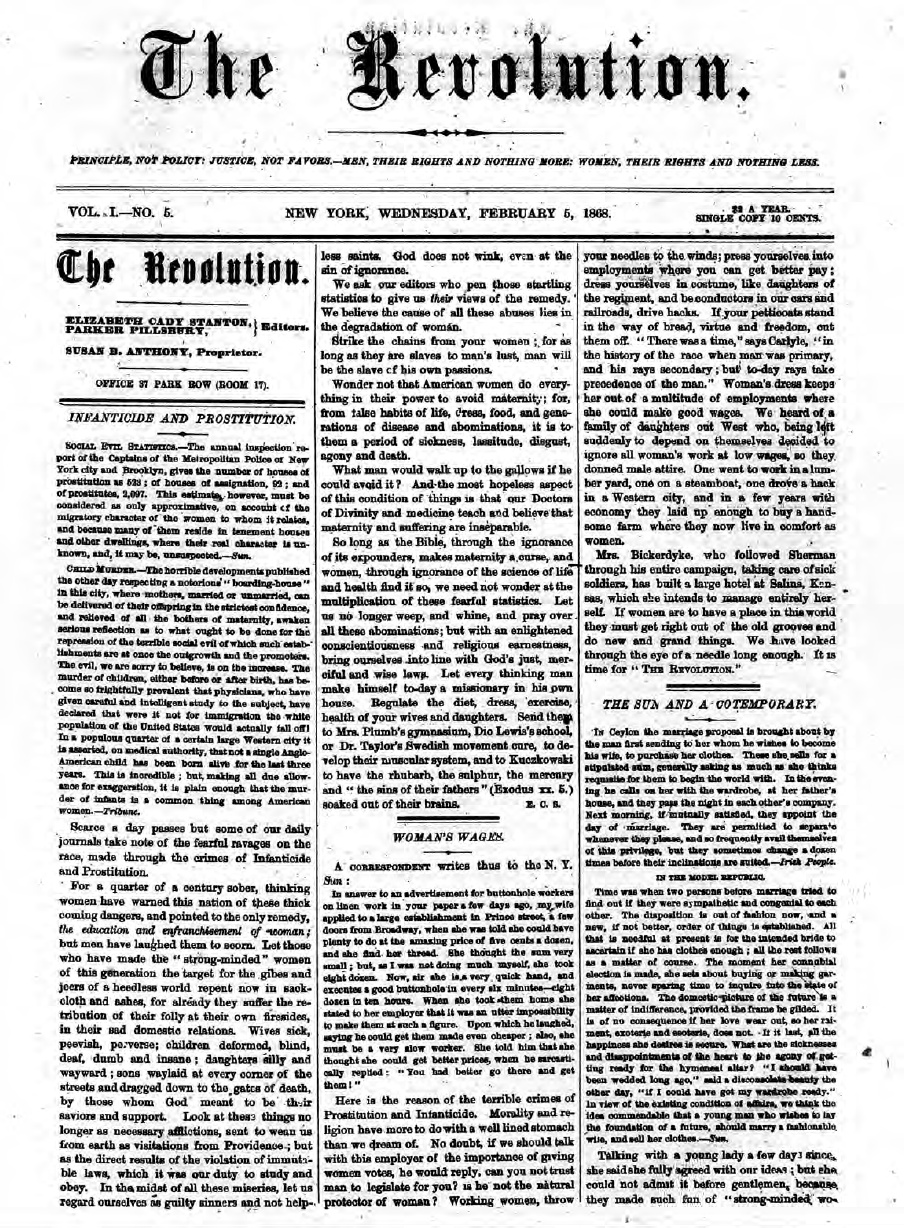
Susan B. Anthony and Elizabeth Cady Stanton co-founded a weekly women’s rights newspaper called The Revolution. From its beginning the paper had a policy against accepting ads for abortifacients: “Quack medicine vendors, …Foeticides and Infanticides, should be classed together and regarded with shuddering horror by the whole human race.” Their rejection of such revenue was a principled sacrifice for their struggling publication, since “child murder both before and after birth [was] a regular and, terrible to tell, a vastly extensive business.” In an 1868 editorial, Stanton called abortion “Infanticide,” declaring, “We believe the cause of all these abuses lies in the degradation of women.” (As honored suffragist Alice Paul, author of the first Equal Rights Amendment, wrote, “Abortion is the ultimate exploitation of women.”)

An 1869 Revolution piece denouncing abortion is frequently attributed to Susan B. Anthony, though its signature (“A.” rather than “S.B.A.”) may well stand for some “Anonymous” author. However, there is no doubt that in an 1875 speech about “the evil of intemperance” Anthony listed abortion among the society’s worst evils: “The prosecutions on our courts for breach of promise, divorce, adultery, bigamy, seduction, rape; the newspaper reports every day of every year of scandals and outrages, of wife murders and paramour shooting, of abortions and infanticides, are perpetual reminders of men’s incapacity to cope successfully with this monster evil of society.

These five suffragists devoted many words and efforts to women’s equality at the voting booth and throughout society. By comparison, they said relatively little about abortion. Yet this is not because early feminists accepted the killing of the unborn as normal but because they acknowledged its great evil as a given. In the 1880’s, all U.S. states had laws against abortion and for early feminists opposition to abortion was a commonly held conviction.Alexander Hamilton Bill Portrait
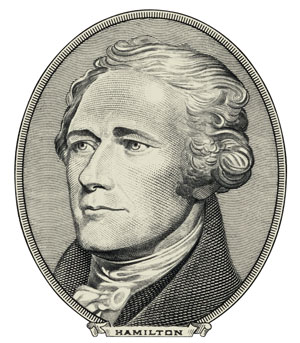
It is especially fitting that the women to be honored on the ten-dollar bill will be sharing the company of Alexander Hamilton. As the sensational, new musical about him dramatically recalls, by Providence, Alexander Hamilton, the out-of-wedlock son of a prostitute, was born impoverished and in squalor yet grew up to be a hero and a scholar. In our day, baby Alexander quite likely would have been aborted but his remarkable life demonstrates how even an unwanted child can bless an entire nation.

In this conviction, as on the new ten-dollar bill,
the pro-life suffragists have Hamilton’s back.
April 24th Parish Bulletin

April 20, 2016

The St. Wenceslaus parish bulletin for the 5th Sunday of Easter, April 24th, 2016.

The Centrality of Jesus — Monday, 4th Week of Easter—Year II

April 18, 2016

Readings: Acts 11:1-18, John 10:1-10

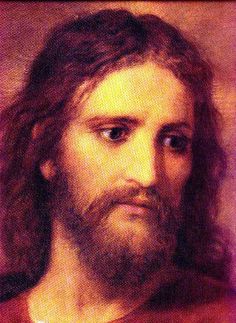
Detail of The Rich Young Ruler by Heinrich HofmannIn St. John’s Gospel, Jesus is the Good Shepherd, the Lamb of God, and the Gate for the flock.

Our Easter preface (V) for the Mass calls him “the priest, the altar, and the lamb of sacrifice.”

Jesus declares, “I am the way and the truth and the life. No one comes to the Father except through me.”

One may say Jesus is the road we travel, the vehicle we take, and the destination we long for.

The centrality and importance of Jesus Christ cannot be overstated.

Like Cornelius’ household at Caesarea, the God-fearing and truth-loving people amongst the nations need him, seek him, and perhaps (even if unknowingly) have a nascent love for him. As Jesus says, “I have other sheep that do not belong to this fold. These also I must lead, and they will hear my voice, and there will be one flock, one shepherd.” Jesus says to Pilate, “Everyone who belongs to the truth listens to my voice.”

Let us grow in our knowledge, relationship, and love of the Lord Jesus Christ at this Mass and every day, and labor to help others come to know and love him more deeply as well.


April 17th Parish Bulletin

April 13, 2016

The St. Wenceslaus parish bulletin for the 4th Sunday of Easter, April 17th, 2016.

Tips for Raising Faith-Filled Children

April 13, 2016
  • Tell your children every day that you love them and that God loves them too.
  • Listen attentively and respectfully to what your child says.
  • Forgive frequently. Ask forgiveness when you have done wrong. Look for the humor in stressful situations and hug often.
  • Ask children to consider “what if…” when dealing  with challenging situations. Help them find creative, peaceful, and moral responses.
  • Tell your child that you pray for them every day and DO it. Thank God for the gifts they are.
  • Share your faith beliefs so your child can understand your hopes. Also share your doubts so they understand that doubts do not overwhelm faith.
  • Bless your child before bedtime by tracing the Sign of the Cross on their foreheads and saying: “God love you and keep you safe” or some other blessing. Teach your child to respond. “Amen.”
  • Encourage your child to value others for who they are – not what they have. Help them to develop Christian virtues and to treat others kindly and with respect.
  • Once a week, have a family night when you “unplug” to play board games, do crafts, read stories, or take time to talk together.
  • Honor family  dinner. The benefits are amazing and establish a sacred time to share the joys and trials of life with each other.
  • Pray before meals, before bed, during holidays and family celebrations, and any time when one needs guidance or comfort.
  • Have a family Bible and read the Gospel passages before Church.
  • Decorate your house for the liturgical seasons with an Advent wreath, purple during Lent, and a prominently placed crucifix.
  • Take time to ponder the beauty of creation with your child. Easter is a wonderful time to appreciate the new life of springtime.
  • During the fall and spring, help your child sort through their clothes and toys to donate to a shelter. Bring the child with you when you drop off your donations.
  • Select a patron saint to watch over your children when they become involved in a sporting activity. Pray to that saint every time they are at a practice or event.
  • Participate in the Catholic Relief  Services Rice Bowl program: read the prayers during Lent, look up the featured countries, and donate coins in the box provided.
  • Introduce your child to older people or those with disabilities in your neighborhood. Find out if they need assistance with chores or shopping.
  • When you can’t physically help someone, pray for them.
  • Choose sporting events that do not conflict with your Sunday Mass attendance.
  • Encourage “secret” good deeds.
  • Contribute to a food bank. Ask your child to help you with the collection and delivery.
  • Watch TV with your child and explain during commercials or afterward what you found to be good, wholesome, and valuable. If you find a program objectionable explain why when changing the channel.
  • Encourage your child to use their God-given talents to serve others.
  • Help your child find ways to participate in the of the parish, such as being an altar server, choir member, greeter, or reader.
  • Invite your parish priest over for dinner.
  • Volunteer in your child’s religious education program or Catholic school.
  • Have the sporting equipment your child uses get blessed.
  • Read stories from the Bible and biographies of saints to your child. Several great videos can also be found online.
  • Ask grandparents, godparents, and extended family to share stories about the family their faith lives.
  • On the anniversaries of your children’s Baptism, light their Baptismal candles and tell stories about that special day.
  • Display religious items in your home, such as a cross, artwork, or a picture of your child’s patron saint. Talk to your child about them.
  • By the way you live, let your child know that life is good, that your values and faith guide your decisions and how you interact with others, and that the happiness you experience is a direct result of your personal relationship with God.

Adapted from the pamphlet “Raising Your Child With Faith” by Cecilia P. Regan.

The Heights of Holiness

April 12, 2016
Tall G.K. Chesterton shakes a girl's hand

Servant of God G.K. Chesterton

How tall have the famous Catholic men and women of past and present been? Precise figures can be hard to find, but here is a sampling:

6’ 4” — Servant of God G.K. Chesterton

6’ 0” — Venerable Pope Pius XII

5’ 10” — Our Lord Jesus Christ (based upon the Shroud of Turin) , Pope St. John Paul II

5’ 9” — Pope Francis

5’ 8½” — Servant of God Bishop Fulton Sheen  (or 5’ 7” according to his niece )

5’ 8” — Blessed Pope Paul VI

5’ 7” — St. Peter the Apostle (based on the bones found beneath St. Peter’s Basilica’s high altar) , Pope Emeritus Benedict XVI

5’ 6” — Pope St. John XXIII

5’ 5” — Servant of God Pope John Paul I

5’ 4” — St. Therese of Lisieux

5’ 2½”— St. John Neumann

5’ 2” — St. Joan of Arc , St. Junipero Serra

5’ 1½”— St. Ignatius Loyola

5’ 0” — Blessed Mother Teresa of Calcutta

St. Stanislaus: A Patron Saint of Poland

April 11, 2016

Stanislaus was born of noble parents on July 26, 1030 near Kraków, Poland. After his priestly ordination he became known for his preaching and good spiritual advice. At age 42, he was made bishop of Kraków (the future office of St. John Paul the Great, who nearly chose the name “Stanislaus” as pope.)

King Boleslaus the Bold oppressed the Church and hated Stanislaus for denouncing his reign’s injustices and cruelties. In hopes of the Polish king’s conversion, Stanislaus excommunicated the king, even ceasing cathedral liturgies upon his entrance. On April 11, 1079, the sword-wielding king murdered Stanislaus himself while the bishop was saying Mass in a chapel outside the city.

The martyr St. Stanislaus has long since been celebrated as the Polish nation’s beloved patron.

Pope St. Gregory the Great’s Reflections on John 21

April 10, 2016

From the Catena Aurea or Golden Chain, St. Thomas Aquinas’ collection of Church Father quotes.

  • It may be asked, why Peter, who was a fisherman before his conversion, returned to fishing, when it is said, “No man putting his hand to the plow, and looking back, is fit for the kingdom of God.” The craft which was exercised without sin before conversion, was no sin after it. Wherefore after his conversion Peter returned to fishing; but Matthew sat not down again for the receipts of custom. For there are some businesses which cannot or it can hardly be carried on without sin; and these cannot be returned to after conversion.
  • The [disciples’] fishing was made to be very unlucky, in order to raise their astonishment at the miracle after: “And that night they caught nothing.”
  • It may be asked, why after His resurrection He stood on the shore to receive the disciples, whereas before He walked on the sea? The sea signifies the world, which is tossed about with various causes of tumults, and the waves of this corruptible life; the shore by its solidity figures the rest eternal. The disciples then, inasmuch as they were still upon the waves of this mortal life, were laboring on the sea; but the Redeemer having by His resurrection thrown off the corruption of the flesh, stood upon the shore.
  • To Peter was the holy Church committed; to him is it specially said, “Feed my sheep.” That then which is afterwards declared by word, is now signified by act. He it is who draws the fishes to the firm shore, because he it was who pointed out the stability of the eternal country to the faithful. This he did by word of mouth, by epistles; this he does daily by signs and miracles.
  • By holding this last feast with seven disciples, [Jesus] declares that they only who are full of the seven-fold grace of the Holy Spirit, shall be with Him in the eternal feast. Time also is reckoned by periods of seven days, and perfection is often designated by the number seven. They therefore feast upon the presence of the Truth in that last banquet, who now strive for perfection.

Jesus Asks, “Do You Love Me?”

April 9, 2016

Christ Handing the Keys to St. Peter by Pietro Perugino (detail)In St. Peter along the shore of Galilee, Jesus is asking this question of us: “Do you love me?” We each have a choice to make in how we respond.

You can answer like Simon Peter in the high priest’s courtyard, with blasphemous denials and lingering regret. Or you can answer like St. Peter the Rock, who said, “Yes Lord, you know that I love you,” and then lived a life which proved that love.  How are you going to answer?

I do not know the particulars of Christ’s will and plan for you, but I know it consists at least in this: to pray every day, to attend Mass every week, and to strive to do His will for the rest of your days.

Jesus as an Undercover Boss

April 7, 2016

During the seven week span from Easter to Pentecost, the apostles were firsthand witnesses to Christ’s resurrection, but they lacked their mission. In those days, Jesus was not always visibly with them and the Holy Spirit was not prompting them to preach the Good News. And so, the apostles had extra spare time on their hands. But even if you’re a person who has seen Jesus Christ risen from the dead you still need to eat. Therefore, Peter says, “I am going fishing,” and six others decide to go along with him. Fishing the Sea of Galilee was Peter’s line of work before Jesus called him to become a ‘fisher of men.’

Jesus Appears on the Shore in John 21In today’s Gospel, Peter goes back to his old job. And then, unexpectedly, Jesus shows up at Peter’s workplace. Like an “undercover boss” on TV, Jesus comes in disguise. Jesus’ glorified and resurrected body allows him to conceal or change his appearance. At first, amid the routine of their work, the disciples fail to recognize him. But after catching their huge catch of (153!) fish, they realize “it is the Lord” and begin acting differently. How would you respond if the Lord appeared at your workplace as a customer, co-worker, or boss?
Sometimes we Christians slip into mentally separating our life at church from our life in the world; for example, working in the world without thinking of our faith. But we must remember to honor and serve Jesus Christ always and everywhere. You have probably heard of the importance of ‘seeing Christ in others.’ Seeing Christ in others means treating them like you would treat Jesus Christ himself. Now, of course, a Christian should not worship anything or anyone other than God, but Jesus wants you to love other people through the love you have for him.

As Jesus says in the Gospel of Matthew, when he comes in his glory with all the holy angels with him, Jesus will sit upon the throne of his glory and all the nations shall be gathered before him. And Jesus, the king and judge, shall declare to them, “Amen, I say unto you, inasmuch as you did it to one of these least of brethren of mine, you did for me.” Therefore, recognize Jesus encountering you, unexpectedly and disguised, at the place where you work—in your customers, your coworkers, and your bosses—and love them with your love for Christ.

Rejecting Reincarnation

April 6, 2016

G.K. ChestertonA friend once told me his flirtations with belief in reincarnation ended by reading two good points by G.K. Chesterton. If all people were (re)born into the blessings or curses of their present lives on account of their good or bad actions in the past, then:

  1. We could expect nearly all well-born persons to be honest, given their long track records of virtue.
  2. Those who are born into bad circumstances would merit their own suffering and unhappiness.

Buddhist reincarnation beliefs may vary, but Hindus in India have traditionally believed that their top castes merit their nobility (and the untouchables their servitude) due to reincarnation’s Karmic justice.

However, as Hebrews 9:27 says, “it is appointed that men die once, and after this the judgment…”

April 10th Parish Bulletin

April 5, 2016

The St. Wenceslaus parish bulletin for the 3rd Sunday of Easter, April 10th, 2016.

April 3rd Parish Bulletin

March 31, 2016

The St. Wenceslaus parish bulletin for Divine Mercy Sunday, April 3rd, 2016.

He Proved Faithful — Good Friday Homily

March 25, 2016

Few proved faithful to Jesus on Good Friday, but on Good Friday Jesus proved himself faithful to us.

The political leaders were supposed to serve justice, but Pilate and Herod failed to protect Jesus as an innocent man. Jesus protected us when we were guilty.

The religious leaders were supposed to serve holiness, but the High Priests and the Sanhedrin failed to accept Jesus as their Messiah. Jesus accepted us so that we might become holy.

The disciples were supposed to serve their teacher and lord, but Judas betrayed him, Peter denied him, and the others abandoned him. By enduring his suffering and death, Jesus proved himself faithful to us.

Jesus’ mother Mary was faithful. She stood with him at the foot of the cross. It was a consolation for Jesus to have her there. Two of his beloved disciples were also there: Mary Magdalene and the apostle John. Jesus was grateful to have them close by.

Today, on this Good Friday, by the grace of God, we are at the foot of the cross. Let us pray for mercy, for ourselves and for others. Despite our past unfaithfulness, let us honor his faithfulness to us. Jesus is pleased that we are here with him, and he is grateful for our gratitude.

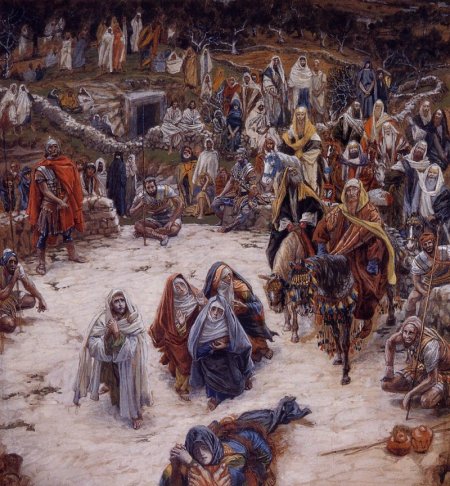
View From the Cross by Tissot

Returning the Favor — Holy Thursday Homily

March 24, 2016

St. Augustine wrote a famous reflection on Proverbs 23:1 :

“If you sit down to eat at the table of a ruler,
observe carefully what is set before you.”

Why? Because you will be expected to provide the same kind of meal for him. This proverb is a practical tip of worldly wisdom, but St. Augustine goes deeper; what is its spiritual meaning for the Christian?

Who is our ruler?  It is Jesus our Lord.
Where is his table? It is here, his altar.
Now carefully observe the food he sets before us: it is the Eucharist, his very self.

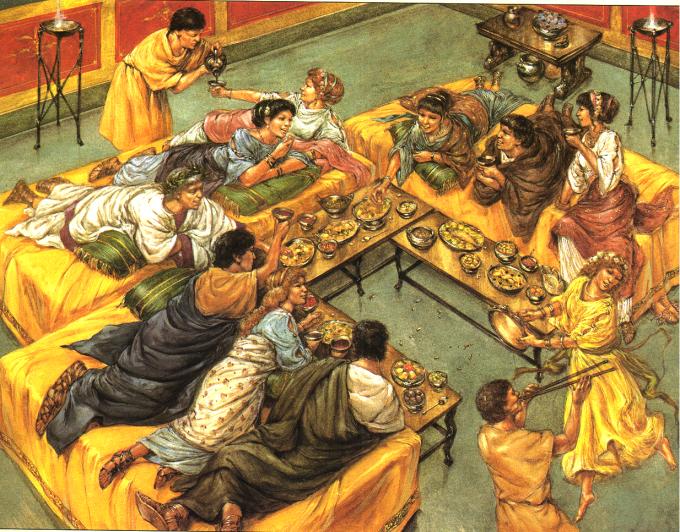
Jesus, like others in the ancient world, reclined at table.Jesus calls us to prepare the same kind of meal for him. He says, “This is my body, given up for you. Do this in memory of me.” We must make a gift of ourselves by living our lives for him, and we are to serve him in others for he tells us, “Amen, I say to you, whatever you did for one of these least brothers of mine, you did for me.”

After washing his disciples feet at the Last Supper where he institutes the Eucharist, Jesus says to his disciples, and to us: “Do you realize what I have done for you? … I have given you a model to follow, so that as I have done for you, you should also do.