The St. Wenceslaus parish bulletin (PDF) for the 21st Sunday in Ordinary Time on August 21st, 2016.
August 21st Parish Bulletin
August 19, 2016Mary, the World’s First Love
August 19, 2016
“When Whistler painted the picture of his mother, did he not have the image of her in his mind before he ever gathered his colors on his palette? If you could have preexisted your mother (not artistically, but really), would you not have made her the most perfect woman that ever lived—one so beautiful she would have been the sweet envy of all women, and one so gentle and so merciful that all other mothers would have sought to imitate her virtues? Why, then, should we think that God would do otherwise? When Whistler was complimented on the portrait of his mother, he said, “You know how it is; one tries to make one’s Mummy just as nice as he can.” When God became Man, He too, I believe, would make His Mother as nice as He could—and that would make her a perfect Mother.
She existed in the Divine Mind as an Eternal Thought before there were any mothers. She is the Mother of mothers — she is the world’s first love.”
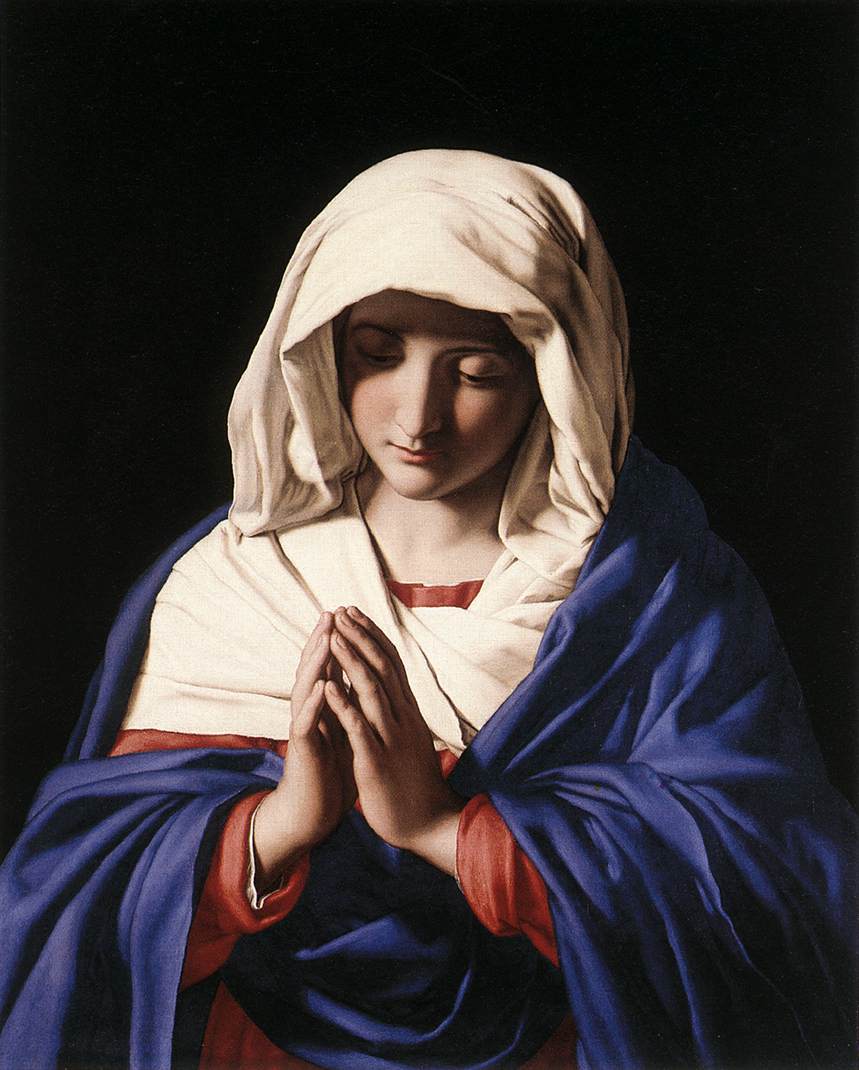
—Venerable Fulton Sheen (1895–1979 A.D.)
in The World’s First Love: Mary, Mother of God
How Many Will Be Saved?
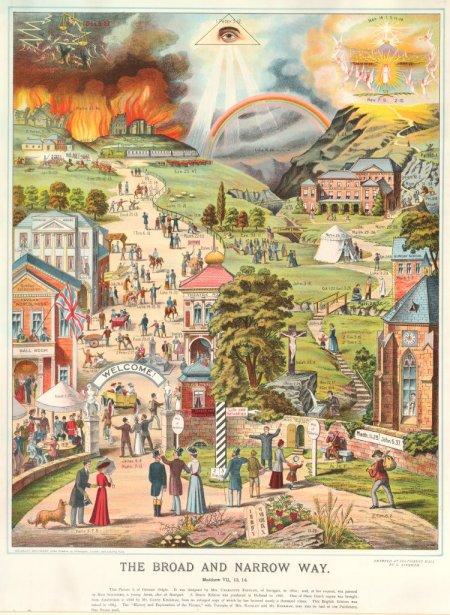
August 19, 2016In this Sunday’s gospel, someone asks Jesus from the crowd, “Lord, will only a few people be saved?” Jesus replies, “Strive to enter through the narrow gate, for many, I tell you, will attempt to enter but will not be strong enough.” (Luke 13:24) Instead of quoting some particular figure, like one million or ten billion souls, Jesus says, “Strive to enter through the narrow gate…” We are left to wonder: in the end, will the number saved be numerous or few?
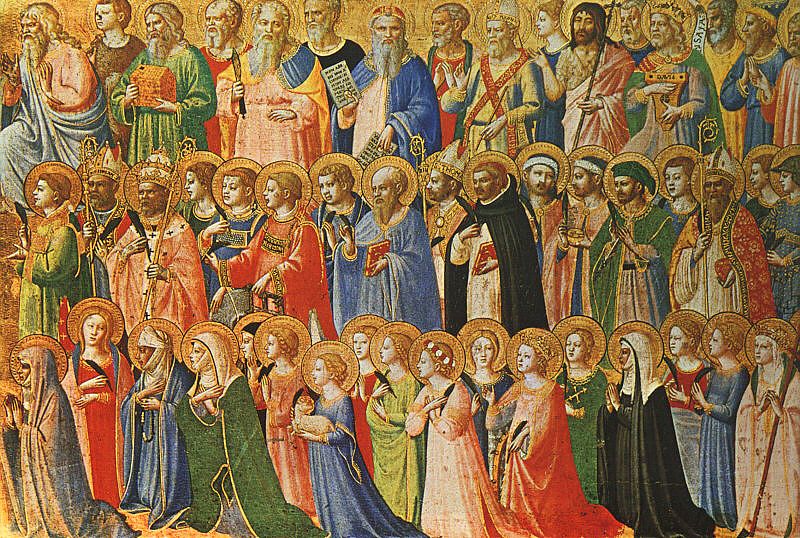 In the Book of Revelation, St. John witnesses a vast number of saints worshiping God in heaven. He beholds “a vision of a great multitude, which no one could count, from every nation, race, people, and tongue.” (Revelation 7:9) Note that this ‘countless multitude’ is different and much larger than the “one hundred and forty-four thousand marked from every tribe of the Israelites” that St. John enumerates several verses before. Jesus came to save souls not only from the twelve tribes of Israel. As the Lord declares through the prophet in Sunday’s first reading, “I come to gather nations of every language; they shall come and see my glory.” (Isaiah 66:18) Based on this, we can confidently say that a great number will be saved.
On the other hand, in our gospel’s parallel passage from St. Matthew, Jesus says, “Enter through the narrow gate; for the gate is wide and the road broad that leads to destruction, and those who enter through it are many. How narrow the gate and constricted the road that leads to life. And those who find it are few.” (Matthew 7:13-14) The ‘few’ who enter the narrow gate to life sounds smaller than the ‘many’ who do not. Based on this, it would seem that the number saved will be comparatively small.
However, “few” and “many” are relative terms which depend upon the context. For example, more than 18,000 Olympic medals have been awarded in the modern Summer and Winter Games and that is indeed many. But how many Olympic medalists have you personally ever met? Probably, at most, only a few. In a more tragic example, around 130,000 Americans die annually in accidents and that is awfully many. But at the same time, roughly 99.96% of Americans do not perish in accidents each year, making the 0.04% who do a relative few. The word “many” sometimes refers to a majority of people, but not always.
Jesus Christ suffered and died on the cross to redeem all mankind. Even if there were only one sinner on earth in all of human history, it seems that Jesus would have become man in order to offer himself for just him, or her, or you. Suppose that the number of human souls condemned on the last day turns out to be only a dozen. Knowing how much our Lord loves each and every person, will not those twelve feel like many in the heart of Jesus and those billions he saves seem too few? In any case, Jesus never reveals to us whether most human beings will be saved or lost. Either outcome is possible.
Why was Jesus not more clear about exactly how many people would be saved? Because he knew how such knowledge would be harmful for us. He knew that if we were told that most people would be saved in the end, it would lead us into dangerous presumption. If we were told that most people would be lost, he knew it would lead us into poisonous despair. Jesus “did not need anyone to testify about human nature. He himself understood it well.” (John 2:25)
Instead of providing us with some number or percentage, Jesus gives us some much more valuable and beneficial advice: “Strive to enter through the narrow gate (for whether you are saved or not depends, in part, upon you.)” God “wills everyone to be saved and to come to knowledge of the truth.” (1st Timothy 2:4) And to “as many as did accept him, [Jesus] gave power to become children of God.” (John 1:12) Let us strive to cooperate with God, let us accept the Lordship of Jesus Christ in our lives, so that we may be numbered among “the few” who are saved and enter into life.
The Divided Household of Luke 12
August 12, 2016In Luke 12:51-53, Jesus tells his disciples:
“Do you think that I have come to establish peace on the earth? No, I tell you, but rather division. From now on a household of five will be divided, three against two and two against three; a father will be divided against his son and a son against his father, a mother against her daughter and a daughter against her mother, a mother-in-law against her daughter-in-law and a daughter-in-law against her mother-in-law.”
What do the family dynamics within this divided household look like? For starters, exactly how many people are we talking about? St. Ambrose (337-397 AD) clarifies this point:
“Though the connection would seem to be of six persons, father and son, mother and daughter, mother-in-law and daughter-in-law, yet are they five, for the mother and the mother-in-law may be taken as the same, since she who is the mother of the son, is the mother-in-law of his wife.”
Jesus describes these five persons as divided into two factions, “three against two and two against three.” We learn from his further details that the father opposes his son, while the mother opposes the other two females. Depending on whether this father and mother are allied or not, their household could be divided in two possible patterns.

Figure 1 shows the family split generationally, with the parents set against the children. In Figure 2, the fractures cut between the couples. (Jesus not mentioning marital strife suggests the first interpretation and this is the favored reading of St. Bede,1 yet the ambiguity of these passages may well be intentional.2) In any case, Jesus is the occasion for this household’s divisions. One side (either the blue or the orange) rejects him while the other acknowledges him as Lord. Sometimes one’s allegiance to Christ leads to interpersonal conflict, even within families.
This prompts St. Ambrose to ask:
“Are we to believe that [our Lord] has commanded discord within families? How is he our peace, who has made both one? How does he himself say, ‘My peace I give you, my peace I leave you,’ if he has come to separate fathers from sons and sons from fathers by the division of households? How is he cursed who dishonors his father and devout who forsakes him?”
St. Ambrose unknots the seeming paradox in this way:
“It is necessary that we should esteem the human less than the divine. If honor is to be paid to parents, how much more to your parents’ Creator, to whom you owe gratitude for your parents! … He does not say children should reject a father but that God is to be set before all. … You are not forbidden to love your parents, but you are forbidden to prefer them to God.”
People sometimes hesitate to commit to Christian lifestyle changes, pursue their God-given vocations, or enter Christ’s Catholic Church because they fear the reactions of family, friends, or others. But even if following Jesus Christ entails sacrifices, these persons should not be afraid to place God first. Notice how the Lord does not say “five will be divided, four against one and one against four.” When three unbelievers pit themselves against two faithful ones, the pair are blessed with each other’s support. Should your family disown you, the Lord will summon faithful friends to your side. Even if your friends should leave you, the Lord provides you with the household of believers in his Church. Even if your parish community should fail to welcome or support you, the Lord will not make you stand alone — for Jesus Christ is always at your side and will never abandon you.
Footnotes:
1. St. Bede (672-735 AD) assumes Figure 1 for his allegorical interpretation of the Divided Household:
“By three are signified those who have faith in the Trinity, by two the unbelievers who depart from the unity of the faith. But the father is the devil, whose children we were by following him, but when that heavenly fire came down, it separated us from one another, and showed us another Father who is in heaven. The mother is the Synagogue, the daughter is the Primitive Church, who had to bear the persecution of that same synagogue, from whom she derived her birth, and whom she did herself in the truth of the faith contradict. The mother-in-law is the Synagogue, the daughter-in-law the Gentile Church, for Christ the husband of the Church is the son of the Synagogue, according to the flesh. The Synagogue then was divided both against its daughter-in-law, and its daughter, persecuting believers of each people. But they also were divided against their mother-in-law and mother, because they wished to abolish the circumcision of the flesh.”
2. Perhaps our Lord (in preaching these words) and the Holy Spirit (in inspiring these Lucan passages) fully-intended this ambiguity. By providentially allowing for both readings (i.e., Figures 1 & 2) this teaching can reflect more varieties of interfamily conflict: spousal, sibling, in-law, parental and filial.
Perspective for Our Times
August 9, 2016“It was the best of times, it was the worst of times, it was the age of wisdom, it was the age of foolishness, it was the epoch of belief, it was the epoch of incredulity, it was the season of Light, it was the season of Darkness, it was the spring of hope, it was the winter of despair, we had everything before us, we had nothing before us, we were all going direct to Heaven, we were all going direct the other way – in short, the period was so far like the present period, that some of its noisiest authorities insisted on its being received, for good or for evil, in the superlative degree of comparison only.”
So begins Charles Dickens’ A Tale of Two Cities. Our time is a mixture of good things and bad. In some ways we’re progressing, while in others we’re in decline. Some despair, but the trials of past generations were far worse than ours. As St. Augustine of Hippo (354-430 A.D.) observed:
“Is there any affliction now endured by mankind that was not endured by our fathers before us? What sufferings of ours even bears comparison with what we know of their sufferings? And yet you hear people complaining about this present day and age because things were so much better in former times. I wonder what would happen if they could be taken back to the days of their ancestors–would we not still hear them complaining? You may think past ages were good, but it is only because you are not living in them.”
There has been no perfect “Golden Age” since Eden. We learn from the New Testament that even the first-century Christian communities had controversies within and persecutions from without. Yet pining for a romanticized past pairs with an opposite, pervasive error today: thinking that “old things” have nothing to teach or offer us. C.S. Lewis noted this modern disposition in 1955:
“…Chronological snobbery [is] the uncritical acceptance of the intellectual climate common to our own age and the assumption that whatever has gone out of date is on that account discredited. You must find why it went out of date. Was it ever refuted (and if so by whom, where, and how conclusively) or did it merely die away as fashions do? If the latter, this tells us nothing about its truth or falsehood. From seeing this, one passes to the realization that our own age is also ‘a period,’ and certainly has, like all periods, its own characteristic illusions. They are likeliest to lurk in those widespread assumptions which are so ingrained in the age that no one dares to attack or feels it necessary to defend them.”
The ignorant dismissal of the past leads to foolishness today. All advocate for change, but not all change is progress. For example, naively tearing down the wrong fences can permit evils to get in. G.K. Chesterton wrote in 1929:
“In the matter of reforming things, as distinct from deforming them, there is one plain and simple principle; a principle which will probably be called a paradox. There exists in such a case a certain institution or law; let us say, for the sake of simplicity, a fence or gate erected across a road. The more modern type of reformer goes gaily up to it and says, “I don’t see the use of this; let us clear it away.” To which the more intelligent type of reformer will do well to answer: “If you don’t see the use of it, I certainly won’t let you clear it away. Go away and think. Then, when you can come back and tell me that you do see the use of it, I may allow you to destroy it.”
We live in a time filled with serious problems and great blessings. We have grave reasons for concern, such as the present threats to religious liberty and the persistent Culture of Death, but we should not despair. Not only do we know Who wins in the end, but even today’s broken world has good things to offer. Computers are facilitating new technologies and improved communications. Healthcare advances are saving and enhancing lives. International economic development is helping billions rise from poverty. Imagine how these modern-day advances in communication, healthcare, economic wealth, and other fields could be utilized for the Kingdom of God. Jesus once asked his disciples:
“Do you understand all these things?” They answered, “Yes.” And he replied, “Then every scribe who has been instructed in the kingdom of heaven is like the head of a household who brings from his storeroom both the new and the old.” (Matthew 13:51-52)
To keep proper perspective today we must be neither naive nor despondent. We should be conscious of both the dangers and the opportunities around us. These present times will surely try us, but there has yet to be an era of the Church that has not tested the saints. Our generation is called to be faithful witnesses to Christ’s Church and Sacred Tradition. As Scripture says:
“Anyone who is so ‘progressive’ as not to remain in the teaching of the Christ does not have God; [but] whoever remains in the teaching has the Father and the Son.” (2nd John 1:9)
The world may refuse to heed us as it recklessly marches on but we can still benefit ourselves, for this life and the next, by holding on to timeless truths. Our Church has persevered through controversies and persecutions from its beginning. It challenged the Roman culture while making use of the best things it had to offer to introduce and spread the Kingdom of God on earth. That Kingdom endures to our day. By keeping what is good and rejecting what is evil, let us remain ever-faithful to Jesus Christ in our times.

August 14th Parish Bulletin
August 9, 2016The St. Wenceslaus parish bulletin (PDF) for the 20th Sunday in Ordinary Time on August 14th, 2016.
Our Pilgrimage to the Shrine
August 4, 2016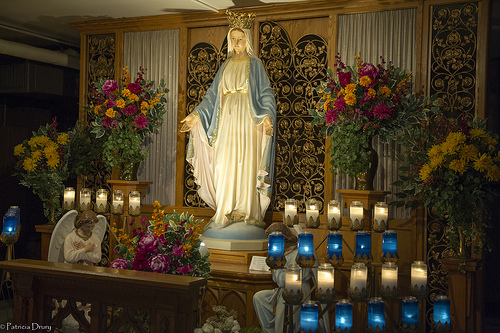 Register for our Tuesday, August 16th pilgrimage to The Shrine of Our Lady of Good Help outside of Green Bay. Our bus will depart from St. Wenceslaus’ parking lot at 7:30 AM and return there about 7:30 PM the same day. This pilgrimage is free, but you must mail (P.O. Box 109, Eastman WI 54626) or deliver a deposit to St. Wenceslaus to reserve your spots on the bus ($15 per person or $75 per family, whichever is less.) This check will be returned to you if and when you attend the pilgrimage. Required release forms for minors are available in the back of church or may be downloaded here. Remember to pack sack lunches. Please contact Father with any additional questions.
The Virgin Mary’s Wisconsin Apparition in 1859
August 4, 2016This account is according to Sister Pauline LaPlant, to whom the visionary, Adele Brise, often told her story:
She [Adele] was going to the grist mill about four miles from here [Champion] with a sack of wheat on her head […]. As Adele came near the place, she saw a lady all in white standing between two trees, one a maple, the other a hemlock. Adele was frightened and stood still. The vision slowly disappeared, leaving a white cloud after it. Adele continued on her errand and returned home without seeing anything more. She told her parents what had happened, and they wondered what it could be — maybe a poor soul who needed prayers?
On the following Sunday, she had to pass here again on her way to Mass at Bay Settlement, about eleven miles from her home […]. This time, she was not alone, but was accompanied by her sister Isabel and a neighbor woman [Mrs. Vander Niessen]. When they came near the trees, the same lady in white was at the place where Adele had seen her before. Adele was again frightened and said, almost in a tone of reproach, “Oh, there is that lady again.”

The Visionary, Adele Brise, 1831-1896
Adele had not the courage to go on. The other two did not see anything, but they could tell by Adele’s look that she was afraid. They thought, too, that it might be a poor soul that needed prayers. They waited a few minutes, and Adele told them it was gone. It had disappeared as the first time, and all she could see was a little mist or white cloud. After Mass, Adele went to confession and told her confessor how she had been frightened at the sight of a lady in white. He [Father William Verhoef] bade her not to fear, and to speak to him of this outside of the confessional. Father Verhoef told her that if it were a heavenly messenger, she would see it again, and it would not harm her, but to ask in God’s name who it was and what it desired of her. After that, Adele had more courage. She started home with her two companions, and a man who was clearing land for the Holy Cross Fathers at Bay Settlement accompanied them.
As they approached the hallowed spot, Adele could see the beautiful lady, clothed in dazzling white, with a yellow sash around her waist. Her dress fell to her feet in graceful folds. She had a crown of stars around her head, and her long, golden, wavy hair fell loosely around her shoulders. Such a heavenly light shone around her that Adele could hardly look back at her sweet face. Overcome by this heavenly light and the beauty of her amiable visitor, Adele fell on her knees.
“In God’s name, who are you and what do you want of me?” asked Adele, as she had been directed.
“I am the Queen of Heaven, who prays for the conversion of sinners, and I wish you to do the same. You received Holy Communion this morning, and that is well. But you must do more. Make a general confession, and offer Communion for the conversion of sinners. If they do not convert and do penance, my Son will be obliged to punish them.”
“Adele, who is it?” said one of the women. “O why can’t we see her as you do?” said another weeping.
“Kneel,” said Adele, “the Lady says she is the Queen of Heaven.” Our Blessed Lady turned, looked kindly at them, and said, “Blessed are they that believe without seeing. What are you doing here in idleness…while your companions are working in the vineyard of my Son?”
“What more can I do, dear Lady?” said Adele, weeping.
“Gather the children in this wild country and teach them what they should know for salvation.”
“But how shall I teach them who know so little myself?” replied Adele.
“Teach them,” replied her radiant visitor, “their catechism, how to sign themselves with the sign of the Cross, and how to approach the sacraments; that is what I wish you to do. Go and fear nothing. I will help you.”
The manifestation of Our Lady then lifted her hands, as though beseeching a blessing for those at her feet, and slowly vanished, leaving Adele overwhelmed and prostrate on the ground.
When the news spread about Adele Brise’s vision of the Blessed Virgin, most people believed the account and were astonished. Some considered the event a demented delusion. Adele Brise, however, considered it a commission to catechize the children and admonish the sinners of the Bay Settlement. To honor the alleged apparition, Adele’s father erected a makeshift chapel near the spot of Adele’s vision.
August 7th Parish Bulletin
August 4, 2016The St. Wenceslaus parish bulletin (PDF) for the 19th Sunday in Ordinary Time on August 7th, 2016.
Be Rich In What Matters — 18th Sunday of Ordinary Time—Year C
July 30, 2016
The Parable of the Rich Fool by Rembrandt, 1627.
A large crowd surrounds Jesus as he preaches and teaches. During a brief pause, a man in the crowd says to Jesus, “Teacher, tell my brother to share the inheritance with me!” Presumably, his brother is there amongst them as well (otherwise how could Jesus reprove him?) Yet the Lord replies to the man, “Friend, who appointed me as your judge and arbitrator?” That seems like an odd response from Jesus. Is Jesus denying his own authority? On a different occasion, Jesus stated, “If I should judge, my judgment is valid, because I am not alone, but it is I and the Father who sent me.” Imagine if the man in the crowd had answered Jesus’ rhetorical question, “Friend, who appointed me as your judge and arbitrator?” The man might say, “Well Teacher, we think you’re God’s prophet, so you speak for God.”
To this, Jesus could reply, “Indeed, the words that I speak to you I do not speak on my own. But if you accept that I am God’s prophet, that I speak for God, then listen and heed all that I teach, not just the things you want to hear. On the last day, when I return in my glory with all the angels with me, I will sit upon my glorious throne with all peoples assembled before me and I shall judge and separate the righteous and the unrighteous, one from another, as a shepherd separates the sheep from the goats. Yet, my Father God did not send me into this world to condemn the world, but that the world might be saved through me.”
In our Gospel, Jesus goes on to tell the crowd (including those two feuding brothers): “Take care to guard against all greed, for though one may be rich, one’s life does not consist of possessions.” Jesus is warning the crowd, the brothers, and us that ‘personal bitterness and earthly greed will hinder you from entering the Kingdom.’ Rather, we must keep a heavenly perspective. As St. Paul urges in our second reading, “seek what is above, where Christ is seated at the right hand of God. Think of what is above, not of what is on earth.”
Of course, we all have material needs as human beings here on earth —we’re not angels and we need our daily bread. So Jesus teaches us to practice prudent stewardship, marked by frugality, generosity, and a trust in the Lord that frees us from worthless worrying. However, both Jesus in our Gospel and King Solomon in our first reading note the futility of amassing riches for ourselves.
Jesus tells a parable of “a rich man whose land produced a bountiful harvest. He asked himself, ‘What shall I do, for I do not have space to store my harvest?’” (Notice how “He asked himself, ‘What shall I do?” The man does not look beyond himself for holy wisdom or guidance.)
“And [then the rich man] said, ‘This is what I shall do: I shall tear down my barns and build larger ones.” (Why does he need to tear down his old barns? Does not the rich man, who just reaped a bountiful harvest, own plenty of land on which to build more barns? It seems his vanity desires to tear down the old barns so that his new barns may be huge and impressive.)
The rich man continues his conversation with himself, “[In my new barns] I shall store all my grain and other goods and I shall say to myself, ‘Now as for you, you have so many good things stored up for many years, rest, eat, drink, be merry!’” (He shows no thought for his family or friends, his neighbors or the needy, only his own personal pleasure.)
The rich man has made grand plans for himself, but God says to him, “You fool, this night your life will be demanded of you!” If this man is only interested in his own will, his own glory, and his own happiness in this life, then how will he love his neighbors, hallow God’s name, or desire God’s will in the next life?
To find ourselves at home in Heaven someday we should seek and follow God’s will for our time, talents, and treasure today. We should practice faithful stewardship, with prudence and trust, frugality and generosity. And this stewardship should include tithing and supporting worthy causes—not to buy Heaven (for God cannot be bribed or bought) but in order to become more virtuous and loving, to become more fit for Heaven. Those who store up treasure for themselves on earth profit nothing in the end. Let us not be foolish. Let us instead become rich in what matters to God by becoming more like Jesus, who has been so generous to us.
July 31st Parish Bulletin
July 27, 2016The St. Wenceslaus parish bulletin (PDF) for the 18th Sunday in Ordinary Time on July 31st, 2016.
The Cure d’Ars on the Holy Mass
July 27, 2016
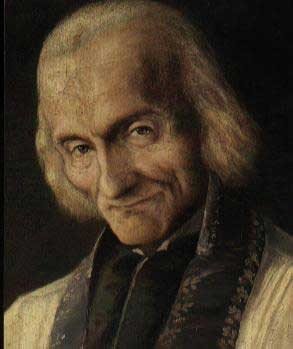
“All the good works in the world are not equal to the Holy Sacrifice of the Mass because they are the works of men; but the Mass is the work of God. Martyrdom is nothing in comparison for it is but the sacrifice of man to God; but the Mass is the sacrifice of God for man.”
“If we could comprehend all the good things contained in Holy Communion, nothing more would be wanting to content the heart of man. The miser would run no more after his treasures, or the ambitious after glory; each would shake off the dust of the earth, leave the world, and fly away towards heaven.”
—St. John Vianney
History’s Ten Wealthiest People and the Vanity of Riches
July 27, 2016In estimated billions of present-day dollars
- Cornelius Vanderbilt ($185, died 1877)
This railroad tycoon’s only large philanthropic gift gave about 1% of his fortune to build Vanderbilt University.
- Henry Ford ($199, died 1947)
This deceased automaker’s name survives on vehicles seen upon every road and junkyard.
- Muammar Gaddafi ($200, died 2011)
This dictator of Libya, after being discovered hiding in a desert culvert, was killed by his people.
- Jakob Fugger “the Rich” ($221, died 1525)
While he lived, this German merchant-financier declared, “The king reigns, but the bank rules!“
- William The Conqueror ($229, died 1087)
After killing many to capture England, this Duke of Normandy, France joined the dead.
- Mir Osman Ali Khan ($230, died 1967)
As head of the state of Hyderabad, India, he used a 185-carat diamond as a paperweight.
- Czar Nikolas II ($300, died 1918)
This Russian ruler was assassinated along with his family by communist revolutionaries.
- Andrew Carnegie ($310, died 1919)
This steel magnate and philanthropist said, “The man who dies rich dies disgraced.”
- John D. Rockefeller ($340, died 1937)
He sold oil drawn from Ohio’s earth and now lays buried in the same.
- Mansa Musa I ($400, died 1337)
This African king of Mali was the richest man to ever live. But have you ever heard of him?
Psalm 49:7-12 :
“No man can buy his own ransom, or pay a price to God for his life. The ransom of his soul is beyond him. He cannot buy life without end, nor avoid coming to the grave. He knows that wise men and fools must both perish and must leave their wealth to others. Their graves are their homes for ever, their dwelling place from age to age, though their names spread wide through the land. In his riches, man lacks wisdom; he is like the beasts that are destroyed.”
Abraham’s Intercessions for Sodom & Gomorrah
July 23, 2016A Mathematical Analysis of Genesis 18:22-33
Conversation
|
Bid # for Innocents |
# Decrease |
% Decrease |
Factional Decrease |
|
1st |
50 |
– |
– | – |
|
2nd |
45 |
5 |
10% | 1/10 |
|
3rd |
40 |
10 |
11.111% | 1/9 |
|
4th |
30 |
10 |
25% | 1/4 |
|
5th |
20 |
10 |
33.333% | 1/3 |
|
6th |
10 |
10 |
50% | 1/2 |
Holymon Go!
July 22, 2016Can you catch sight of each of the following persons or things depicted in the interior of St. Wenceslaus Church?
- Our single depiction of St. John the Baptist.
- The two appearances of St. Joseph.
- The Holy Spirit twice in the form of a dove.
- The two depictions of the devil as a serpent.
- How many halos are surrounding holy heads?
- How many depictions of St. Mary are here?
- How many angels do we have?
- How many images of Jesus are in our church?
Holymon Go! Answers
(Highlight to reveal):
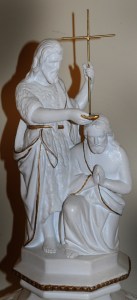 His statue appears atop our Baptistery.
- His statue and in a stained-glass window.
- He has this likeness in two of our windows.
- Under Mary’s feet; in a window and a statue.
- Our stained-glass windows depict twenty-four halos.
- Ten. (5 in windows, 4 in stations, and 1 statue, not including her Immaculate Heart window.)
- Six. (4 tabernacle statues and 2 in windows.)
- Twenty-three. (14 stations, 5 windows, 2 statues, and 2 crucifixes, not including sanctuary images of his Sacred Heart or the Eucharist.)


