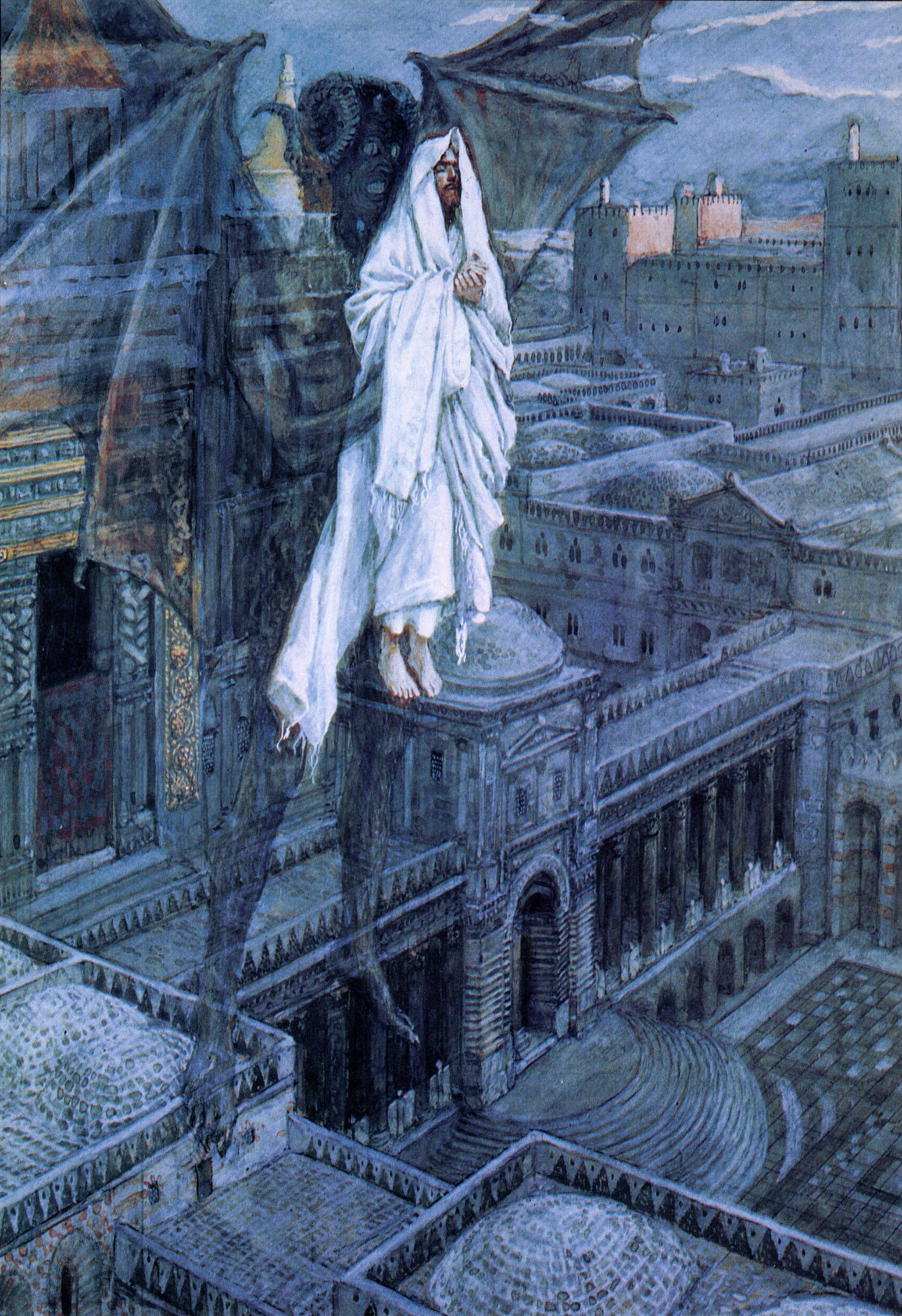
Refusing Signs — Monday, 6th Week of Ordinary Time—Year II

February 17, 2014

Readings: James 1:1-11, Mark 8:11-13

The Pharisees came forward and began to argue with Jesus, seeking from him a sign from heaven to test him. He sighed from the depth of his spirit and said, “Why does this generation seek a sign? Amen, I say to you, no sign will be given to this generation.

Yet, soon before this scene in Mark’s Gospel, Jesus took seven loaves and a few fish and miraculously fed about 4,000 people with them. That is a sign as surely as his resurrection will be, so how can Jesus say “no sign will be given to this generation”? Perhaps because there was no sign that his critics would accept.

The Pharisees sought “a sign from heaven.” If Jesus had performed some meteorological sign for them they may well have judged him as more evil than they had thought, in union with the demons of the air, just as they had condemned his manifest power to cast out demons. (Mark 3:21-30) They asked for proof but refused to accept evidence in his favor–they were of people of two minds, like St. James describes in the first reading:

But if any of you lacks wisdom, he should ask God who gives to all generously and ungrudgingly, and he will be given it. But he should ask in faith, not doubting, for the one who doubts is like a wave of the sea that is driven and tossed about by the wind. For that person must not suppose that he will receive anything from the Lord, since he is a man of two minds, unstable in all his ways.

Let us pray for those who do not believe; for the sincere, that they may be given sufficient evidence to change their minds, and for the obstinate, that their hardened hearts may be opened. And let us who believe in God (as even the Pharisees did) not cause Jesus to “[sigh] from the depth of his spirit.” Let us be trusting and docile in following him.

Catholicism

February 14, 2014
  • We love marriage and celebrate celibacy.
  • We scandalize with hard truths and easy mercy.
  • We feed the poor and hungry with food and beauty.
  • We observe days for fasting and feasting.
  • We insist that men lead as servants.
  • We help mothers and their children.
  • We respect women and men as unique and equal.
  • We condemn communism and critique capitalism.
  • We advocate for peace and, as a last resort, Just War.
  • We want everyone to go to Heaven and no one to be killed.
  • We have faith in human reason and employ reason in our Faith.
  • We believe in miracles and demons and investigate them critically.
  • We accept science and Divine Revelation.
  • We canonized God’s books and canonize His saints.
  • We honor Jesus’ Father and mother like He did, as our own.
  • We pray for living and dead neighbors and ask their prayers for us.

Increasing Intimacy in your Marriage & Home

February 13, 2014

Physical intimacy is an important aspect of marriage, but it is certainly not the only kind of intimacy. A marriage in which the intimacy shared is exclusively physical will not endure. The acronym “SPICE” contains five modes of sharing intimacy: Spiritual, Physical, Intellectual, Creative, and Emotional. Sharing your prayers, touches, ideas, projects, and feelings are all important elements to keeping your marriage strong.

Another issue in relationships between spouses and within households comes in how love is expressed and received. Gary Chapman’s 1995 book, “The Five Love Languages: How to Express Heartfelt Commitment to Your Mate,” suggests that people prefer to receive love in different ways. Chapman describes five main ways, or languages, by which love is experienced: Gifts, Quality Time, Acts of Service, Words of Affirmation, and Physical Touch. Some people feel love most deeply when their spouses help around the house and with the kids (Acts of Service) but feel little thrill from receiving gifts, such as golf clubs or jewelry.

A problem arises when people understandably, but mistakenly, assume that the significant others in their lives receive love best through the same love language as themselves. They try to love their neighbor just like themselves without realizing that their love languages differ. For instance, people whose main love language is Quality Time may feel neglected or even abandoned, despite their spouses’ tender caresses and sincere compliments, if not enough time is shared together between them at home. Knowing another’s love language allows you to love them in the manner they most want to be loved.

  • What are your top-two favorite Love Languages?
  • Can you guess what your spouse and children’s top Love Languages are?
  • Share your answers with each other—you may discover something new.
  • How can you add more SPICE, more Spiritual, Physical, Intellectual, Creative, and Emotional Intimacy, into your marriage and your home?

The Importance of Praise — Wednesday, 5th Week of Ordinary Time—Year II

February 12, 2014

Readings: 1 Kings 10:1-10, Mark 7:14-23

Solomon & the Queen of Sheba, Pleased to Meet Each Other.The Queen of Sheba was genuinely impressed by King Solomon and told him so: “The report I heard in my country about your deeds and your wisdom is true,” she told the king. “Though I did not believe the report until I came and saw with my own eyes, I have discovered that they were not telling me the half. Your wisdom and prosperity surpass the report I heard. Blessed are your men, blessed these servants of yours, who stand before you always and listen to your wisdom. Blessed be the LORD, your God, whom it has pleased to place you on the throne of Israel. In his enduring love for Israel, the LORD has made you king to carry out judgment and justice.” This was not flattery, lies told to manipulate him, but real praise. The praises the Queen spoke to the son of David equally apply to Jesus Christ.

When we perceive good things in another, we should note and compliment it. Not only does this encourage and help that person, but it benefits us as well; it increases our humility, gratitude, and joy. We should especially praise God, not because He needs it (though He appreciates it,) but because the praise which comes “from within the man, from his heart,” helps to sanctify him. As one Mass Preface says, “You have no need of our praise, yet our desire to thank You is itself Your gift. Our prayer of thanksgiving adds nothing to Your greatness, but makes us grow in Your grace, through Jesus Christ our Lord.”

Praying For Rain — February 10 — St. Scholastica

February 10, 2014

While some people only pray when they need or want something, others pray frequently but hesitate to ask anything for themselves. Like the Prodigal Son’s older brother, these think it more proper to never ask God for special gifts (not “even a young goat to feast on with” their friends.) However, the Office of Readings selection for St. Scholastica written by St. Pope Gregory the Great shows us that God is pleased to give His children the good gifts they request:

Scholastica, the sister of Saint Benedict, had been consecrated to God from her earliest years. She was accustomed to visiting her brother once a year. He would come down to meet her at a place on the monastery property, not far outside the gate. One day she came as usual and her saintly brother went with some of his disciples; they spent the whole day praising God and talking of sacred things. As night fell they had supper together.

Their spiritual conversation went on and the hour grew late. The holy nun said to her brother: “Please do not leave me tonight; let us go on until morning talking about the delights of the spiritual life.” “Sister,” he replied, “what are you saying? I simply cannot stay outside my cell.” When she heard her brother refuse her request, the holy woman joined her hands on the table, laid her head on them and began to pray. As she raised her head from the table, there were such brilliant flashes of lightning, such great peals of thunder and such a heavy downpour of rain that neither Benedict nor his brethren could stir across the threshold of the place where they had been seated. Sadly he began to complain: “May God forgive you, sister. What have you done?” “Well,” she answered, “I asked you and you would not listen; so I asked my God and he did listen. So now go off, if you can, leave me and return to your monastery.” Reluctant as he was to stay of his own will, he remained against his will. So it came about that they stayed awake the whole night, engrossed in their conversation about the spiritual life.

It is not surprising that she was more effective than he, since as John says, God is love, it was absolutely right that she could do more, as she loved more. Three days later, Benedict was in his cell. Looking up to the sky, he saw his sister’s soul leave her body in the form of a dove, and fly up to the secret places of heaven. Rejoicing in her great glory, he thanked almighty God with hymns and words of praise. He then sent his brethren to bring her body to the monastery and lay it in the tomb he had prepared for himself. Their minds had always been united in God; their bodies were to share a common grave.

Of Earth & The Universe — 5th Sunday in Ordinary Time—Year A

February 9, 2014

Literally, from the Greek:

You are the salt of the [ground] … You are the light of the [cosmos.]”

A Christian’s ordinary life on earth reveals the divine light responsible for the universe.

Stained Glass Symbols — The Dove

February 9, 2014

Holy Spirit Dove - Sacred Heart Catholic Church -  Wauzeka WIA Symbol of the Holy Spirit

From the Ark, at the time of the Flood, Noah released a dove three times to scout for land. The bird’s return with a fresh olive leaf in its beak signaled an end to the deadly judgment and the beginning of new life. Noah’s dove revealed that peace was restored between heaven and earth. When Jesus was baptized in the Jordan River by John the Baptist, they saw the Holy Spirit descend in bodily form, like a dove, and land upon Christ. By receiving Christ’s baptism, the Holy Spirit comes to rest on us, pouring into us the new life and graces of the Trinity.

Stained Glass Symbols — The Host & Chalice

February 8, 2014

Host and Chalice - Sacred Heart Catholic Church -  Wauzeka WIA Symbol of Christ’s Death

Jesus Christ is really and truly present in the Eucharist Host and chalice, yet the Host and chalice are symbolic as well. At the Last Supper, Jesus took bread, broke it, and said, “This is my body, which will be given up for you.” Then he took a chalice of wine and said, “This is the chalice of my blood… which will be poured out for you…” When a living creature’s blood is separated from its broken body, death naturally follows. Though Christ’s Body, Blood, Soul, and Divinity are fully present in every fragment of the Host and in every drop of the chalice, the symbolic separation of Jesus’ body and blood points to his sacrificial death.

Stained Glass Symbols — The Ten Commandments

February 7, 2014

Ten Commandments - Sacred Heart Catholic Church -  Wauzeka WIA Symbol of God’s Laws

The two stone tablets Moses brought down from Mount Sinai were not inscribed with Roman numerals, but this is how God’s Ten Commandments, the Decalogue, are often symbolized. Why are #1 through #3 (I, II, III) on one tablet, while #4 through #10 are depicted on the other? This is because the first three commandments relate primarily to God, while the latter seven relate to our neighbors.

Stained Glass Symbols — The Temple Menorah

February 6, 2014

Temple Menorah - Sacred Heart Catholic Church -  Wauzeka WIA Symbol of Christ

Menorah is the Hebrew word for “Candlestick.” You may be familiar with the nine-branched menorahs Jews employ to celebrate Hanukah, the “Festival of Lights,” however the menorah above features seven branches. This is the design God gave to Moses when commanding him to have a lampstand fashioned to stand within His tabernacle in the desert. (Exodus 25) Later, this pure gold lampstand lit the sanctuary of the Jewish Temple in Jerusalem. Christians see in the temple menorah a sign of Christ, the Light of the World, who is always in the Father’s presence.

It is from a story about the temple menorah that the feast of Hanukah comes. In the second century BC, the Greeks profaned the temple with pagan sacrifices and tried to force the Jews to abandon their faith. One family, called the Maccabees, rose up against their Greeks oppressors, defeated them, and rededicated the Jerusalem Temple in 165 BC. When those Jews relit the temple’s sanctuary lamp they could supply it with only one-day’s worth of olive oil and it would take a week to prepare more. Yet, the temple menorah kept miraculously burning for eight days until the new oil was ready. Rather than olive oil, Hanukah menorahs burn nine candles: one for each of the eight nights and one central candle from which the others are lit.

Stained Glass Symbols — The Sailboat

February 5, 2014

Sailboat - Sacred Heart Catholic Church -  Wauzeka WIA Symbol of the Church

Like Noah’s Ark, the Church carries God’s people through the world’s deadly and chaotic waters. The Holy Spirit fills the sails of this “barque (boat) of St. Peter,” guiding her course through time and leading her safely to the distant shore of Heaven.

Stained Glass Symbols — “IHS”

February 4, 2014

IHS - Sacred Heart Catholic Church -  Wauzeka WIA Symbol for Jesus’ Holy Name

In Greek, the name “Jesus” is spelled “ΙΗΣΟΥΣ.” These first three Greek letters were Latinized into “IHS,” forming a symbol for the Holy Name of Jesus.

Stained Glass Symbols — The Ichthys Fish

February 3, 2014

Ichthys Fish - Sacred Heart Catholic Church -  Wauzeka WIA Summary of Our Faith

The early Christians used the fish as a symbol for Christianity. The Greek word for fish is “Ichthys,” or using the Greek letters: “ΙΧΘΥΣ.” The letters of this word were an acronym for a phrase summarizing some of our core Christian beliefs: “Jesus Christ, [is] God’s Son, [and our] Savior.”

Stained Glass Symbols — The Lily

February 2, 2014

Fleur-De-Lis - Sacred Heart Catholic Church -  Wauzeka WIThe Fleur-de-Lis (“Flur-d-lee”)

The Fleur-de-lis (French for “Flower of the Lily”) has had many Christian meanings. This image was adopted as a royal symbol by the kings of France, and thus it symbolizes royalty. The lily is also an ancient symbol for purity, and so the Fleur-de-lis represents our most-pure queen, the Blessed Virgin Mary. Finally, the three petals of this single flower symbolize the Holy Trinity: three divine Persons united in one God.

Stained Glass Symbols — The Star

February 1, 2014

Star - Sacred Heart Catholic Church -  Wauzeka WIA Symbol of Christ’s Coming

In ancient Old Testament times, a prophet declared, “I see him, though not now; I observe him, though not near: A star shall advance from Jacob, and a scepter shall rise from Israel…” (Numbers 24:17) Later, a psalmist mused to the Lord, “When I see your heavens, the work of your fingers, the moon and stars that you set in place—What is man that you are mindful of him, and a son of man that you care for him?” (Psalm 8:4-5) Then in the fullness of time, the God who cares for man and who set the stars according to His plan, gave a Savior to the world and announced Him by a star: “Behold, magi from the east arrived in Jerusalem, saying, ‘Where is the newborn king of the Jews? We saw his star at its rising and have come to do him homage.'” (Matthew 2:2)