Tempting the Messiah — 1st Sunday in Lent—Year A

March 7, 2014

Gospel: Matthew 4:1-11

Jesus Tempted in the Wilderness by James Tissot 1886-1894.The devil suggests Jesus should change stones into bread. He wants Jesus to be a materialistic Messiah who will focus on nourishing bodies to the neglect saving souls. Jesus replies that “one does not live on bread alone, but on every word that comes forth from the mouth of God.” Christ shall change bread into himself at the Last Supper “for the life of the world.” (John 6:51)

A depiction of Jesus being tempted at the temple by James Tissot, 1895The devil takes Jesus to a precipice atop the temple in Jerusalem and challenges him to throw himself down. He wants Jesus to be a Messiah who will hope to never suffer. Jesus responds that “you shall not put the Lord, your God, to the test” by trying to force him into doing our will. Christ shall be tested and condemned by the Sanhedrin in Jerusalem and be made a suffering Savior according to God’s plan. (Isaiah 53)

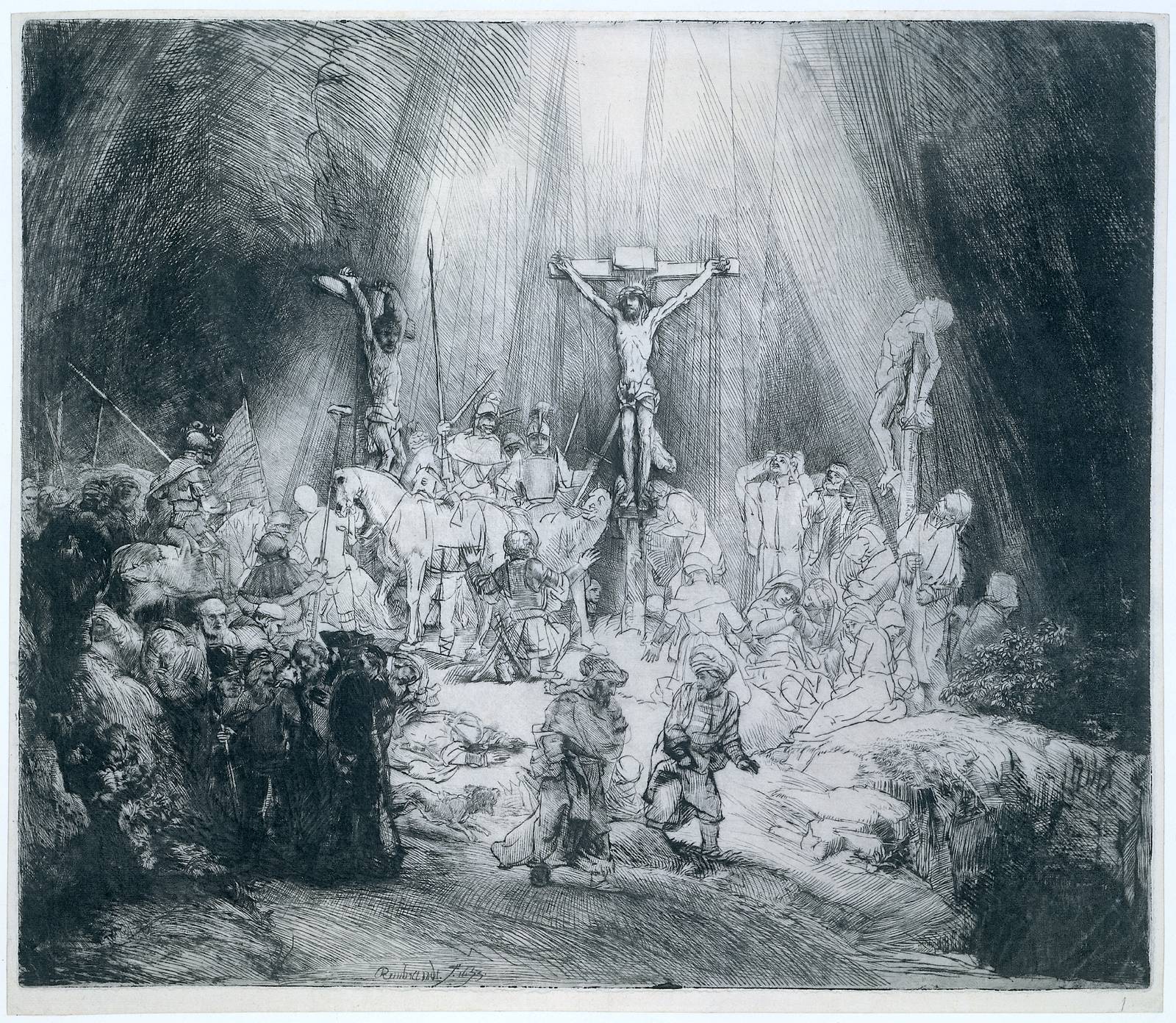
The devil takes Jesus up to a very high mountain, shows him all the kingdoms of the world, and promises to bestow them all if Jesus would simply prostrate himself and worship him. He wants Jesus to be a compromised Messiah who will pursue good by doing (or serving) evil. Jesus replies that “Lord, your God, shall you worship and him alone shall you serve.” By unwavering obedience to his heavenly Father, Christ shall become the king of all nations, enthroned high upon a cross on Mount Calvary. (Matthew 20:21)

The Seven Deadly Sins & Seven Lively Virtues

March 6, 2014

Pride is lowered by Humility

Envy is opposed by Admiration

Wrath is tamed by Forgiveness

Sloth is stopped by Zeal

Greed is relinquished by Generosity

Gluttony is moderated by Asceticism

Lust is controlled by Chastity

Which lively virtue will you focus on growing?


The Meaning of Ashes — Ash Wednesday

March 6, 2014

Both the atheist and the Christian will agree on this: we came from dust and to dust we shall return. Apart from God we have no hope, for we are dust and ashes.

The ashes on our forehead are not a beauty mark. They point to the ugliness of the sins within us. Yet they are also an appeal to God that he would wash us clean.

Fire, like sin, consumes all it touches. Our ashes are a sign of all we have lost or harmed by sin. However, Old Testament sacrifices were also offered up to God by fire. Our ashes are also a sign of our desire to sacrifice ourselves entirely to him.

We receive ashes on our forehead in the shape of a cross; ashes because we are sinners, and a cross because we are Christ’s.

One Is Enough — Tuesday, 8th Week of Ordinary Time—Year II

March 4, 2014

Gospel: Mark 10:28-31

Jesus said, “Amen, I say to you, there is no one who has given up house or brothers or sisters or mother or father or children or lands for my sake and for the sake of the Gospel who will not receive a hundred times more now in this present age: houses and brothers and sisters and mothers and children and lands, with persecutions, and eternal life in the age to come.

Jesus lists seven things people give up for him and his Gospel but only six things that we will receive a one hundred-fold more in this present age. A person might give up an earthly father for the Kingdom of God, but he or she receives in return the singular, infinite fullness of God the Father.

Questions & Answers for Lent

March 1, 2014

What Are the Lenten Fasts and Who Keeps Them?

Catholics who have celebrated their 14th birthday are to abstain from meat on Ash Wednesday, the Fridays in Lent, and Good Friday. In addition to not eating meat, Catholics who have celebrated their 18th birthday are to fast on both Ash Wednesday and Good Friday until at least their 59th birthday. Here, fasting is defined as eating just one full meal.  Two smaller meals are also allowed if necessary to maintain one’s strength, but eating solid foods between meals is not permitted. (The physically, mentally, or chronically ill, as well as pregnant or nursing women, are also excused from fasting and abstinence.)

Why the Ages 18 to 59?

Two reasons: because of the nutritional needs of the young and elderly, and because the number forty symbolizes penance and purification in the Bible.

Why Isn’t Fish Considered “Meat” on Meatless Fridays?

In times past, fish was considered a food of the poor. It took multiple pounds of grain to raise one pound of livestock, but fish were simply caught from the water. Eating fish conserved grain for others and was an act in solidarity with the poor. Today, Catholics are only obliged to abstain from (land-based) meats on certain days of Lent. However, Catholics remain obliged to offer penance on Fridays throughout the whole year; be it through fasting, abstinence, pious devotions, or loving service. Every Friday is to be a little remembrance of Good Friday.

Why is Lent Longer Than Forty Days?

There are actually 46 days from Ash Wednesday to Easter. However, every Sunday is a “little Easter” and, like all solemnities, Sundays are not considered days of penance.  As Jesus said, “Can you make the wedding guests fast while the bridegroom is with them?” (Matthew 9:15) All are free to keep Lenten penances on these days, but enjoying these respites can increase one’s devotion and joy in the Lord. Subtract the six Sundays in Lent from the total and you are left with forty days.

Prophetic Perseverance — Friday, 7th Week of Ordinary Time—Year II

February 28, 2014

Readings: James 5:9-12, Mark 10:1-12

Do not complain, brothers and sisters, about one another, that you may not be judged. Behold, the Judge is standing before the gates. Take as an example of hardship and patience, brothers and sisters, the prophets who spoke in the name of the Lord. Indeed we call blessed those who have persevered.

St. James recalls that the prophets endured the complaints, criticisms, and condemnation of their brothers and sisters. The Hebrews repeatedly complained against the prophet Moses in the desert, displeasing God and earning his serious chastisements. Perhaps Moses realized the ‘hardness of their hearts’ would incite them to reject any mandate of God’s original intention for marriage as an unbreakable lifelong union, thereby incurring severe condemnation. Yet, “blessed [are] those who have persevered” in keeping their marriage vows—blessed by God’s granting of needed graces and blessed by accepting these graces—those whose spousal “Yes” means “Yes.” What a prophetic witness their faithful love is to the world!

Cut It Out — Thursday, 7th Week of Ordinary Time—Year II

February 28, 2014

Gospel: Mark 9:41-50

Jesus said to his disciples: “Anyone who gives you a cup of water to drink because you belong to Christ, amen, I say to you, will surely not lose his reward.”

“Whoever causes one of these little ones who believe in me to sin, it would be better for him if a great millstone were put around his neck and he were thrown into the sea.”

In establishing his first covenant with Abraham, the Lord said, “I will bless those who bless you and curse those who curse you.” (Genesis 12:3) Likewise, Jesus declares that whoever does the least kindness to those in his covenant will be rewarded, while whoever leads one his own into sin faces dire consequences. Sin is a serious thing.

“If your hand causes you to sin, cut it off.”

“And if your foot causes you to sin, cut if off.”

“And if your eye causes you to sin, pluck it out.”

Of course, Jesus does not want us to mutilate ourselves because our bodily organs are not the real cause of our sins. But let us consider: what actions or material possessions do I take in hand, to what places do I go by foot, what sights do I perceive with my eyes, that are near occasions of sin for me? Let us firmly resolve with the help of God’s grace to cut these things out of our lives, so that we may be a blessing to all and a scandal to none, the salt of the earth and never cast out.

False Presumptions — Wednesday, 7th Week of Ordinary Time—Year II

February 28, 2014

Readings: James 4:13-17, Mark 9:38-40

We must be careful not to cling to false presumptions about God’s activity regarding the present or the future. It is prudent to make plans for tomorrow and also good to strive for the reunion of all Christians into Christ’s one, holy, catholic, and apostolic Church. However, James warns us not to be presumptuous about our plans (instead of remaining open to God’s will,) while Jesus reminds us that even those who “do not follow us” can ‘perform mighty deeds in his name.’ “Whoever is not against us is for us.” God is never against us, and (unusually) neither are our separated brethren.

Magnanimous, Not Petty — 7th Sunday in Ordinary Time—Year A

February 23, 2014

“Petty” comes from the French word for “small” (“petit.“) “Magnanimous” comes from the Latin words for “great” and “soul” (“magna” and “anima.“) We are not called to be small, but of great soul in our interactions with others.

Four Cheeks Turned — 7th Sunday in Ordinary Time—Year A

February 22, 2014

Gospel: Matthew 5:38-48

When attacked, our natural response is “fight or flight,” but Jesus suggests a  supernatural response: “When someone strikes you on your right cheek, turn the other one as well.” Since the Jews regarded the left hand as unclean, they would reflexively strike with the right hand. If the right cheek were hit, then one had been backhanded with contempt. Responding by turning the other cheek neither attacks not retreats, but insists on being regarded as an equal, whom one must strike (if at all) with an open hand. Jesus wants us to stand our ground in the face of injustice, assertively but lovingly, in hopes that the offender will reconsider his ways. Jesus modeled this response when he was struck during his trial before Annas:

The high priest questioned Jesus about his disciples and about his doctrine. Jesus answered him, “I have spoken publicly to the world. I have always taught in a synagogue or in the temple area where all the Jews gather, and in secret I have said nothing. Why ask me? Ask those who heard me what I said to them. They know what I said.” When he had said this, one of the temple guards standing there struck Jesus and said, “Is this the way you answer the high priest?” Jesus answered him, “If I have spoken wrongly, testify to the wrong; but if I have spoken rightly, why do you strike me?” (John 18:19-24)

Another saintly example was shown by Blessed Mother Teresa of Calcutta. Though reports vary, Mother Teresa was once begging bread from a baker for her orphanage. When the baker responded by spitting into her hand, she replied to effect, ‘I will keep this for me, but please give something for my children.’

In Victor Hugo’s Les Miserables, a bishop welcomes an impoverished convict to join his table and sleep at his home. However, that night, Jean Valjean steals his host’s silverware and goes away. The police catch him and take him to the bishop. Looking at Jean Valjean, the good bishop exclaims, “Ah! here you are! I am glad to see you. Well, but how is this? I gave you the candlesticks too, which are of silver like the rest, and for which you can certainly get two hundred francs. Why did you not carry them away with your forks and spoons?” Jean Valjean opens his eyes wide and stares at the venerable Bishop “with an expression which no human tongue can render any account of.” The bishop’s turn of the cheek spares the thief’s freedom and saves his soul.

And finally, a true story from a modern marriage: A woman’s husband had a terrible temper and every time it flared she would say, “That’s just like you to lose your temper!” But then, following a stroke of insight, she began responding differently. The next time he began to fly of the handle she told him, “That’s not like you to lose your temper,” and he nearly fell out of his chair. Even the kids looked at her funny, but she stuck with her new resolution. Months later, while at a restaurant together, he became irritated by the slow service. He started to fume about it, but then he suddenly stopped, turned to her, and said, “That’s not like me to lose my temper, is it?” This time, it is said, she nearly fell on the floor.

Was it true the first time the woman declared that it was not like her husband to lose his temper? The claim did not match his previous behavior, but perhaps he changed because she revealed to him that his uncontrolled anger was quite unlike the father, husband, and Christian man he truly and deeply wanted to be. This is the sort of realization and conversion we are to hope for in turning the other cheek.

Plus, a fifth story: “If a teen mugs you for your wallet…

Recognizing the Christ — Thursday, 6th Week of Ordinary Time—Year II

February 20, 2014

Readings: James 2:1-9, Mark 8:27-33

St. Peter confesses that Jesus is the Christ, but “the elders, the chief priests, and the scribes” reject him. Would we have recognized and welcomed the Christ when he came?  Let us consider: Do we show partiality for or against others based on their popularity or prominence?

Would we have received Jesus’ challenging teachings? All the prophets were persecuted for sharing truths people refused to hear. How do we respond when someone critiques or challenges us?

Jesus was poor and perhaps wore “shabby clothes.” Do we have any friends who are poor?

As Dorothy Day said, “We love God as much as the one we love the least.” If we want to know whether we would have recognized and welcomed the Christ we should consider whether we receive and love him now, for Jesus says, “whatever you did for one of these least brothers of mine, you did for me.” (Matthew 25)

Stained Glass Symbols — The Holy Cross

February 20, 2014

Holy Cross - Sacred Heart Catholic Church -  Wauzeka WIA Symbol of Christ’s Triumph

Jesus Christ’s cross is holy because it is the instrument he uses to save the world. The Roman Empire, in a demonstration of worldly wisdom and power, used crucifixion to humiliate, torture, and terrorize whoever would dare to oppose them. Jesus takes the cross, the worst evil the spiritual and human rulers of this world could wield against him, and employs it to achieve his victory.

Gradually Growing Trees — Wednesday, 6th Week of Ordinary Time—Year II

February 19, 2014

Readings: James 1:19-27, Mark 8:22-26

When Jesus and his disciples arrived at Bethsaida, people brought to him a blind man and begged Jesus to touch him.  He took the blind man by the hand and led him outside the village. Putting spittle on his eyes he laid his hands on the man and asked, “Do you see anything?” Looking up the man replied, “I see people looking like trees and walking.” Then he laid hands on the man’s eyes a second time and he saw clearly; his sight was restored and he could see everything distinctly.

Jesus healed the blind man gradually, and he sometimes does the same with us; transforming us over months, years, or a lifetime. The change is subtle and we fail to notice it, “like a man who looks at his own face in a mirror. He sees himself, then goes off and promptly forgets what he looked like.” If we’ve been following Jesus but doubt our own growth, let us reflect on how we used to look, months or years ago.

Halfway through his cure, the blind man beholds “people looking like trees and walking.” Perhaps this more than just a distorted perception, perhaps he sees a vision of a spiritual reality. Jesus walked and suffered with “a tree”: his cross. (Galatians 3:13) If we have the eyes to see, we recognize that every person walks with a cross of their own. So “everyone should be quick to hear, slow to speak, slow to anger,” remembering that people resemble gradually growing trees.

Stained Glass Symbols — The Triple Candelabra

February 19, 2014

Triple Candelabra - Sacred Heart Catholic Church -  Wauzeka WIA Symbol of the Holy Trinity

As a triple candelabra unites three lights, so the Holy Trinity is a united three in one. The three flames share one and the same fiery nature, as the three divine persons share the same divine substance. Like St. Patrick’s three-leafed shamrock, the triple candelabra is a visible symbol for an invisible mystery: that from all eternity, God has been one “what” and three “who’s.”

Stained Glass Symbols — Mount Calvary’s Cross

February 18, 2014

Mount Calvary's Cross - Sacred Heart Catholic Church -  Wauzeka WIA Symbol of the Source & Summit of the Christian Life

Jesus Christ’s sacrifice on Mount Calvary’s cross was offered in love of God and man. It is the source or fount for all saving grace, and the summit or pattern to which all Christians are called.