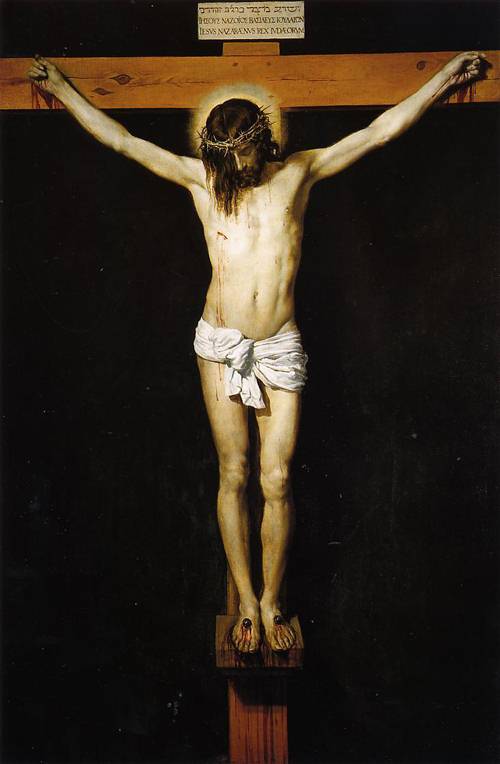
On Holy Thursday, we meditated on the disciples’ feet. On Good Friday, our Saviour’s hands. Today, let us consider Jesus’ resurrected body.
Jesus’ resurrected body is the very same that died and was buried, but it is a very different body, too. The tomb was empty on Easter morning, not because Jesus’ body was vaporized, but because it was raised.
Jesus’ resurrected body has wounds, in his hands and feet and side, showing that this is the same body that suffered on the cross. It seems that the cuts and bruises on Jesus’ face and the lashes on His back are healed, but these five wounds remain. Why? These wounds are trophies and jewels. They no longer cause Him pain, but they testify to Jesus’ greatness and love and He will have them forever.
So Jesus’ resurrected body is the very same body that died on the cross and was buried in the tomb, but it is a very different body. For instance, Jesus in His glorified body can cause others to see but not recognize Him, as He did on Easter evening with two disciples on the road to Emmaus. Only later, in the breaking of the bread, did they recognize Him. Then Jesus displayed another new power, disappearing from their sight. In His glorified body Jesus can move at the speed of thought and the walls and locked doors of the upper room do not prevent Him from appearing in the midst of the apostles.
In this there is a sign for the future of humanity. People often speak of “the end of the world” and imagine Heaven in strictly spiritual terms, but just as Jesus’ body was not annihilated but transformed, so our bodies and this universe will be remade. A glimpse into the future of the righteous is reflected in the resurrection of Christ.
Jesus’ body is not discarded, but gloriously transformed. In this there is a lesson for us. In (just about) every life, there is a line that we have drawn in our relationship with God. It is a self-imposed limit on our trust, commitment, and self-gift towards Christ. “Lord, I will walk with you that far, (but no farther.)”

Perhaps we are unwilling to cross that line with us because we are too attached to the sins and mediocrity we have settled for, maybe we are afraid that we will lose who we are and become something that we are not, or maybe we are afraid that a total self-gift to God won’t truly make us happy. The devil likes this arbitrary line. He would like you to reach the end of your life and have to wonder with regret, “What would my life been if I had gone all-in for God?” The devil would have you fearful and repulsed of “the cross, the cross!” but the cross is not the end of our story. Remember, as in Christ, God does not want to destroy you, but to transform you into who you truly are.
Do you believe Jesus suffered and died for you? Then He surely loves you. If He loves you, then how could He not desire your greatest happiness? Do you believe Jesus is divine and all-knowing? The surely He knows what will lead to your greatest good. Do you believe Jesus is all-powerful? Then surely He has the power the lead you to that good. Then what is standing in His way? There is only one thing standing in the way of His omnipotent power, preventing Him from transforming us into who (deep down) we truly want to be. That obstacle is our own freewill, the arbitrary line we draw in our relationship with Christ.
This Easter, let us be resolved to follow Christ without compromise. Let us entrust our whole selves to Him who has given us everything. Jesus does not want to destroy you, but to gloriously transform you into who you truly are.