Solemnity of Corpus Christi
By Fr. Victor Feltes
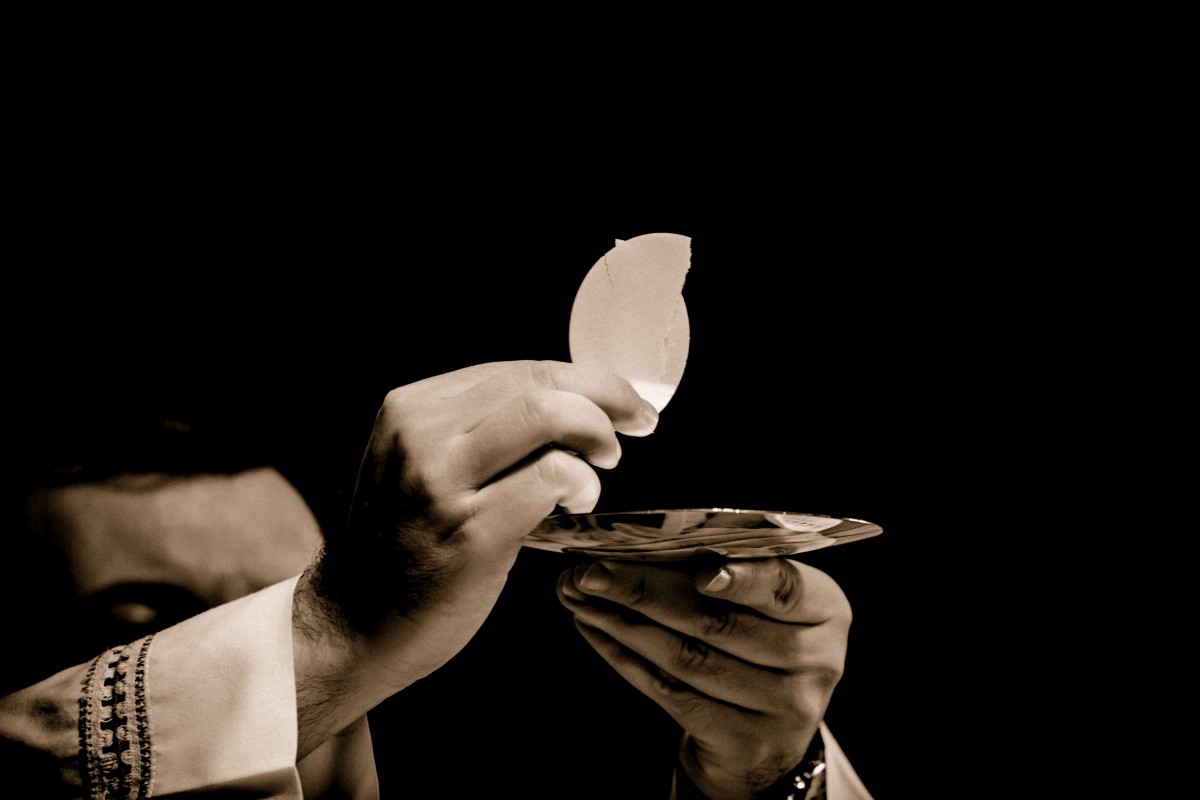
Scripture scholars agree that St. John’s Gospel was the last of the four Gospels to be written. Saints Matthew, Mark, and Luke had already shared their often-overlapping accounts, so the Gospel of John supplements their stories with his own. John often omits events which the other Gospel writers include, while he mentions events and details they do not. For instance, Matthew, Mark, and Luke all quote Jesus saying at the Last Supper “This is my Body…This is the chalice of my Blood,” but John does not. Instead, John shares unique details from the Last Supper, like his memory of Christ washing his disciples’ feet. Upon washing their feet, Jesus says, “What I am doing, you do not understand now, but you will understand later. … I have given you a model to follow, so that as I have done for you, you should also do.” Jesus washes their feet and John recounts this so that Christians will better understand Christ’s self-sacrificial offering. Another thing Jesus does which only John recounts to teach us more about Christ’s self-sacrificial offering is today’s Gospel: Jesus’ discourse at Capernaum’s synagogue about the Bread of Life.
All four Gospels record the miracle of Jesus multiplying five loaves and two fish to feed a crowd of about five thousand people. But only St. John tells how afterwards folks in that crowd follow Jesus to Capernaum — primarily interested in getting more free bread. In his conversation with them, Jesus says: “I am the bread that came down from heaven.” But people object: “Isn’t this Jesus, the son of Joseph? Don’t we know his father and mother? Then how can he say, ‘I have come down from heaven’?” Jesus replies, “Stop murmuring among yourselves.” What Jesus has told them is literally true. Jesus has come down from heaven. Eternally the Son of God, he has become man born of the Virgin Mary, but they do not yet understand how.
Jesus goes on to tell them: “I am the living bread that came down from heaven; whoever eats this bread will live forever; and the bread that I will give is my flesh for the life of the world.” So the Jews quarrel amongst themselves again, complaining: “How can this man give us his flesh to eat?” Jesus replies emphatically: “Amen, amen, I say to you, unless you eat the flesh of the Son of Man and drink his blood, you do not have life within you.” Now is Jesus here speaking literally or symbolically about giving his flesh as bread for us to eat and live? Well, a very revealing change occurs here in the original Greek text.
For the remainder of his response in John’s Gospel, the word Jesus uses for “eat” changes from the ordinary word, phago, to trogo, which means “to gnaw, chew, crunch, or munch” in eating. St. John presents Jesus repeatedly using the word trogo to affirm: “Whoever (gnaws) my flesh and drinks my blood has eternal life, and I will raise him on the last day. For my flesh is true food, and my blood is true drink. Whoever (chews) my flesh and drinks my blood remains in me and I in him. Just as the living Father sent me and I have life because of the Father, so also the one who (crunches) me will have life because of me. This is the bread that came down from heaven. Unlike your ancestors who (ate/phago) and still died, whoever (trogo/munches) this bread will live forever.”
Then many of his disciples who are listening say, “This saying is hard; who can accept it?” “As a result of this,” John 6:66 says, “many of his disciples returned to their former way of life and no longer accompanied him.” That verse is the only occasion in the Gospels where many of Jesus’ disciples stop following him because of one of his teachings. But like his previous claim about having come from heaven, what Jesus has told them is literally true. Though they do not yet understand how, Jesus will give his flesh as bread to eat for eternal life — in his Holy Eucharist. Jesus turns to his twelve apostles and asks, “Do you also want to leave?” Simon Peter answers him, “Master, to whom shall we go? You have the words of eternal life. We have come to believe and are convinced that you are the Holy One of God.” Those who rallied around Peter and his trusting faith would go on to understand the Last Supper’s self-sacrificial offering, where Jesus says, “This is my Body… Do this in memory of me.”
That is why we are here today, continuing an unbroken line of Catholics rallied around the successor of St. Peter, the pope, believing as the Church has always believed about the Eucharist. The Eucharist is Jesus Christ, truly present, living and entire — Body and Blood, Soul and Divinity — veiled in the appearances of bread and wine, so that we may adore him and receive him, becoming more perfectly one in him, with him and with one another. The Letter to the Hebrews rightly says, “We should not stay away from our assembly, as is the custom of some.” That is why, despite the inconveniences of our church renovation now underway, we will continue celebrating Sunday Masses at St. Paul’s.
We will hold weekend Masses here in the gym as the summer heat permits. This gym has fans and ventilation, but it is not air-conditioned and, having investigated the matter, there are no clear good ways to air-condition it. We can cool this room down overnight, but once our summer nights become as hot as our summer days, moving air may not be enough to keep our Masses comfortable. At that point, we will likely transition to holding Mass in St. Paul’s air-conditioned church undercroft, the basement lunchroom, until the temperature decline or our church renovation is finished.
But whether we celebrate here or there, or even if you visit another parish for Mass, recognize, appreciate, and love our Lord whom we adore and receive in the Holy Eucharist. Jesus says, “My flesh is true food and my blood is true drink… This is my Body which is given for you; do this in remembrance of me.”

