Archive for July, 2026

The Treasure & The Pearl

July 25, 2026

17th Sunday in Ordinary Time
By Fr. Victor Feltes

Jesus said to his disciples: “The Kingdom of Heaven is like a treasure buried in a field, which a person finds and hides again, and out of joy goes and sells all that he has and buys that field. Again, the Kingdom of Heaven is like a merchant searching for fine pearls. When he finds [one] pearl of great price, he goes and sells all that he has and buys it.”

Jesus tells two parables today about the Kingdom of Heaven, the Kingdom of God. These stories are symbolic, about him and us.

Jesus speaks of a man who finds a treasure. The treasure has been buried in a field and overlooked. But this man sees it, recognizes its value, and chooses to give up everything he has to gain that treasure. Imagine selling everything you own. It would not only be logistically challenging to do, it would also take courage. But this man joyfully gives up everything he has, eager to gain its reward. This man refuses to just take the treasure, since that would be unjust. Instead, he pays the price for the entire field along with the treasure. As I said, this is a parable story about Jesus Christ and us.

Jesus can be thought of as that man who found us buried in this world. Humanity was buried in sin and death by following the demons in their rebellion against God. From Adam and Eve’s sin, Satan acquired a certain domination over man. We were in “captivity under the power of him who thenceforth had the power of death, that is, the devil.” The whole world was in the power of the evil one. But while we were still sinners, Jesus saw and loved us. Though divine, he emptied himself, willingly giving up everything to die for us as man. So we adore Christ and we praise him, because by his Holy Cross he has redeemed us with the world. Christians living today will (most likely) still experience death, with our bodies being buried in the earth. But like the treasure in the parable, Jesus will raise us up again rejoicing upon his return.

In light of who Jesus is and his love for us, how should we respond to him? He illustrates this for us through another parable. Jesus says, “The Kingdom of Heaven is like a merchant searching for fine pearls. When he finds [one] pearl of great price, he goes and sells all that he has and buys it.” You and I may be imagined as that merchant.

In life, we search for the good of human fulfillment, understanding that some things are more valuable than others. And Jesus Christ presents himself as the most worthy object of our love and sacrifice. He teaches, “Anyone who loves their father or mother more than me is not worthy of me; [and] anyone who loves their son or daughter more than me is not worthy of me. … And everyone who has given up houses or brothers or sisters or father or mother or children or lands for the sake of my name will receive a hundred times more, and will inherit eternal life.” But if everyone in life is looking for the greatest good of human fulfillment, why doesn’t everyone find Christ? Like a successful pearl merchant, a person needs training and/or experience to appraise value correctly. So where is Jesus Christ, our Pearl of Great Price, to be found?

At the conversion of St. Paul, while he was still persecuting Christians, Jesus knocked him down on the road to Damascus and called out to him from a blinding light: “Saul, Saul, why are you persecuting me?” Saul (also known as Paul) replied, “Who are you, sir?” And the reply came, “I am Jesus, whom you are persecuting.” Realize that this happened after Jesus had bodily ascended into heaven, when Jesus no longer walked the face of the earth. But Jesus had taught his disciples, “Whoever receives you, receives me,” and ‘Whatever you do to the least of my brethren, you do it to me.’ And the Holy Spirit would inspire St. Paul to go on to explain that Christians are made mystical members of Christ’s Body through baptism, with Christ himself as our head. Coupled with the Eucharist and the other sacraments, we remain in Christ, and he in us. The Body of Christ is Christ’s Church, and Christ’s Church is his Body. As St. Joan of Arc said: “About Jesus Christ and the Church, I simply know they are just one thing and we shouldn’t complicate the matter.”

Jesus founded upon Peter and the apostles one Church which the Bible calls “the pillar and foundation of truth.” But where is Christ’s one Church to be found today when various Christian groups teach contradictory things? Well, what are the qualities of the best pearls? The criteria for evaluating pearls are size, roundness, surface, shine, and nacre. Different Christian groups may share these pearly qualities to varying degrees, but Christ’s Church should have them in the fullest measure.

The best pearl would have a very large size and fully round shape. I think most people do not realize that 50% of all Christians around the world identify as Catholic. Even if you consolidate each of the different types of Anglicans, Baptists, Evangelicals, Lutherans, Pentecostals, and Eastern Orthodox Christians into their various denominations and none of them come close to the Catholic Church in their numbers or presence throughout the globe. Now, being the largest doesn’t necessarily make something the best. Russia is the largest country on earth by area and (until recently) the largest country by population was China, but we would not call China or Russia the best countries in the world. However, Jesus describes his Kingdom as a mustard seed. It begins as “the smallest of all the seeds, yet it grows into the largest of the garden plants,” offering a dwelling place for birds from north, south, east, and west. So we should not be surprised that Christ’s Church would be the largest Christian communion both in membership and extent across the globe.

The best pearl would also have an unblemished surface and a lustrous shine. The surface of a great pearl is flawless, bright, and mirror-like. Great Catholic saints reflect the goodness of Christ and his Church. And vindicatory miracles (like at Fatima, Lourdes, Guadalupe, Lanciano, and elsewhere) reflect that the Catholic Church is Christ’s.

Finally, the best pearl would also have thick nacre. The thickness of the nacre (the mother-of-pearl) enables durability. Remember how a pearl grows after being an irritant within a clam? So the world commonly attacks Christ’s Church as an irritant. The endurance of the Catholic Church through two thousand years, despite fierce opposition in every century, manifests that the Lord is working within her as he promised.

In the Book of Revelation, St. John is shown a vision of the New Jerusalem, the Bride of Christ, a gleaming city coming down from heaven. The wall of the city has twelve courses of precious stones as its foundation, inscribed with the names of the twelve apostles, for the Church is built upon them. And the city has twelve gates, three facing east, three facing north, three facing south, and three facing west, inscribed with the names of the twelve tribes of Israel, for people of every land are called to enter to become God’s people. And those twelve gates are twelve pearls, with each of the gates made from a single pearl. Jesus himself is the Pearl of Great Price, and Jesus says, “I am the gate. Whoever enters through me will be saved,” and the Body of Christ is his Church. So let us respond to him who has loved us so much, by sacrificing anything else to dwell with Christ in his Body, his Bride, his Church.
Carrots Need Time to Grow

July 20, 2026

16th Sunday in Ordinary Time
By Deacon Dick Kostner

One of my best education days as I was “growing up” was when Fr. Frank explained to his Pastoral Study Students the significance of Jesus always teaching through parables. When Fr. Victor asked when I would like to preach to you folks again and I reviewed the upcoming Gospels for this month and I saw this weeks story about God’s Kingdom and Jesus telling the Parable of Seeds I thought this would be the time to share with you what I learned in class about Jesus and parables.

Jesus, while spending time with his brothers and sisters wished them to understand how the Kingdom of God differs from world thoughts and practices. During this period of time most people were agricultural people and had no formal educational skills to help them mature in thought and deed. So Jesus used parable stories to help them develop into God thinking children of God. Parables tell us a story about activities we are comfortable with understanding. But parables come to us with a twist that takes our mindset on a topic and turns it upside down from what we had learned and sends our mind out into a new direction from world thoughts and sends them upward to help us to understand how God’s Kingdom differs from our Earthly thoughts and practices.

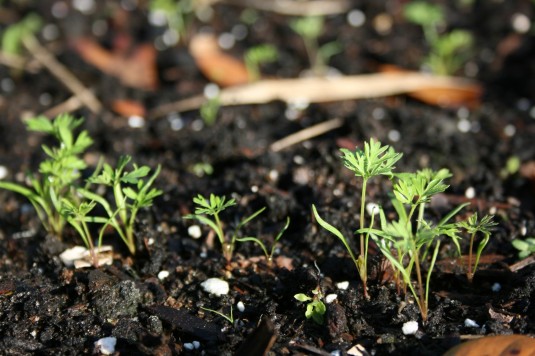
As many of you know, I love to spend time with my garden and watch new life transform into mature good eating things. What I don’t love is doing battle with weeds that wish to choke off my vegetable babies. So, I go into the battle mode with a vengeance. This year we were having trouble getting our carrots to spout. After waiting and waiting I told Barb that we might not be getting any carrots this year. She finally agreed and replanted the 20 feet we had prepared for them. The new plantings started to sprout but soon thereafter so did the seeds we had planted earlier. This required us to remove some of the seedlings in order to have any hopes of getting carrots.

In today’s Gospel, the parable story told by Jesus tells us that we must have patience. Deacon Dick is a slow learner on this common sense lesson taught to us by Jesus so I get a “D-”. After sprouting it was only a couple of days and my watering that my weed enemies invaded my carrots. I told Barb we needed to weed in order to save the carrots. Her response was we need to wait until the carrots grow enough or we will tear out the carrot seedlings. The Farmer Jesus gives Dick an “F” but gives Barb an “A-”. for being a good farmer by earthly standards but she fails to get a an “A” in Gods Kingdom because in God’s kingdom patience is needed allowing the evil persons to repent for having sowed the weed seeds before being condemned and punished for evil acts in trying to destroy Gods plants of Love he calls his children.

In my true story we see that parable not only teaches and reinforces activities we are accustomed to for it takes us to a new road to travel. A road that will lead us to a higher level of love patience leading us to God’s Kingdom. In God’s kingdom the seeds planted by God (us children) are given time to develop and mature through mistakes made by allowing evil (weeds) to move us further away from God and His Kingdom instead of moving us closer to sainthood and a life of love in the Kingdom of God. In God’s Kingdom Forgiveness ,unlike the Earthly Kingdom, always trumps justice where there exists in his children a contrite heart. This time conversion can happen anytime during our life experience.

Jesus gives us the tools to ignore and be patient with the weeds that attempt to keep us from sharing eternal life with him in heaven after our earthly life. The tools are his commandments to love as he has loved us. He also allows us and the sinful, to make mistakes and repent before the final harvest when the weeds of evil will be separated from the wheat and burned, while the wheat , the fruit of love and patience ,is gathered and stored and shared in God’s Kingdom. Wishing all of you a blessed and fruitful harvest, and keep your eyes open to see for yourselves a new road to follow when Jesus shares with us his parable stories.

Post-Script: On First Friday’s I attend Exposition at St. John’s. I close out my hour by asking if God wishes that I do anything for him. Usually he says nothing but the last time I attended on July 3, I received this request: “I ask that you tell my Church that I gave Barb an ‘A’ not an ‘A-.’ She knew it was not evil that put weeds in her garden it was horses who donated fertilizer this year for her garden.” Thanks, God.

The Legacy of a Faithful Life — Funeral Homily for Bernadine Sikora, 90

July 18, 2026

By Fr. Anandan “Rajen” Rajendran

My brothers and sisters in Christ, today we gather with heavy hearts, but also with hearts filled with gratitude. We come to pray for Bernadine Sikora, to thank God for the gift of her 90 years of life, and to entrust her to the loving mercy of our Heavenly Father. Whenever we gather for a funeral, there are naturally tears. We miss someone we love. Death leaves an empty chair at the family table, a silence in the home, and an ache in the heart. Yet, as Christians, we do not gather as people without hope.

We gather around the altar of Jesus Christ—the altar where death never has the final word. That is why today’s Gospel begins with these beautiful words of Jesus: “Do not let your hearts be troubled.” Jesus knew that one day his disciples would experience loss. He knew they would stand beside graves, just as we are doing today. So before they even experienced sorrow, he gave them hope.

He said, “In my Father’s house there are many dwelling places.” Notice what Jesus does not say. He does not say life ends in the cemetery. He does not say death is the end. He says there is a home waiting for us. For Christians, death is not moving into darkness; it is moving home. Today, we pray that Bernadine has entered that home prepared by Christ himself.

Our first reading from Proverbs describes “a worthy wife.” The reading tells us, “Her value is far beyond pearls.” It’s interesting that the reading doesn’t praise a woman because she was wealthy or famous. Instead, it praises her because she loved. She worked with willing hands. She cared for her family. She reached out to those in need. She feared the Lord. As we listened to those words, it was hard not to think of Bernadine. She lived those verses. She wasn’t seeking recognition. She simply lived faithfully. She built a home. She supported her husband Donald in the family business. She raised five children with love and sacrifice. She welcomed grandchildren and eventually thirty-six great-grandchildren into her life. What an extraordinary legacy.

Today, we often measure success by titles, promotions, or possessions. God measures success differently. He asks, “Did you love? Did you serve? Did you remain faithful?” Bernadine answered those questions with her life. One of the most beautiful descriptions in her obituary says she was “a homemaker in the truest sense of the word.” That phrase deserves our attention. A house is built with wood, bricks, and nails. A home is built with love. A home is built by countless unseen acts.

Meals prepared, laundry folded, children comforted, prayers whispered, sacrifices no one noticed except God. Many of the greatest things done in this world never make the newspapers. But they are all written in God’s book. God notices every hidden act of love.

The obituary also tells us something very beautiful about Bernadine. She loved simple things—playing Sheepshead with her sisters, playing bingo, being surrounded by family. Those may seem like ordinary moments. But when we look back after someone dies, we discover those ordinary moments become extraordinary memories. Life isn’t made beautiful by grand events. It is made beautiful by shared laughter around a card table, family gatherings, holidays, simple conversations, being together. Those are the treasures that never disappear.

The second reading from Saint Paul is deeply moving. Paul says, “I have competed well. I have finished the race. I have kept the faith.” What wonderful words. Life is not measured only by its length. It is measured by its faithfulness. Bernadine lived 90 years. She experienced joy. She experienced loss. She buried her beloved husband Donald. She endured the heartbreaking deaths of her sons, Jeffrey and Gary. She experienced the sorrow of saying goodbye to brothers, sisters, and loved ones.

Yet, through all those seasons, she remained faithful. That is not easy. Faith isn’t only for sunny days. Real faith shines brightest in difficult days. And Bernadine continued walking with God. She remained active in St. John the Baptist Church. She prayed. She trusted. She believed. Like Saint Paul, we hope she can now hear the Lord say, “Well done, good and faithful servant.” One thing that always amazes me is how one person’s life reaches so many others. Think about it. One woman. Five children. Sixteen grandchildren. Thirty-six great-grandchildren. Imagine all the birthday parties, Christmas celebrations, First Communions, graduations, wedding days, and family reunions. Every one of those lives carries something of Bernadine, perhaps her kindness, perhaps her smile, perhaps her work ethic, perhaps her faith. Love has a way of multiplying across generations. That is her legacy.

I once heard a story about a grandmother who was dying. Her grandchildren asked, “Grandma, are you afraid?” She smiled and said, “Why should I be afraid? I’ve known Jesus all my life. I’m simply going where He has been preparing a room for me.” What beautiful faith. That is exactly what Jesus promises today. “In my Father’s house there are many dwelling places.”

Jesus doesn’t merely point us toward heaven. He says, “I am the way.” Notice he doesn’t say, “I will show you the way.” He says, “I am the way.” Because Christianity is not merely following rules. It is following a person, the person of Jesus Christ. And when we follow Him through this life, He leads us safely into eternal life.

To Bernadine’s family, today is difficult. There is sadness because love always grieves. But remember this, your mother, your grandmother, your great-grandmother has given you far more than memories. She has given you an example. The greatest tribute you can offer her is not only flowers at the cemetery. It is to continue living the faith she treasured. Love your families. Care for one another. Come to Mass. Pray together. Forgive quickly. Remain close to Christ. That would make Bernadine happiest.

As we prepare to celebrate this Holy Eucharist, we place Bernadine into the hands of the God she trusted throughout her life. The same hands that guided her through 90 years, the same hands that welcomed her husband Donald, the same hands that carried her through every joy and sorrow, are now the hands that we trust will receive her into eternal peace. And one day, by God’s grace, we pray that we will hear those same comforting words spoken to us: ‘Do not let your hearts be troubled.’ Because Christ has gone before us. He has prepared a place for us.

And where He is, we too hope to be. May the angels lead Bernadine into paradise. May the saints welcome her. May perpetual light shine upon her. And may she rest in the peace of Christ until that joyful day when we are reunited in the Father’s house, where every tear will be wiped away, and love will never end. Amen.

Four Soils, One Calling

July 11, 2026

15th Sunday in Ordinary Time
By Fr. Victor Feltes

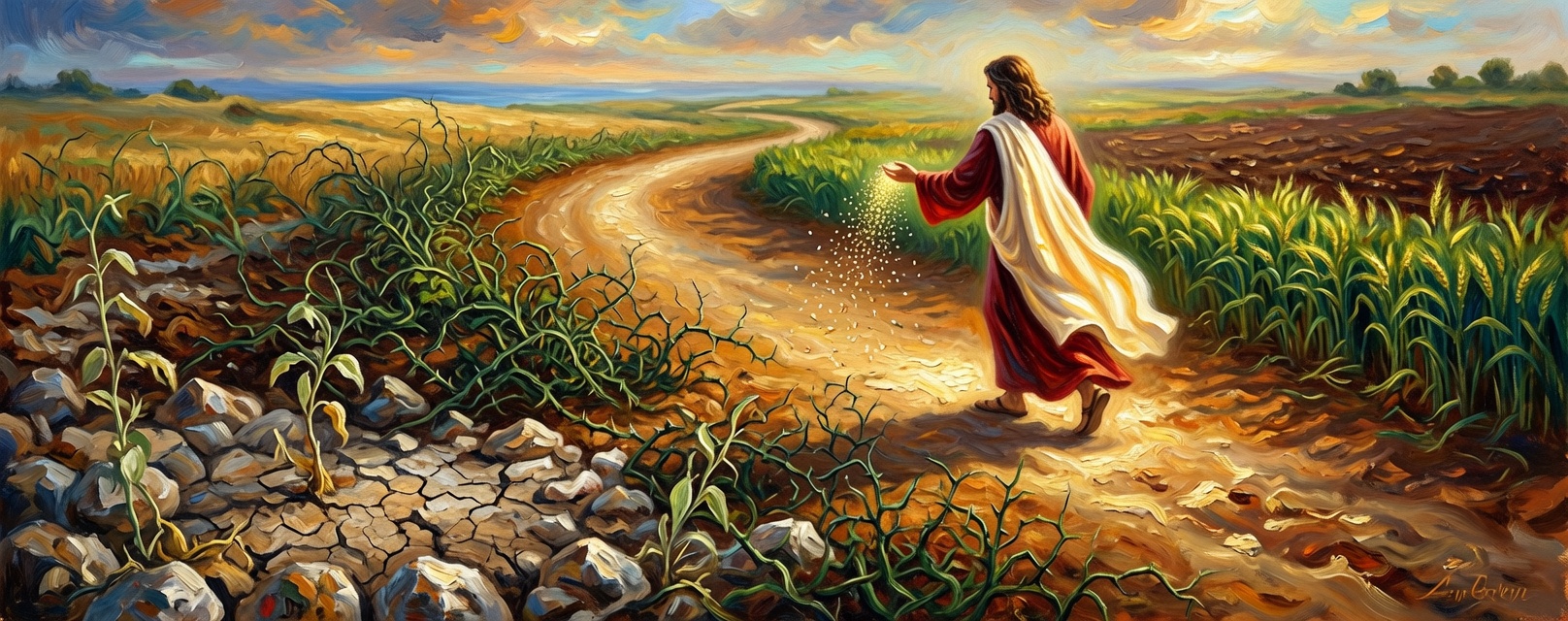
Jesus explains the meaning of his own Parable of the Sower. The seed sown on the hardened path is the sort of person who hears about the Kingdom of God without understanding. And what was sown within that person’s heart is quickly taken away by the evil one.

The seed sown on rocky ground is the sort of person who hears and receives the word with joy, but this person is shallow and the seed takes no root. When tribulation or persecution come because of the word that person quickly falls away.

The seed sown among thorns is the sort of person who hears the word, receives it, and begins to grow. But then worldly anxiety and the lure of riches choke the word and that person produces no fruit.

But the seed sown on rich soil is the sort of person who hears the word, receives and understands it. That person grows and—to a good, or great, or greatest degree—bears abundant fruit for the Kingdom of God.

Some people dismiss Christianity out of hand. Others abandon Christianity when faithfulness begins to burden them. Other Christians are ruled by fears and desires which prevent them from being fruitful. But Jesus wants us to faithfully endure and do many good and holy things for God and our neighbor, in the Church and in the world. So which kind of soil are you?

If you are here today as hardened path soil, or if that describes someone you know, I encourage a deeper search for truth. I believe our only credible philosophical options in life are Catholicism or nihilistic nothingness. Now this fact doesn’t automatically make Catholicism true—it’s true for other reasons—but this justifies a further investigation, since there is no other hope. A person who seeks for truth can find more than just their own excuses. Jesus says that the one who seeks, finds. And to anyone who has, more will be given and he will grow rich; but from anyone who has not, even what he has will be taken away.

If you are here as shallow rocky soil, appreciate that Christianity does not exempt us from experiencing tribulation or persecution. As St. Peter, the first pope, wrote in a New Testament letter: “Beloved, do not be surprised that a trial by fire is occurring among you, as if something strange were happening to you. But rejoice to the extent that you share in the sufferings of Christ, so that when his glory is revealed you may also rejoice exultantly.” So forewarned, I hope you will be forearmed, prepared and resolved to remain faithful to Christ.

If you are here as thorny soil, dominated by worldly anxiety and the lure of riches, Jesus reminds you to “be not afraid,” and notes that “no one can serve two masters.” Trust Jesus enough not to worry, choose love of God over love of money, and you will begin to bear better fruits.

And if you are here as rich soil: well done, good and faithful servant! Jesus says of every branch in him God the Father prunes so that it bears more fruit. So see if your thirtyfold yield can increase to sixty or a hundredfold.

Inside my kitchen, sitting by the window, are two potted plants that came along with the rectory. From time to time I turn their pots, so I can see the leaves better and so the plants’ other sides can get more sunlight. But as weeks go by, the plants’ leaves and branches gradually turn back toward the window and the sun. It’s their source of life and essential for their growth. Likewise, whatever kind of person or sort of soil you are, you are called to live and grow by turning toward Jesus Christ.

Perhaps this means pursuing him through study, learning more about him. Perhaps this means turning away from sin and encountering him in Confession. Perhaps this means dedicating more consistent time to daily prayer, to better conform your heart and desires to his. Or perhaps he desires you to simply turn more to him throughout your day. St. Therese of Lisieux wrote, “For me, prayer is a surge of the heart; it is a simple look turned toward heaven, it is a cry of recognition and of love, embracing both trial and joy.” So wherever you are, turn to him, to live and grow and bear more fruit.

Reflecting Our Father — Funeral Homily for Ronald Bischel, 91

July 6, 2026

By Fr. Victor Feltes

In a way, our parents are our first representations of God. For instance, our earthly fathers—for better or worse—serve as icons of God the Father. None of our birth parents were perfect, so our spirituality can be wounded by their sins and shortcomings. But the goodness found in our parents—their virtues and their love—can help reflect who God the Father is. Ron, the father of eight children, was seen loving his farm, his family, and his Faith.

A hardworking dairy farmer, his farm has passed down to his sons. The farm transitioned to exclusively growing crops several years ago and there was sadness at seeing his cowherd go. God the Father, the creator of this earth, treasures his herd, too. David wrote centuries ago, “The Lord is my shepherd.” We are his herd. As another Psalm adds, “We are his people, the sheep of his flock.” Fear not, we are more precious than many cows.

Ron tended to be calmly present, very quiet, and listen, yet he ironically became the family’s so-called “informant.” When his children visited, one by one or in small groups, they told him all the latest about their lives and his twenty grandchildren. Then he in turn, though not in a gossipy way, would update his guests on the family news, keeping them connected to one another through him. “Beloved,” St. John writes, “we are God’s children now.” In Christ, God the Father adopts us as his own. He listens, cares about our lives, and connects us to each other. This relationship makes us brothers and sisters to each other here and now and makes us siblings with a multitude of the living and the dead, most of whom we have never met. But we can look forward to a family reunion of countless millions on the mountain of the Lord that the Prophet Isaiah describes: “On that day it will be said, ‘Behold our God, let us rejoice and be glad he has saved us!’”

Ron was interested in all sorts of subjects; well-read through not just news, farming, or financial publications but also many books. This universe is so endlessly detailed and interesting because heaven and earth are full of God’s glory. With Ron’s strong memory, he could remember details months after reading them. But no matter how sharp, worldly-wise, and learned a person may be, Ron considered these ultimately futile if one did not know God. As a St. Paul’s School alumnus, he sent all of his children to that school as well. He faithfully attended Sunday Mass, and when he could no longer attend he would watch TV Mass and have our Eucharistic Lord brought to him. God the Father is thoroughly interested in us all, and desires closer communion with each of us through his Son and the Holy Spirit.

Jesus praised God our Father, noting that although the wise and learned sometimes fail to perceive spiritual truths, our Father has “revealed these things to the childlike.” Jesus says, “Come to me [and] learn from me. … Whoever has seen me has seen the Father.” And St. Paul adds, “Be imitators of me as I imitate Christ.” Let us pray for Ronald’s soul, for the cleansing of any imperfection which might still distance him from God. And moved by the Holy Spirit, let us look at Christ to behold the best reflection of our heavenly Father. For he “is the image of the invisible God.” And then in him we can be transformed into saints whom others may encounter and see—like they saw in Ronald—an earthly likeness of God.