Archive for the ‘Culture’ Category

Jesus Rested

June 19, 2021

12th Sunday in Ordinary Time

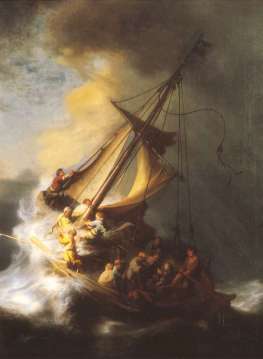
The Storm on the Sea of Galilee by Rembrandt, 1633.In today’s Gospel, we see Jesus commanding the wind and sea during a storm. He rebukes the wind and tells the sea, “Quiet! Be still!” and a great calm settles. His disciples in the boat, in awe at what they’ve witnessed, say to one another, “Who then is this whom even wind and sea obey?” It’s a stunning moment for them, but there’s another striking detail contained in this Gospel – a detail which Jesus’ disciples found completely unremarkable before the storm: Jesus was resting in the boat, he was asleep on a cushion in the stern. Christ wielding divine power is an important sign, but the fact that Jesus took naps also contains lessons for us that I’ll discuss a bit later.

The Book of Exodus records how the Lord had previously commanded winds and waters to save his people when he parted the Red Sea: “The Lord drove back the sea with a strong east wind all night long and turned the sea into dry ground. The waters were split, so that the Israelites entered into the midst of the sea on dry land.” God commanded the waters as with his words from the Book of Job: “Thus far shall you come but no farther, and here shall your proud waves be stilled!” Even though God brought the Hebrews safely through the Red Sea to Mount Sinai, delivering them from their Egyptian slavemasters, they were not yet free. God had gotten his people out of Egypt, but he needed to get Egypt out of his people.

Habits and attitudes from their years of bondage had to be unlearned. To do this, God’s Mosaic covenant commanded them, for example, to sacrifice animals which the Egyptians associated with their pagan deities, such as bulls and rams. To slay and offer up these creatures to the Lord undermined the cults of the false gods. Likewise, when you desire to turn away from old sinful habits, absolutely pray for God’s help and go to Confession, but also after that do more than just passively hoping that things will change. Take positive steps in the right direction. Make an act of your will to renounce your sins. Literally say: “I renounce the sin of (such-and-so),” and then actively avoid the patterns which you know lead you into sin. Like those bulls and rams sacrificed on God’s altar, kill and burn your idols.

Another way in which the Lord sought to train the Hebrews out of the old mindset and routines of their prior slavery was through giving them a weekly vacation day. God commanded his people:

“Remember to keep holy the sabbath day.
Six days you may labor and do all your work, but the seventh day is the sabbath of the Lord, your God.
No work may be done then either by you, or your son or daughter, or your male or female servant, or your beast, or by the alien who lives with you.”

As slaves in Egypt, the Hebrews worked long days for long stretches of days. It was grueling labor, fueled by fear of painful consequences. But the Lord did not wish for them to carry with them this slave mentality toward work. So he gave them a special day, every week, for worship, rest, and joy. God desires the Lord’s Day, Sunday, to be such a day for us.

When I was an undergrad at college, my studies were my daily grind. I looked forward to my college breaks, but those could be weeks or months away, and were always on the other side of due dates and exams. Although I faithfully attended Mass I had never observed Sunday as a special day of rest. The Catechism of the Catholic Church teaches:

On Sundays and other holy days of obligation, the faithful are to refrain from engaging in work or activities that hinder the worship owed to God, (that hinder) the joy proper to the Lord’s Day, (that hinder) the performance of the works of mercy, (or that hinder) the appropriate relaxation of mind and body.” Then it notes, “Family needs or important social service can legitimately excuse from the obligation of Sunday rest. (However,) the faithful should see to it that legitimate excuses do not lead to habits prejudicial to religion, family life, and health.

So I resolved in those days of college to abstain from doing homework or studying on Sundays. I had some very late Saturday nights, but I held faithfully to this rule. And over time, I noticed two surprising things. First, my Sunday resting never burned me academically. I can’t recall ever bombing a test, failing to meet a deadline, or doing worse on my assignments because I didn’t work on Sunday. My second great surprise was that I began looking forward to every Sunday as a one-day vacation. In addition to going to Mass, Sunday was a day for me to take a nap, see a movie, play a game, hang out with friends, or do anything delightful. I sacrificed a gift of myself to the Lord and he gave me an even greater gift in return. So I urge you to be courageous and intentional about keeping and celebrating the Lord’s day of rest yourself.

Let’s return to Jesus sleeping in the boat. What lessons does this teach us? First, the fact that he sleeps means he is a real human being who can personally relate to our own lived experience. Jesus knows firsthand what it’s like to be one of us, and he compassionately understands us.

Second, his sleep shows us that human fatigue is not a sin. Sometimes in confession I hear older people accuse themselves of laziness because they aren’t as productive as they were when they were decades younger. I encourage these persons to be easier on themselves. The Stations of the Cross recount Christ falling down three times. Jesus’ holy, loving spirit was willing, but his flesh was weakened, and none of his physical limitations, missteps, or stumbles were sins. Our own bodily limitations are not sins either.

A third lesson from Jesus napping is that caring for your body is an ordinary part of doing God’s will. While taking his nap, Christ isn’t preaching to the crowds, healing the sick, or performing mighty miracles, but he is exactly doing his Father’s will. And this rest prepares Jesus to do the Father’s works after. When I hear a parent in confession say they blew up unusually at their children, lost their temper and yelled at their kids, I ask that person whether they’re tired. Their answer is almost always yes. That’s not surprising, since everything is harder when you’re tired. Rather than disregarding your body, realize that sleeping well, eating right, and trying to be physically active can be important in enabling you to do God’s will.

St. John writes in his 1st New Testament epistle: “This is how you can recognize the Spirit of God: Every spirit that acknowledges that Jesus Christ has come in the flesh is from God.” Jesus Christ, God’s divine Son, took rest and enjoyed rest as a human being like us. Let us learn from his holy example.

Trivia Question Archive

June 4, 2021


I invite you to use these questions I authored for your own Trivia Night events. But if you do, I ask that you would mail some donation to my parish:

St. Paul’s Catholic Parish
1222 Main St.
Bloomer WI 54724


Advertising
Ad Slogans (Answers)
Corporate Logos (Answers)
Food People (Answers)
TV Commercials (Answers)

Christianity
Catholic Stats (Answers)
Gospel Writers (Answers)
Grace States (Answers)*
Saints (Answers)
Scripture Cities (Answers)
Scripture Specifics (Answers)
Selected Scriptures (Answers)

History
20th Century History (Answers)
20th Century Quotes (Answers)
2015 A.D. (Answers)
2019 A.D. (Answers)
Burial Sites (Answers)
U.S. Disasters (Answers

Literature & Language
Acronyms (Answers)
Comic Characters (Answers)
Famous First Words (Answers)
Famous Last Words (Answers)
Language Arts (Answers)
Languages (Answers)
Latin Phrases (Answers)
NATO Alphabet (Answers)
Shakespeare or Scripture (Answers)

Movies & TV
80’s Movie Quotes (Answers)
Disney Dialogue (Answers)
Fictional Addresses (Answers)
Fictitious Pets (Answers)
Film Franchises (Answers)
Game Show Quotes (Answers)
Leading Lady Lines (Answers)
Out on a Date (Answers)
Sidekicks (Answers)
TV Jobs (Answers)
TV Leads (Answers)

Music
Christmas Lyrics (Answers)
Lead Singers (Answers)
Musicals (Answers)
The Beatles (Answers)
“Weird Al” Songs (Answers)
Work Songs (Answers)

Object Identification
Candies (Answers)
Cereals (Answers)
Game Pieces (Answers)
Noodles (Answers)
Seeds (Answers)

People
American Idol or U.S. Senator (Answers)*
Caesar, Luther, or Bieber (Answers)
Famous Mates (Answers)*
Gandhi, Lincoln, or Joan (Answers)
Past Presidents (Answers)
Ten Toms (Answers)

Places
Famous Buildings (Answers)
Island Silhouettes (Answers)
Largest Cities (Answers)*
Plant Places (Answers)
State Silhouettes (Answers)
State Nicknames (Answers)
U.S. States (Answers)
Wisconsin Attractions (Answers)

Science & Tech
Animals (Answers)
Car Models (Answers)
Inventions (Answers)
Medical Facts (Answers)
Meteorology (Answers)
Scientific Claims (Answers)
Weighty Questions (Answers)*

Sports
Athlete Nicknames (Answers)
Second Place Sports (Answers)*
The Green Bay Packers (Answers)

Tie-Breakers
Tie-Breaker Examples*

Uncategorized
Child Psychology (Answers)
Colors (Answers)
Days of the Week (Answers)
Famous Paintings (Answers)
Holidays (Answers)
Key Food Ingredients (Answers)
Left or Right (Answers)
Search Results (Answers)

Note: Answer sheets tagged above with an “*”
may need updating with the passage of time.

Protected: Hosting Parish Trivia Nights

May 29, 2021

This content is password-protected. To view it, please enter the password below.

Watch “The Chosen” Season 2

May 11, 2021

The Chosen” is a truly excellent dramatized series about Jesus and his disciples now in its second season. Four new episodes have been released so far (with the most recent only available on YouTube until Wednesday evening). These episodes can also be seen through this free app.

“But Him They Did Not See”

April 5, 2021

Easter Sunday

Saint Peter and Saint John Running to the Sepulchre by James Tissot.

Holy Thursday Homily – The New Passover Lamb
Good Friday Homily – The New Adam
Easter Vigil Homily – The Beginning of the New Creation

It’s surprising and remarkable that the Church’s Gospel for this Mass, the Mass on Easter Sunday morning, does not feature even a brief cameo of Jesus. In this morning’s gospel, the risen Lord does not make any appearance. Mary of Magdala runs back from his tomb without having seen him. She goes to Peter and John and reports her fear that someone has stolen his body. So Peter and John run to the tomb. They arrive and investigate, but him they do not see. And then those two disciples return home.

Later that same day, in encounters recorded by the Gospels, they would see the Jesus alive in the flesh, and touch him, speak with him, and rejoice. As St. Peter announces in our first reading:

“This man God raised on the third day
and granted that he be visible,
not to all the people, but to us,
the witnesses chosen by God in advance,
who ate & drank with him after he rose from the dead.”

Jesus did not appear to everyone, but only some, mostly his friends and others open to receive him.

The Risen Lord did not appear to King Herod, whom he met briefly during his Passion. Herod was a man of vices and pleasures and was curious and excited to see this wonder worker. But when Jesus only answered him with silence, Herod was not entertained and, no longer interested, sent Jesus away.

The Risen Lord did not appear either to Governor Pontius Pilate, who presided over his Roman trial. Pilate thought Jesus had committed no capital crime, but this cynical man of the world (who had scoffed “What is truth?”) thought life would be easier with Jesus out of the way, and so he put him to death.

And the Risen Lord did not appear to the High Priest Caiaphas, who conspired against him. The High Priest was offended by Jesus’ calls to conversion and he envied his popularity and influence among the people. Caiaphas was too proud to learn from and follow Jesus, so he condemned the Christ and became his enemy.

The hedonism of Herod, the pragmatism of Pilate, and the conceitedness of Caiaphas kept them from accepting and following Jesus. Imagine if Jesus had appeared to Herod, Pilate, and Caiaphas after rising from the dead. Would they have loved him then? Seeing his power they might well have submitted to him, but that’s very different than devotion.

Jesus did, however, appear to his disciples, his friends, following his resurrection. For example, Jesus met Mary Magdalene at the tomb on Easter morning after Peter and John had left. On Easter evening, Peter, John, and other disciples were visited by Jesus within the Upper Room even though the doors were locked. And Jesus would go on to appear beside the Sea of Galilee, to reconcile and rehabilitate Simon Peter who had denied him. Each encounter with the Risen Lord was surprising, personal, and beautiful. But at the time of our gospel reading there was only Jesus’ Easter tomb, an open door paired with an inner emptiness, which pointed to something greater, something divine, something real but still unseen.

In 1937, when the Gallup polling organization first began asking the question, 73% of Americans said they were members of a church, synagogue, or mosque. That figure remained near 70% for the next six decades, until about twenty years ago when the number began steadily declining. This week, Gallup’s latest polling indicates for the first time, a majority of Americans (53%) report not belonging to a house of worship. It’s a discouraging trend.

This seems related to a different Gallup poll published in 2020. At the end of that very trying year, surveyed Americans’ self-assessed mental health was worse than it had been at any point in the last two decades. The percentage of those rating their mental health as “excellent” fell for almost every demographic compared to the year before. Every age group, men and women; the married and the unmarried; the wealthy, the poor, and the middle class; each of these groups polled eight to twelve points lower on this question. Only one group reported higher rates of excellent mental health than before, increasing by four points despite the trials of 2020. It was those who, at least once a week, attended religious services.

Like other churches around the country, our public liturgies were suspended for awhile, about three months last year, due to the pandemic. But we have been safely celebrating public Masses in my parishes since last June. I am very pleased that none of my parishioners who have been attending Church have died from Covid; which suggests our Masses here are quite safe. But next Sunday, the weekend after Easter, will all our Masses be filled again like this?

Jesus says, To anyone who has, more will be given and he will grow rich; from anyone who has not, even what he has will be taken away. Jesus here is not primarily speaking about earthly economics, but of spiritual wealth. Christian discipleship requires real investment to show a great return. Like the Easter Tomb, our church door is open. Like the Easter Tomb, perhaps you find an emptiness within you. These things point to something greater, something divine, something real but still unseen. I urge you to begin coming back to Mass again, because Jesus reveals himself in surprising, personal, and beautiful ways to his disciples and friends.

Recreating the Way of the Cross

March 21, 2021

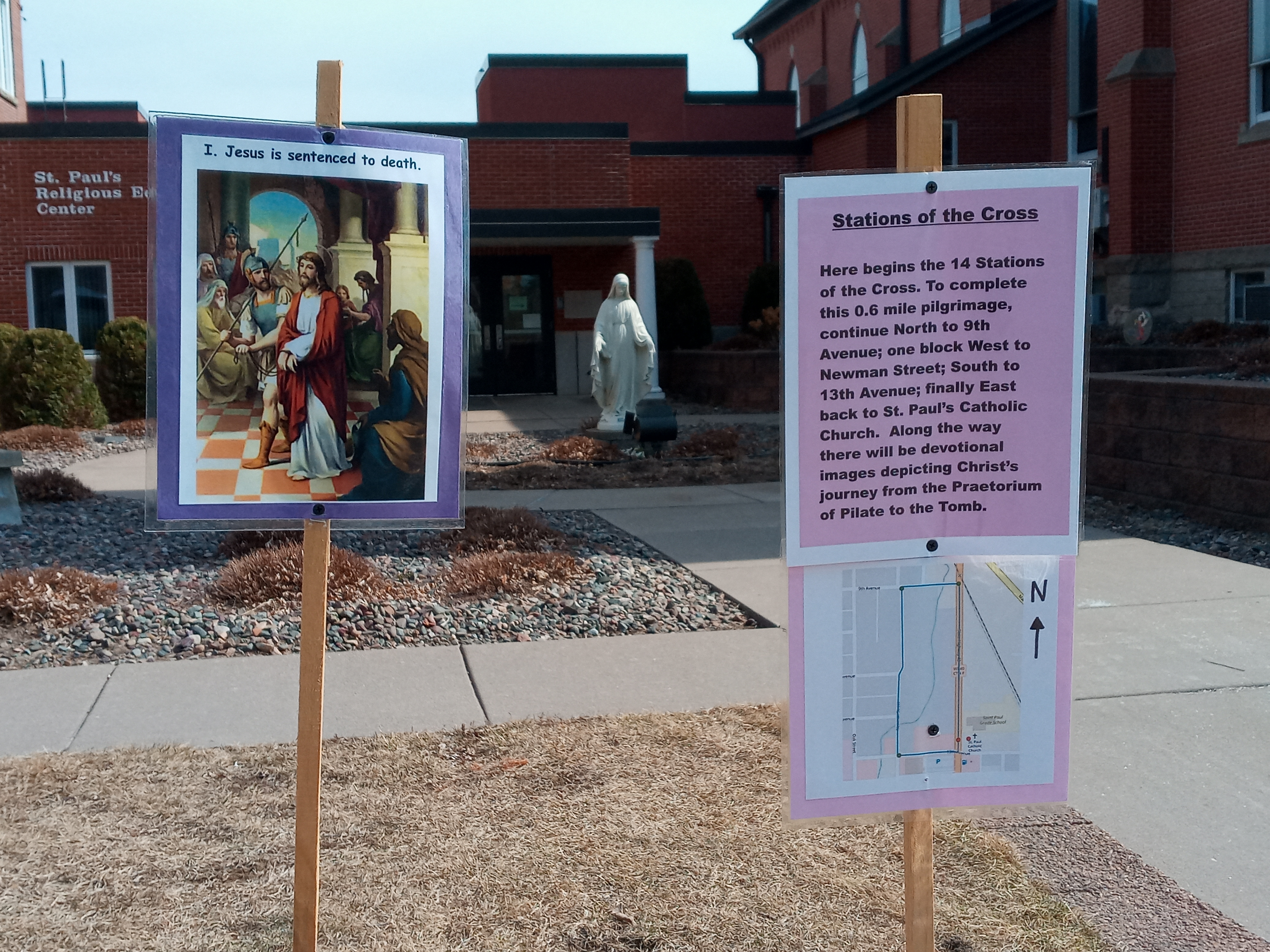
Our 1st Station, with an introduction and a map of our Way of the Cross

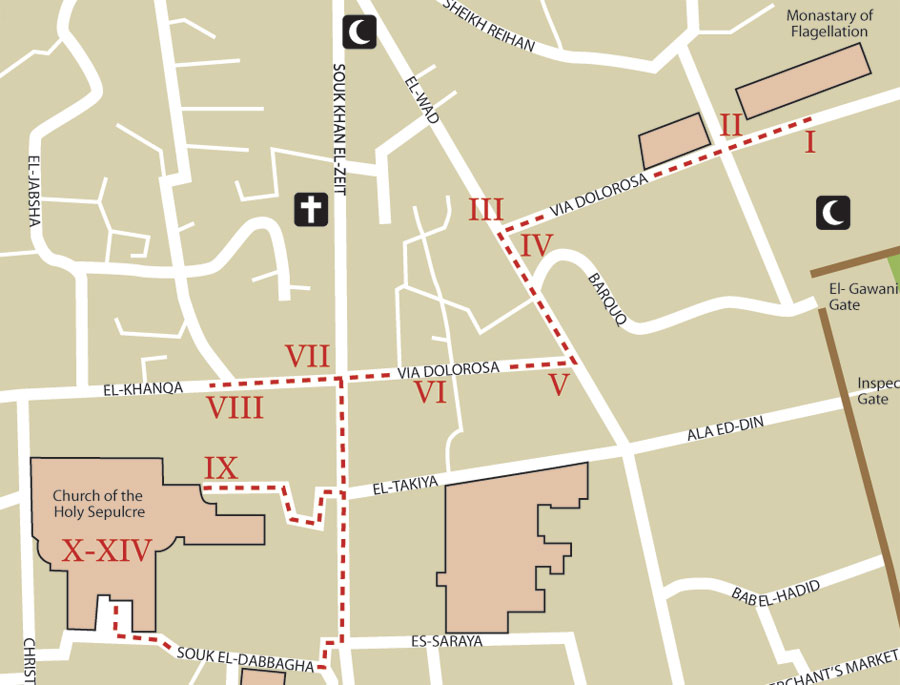
The experience of visiting the Holy Land (as I did in 2016) gives a person lasting impressions. One is a deepened sense that the Gospel stories were not “once upon a time” but events of a real time and place. Another takeaway is a better sense of the region’s scale – which is smaller than what you would think. The size of the nation of Israel is less than New Jersey, and the area enclosed by the walls of Jerusalem’s Old City (0.35 square miles) is that of only one-and-a-half Vatican City’s. The Way of the Cross, from where Governor Pilate sentenced Jesus to death to the place of Christ’s death and burial, is about 600 meters or 2,000 feet, less than half a mile.

Remember in the film “The Passion of the Christ,” when Jesus falls and Mary rushes to him? This is my photo of the 3rd and 4th Stations in Jerusalem.

In the Holy Land I also learned that Christian tradition not only preserves details about Jesus’ Passion (such as his three falls and St. Veronica’s veil) but also commemorates the locations at which these sad moments occurred. These fourteen Stations of the Cross are still venerated and prayerfully walked by pilgrims in Jerusalem today. It is a powerful, beautiful experience which I wanted to recreate in the streets of my community, and which you might wish to offer yours.

A present-day map of the fourteen Stations on Way of the Cross in Jerusalem

This Lent, we’ve created an outdoor Way of the Cross. It begins in front of our church and school and loops one time around the city block opposite them. After measuring maps and receiving permission from the various landowners, we posted the traditional fourteen Stations along a path which approximates the actual Way of the Cross, both in its length and its distances between the Stations. Walking it takes about twelve minutes (if one does not pause to pray) and we plan to keep the Stations up until Easter Sunday. Our small-town, local newspaper even ran a story about them.

The final five Stations, commemorating Jesus’ crucifixion and burial, are grouped closely together near the end. This is because the locations of Jesus’ Cross and Tomb were situated only about 150 feet away from each other. Both sites are now housed within the Church of the Holy Sepulchre. On Good Friday, the Roman soldiers led Jesus west outside the walls of Jerusalem to a white limestone quarry. St. John’s Gospel records that many people read the sign posted above our Lord’s head on the Cross indicating the “crime” for which he was condemned (“Jesus the Nazorean, the King of the Jews”) because the place where he was crucified was near the city. It was also apparently alongside a road, since St. Matthew notes “those who passed by hurled insults at him.” Christ was crucified atop a rock formation there called Golgotha in Hebrew and Calvary in Latin, which laborers had cut around and left behind. As Psalm 118:22 had foretold, “the stone which the builders rejected has become the cornerstone.”

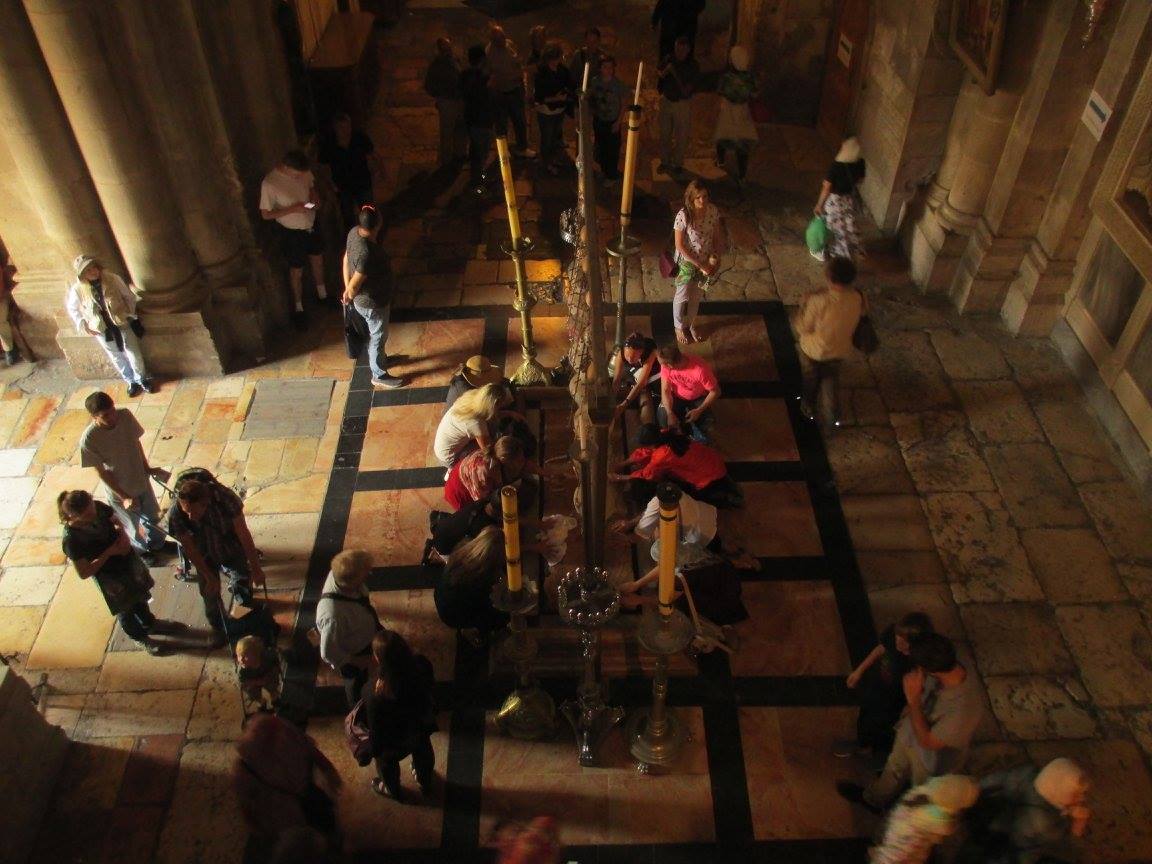
A view from Calvary of the Stone of Unction in The Church of the Holy Sepulchre

The new tomb which St. Joseph of Arimathea gave to Jesus had been cut into a rock face amidst a garden nearby. Midway between these two places, the Church of the Holy Sepulchre now displays a stone venerated as the slab upon which Jesus’ body was prepared for burial by his mother and his friends. In whatever ways you accompany Christ through his sufferings this Lent, may you come to share more greatly in the graces and joys of his Easter Resurrection.

St. Patrick, the Moses of Ireland

March 17, 2021

Wednesday of the 4th Week of Lent

St. Patrick, the Apostle to Ireland, and Moses from the Exodus have a lot in common. Moses was targeted by the wicked as a baby; Pharaoh ordered that all newborn Hebrew boys be tossed into the Nile River to die. Patrick was also targeted by the wicked. Raiders kidnapped him from Roman Britain at the age of sixteen. Moses was separated from his family, growing up in Pharaoh’s palace. Patrick was separated from his family as a slave in Ireland for six years. Moses escaped Pharaoh and Patrick escaped his captors, and neither of them planned to ever go back again. But then, Moses had a vision at the Burning Bush calling him to return to Egypt. And Patrick had a vision in his sleep in which he heard the people of Ireland call out to him, “We appeal to you, holy servant boy, to come and walk among us!” Both men had worked as shepherds during their exiles, and this experience helped spiritually prepare them to become shepherds of men.

Moses was sent by God to free the Hebrews from slavery. Patrick was sent by God to free the Irish from their errors and sins. “Saying to the prisoners: Come out!” But the Egyptian and Irish leaders resisted. Pharaoh’s Egyptian gods and the druids’ Celtic gods were quite different from the Lord. Pharaoh thought killing babies in the river would please the god of the Nile while solving his problems, and the druids offered their gods many human sacrifices hoping that good things would come from them. By proclaiming mighty messages and performing mighty miracles, Moses and Patrick defeated these foes and freed the people. Both men are rightly celebrated for leading many people to God.

The Hebrews who left in Egypt and the Irish who lived in Ireland were introduced to a different and better way of life with the Lord our God. Yet amazingly, once they had been set free, the Hebrews often complained against Moses and said they wanted to return to Egypt and slavery. Today, after some 1,500 years of the True Faith in Ireland, more and more people there live as if Catholic in name only; not believing, not praying, not practicing. For example, in 2018 the people of Ireland voted 2-to-1 in a referendum to legalize more abortion. And in 2019, the first year under the new laws, Ireland’s Department of Health recorded exactly 6,666 abortions. “Can a mother forget her infant, be without tenderness for the child of her womb?” Isaiah suggests this as unthinkable thing – but that is how far we have wandered. Yet even if she should forget, God never forgets us. Even if we give up on God, he will not give up on us. “The Lord is gracious and merciful.” But you are free and you can choose to leave him.

Moses cared about the Hebrews, Patrick cared about the Irish, and I care about you, and we do not want any of you to be lost. But life in the desert is hard, and this world is seductive, and it is easy to be lost. Will you choose to follow the Lord, the God of Moses and St. Patrick, or not?

“Amen, amen, I say to you, whoever hears my word
and believes in the one who sent me
has eternal life and will not come to condemnation,
but has passed from death to life.”

As Moses said, “This day I call the heavens and the earth as witnesses… that I have set before you life and death, blessings and curses. So choose life, that you and your children may live.

“I Believe in God”

February 20, 2021

1st Sunday of Lent

“I believe in God,
  the Father almighty,
  creator of heaven and earth.
  I believe in Jesus Christ,
  his only Son, our Lord.”

Thus begins the Apostles’ Creed, the earliest known Christian creed. Like the later Nicene Creed, it opens with a statement: “I believe” which in Latin is “Credo,” and from this the Church’s authoritative summaries of our Christian Faith are called creeds. The Apostles’ Creed is so named because it is rightly considered a faithful profession of the Faith the apostles believed and preached. Since our return to public Masses, we have been proclaiming the Apostles’ Creed together on Sundays and solemnities. For this season of Lent, I am going to do something I have never tried before. Beginning this Sunday and continuing through the 5th Sunday of Lent, I will be preaching a homily series on the Apostles’ Creed. Week by week, we will unpack this, “the oldest Roman catechism,” and explore its meaning and implications for us. The Apostles Creed begins, as all things began, with God.

I believe in God. The whole creed speaks of God, and when it also speaks of man and of this world it does so in relation to God. Each passage in the creed tells us more about him, much like how God has progressively revealed himself to us, who he is and what he is like, more and more throughout salvation history. Who is God? God is the fullness of Being and of every perfection. God is without beginning and without end. God is Truth who cannot lie. The beginning of sin and of man’s fall was due to a lie of the tempter who sowed doubt concerning God’s word, faithfulness, and love. God is love. God’s very being is love. By sending his only Son and the Spirit of love in the fullness of time, God has revealed his innermost secret: God is an eternal exchange of love between Father, Son, and Holy Spirit. They call us to share in their personal communion of love now and forever, but the choice whether to respond is ours.

I believe in God, the Father almighty, creator of heaven and earth. God the Father is the Father of all. He is the origin of everything, of the Holy Trinity in eternity and of all Creation in history. The Father fashions the material universe and the spiritual realms distinct from and outside of himself, and by his gift he creates new life inside of them, including the angels and us. God the Father is transcendent authority, perfectly just, while providing good things and loving care for all his children.

The story of Noah’s Ark and the Great Flood from the Book of Genesis communicates important truths. God is our Creator with sovereignty over all he has made. He is holy and hates sin in his creatures. God’s Great Flood aims to wash away sin from the face of the earth and then begin anew through a new covenant with Noah. Yet the consequences of the Fall were neither cured nor cleansed; Noah and his household carried sin with them onto the ark and humanity’s waywardness continued after they disembarked.

This represents a cautionary tale for us against a common human error or misconception about how evil might be cancelled or conquered in this world. In 1945, the Russian writer Aleksandr Solzhenitsyn was sentenced to a Soviet forced labor camp for his criticism of communist tyranny. After his release he went on to write his most famous work, “The Gulag Archipelago.” In it, the Christian Solzhenitsyn shares this true insight:

“If only it were all so simple! If only there were evil people somewhere insidiously committing evil deeds, and it were necessary only to separate them from the rest of us and destroy them. But the line dividing good and evil cuts through the heart of every human being. And who is willing to destroy a piece of his own heart?”

We can and should work for change in this world, but advocacy for changing evils “out there” will prove ultimately futile without accompanying spiritual change within us. But how are we to accomplish this most difficult transformation inside our own hearts? Human history and our personal experience show we cannot achieve this on our own, so how shall we be saved?

I believe in Jesus Christ, his only Son, our Lord. On the cusp of his fruitful public ministry,

“The Spirit drove Jesus out into the desert,
  and he remained in the desert for forty days,
  tempted by Satan. He was among wild beasts…”

After the Fall of man, the garden paradise is replaced by a desert. The animals, formerly tame in the Garden of Eden, have become wild in our fractured world. Humanity now had a great debt with God it could not pay, a vast chasm between him and us we could not cross. The first Adam died unatoned, but a new Adam has come. The Eternal Son of God entered time and space and became human to reconcile God and man and establish a new covenant between us. Jesus comes to undo the Fall, dwelling in the desert among the wild beasts, to be tempted by the ancient serpent, the devil. Jesus comes to reclaim the crown that Adam had lost. Jesus Christ, God’s only Son, would be the Lord of all. He comes and proclaims:

“This is the time of fulfillment.
  The Kingdom of God is at hand.
  Repent, and believe in the gospel.”

During these forty desert days of Lent, Jesus invites you to approach him, asking his forgiveness in the Sacrament of Confession. He invites you dwell with him, spend time with him, encountering him through daily prayer and the Holy Eucharist. Jesus would accompany and strengthen you in your earnest battles against temptation, growing you in his virtues. And he would perfect your love, forming you in his likeness, preparing you for more fruitful works on earth and for the supreme, communal joy of Heaven. Now is the time for Confession, for prayer, for the Mass, growth in virtue, and growth in love.

The Holy Spirit would lead you out to Jesus during this desert retreat of Lent. And everything Jesus does for you, everything he does within you, is to lead you back to God our Father. I believe and proclaim that this is the Father’s will for you. Yet, despite all of almighty God’s infinite, omnipotent power, only you can freely choose whether to answer him with your “Yes.”

The Ashes of Sin

February 17, 2021

Ash Wednesday

One evening when was a teenager, I was alone at my uncle and aunt’s home in Illinois experiencing a particular temptation. Knowing the direction where things were headed, I prayed to God for some kind of diversion, saying, “Lord, give me something.” The next moment, as I scanned the living room bookshelves, I saw a paperback book. Its red cover shows the faceless silhouette of a horned demon dressed in formal attire, a suit, beneath the book’s famous title: “The Screwtape Letters” by C.S. Lewis. That night God delivered me from temptation through what would go on to become one of my all-time favorite novels.

In it, we read the letters of a senior demon named Screwtape to a junior demon, his “nephew” Wormwood. Screwtape instructs Wormwood in spiritual and psychological techniques for misleading human beings, describing how to draw the soul of one’s target (called the “patient”) away from God (called “the Enemy“) and toward the devil (called “Our Father Below”). The book is really wonderful, seasoned with dry, ironic humor and containing great insights into human nature and spiritual realities. In one passage, Screwtape reflects upon the use of pleasure in tempting souls:

I know we have won many a soul through pleasure. All the same, it is His [God’s] invention, not ours. He made the pleasures: all our research so far has not enabled us to produce one. All we can do is to encourage the humans to take the pleasures which our Enemy has produced, at times, or in ways, or in degrees, which He has forbidden. … An ever increasing craving for an ever diminishing pleasure is the formula. … To get the man’s soul and give him nothing in return — that is what really gladdens our [Father the devil’s] heart.

Indeed the demons and every sin always take good things and corrupt, distort, or misuse them.

Reflect upon fire for a moment. Is fire a good thing or is it bad? St. Francis of Assisi, in his poetic hymn “The Canticle of the Creatures,” praises God for his creation of fire:

“Be praised, my Lord, through Brother Fire,
through whom You brighten the night.
He is beautiful and cheerful, and powerful and strong.”

Fire gives light, it offers heat, and it dances with a fascinating beauty. If fire were evil, would the Holy Spirit have descended in the likeness of tongues of fire at Pentecost? Yet fire, though God’s good creation, can be misused, at wrong times or wrong places or for wrong reasons, causing great suffering, destruction, and even death. Whenever we sin (be it through lying, stealing, lust, greed, gluttony, or whatever) we take some good thing God has given and set it aflame. Our misdeeds may yield heat and light for awhile, serving some purpose we find useful, but when they burn out we are left with ashes.

Do you know where the ashes we use on Ash Wednesday come from? Customarily, they are the ashes of burnt palms used on previous Palm Sundays. Like the people of Jerusalem on Palm Sunday who waved palms and sang “Hosannas” for Jesus and then went on to crucify him, so our sins are major or minor denials or rejections of Christ.

There’s another famous book about temptation and sin I’d like to mention that’s by an author named Oscar Wilde, who himself lived a sinful life but repented on his deathbed and died a Catholic. In “The Picture of Dorian Gray” a very handsome, very wealthy young man sits to have his portrait painted and offers his soul in exchange for the wish that his portrait would age instead of himself. The wish is granted and as the years pass by the picture of Dorian Gray ages while his own youthful appearance remains unchanged. However, as he lives a wicked, selfish life, the state of his sinful soul is reflected by the increasingly hideous portrait which Dorian keeps secretly hidden and covered up in his attic. Are not most of our unrepeated sins like this? Unseen by others yet marked on our souls and clearly visible to God who sees what is hidden. We have played with fire, we have been burnt by it, and we are left with ashes.

In the Old Testament, God’s people put dirt or ashes upon their heads as a sign of repentance. In the Book of Nehemiah “the Israelites gathered together while fasting and wearing sackcloth, their heads covered with dust.” And the Book of Daniel records how the prophet “turned to the Lord God, to seek help, in prayer and petition, with fasting, sackcloth, and ashes.” This year, because of the pandemic, the Vatican has asked us to put on ashes in a way common in other Catholic countries but which is different from what we’re used to. Rather than marking our foreheads with a cross, the top of our heads will be sprinkled with ashes.

Even if no one else notices these ashes atop our heads today, they will outwardly symbolize the ugliness of our secret sins and the uncleanliness of our invisible souls, and appeal to our merciful God above who is able to make us clean. Repent and believe in the Gospel, discouraging the demons and delighting the angels. Make the most of Lent this year by confessing your sins and to drawing closer to the Lord and to that holy image of yourself which God envisions for you in Heaven.

When Demons Speak

January 31, 2021

4th Sunday in Ordinary Time

“The Devil Tempting a Young Woman” by André Jacques Victor Orsel, 1832.

Eve in the Garden of Eden, Jesus in the synagogue at Capernaum, and St. Paul on the roads of Greece each encountered demons speaking. The words of these rebellious, fallen angels are dangerous because they cleverly combine facts and falsehoods to mislead us toward sin and division. Jesus called the demonic warlord, Satan, the Devil, “a murderer from the beginning… a liar and the father of lies,” and the Book of Revelation identifies him as “the ancient serpent… who deceived the whole world.

Satan was the serpent who approached Eve and asked, “Did God really say, ‘You shall not eat from any of the trees in the garden’?” The woman answered the serpent: “We may eat of the fruit of the trees in the garden; it is only about the fruit of the tree in the middle of the garden that God said, ‘You shall not eat it or even touch it, or else you will die.’” But the serpent said to the woman: “You certainly will not die! God knows well that when you eat of it your eyes will be opened and you will be like gods who know good and evil.

The tree’s attractive fruit looked useful for nourishment and wisdom, so Eve took and ate it; and she gave some to her husband who was with her, and Adam ate it too. It’s true that they did not die in that instant and they did gain new insights into evil and its absence, but by this act of mistrust and disobedience toward God the grace and harmony of original holiness died within them. Adam and Eve were now separated from God, divided from each other, and doomed to suffer and someday die. The devil’s half-truths led them to this.

Another demon was inside of a man at the synagogue in Capernaum as Jesus taught there in today’s gospel. The unclean spirit cried out through the man in front of everyone, “What have you to do with us, Jesus of Nazareth? Have you come to destroy us? I know who you are – the Holy One of God!” It’s true that Jesus is indeed the “Holy One of God,” but what effect could hearing the demon’s other words have on the townspeople? “What have you to do with us… Have you come to destroy us?” The demon insinuates that Jesus is there to condemn and destroy, that all sinners should fear God’s Holy One and flee or fight the Christ who has come to save them. Jesus rebuked the demon, saying, “Quiet! Come out of him!” The unclean spirit could not resist Jesus’ command, and after a convulsion and a loud cry the man was freed. Demons are untrustworthy spokesmen to proclaim Christ and his gospel.

About twenty years later, while St. Paul was doing missionary work in Greece, he and his companions met a slave girl who had a demon. The demon would pronounce oracles through her, generating large profits for her owners. (Demons reportedly do not know the future, but using their very high intelligence and powers of observation they can make keen guesses.) The girl began to follow Paul and his companions, shouting: “These people are slaves of the Most High God, who proclaim to you a way of salvation!” She did this for many days and Paul became annoyed. He turned and said to the demon, “I command you in the name of Jesus Christ to come out of her.” And the demon left her at that moment.

So what was wrong with what the demon was saying through the girl? In addition to yelling the message at inappropriate times, it contained a subtle, fatal flaw which – if uncorrected – could undermine the saving work that Paul was doing: “These people are slaves of the Most High God, who proclaim to you a way of salvation.” If the Good News of Jesus Christ were merely a way of salvation, then you could take him or leave him, and opt instead to choose some other saving path. But as St. Peter preached, “There is no salvation through anyone else, nor is there any other name under heaven given to the human race by which we are to be saved.

As it was in the beginning and in the days of Jesus and his apostles, demons are still in our world today. Your baptism into Christ gives you great personal protection against them. You belong to Christ, so you should not be afraid, but I want you to be aware that the demons continue sowing seeds of sin and division in our time. Where are the demons active today? Where do we see the most harmful confusions and divisions? In so many teachings of our Catholic Faith the truth is a “both/and,” while the demonic errors and divisions of our time stem from false “either/or’s” and half-truths.

The demons either say that you need not change at all because you are loved by God, or that God will not love you until you become perfect. The truth is that you are loved by God as you are and called to repent and grow. The demons either tell you that God does not desire your happiness, or that you are entitled to avoid all suffering. The truth is God wills your greatest happiness and because of this he will lead you through trials. In this world, the demons encourage us to condemn one political party or politician and ignore the faults of the other, when the truth is both are flawed.

The demons don’t want you to see and promote full truths: that pregnant women need to be helped and unborn children must be protected; that immigrants should be welcomed and the rule of law should be respected; that all people are made for love, for intimacy with others, and sexual relations are meant only for holy matrimony; that there exists a God-given right to private property and a moral obligation to share with the needy; that we should live freely and use our freedom to honor God while safeguarding the good of others. Other examples are abundant around us.

Where there’s smoke there’s fire, and where truths are widely twisted and truncated demons have been at work with their old half-truth tricks. So do not conform to the demon-fueled factionalism of this world, but be transformed by the renewal of your mind in the teachings of Jesus Christ and his Holy Catholic Church, that you may know and do the complete will of God, what is good and pleasing and perfect.

Who Conquers the World?

January 9, 2021

The Baptism of the Lord

I have a friend, Kathy, a former parishioner of mine now living in Michigan, whom I often call to converse about upcoming Sunday readings. She’s quite knowledgeable about the Scriptures and our Faith and, even now as she endures cancer, delights to discuss them. Talking with her always makes my homilies better. When we chatted this week I shared my hope, frustration, and challenge in preaching compellingly about the Baptism of the Lord. Virtually everyone who will encounter my homily is already baptized, a baptism they do not remember – they were baptized so young that they can’t remember any time in their lives when they were unbaptized. Getting people to appreciate having been baptized is like trying to get them excited about having once been born; or like getting an American to appreciate living their whole lives in a country where freedoms of religion, speech, and representative government are taken for granted. I didn’t know what message I was going to preach when I spoke with Kathy, but she encouraged me that God would give me something and promised to pray for me. Today I’d like to share with you some threads from other interesting conversations I’ve had this week and in the end I promise to tie their lessons together.

On Monday evening, my fortieth birthday, I spoke with my life’s longest friend. Josh is nine days older than me, we were in school together all the way from pre-K through college, and he grew up into a dynamic Christian businessman. Josh remarked that he is struck and bewildered by how much New Year’s matters to people – it’s far less big a deal for him than it seems to be for others. I likewise have memories of being underwhelmed by New Year’s Eve ever since I was a kid. Even though the ball that drops over Times Square is now covered with high-tech shimmering lights, the sight of that sphere’s slow descent still remains a disappointment to behold. A new year is just a change in number on our calendars and forms, a number whose only significance comes in reference to Jesus Christ. Maybe people like it in the way some of us have enjoyed watching a car’s mileage rollover to 100,000 on the odometer. Maybe people just like any excuse to party. But I think New Year’s appeal in popular culture owes greatly to the idea of a new time beginning, the start of a new chapter in our lives. Lots of people make New Years resolutions, typically related to health. They’re hoping for change, hoping this year will be different, yet their resolutions typically fail quickly because our human nature, by itself, is so very weak.

Thursday morning I did spiritual direction through Facebook for another past parishioner and friend of mine. I met Stephanie at my first priestly assignment, helped her become a Catholic, and today she is her parish’s Coordinator of Religious Education and Director of Youth Ministry in Neillsville. Stephanie’s family has an annual tradition of watching “It’s a Wonderful Life” and this year she saw it twice. I asked her if she took away any new insights from that rich film and indeed she had. The first time George Bailey goes to Martini’s Bar it’s a calm and friendly establishment where people show concern about him. George quietly prays there, “Dear Father in Heaven… Show me the way,” leaves, meets Clarence, and returns to the bar again in a world where he was never born. The bar is called “Nick’s” now and like the rest of town it has become more crowded and less wholesome, rude and cruel. These scenes impressed on her anew how much one life well-lived can make an extraordinary difference to all the lives around it.

On Thursday afternoon I partook of spiritual direction myself through Zoom with Fr. Bill Dhein, the thoughtful Chancellor of our diocese who sometimes celebrates Masses here for us. Father and I were both drawn by the Spirit to this passage from today’s second reading from the 1st Letter of John:

“Whoever is begotten by God conquers the world.
And the victory that conquers the world is our faith.
Who indeed is the victor over the world
but the one who believes that Jesus is the Son of God?”

Who indeed conquers the world? If the rioters at the Capitol this week or the rioters from this summer had succeeded, if they had prevailed and conquered, would they find peace in this world? History suggests not. Violence and death would continue to accompany them. In today’s first reading, the Lord tells us through the Prophet Isaiah:

“My thoughts are not your thoughts,
nor are your ways my ways, says the Lord.
As high as the heavens are above the earth
so high are my ways above your ways
and my thoughts above your thoughts.”

Fr. Bill told me one of his admired spiritual heroes is St. Mother Teresa of Calcutta. She was in the world but not of the world, and in Jesus Christ she conquered the world through a holy power which transforms this world for the better. Today’s gospel says:

“[Jesus of Nazareth] was baptized in the Jordan by John.
On coming up out of the water he saw the heavens being torn open and the Spirit, like a dove, descending upon him.
And a voice came from the heavens,
‘You are my beloved Son; with you I am well pleased.’”

Remember, Christian, that you have been baptized into Christ, the Holy Spirit rests on you, and the Father acknowledges you as his beloved child. Your human nature, by itself, is weak and frail, but you are clothed in Christ and ‘can do all things through Christ who strengthens you.’ Do you want to change yourself? Do you want to be a blessing to others? Do you want to change this world wonderfully for the better? Then ask God for his indispensable, gracious help; and also seek the support of Christian friends, for iron sharpens iron and coals stay hot when gathered.

As our culture becomes increasingly less Christian we can expect to see increasing examples of social decay and religious persecution. Just as you cannot remove the foundation of a house and expect its walls and ceiling to stand upright and level, so our nation will suffer in many ways from discarding its Christian faith. But when worse things come, do not fear and do not despair – ‘God works all things for the good of those who love him.’ Do not be afraid and do not give up. The good of this community depends on you and those around you. Who indeed is the victor over the world? Those who believe that Jesus is the Son of God, the children of God, whose faith shall conquer the world.

Bowing to the Child

December 23, 2020


When I was in seminary studying to become a priest, there was an older seminarian named Phil who years before had worked as a hospital orderly. An orderly does jobs around the hospital that the nurses and doctors don’t do, such as bringing people trays of food, tidying up rooms, or moving patients around the building. If you’re ever a patient in a hospital, when you’re discharged and it’s time to go home, they’ll put you into a wheelchair to roll you to the exit, even if you can walk just fine. (Maybe they don’t want anybody to fall and sue the hospital for lots of money.) In any case, one of my friend Phil’s jobs was to push peoples’ wheelchairs on their way out of the hospital. It was in doing this task that Phil noticed something interesting.

Sometimes the patient would be a mom who had recently given birth to a new baby. These women would hold their tiny children in their arms as Phil pushed them down hallways, in and out of elevators, and through the lobbies. What Phil noticed is that the other people in the hallways, elevators, and lobbies would stop, turn, and lean over for a closer look at the baby. Everyone was bowing down, showing love and honor, towards the child and its mother, with the father proudly looking on.

Notice in our gospel today how many people gathered around Elizabeth, Zechariah, and baby John the Baptist to celebrate his birth? God knows how much we love and flock to babies. So, in order that we might adore him more, for his glory and our good, the Son of God became a baby. Jesus became a baby to be even more adorable.

There are many wonderful Christmas customs and traditions, like trees and stockings and wrapped presents, but these are not the reason for the season. Whatever this coming Christmastime holds for you, whatever you are doing, be sure to stop, turn, and see the baby Jesus. Bow down with your heart with love and honor toward the holy Child and his loving mother, with God the Father proudly looking on.

A New Light in the Darkness

December 19, 2020

4th Sunday of Advent

The largest planet in our Solar System is Jupiter. Named for the king of all the Roman gods (whose name means “Sky Father”), Jupiter is over three hundred times more massive than Earth. The second largest planet in our Solar System is Saturn, the planet God liked so much that he put a ring on it. Every twenty years, the orbits of Jupiter and Saturn align closely together in our sky. And, as you may have already heard, this Monday on the Winter Solstice these two planets will appear so close to each other that their light will be joined as one. The last time these planets appeared this close in our sky was almost eight centuries ago. That previous conjunction, in March of the year 1226 AD, may have been witnessed by St. Francis of Assisi seven months before he died; the saint who once wrote: “Glory to you, my Lord, for sister moon and the stars you have made in heaven clear, precious, and beautiful.

Why do we wonder at the planets and the stars? Because they sparkle as gifts of light in the darkness. Because they reflect the vastness of God’s intricate plans and mighty works across the universe. And because we know their sparkling light we see comes to us from the past, even from thousands of years ago. They are stars of wonder, stars of night.

Could the conjunction of these two planets be the sign, that Christmas Star, which the Magi saw as recorded in St. Matthew’s Gospel? Perhaps. The word “planet” comes from the Greek word for “wanderer” since the ancients deemed other planets to be wandering stars. And in the year 7 B.C., Jupiter and Saturn conjoined in three different months. Will we see this Monday what the Magi rejoiced to behold? Maybe, maybe not.

Monday, in the first hour after sunset, during the longest night of the year, when Jupiter and Saturn form a new star low in the southwestern sky, it’s quite possible—even probable—that our skies will be overcast. That would be disappointing, but even this would be a sign for us. Even if we cannot see it, this joining of Saturn with the much brighter Jupiter will still be there. By Christmas Day, this event will surely have occurred. So it is with our Faith.

Two thousand years ago, in accord with his vast and intricate plan, God our King and Father in Heaven, whose great glory far surpasses any creature on earth or throughout the universe, began a new and wondrous work. He approached his most gracious creature, a young woman named Mary, and proposed to her that together they give birth to a new star, “a light for revelation to the nations, and the glory of (his) people Israel.” The virgin agreed and the true light, Jesus Christ, entered the world. So whatever clouds or darkness may accompany this week at the end of this terribly trying year, we will still be witnesses to something supremely special. “The light shines in the darkness, and the darkness has not overcome it.

Jesus or Barabbas?

November 23, 2020

The Solemnity of Our Lord Jesus Christ, King of the Universe

For the feast of Passover, the Governor Pontius Pilate observed a tradition of releasing to the crowds any one prisoner they wished. On Good Friday, in addition to holding Jesus of Nazareth, the Romans in Jerusalem had a notorious prisoner named Barabbas. When the crowd came forward and began to ask Pilate to do for them as he was accustomed the governor dryly asked, “Do you want me to release to you the king of the Jews?” The chief priests stirred up the crowd to have him release Barabbas for them instead.

Pilate asked, “Which of the two do you want me to release to you? Barabbas, or Jesus who is called Christ?” They answered, “Barabbas!” Pilate said to them in reply, “Then what do you want me to do with the man you call the king of the Jews?” They shouted again, “Crucify him!” Pilate said to them, “Why? What evil has he done?” But they only shouted the louder, “Crucify him!” So Pilate, wishing to satisfy the crowd lest they riot, released Barabbas to them and, after he had Jesus scourged, handed him over to be crucified.

This episode with Jesus and Barabbas is recounted each Palm Sunday and Good Friday when the Passion narratives are read at church. However, the Gospels’ Passion accounts are so lengthy and rich with themes to consider that the crowds’ choice between these two figures is rarely ever preached on. Today, I would like to show you the deeper significance in this rejection of Christ the King.

The first interesting detail is in the meaning of these two men’s names. “Jesus” was the name given through angelic messages to Mary and Joseph, a name chosen in Heaven for the Son of God on earth. “Jesus” or “Yeshuah” in Hebrew means “God saves.” The name Barabbas breaks down into the Aramaic words “Bar” and “Abba”; “Bar” means “the son of,” while “Abba” means “father.” And thus, the name Barabbas means “the son of the father.” So Pilate is proposing a question to the crowd more profound than they realize: “Which son of the father do you choose? Do you desire God’s salvation?

The New Testament tells us that Barabbas was a Jewish revolutionary who, along with other captured rebels, had committed murder in a rebellion against Roman rule. The Jews commonly hated the Romans and resented the occupation of their Promised Land by a foreign, Gentile power. Jews expected that the Christ, the Messiah, if he were to come in Jesus’ day, would drive out the Romans and their puppets using the force of arms. Then they imagined that this man, God’s Anointed One, would take his seat upon his ancestor King David’s throne, establishing a renewed Israeli kingdom of worldly glory, with international power, military strength, and overflowing wealth. So when Jesus came among them they failed to recognize him as the Christ.

Unlike Barabbas, Jesus did not promote hatred for the Romans but a love for enemies. Jesus did not raise an army nor a sword, but preached “blessed are the peacemakers.” On Palm Sunday, Jesus does not enter Jerusalem riding on a warhorse, but on a donkey, as the Old Testament prophet Zechariah had foretold: “Shout for joy, O daughter Jerusalem! See, your king shall come to you; a just savior is he, meek, and riding on a donkey.” But when presented with Jesus and Barabbas, the people rejected their true King and Savior, the Christ. St. Peter would go on to preach to the people of Jerusalem on Pentecost, “You denied the Holy and Righteous One and asked that a murderer be released to you.” The choice between Barabbas and Jesus is a choice between two sorts of saviors, two very different kinds of revolutionaries and kings; one whom the earth thinks would be most effective and the one whom Heaven has sent us. The Christ and an anti-Christ.

It was within Jesus’ power to have forcibly imposed his rule over the whole world. At Jesus’ arrest in the Garden of Gethsemane, Peter is ready to fight—he draws a sword and cuts off the ear of the high priest’s servant. But Jesus intervenes, “Put your sword back into its sheath, for all who take the sword will perish by the sword. Do you think that I cannot call upon my Father and he will not provide me at this moment with more than twelve legions of angels? But then how would the scriptures be fulfilled which say that it must come to pass in this way? Put your sword into its scabbard. Shall I not drink the cup that the Father gave me?” Jesus then heals to slave’s ear before he is led away by the guards.

Like a gentle lamb silently led to slaughter, Jesus endures his Passion and death. And who would have thought any more of him? But God raised him from the dead and he appeared to his disciples, who then courageously proclaimed to everyone that Jesus is the Christ. The Jews and Romans persecuted the early Christians. Though peaceful and innocent, Christians suffered indignities, imprisonments, and martyrdoms, yet the number of those saved by the Church continued to grow. Then, in 313 A.D. the Emperor Constantine legalized Christianity and ten years later gave it the most favored religious status throughout the Roman Empire. “Blessed are the meek, for they will inherit the land … Blessed are those who are persecuted for the sake of righteousness, for they will be satisfied.” Indeed, Jesus Christ and his Church succeeded where Barabbas failed: they conquered the Roman Empire not by destroying it but by converting it.

Today we celebrate Jesus Christ, the King of the Universe. Jesus the Almighty now reigns over us and over the whole world. But this knowledge, upon reflection, can raise troubling questions in our hearts. When we see the horrors of this world, grave evils throughout history and evil happening in our time, we may ask, “Lord, why aren’t you doing more?” Every year in our country, hundreds of thousands of unborn children are being legally murdered. Right now, millions of people in Asia are being held in concentration camps. How many billions of grave sins are being committed every day which cause innocents to suffer? Lord, why don’t you end this evil? Why don’t you force the world to bow down to your will?

We may wish Jesus and others to go violently into full Barabbas-mode against all the world’s evil, but this is not his way. Christ’s goal is the salvation of souls, as many souls as possible. Jesus the Good Shepherd shepherds the world subtly but in every place, speaking to the souls of both his friends and sinners, drawing them freely toward his salvation. But what about the grievous sufferings and injustices along the way? Jesus is not at all indifferent to these. Our loving shepherd is the best of shepherds because he has been a sheep like us, a lamb who was slain. He endured such sufferings and injustices personally as the lamb of God, and he still mystically suffers in and with the innocent. “Amen, I say to you, what you did [or did] not do for one of these least ones, you did [or did] not do for me.

The evil of this world is a heart-breaking scandal. But sin and death do not have the final word. The last word will belong to Jesus Christ. Trust in the crucified One, our suffering God who died and rose for us, the Shepherd of souls, the victorious Lamb, Christ our King. May his Kingdom come and his will be more fully done, on earth as it is in Heaven, in each and every soul.

The Oil for our Lamps

November 7, 2020

32nd Sunday in Ordinary Time

“The kingdom of heaven will be like ten virgins who took their lamps and went out to meet the bridegroom. Five of them were foolish and five were wise.”

What are we to make of Jesus’ parable today? Who is this bridegroom and who are these virgins? What are these lamps and the oil that fuels them? How can we be like those wise virgins who enter the wedding feast, and unlike the foolish who are unhappily locked outside? We will better understand the meaning of this parable through a familiarity with Jewish marriage customs.

In the culture of Jesus’ day, when a young man betrothed a woman they would remain apart, typically for twelve months, manifesting the propriety of their union. Once this time of separation was over, the groom would return to his bride with his groomsmen, usually with a nighttime torchlight procession. The bride and her bridesmaids would be expecting him but without knowing the exact hour of his arrival. This is why the bridegroom’s second coming would be preceded by his friend and forerunner’s announcing cry: “Behold, the bridegroom! Come out to meet him!” Then the bride and her virgin attendants would go up with the groom to his father’s house for a great wedding feast. There the marriage would be consummated and days of feasting and merriment would commence. So whose marriage is being symbolized in Jesus’ parable? Who is the bridegroom and who is his bride? The Scriptures point to Jesus Christ as the bridegroom and his Church as his bride.

The Old Testament prophet Isaiah spoke of God’s promise: “As a young man marries a virgin, your Builder shall marry you; and as a bridegroom rejoices in his bride so shall your God rejoice in you.” In the Gospels, St. John the Baptist testifies, “I am not the Christ but I have been sent ahead of Him. He who has the bride is the bridegroom…” Then later, when Jesus is questioned as to why his disciples do not fast, he replies, “Can the wedding guests fast while the bridegroom is with them? As long as they have the bridegroom with them they cannot fast.” Later in the New Testament, St. Paul tells the Church at Corinth, “I betrothed you to one husband, so that to Christ I might present you as a pure virgin.” And finally, the Book of Revelation peers into Heaven declaring, “The marriage of the Lamb has come and His bride has made herself ready. … Blessed are those who are invited to the marriage supper of the Lamb.” Heaven is the fullness of the marriage supper of the Lamb to which his Bride, the Church, is called.

While the Church is one, its members are many. The one Bride of Christ exists as a collection of persons. This is why there are multiple bridesmaids in this parable. Each of us is called individually and together to join the Bridegroom in Heaven. Each virgin in the parable awaits the coming of the Bridegroom and each holds a lamp which could provide light to lead her to the joyful wedding feast. Yet not all have oil for their lamps and, due to their foolishness, some go on to find themselves locked outside.

What is this lamp that leads to Heaven and what is the oil that fuels it? We can look to other Bible passages for answers. The Second Book of Samuel quotes David rejoicing in God: “You are my lamp, O Lord; and the Lord illumines my darkness.” While Psalm 119 calls God’s word a lamp: “Your word is a lamp for my feet, a light for my path.” But how could both God and God’s word be the lamp? “In the beginning was the Word, and the Word was with God, and the Word was God.” Jesus Christ is the Word of God. Later John’s Gospel, Jesus says: “I am the light of the world. (Which can also be translated as, “I am the lamp of the world.”) Whoever follows me will not walk in darkness, but will have the light of life.” So we are individually the bridesmaids, and Jesus is our lamp that would lead us to Heaven. But we must not neglect the oil which fuels this lamp.

What or who is this oil? Oil (which was used to anoint biblical priests, prophets, and kings) is a symbol for the Holy Spirit and grace. After the Holy Spirit descended upon Jesus at his baptism, revealing him to be the promised Messiah and Christ (two words which both mean “Anointed One”) Jesus likens the Holy Spirit to anointing oil. “In the power of the Spirit” Jesus declares at Nazareth; “The Spirit of the Lord is upon me, because he has anointed me…” And the Book of Acts recalls how, “God anointed Jesus of Nazareth with the Holy Spirit and power…” The Holy Spirit is a gift of God, and Jesus teaches that “the Father in Heaven [will] give the Holy Spirit to those who ask him.” This Spirit connects us to Jesus, to know him and be like him. As the Holy Spirit inspired and strengthened Jesus throughout his ministry, like the oil of a lamp fueling its light, so the Holy Spirit enables the Christian to shine. “You are the light [the lamp] of the world,” Jesus tells us, “Your light must shine before others…

In Jesus’ parable, all of the virgins believed in the bridegroom and expected his arrival. All of them had lamps but not all had oil. Similarly, all Christians have heard of Jesus and of his Second Coming, yet not all of them are prepared for him, to burn with his holy light. As the Book of Proverbs says, “The light of the just gives joy, but the lamp of the wicked goes out.” When the foolish virgins’ need for oil becomes clear, why don’t the wise virgins give to those without? This seems very strange to us because sharing would seem to be the kind and generous Christian thing to do. But the oil the wise virgins possess is not something they can hand over. “No… Go instead to the merchants,” they say, “and buy some for yourselves.” This oil is the gift of the Holy Spirit and grace that God the Father provides; but then what is meant by this detail of dealing with the merchants?

In our world, whenever we make a purchase or trade, we exchange a thing we possess for something else we desire more. For instance, when I fill up my tank at Kwik Trip, I’m exchanging $25 I have for gasoline instead. I can have either the money or the gas but I can’t have both. I must to decide which I value more — though without the gas I won’t get very far. The wise virgins brought flasks of oil with their lamps but the foolish ones did not. They carried extra coins of the world instead. The Holy Spirit is not of this world. St. Paul wrote the Corinthians, “We have not received the spirit of the world but the Spirit that is from God.” But to possess the Holy Spirit we must sacrifice — hand back to the world — what is taking up the space for the Spirit and his graces.

For example, for some Christians, TV prime time crowds out quiet prayer time. For too many, Sunday various entertainments and excursions take the place of Sunday Mass. A smartphone can distract us from noticing God is calling. And if we are possessed by our possessions, our fearful clinging excludes a generous spirit. Are you restrained in your devotion to Jesus because of what worldly people might think of you? Chose either God or the world, take the oil or the coins, you can’t have both. Sacrifice in your life what makes the Holy Spirit and his grace unwelcome.

Just as Lady Wisdom (poetically described in our first reading) is met by those who seek, desire, and watch for her, so the Holy Spirit more readily comes not to those who are indifferent or resistant, but to those who are intentional, receptive, and docile for him. Know that the Holy Spirit is given not merely so that your labors can be more fruitful — though you will be more fruitful. Something else is more important than all good works. Elsewhere in Matthew’s Gospel, Jesus teaches, “Not everyone who says to me, ‘Lord, Lord,’ will enter the kingdom of Heaven… Many will say to me on that day, ‘Lord, Lord, did we not prophesy in your name? Did we not drive out demons in your name? Did we not do mighty deeds in your name?’ Then I will declare to them solemnly, ‘I never knew you. Depart from me, you evildoers.’” Note that this is just like what the Bridegroom says to the foolish virgins after the door to the feast has been locked. They say, “Lord, Lord, open the door for us!” But he says in reply, “Amen, I say to you, I do not know you.”

The most important mission of the Holy Spirit is not to make us fruitful laborers, but to grow our relationship with the Holy Trinity, so that we will approach God’s door as friends and not as strangers. The Holy Spirit leads us to the Father. St. Paul writes to the Romans, “you received a Spirit of adoption, through which we cry, ‘Abba, Father!’ The Spirit himself bears witness with our spirit that we are children of God.” And the Holy Spirit reveals to us the person of Jesus Christ. St. Paul tells the Corinthians, “the natural [worldly] person does not accept what pertains to the Spirit of God, for to him it is foolishness, and he cannot understand it, because it is judged spiritually. The spiritual person, however, can judge everything… [Because] we have the mind of Christ.

However, we know neither the day nor the hour of Christ the Bridegroom’s Second Coming. He does not reveal this knowledge to us for our own good, but Jesus urges us to always be ready for him. Like all ten virgins in the parable,  it is quite possible that all of us here will fall asleep, will experience the sleep of death, before Jesus returns. But when the cry goes up at his coming and the dead are raised, will we be prepared to follow him into his joyful wedding feast? That will all depend upon what we do now in this present life. Will we have already traded away the coins of this world to have the precious oil, the Holy Spirit, fueling the lamp of our relationship with Jesus Christ? This is what the wise will do, and what the foolish will neglect until it is too late to their great regret. So let us be wise and welcome the Holy Spirit and his graces.