James and John, the sons of Zebedee, approach Jesus asking for a favor: “Grant that in your glory we may sit one at your right and the other at your left.” Jesus says to them, “You do not know what you are asking. Can you drink the cup that I drink…?” They respond, “We can!” Jesus answers them, “The cup that I drink, you will drink… but to sit at my right or at my left is not mine to give but is for those for whom it has been prepared.”
Jesus told James and John, “You do not know what you are asking,” but how well do we understand what Jesus is saying here? What was the cup that Jesus would drink? How would Jesus be enthroned in glory? And who got those places at his right and his left? The answers are found in the gospel accounts of the Passion.
Jesus, the night before he died, prayed in the Garden of Gethsemane: “My Father, if it is possible, let this cup pass from me; yet, not as I will, but as you will.” And again, “My Father, if it is not possible that this cup pass without my drinking it, your will be done!” Earlier that same evening, at the Last Supper, Jesus told his disciples, “from this time on I shall not drink of the fruit of the vine until the kingdom of God comes. … Amen, I say to you, I shall not drink again the fruit of the vine until the day when I drink it new in the kingdom of God.” So when is the next time we see Jesus drink “the fruit of the vine”? All four gospels record that Jesus was given wine on his Cross. In his suffering, Jesus said, “I thirst.” Someone soaked a sponge in a vessel filled with sour wine and put it up to his mouth. Once Jesus had taken the wine, he said, “It is finished,” and then he died.
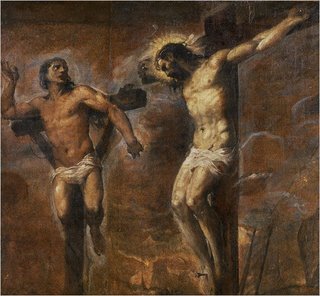 Alongside the cross of Jesus a pair of guilty criminals were also crucified; one on his right and the other on his left. Both of them had mocked Jesus at first, but then one of them repented. Acknowledging Christ’s innocence and lordship, he asked: “Jesus, remember me when you come into your kingdom.” And Jesus replied to him, “Amen, I say to you, today you will be with me in Paradise.”
So what is the cup which Jesus drank? His cup is a cup of suffering. When and where was Jesus first enthroned in the kingdom of God? He is enthroned in glory upon his Cross. And who received the places at his right and left? Those places close to Jesus went first to two crucified criminals. Indeed, James and John in today’s gospel did not know what they were asking. Yet these apostles would go on to be glorified through their own shares in Christ’s sufferings: including martyrdom for St. James and exile for St. John “the Beloved Disciple.”
Many people struggle to reconcile the reality of suffering with the power and love of God. Some Christians even mistakenly preach a “Prosperity Gospel,” saying that if you believe in God and love him, he will bless you so that bad things never happen to you. But this view is incomplete. There are true blessings which flow from following Jesus Christ and his Gospel, but the worldview of the “Prosperity Gospel” sets believers up for a fall. When painful hardship or tragedy eventually come, those Christians will either blame themselves for not having had enough faith or blame God for seeming to fail them. This latter group wonders, “If God is not dependable, why should I keep faith in him?” And then, feeling wounded, confused, and abandoned, they abandon God.
We do not completely understand the mystery of evils in our world; why a devastating earthquake happens to some particular city, why a particular healthy adult gets cancer, or why a particular young person perishes in a car wreck. We do know that God’s thoughts are higher than our thoughts, that his plans see farther than our sight. And we know that God, who is the highest good, would not permit evils to exist unless his omnipotence and goodness were such as to bring good even out of evil. In Jesus Christ we see that God intimately knows and deeply cares about all the things we suffer. So what is the Lord up to?
It’s no coincidence that all four gospels mention how Jesus is crucified between two criminals, one on his right and the other on his left, with one who repents and one who appears not to repent. All of humanity is similarly suffering as a result of our original or personal sin. We too begin as guilty rebels condemned. But on the Cross, Jesus Christ the Son of God, though divine and innocent, joins us in our suffering.
The Letter to the Hebrews observes that in him “we do not have a high priest who is unable to sympathize with our weaknesses, but one who has similarly been tested in every way…” This divine plan for Christ to be a suffering servant was foretold through the Prophet Isaiah centuries before: “If he gives his life as an offering for sin… the will of the Lord shall be accomplished through him. …Through his suffering, my servant shall justify many, and their guilt he shall bear.”
This Good Shepherd intimately understands the sufferings of the flock. He comes down from his high mountain into our dark valley and calls us to himself. We can respond to him with faith, acknowledging his goodness and lordship as sheep on his right. Or we can remain as faithless goats on his left, unrepentant for our sins and rejecting Christ forever. Realize that Jesus Christ desires not merely to forgive our sins, but that you and I would become children of God the Father just like himself.
Why do evils and sufferings continue to afflict those who follow Christ? As I said before, we do not know the answer to every painful question. (I believe we will understand God’s plan and purposes far better in heaven when he ‘wipes away every tear from our eyes.’) But we do know that Jesus Christ wants us to share in his own greatness and glory.
In today’s gospel, Jesus tries to help his disciples see that the path to true greatness and glory are not what they imagine. “Those who are recognized as rulers over the Gentiles,” Jesus notes, “lord it over them, and their great ones make their authority over them felt. But it shall not be so among you. Rather, whoever wishes to be great among you will be your servant; whoever wishes to be first among you will be the slave of all. For the Son of Man did not come to be served but to serve and to give his life as a ransom for many.”
In our loving service and in our faithful suffering, we become more like Jesus. With Jesus, our sacrifices and sufferings are redemptive, helping to make us saints while helping to save the world. This is the precious, challenging, saving cup our Lord offers us. But can we drink it? With the grace and love of Jesus Christ strengthening us, we can!


 In today’s gospel, Andrew the brother of Simon Peter sees the hungry crowd of thousands and says to Jesus, “There is a boy here who has five barley loaves and two fish; but what good are these for so many?” Andrew is discouraged and despairing. He has located some food – five loaves and two fish, and if they’re for sale he perhaps has enough coins on his person to purchase them. “But what good are these for so many?” Does what Andrew has to offer really matter? Will it make any real difference?
 St. John the Baptist Parish is honored welcome you and to offer our greatest prayer, the Holy Mass, for John’s soul and the consolation of all who know and love him. No short funeral homily can capture the fullness of a person. If I were to preach to you for an hour about his life, afterwards I bet that each of you here could add another unique story. This morning, I’m going to reflect upon just a single aspect of John’s life, one that all of you who are his family and friends are already familiar with: his being a chef.
 The “ninth of Av,” also known as Tisha B’Av, is no ordinary day for observant Jews, but a day of fasting and abstaining, because ninth of Av has seen multiple calamities in Jewish history. First, during the Exodus, when the twelve spies sent by Moses returned from scouting the Land of Canaan, most of them voiced negative reports, saying there was no way The Promised Land could be conquered. The Hebrews despaired and cried and refused to proceed. As a consequence, God made his people spend 40 more years in the desert until almost all the adults of that generation had died without entering The Promised Land. The next calamity came in the days of the Prophet Jeremiah, after the founding of the Kingdom of Israel. In the sixth century B.C., the Jewish Temple built by King Solomon in Jerusalem was destroyed by the conquering Babylonians. With that disaster, the Jews were forced to leave their homeland and resettle in the East, and this Babylonian Exile lasted about seventy years until a significant number of Jews were able to return. A third catastrophe occurred in 70 A.D., when the Second Temple in Jerusalem was destroyed by the Romans in response to a Jewish revolt. Not one stone was left upon another, as Jesus had foretold about 40 years before it came to pass. All of these devastating catastrophes, all three of these traumatic, mournful events (the denial of The Promised Land and the destruction of the first and second Temples) are remembered as occurring over the ninth day of Av.
 We extend to you, who mourn Barb’s passing most, our sympathy and condolences. We are honored and grateful to be able to offer today, here inside of Barb’s former parish church, our greatest prayer: the Holy Mass. May its graces help purify Barb’s soul of any imperfection, speed her soul to heaven, console all those who mourn her here below, and strengthen us on all our own lives’ journeys to God. No brief funeral homily can present the fullness of a Christian life, but holy aspects of a Christian’s life will reflect God’s goodness, beauty, and truth.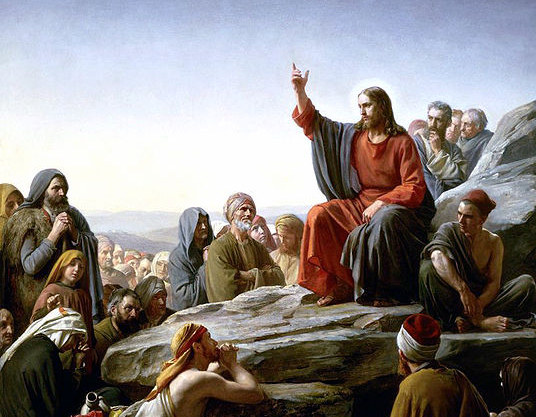
 Beatrice, Bob’s wife of sixty-six years, and his children have shared with me many stories about him. For instance, they told me of his precious Catholic faith in Jesus Christ. It was so important to Bob that he sacrificed for all eight of his children to be taught eight years each at St. Paul’s Catholic School. More recently, during the Covid pandemic and his infirmity, he would worship by watching the Holy Mass on TV, and delighted to have Jesus brought to his home in the Holy Eucharist. Through the years, at Bob’s supper table, where everyone had his or her own special spot, Bob would pray before meals, a devotion he always kept to the end of his life.
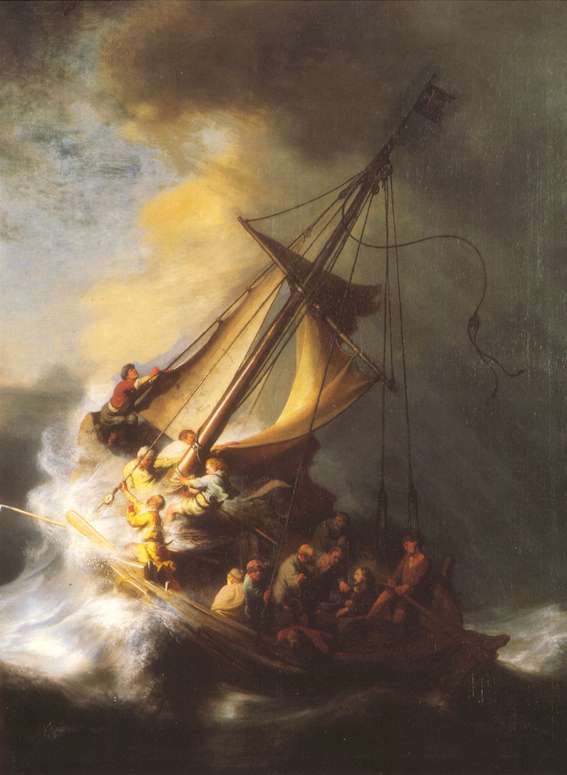 In today’s Gospel, we see Jesus commanding the wind and sea during a storm. He rebukes the wind and tells the sea, “Quiet! Be still!” and a great calm settles. His disciples in the boat, in awe at what they’ve witnessed, say to one another, “Who then is this whom even wind and sea obey?” It’s a stunning moment for them, but there’s another striking detail contained in this Gospel – a detail which Jesus’ disciples found completely unremarkable before the storm: Jesus was resting in the boat, he was asleep on a cushion in the stern. Christ wielding divine power is an important sign, but the fact that Jesus took naps also contains lessons for us that I’ll discuss a bit later.
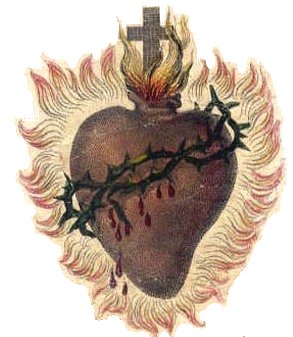 Nathan and Cassie’s wedding day lands upon this, the third Friday after the Feast of Pentecost, the eleventh day of June. God’s providence has arranged it that they be married on this special day – a feast day, the Solemnity of the Sacred Heart of Jesus, during a month especially dedicated to Jesus’ Sacred Heart. You can see depictions of the Sacred Heart inside this church. There is the statue of Jesus behind me, here in the sanctuary, and presently another statue in our devotional corner in the back. In artistic depictions, you may see Jesus’ Sacred Heart resting upon his chest, or maybe he holds it in his hand offering it to you, and sometimes his heart is depicted by all itself. In every depiction it is a human heart, crowned with thorns, pierced on the side, with flames and a cross emerging from the top. What is the meaning of these things? What do they reveal about Jesus? And what do they mean for Nathan and Cassie and us?
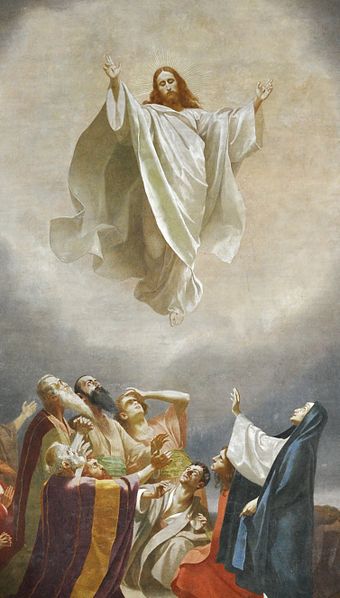 Where are we now in the Easter season? Let’s recap. Jesus resurrects and first appeared to his disciples on Easter Sunday. And for forty days, he is with them off and on, appearing and disappearing, teaching them about the Kingdom of God and preparing them for their important work ahead: that of sharing the Good News and shepherding his Church. On the last of those forty days, Jesus ascends to his Father in heaven. And for the next nine days, his disciples (as per Christ’s instructions) remain in Jerusalem praying for and awaiting the promise of the Father about which they had heard Jesus speak. Finally, on the fiftieth day, on the Jewish feast of Pentecost, the disciples are intensely filled with the Holy Spirit. They become empowered to begin sharing their stories about who Jesus is and what he has done, inviting others to know him, love him, serve him, and be saved through him. Today we celebrate the Feast of the Ascension, looking forward to the Feast of Pentecost next Sunday.
 Though children are small and weak, Jesus says, “See that you do not despise one of these little ones, for I say to you that their angels in heaven always look upon the face of my heavenly Father.” They have no wealth or worldly power, but Jesus says, “Unless you turn and become like children, you will not enter the kingdom of heaven.” Jesus, calling a child over and putting his arms around it, says, “Whoever humbles himself like this child is the greatest in the kingdom of heaven.” Jesus says that children are to be treasured and loved like himself: “Whoever receives one child such as this in my name receives me.” Jesus says, “Let the children come to me, and do not prevent them; for the kingdom of heaven belongs to such as these.” In just the same way as a good shepherd hates to lose even one of his many sheep, Jesus says, “it is not the will of your heavenly Father that one of these little ones be lost.” Indeed, ‘Jesus loves the little children, all the little children of the world.’

