Archive for the ‘Salvation History’ Category

Fasting from the Eucharist

April 10, 2020

Good Friday

St. Pope John Paul II and Joseph Cardinal Ratzinger, Lent of 1995

The Latin Rite of the Catholic Church, to which we and 98.6% of the world’s Catholics belong, has just one day each year when no Masses are to be celebrated. That day is today, Good Friday. After a reading of Christ’s Passion from the Gospel of John and reverencing his holy Cross, the Good Friday liturgy contains a Communion service in which presanctified (previously consecrated) Hosts are distributed and consumed. However, in the early Church, there was no reception of Holy Communion by the faithful on Good Fridays at all. This fact was once noted by Joseph Cardinal Ratzinger. Cardinal Ratzinger, this highly-esteemed theologian, would go on to be elected pope and take the more familiar name Benedict XVI. In his 1986 book “Behold the Pierced One,” he reflected upon the spiritual benefits that could be found by Catholics in full communion with the Church abstaining for a time from receiving our Lord in the Holy Eucharist. Obviously, these interesting passages are relevant to us now during this Long Lent of 2020.

Cardinal Ratzinger wrote:

“When [St.] Augustine felt his death approaching, he ‘excommunicated’ himself and took upon himself ecclesiastical penitence. In his last days, he set himself alongside, in solidarity, with the public sinners who seek forgiveness and grace through the pain of not receiving the Communion. He wanted to meet his Lord in humility of those who hunger and thirst for righteousness, for Him, the righteous and gracious One. Against the background of his sermons and writings, which describe the mystery of the Church as a communion with the Body of Christ and as the Body of Christ, on the basis of the Eucharist, in a really marvelous way, this gesture is quite shocking. It seems to me more profound and fitting, the more often I ponder it. Do we not often take things too lightly today when we receive the most Holy Sacrament? Could such a spiritual fasting not sometimes be useful, or even necessary, to renew and establish more deeply our relation to the Body of Christ?

In the early Church there was a most expressive exercise of this kind: probably since the time of the apostles, Eucharistic fasting on Good Friday was part of the Church’s spirituality of Communion. Not receiving Communion on one of the most holy days of the Church’s year, which was celebrated with no Mass and without any Communion of the faithful, was a particularly profound way of sharing in the Passion of the Lord: the sorrowing of the bride from whom the bridegroom has been taken away (see Mark 2:20). I think that a Eucharistic fast of this kind, if it were deliberate and experienced as a deprivation, could even today be properly significant, on certain occasions that would have to be carefully considered—such as days of penitence (and why not, for instance, on Good Friday once more?) […]

Such fasting — which could not be allowed to become arbitrary, of course, but would have to be consonant with the spiritual guidance of the Church — could help people toward a deepening of their personal relation to the Lord in the Sacrament; it could be an act of solidarity with all those who have a yearning for the Sacrament but cannot receive it. […] I would not of course wish to suggest by this a return to some kind of Jansenism: in biological life, as in spiritual life, fasting presumes that eating is the normal thing to do. Yet from time to time we need a cure for falling into mere habit and its dullness. Sometimes we need to be hungry—need bodily and spiritual hunger—so as once more to comprehend the Lord’s gifts and to understand the suffering of our brethren who are hungry. Spiritual hunger, like bodily hunger, can be a vehicle of love.”

During this dangerous Coronavirus pandemic, faithful shepherds charged by Christ to care for the fullness of persons entrusted to them have prescribed sad but necessary measures which have restricted access to Holy Communion. In doing this, our Church leaders follow in the prudential footsteps of past prelates who likewise suspended public Masses during times of deadly contagion, from the medieval plagues to the modern Spanish Flu. Although public liturgies with Communion have ceased it is important to remember that the Holy Mass continues to be offered by priests in our Catholic churches. The graces of Jesus’ sacrifice pour forth from these altars into Christians souls around the world. Do not doubt that our Lord will provide sufficient grace for all that you are called to do in this season of our lives. As the Lord once told St. Paul when the saint prayerfully begged for a certain trial to be taken away, “My grace is sufficient for you, for power is made perfect in weakness.”

When we cannot physically receive Jesus in the Eucharist we can still unite ourselves to him through a prayer for Spiritual Communion. Pope St. John Paul the Great wrote that the practice of Spiritual Communion “has happily been established in the Church for centuries and recommended by saints who were masters of the spiritual life. St. Teresa of Jesus wrote: ‘When you do not receive Communion and you do not attend Mass, you can make a Spiritual Communion, which is a most beneficial practice; by it the love of God will be greatly impressed on you.’” Once, in a 14th century vision, Jesus showed St. Catherine of Siena two chalices, one gold and one silver. He said her Sacramental Communions were preserved in the gold chalice and her Spiritual Communions in the silver one. When our sacramental reception of our Lord proves impossible, Jesus desires our Spiritual Communion. Until the day we are all safely reunited around his altar, I urge you to make acts of Spiritual Communion, such as this famous prayer of St. Alphonsus Liguori:

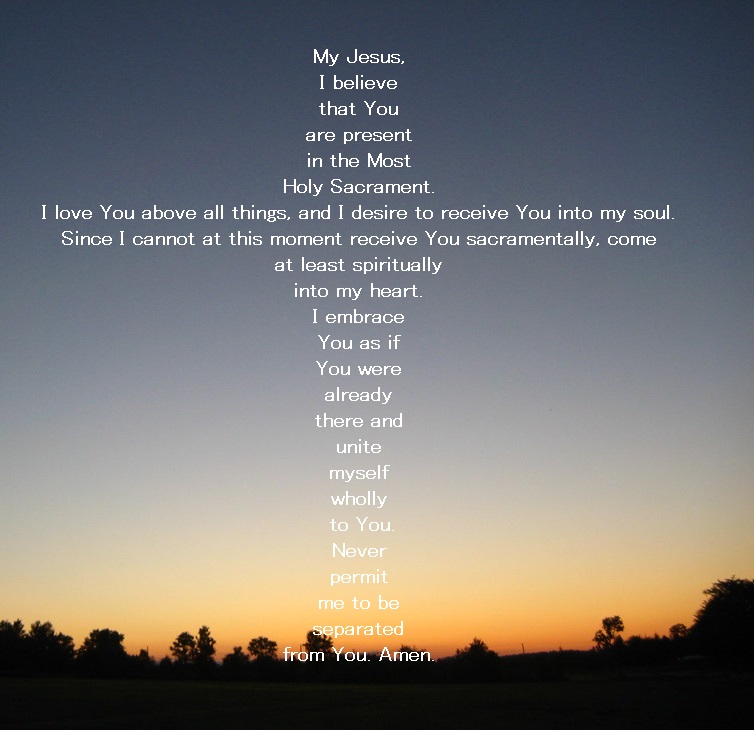
My Jesus,
I believe that You are present in the Most Holy Sacrament.
I love You above all things, and I desire to receive You into my soul.
Since I cannot at this moment receive You sacramentally,
come at least spiritually into my heart.
I embrace You as if You were already there
and unite myself wholly to You.
Never permit me to be separated from You.
Amen.

Just one month ago, when pews were full for the 2nd Sunday of Lent, we heard the Gospel story of the Transfiguration. On Mount Tabor, Jesus’ face shone like the sun and his clothes became white as light. Ecstatic, Simon Peter said in reply, “Lord, it is good that we are here! If you wish, I will make three tents here, one for you, one for Moses, and one for Elijah.” Peter wanted to never leave that euphoric time and place, but it was necessary that Jesus lead him down from that mountain top into the dark valley; from the Mount of Transfiguration to the Hill of Crucifixion.

It is a true sacrifice to fast from the Eucharist this Good Friday amidst this Long Lent. But our Christian sacrifice is not without purpose nor without hope. Like Jesus’ Passion, it is a sacrifice offered for the love of others. This is his Body given up to save many; we do this in memory of him. And like Jesus within his Passion, we can be confident that this arduous trial shall pass away and our suffering and obedience will soon yield great rewards, particularly a deepened love for our Eucharistic Lord. Being followers of the transfigured Christ takes us to Calvary, but the Passion is what leads us to his Resurrection. And the more we share in the likeness of Christ, the more we will share in his glory.

An Identity and a Mission

April 1, 2020

2nd Sunday in Ordinary Time—Year A


When St. John the Baptist sees Jesus coming toward him he declares, “Behold, the Lamb of God, who takes away the sin of the world!” Why did John say that? How is Jesus like a lamb? Under the Old Covenant, animal sacrifices were offered for sins. The symbolism was that the living animal, often an unblemished male sheep, was dying in place of the sinner who offered it. This prefigured what was to come. Jesus Christ, like a flawless, obedient sheep, hears and follows his master’s voice, He does the Father’s will, and takes our place in the sacrifice which actually forgives sins. This is why Jesus is rightly called the Lamb of God who takes away the sins of the world.

John the Baptist goes on to say, “He is the one of whom I said, ‘A man is coming after me who ranks ahead of me because he existed before me.’” Indeed, Jesus, as the Second Person of the Most Holy Trinity, existed before the universe itself. Through Him all things were made, and the things that came to be pointed to and culminated in Him. For this reason, it is not so much that Jesus resembles the lambs of Old Covenant sacrifices, but rather that God establishes the ritual of lamb sacrifice for sins in order to point to Jesus and his ultimate sacrifice.

The story of the life of Jesus appears in the New Testament, but the Holy Spirit has spoken through the prophets about Him throughout the Old Testament. For example, our first reading from the Book of Isaiah written several centuries before Christ, is one of hundreds of passages which speak of Him. But before we return to that passage again, let’s review a little historical background.

We read in the Book of Genesis that Jacob was Abraham’s grandson. Jacob was renamed “Israel” by God and fathered twelve sons. From these twelve sons the “twelve tribes of Israel” descended. This is why the names “Jacob” and “Israel” are usually interchangeable, and may refer to one person or to many. In Isaiah, the prophet writes, “The Lord said to me: You are my servant, Israel, through whom I show my glory. Now the Lord has spoken who formed me as his servant from the womb…” To whom is God speaking in these lines? Who is the servant whom God formed from their beginning; the prophet himself, God’s faithful people, or Jesus Christ? There is truth in each of these interpretations, but this reading’s relevance to Jesus particularly shines forth. The prophesy continues:

It is too little, the Lord says, for you to be my servant, to raise up the tribes of Jacob, and restore the survivors of Israel; I will make you a light to the nations, that my salvation may reach to the ends of the earth.”

Jesus is the one who brings light and salvation not only for the physical descendants of Abraham, Isaac, and Jacob, but for all the nations on earth, to non-Jewish Gentiles like you and me through His one, holy, catholic, and apostolic Church. Another foreshadowing of Christ is seen in today’s psalm, written by King David one thousand years before Christ. Hear these words as if spoken from Jesus’ lips:

[Mere] sacrifice or offering you wished not, but ears open to obedience you gave me. [More of the former] burnt-offerings or sin-offerings you sought not; then said I, “Behold I come.”

In the written scroll it is prescribed [that is, it is foretold in the Scriptures.] For me to do your will, O my God, is my delight, and your law is within my heart!

I announced your justice in the vast assembly; I did not restrain my lips, as you, O Lord, know. I have waited, waited for the Lord, and he stooped toward me and heard my cry. And he put a new song into my mouth, a hymn to our God.

I fully suspect the 40th Psalm had an original, personal meaning for King David when he authored it, and these words have been prayed by God’s faithful people in a personal way ever since, but these words especially apply to the person and mission of Christ. After preaching God’s word to vast assemblies, obedience to his mission led Jesus to His Passion. After crying out for His Father to save Him, and waiting, waiting three days in the tomb, Jesus’ resurrection has put a new song in his mouth, a new hymn of praise to the Father in which we all have a part.

As I mentioned in my homily last week, by baptism you are baptized into Christ. And by remaining connected to Jesus Christ through his sacraments, He remains in you. The prophecies of Scripture refer not only to the human authors, like Isaiah or David, and they refer not only to Jesus, these passages’ fullest fulfillment, but also to us, His Bride and His Body, the Church in her members, the New Israel which comes to us through the twelve Apostles of Jesus. Hear those words of the Lord from Isaiah again:

You are my servant, Israel, through whom I show my glory. Now the Lord has spoken… that Jacob may be brought back to him and Israel gathered to him.”

Israel had been scattered, whole tribes of Jacob were lost due to sin and its consequences, but God Ever-Faithful used Israel, perfected in his Son, to gather his people Israel back to Himself. He says to us:

You are my servant, O Church of God, through whom I show my glory. Now the Lord has spoken… that the People of God may be brought back to him and the Church gathered to him.

God has purpose for your life. A purpose found in Christ. A mission to be faithful and fruitful in Christ. Jesus is still working to save souls today and he desires to work though each of us in His Body, the Church.

What We Should Do Now

March 25, 2020

The Solemnity of the Annunciation

The angel Gabriel was sent from God to a town of Galilee called Nazareth, to a virgin betrothed to a man named Joseph, of the house of David, and the virgin’s name was Mary. And coming to her, he said, “Hail, full of grace! The Lord is with you.” But she was greatly troubled at what was said and pondered what sort of greeting this might be. Then the angel said to her, “Do not be afraid, Mary, for you have found favor with God. Behold, you will conceive in your womb and bear a son, and you shall name him Jesus. He will be great and will be called Son of the Most High, and the Lord God will give him the throne of David his father, and he will rule over the house of Jacob forever, and of his Kingdom there will be no end.”

But Mary said to the angel, “How can this be, since I have no relations with a man?” And the angel said to her in reply, “The Holy Spirit will come upon you, and the power of the Most High will overshadow you. Therefore the child to be born will be called holy, the Son of God. And behold, Elizabeth, your relative, has also conceived a son in her old age, and this is the sixth month for her who was called barren; for nothing will be impossible for God.” Mary said, “Behold, I am the handmaid of the Lord. May it be done to me according to your word.” Then the angel departed from her.


What would it be like to be visited by an angel? Scripture tells us “some [people] have unknowingly entertained angels,” like Gideon or Tobiah, because angels can appear on earth in human disguise. But if you ever saw an angel in unveiled glory this spiritual creature would not be a winged Precious Moments character like some people imagine. As C.S. Lewis writes in the preface of his book The Screwtape Letters:

In the plastic arts [the symbolic representations of angels] have steadily degenerated. Fra Angelico’s angels carry in their face and gesture the peace and authority of Heaven. Later come the chubby infantile nudes of Raphael; finally the soft, slim, girlish and consolatory angels of nineteenth-century art… They are a pernicious symbol. In Scripture the visitation of an angel is always alarming; it has to begin by saying “Fear not.” The Victorian angel looks as if it were going to say “There, there.

When the Archangel Gabriel came and greeted the Virgin Mary in Nazareth, “she was greatly troubled.” He must calm and reassure her, “Do not be afraid, Mary, for you have found favor with God.” His message from Heaven is a weighty and mysterious one: you shall conceive and bear the Messiah, the Christ, who is both the heir to David’s kingdom and the Son of Almighty God. Mary has apparently made a prior vow to remain a virgin within her current marriage to Joseph, for she questions how she would ever conceive apart from relations with a man. Gabriel explains this will be through the power of God, for whom all things are possible. Even this answer leaves a great deal unrevealed.

It’s natural for Mary to feel anxious. She has heard God’s promises but much remains uncertain for her near and distant future: Will Joseph believe her? How should she parent such a Holy Child? How will Jesus become king? What will happen to her? How long or difficult will her life be? God’s full plan is unknown to Mary, but she knows what to do for that moment. She says, “Behold, I am the handmaid of the Lord. May it be done to me according to your word.” Through this faithful, trusting response, Jesus Christ saves his Church, the Virgin Mary becomes the Most Blessed, and every generation is blessed.

It’s natural to feel anxious now. We have received God’s promises but much remains uncertain about our near and distant future. Follow Mary’s example and entrust your life to God’s will, so that you may be the most blessed and a great multitude may be blessed through you.

This is His Body Given up to Save Many

March 21, 2020

Laetare Sunday — 4th Sunday of Lent—Year A

This past Wednesday evening, I saw this image online with the caption: “Darkness has fallen: every single U.S. diocese has suspended public celebrations of the Mass.”

Our Laetare Sunday rejoicing is more subdued this Lent. The sad but necessary suspension of public Masses by our nation’s bishops is a painful loss. And for many of the faithful, the greater their love for the Lord the greater the pain they feel. They are like the woman at Simon the Pharisee’s house who could bathe Jesus’ feet with dripping tears ‘because she loved much.’ (Luke 7:47) However, darkness has not overcome us.

Brothers and sisters,” today’s second reading tells us, “you were once darkness, but now you are light in the Lord.” God is still God, Christ is still Lord, and we are still His. Though public liturgies have ended the Holy Mass continues to be privately offered in most every Catholic church. The graces of Jesus’ sacrifice pour forth from these altars into Christian souls throughout the world, for our good and the good of all his holy Church. Priests are celebrating these Masses in obedience to the command of Christ recalled at every Consecration, “Do this in memory of me.” Yet each of us, ordained and lay people alike, is called to keep this commandment of Christ in a deeper way; by personally imitating Jesus in his loving self-sacrifice for others.

Today, and in the critical weeks and months ahead, all of us are called to sacrifice in ways that will seriously limit our activities and impact our finances. Why are we doing this? To stop the spread of a deadly disease not merely to ourselves but to our many neighbors around us. From my research into this grave topic, it appears that hundreds of thousands—potentially millions—of American lives depend upon the extent of our collective and individual actions now. So please respond with a firm resolve from a Christian love for others.

When you ache today because you can neither gather for Mass nor physically receive our Lord, take heart in the reason for your sacrifice. This is his Body given up to save many; we do this in memory of Him. And soon, when you are asked to help people in the community meet their material needs, sacrifice for them knowing whom you are also serving. For whatever you do for the least of your brethren, you do it for Him. Invite Jesus now to enter into your heart and be with you, to console and strengthen you, today and in the trials ahead of us.

Finding Jesus in the Temple

March 19, 2020

The Solemnity of St. Joseph

Each year Jesus’ parents went to Jerusalem for the feast of Passover, and when he was twelve years old, they went up according to festival custom. After they had completed its days, as they were returning, the boy Jesus remained behind in Jerusalem, but his parents did not know it. Thinking that he was in the caravan, they journeyed for a day and looked for him among their relatives and acquaintances, but not finding him, they returned to Jerusalem to look for him.

After three days they found him in the temple, sitting in the midst of the teachers, listening to them and asking them questions, and all who heard him were astounded at his understanding and his answers. When his parents saw him, they were astonished, and his mother said to him, “Son, why have you done this to us? Your father and I have been looking for you with great anxiety.” And he said to them, “Why were you looking for me? Did you not know that I must be in my Father’s house?” But they did not understand what he said to them.


Joseph and Mary feel great anxiety in these days. Jesus is missing and Jerusalem could be dangerous. Yet the young Lord Jesus is not lost. Retracing their steps they find him in the Temple. He’s dialoguing with the Jewish teachers, perhaps answering their replies with more probing questions of his own in the tradition of the rabbis.

Mary asks her Son, “Why have you done this to us?” Her anxiety, perhaps even touched by anger, is natural. Jesus has purposes in these events that his parents do not fully grasp, but they still love him and he loves them too. “Why were you looking for me? Did you not know that I must be in my Father’s house?” Jesus could have been found by his parents sooner; he was in the Temple the whole time.

You may feel great anxiety in these days. With the suspension of public Masses you could feel like Jesus is missing. Given the serious reports of disease the city could be dangerous. Yet we have not lost Jesus. Retracing your steps you can find him in the church.

What questions are you asking Jesus in prayer? What question does he pose you in reply? Perhaps you ask, “Why have you allowed this to happen to us?” Our feelings of anxiety or anger are natural. Jesus has purposes in these events that we do not fully grasp, but we still love him and he loves us too.

And Jesus can still be found nearby; he has been present in the tabernacle of the church this whole time. You can find Jesus in his Temple by visiting the Real Presence of our Eucharistic Lord. St. Paul’s Church is open daily, 7 AM to 7 PM and St. John the Baptist’s Church is open 8 AM to 7 PM on Saturdays, Sundays, Tuesdays, & Thursdays. These churches will be spray-disinfected for each day they are open, but use the cleaning materials located in the back of church to clean your seating area before and after use.

Follow these important safety tips as they might save your life or the lives of others’:

  • Realize that possibly 80% of confirmed cases of Coronavirus are contracted from people who did not realize they were sick and that symptoms typically take five days to manifest. Therefore, we must guard against this disease before we know it is among us. Practice social distancing.
  • If you have a cough or a fever, you might not be sick with the Coronavirus but please stay home; this virus can linger in the air and upon surfaces and infect others.
  • Remember that the virus can survive on surfaces (such as door handles, pews, and clothing) for one, two, or three days; so avoid touching your eyes, nose, or mouth. Treat unwashed hands as if they were infected and clean them often with soap and water.
  • Maintain at least a six-foot distance from other people.
  • No more than nine persons can be at the church at once (under emergency Wisconsin state law and by our bishop’s decree).
  • The most common place visitors sit in church is the back pews; so I suggest sitting in other, less-frequented, possibly-safer rows.


St. Joseph,
Patron of the Universal Church
and Protector of the Holy Family,
pray for us in our time of need


Moses & the Rock — 2nd Sunday of Lent—Year A

March 8, 2020

You’re familiar with the story of Moses: his being saved from the waters of the Nile as a baby, his growing up in the household of Pharaoh, his flight as a fugitive after killing an Egyptian taskmaster, his years shepherding in the Sinai Desert until God called him from the Burning Bush, how God used Moses to free the Hebrews from Egyptian slavery with great plagues and awesome miracles, how God through Moses gave his people the Law of the Old Covenant. Moses shared an incredible intimacy with God.

In the Book of Numbers, God said:

“If there are prophets among you,
in visions I reveal myself to them,
in dreams I speak to them;
Not so with my servant Moses!
Throughout my house he is worthy of trust:
face to face I speak to him,
plainly and not in riddles.
The likeness of the Lord he beholds.”

The Book of Deuteronomy declares: “Since [that time] no prophet has arisen in Israel like Moses, whom the Lord knew face to face.” So one would imagine, one would think, that Moses saw God’s face. The Book of Exodus says: “The Lord used to speak to Moses face to face, as a person speaks to a friend.” However, following soon after in that same chapter from Exodus, Moses asks the Lord, “Please let me see your glory!” And the Lord answers: “I will make all my goodness pass before you, and I will proclaim my name, ‘Lord,’ before you … But you cannot see my face, for no one can see me and live. Here is a place near me where you shall station yourself on the rock. When my glory passes I will set you in the cleft of the rock and will cover you with my hand until I have passed by. Then I will remove my hand, so that you may see my back; but my face may not be seen.” So Moses met with God in intimate conversation as one friend speaks to another, in his holy presence, yet it is not clear that Moses, during his lifetime, ever beheld God’s face. Similarly, God gave Moses the mission of leading his people from Egypt to the Promised Land, the land promised to Abraham and his descendants, yet Moses during his lifetime never entered the Promised Land himself.

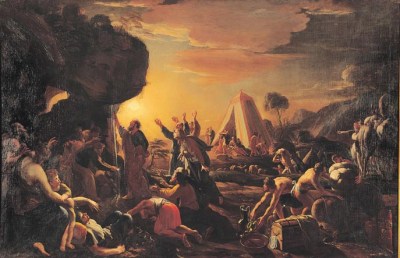
Why was that the case? Early in their desert wanderings, the Hebrews complained against Moses because of their lack of water. Moses cried out to the Lord, “What shall I do with this people? A little more and they will stone me!” And the Lord answered Moses: “Go on ahead of the people, and take along with you some of the elders of Israel, holding in your hand, as you go, the staff with which you struck the Nile. I will be standing there in front of you on the rock in Horeb. Strike the rock, and the water will flow from it for the people to drink.” Moses did this in the sight of the elders of Israel and the crisis was adverted.

However, on a later occasion, when the community again lacked water, they held an assembly against Moses and Aaron. The people quarreled with Moses, exclaiming, “Why have you brought us out of Egypt, only to bring us to this wretched place [to die]? It is not a place for grain nor figs nor vines nor pomegranates! And there is no water to drink!” The Lord said to Moses: “Take the staff and assemble the community, you and Aaron your brother, and in their presence command the rock to yield its waters. Thereby you will bring forth water from the rock for them, and supply the community and their livestock with water.

So Moses took the staff from its place before the Lord, as he was commanded. Then Moses and Aaron gathered the assembly in front of the rock, where he said to them, “Just listen, you rebels! Are we to produce water for you out of this rock?” Then, raising his hand, Moses struck the rock twice with his staff, and water came out in abundance, and the community and their livestock drank. But the Lord said to Moses and Aaron: “Because you did not have confidence in me, to acknowledge my holiness before the Israelites, therefore you shall not lead this assembly into the land I have given them.

Years later, at the edge of the Promised Land, the Lord told Moses: “Ascend this mountain [Mount Nebo] and view the land … which I am giving to the Israelites as a possession. Then you shall die on the mountain you are about to ascend, and shall be gathered to your people, [because] you broke faith with me among the Israelites at the waters of Meribath-kadesh in the wilderness of Zin: you did not manifest my holiness among the Israelites. You may indeed see the land from a distance, but you shall not enter that land which I am giving to the Israelites.” And there, Moses the servant of the Lord died as the Lord had foretold. Moses was one hundred and twenty years old when he died, yet his eyes were undimmed and his vigor unabated.

What was behind this punishment from God? Moses had been disobedient to the Lord, striking the rock twice instead of speaking to the rock as instructed; and this was more than just some desert rock—the rock carried spiritual, symbolic, prophetic significance. In his First Letter to the Corinthians, St. Paul saw the Church and her sacraments prefigured in the story of the Hebrews and the Exodus. St. Paul writes: “Our ancestors were all under the cloud and all passed through the sea, and all of them were baptized into Moses in the cloud and in the sea. All ate the same spiritual food, and all drank the same spiritual drink, for they drank from a spiritual rock that followed them, and the rock was the Christ.

So the rock in the desert symbolized Jesus Christ. The first time, God told Moses to strike the rock, and it poured forth from its side saving water for God’s people. But the second time, when God told Moses to speak to the rock, Moses disobeyed and struck it twice. Jesus Christ has already been struck, beaten, and suffered violence once, for you and me in his Passion. We are no longer to keep striking him, again and again, through our sinful disobedience. Rather than choosing sin, we are to speak to Christ, asking him to pour forth his saving gifts. Jesus says, “Let anyone who thirsts come to me and drink. … To the thirsty I will give a gift from the spring of life-giving water.

I fear that sometimes we might think, “I can keep on sinning, it’s no big deal, because if I keep on going to Confession and have my sins forgiven it’s like they never happened—they don’t really matter.” Yet every sin is a lost opportunity to do God’s will. Every sin refuses God’s “Plan A.” And sins, even after they are forgiven, can bear earthly consequences which remain for the rest of our lives. Moses sinned, and repented, and remained God’s friend, but he was refused entry into the earthly Holy Land to his own great disappointment. Even convicted murderers can be forgiven by God, but they still remain behind prison bars and their victims bodies remain buried underground. Let’s not be complacent about our sins, for every sin is a lost opportunity to follow God’s better plan and, even if forgiven, sins can have irreparable consequences in this world for the rest of our lives. But, thanks be to God, our Christian hopes are not for this lifetime alone. Moses died and was buried, but that is not the end of his story.

Jesus took Peter, James, and John his brother, and led them up a high mountain by themselves. And he was transfigured before them; his face shone like the sun and his clothes became white as light. And behold, Moses and Elijah appeared to them, conversing with him.” St. Luke’s telling of today’s Gospel story notes Moses and Elijah “appeared in glory and spoke of [Jesus’] exodus that he was going to accomplish in Jerusalem.

Sometimes people ask how the apostles knew it was Moses and Elijah. Most likely they either introduced themselves, or Jesus introduced them. Some people have the notion that the dead forget who they were, forget all their memories, and care nothing about the events on earth. But Moses can only introduce himself if he knows who he is. And if Jesus said, “This is the prophet Moses,” there’s no indication that Moses replied, “I am? Where am I? What is happening?” Moses and Elijah can converse with Jesus about the exodus he is going to accomplish in Jerusalem (that is, about his coming Passion, death, and resurrection) because they know who they are, remember their lives, and are concerned about events among the living.

At the Transfiguration, we see the not quite fully-satisfied aspects of Moses’ life reaching their fulfillment. Moses never entered the Promised Land in his lifetime, but here he stands in Israel upon Mount Tabor with Jesus. Moses seems to have never seen God’s face, but now he speaks face to face with Christ. Consider how privileged we are to stand in this holy place and have such intimacy with Jesus Christ in his Holy Eucharist. It is good that we are here.

God greatly desires that we not sin. And if we have sinned, the Lord desires that we promptly repent and sin no more. Now, this season of Lent is an excellent time for repentance—especially while we’re still healthy. This world is scarred by sins, some forgiven and many not; and these painful wounds grieve us and prevent our full satisfaction in life. Yet the full story of Moses shows that our hopes are not merely limited to this life. Our hope extends beyond death, and St. Paul says, “God works all things for the good of those who love him.” And in the end, as St. Julian of Norwich says, “all shall be well, and all shall be well, and all manner of thing shall be well.

Satan’s Old Tricks — 1st Sunday of Lent—Year A

March 3, 2020

After his baptism in the Jordan, but before the start of his public ministry, Jesus was led by the Holy Spirit into the desert to be tempted by the devil. Did Satan realize at that time that Jesus was God? He says, “If you are the son of God… If you are the son of God.” But if Satan knew, it’s strange that he would attempt the impossible: to try tempting the all-holy God into sinning and doing evil. Old Testament prophesies allude to the promised Messiah, the awaited Anointed One, as being “Son of God.” God says in the 2nd Psalm:

“I myself have installed my king
on Zion, my holy mountain….
You are my son;
today I have begotten you.”

And in Psalm 89, God says:

“He shall cry to me, ‘You are my father,
my God, the Rock of my salvation!’
I myself make him the firstborn,
Most High over the kings of the earth.”

Old Testament Jews had been told their Messiah would at least figuratively be the Son of God; so, whether or not Satan knew Jesus was divine, he at very least suspected that this man from Nazareth was the Christ.

Jesus evidently went on to tell his apostles of the devil’s temptations in the desert—for how else would anyone know to write about them in the Gospels? There may have been additional temptations, but three are retold in Matthew and Luke’s Gospels. Jesus is on the verge of beginning his public ministry. What kind of Messiah will he be? The devil’s three temptations seek to corrupt his mission from the start. Satan seeks to lead the Christ off track so as to derail the plan of God. He did this first in the lush Garden of Eden, and here he seeks to do it again in the desert.

If you are the Son of God,” Satan says, “command that these stones become loaves of bread.” Jesus was hungry, but if he does this miracle the next question may be, “So you feed yourself, do you? How now can you refuse to give bread to everyone?” Satan wants Jesus to be a materialistic Messiah who must focus on nourishing bodies to the neglect of their souls. Jesus calls his disciples to practice material charity; today the Catholic Church is the largest charitable organization in the world; teaching, healing, clothing, housing, feeding, but this is all of secondary importance to its spiritual work. For what would it profit us to have all of our material needs fulfilled if our spiritual needs went unaddressed and we ultimately died separated from God? How do these things personally apply to us? Well, did the recent stock market drops ruin your week? Or are you too afraid or possessive to share, to tithe, to give to good causes? Or are you too busy working to pray? Jesus answers, “One does not live on bread alone, but on every word that comes forth from the mouth of God.

Next we hear how the devil takes Jesus to the roof edge atop the temple in Jerusalem and challenges him: “If you are the Son of God, throw yourself down. For it is written: ‘He will command his angels concerning you’ and ‘with their hands they will support you, lest you dash your foot against a stone.’” Satan is quoting Psalm 91. This goes to show—and serves as a warning—that not every Bible quote teaches what some people claim it does. True Scripture interpretation must be in union with the mind of Christ, and one with the Body of Christ, that is his Church.

God does not want Jesus to jump off buildings, but the devil wants the Messiah to demand that God protect him from all harm or hardship. Satan wants Jesus to be a Christ who is unwilling to suffer, who will refuse to drink any bitter chalice. The devil knows doing God’s will in this broken world will necessarily entail some sufferings for his faithful ones. If Jesus is unwilling to sacrifice then God’s people will never be saved. Are you trying to force your plans upon God? Are you pleased to serve God only so long as you experience no pain? Are you demanding that your salvation come without embracing your cross? Jesus answers, “You shall not put the Lord, your God, to the test.

Lastly, we hear the devil takes him up to a very high mountain, and shows him all the kingdoms of the world in their magnificence, and says, “All these I shall give to you, if you will prostrate yourself and worship me.” Satan wants Jesus to be a compromised Messiah who will pursue good things by doing, by serving, evil. The tempter says, “It’s only a little thing, just lay down, just say the words, just take a small bite, everything will be so much easier and better if you do.” Or else the tempter lies in the opposite extreme direction, “You have no choice – it’s a sin but there’s no other way – this must be done!” What sins do you still commit in hopes that good will result? Where do you bow down and side with Satan against the will of God? Jesus answers, “The Lord, your God, shall you worship and him alone shall you serve.

By God’s providence, the temptations of Jesus in the desert foreshadow Christ’s Passion to come. Jesus is not a materialist Messiah, changing stones to loaves of bread. But, beginning at the Last Supper, he feeds the world by changing bread into himself “for the life of the world.” Jesus is not a Christ who refuses to sacrifice. At the Temple he endures trail and condemnation by the Sanhedrin and accepts the bitter chalice of his Passion according to his Father’s saving will. And Jesus is not a compromised Messiah, committing sins for false and illusory gains. Christ becomes the magnificent, sinless king of all nations, atop Mount Calvary enthroned upon the Cross.

In this season of Lent, in these forty days of penance, we are in the desert with Jesus, learning from him, and being strengthened by him, so that we can stand straight and strong and not fall for the temptations and traps of the enemy, the same tricks he used against of Adam and Eve, that he attempted with Jesus Christ, and that he still uses in our day. This Lent, instead of falling for Satan’s same old tricks, let us grow closer to Jesus Christ in relationship and resemblance, closer in his friendship and closer to his holy likeness.

Shepherds & Fishermen — 3rd Sunday in Ordinary Time—Year A

March 3, 2020

What did the twelve apostles do for a living before Jesus called them to follow him? For six of the first apostles, that is half of the original twelve, we have no words from Scripture concerning their previous jobs. We are told that St. Matthew was a tax collector for the Roman government. We also hear of St. Simon the Zealot, who was either especially zealous in his personal religious devotion, or had ties to the Jewish Zealot movement is Israel. The Zealot movement sought, through politics and insurrection, to overthrow the Roman government in the Promised Land. If Matthew and Simon did indeed come from opposite sides of that era’s political spectrum, it suggests that every political party or faction has important things to learn from Jesus Christ.

In today’s Gospel, we learn the shared profession of four other apostles: Simon Peter, Andrew, James, and John; they were commercial fishermen. Now the Lord choosing men from the fishing industry was something new in salvation history. In the Old Testament, God often employs shepherds in his holy service. Among the patriarchs there is Abraham, Jacob-Israel, and his twelve sons – shepherds all. Later there’s the prophet Moses, King David, and Amos the prophet, each of whom tended flocks for some time before receiving their higher calling from God. As far as I can tell, there are no fishermen of particular note in the Bible before these four to whom Jesus says, “Come after me, and I will make you fishers of men.” Jesus, in calling fishermen, is doing something new. Now if the fishing background of these four apostles were irrelevant, I doubt the Holy Spirit would have inspired the inclusion of this fact into the Gospels. So what is the significance of this detail?

The work of a shepherd is different from that of fisherman. A shepherd tends his flock. He knows his sheep and his sheep know him. Some new lambs are born while other, older sheep go off to market or return to the earth, but the size of the sheepfold tends to remain rather stable. A fisherman, on the other hand, through his practiced skills and God’s providence, seeks and finds new fish every day. The fish are living in their own dark, watery world until the fisherman gathers them to himself. A shepherd maintains his numbers, but a fisherman goes out to seek more and more. Jesus chose his apostles not only to shepherd his people Israel, but to go forth to fish for people from all nations. Jesus made Peter not only a “fisher of men” but commanded him to ‘”feed my lambs… tend my sheep… feed my sheep.

Today we primarily think of water as a symbol of life, because nothing lives without water. Yet in the ancient world, water was often seen as a symbol of death. It’s possible even on a calm day to drown in a river, lake, or sea, but the volatile, deadly nature of large bodies of water is the subject of stories, poems, and songs even up to our day. For example:

The legend lives on from the Chippewa on down
Of the big lake they called Gitche Gumee
Superior, they said, never gives up her dead
When the gales of November come early

Fish live with this realm of death, a dark, watery world. The fisherman brings fish into the light, to a higher realm, a world they had previously ignored or never imagined. In our semi-post-Christian world today, is Jesus calling you and I to be shepherds or fishermen? Are we meant to maintain our flock, or to endeavor for more unnetted souls? There is need for both missions. In fact, we are called to do both. Many around us are baptized and still identify as Christians, yet how deep does their faithful devotion really go? Peter and Andrew left their careers for Jesus. James and John left their family for Jesus. Yet how few people today even come to church for him. True devotion and divine relationship is ignored or never imagined. Jesus calls you to be a missionary; not on the far side of the earth so much as in our own community. Be able to give witness to him. When I was a kid, when we were driving home from Sunday Mass, my family would often talk about what we heard in the homily. Today you your drive home from church I encourage you to ask each other: Why did you come to church today? What difference does it make for your life? We need to practice sharing why our faith is a gift with one another so that we can invite others to share this treasure.

In our first reading from St. Paul’s first letter to the Corinthians, we learn that the Christians in Corinth were choosing favorites and forming factions: ‘I belong to Paul. I belong to Apollos. I belong to Cephas.‘ St. Paul writes to remind them, you belong to Christ! Do not allow another person to get in way of Jesus for you. Pastors are important and Jesus has ordained it so, since without clear leadership how could St. Paul’s prayer and Christ’s desire, ‘that all of us agree in what we say, that there be no divisions among us, that we be united in the same mind and in the same purpose‘ ever be achieved? The need for human leadership of Jesus’ Church in this broken world, however, makes grave sin and scandal possible. This is a terrible thing, wherever and whenever it occurs. But please, please, do not separate from Peter on account of another apostle’s sin. You need Jesus, I need Jesus, and everyone else needs Jesus, too. Let us be good shepherds and fishers of men, caring for and seeking out everyone in our midst, as Jesus calls us to do.

The Great Restoration — Funeral for Donald “Don” Sokup, 76

January 15, 2020

Today, St. John the Baptist Parish is humbled, honored, and pleased to be able to offer our greatest prayer, the Holy Mass, for Don’s soul. We earnestly hope that our prayers will be a blessing to him, and a consolation to you, who know and love him best. A life like Don’s has many, many parts. And no brief funeral homily can examine or present them all. But just as you can look at a machine and draw some conclusions about the engineer who designed it, so parts of our lives can reflect truths of our Maker.

In the June/July 1996 issue of Gas Engine Magazine, a publication dedicated to “preserving the history of internal combustion engines,” there was an article entitled “Titan with a Top.” It was authored and submitted by a gas engine enthusiast from Elk Mound, Wisconsin: a Mr. Don Sokup. The titular Titan was a tractor, a 10-20 Titan tractor, manufactured in 1918. When Don found it, it was broken, buried, and decayed; the head of the engine had been buried in dirt for who knows how long. Most people said it would never run again, but Don believed he could restore it. This first picture is what it looked like, unearthed but dead.

After a year of hard labor,” Don wrote, “she came back to life and now purrs like a kitten. In the photo [below], you can see what a difference all my hard work made.” Don noted, “the top [the new red roof] is my own invention.” His resurrected and restored tractor was made greater and more glorious than it had been before. This is what our divine maker and restorer desires to do with each of us.

As our first reading from the Book of Wisdom says:

“The souls of the just.. seemed, in the view of the foolish, to be dead; and their passing away was thought an affliction and their going forth from us, utter destruction. But they are in peace… and their hope full of immortality…”

Jesus declares to us in our Gospel:

“This is the will of the one who sent me, that I should not lose anything of what he gave me, but that I should raise it on the last day.”

We heard St. Paul teach the Romans:

“If we have grown into union with him through a death like his, we shall also be united with him in the resurrection. … [If] we have died with Christ, we believe that we shall also live with him.”

May the words of our psalm today be our prayer, for Don and for ourselves:

“Preserve my life and rescue me;
let me not be put to shame, for I take refuge in you.
Let integrity and uprightness preserve me,
Because I wait for you, O Lord.”

As we commend Don’s soul to Jesus, entrust yourself to our good Lord as well, so that in Christ’s Resurrection we may all be gloriously restored and happily reunited one day.

The Holy Stream — Baptism of the Lord—Year A

January 13, 2020

When you think of the River Jordan, maybe you imagine something broad, vast, and impressive, like the mighty Mississippi or even the Chippewa River. But the Jordan River is a lot more like Duncan Creek. Ever heard of Duncan Creek? It’s not far from here. Duncan Creek flows out of the south end of Lake Como in Bloomer. You know the bridge between Dairy Queen and the post office? That bridge crosses over Duncan Creek. In terms of size and color, the Jordan River is much like Duncan Creek; small and muddy with shrubs and trees growing along its banks. But unlike the rivers around here in Wisconsin, which are numerous and flow though green and lush countryside, the Jordan is among the few rivers passing through its region’s mostly arid lands. This is the body of water Jesus chose to be baptized in. A humble river of life flowing through a desert. Joshua led God’s Old Covenant people into the earthly Promised Land through this river. And Jesus, the new Joshua, leads God’s New Covenant people to the true Promised Land through holy baptism.

Jesus did not need John’s baptism for himself. John the Baptist sensed this and tried to prevent him, saying, “I need to be baptized by you, and yet you are coming to me?” Jesus insists, so John relents, but what is the purpose of his baptism? Jesus is baptized not to be made holy by the water, but to make the water holy, so that this most plentiful substance on the face of the earth could serve as the material for Christ’s gateway sacrament all throughout the world.

Jesus is baptized to allow us, through baptism, to be united to himself. His baptism foreshadows what comes in Christian baptism, what happened for you and me when we were baptized. The water, the decent of the Spirit, and the voice of the Father all signify effects of our first sacrament. Through baptism our souls were cleansed, the grace of the Holy Spirit was imparted to us, and we were acknowledged as a beloved children of God. We might take these things for granted: that sins can be forgiven, that the divine can dwell with us, that we can be more than mere servants, or slaves, or distant acquaintances to the transcendent God of the universe. That we can be treasured sons and daughters of God our Father. We need to remember and appreciate these things, for what goes unappreciated can be neglected to our loss.

The Jordan River flows about one hundred and fifty miles on the eastern border of Israel, south from the Sea of Galilee into the Dead Sea. These physical bodies of water contain a spiritual allegory. The Sea of Galilee is a large lake. Its fresh water, full of fish, pours out as the Jordan River. And this river, flowing through the arid desert, blesses its shores with life. But once these waters descent seven hundred vertical feet down into the Dead Sea, to the lowest place on earth, the water has no place else to go. So there the water sits, evaporating away in the heat, leaving its trace amounts of salt behind, causing the Dead Sea today to be an intensely salty sea in which no plants, nor fish, nor any other visible life lives.

The pure waters from above, received from the holy stream, bear no life in this recipient. Likewise, the sacraments offer grace from Heaven above, through Jesus Christ the stream of living water, but in the unrepentant soul they bear no life. Even a priest, baptized, confirmed, and ordained, saying the Mass every day, can be spiritually dead, causing spiritual harm to many, if he does not turn away from mortal sin. If you are in mortal sin, for God’s sake, for your sake, and for the sake of those around you, repent and be reconciled to God through his Sacrament of Confession. Jesus desires us to flow with his graces as a great blessing to others in this spiritually-arid world.

The words of Isaiah in our first reading point to Jesus, but because of your baptism you are in Christ. So Isaiah’s inspired words are spoken to every soul in a state of grace:

Thus says the Lord:
“You are my servant whom I uphold, my chosen one with whom I am pleased, upon whom I have put my spirit;
I, the LORD, have called you for the victory of justice, I have grasped you by the hand; I formed you… a light for the nations, to open the eyes of the blind, to bring out prisoners from confinement [and darkness.]”

You might not be called to cry out or shout, making your voice heard in the streets, breaking this and crushing that. But Jesus wants to use you as his powerful instrument to do transforming good in this world. Jesus is still quietly saving souls through his faithful ones, who receive his graces and pour them forth for others. Let this be you, for Him, and for many.

The Magi Sought Jesus — Epiphany of the Lord

January 7, 2020


The Magi from the east arrived in Jerusalem, saying, “Where is the newborn king of the Jews? We saw his star at its rising and have come to do him homage.” When King Herod heard this, he was greatly troubled, and all Jerusalem with him.

Why was King Herod greatly troubled? Because he saw this rumored, newborn king as a threat to his power and rule. No one ever mistook King Herod himself for being the Messiah or the Christ. Herod was not descended from David (as it was prophesied the great king of the Jews would be) and King Herod was not a godly ruler. The Roman Senate had installed him as king of Jerusalem and Judea, and he ruled as a brutal tyrant. Herod imposed harsh taxes, killed large numbers of his political opponents, and executed members of his family as well, including several of his wives and sons. The Magi, these wise astronomers from the east, had rightly interpreted the signs of heaven, but they badly misjudged Herod’s intentions. They had come, naturally enough, to Jerusalem to find the newborn King, but King Herod had no such son, so Herod hatched a wicked plan to murder any innocent child reputed to be the Christ.

Assembling all the chief priests and the scribes of the people, He inquired of them where the Christ was to be born. They said to him, “In Bethlehem of Judea, for thus it has been written through the prophet  [Micah]: And you, Bethlehem, land of Judah, are by no means least among the rulers of Judah; since from you shall come a ruler, who is to shepherd my people Israel.”

When King Herod was greatly troubled, all of Jerusalem was troubled with him because, knowing Herod, they knew the Magis’ message would likely lead to death and violence. Why did the Jewish religious leaders plainly-reveal to Herod where the Messiah might be born? They had reason to fear Herod, yet they could have demurred in Herod’s presence at responding to his inquiry. We must never tell lies, but we need not tell everything we know to everyone who asks us; for example, you don’t tell a killer where to find his next victim. The religious leaders could have replied to Herod, “Well, there are various disagreeing opinions about where the Christ will be born,” and that would have been true. The Jewish rabbis enjoyed theological debates about every question – and there was no need to let Herod know their best and most-accepted answer. Or, they could have replied, “Moses does not clearly tell us where the Christ will be born,” and that also could have been true – the prophet Micah provides that particular answer. Instead, the religious leaders tell Herod exactly where to look: “In Bethlehem of Judea,” they said to him. Without even realizing it, this was the Jewish religious leaders’ first betrayal, first denial, first rejection of Jesus Christ on earth.

Then King Herod called the magi secretly and ascertained from them the time of the star’s appearance. He sent them to Bethlehem and said, “Go and search diligently for the child. When you have found him, bring me word, that I too may go and do him homage.” After their audience with the king they set out [and found the fulfillment of their hearts’ hopes.]

If the Magi were “overjoyed at seeing the star,” imagine how they felt upon entering the house and finding Jesus with his mother. The Magi had traveled hundreds of miles to seek out the newborn king, to give him their precious gifts, and to show him their homage. But did any of Jerusalem’s priests or scribes travel the five miles to Bethlehem to do the same? Did any of them seek out the Magi or the Holy Family to privately warm them that they were in grave danger? Apparently not, for it required dreams from Heaven to warn the Holy Family and the Magi to flee from Herod. It is as if the religious leaders didn’t believe the Messiah, their Christ, would or could be born for them; like they did not believe that God was alive and active in their present day. Despite their vast religious knowledge, these men lacked faith. You and I profess to be Catholic Christians, and that is important. We have come to Mass today, and that is very well. But the Jewish leaders show us the danger of our faith being just a theory, an idea we hold without it prompting our full response to God.

The Magi sought out Jesus. Are we seeking a daily encounter with Christ? The Magi gave Jesus their precious gifts. Are we offering our Lord our time, talents, and treasures generously? The Magi prostrated themselves before Jesus and showed him their homage. Are we loving Jesus as merely an idea, or as the most important person in our lives? The beginning of this new year is a good time to take stock of ourselves and make resolutions to follow Christ better. Do not be afraid, for it will be the fulfillment of your heart’s hopes. If you are willing, he will lead and guide you on your journey.

Lord of wonder, Lord of light,
Lord with royal beauty bright,
Heaven leading, still proceeding,
guide us to thy perfect light.

The Visiting Shepherds — Christmas Mass

December 25, 2019

Early on the first Christmas Eve, in a field outside of Bethlehem, I imagine one of the shepherds complaining to his companions: “Wouldn’t you know it, we have to work on Christmas!” That’s just a joke, of course. The shepherds near Bethlehem, living in the fields and keeping watch over their flock, had no reason to expect that night would be anything special. Indeed, if not for Jesus’ birth into our world, today would be just another workday and there would be no reason to celebrate. But Jesus did come into our world to save us, and those shepherds were his first invited guests. “Do not be afraid; for behold, I proclaim to you good news of great joy that will be for all the people. For today in the city of David a savior has been born for you who is Christ and Lord.”

These shepherds would seem to be unlikely guests. Not rich, not powerful, not admired; but poor, dirty, and smelly. They lived apart from the community like outcasts. Shepherds were so little trusted that they could not give testimony in court. And yet, God’s Good News was offered to them. The Emperor Caesar Augustus, whose census brought the Holy Family to Bethlehem, was not given an angelic invitation. Perhaps the Roman Emperor was too proud to receive one; unwilling to admit that he was not a god over anything and that one God deserved his full worship, love, and obedience. But the shepherds were humble, humble enough to listen to the Heaven-sent message and act on it. “Let us go, then, to Bethlehem to see this thing that has taken place, which the Lord has made known to us.

The city of Bethlehem is to the south and west of Jerusalem. Bethlehem was only about 5½ miles away from the Jewish Temple, roughly the same direction and distance that St. John the Baptist Church in Cooks Valley is from here. Just as Bethlehem and Jerusalem are situated closely to each other, so Christmas points to Easter. The two are closely linked. It was specifically from Bethlehem’s flocks that sheep were provided to be sacrificed in Jerusalem for the peoples’ sins. In this region, the Lamb of God was born and to this region Jesus would return to die and rise to take away the sins of the world. Mary wrapped her little newborn snugly in swaddling clothes. Mary would later wrap his body in a linen burial shroud. Tradition says Joseph prepared a cave for the place of Jesus’ birth when other accommodations were unavailable. Later, another Joseph would make last-minute arrangements for Jesus to be buried in a rock-hewn tomb. Baby Jesus was born in Bethlehem, a city whose name means “House of Bread.” He was laid in a manger, a feed-box for grain. Later, on the day before he was to suffer, Jesus would take bread in hand and say, “Take this, all of you, and eat of it: for this is my body which will be given up for you.

The shepherds went in haste into Bethlehem and found Mary, Joseph, and the baby Jesus there. “When they saw this, they made known the message that had been told them about this child. … Then the shepherds returned, glorifying and praising God for all they had heard and seen, just as it had been told to them.” After Christmas, after that beautiful day, did the shepherds ever come back to visit the Holy Family? I doubt you could find two people more friendly and welcoming than holy Joseph and Mary, but did the shepherds ever take the opportunity to visit them and the Christ Child again? The Magi were soon to travel hundreds of miles to see Jesus just once, but these shepherds lived only a short, walking distance away. Did the shepherds ever take time come back and adore Jesus, to rest and to contemplate what he meant for their lives, to praise and thank the God for his presence in their midst? Did the shepherds ever get to know Mary and Joseph better, these holy saints and friends of God?

If the shepherds had spent a single hour each week in the presence of Christ and his holy family, imagine how it would have improved their daily lives; their work, their relationships, their whole outlook on life? Great graces flow from being close to Jesus. What do you think they should have done? What would you have done? We don’t know whether the shepherds ever came back again after Christmas, but if they didn’t, they really missed out. Living a life with Jesus Christ is better than a life neglecting him.

Christmas is a truly special day, a happy day and rightly so, but a day that points beyond merely itself to Easter and the fullness of Christ’s Gospel, Good News of great joy. For a Savior has been born for you who is Christ and Lord. Do not be too proud, do not be too busy, do not be afraid, make the short journeys to visit Jesus here again. Do not feel too unworthy to come, for even shepherds were his first guests. Feel welcome in this his dwelling place and find friends here among his family. Will you come back again after Christmas? I hope you will, but if you don’t, you’re really missing out; because living your life with Jesus Christ is better than life without him.

What Happens When You Die — 32nd Sunday of Ordinary Time—Year C

November 9, 2019

Our days are growing shorter and shorter. In the fall, it’s impossible not to notice the dark night encroaching. The trees are being drained of the color of life, their foliage is falling dead to the ground, turning the trees into bare skeletons. The farmer’s field has yielded its harvest; the once-living crops have been cut down. This changing of nature chills us in our flesh. During this season of dying, we are reminded in the world and in the Church, of our own mortality. This is a topic personally relevant to us all. Unless Jesus comes back first, each of us is going to die. What happens next is what I’ll preach about today.

Human nature is a unity of body and soul. At death, our body and soul will separate. Our mortal remains, our dead bodies, will decay according to natural processes. Sometimes God works a miracle, causing a saint’s corpse to remain incorruptible in part or in whole, but ordinarily our dead bodies return to the dust from which we were made. Our immortal souls, however, will not go into the grave with our bodies; at death; the who that is you behind your senses, your soul, will appear for the judgment of your Creator. As the Letter to the Hebrews says, “it is appointed that human beings die once, and after this the judgment.”

In the words of the Catechism of the Catholic Church: “Death puts an end to human life as the time open to either accepting or rejecting the divine grace manifested in Christ… each will be rewarded immediately after death in accordance with his works and faith. … Each man receives his eternal retribution in his immortal soul at the very moment of his death, in a particular judgment that refers his life to Christ: either entrance into the blessedness of Heaven—through a purification or immediately,—or immediate and everlasting damnation.”

Those who die in God’s grace and friendship and are perfectly purified live for ever with Christ. This perfect life with the Most Holy Trinity – this communion of life and love with the Trinity, with the Virgin Mary, the angels and all the blessed – is called ‘Heaven.’ Heaven is the ultimate end and fulfillment of the deepest human longings, the state of supreme, definitive happiness. … [Jesus] makes partners in his heavenly glorification those who have believed in him and remained faithful to his will.

But what if we die spurning his friendship? We cannot be united with God unless we freely choose to love him. But we cannot love God if we sin gravely against him, against our neighbor or against ourselves. To die in mortal sin without repenting and accepting God’s merciful love means remaining separated from him for ever by our own free choice. This state of definitive self-exclusion from communion with God and the blessed is called “Hell.” Jesus speaks repeatedly of Hell in the Gospels, so we cannot dismiss its reality. The numerous rebel angels, the demons, experience Hell, and it seems that many human beings will experience it forever as well. It’s a terrible thing, but recall C.S. Lewis’ words: “The gates of Hell are locked from the inside. … There are only two kinds of people in the end: those who say to God, ‘Thy will be done,’ and those to whom God says, in the end, ‘Thy will be done.’ All that are in Hell, choose it. Without that self-choice there could be no Hell.

What if I die as a friend of God but I’m still not yet perfect? What if I sincerely love God and my neighbor but I still retain a fondness for my sins. The Book of Revelation says of God’s Heavenly city “nothing unclean will enter it,” so how can I be cleansed to enter in? The Catechism teaches: “All who die in God’s grace and friendship, but still imperfectly purified, are indeed assured of their eternal salvation; but after death they undergo purification, so as to achieve the holiness necessary to enter the joy of Heaven. The Church gives the name ‘Purgatory’ to this final purification of the elect, which is entirely different from the punishment of the damned.

On earth we know that personal conversion and change of lifestyle can be difficult. Private revelation suggests that the purifying process of Purgatory is both painful and joyful at the same time. It’s like a soldier returning victorious from a war overseas, traveling to his wife and family. His long trip home may be exhausting, but his great love for those who await him sweetens his journey and focuses his efforts to join them.

We should pray for one another on earth and we should pray for the dead as well. From her beginning, the Church has honored the memory of the dead and offered prayers for them, above all at Christ’s great sacrifice, the Mass, so that, thus purified, they may attain the beatific vision of God. The Church also commends us, especially in the month of November, to almsgiving, indulgences, and works of penance on behalf of the dead to help them on their way to the fully-unveiled presence of God. The saints in Heaven now behold the divine essence with an intuitive vision, without the mediation of any creature. The Blessed Virgin Mary, and possibly Elijah, Moses, and Enoch, already have their bodies there, but the reunited bodies and souls of all the dead, of both the just and the unjust, will rise again one day.

The resurrection of the dead, which in today’s Gospel the Sadducees denied and Jesus affirms, will precede the Last Judgment. This will be “the hour when all who are in the tombs will hear [the Son of man’s] voice and come forth, those who have done good, to the resurrection of life, and those who have done evil, to the resurrection of judgment.” Then Christ will come “in his glory, and all the angels with him… Before him will be gathered all the nations, and he will separate them one from another as a shepherd separates the sheep from the goats, and he will place the sheep at his right hand, but the goats at the left… And they will go away into eternal punishment, but the righteous into eternal life.” This Last Judgment will reveal even to its furthest consequences the good each of us has done or failed to do during our earthly life.

After this last and universal judgment, the universe itself will be renewed into what Scripture calls “a new Heavens and a new Earth.” Recall how Jesus’ resurrected body is the body that was pierced (for he still bears some wounds as trophies,) and it is the body that was buried (for the Easter tomb is empty,) but Jesus’ resurrected body is now gloriously transformed. The same body, but renewed Likewise, our resurrected bodies and this material universe will be renewed and transformed as well. Then the righteous will reign with Christ, glorified in body and soul, in a new heavens and new earth, forever.

From these reflections on the last things, I offer you these three takeaways. First: care for your soul. Be committed to prayer and the sacraments (particularly confession for the forgiveness of your sins.) Second: pray for the dead. They will appreciate it forever and pray for you too. Third and finally: remember that our time on earth is short. And forever is a very long time. You have just one life, so live and love heroically in Christ.

Preaching Aid for Advent, Year A

November 7, 2019

This is a homily creation aid for preaching on themes of marriage and family during the seasons of Advent and Christmas during Year A of the lectionary cycle. I wrote this guide back in seminary and I welcome its being put to good use.

A Preview of our Future Glory – The Assumption of the Blessed Virgin Mary – August 15th

August 15, 2019

In the year 1950, with the world past beyond the deaths of World World II and rejoicing in the victory against evil, Pope Pius XII promulgated this joyful message:

“…For the glory of Almighty God who has lavished his special affection upon the Virgin Mary, for the honor of her Son – the immortal King of the Ages and the Victor over sin and death, for the increase of the glory of that same august Mother, and for the joy and exultation of the entire Church; by the authority of our Lord Jesus Christ, of the Blessed Apostles Peter and Paul, and by our own authority, we pronounce, declare, and define it to be a divinely revealed dogma: that the Immaculate Mother of God, the ever Virgin Mary, having completed the course of her earthly life, was assumed body and soul into heavenly glory.”

As Pope Pius detailed in the decree in which he proclaimed this dogma, the Church’s belief in Mary’s Assumption into Heaven is not something new. This is evidenced by the fact that no Church in East or West claims to have her body. You can find purported (and quite probable) relics of St. Peter or St. Paul, but you will encounter no bones of St. Mary. This is because Christians everywhere believed that her body no longer remained to be found anywhere on earth.

Some people say Catholics honor Mary too much, but this is an unfounded concern. Whatever we celebrate about Mary at the same time points to and glorifies her Son. The Lord’s Ark of the Covenant, his throne, and his mother are celebrated and glorious; but the One whom the ark, the throne, and the mother bear is greater still. While the mysteries of Mary point to and glorify Jesus, the mystery of Mary’s Assumption particularly points to our future glory in Christ.

For example, as I mentioned before, Mary’s body is no longer to be found on earth. In times past and present, some have doubted whether the bodily resurrection of the dead extends beyond Jesus from his tomb. Mary in her glory is not a disembodied spirit, but united in her body and soul. This is the future destined for our bodies as well. That is why we do not treat dead bodies as trash, like dirt swept up from the floor to be thrown outside to the wind. We reverence the bodies of the dead because those bodies will rise again.

We know more about Mary after her Assumption through the Church-approved apparitions of her; such as Our Lady of Guadalupe, Our Lady of Lourdes, Our Lady of Fatima, and other appearances. While we are not bound to believe in these apparitions, the Church – having investigated them thoroughly – has judged them to be true and worthy of belief. These apparitions indicate that Mary has been globe-traveling for nearly two thousand years.

The dogma of Mary’s Assumption leaves open the question of whether Mary ever actually died. There are traditions on both sides of the question, and Pope Pius XII merely proclaimed that she assumed after “having completed the course of her earthly life.” But in either case, whether she died or not, Mary now clearly shares in her Son’s victory over death. Death no longer has any power over her, and this will be true for all of us who rise in Christ.

A detail that seers of Mary’s apparitions agree on is that she is now exceedingly beautiful. During the years of her life on earth, Mary might not have been the most beautiful woman alive. We do not imagine that Jesus had to be the tallest or most muscular man who has ever lived, so likewise Mary need not have lived as history’s most beautiful woman either. If she had been that physically beautiful, I can easily imagine it impeding her God-given mission. But regardless, now there is no mismatch between Mary’s inner and outer beauty. This inner beauty is called holiness. Sometimes in this world the holy can look quite plain or even ugly, while the wicked can look very attractive. But after the resurrection, the abundance (or lack) of holiness we have cultivated within will be seen in our endless beauty (or ugliness) forever.

It seems that Mary, in her now-glorified body, can change aspects of her appearance. For instance, in her apparition to St. Juan Diego as Our Lady of Guadalupe in Mexico in 1531 she had darker skin and black hair, like the Native Americans. But at her first Church-approved apparition in the United States, to the Belgian-immigrant Adele Brise in 1859 here in Wisconsin near Green Bay, Mary had white skin and blonde hair. And on these occasions she did not speak to them in her own original language, in Hebrew or Aramaic, but in the familiar languages of those she was speaking to. She chose to look and speak this way to them because she is their spiritual mother. And she is our mother, too.

Mary may change her hair color, skin color, and age because these are relatively unimportant details of our person; but interestingly, she never appears as a different sex. She has never appeared as a bearded man declaring, “I am the Virgin Mary, who gave birth to Jesus.” God has created Mary as a female, just as the body he created for Jesus is forever male. God made them male and female, and what God has created is very good.

In none of her apparitions has Mary ever said, “I appreciate the sentiment, I really do, but could you please let up on all the prayers? I can’t keep up with all your Hail Marys!” Just imagine having an email account with an inbox receiving a billion new messages every day. For us this would be overwhelming, but Mary’s capacity to hear, and know, and act has been heightened in her glorified state. She hears you, she knows you, and she loves you personally. This foreshadows our life in the Kingdom to come. How many close friends can a person have? Five, ten, maybe twenty? But in Heaven we will have more than a billion such friends, and the capacity to profoundly know them all and to intensely love them all will be within our ability. The practice of love in this life is a preparation for that endless day.

What is Mary’s mission after her Assumption? It’s not that different from the Visitation we hear about in today’s Gospel. Mary encounters her extended family member, Elizabeth, and comes to serve her in love, for Elizabeth is up in age and pregnant with her first child. And Mary does not come alone, but with Jesus within her, and she helps to make him known. And then Mary and Elizabeth praise and rejoice in God together: “the Almighty has done great things for me and holy is his Name!” That is what she’s doing in her apparitions. And even after the Resurrection, that will continue to be her mission and ours; to encounter and love and serve our family in Christ, to praise and glorify God, and to rejoice with Christ and each other forever.

In conclusion, Mary’s Assumption points to our own bodily resurrection. Her beauty encourages us to pursue the beauty of holiness. She is our mother, and as long as we have God as our Father we will be their son or daughter forever. Mary knows and loves each one of us, helping us to grow in love. And her mission is our mission; to encounter and serve others, to walk with Jesus Christ, and to praise and rejoice in God. All of the mysteries of Mary point to and glorify Jesus, but the mystery of Mary’s Assumption particularly points to our future glory in Christ.