Archive for the ‘Salvation History’ Category

Mass Apparitions of Our Lord

June 26, 2019

So there’s Our Lady of Guadalupe, Our Lady of Lourdes, Our Lady of Knock, Our Lady of Fatima, and Our Lady of lots of places. Our Lady of the Rosary, Our Lady of the Miraculous Medal, Our Lady of Good Counsel, Our Lady of Good Help, Our Lady of Sorrows, Our Lady of Victory, Our Lady of Grace, Our Lady of Peace, and Our Lady of lots of other good things, too. When I was a kid, I didn’t realize that all these ladies were the same lady. But eventually I figured out that these were all titles of the Blessed Virgin Mary. With that confusion cleared up, I went on to wonder why there seems to be so many apparitions of Mother Mary throughout Church history and so few of her Son, Jesus Christ.

Sure, there are famous exceptions. In the 18th century, Jesus appeared to St. Margaret Mary Alacoque to invite devotion to his Sacred Heart. The month of June is now dedicated to the Sacred Heart of Jesus. And in the 20th century, St. Faustina Kowalska had visions of Jesus encouraging devotion to his Divine Mercy. As a result, the first Sunday after Easter is celebrated as Divine Mercy Sunday. But it’s usually Mary who we hear about appearing here or there around the world, encouraging people to repent, to listen to her Son’s words, and be saved.

So I wondered, “Why aren’t there more apparitions of Jesus in the world?” Eventually I figured out the reason: there’s an apparition of Jesus Christ at every Holy Mass. At every Mass, Jesus’ words are proclaimed. At every Mass, he works a miracle for us. At every Mass, his Real Presence come to us by the Eucharist. Compared to how frequently Jesus appears before us at Mass, Marian apparitions are the rarity.

In today’s Gospel, Jesus multiplies five loaves and two fish to feed more than five thousand people (and that’s just counting the men.) He has them sit in groups of about fifty, blesses and breaks the food, and hands it to his disciples to serve the people. They all eat and are satisfied, and the leftovers are more than Jesus had started with. The day after this amazing event (a miracle recounted by all four Gospels) St. John tells us that Jesus was in Capernaum, teaching in the synagogue about the Bread of Life:

I am the bread of life,” he said, “whoever eats this bread will live forever; and the bread that I will give is my flesh for the life of the world.” At this the Jews quarreled among themselves, saying, “How can this man give us his flesh to eat?” And Jesus replied, “Amen, amen, I say to you, unless you eat the flesh of the Son of Man and drink his blood, you do not have life within you. Whoever eats my flesh and drinks my blood has eternal life, and I will raise him on the last day. …My flesh is true food, and my blood is true drink. Whoever eats my flesh and drinks my blood remains in me and I in him. …The one who feeds on me will have life because of me. …Whoever eats this bread will live forever.

The crowds were perplexed by this teaching and St. John notes that after this many of Jesus disciples left and no longer followed him. But Jesus doesn’t chase them down saying, “Come back, you misunderstood, I was only using a figure of speech.” Instead, he turns to his apostles and asks, “Do you also want to leave?” St. Peter, not understanding but trusting, replies, “Master, to whom shall we go? You have the words of eternal life.” After the Last Supper, recounted by St. Paul in today’s second reading, the Early Church understood Jesus’ teaching. Multiplying five loaves into enough bread to feed thousands is a miracle, but Jesus’ far greater miracle is feeding the world with bread transformed into himself.

If someone asked you, “Are you an object? Are you a thing?” how would you answer? If someone asked me if I was an object, I’d say that I do have many qualities and traits of an object; I have size, and shape, and color, and weight. But an object or a thing can be bought or sold, used and discarded, held cheaply and treated cheaply. You and I are not merely objects or things, but persons; persons meant to be loved and to recognized as worthy of love. So much about our devotion is set right when we recognize that the Holy Eucharist is not merely an object but a person.

When we dress up for Sunday Mass, we dress up for him. When we sing as Mass, we’re singing for him. Unlike Judas, who took the morsel and left the Last Supper before it was over, we remain until the end of Mass because he is here. Sunday Mass in not merely an obligation, but an opportunity for encounter with him. And when we visit him (on Sundays, or at a weekday Mass, or just stopping by the church) he is please that we are here. In love, Jesus offers us a communion with himself through the Eucharist more intimate and profound than that shared by spouses. Our Eucharistic Lord wants us to behold him, recognize him, and rejoice to receive him. So, if a Christian ever asks you, “Have you personally received Jesus?” you can answer, “Yes, in my hand, on my tongue, into my body and blood, in my soul and in my heart, through the Most Holy Eucharist, which is his very self.

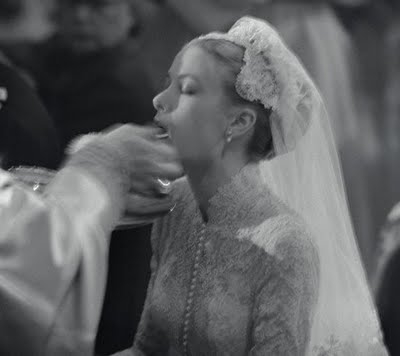
Princess Grace (née Kelly) of Monaco receives
the Holy Eucharist at her 1956 nuptial Mass


The Gift of the Holy Spirit

June 11, 2019

If you ask people what the Solemnity of Pentecost is about, most will say “the sending of the Holy Spirit.” But Pentecost was not the first time the Holy Spirit had been active in human history.

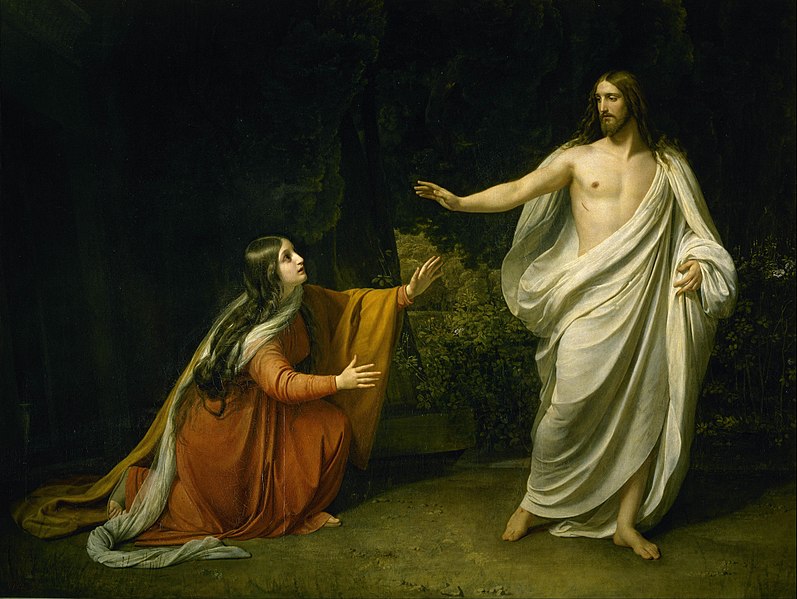
On Easter Sunday evening, Jesus appeared the Apostles in the Upper Room – although the doors were locked. He said, “Peace be with you,” and showed them his hands and his side. Then Jesus breathed on them and said, “Receive the Holy Spirit…” Earlier in the Gospels, at the Annunciation, Mary asked the archangel how the Messiah, the Christ, would be conceived in her; and Gabriel replied it would be a miraculous work of the Holy Spirit. And then soon after, at the Visitation, her relative Elizabeth, with the little John the Baptist within her, was “filled with the Holy Spirit,” moving Elizabeth to joyfully exclaim the hidden knowledge: “Most blessed are you among women, and blessed is the fruit of your womb!” And the Holy Spirit worked in more than just the time of the Gospels. The Nicene Creed says the Holy Spirit “has spoken through the prophets.” He inspired all the books of both the Old and New Testaments.

So what was different about Pentecost? Before answering that, let’s review what happened. On that day, the Holy Spirit descended to the sound of strong, driving wind and in the appearance of flames, which separated and came to rest upon each of the gathered disciples without doing them any harm.

They were moved to voice ecstatic praises glorifying God and the Holy Spirit gave them the power to speak in different languages they did not naturally know to address Jews visiting from many lands of the then-known world. These devout Jews were gathered in Jerusalem to celebrate the annual Jewish feast of Pentecost, their feast of first fruits celebrating the new harvest from the earth. Similarly, the first Christian Pentecost was the disciples’ first abundant harvest of souls into Christ’s Kingdom.

The Holy Spirit not only gave the disciples the capacity to speak but embed them with courage to bear witness to Christ. Previously, they had hidden behind locked doors. Now they spoke openly in the streets. Peter, who during the Passion had denied Jesus three times out of fear, is inspired this day to begin preaching the Gospel to total strangers. “Those who accepted his message were baptized, and about 3,000 persons were added that day.”

On Pentecost, the curse of Babel is reversed. In the Genesis story of Babel, people tried to reach Heaven by building a towering city apart from God. God confused their language as a kindness, to limit the evil they could do. But at Pentecost, the Holy Spirit is building and populating the city of God, the Church, gathering them to God with this miracle of all languages united as one. Indeed his Church is catholic, that is universal, for every land and people, tribe and tongue.

So, returning to the previous question, what is different about Pentecost? Notice that these gifts of the Holy Spirit were given to each of the disciples gathered in the house; not only the Blessed Virgin full of grace, not just the Apostles—the first leaders of the Church, but each and every one of the roughly one hundred and twenty Christians gathered together there. The Holy Spirit was not acting in the world for the first time at Pentecost; nor was his presence and gifts meant for only for the most famous saints in the Early Church. The Holy Spirit’s activity continues in the Church today, not only within a favored few but in all of us in Christ.

As St. Augustine preached: “What the soul is to the human body, the Holy Spirit is to the Body of Christ, which is the Church.” In a living human body, all the parts of the body are joined to each other and joined to their supremely important head. Without the head, the body dies. Without the soul, the body is lifeless. We are the Body of Christ, Jesus is our exalted Head, and the Holy Spirit—the Soul of the Church—animates the body and every living part of it.

You and I first received the Holy Spirit at our baptisms, probably at an age earlier than we can remember. (I wish I had the time and opportunity to ask people baptized as adults to describe the difference having the Holy Spirit in their life has had.) We were more deeply configured to the Holy Spirit at our confirmations. (After my confirmation at Zorn Arena in Eau Claire, as my family and I were driving to a restaurant, I remember feeling particularly happy and wondering why. Then I remembered, “Oh yeah, the Holy Spirit.” Joy is one of his fruits.) The Holy Spirit was not new at Pentecost but he outpoured amazing gifts into all the Christians. Likewise, the Holy Spirit is not new in you, but he desires to outpour himself to you with his gifts anew.

How can this happen for us? Simply by asking and inviting him. Jesus tells us, “Everyone who asks, receives; and the one who seeks, finds; and to the one who knocks, the door will be opened.” In those days, a round, baked, loaf of bread could resemble a brown stone, so Jesus adds, “Which one of you would hand his son a stone when he asks for a loaf of bread? If you, who are wicked (who are sinful), know how to give good gifts to your children, how much more will the Father in Heaven give the Holy Spirit to those who ask him?” Ask for the Holy Spirit to empower you.

Try some experiments with the Holy Spirit. For instance, invite him into your prayer times. Anyone committed to regular prayer will have times of dryness, listlessness, lack of direction. St. Paul writes to the Romans that the Holy Spirit “comes to the aid of our weakness; for we do not know how to pray as we ought, but the Spirit intercedes…” At dry times in prayer, when I remember to ask the Holy Spirit for help, my prayer immediately becomes easier.

Invite the Holy Spirit to inspire your work. Though I care a great deal about writing good homilies, most Friday nights I don’t know what I will be preaching on Saturday afternoon. I think the Lord does this to improve my trust. After ten years of priesthood, he has never left me high and dry without anything to preach for Sunday.

And ask for the Holy Spirit’s aid in your interactions with others. I ask for his help in confessions or before challenging conversations. Now I share these examples because they are examples from my life, but don’t think that the Holy Spirit only comes to our air with church-y things. He wants to be present, to share his gifts in your everyday life, because this is where souls are lost and won for the Kingdom of God.

About a dozen years ago, I was lying on my bed one afternoon praying to the Holy Spirit rather apologetically. I said, ‘Holy Spirit, you are like the forgotten and ignored third Person of the Trinity. You’re just as much God as the Father and the Son, but we address many more prayers to them than you; and when we do pray to you it’s because we want something, but you’re more than just some divine vending machine.” Then I heard in my mind these words: “I am gift.”

Now whenever you receive a word in prayer it’s good to verify it against the truths that you know. So I thought, “Let’s see if this checks out.” From all eternity, God the Father gives all that he is to God the Son, and the Son gives himself back as a total gift to the Father. From this exchange of self-gift and love, God the Holy Spirit eternally proceeds. The Father and the Son send the Holy Spirit to earth as a gift to sanctify and transform us so we can join the life of the Trinity. The Holy Spirit rejoices to be gift. It is who he is. And when we ask for his gifts we are implicitly welcoming for his presence; for how could his gifts be manifested where he is not?

So conduct some experiments with the Holy Spirit. Invite him, and ask that his gifts be manifested in you. He is happy to give.

True Witnesses to the Resurrection

April 23, 2019

“[S]ome of the [tomb] guard went into the city and told the chief priests all that had happened. The chief priests assembled with the elders and took counsel; then they gave a large sum of money to the soldiers, telling them, ‘You are to say, “His disciples came by night and stole him while we were asleep.” And if this gets to the ears of the governor, we will satisfy him and keep you out of trouble.’ The soldiers took the money and did as they were instructed. And this story has circulated among the Jews to the present day.”

—The Gospel according to St. Matthew 28:11-15

When I was a grade-schooler, a classmate told me, “Did you know, if you dream that you’re falling and you hit the ground in your dream, you’ll die in real life?” I was astounded and the idea stuck with me. But upon later reflection, I realized the suggestion was nonsense. If someone had died in their sleep because they fell to the ground in a dream, how would anyone find out what they had been dreaming about? The tomb guards’ cover story likewise makes no sense. If they had been sound asleep, how could they identify who (if anyone) had stolen the body?

For the sake of argument, let’s suppose Jesus’ disciples stole his dead body from the tomb. Then the Apostles would know for a fact that the stories they told of interacting with the resurrected Jesus were lies. Church history reports that ten out of the eleven faithful Apostles would go on to die bloody, martyrs’ deaths. Now someone might die for what they mistakenly believe to be true, but who would knowingly die for a lie?

So let’s suppose instead – again for the sake of argument – that the early Christians lied about the Apostles. But if the Gospel writers had been liars they would have spun their tales differently. The Apostles, the founding father-leaders of this new Christian Church, are not presented flatteringly but with their warts and all. They repeatedly misunderstand Jesus’ teachings, squabble for place and prestige, fall asleep in the garden and then desert their Lord when trouble arrives, and even after the Resurrection they are slow to accept it. A liar would neither invent nor include the story of St. Peter repeatedly denying Christ, but all four Gospel writers did. And who is presented as the first eyewitnesses to Easter morning’s miracle? Various women — in an era where neither Roman nor Jewish courts accepted the testimony of females. Liars would have fabricated more culturally acceptable witnesses, but the Gospels record the story of the Resurrection this way because that is how it really happened.

The Apostles were willing to boldly preach across an empire that had murdered their master, for no notable earthly benefit, until they got killed for it. We might have expected them to lay low, leave town, and go back to full-time fishing, yet these self-admittedly imperfect men were transformed after Easter. They became unafraid of death because they had truly witnessed, seen and touched, Jesus Christ alive from the dead. Christ is risen. He is risen indeed! And this eyewitness testimony has circulated among the nations to this present day.

Lessons from the Sins of Simon Peter & Judas

April 9, 2019

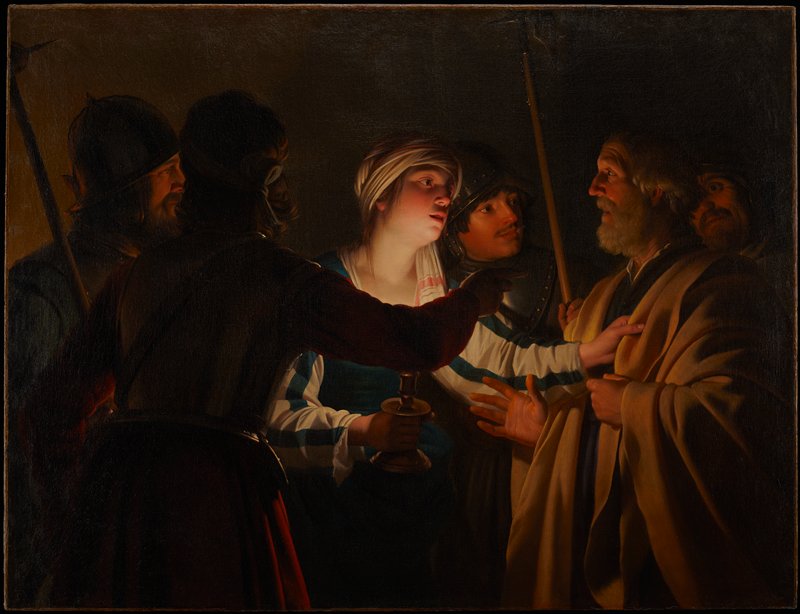
After arresting [Jesus] they led him away and took him into the house of the high priest; Peter was following at a distance. They lit a fire in the middle of the courtyard and sat around it, and Peter sat down with them. … About an hour later, still another insisted, “Assuredly, this man too was with him, for he also is a Galilean.” But Peter said, “My friend, I do not know what you are talking about.” Just as he was saying this, the cock crowed, and the Lord turned and looked at Peter, and Peter remembered the word of the Lord, how he had said to him, “Before the cock crows today, you will deny me three times.” He went out and began to weep bitterly.

– Luke 22:54-55,59-62

This threefold denial by Simon Peter was perhaps the most regretted moment of his life. He denied even knowing Jesus Christ, his teacher, friend, Lord, and God. How humble Peter was to share this story with the Early Church and how wonderful that the Holy Spirit inspired its inclusion in the Gospels! He shows us the fallen can get back up, wanderers can return, sinners can be forgiven, and even those who gravely sin can go on to become the greatest saints.

Jesus would go on to rehabilitate Peter after the Resurrection, alongside another charcoal fire by the Sea of Galilee. Mirroring the three denials, Jesus asks three times, “Simon, son of John, do you love me?” Simon Peter replies, “Yes, Lord, you know that I love you,” and Jesus reinstates him as shepherd of his sheep and lambs. The Sacrament of Reconciliation (or Confession) is likewise a personal encounter with Jesus Christ where we re-profess our love for God and receive his restoring forgiveness through the ministry of his ordained priest.

Though Simon Peter’s sins were forgiven they were not without loss and opportunities squandered. During the Passion, as they led Jesus away, “they took hold of a certain Simon, a Cyrenian, who was coming in from the country; and after laying the cross on him, they made him carry it behind Jesus.” If Simon Peter had not sinned in denying Christ the night before he could have been there, ready and willing to get behind his Lord, pick up Jesus’ cross and follow him. How beautiful that would have been! But this opportunity fell to another Simon.

Thanks be to God, St. Peter went on to repent. He did not give up to despair like Judas Iscariot. When Judas saw Jesus condemned and on his way to execution he deeply regretted what he had done. (One theory for why Judas had sold Jesus out is he wanted to trigger a confrontation with the leaders of Israel which would force Jesus to wield his mighty powers and take the throne.) Judas tried to return the thirty silver coins to the chief priests and elders saying, “I have sinned in betraying innocent blood.” They answered, “What is that to us? Look to it yourself.” Flinging the money into the temple, Judas departed and went off and hanged himself.

What if instead, on Good Friday afternoon, Judas had immediately ran to Calvary Hill? What if he had thrown himself down before Christ hanging on the Cross and begged his forgiveness? What would Jesus have said? What would Jesus have done? I think we already know the answer, or could pretty closely guess. Jesus would have forgiven Judas.

So come to Jesus in sacramental Confession. Come sooner rather than later and more than just once or twice a year. And, once wonderfully absolved, resolve and strive to sin no more. Though sins can be forgiven, we see that every sin or delayed conversion entails some loss, an opportunity missed.

When Was Easter?

March 30, 2019

Easter Sunday is April 21st this year, but other years it can fall anywhere between March 21st and April 25th. The date of Easter moves around the calendar because we celebrate it on the first Sunday, after the first full moon, on or after our first day of spring. In this, the Church echoes how the ancient, Jewish feast day of Passover was determined. Which raises a question: what’s the historical date of the very first Easter?

By pairing the four Gospels with other historical records we can narrow down the first Easter’s exact date. Jesus began his ministry after John the Baptist’s, which Luke reports began “in the fifteenth year of the reign of [the Roman Emperor] Tiberius Caesar,” or 29 AD. The Roman governor Pontius Pilate who condemned Jesus to death ruled Judea from 26 to 36 AD. We also know Jesus was crucified on a Friday the day before a Passover. There were only two such dates between 29 and 36 AD (namely, in 30 and 33 AD.) Finally, John’s Gospel notes three distinct Passovers (a timespan of at least two years) during the ministry of Jesus, which rules out 30 AD as too early to be Easter. Therefore, we can precisely pinpoint several of Christianity’s most important historic dates:

  • Holy Thursday – April 2nd, 33 AD – The Last Supper & beginning of the Passion
  • Good Friday – April 3rd, 33 AD – Jesus Passion, Crucifixion at noon, & Death at 3 p.m.
  • Easter Sunday – April 5th, 33 AD – Jesus’ Resurrection in early morning
  • Pentecost Sunday – May 24th, 33 AD – Descent of the Holy Spirit at 9 a.m.

Our Catholic Faith, our Christian religion, cannot be dismissed as a misty myth from “once upon a time.” Jesus of Nazareth was born of the Virgin Mary and crucified under Pontius Pilate. He suffered and died, was buried and rose in actual history. As Pope Benedict XVI famously wrote in his first encyclical, “Being Christian is not the result of an ethical choice or a lofty idea, but the encounter with an event, a person, which gives life a new horizon and a decisive direction.” Jesus Christ is a real person who once lived and still lives today.

Returning to Dust & Rising From the Ashes

March 11, 2019

Funeral Homily for Daniel G. Zwiefelhofer
by Fr. Victor Feltes on March 7, 2019

The Fall of Mankind and Expulsion from Paradise
by Michelangelo on the ceiling of the Sistine Chapel

Remember that you are dust, and to dust you shall return.” These words were heard many times yesterday on Ash Wednesday as ashes were applied to foreheads. There is another phrase the ash-bestowing minister can say, but “remember that you are dust, and to dust you shall return” is the classic option. Where does this phrase come from? It’s from the story of Genesis, following the Original Sin, the Fall of Man.

When Adam and Eve sinned in the Garden, punishments were placed on them and their descendants. To the woman God said, “I will intensify your toil in childbearing; in pain you shall bring forth children.” And to the man God said, “In toil you shall eat the ground’s yield all the days of your life. Thorns and thistles it shall bear for you, and you shall eat the plants of the field. By the sweat of your brow you shall eat bread, until you return to the ground, from which you were taken; for you are dust, and to dust you shall return.” And God announced a punishment upon the wicked serpent too: “I will put enmity between you and the woman, and between your offspring and hers; he will strike at your head, while you strike at his heel.”

We still feel the consequences of sin and observe of the brokenness of our world. Birthing babies is painful and raising children is challenging. Daniel learned these truths firsthand alongside Marion. And, as a lifelong farmer, Daniel experienced firsthand that farming is hard work. Growing food, from beasts or fields, demands the sweat of one’s brow. And today, after eighty-one years of life on this earth, we gather for Daniel’s funeral; for we are dust, and to dust we return. If these things were all that we saw and knew we would be left in sad despair, but this is not the end of the story; for Genesis, for Daniel, or for us.

I mentioned earlier that there’s another phrase option for ash-distributors to say on Ash Wednesday: “Repent and believe in the Gospel.” The Gospel is a message of living hope and it was proclaimed from the beginning. The Church teaches that the Protoevangelium, or “First Gospel” promising salvation was announced in the Garden of Eden. Recall how God said to the serpent, in the presence of Adam and Eve: “I will put enmity between you and the woman, and between your offspring and hers; he will strike at your head, while you strike at his heel.” This is speaking to more than the natural hatred between humans and deadly snakes – it’s a prophesy. That “he,” the offspring of the woman, was to be Jesus. The ancient serpent, the devil, struck out at Jesus’ lowly flesh (as at Jesus’ heel) in the Passion. But Jesus the New Adam, triumphed through his Passion, death, and resurrection, crushing the enemy’s head.

Jesus is the New Adam. Tempted in a garden (the Garden of Gethsemane) Jesus did not falter. Called to lay down his wife for his bride (the Church) Jesus did not balk. And by the sweat of his brow (even sweating blood) he has provided her bread, in the Most Holy Eucharist, which is himself. He accepted a crown of thorns from a world turned against him, but by his toil of carrying his Cross Jesus has produced a fruitful yield on earth. Jesus was placed into the dust of the earth — entombed at death, but Jesus was not abandoned to the dustbin of history. The New Adam triumphs over death.

And the New Eve, his bride the Church, continues (with toil and pains, but also with joy) to bear forth children who live and die with faith in Christ, like Daniel. And, as Daniel’s prophetic namesake says in our first reading, “Those who sleep in the dust of the earth shall awake; and some shall live forever…” Likewise, in our second reading, St. Paul proclaims to the Thessalonians: “We do not want you to be unaware, brothers and sisters, about those who have fallen asleep, so that you may not grieve like the rest, who have no hope. For if we believe that Jesus died and rose, so too will God, through Jesus, bring with him those who have fallen asleep.” The first Adam, by sinning, and gave death to all his descendants. But Jesus Christ, the new faithful Adam, offers life to all who follow him.

On Ash Wednesday and at any funeral, we are reminded that are dust and to dust we shall return. But we must also remember to repent and believe in the Good News of the Gospel. As night lead to dawn and sleep to arising; as winter leads to spring and Lent leads to Easter, so the dying of friends of Jesus leads to joyful resurrection.

The Mercies of Two Adams

February 24, 2019

In our second reading this Sunday, St. Paul compares the First Man to the Last Adam. In our Gospel, that Second Adam (Jesus Christ) shares teachings on forgiveness which have reshaped the world. Catholic spiritual tradition holds that when Jesus descended to the Abode of the Dead on Holy Saturday he found Adam and announced that the gates of Heaven were now open to him and all the Old Testament’s friends of God. If Adam went to Heaven we know he practiced forgiveness himself because Jesus says “if you do not forgive others, neither will your Father forgive your transgressions.” I’d like to begin by reflecting on three people from Adam’s life whom he had to forgive; and each one has a practical lesson for us touching on forgiveness.

One person Adam had to forgive was his wife, Eve. “She saw that the [forbidden] tree was good for food and pleasing to the eyes, and the tree was desirable for gaining wisdom. So she took some of its fruit and ate it; and she also gave some to her husband, who was with her, and he ate it.” Adam had to forgive her for doing this, but he also had to seek her forgiveness. He had been charged by God with protecting her and the garden. He was with her as the Serpent spoke, and he failed in his duty. Adam and Eve had to forgive each other.

Now a foolish person insists that other people are completely at fault one hundred percent of the time. After a conflict, even if I didn’t sin (even if I did nothing intentionally that I knew to be wrong at the time) I can still reflect upon how I could have expressed myself or handled the situation better. Mistakes are not sins—we can only sin on purpose—but we should learn from our mistakes.

Another person Adam had to forgive was his son, Cain. Because he felt snubbed, Cain was filled with jealous anger towards his brother. “Cain said to his brother Abel, ‘Let us go out in the field.’ When they were in the field, Cain attacked his brother Abel and killed him.” This was the first recorded murder, and Adam had to forgive his son for it.

In 1981, Mehmet Ali Ağca shot the pope in St. Peter’s Square at the Vatican. St. Pope John Paul the Great nearly died, but two years later after he had recovered he went to visit his would-be assassin in prison. I remember being amazed as a kid in CCD class to learn that the pope sat at an arm’s length from the unshackled man who almost killed him in order to personally forgive him. Significantly, the pope did not ask Italy’s leader or government to release Ağca at that time. Ağca served twenty-nine years in prison until his release in 2010. Similarly, God showed his mercy and did not destroy Cain the murderer, but God did place punishments on him.

Sometimes withholding punishment is not kindness because we need discipline, to experience just consequences for our actions, for our own good. As the Letter to the Hebrews says, “whom the Lord loves, he disciplines; he chastises every son he acknowledges. … At the time, all discipline seems a cause not for joy but for pain, yet later it brings the peaceful fruit of righteousness to those who are trained by it.” Mercy and forgiveness do not rule out experiencing any consequences.

A third person Adam had to forgive is one you might not expect: Adam had to forgive the Serpent. Was the wicked Serpent sorry for what he had done? No, but Adam had to forgive for Adam’s own sake. Unforgiveness is a bitter poison we drink in hopes of hurting someone else. Renouncing our claims to vengeance against another actually sets us free.

Jesus said we must forgive to be forgiven ourselves, but some people think they can’t forgive because they think forgiveness means something it doesn’t. Forgiveness is not to say that the sin wasn’t wrong, or that it’s no big deal, or that it doesn’t hurt anymore, or that it never really happened, or everything can go back to how it was before. Forgiveness means loving someone despite their sins, even if prudence may require us to keep a healthy distance from them (as with the Devil.)

Does God hate that ancient serpent, the Devil, the father of lies and a murderer from the beginning? Amazingly, no. As the Book of Wisdom says, “you [Lord] love all things that are and loathe nothing that you have made; for you would not fashion what you hate. [And] how could a thing remain, unless you willed it; or be preserved, had it not been called forth by you? But you spare all things, because they are yours…” God hates what Satan does, but loves him still. God hates the sin, but loves the sinner. In the end, the wicked will not be annihilated, made to no longer exist, but given the disassociation and space away from God they desire forever. God hates no one and neither should we.

In several places in the New Testaments, St. Paul draws parallels between Adam and Jesus. St. Paul wrote the Romans: “just as through the disobedience of one person the many were made sinners, so through the obedience of one the many will be made righteous.” The First Adam gave life to all his descendants, and the Last Adam gives life to all who follow him. The Old Adam, by his selfish sin, condemned the world; but the New Adam, by his holy self-sacrifice, redeems us. The First Adam, as we have seen, practiced forgiveness, but Jesus Christ is personified Mercy.

Consider how autobiographical Jesus’ Gospel teaching on forgiveness is. Jesus says, “To the person who strikes you on one cheek, offer the other one as well.” During the Passion, at his Jewish trial before the Sanhedrin, “they spat in [Jesus’] face and struck him, while some slapped him, saying, ‘Prophesy for us, Messiah: who is it that struck you?’

Jesus says, “From the person who takes your cloak, do not withhold even your tunic.” “When the [Roman] soldiers had crucified Jesus, they took his clothes and divided them into four shares, a share for each soldier. They also took his tunic, but the tunic was seamless, woven in one piece from the top down. So they said to one another, ‘Let’s not tear it, but cast lots for it to see whose it will be…’

Jesus says, “Love your enemies, do good to those who hate you, bless those who curse you, pray for those who mistreat you.” The religious leaders sneered at Jesus as he hung on the Cross. Even the soldiers jeered at him. But Jesus prayed for them saying, “Father, forgive them, they know not what they do.”

Jesus says, “If you love those who love you, what credit is that to you? Even sinners love those who love them. And if you do good to those who do good to you,what credit is that to you? Even sinners do the same.” St. Paul wrote to the Christians at Rome, “God proves his love for us in that while we were still sinners Christ died for us.

Jesus says, “If you lend money to those from whom you expect repayment, what credit is that to you? Even sinners lend to sinners, and get back the same amount. But rather, love your enemies and do good to them, and lend expecting nothing back; then your reward will be great and you will be children of the Most High…” Jesus gave of himself knowing that many would give him nothing in return, he loves sinners knowing that many will not love him back. But Jesus is his Father’s Son, merciful as he is merciful, loving as he is loving, good as he is good, and generous as he is generous. And Jesus invites us to also be children of the Most High like himself.

So let’s be generous in every way towards Jesus, who gives us mercy, our every blessing in life, and his very self in the Eucharist. Jesus’ teaching at the close of today’s Gospel is true not only for financial giving but for every gift to God, for God is never outdone in generosity: “Give, and gifts will be given to you; a good measure, packed together, shaken down, and overflowing, will be poured into your lap. For the measure with which you measure will in return be measured out to you.” Let us be merciful and generous like Jesus is towards us.

Sound Interpretations

February 17, 2019

Last year, the internet hotly debated whether a particular sound clip was saying Yanny” or “Laurel.” While most people can only hear one name or the other, some people can make out each. In fact, both of the names are sounding in the clip together but at higher and lower pitches. In another online curiosity, a short video shows a small figurine glowing and emitting a sound, either “Brainstorm” or “Green Needle.” The amazing thing is that if you listen to this clip with either phrase in mind then that is the phrase you’ll hear. You can even alternate back and forth between the two. In each of these examples, the messages are indeed there to be heard if one has the ears to hear them.

These phenomena suggest how people in the Bible may have been present to the same auditory events but heard things quite differently. On one occasion recorded in John’s Gospel, Jesus prayed aloud, “Father, glorify your name.” Then a voice came from Heaven, “I have glorified it and will glorify it again.” John notes, “The crowd there heard it and said it was thunder; but others said, ‘An angel has spoken to him.‘” Later, at Pentecost in The Acts of the Apostles, the disciples “were filled with the Holy Spirit and began to speak in different tongues, as the Spirit enabled them to proclaim.” At the sound of it others in Jerusalem from many nations gathered in a large crowd “but they were confused because each one heard them speaking in his own language. … They were all astounded and bewildered, and said to one another, ‘What does this mean?’ But others said, scoffing, ‘They have had too much new wine.’” Sometimes people can hear more than one thing in the same divine message, or dismiss it all as nonsense.

Does each passage of the Bible have only one true interpretation? Some reject that Isaiah 7:14 (“The virgin shall be with child and bear a son, and they shall name him Emmanuel”) could foretell the virgin birth of Jesus, arguing “the author was referring only to the political situation of his day, not to an event centuries later he couldn’t possibly have known.” But this view forgets or denies that human beings are not the sole authors of Scripture. They are co-authors inspired by the Holy Spirit. God is all-knowing and alive outside of time. He can inspire prophesies with both near and distant fulfillments. And God can invest passages with multiple true and divinely-intended meanings. For example, in the Book of Revelation, John beholds in the sky, “a woman clothed with the sun, with the moon under her feet, and on her head a crown of twelve stars.” She gives birth to a son, the Christ, and then she is protected by God from a red dragon, the Devil. Does this represent God’s people of the Old and the New Covenants, or does it symbolize Mary the Mother of God? Yes. The answer is both.

Sacred Scripture, like other things of God, may be compared to a magic pool. It is a pool in which a small toddler may safely play and a great whale may deeply swim. Let us not remain shallow in our understandings, but explore the true depths of God’s Word.

The Seventh Jar

January 22, 2019

Anyone who has done the chore of carrying milk gallons from the store to the car, and from the car into the house, knows they are not feather light. “Now there were six stone water jars (at Cana) for Jewish ceremonial washings, each holding 20 to 30 gallons.” Perhaps the servants did not have to lug those stone jars around, but they had to move the water from the local well or cistern to where the party was held. Have you ever considered how much those 120 to 180 gallons of water weighed? One gallon of water weights a little more than eight pounds. So six stone jars holding 20 to 30 gallons each is a weight of water somewhere between 1,000 and 1,500 pounds.

Mary said to the servers, “Do whatever he tells you.”
Jesus told them, ‘Fill the jars with water.’
So they filled them to the brim.”

It wasn’t easy work. At the time it did not seem that important or glorious. But those servants obediently and generously served Christ at that marriage, filling the jars to the very brim, and what they did will be remembered and celebrated forever.

In various times and places, different numbers can carry symbolic meanings. For example, if I asked you for a lucky number, you would probably say “seven.” And if I asked you for an unlucky number, you would probably quote me “thirteen.” The Jewish culture of the Bible has its own symbolic associations with numbers. For instance, for Jews the number six meant imperfection. (This is partly why, in the Book of Revelation, the number of the Beast is “666,” because great evil is profoundly imperfect.) And for Jews the number seven meant completeness. (In the beginning, when God had finished Creation, he rested on the seventh day because his work was complete.)

“Now there were six stone water jars there for Jewish ceremonial washings.” These six jars of water which Jesus turns into wine point to how his New Covenant fulfills and improves upon the imperfect Old Covenant. The water for the purification rites was good, but the wine for the wedding is best. Along with those six stone jars, John’s Gospel goes on to notice one more jar:

“[On the Cross,] aware that everything was now finished, in order that the scripture might be fulfilled, Jesus said, ‘I thirst.’ There was a jar filled with sour wine. So they put a sponge soaked in wine on a sprig of hyssop and put it up to his mouth. When Jesus had taken the wine, he said, ‘It is finished (fulfilled / complete / consummated)’ And bowing his head, he handed over the spirit.”

All four gospels mention this sour wine Jesus received on the Cross, fulfilling the Psalm which said, “for my thirst they gave me vinegar to drink.” Vinegar is made from wine which grows old and sour. This jar of sour vinegar wine at the Cross is the seventh jar which completes the six jars from Cana. The public ministry of Our Lord began with the joy of a wedding. And public ministry led him to sacrificing himself for his spouse, the Church. Every marriage should have its share of joy and sacrifice.

Marriages are often said to go through a “honeymoon” period. When the relationship is fresh and new, life feels like water changed into wine and joy flows easily. But as the relationship continues and grows older, the wine sometimes turns into vinegar. And then people ask themselves, “Did I make a mistake? Did I marry the wrong person? Did I choose the wrong vocation?” And many people give up too hastily. But these challenging times are a call to purifying love.

When someone says, “I love coffee” or “I love pizza,” they’re really saying “I love how these foods make me feel. I love what they do for me.” But this is not how we are called to love God and one another. We are to love others for their own sake. And in this the Cross of Christ is unavoidable. If mere personal happiness were the meaning of life, then suffering would be meaningless. That’s not what we believe. The Cross grows us into Christ. God does not want us to be endlessly miserable, but if we think the journey of our lives will always be on mountain tops, and never in dark valleys, then we will not journey well through the highs and lows and plains of life.

What if I’m saying to myself, “I have no wine.” What should I do? As Jesus’ Mother said to the servers, “Do whatever he tells you.” This means obedience to Jesus Christ. What if I think I lack the strength to do what Christ asks, or despair that things can really change? The Virgin Mary may not have known it at the time, but in saying “Do whatever he tells you” she was echoing this passage from Genesis:

“When the seven years of abundance enjoyed by the land of Egypt came to an end, the seven years of famine set in, just as Joseph had foretold. Although there was famine in all the other countries, food was available throughout the land of Egypt. When all the land of Egypt became hungry and the people cried to Pharaoh for food, Pharaoh said to all the Egyptians: ‘Go to Joseph and do whatever he tells you.’”

Joseph had been storing up surplus grain for seven years before and he proceeded to provide sufficient food for the entire Kingdom of Egypt and all the world who came to him and asked. When there is no wine where there ought to be (in your marriage, in your household, in your life) do your small part like the servants did at Cana, and invite, ask, and rely on Jesus to provide the rest.

The Christian life has highs and lows, but most of our days are lived in between, on the flat plains. Our lives matter greatly to God, so he has told us so and shown us so through Jesus Christ, but for the most part our lives feel ordinary. As our second reading from 1st Corinthians says, the Church of Christ has many members, with various gifts and roles for the Kingdom of God. Yet nobody feels they are particularly extraordinary because our lives are full of the ordinary.

Say you’re raising children, forming saints for Heaven, who produce piles of laundry and dirty dishes. So say you’re working outside of home, doing a regular job, which provides a service so beneficial and valuable that people pay you money to do it, money you then use to help others. Say you’re praying daily (as we’re called to do,) blessing others, near and far, the living and deceased, by your worship and intercessions before Almighty God, and repeatedly checking your watch. Even if you’re ordained priest, you can be celebrating the Holy Sacrifice of the Mass… fourteen times a week. So much of our lives filled with the ordinary that these ordinary things must matter much more than we might think.

Nothing is recorded in the gospels about most of the years of Jesus’ life. We hear about his early years and his later, few-year ministry, but not what happened in between. The span of time from the finding of twelve-year-old Jesus in the Temple to the start of his public ministry at about thirty years of age is called his “hidden years.” Jesus may not have worked any miracles in those years, but in Heaven we will see how he lived and worked and loved then in ordinary and yet far from insignificant ways.

A full Christian life is not easy work. At times what we do may not feel that important or glorious. But if we serve Jesus Christ, obediently and generously, then what we do here will be remembered and celebrated, by us and by all, with joy forever.

Christ Calls in Ordinary Time

January 16, 2019

As [Jesus] passed by the Sea of Galilee, he saw Simon and his brother Andrew casting their nets into the sea; they were fishermen. Jesus said to them, “Come after me, and I will make you fishers of men.” Then they left their nets and followed him.

— Mark 1:16-18

A remarkable thing about this calling of Simon Peter and Andrew is its ordinariness. The pair are not called through a vision or by angels. Mark mentions no miracles performed there on the shore. We know from John’s Gospel that they have met this rabbi before. Jesus simply tells them to follow him.

This call does not happen on a Jewish holy day, in the Temple, or in a palace, nor at Jerusalem or Rome. (The region of Galilee was an unesteemed place for the Jews and doubly so for the Romans.) Simon and Andrew are not clergy nor scholars, neither governors nor generals. They’re fishermen who work nights doing manual labor. They’re not on spiritual retreat or pilgrimage, they haven’t journeyed for days to a holy mountain of God. Yet Christ walks up to them and calls these two brothers during an ordinary day at their place of work.

Jesus Christ the God-Man does extraordinary things through the ordinary. He makes use of water for his baptism, bread for his Eucharist, and human pairing to reveal his loving union with the Church. He uses our human words to communicate God’s Word in the most published book on earth. He dwells (and waits) for us in every Catholic tabernacle. He makes himself so accessible that, if we are unattentive to him, we can disregard his presence and graces amidst familiar things.

Ordinary Time has returned in the Church. Though not a “special” season like Advent, Lent, Christmas, or Easter, its name does not derive from a lack of value but from the ordinal numbers which count its weeks (1st, 2nd, 3rd, etc.) The color of this time is green because it is a season for our ongoing growth. So let us follow the Christ who greets and calls us like Simon Peter and Andrew even in Ordinary Time.

A Christmas Funeral

December 29, 2018

Funeral Homily for Marie Clark

There is an understandable and natural sadness felt in the passing of a well-loved mother, sister, aunt, grandma, and  great-grandmother like Marie in any season of the year. But a funeral like this, so close to Christmas, can feel strange as well. Perhaps I have forgotten but I can’t remember — in almost a decade of priesthood — ever offering a funeral Mass so close to the celebration of Jesus’ birth, with Christmas trees still in the sanctuary. And yet, this is not so strange as it may seem, for the birth of Jesus the Christ bears many connections with and foreshadowings of his death:

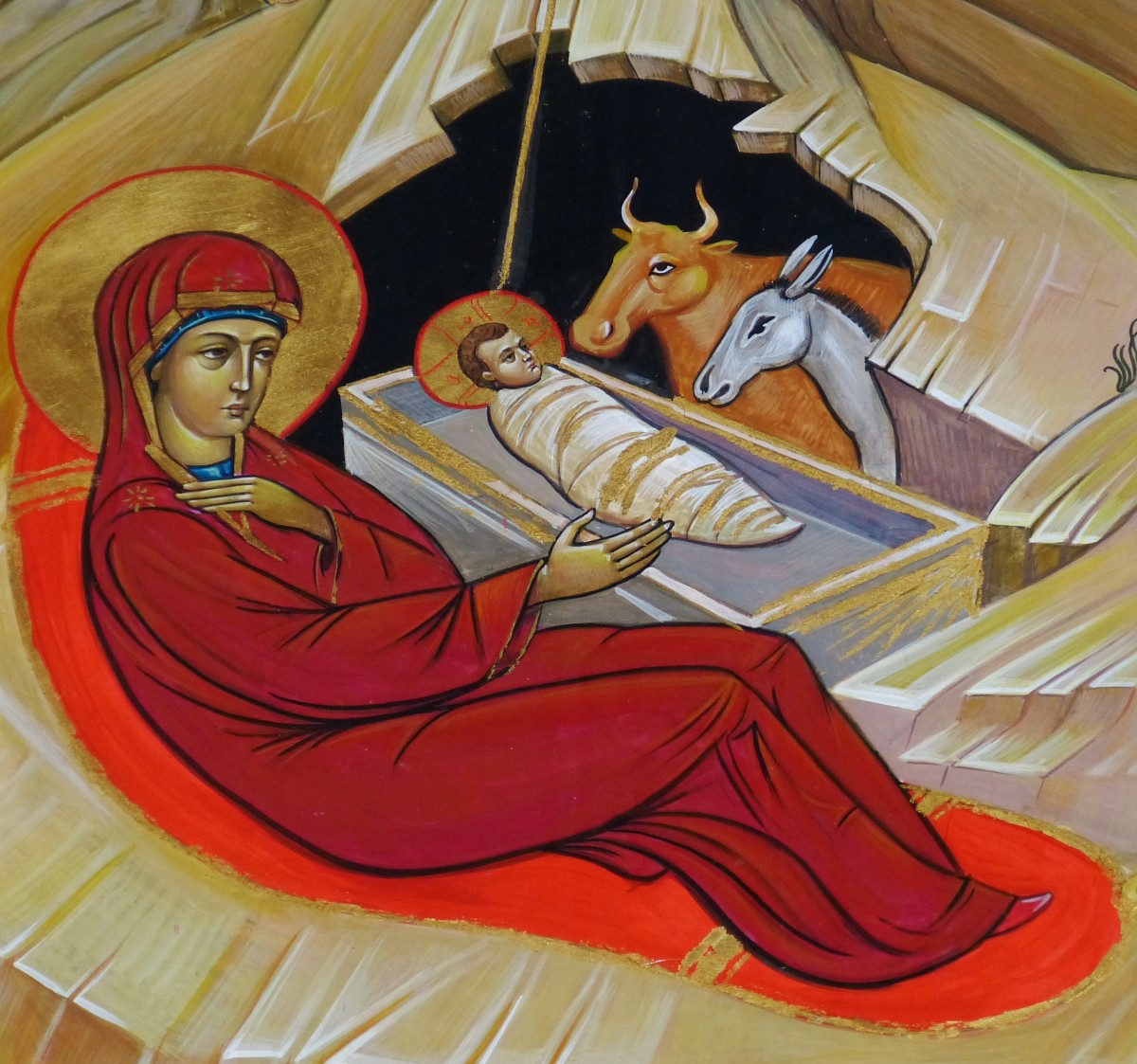
Jesus’ birthplace, a stable, was actually a cave. His burial-place, his tomb, was a cave as well.

The first cave was prepared by Joseph, the poor carpenter from Nazareth. The second cave was also prepared by a Joseph, a rich man from Arimathea.

At his birth, Mary wrapped Jesus’ body tightly in cloths for swaddling clothes. At his death, Mary also wrapped Jesus’ body, in linen cloth, for a burial shroud.

She placed his body in a manger, a feed-box for grain. He would give his own body as food, feeding his flock with his flesh and blood.

Who first heard the news of Jesus’ birth? It was shepherds in the fields outside Bethlehem. From Bethlehem’s flocks the lambs were provided for sacrifice at the Temple in Jerusalem about 5½ miles away. Jesus is the Lamb of God who was born to die as a sacrifice to take away our sins.

The Christmas trees in our sanctuary are evergreen and gloriously-lighted. Contrast that to the wood of the Cross, stark and dead, where we see the starkness of death in Christ crucified. Yet the cross bears the Light of the World, for Jesus says, “I am the Light of the World.” Life flows from this tree.

The Church, in these days following Christmas, celebrates a series of martyrs. The day after Christmas is the feast of St. Stephen, the first martyr after Jesus’ Ascension. Tomorrow, it’s St. Thomas Becket, a bishop martyred more than a millennium later. Today, it’s the Holy Infants of Bethlehem, who died unknowingly for Christ, but who the Church has long-celebrated as martyrs. We can fittingly celebrate the martyrs or even a funeral so close to Christmas because the birth of Jesus Christ has great and vast implications for life and death.

As we heard in our first reading, “If before men, indeed they be punished, yet is their hope full of immortality. … They seemed, in the view of the foolish, to be dead; and their passing away was thought an affliction, and their going forth from us, utter destruction. But they are in peace.” So, even in the dark valleys of life, we are courageous (as St. Paul twice declares in the second reading) for the Lord who died and rose is our shepherd. “Even though I walk in the dark valley I fear no evil; for you are at my side.” And this is our Gospel: ‘this is the will of the Father, that everyone who sees the Son and believes in him may have eternal life, and Jesus shall raise them on the last day.’

Pray for Marie’s soul, as is fitting and right, but be courageous and even joyful through the sadness; for at Christmas we see:

Christ, by highest heaven adored,
Christ, the everlasting Lord.
Late in time behold he comes,
offspring of the Virgin’s womb.

Mild he lays his glory by,
born that we no more may die,
born to raise us from the earth,
born to give us second birth.

With the herald angels sing,
“Glory to the newborn King.”

Christ, the Peace Light, is Born

December 27, 2018

In the city of Israel that is called Bethlehem, the ancient Church of the Nativity marks the site of the first Christmas. There one can actually stoop and bend down beneath the central altar & touch the celebrated spot where Jesus Christ was born. It is fitting that the pilgrims bend low to do this, because the miracle of God becoming a human being — to live and die and rise for us — surely deserves humble reverence with everything that we are.

Earlier this year, as has happened for a number of years now, an Austrian child and their family was selected to travel to Bethlehem. Candles and lamps are always burning within the Church of the Nativity, and there this chosen child transferred their fire into two blast-proof lanterns. Then they all flew back to Austria, where this flame (called “The Peace Light”) has spread from lamp to lamp, light to light, candle to candle, into more than thirty European countries and to places around the world. On December 1st of this year, the Peace Light arrived at J.F.K. Airport in New York City and it has traveled from there across our country. This week, it providentially came to our parish.

Last Friday, a Hudson couple traveling with the Peace Light approached me after morning Mass at St. Paul’s. I had never heard of the Peace Light before, but I happily received it and kept it for this Christmas celebration. All the flames you see burning our sanctuary this Christmas were originally lit from Bethlehem’s flame. Now I carefully carried, protected, and preserved this light; especially when I only had one vigil candle. I realized that one error, one jostling of the liquid wax, could extinguish the fire; and then what would become of this, my Christmas homily? I’d be lost. But, thanks be to God, these candles are lit here today.

So why do we have candles at Mass? Since the early days of Christianity, when Catholic Mass was celebrated in hiding, underground in the catacombs, lamps have provided useful illumination. But these lights are not merely practical. In the late 300’s A.D., a heretic named Vigilantius criticized Christians in the East about many of their practices, including their lighting of great piles of candles while the sun was still shining in the sky. St. Jerome declared in answer to him that candles are lighted where the Gospel is proclaimed not merely to put darkness to flight, but as a sign of joy. As an added symbol, these candles on the altar (and the Easter Candle) are, by tradition, mostly made of beeswax. Because beeswax, which is the product of the virginal female bee, is like the flesh of Our Lord supplied by the Blessed Virgin Mary.

Of course, the celebrated Peace Light is not merely a symbol of some abstract notion or idea of peace; it’s a symbol of the very real person of Jesus Christ. The “Light of the World” entered our world from his mother’s womb in Bethlehem. And his light has spread across the world and throughout time to this place and our day. Today, our candles burn and shine for him.

Within you there is also candle, but it is a very vulnerable light. Through error or neglect its light can go out. And without this light we are in darkness without true joy. So Jesus commands us to regularly gather all our candles together here, to be re-lit from the Source, the Light of Christ. In conclusion, in case my symbolism has been too subtle: Have a very joyful Christmas, and know that Jesus Christ (who loves you) wishes you to return here again for his Holy Mass next Sunday.

The Holy Family and Yours

January 1, 2018

Every year, Holy Mother Church presents the Holy Family for our contemplation and imitation. Some imagine life in the home of Jesus, Mary, and Joseph in the soft, pastel colors of a Christmas card; so holy, so flawless, so unobtainable. We wonder, “Can the Holy Family and my family really relate to one another?” At least two out of the three members of the Holy Family never sinned in their entire lives together. We, meanwhile, could jokingly refer to the Feast of the Holy Family as “Elbow-Nudge Sunday.” Throughout the world this day, wives and husbands, parents and children, take turns gently nudging one another as they listen to God’s words about marriage and family life. The Holy Family was holy, but that doesn’t mean their lives were easy or smooth.

I’ve previously written about the stresses and difficulties of the holy couple leading up to the first Christmas: about Mary’s crisis pregnancy, about Joseph grappling with his wife telling him the child within her is the Son of God and Joseph contemplating a divorce, about their giving birth to that holy child in an animal stable. And their trials together continued after Jesus’ birth.

Imagine being Mary and hearing Simeon prophesy, “Behold, this child is destined … to be a sign that will be contradicted — and you yourself a sword will pierce…” How would that make you feel about the future for you and your child? Picture being Mary as her husband awakes and says “our boy is being hunted, we need to leave tonight.” Consider Joseph, the servant-leader of his family, having to pack-up quickly and leave so much behind to take his family into hiding in Egypt. Later, an angel tells Joseph to bring his family back into Israel. So Joseph returns with Jesus and Mary, but he’s afraid to resettle in the south because the son of Herod the Great now rules Judea. With the help of another dream, Joseph decides to resettle in the north, in Nazareth of Galilee.

I mention all this because St. Joseph, the just and holy man, feared an earthly king even as he trusted God. St. Mary at the Annunciation did not know all the details of her future, but she trusted in God by saying, “Let it be done to me according to your word.” Our Lord Jesus, sweating blood from stress the night before he died, trusted God to say, “Not my will but yours be done.” Their holy lives were often difficult, but God always rewarded their trust, bringing about good for them in the end.

In Genesis, Abram (whose name later got changed to Abraham) was promised a son by the Lord. But the childless Abraham looks at the old age of his wife and himself and asks, ‘Will my steward, Eliezer, be my heir?‘ God answers, ‘No, not him; your own flesh and blood son shall be your heir.’ Then the Lord took Abraham outside and said, “Look up at the sky and count the stars, if you can. Just so,” he added, “shall your descendants be.” And Abraham put his faith in the Lord.

When I first heard this story (and maybe when you heard it too) I assumed this event happened at night. But the message is even more powerful if God told him to “look up at the sky and count the stars, if you can,” during the daytime. Where do the stars go during the day? We know they’re still there, even though the Sun’s brightness the sky’s blueness prevent us from seeing them. Abraham trusted in the Lord’s unwavering goodwill towards him and beheld God’s word fulfilled in the birth of Isaac. Through that son, Abraham received glory and the whole world was blessed.

One of the things Jesus says in the Gospels more than anything else is, “Be not afraid.” Sacrifice your fears. Imagine taking those obsessive worrying thoughts from your mind, placing them upon the altar, and lighting them afire like a sacrifice of old to God. “Let the peace of Christ control your heart…” Trust that “God works all things for the good of those who love him” and then “the peace of God, which surpasses all understanding will guard your hearts and minds in Christ Jesus.”

God not only wants peace within us, but peace among us as well. In our homes there is always room for improvement. The household of the Holy Family may have been a sinless one, but mistakes and miscommunications surely happened. Joseph probably broke or misplaced tools. Mary probably burnt an occasional loaf of bread. From the Gospels we know they both thought they knew where their 12-year-old boy was as they left Jerusalem for home; several hours passed before they realized he was missing. Even when we deeply love one another, we must learn and practice how to love and serve each other better.

We love each other in many ways, and the best modes by which we experience love can vary from person to person. The book “The Five Love Languages” lays out five major ways that we give and receive love, namely:

Gift Giving
Acts of Service
Affectionate Touch
Words of Affirmation
Quality Time

What are your top-two love languages? Can you guess the preferred languages of your spouse and children? Sometimes we try to love others as ourselves by loving them exactly as ourselves and we unfortunately miss our mark. For example, imagine a spouse complaining, “Why don’t you let me know that you love me,” when they really mean “why don’t you get me surprises anymore” (gift giving) or “why don’t you tell me that I delight you and you’re pleased with me” (words of affirmation.) At this, their spouse might reply, “What do you mean? I’m loving you all the time,” when they’re really saying “I take care of the kids and do housework” (acts of service) and “We eat and sit in the living room together every evening” (quality time.) These two loving spouses are loving past each other.

Learn the preferred love languages of your family members, and don’t expect others read your mind, sabotaging our own happiness. Tell them how to delight you. They love you and they want to make you happy. Don’t attack and criticize (“You always this” or “You never that”) but invite them to bless you. And pray together, as a couple and a family. The Holy Family surely did and its one of the most valuable things I can recommend. Some married couples, who have shared a bed for years, have never revealed their personal prayer requests to each other. Pray together, and then even whenever frictions arise, you will remember that you are on the same team, together on the same side with God.

Your home will never be perfect – not even the Holy Family’s was perfect. Life’s circumstances will go awry, and there will be sins we have to apologize for and forgive one another. But with trust in God and a daily commitment to loving and serving each other better, you too can live in the peace and joy of the Holy Family.

What if Jerusalem were in Western Wisconsin?

December 29, 2017

(Not all will personally resonate with the reference city
chosen for this reflection, but I share this article because
its device and style may be fruitfully employed by others.)

One thing I brought back with me from my first trip to Israel was a better grasp of its geography. A visit to the Holy Land yields a previously unknown sense of scale offering new insights to the Gospel. In lieu of flying everyone abroad, perhaps I can bring its holy places closer to home. Let’s allow Bloomer, Wisconsin to represent the location of ancient Jerusalem and examine where other sites in the region would be situated relative to it.

The town of Bethlehem is about five and a half miles (in a straight line, as the crow flies) south-southwest (SSW) from Jerusalem. So, allowing Bloomer to be Jerusalem, Jesus was born not far from St. John the Baptist’s Catholic Church in Cooks Valley, Wisconsin. If the Holy Family, retracing the steps of their Hebrew ancestors during their flight into Egypt, passed by the Great Pyramids of Giza (273 miles WSW from Jerusalem) they fled almost as far as Sioux Falls, South Dakota. After King Herod the Great’s death, Joseph and Mary brought Jesus to their hometown of Nazareth, 64 miles north of Jerusalem. Each year, Jesus’ parents would pilgrimage from Nazareth to Jerusalem, as from Hayward, Wisconsin to Bloomer and back, for the Jewish festival of Passover.

One of the things that struck me about seeing the Old City of Jerusalem in person is how very small it is. There is just 0.35 square miles – only twice the area of Vatican City – within its high stone walls. The locales of Jesus’ Passion, Resurrection, and Ascension are all reasonably short walks from each other.  If we take St. Paul’s Catholic Church in Bloomer as the location of the Jewish Temple, the Cenacle (or “Upper Room” where the Last Supper was celebrated) is located to the southwest at the intersection of Riggs Street & 19th Avenue. The site of Jesus’ crucifixion and tomb (the Church of the Holy Sepulcher) is almost due west of the church, in the middle of Bloomer’s Lake Como behind the A.J. Manufacturing building. And the traditional site of Jesus’ Ascension into Heaven from the Mount of Olives would be almost due east from the church, in the first field south of the Bloomer Public Elementary School.

As the young Church spread, a Pharisee named Saul of Tarsus obtained authority from the Jewish High Priest to arrest any Christians he might find in Damascus, 134 miles NNE from Jerusalem in Syria. However, the Lord Jesus enlightened him on his journey as to (quite fittingly) the Apostle Islands off of Wisconsin’s northern shore. This Saul, who became St. Paul, would go on to preach and win converts as in the Canadian provinces of Manitoba & Saskatchewan (i.e., Turkey & Greece.) Just like St. Peter, St. Paul was martyred for Christ far from home, 1,432 miles from Jerusalem in Rome, a distance like that of Seattle, Washington from Bloomer.

Following the Apostles, Jesus’ Church continued to grow through the centuries and around the world, winning new souls in new lands, including our own. Our Christian Faith has come to us today from ancient Jerusalem to St. Paul’s Catholic Church, wondrously spanning a distance equaling that of Bloomer, Wisconsin to Kyoto, Japan.


The two gray domes of the Church of the Holy Sepulcher appear behind the Islamic Dome of the Rock shrine atop the Temple Mount
in this photo I took in November 2016 from the western slope
of the Mount of Olives in Jerusalem.

Jesus Christ, the Center of History

December 25, 2017

If you had walked through the streets Bethlehem or Rome asking people on the first Christmas Eve, “What year is this,” the answers you’d hear might vary. The Sun numbers our days, the Moon tracks our months, and the seasons indicate the passage of years, but answering what year it is requires people to make reference to some shared historical event.

If you had bumped into one of the ancient world’s many sports fans on the first Christmas Eve, they might have told you that it was 3rd year of the 194th Olympiad. Once every four years, famous athletic competitions were held in Olympia, Greece. Freeborn Greek men would compete in footraces, chariot races, wrestling matches, javelin tosses, discus throws, and other events; for the honor of the Greek god Zeus, for the pride of their home city-states, and for their own personal glory. The winners received crowns or wreaths made of green olive leaves that would fade. All that remains of some of those ancient sports superstars today are their names in texts read less often today than last month’s newspapers.

If you had run into a merchant on the first Christmas Eve who used the Roman coins and roads to trade goods, he might have said that it was 752nd year since the founding of the City of Rome. Considering the wealth and influence of Rome at that time, it might have seemed like that empire would live and reign in the world without end. However, from decay within and barbarian attacks from without, much of what that empire built remains today, if at all, only as ruins for tourists.

If you had encountered someone enamored with power and celebrity on the first Christmas Eve, they might have answered that it was 42nd year of the reign of Emperor Caesar Augustus. It was a census he decreed that sent Joseph and Mary to Bethlehem. Early in his reign, Caesar Augustus claimed that the passage of Halley’s Comet over Rome was the spirit of his predecessor, Julius Caesar, rising into heaven. And so, since Julius Caesar had been a god, Caesar Augustus, as his heir, presumed to call himself “the son of a god.” Caesar Augustus would go on to die at age seventy-five and never be heard from again.

If you had spoken on the first Christmas Eve to someone focused on the politics and current events of the land of Israel, they might have replied that it was 38th year of the reign King Herod the Great, the King of Judea under the Romans. Herod the Great was a very controversial figure, with some Jews praising him and still more despising him: he expanded and gloriously refurbished the Temple in Jerusalem but was also a murderous tyrant, like when he ordered the deaths of the innocent baby boys in Bethlehem. Because the Roman Senate had appointed him as “the King of the Jews,” and since he was not descended from King David, nobody mistook Herod for being the Christ.

On the first Christmas Eve, some two thousand and eighteen years ago, only a handful of people on earth had any clue of the world-changing significance of what was about to occur. The baby born that night was the source of the universe and the center of human history.

In the year we call 525, a new way of numbering years was introduced by a monk named Dionysius the Humble. Dionysius numbered years using this baby’s birth as the starting point, naming it “1 A.D.” A.D. stands for the Latin phrase “anno Domini / in the year of our Lord.” 1 A.D. was dubbed the first year of our Lord on earth, and this is currently the 2,017th year of our Lord, Jesus Christ. Now I should mention that Dionysius has reason to be humble here as well. He estimated the time of Jesus’ birth as best as he could, but he seems to have been a little bit off. The best evidence today points to Jesus being born in 2 or 3 B.C. But regardless, it is most fitting that we mark and celebrate the birth of Jesus Christ as the center of human history and the most important person who has ever lived.

  • Christ is the undefeated champion whose glory does not fade. Even when he seems to be down, he triumphs in overtime. (And, unlike Aaron Rodgers, “not one of his bones shall be broken.”)
  • Christ’s holy kingdom has outlasted the Romans. In fact, he conquered them peacefully by converting their hearts. And today, his kingdom extends to all lands and people through his Holy Catholic Church.
  • Christ is greater than Caesar, he is stronger than death. When Jesus died, he rose again. And now he reigns, because he is truly the Son of God.
  • Christ is the King of Kings and Lord of Lords. He is our leader untainted by sin, who is truly wise, and cares about me and you.

Even those without any Christian faith must acknowledge Jesus’ positive influence on the world: in children treasured; in women respected; in slaves freed; in strangers welcomed; in millions and millions fed, clothed, treated, or taught, around the world and across centuries, all because of the baby born on Christmas.

A.D. does not stand for an “Arbitrary Date.” Anno Domini is no accidental demarcation of before and after. Jesus Christ merits more than our apathetic dismissal. Jesus deserves to be at the center of our years and the center of our lives. As he, this Christmas night, so humbly gives himself to you, please give yourself to him anew. He is the Christ, yesterday and today, the beginning and the end, the Alpha and Omega, all time belongs to him and all the ages; to him be glory and power, through every age and forever, in you and in me. Amen.