Archive for the ‘Salvation History’ Category

Captain America, St. Thomas More, & the Spirit of Truth

May 14, 2016

In the new blockbuster movie Captain America: Civil War the titular hero is discerning an important decision when he hears this message in a church:

“Compromise where you can. And where you can’t, don’t. Even if everyone is telling you that something wrong is something right, even if the whole world is telling you to move. It is your duty to plant yourself like a tree, look them in the eye and say, no. You move.”

Captain America - No, You MoveAs I watched in the movie theater, that bit about the tree struck me as odd. Trees bend and can be cut down, but pillars of iron or stone mountains don’t budge. I later discovered that these movie lines were adapted from a famous comic book speech Captain America once addressed to Spider-Man:

“When the mob and the press and the whole world tell you to move, your job is to plant yourself like a tree beside the river of truth, and tell the whole world — ‘No, you move.’”

Did you spot the difference? “Plant yourself like a tree beside the river of truth.” That’s not only more beautiful, it’s also an allusion to Old Testament imagery. Psalm 1:3 says:

“[The Just Man] is like a tree planted near streams of water that yields its fruit in due season, whose leaves do not wither, and whatever he does prospers.”

And Jeremiah 17:8 says:

“[Those who trust in the Lord] are like a tree planted beside the waters that stretches out its roots to the stream: It does not fear heat when it comes, its leaves stay green; In the year of drought it shows no distress, but still produces fruit.”

These verses teach that the just man who is rooted in the Law (or the Truth) of God prospers, and that those who trust in the Lord prevail against adversity.

I wish that Hollywood had included the fuller quote in the new Captain America movie—not only because it’s better writing, not only because it echoes Sacred Scripture, but because it better reflects the truth about where Truth comes from. My all-time favorite film disappoints me in a similar way.

A Man for All Seasons - St. Thomas More at TrialA Man for All Season won the 1966 Academy Award for Best Picture, but its depiction of its hero, St. Thomas More, falls short of perfection. In the movie, as in real life, Thomas More suffers unjust imprisonment for refusing to swear an oath recognizing King Henry VIII as the supreme head of the Catholic Church in England. The movie’s screenwriter, the agnostic Robert Bolt, drew on More’s own writings to craft some fantastic dialogues, but Bolt somewhat misrepresents the saint’s true motivations.

In one scene, Thomas More’s friend, the Duke of Norfolk, asks why he won’t just “give in.” Thomas answers, “I will not give in because I oppose it — I do — not my pride, not my spleen, nor any of my appetites, but I do — I!” The real St. Thomas More’s motivations are portrayed more accurately in the scene at his trial. He tells the court:

“The indictment [against me] is grounded in an act of Parliament which is directly repugnant to the law of God, and his Holy Church, the Supreme Government of which no temporal person may by any law presume to take upon [himself.] This was granted by the mouth of our Savior, Christ himself, to Saint Peter and the Bishops of Rome whilst He lived and was personally present here on earth. It is, therefore, insufficient in law to charge any Christian to obey it.”

The real St. Thomas More refused to sign the King’s oath because he saw in it a denial of Christ. He preferred to die rather than lose Heaven; and he did go on to die, thereby gaining Heaven. But Robert Bolt has his Thomas More conclude his courtroom speech like this:

“Nevertheless, it is not for [refusing the King’s] Supremacy that you have sought my blood, but because I would not bend to the [King’s re-marriage]!” (In other words, “No one is going to make me act contrary to my own self-will!”)

The real St. Thomas More was not standing up against the world for individually-chosen truth. (More opposed heretics when he served as King Henry’s High Chancellor.) He knew that Truth and right and wrong are not things we create for ourselves. We receive them, as water from a river. They do not flow from us as their source. The real St. Thomas More was a champion for the Truth which comes from God.

So how can we be faithful to the Truth which comes from God? How can we be planted like trees beside the River of Truth that flows from God? By prayerfully welcoming the Holy Spirit.

At his interrogation before the Roman Governor Pontius Pilate, Jesus says: “Everyone who belongs to the truth listens to my voice.” (In the Holy Trinity, the Father is the Speaker, Jesus is the Word, and the Holy Spirit is the Voice) But Pilate refuses to listen. He retorts to Jesus, “What is truth?” He rejects the Spirit of Truth and walks away.

Later, at his Ascension, Jesus instructs his disciples to remain in Jerusalem until they are clothed with power from on high with the Spirit of Truth who will teach them everything and remind them of all he has told them. Unlike Pilate, the disciples listen to Jesus and obey him. Some 120 persons (including the apostles, the Virgin Mary, some women, and some male relatives of Jesus) gather together and all devote themselves to prayer. They pray for nine days—the Church’s first novena, and on the tenth day, on the Jewish feast of first fruits called Pentecost, the Holy Spirit, the Spirit of Truth, comes and fills them.

St. Peter PreachingOnce the Spirit’s fire touches their heads, the disciples know what to say and they are unafraid to say it. Previously they had been hiding behind locked doors, but now they go out into Jerusalem’s crowded streets praising and preaching Jesus. This new-found wisdom and courage are gifts from the Holy Spirit, who empowers them to begin reaping the Church’s first fruits from the world. Observe well what the disciples do, for we are called to do the same: they listen to Jesus and obey him, they gather together and pray, they receive the Holy Spirit’s inspiration and gifts, and then they go forth to speak and act powerfully in the world.

In the Gospel of John, on the last and greatest day of one of the Jewish feasts, Jesus stands up in the temple area and exclaims, “Let anyone who thirsts come to me and drink. Whoever believes in me, as scripture says: ‘Rivers of living water will flow from within him.’” Here the Gospel writer adds: “He said this in reference to the Spirit that those who came to believe in him were to receive.”

The Holy Spirit is our River of Living Water. As trees planted beside him we will prosper, and by being rooted in him we will prevail against adversity. In Holy Mass let us pray to receive the Spirit wholeheartedly and to be clothed with his power. And then, filled with the Spirit of Truth, even if the whole world tells us to move, we will have the words and courage to stand our ground. By the Holy Spirit, we can be heroes for this world in desperate need of heroes, in the likeness of Captain America, St. Thomas More, and the apostles after Pentecost.

An Ascension & Mother’s Day Homily

May 8, 2016

The Belly of a Woman with Child

Today, two great celebrations providentially align: the Feast of the Ascension of Jesus Christ into Heaven and Mother’s Day. After his resurrection, Jesus spent 40 days teaching, instructing, and preparing his disciples for their new life ahead. The number 40 often appears in the Bible in relation to times of preparation.  Noah spent 40 days and nights on the ark as the waters of the flood were renewing the world. Moses and the Hebrews spent 40 years wandering in the desert before God’s people entered the Promised Land. Before beginning his public ministry, Jesus spent 40 days and 40 nights praying and fasting in the desert. And after his death on the cross, Jesus’ body spent (by tradition) 40 hours in the tomb awaiting the resurrection. The number 40 also has a place in your life story as well. Each of you remained 40 weeks, more or less, within your mother’s womb being prepared for a new life. I ask you to reflect on that time.

Attached to your mother’s vine you grew into the mature fruit of her womb. You were nourished and grew within her. You were never far from her heart or mind. You existed within her, connected to her at the center of your being.  (Your belly button marks the spot where you were once attached to her.) She fed you with her very self. She provided for all your needs. Apart from her you could do nothing. You remained in her and you found your rest within her.

In the womb, at those earliest stages of life, our minds did not comprehend very much, but what if you could have understood then everything that your mother was doing for you? Surely you would have directed your thoughts to her often.  And, from time to time, you would have turned to her with the eyes of your heart to bask in her love for you.

What if, imagining further, that you could have spoken with your mom when you were in her womb? Wouldn’t you have taken the opportunity to speak with her every day? Wouldn’t you have thanked her with a deep gratitude and let her know how much you love her? I suppose a baby could ignore its mother in such as situation and continue to live on, at least biologically, but the child would be deprived without this first and special relationship with mom.

As you and your mother would continue to talk throughout the days and months of pregnancy she would eventually present you with a most-frightening prospect. She might put it this way, “My child, soon, in a little while, you are going to begin a new stage of your life. You will be departing from the life you know, and then you’ll experience a whole world of people and things you have never known before. Once you are born, you will meet me in a new way.

You might say, “I’m scared! I don’t want to go—not now, not ever!” But she would reassure you, “I realize this concept is scary for you, but trust me when I say that it is better that you go. In fact, someday soon you’ll look back and think it a silly thought to be back again where you are now. This transition is going to hurt a little bit… trust me, I know… but when the appointed time comes, I’ll be right here with you. So don’t be afraid, it’s going to be O.K.

Our life in our mother’s womb is like our life in Jesus Christ. You are attached to Him as to a vine. You are nourished and grow within Him. You are never far from His heart or mind. You exist within Him; you live and move and have your being in Him, connected to Him at the center of your being. He feeds you with His very self in the Eucharist. He provides for all your needs. Apart from Him, you can do nothing. You remain in Him and can find your rest in Him.

Knowing and believing this, shouldn’t we direct our thoughts to Him often? Shouldn’t we, from time to time, turn to Him with the eyes of our hearts to bask in His love for us. We have the ability to talk with Jesus Christ whenever we want in prayer. We should take the opportunity to speak with Him every day, thanking Him out of deep gratitude and telling Him how much we love Him. A person who ignores Him will still continue to live, at biologically, but they will not be fully alive without this primary and special relationship with Christ. We must to pray every day if we want to remain in Him and bear much fruit.

We don’t want to die and that’s perfectly natural. But Jesus says to us, “Soon, in a little while, you are going to begin a new stage of your life. You will be departing from the life you know, and then you’ll experience a whole world of people and things you have never known before. Once you die, you will meet me in a new way. I realize this concept is scary for you, but trust me when I say that it is better that you go. In fact, someday soon you’ll look back and think it a silly thought to be back again where you are now. This transition is going to hurt a little bit… trust me, I know… but when the appointed time comes, I’ll be right there with you. So don’t be afraid, it’s going to be O.K.

Was Jesus afraid when he ascended into heaven? In the Garden of Gethsemane the night before his died Jesus was anxious and distressed at the sufferings before Him. But at the Ascension, as he rose high above the ground, I do not think He was afraid at all. He was beyond all fear and He was going home. The anecdotal evidence of near death experiences indicates that for friends of God the journey beyond this life is peaceful and joyful. A friend of mine once went into cardiac arrest and had a vision like that of going home. When they defibrillated her heart in the Emergency Room and brought her back to into this world she felt quite angry and tore off the wires they had stuck on her skin because she so much wanted to go back to where she had just been.

As our mothers would have told us before we were born from womb into world, and as Jesus tells us before our birth from this life to next, we do not need to be afraid. Instead let us live in gratitude and peace. Today, let us thank God for the life, love, and tender care we have received from our mothers and through Jesus Christ. May God bless our mothers and may Jesus Christ be praised.

The Old Covenant’s (Surprising) Last Seven Prophets

May 6, 2016

A prophet is someone enlightened by God to reveal his message. Each Sunday, we familiarly proclaim that the Holy Spirit has “spoken through the prophets,” but the identities of the seven last Old Covenant prophets (as seen in the Bible) may well surprise you.

#7 :  The Author of 2nd Maccabees

Malachi is the last book in the Old Testament, yet the Bible’s books do not always appear in chronological order. Our separated Protestant brethren would identify Malachi as the last prophetic book in the Old Testament, but the Church’s Bible includes seven books which they exclude. The last of these is 2nd Maccabees, written during the 1st century BC.

The author of 2nd Maccabees, who chronicles the Jews’ successful rebellion against their Greek persecutors, does not seem to know he writes by divine inspiration. In his closing remarks he adds, “If [this story] is well written and to the point, that is what I wanted; if it is poorly done and mediocre, that is the best I could do.” (15:38) However, neither does St. Paul appear to grasp that his letters to the churches would be revered on the level of Genesis, Joshua, or Daniel. This shows that God can use us in amazing ways, in perfect accord with his will, even if we fail to recognize it at the time.

#6 & #5 :  St. Zachariah & St. Elizabeth

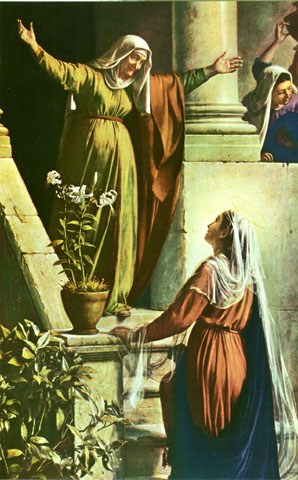
The Visitation by BlocZachariah and his wife, Elizabeth, are old and childless. But the Archangel Gabriel appears to Zachariah in the Temple and says that they shall have a son. Although he knows that God has blessed with children elderly and barren couples of old, Zachariah disbelieves the message. In response, he is put on a forty-week silent retreat. Zachariah becomes mute and apparently deaf as well (since his neighbors and relatives will later resort to making gestures to ask him the name of his newborn son.) Though he cannot tell his pregnant wife of their unborn son’s great mission, Elizabeth receives insights from the Holy Spirit.

When she hears the greeting of her visiting relative, Elizabeth is “filled with the holy Spirit” and cries out in a loud voice, “Most blessed are you among women, and blessed is the fruit of your womb!” The Blessed Virgin’s belly has not yet begun to grow, but Elizabeth prophesies and confirms to Mary that she is indeed pregnant with a boy who is “the Lord.” (Luke 1)

The Holy Spirit also seems to reveal to Elizabeth the name of her child: “John,” a name unfamiliar to her family. At the naming ceremony, Zechariah regains his voice, confirms her word, and “filled with the holy Spirit, prophesie[s]” through the canticle which bears his name. This holy, prophetic couple would ready their son for the great mission prepared for him by God.

#4 :  The Blessed Virgin Mary

The Annunciation by Henry Ossawa Tanner, Philadelphia, 1898.The Archangel Gabriel declared unto Mary that she would conceive the Son of God by the Holy Spirit. But is Mary a prophetess? Unlike Elizabeth and Zachariah, Luke’s Gospel does not say Mary, “filled with the Holy Spirit, prophesied,” or “filled with the Holy Spirit, cried out in a loud voice.” However, as Fr. Raymond Brown observed, the Annunciation to Mary shares the biblical form of a prophetic calling (like those of Moses, Gideon, Isaiah, Jeremiah, and Ezekiel before her):

(1) An Encounter with God or His Angel
(2) An Introductory Word
(3) A Call or Commission
(4) Objection(s) to the Message
(5) Reassurance by God or His Angel
(6) A Sign is Given

In her later canticle, Blessed Mary speaks a prophesy which remains fulfilled in our midst: “Behold, from now on all generations will call me blessed.” Mary is a prophetess, filled with the Holy Spirit, who bears God’s Word.

Simeon Holding the Baby Jesus in the Temple as His Parents Look On#3 & #2 :  St. Simeon & St. Anna

When the baby Jesus’ parents brought him to the Temple for the first time, they were met by Simeon and Anna; she was “a prophetess” and  “[t]he holy Spirit was upon him.” Simeon “came in the Spirit into the temple,” took Jesus in his arms, and declared him “a light for revelation to the Gentiles, and glory for your people Israel.” Anna likewise came forward at that very time and “gave thanks to God and spoke about the child to all who were awaiting the redemption of Jerusalem.” (Luke 2)

Simeon may have been advanced in years, but “it had been revealed to him by the holy Spirit that he should not see death before he had seen the Messiah of the Lord.” Anna, for her part, was an eighty-four-year-old widow who “never left the temple, but worshiped night and day with fasting and prayer.” Anna and Simeon show us how the old can bless the young through sharing the word of the Lord they have personally come to know.

#1 :  St. John the Baptist

St. John the Baptist PreachingWe do not know exactly how many Old Covenant prophets God inspired after the author of 2nd Maccabees. (A case might be made for the Bethlehem shepherds and the Magi as well.)  But we do know that John the Baptist represents the last Old Covenant prophet, the forerunner to the New Covenant Christ. He is “more than a prophet,” Jesus says. “All the prophets and the law prophesied up to the time of John. … Amen, I say to you, among those born of women there has been none greater than John the Baptist; yet the least in the kingdom of heaven is greater than he.” (Matthew 11)

At baptism, each Christian is entrusted with a prophetic mission. As those enlightened with God’s ultimate revelation, we are to share this Word. As great as it is to proclaim Christ’s coming, to proclaim his triumph is still greater.

Islam Cross Examined

April 26, 2016

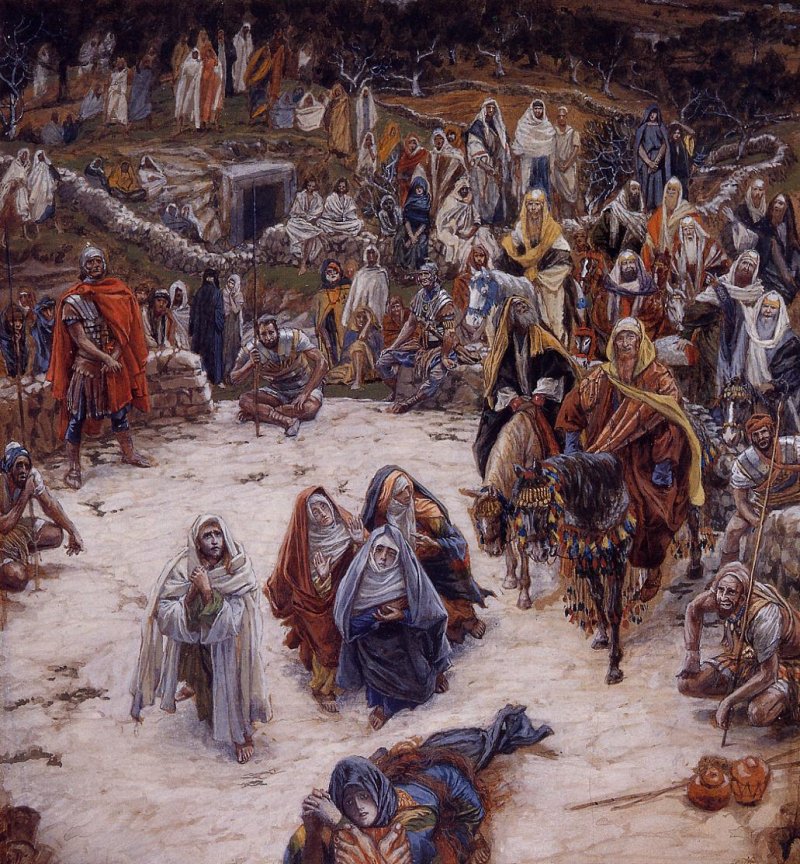
View From the Cross by TissotOnce, at a picnic in college, I learned from a Muslim professor about what Islam teaches regarding Jesus — that he is not the divine Son of God but a prophet of Allah. Of course, my own Christian beliefs differed but I sat patiently listening — until he told me something about ‘Jesus (peace be upon him)’ which left me manifestly incredulous. He said Jesus was never crucified; Allah only made it appear as if he suffered and died. Reportedly, most Muslims (like this professor) believe that Allah gave someone else Jesus’ physical appearance to die on the Cross instead.

The relevant portion of the Quran [4:157] says:

That they said (in boast), ‘We killed Christ Jesus the son of Mary, the Messenger of Allah’; but they killed him not, nor crucified him, but so it was made to appear to them, and those who differ therein are full of doubts, with no (certain) knowledge, but only conjecture to follow, for of a surety they killed him not…

I began asking the professor clarifying questions on this point to make sure that I understood and after a while he asked me why. I replied that if the eyewitnesses to the Crucifixion were not merely mistaken but actively deceived by Allah, then Allah is the author of a lie. God is Truth and “can neither deceive nor be deceived.” (CCC #156-157) So how could Islam’s doppelganger explanation for denying the Crucifixion of Jesus be true? (Similarly, creationists may argue that evolutionists are misinterpreting the ancient fossil record, but they may not say that God has planted false evidence to test our faith.) The now-ruffled Muslim professor retorted that Christianity’s belief in ‘the three gods of the Trinity’ did not make any sense, and we let our interfaith picnic dialogue end there.

But what if Allah can lie? If Allah acts against Truth then his omnipotence would be unlimited in every sense, transcending beyond both logic and goodness. But if Allah transcends good and evil, if God is not absolute goodness in a way that human beings can recognize, then what is our motive to worship him besides submission before his power? C.S. Lewis wrote in opposition to Calvinism’s doctrine of mankind’s “Total Depravity” with words which are just as applicable here:

[I]f God’s moral judgment differs from ours so that our ‘black’ may be His ‘white,’ we can mean nothing by calling Him good; for to say ‘God is good,’ while asserting that His goodness is wholly other than ours, is really only to say ‘God is we know not what.’ … If He is not (in our sense) ‘good’ we shall obey, if at all, only through fear – and should be equally ready to obey an omnipotent Fiend.”

In Plato’s Euthyphro, Socrates asks the title character, “Is the pious loved by the gods because it is pious, or is it pious because it is loved by the gods?” Or, put another way: “Is morality right simply because God declares it so, or does God acknowledge it as right because it is right independently of Himself?” Christianity answers that Euthyphro’s dilemma is a false choice. Goodness comes from God’s eternal nature; nothing could exist without Him. God’s word calls forth the good from Himself. He creates good things, sustains them, and sees that they are good. This is the good God we know; the true God “who does not lie” (Titus 1:2); the God who is supremely revealed by the death on the Cross of our Lord Jesus Christ for all people.

Pope St. Gregory the Great’s Reflections on John 21

April 10, 2016

From the Catena Aurea or Golden Chain, St. Thomas Aquinas’ collection of Church Father quotes.

  • It may be asked, why Peter, who was a fisherman before his conversion, returned to fishing, when it is said, “No man putting his hand to the plow, and looking back, is fit for the kingdom of God.” The craft which was exercised without sin before conversion, was no sin after it. Wherefore after his conversion Peter returned to fishing; but Matthew sat not down again for the receipts of custom. For there are some businesses which cannot or it can hardly be carried on without sin; and these cannot be returned to after conversion.
  • The [disciples’] fishing was made to be very unlucky, in order to raise their astonishment at the miracle after: “And that night they caught nothing.”
  • It may be asked, why after His resurrection He stood on the shore to receive the disciples, whereas before He walked on the sea? The sea signifies the world, which is tossed about with various causes of tumults, and the waves of this corruptible life; the shore by its solidity figures the rest eternal. The disciples then, inasmuch as they were still upon the waves of this mortal life, were laboring on the sea; but the Redeemer having by His resurrection thrown off the corruption of the flesh, stood upon the shore.
  • To Peter was the holy Church committed; to him is it specially said, “Feed my sheep.” That then which is afterwards declared by word, is now signified by act. He it is who draws the fishes to the firm shore, because he it was who pointed out the stability of the eternal country to the faithful. This he did by word of mouth, by epistles; this he does daily by signs and miracles.
  • By holding this last feast with seven disciples, [Jesus] declares that they only who are full of the seven-fold grace of the Holy Spirit, shall be with Him in the eternal feast. Time also is reckoned by periods of seven days, and perfection is often designated by the number seven. They therefore feast upon the presence of the Truth in that last banquet, who now strive for perfection.

He Proved Faithful — Good Friday Homily

March 25, 2016

Few proved faithful to Jesus on Good Friday, but on Good Friday Jesus proved himself faithful to us.

The political leaders were supposed to serve justice, but Pilate and Herod failed to protect Jesus as an innocent man. Jesus protected us when we were guilty.

The religious leaders were supposed to serve holiness, but the High Priests and the Sanhedrin failed to accept Jesus as their Messiah. Jesus accepted us so that we might become holy.

The disciples were supposed to serve their teacher and lord, but Judas betrayed him, Peter denied him, and the others abandoned him. By enduring his suffering and death, Jesus proved himself faithful to us.

Jesus’ mother Mary was faithful. She stood with him at the foot of the cross. It was a consolation for Jesus to have her there. Two of his beloved disciples were also there: Mary Magdalene and the apostle John. Jesus was grateful to have them close by.

Today, on this Good Friday, by the grace of God, we are at the foot of the cross. Let us pray for mercy, for ourselves and for others. Despite our past unfaithfulness, let us honor his faithfulness to us. Jesus is pleased that we are here with him, and he is grateful for our gratitude.

View From the Cross by Tissot

Returning the Favor — Holy Thursday Homily

March 24, 2016

St. Augustine wrote a famous reflection on Proverbs 23:1 :

“If you sit down to eat at the table of a ruler,
observe carefully what is set before you.”

Why? Because you will be expected to provide the same kind of meal for him. This proverb is a practical tip of worldly wisdom, but St. Augustine goes deeper; what is its spiritual meaning for the Christian?

Who is our ruler?  It is Jesus our Lord.
Where is his table? It is here, his altar.
Now carefully observe the food he sets before us: it is the Eucharist, his very self.

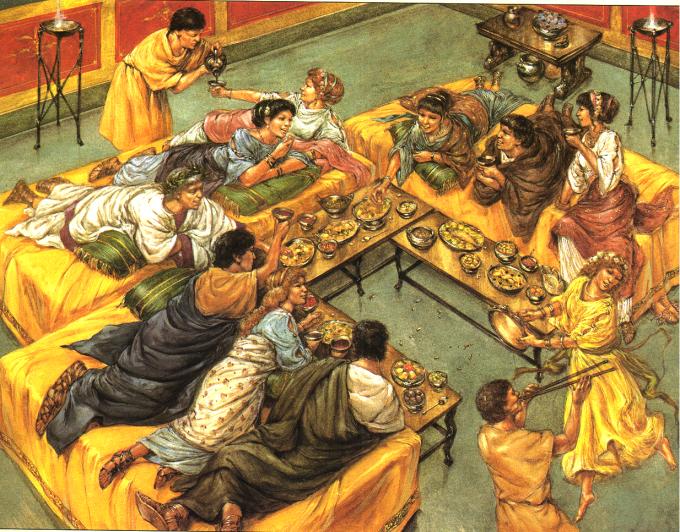
Jesus, like others in the ancient world, reclined at table.Jesus calls us to prepare the same kind of meal for him. He says, “This is my body, given up for you. Do this in memory of me.” We must make a gift of ourselves by living our lives for him, and we are to serve him in others for he tells us, “Amen, I say to you, whatever you did for one of these least brothers of mine, you did for me.”

After washing his disciples feet at the Last Supper where he institutes the Eucharist, Jesus says to his disciples, and to us: “Do you realize what I have done for you? … I have given you a model to follow, so that as I have done for you, you should also do.

Reflections on the Passion in Luke

March 18, 2016
  • Christ Carrying the Cross by Hieronymous Bosch, 1485-1490.At the Last Supper, Jesus says he has “eagerly desired to eat this Passover with you before I suffer…” Jesus did not allow stress to prevent him from enjoying the people and good things in his life. Do I experience joy at Holy Mass? Do I eagerly desire it?
  • Taking a cup, Jesus says, “I shall not drink of the fruit of the vine until the kingdom of God comes.” The next time Jesus drinks wine is on his cross; so God’s kingdom has begun on earth. Despite my trials, what good things am I looking forward to?
  • An argument breaks out among the apostles about which of them should be regarded as the greatest. Justifying ourselves through comparisons with others undermines our personal growth. Instead, Jesus commends imitating him as a servant to all.
  • To save Jerusalem, David tearfully fled the city by way of the Mount of Olives to escape his traitorous son, Absalom. Jesus also retreats there but resolves not to elude his betrayer and escape his death so that he might save us all.
  • Jesus is in such agony, praying so fervently in the garden, that his sweat becomes as drops of blood falling on the ground. This describes Hematidrosis, which has been observed in rare modern cases of people undergoing acute fear and intense mental contemplation. While I seek relief, do I offer my physical and emotional sufferings as a sacrifice?
  • He approaches Jesus to kiss him and Jesus asks, “Judas, are you betraying the Son of Man with a kiss?” Does my familiar intimacy with holy things lead me to hold them cheaply?
  • Jesus’ disciples realize what is about to happen and ask, “Lord, shall we strike with a sword?” However, they act before he can reply. Do I discern prayerfully and wait patiently for the Lord’s direction?
  • One of the disciples (St. Peter) strike the high priest’s servant (Malchus) and cut off his right ear. Jesus exclaims, “Stop, no more of this!” He touches the servant’s ear and heals him. Those without faith in Jesus cannot be converted by violence, that cuts off their ears to hear. Do I share Jesus Christ and my Catholic Faith in a winsome way?
  • Peter was willing to fight and die for Jesus in the garden, when he thought it would make a difference, but Peter did not recognize the importance of acknowledging Jesus to those around the fire. Do I recognize the importance of being faithful to Christ in all company and every moment?
  • Both Peter and Judas regretted what they had done, but Peter returned to Jesus. When I sin, do I delay to repent and return to Jesus?
  • Jesus was condemned for identifying as the Son of God and king of the Jews. When was the last time I suffered for telling the truth?
  • Pilate is glad to refer Jesus’ case to Herod. Pilate never hates Jesus, but sins through not caring about him. Who am I indifferent towards?
  • Herod enjoyed listening to John the Baptist until he had him executed. Jesus gives the unrepentant Herod only silence. Do I receive and heed God’s written and preached word when I can?
  • Barabbas is a murderer and a rebel. His name means “Son of the Father.” The crowds call out for him to be released to them instead of Jesus. Is my hope greater in political actors rather than the Lord?
  • Peter three-times denies Jesus and Pilate condemns Jesus after three-times declaring him innocent. They fold because they fear what others will say or do. Do I allow other people to persuade me to compromise on the truth or what is right?
  • The crowd cries, “Crucify him!” Every decision to sin chooses, at least in a small way, to exile Christ from our world.
  • Simon of Cyrene, coming in from the country, was pressed to carry Jesus’ cross. If Simon Peter had remained faithful, perhaps he would have come to Jesus’ aid. When I sin, what good do I forfeit?
  • The women of Jerusalem mourning and lamenting Jesus, crying for his Passion to end, may have served as a temptation for Jesus. He redirects them to pray for their own families’ deliverance. Do I pray for the salvation of my family and friends?
  • Two criminals were crucified beside Jesus. They symbolize all humanity, and Jesus suffers and dies among them. One is saved and one is likely lost.
  • One criminal acknowledges, “We have been condemned justly, for the sentence we received corresponds to our crimes, but this man has done nothing criminal.” Do I consider what my sins would deserve apart from the saving mercy of God?
  • Jesus says, “Father, forgive them, they know not what they do.” Do I assume malice where simple ignorance could explain the behavior of others?
  • Jesus cries out in a loud voice, “Father, into your hands I commend my spirit,” and breathes his last. What do I want my final, dying words to be?

Time Travel & God’s Prophesies

March 3, 2016

Many science-fiction stories have explored the idea of traveling through time and changing the past. For example, 1980’s “The Final Countdown” imagined a modern-day U.S. aircraft carrier being transported back to 1941 and facing the choice of either thwarting the Japanese attack on Pearl Harbor or allowing history to play out unchanged. In the early 1990’s, the TV time traveler Dr. Sam Beckett would “Quantum Leap” into other people’s lives, “striving to put right what once went wrong.” Just last fall, the internet hotly-debated the morality of going back in time to kill Adolf Hitler when he was still too young to have chosen or have committed any crimes.

ITardiss it possible to go back in history and change the past? There’s good reason to think that it is logically impossible. Here is why: Imagine traveling back in time and, by some tragic accident, killing your grandparent as a child. This would mean that one of your parents would have never been born… so you would have never been born… which raises the question: who killed your grandparent? Or imagine a time traveler’s intended history-changing mission succeeding, such as stopping JFK’s assassination. If so, then there is no cause for the time traveler to have ever been sent back from the future at all. This sort of logical contradiction is called a paradox.
Most serious time travel stories avoid this paradox problem using the premise that the past can be visited but never truly altered. Time travelers simply fulfill the role they have always played in those past events. Any and all attempts to avert some disaster in history will either prove useless or actually contribute to bringing about the calamity.

Time travel is merely fantasy, but the prophesies of God, which have correctly foretold future events, are very real. Consider, for instance, these passages from the 22nd Psalm written by King David under the inspiration of the Holy Spirit some 1,000 years before the coming of Christ:

“My God, my God, why have you abandoned me? … All who see me mock me… Like water my life drains away; all my bones are disjointed. My heart has become like wax, it melts away within me. As dry as a potsherd is my throat; my tongue cleaves to my palate… They have pierced my hands and my feet. I can count all my bones. They stare at me and gloat; they divide my garments among them; for my clothing they cast lots. … I will live for the Lord…”

This psalm is clearly fulfilled in Christ’s sufferings on the cross; the onlookers’ gloating mockery, the gambling over his garments, his dehydration and laboring heart, wounds cutting to his bones. What other form of torture is there that pierces the hands and feet? Jesus spoke this psalm’s opening words even while sharing the psalm’s closing hope in a life restored. These events were accurately described a millennium before they occurred.

God prophesying future events raises questions about human freewill. If Jesus’ crucifixion could be long foretold then what responsibility could Judas, Caiaphas, or Pontius Pilate possibly bear for their roles in the Passion? The answer is that Eternal God, from his vantage point outside of time, can behold all of history, including the free choices that each of us make. C.S. Lewis reconciles God’s knowledge and our freedom in these passages from his book “Mere Christianity”:

“…God is outside and above the Time-line. In that case, what we call ‘tomorrow’ is visible to Him in just the same way as what we call ‘today’. All the days are ‘Now’ for Him. He does not remember you doing things yesterday; He simply sees you doing them, because, though you have lost yesterday, He has not. He does not ‘foresee’ you doing things tomorrow; He simply sees you doing them: because, though tomorrow is not yet there for you, it is for Him. You never supposed that your actions at this moment were any less free because God knows what you are doing. Well, He knows your tomorrow’s actions in just the same way— because He is already in tomorrow and can simply watch you. In a sense, He does not know your action till you have done it: but then the moment at which you have done it is already ‘Now’ for Him.”

God’s knowledge of our free choices does not make our choices any less free. As St. Augustine once noted, “Just as you do not compel past events to happen by your memory of them, so God does not compel events of the future to take place by his knowledge of them.” God’s divine knowledge does not strip us of human freewill, but it does permit him to communicate perfect prophesies to his people concerning events further along our timeline. Such prophesies concern not only the Messiah’s life, but our times and future as well.

Jesus Christ has already victoriously prevailed. His Second Coming in glory is foretold and assured, and his people’s final victory over sin and death is prophesized and certain. This is the connection between time travel stories and the prophesies of God: like the futility of time travelers attempting to avert some historic disaster, any and all attempts to prevent the ultimate triumph of Christ will either prove useless or actually contribute to bringing about the coming of his Kingdom. The enemies of Jesus schemed to destroy him and his movement, but their very plotting led to the fulfillment of his mission and the birth of the Church. This knowledge is a cause for Christian endurance and joy, even amidst our times of struggle. We know that we are free to serve a faithful role in helping bring about the great, holy, happy ending of history.

Jesus is Risen, Not Undead

February 26, 2016

All the classics of horror are Catholicism twisted. Vampires are the shadow opposite of Jesus in the Eucharist; they prey on the blood of others to possess eternal life apart from God. Depictions of Frankenstein are distortions of the Mystical Body of Christ, with the dead parts of many monstrously combined as one. And what are zombie stories but corruptions of the Resurrection? A new friend of mine teaches a faith formation class with a 5th grader who periodically pipes up saying, “Jesus was a zombie.” So, this week, she taught them about how Jesus is different from zombies.

Zombies are typically said to be created by a virus or a magic spell, but Jesus lives by the power of God. Zombies lose their memory and intellects, but the risen Jesus knows his friends and converses with them. The bodies of zombies decay and they can be “killed,” but the risen Jesus is free from corruption and can die no more. Zombies “desire” to kill people, but Jesus would give them life. (What other differences can you find with your family?)

After seeing The Passion of the Christ in 2004, I heard a fellow seminarian say that the movie ending with Jesus walking from the tomb on Easter morning frustrated him—he want to see what happened next, he wanted the story to continue. Last Friday, I had the great pleasure of seeing a new film which tells that story: Risen. In it, a Roman soldier named Clavius is tasked by Governor Pontius Pilate to find the body of Jesus the Nazarene and end rumors of his resurrection. Only about a dozen people were in the theater on opening night, so if you want to enjoy this highly-recommended film on the big screen you should make a point to see it soon.


The Significance of Anna’s Age and Lifestyle — Sixth Day in the Christmas Octave

December 31, 2015

Readings: 1st John 2:12-17, Luke 2:36-40

Whenever we read the Bible, it is profitable for us to remember that every detail is there for a reason. The sacred authors and the Holy Spirit chose to omit so many minor facts that “I do not think the whole world would contain the books that would be written” if they had described everything. (John 21:25) Instead, all that we find in Scripture has been purposely included for our benefit. (John 20:30-31) Consider the details mentioned in this encounter from the Presentation, when Joseph and Mary brought the baby Jesus to the temple in Jerusalem for the first time:

The Presentation of Jesus in the Temple by James Tissot

There was a prophetess, Anna, the daughter of Phanuel, of the tribe of Asher. She was advanced in years, having lived seven years with her husband after her marriage, and then as a widow until she was eighty-four. She never left the temple, but worshiped night and day with fasting and prayer. And coming forward at that very time, she gave thanks to God and spoke about the child to all who were awaiting the redemption of Jerusalem.

This is the only episode in the New Testament where the prophetess Anna appears. Why does St. Luke include Anna’s age and the length of her marriage? Let’s explore this obscure detail. The 84-year-old widow was married for seven years, and thus was unmarried for 77 years of her life. She is 7 x 12: the Jewish number symbolizing completeness and perfection times the number of the tribes of Israel. Anna personifies Old Testament Israel at her best. But of the twelve tribes, which tribe would correspond with Anna’s seven years of marriage?

After the death of Saul, all the tribes of Israel came to David (of the tribe of Judah) seeking to make him their king. They said: “Look! We are your bone and your flesh,” echoing the words of Adam towards Eve at the beginning of their marriage covenant, “This one, at last, is bone of my bones and flesh of my flesh.” (2nd Samuel 5:1, Genesis 2:23) Old Testament Israel had been wedded for a time to David, but now she awaited the kingship of a Son of David from the tribe of Judah. While David had once conquered Jerusalem from the Jebusites, Anna and others in her day were “awaiting the redemption of Jerusalem” by the Messiah/Christ. (1st Chronicles 11:4-5)

Living like a Christian nun veiled in anticipation of her bridegroom’s arrival, Anna “never left the temple, but worshiped night and day with fasting and prayer.” Why would Anna, or any woman, choose to live in this way? St. John’s first epistle offers this admonition:

Do not love the world or the things of the world. If anyone loves the world, the love of the Father is not in him. For all that is in the world, sensual lust, enticement for the eyes, and a pretentious life, is not from the Father but is from the world. Yet the world and its enticement are passing away. But whoever does the will of God remains forever.

Alexandrian World Chronicle (5th century) featuring Anna the ProphetessThough Anna understood the evil corruptions of “the world,” she was also well aware of the goodness of creation. She had known the blessings of marriage and the (at least occasional) pleasures of feasting, but Anna knew that these passing things could not fully satisfy her. Her deepest longings could only be met by the One to come, not only for her but for all Jews and Gentiles. When Jesus Christ came to the temple, Anna rejoiced, gave thanks, and “spoke about the child to all who were awaiting the redemption of Jerusalem.” Because she devoted herself to “the will of God,” Anna’s scriptural legacy and joy before the Lord ‘remain forever.’

The Temptations of the First Christmas

December 22, 2015

If I were a demon prowling about the world for the discouragement, confusion, and ruin of souls, how might I have tried to tempt God’s beloved ones in the year leading up to the first Christmas?

If I were a demon, I would say to St. Elizabeth, “Did people imagine that Zechariah had a vision while he was serving in the temple? He simply had a stroke and he will never speak again. You’re feeling sick every day and your abdomen is expanding. You clearly have a cancer. You will soon be dead. There is no hope.

If I were a demon, I would say to St. Mary, “You think you saw an angel? That’s crazy! You’re imagining things. Who are you to be the mother of God’s son? Who do you think you are! Don’t even bother going to visit Elizabeth. You’ll feel foolish when you arrive and see that nothing has changed. None of your family, friends, or neighbors will believe you. Joseph will divorce you and you will be all alone.

And if I were a demon, I would say to St. Joseph, “Do you really believe Mary conceived by God’s Spirit? She’s obviously lying. Even if it’s true, who are you to be a father to the Messiah? Either way, it is best for you to just get a divorce. Whatever you imagined when you married her, now you can see that you were so very wrong.

Mary & Joseph

Even with the coming of Christmas, my diabolical efforts would not cease. I would advise Bethlehem’s shepherds to steer safely-clear of the holy child and to keep to watching their flocks. I would urge the Magi to dismiss the starry signs as meaningless coincidences and not to risk a long journey. I would encourage Joseph to ignore the warning dream to take his family into Egypt and I would encourage Mary not to trust in her loving husband’s lead: “Surely, God would have told you this before telling Joseph.” Thankfully for us, none of them were prevented from doing God’s will through being tripped-up by such traps.

Some people think of temptation strictly as a prompting toward pleasurable, immoral action. But temptation can come in other forms. It can also pull us toward inaction and negative experiences like fear, doubt, sadness, and despair.

Some people assume that the saints do not know temptation like the rest of us. But did Mary, Joseph, and Elizabeth live oblivious to the thoughts and unassailed by the feelings realistically described above? In truth, the saints come to understand temptation well as they discern and persevere through the trials of life.

Some people believe that God loves and watches over a few favored saints while having less concern for the rest of us. But this is also a temptation. Even if our life takes a shocking turn and we don’t know what to do, even if we have a stroke, or cancer, or our mind begins to fail, even if we seem betrayed or abandoned by everyone, each and all of us are his dearly beloved ones. (And we shouldn’t listen to anyone telling us otherwise, even if they speak to us in our own voice.)

The Two (Old & New) Arks of God

December 17, 2015

Remember Raiders of the Lost Ark? The Ark that Indiana Jones and the Nazis were pursued in that entertaining film was the most precious object in the entire Old Testament. But what is lost on many is how that holy artifact is related to the most important woman in the New Testament and its New Covenant.

The Old Testament Ark of the Covenant was a box built in the days of Moses according to God’s instructions at Mount Sinai. It was made of wood overlaid with pure gold, inside and out. No man was allowed to touch God’s Holy Ark—lest they die—so it was designed to be carried about using a pair of poles. The Ark was the throne for God’s presence on earth. The wings of two, golden Cherubim angel statues atop the Ark’s lid served as his “mercy-seat.” The Ark itself contained within several interesting items from the time of the Exodus: the two stone tablets of the 10 Commandments, the wooden staff of Aaron (which miraculously blossomed to confirm his divinely-ordained priesthood), and a gold container holding some of the Manna from heaven which God provided to feed his people on their desert pilgrimage.

Ark

About 450 years after its construction, around 1000 BC, King David reigned over all of Israel. He tried to bring the Ark up to his royal city, Jerusalem, until one of the priests (who should have known better) touched the Ark and fell down dead. David exclaimed, “How can the Ark of the Lord come to me?” He arranged for it to be kept at the house of Obed-edom in the Judean countryside. The Ark remained there for three months and manifestly blessed the whole household. When it was reported to the king how richly Obed-edom was being graced, King David decided to try transporting the Ark into Jerusalem once more. David himself led that procession, dancing and leaping before the Lord with joyful abandon.

The Ark would eventually reside in the Jerusalem Temple built by David’s son, King Solomon. It is written that before that Temple was destroyed by the Babylonians in 587 BC, Jeremiah the Prophet took the Ark and hid it in a secret cave, saying, “No one must know about this place until God gathers his people together again and shows them mercy.”Unlike in the 1981 film, the Lost Ark has never been found, but a new Ark of God did appear.

The Blessed Virgin Mary is the New Ark of the Covenant because she bears Jesus Christ, God’s fullest presence on earth. By God’s design, the first Ark was made of wood and covered with gold; Mary is a human being full with grace. The former Ark carried the word of God in stone; Mary’s womb carries the Word become flesh. Aaron’s dead staff miraculously flowered; Mary’s virgin womb blossomed with a bud from the stump of Jesse. The Ark held Manna from heaven; Mary bore the true bread from heaven. Mary’s womb holds Jesus Christ, our Prophet, Priest, and King.

The Visitation by Albertinelli, 1503.As the Gospel of Luke tells us, after she was visited by St. Gabriel the Archangel at the Annunciation, “Mary set out and traveled to the hill country in haste to a town of Judah, where she entered the house of Zechariah and greeted Elizabeth. When Elizabeth heard Mary’s greeting, the infant leaped in her womb, and Elizabeth, filled with the holy Spirit, cried out in a loud voice and said, ‘Most blessed are you among women, and blessed is the fruit of your womb. And how does this happen to me, that the mother of my Lord should come to me?’” And Mary would bless them with her help and companionship, staying at their house in the Judean hill country about three months.

Like King David, St. Elizabeth questions and St. John the Baptist leaps for joy before the Ark of the Lord. St. Joseph, regarding the inviolable sanctity of his wife with reverent fear, never touched her virginity. Mary would also go on to literally serve as God’s throne, his mercy-seat; “On entering the house [the Magi] saw the child with Mary his mother.”

In the Book of Revelation, St. John’s vision of heaven includes a sighting of the Lost Ark: “Then God’s temple in heaven was opened, and the Ark of his Covenant could be seen in the temple.” Then John beholds “in the sky, a woman clothed with the sun, with the moon under her feet, and on her head a crown of twelve stars.” We soon discover that this  glorious woman is pregnant with “a son, a male child, destined to rule all the nations….” This is the Christ, and she is his Holy Ark.

Now the Lord’s Ark is not meant to be worshiped. (Though among God’s most holy creations, an Ark of God is not divine.) Yet, as one draws nearer to the Holy Ark, one inevitably draws nearer to God’s presence. Just as the old Ark of the Covenant was of central (though secondary) importance in the Old Covenant, so God gives the Blessed Virgin Mary an essential role in his New Covenant. All who come to her are drawn nearer to her Son.

Imagine daring to enter the old Jewish Temple’s the Holy of Holies where the Ark of God was kept. What awe and reverence would you feel before the all-holy presence of God? Now consider drawing near to the even greater Ark, Mary the Mother of all Christians, who reaches out to each of us with love and takes away our fear. And now reflect upon the great privilege we have in approaching and even touching the Christmas Gift of God she bore, Jesus Christ himself. Mary is blessed among women and blessed is the fruit of her womb, Jesus. But blessed are we who would believe in all that the Lord has revealed to us.

Our Holy Conspiracy & the End of the World — 33rd Sunday of Ordinary Time—Year B

November 16, 2015

C.S. Lewis, 1898-1963A new liturgical Church year will begin in a couple of weeks with the first Sunday of Advent. As this Church year ends, our Mass readings (like today’s Sunday readings) focus on the Last Things and the end of the world as we know it. This weekend’s news reports, especially the terrible events in France, remind us that though the Kingdom of God is among us, we pray “thy Kingdom come” because it is not yet fully here in total, unveiled power. This weekend’s readings and news events remind me of passages from C.S. Lewis in excellent book Mere Christianity:

“Enemy-occupied territory—that is what this world is. Christianity is the story of how the rightful king has landed, you might say landed in disguise, and is calling us all to take part in a great campaign of sabotage. When you go to church you are really listening-in to the secret wireless [radio] from our friends: that is why the enemy is so anxious to prevent us from going.”

Why does Lewis say that our king has landed “in disguise?” Well, where would you expect a king to be born? The Magi sought the newborn king of the Jews in the palace at Jerusalem, but Jesus was born in a barn—a cave in Bethlehem—to a pair of poor parents. How would one expect the Jewish Messiah to enter into Jerusalem to claim his throne? Probably riding on a warhorse, but Jesus came meekly riding on a donkey, just as had been prophesied about him. Who would have thought that God would become a man, and then suffer and die as he did? After the vindication of the resurrection, one would have thought he would appear to the high priest and Governor Pilate, or to the Emperor Tiberius in Rome, to declare that he was indeed who he claimed to be. Instead, Jesus appeared discretely, to his disciples.

Lewis writes that God has landed in this enemy-occupied world in disguise and has started “a sort of secret society” to undermine the devil. This secret society he speaks of is the Church. But what is so secret about the Church? We have a sign in front with our Mass times. We don’t check ID’s at the door. And if anyone wants to know about what we do or what we believe, we will gladly inform them. But, in a sense, the Church is a secret society—for the world and even many Catholics do not recognize who and what we really are. We are a holy conspiracy. We are fighting the propaganda of the world and the devil with the truth of God. We are recruiting others to the side of the Lord. We are his special forces sabotaging evil with the weapons of love in preparation for the king’s arrival.

From where do we receive our power for this mission? The source of our power is the Holy Mass. Today’s second reading says that the Old Testament’s priests offered many sacrifices because those  could not truly achieve their purpose, but Jesus our High Priest offers his sacrifice once for all. At Mass we transcend space and time to personally encounter that sacrifice, and it’s power is applied to us here and now, providing all the graces we need to fulfill his will.

Lewis asks, “Why is [God] not [yet] landing in [total unveiled] force, invading [our world]? Is it that He is not strong enough? Well, Christians think He is going to land in force; [but] we do not know when.”

Indeed, as Jesus says in today’s Gospel, “of that day or hour, no one knows… but only the Father.”

We do not know when the Lord is going to land in force. “But,” Lewis continues, “we can guess why He is delaying. He wants to give us the chance of joining His side freely. I do not suppose you and I would have thought much of a Frenchman [during World War II] who waited till the Allies were marching into Germany and then announced he was on our side. God will invade.”

Why has God not yet invaded our world with his full, unveiled force? Why does he allow the wicked to use their freedom for evil, like the terrorism we saw in Paris?

Lewis writes, “I wonder whether people who ask God to interfere openly and directly in our world quite realize what it will be like when He does. When that happens, it is the end of the world. When the author walks on to the stage the play is over. God is going to invade, all right: but what is the good of saying you are on His side then, when you see the whole natural universe melting away like a dream and something else—something it never entered your head to conceive—comes crashing in; something so beautiful to some of us and so terrible to others that none of us will have any choice left?”

I think “the whole natural universe melting away” is an excellent reflection on today’s gospel. Jesus tells us that at the end:

“the sun will be darkened,
and the moon will not give its light,
and the stars will be falling from the sky,
and the powers in the heavens will be shaken…”

In the ancient world, the sun and moon, stars and planets, were considered the most stable and eternal things in the cosmos (and you can understand why.) But when even these things are passing, you know the universe as we know it is melting away. After this, the Lord Jesus comes with judgment. “And then they will see ‘the Son of Man coming in the clouds’ with great power and glory… (and his angels, like St. Michael from our first reading, along with him…)”

Sprouting Fig Tree in SpringtimePerhaps we may find it surprising that Jesus describes these events as a good thing to his disciples. He says:

“Learn a lesson from the fig tree. When its branch becomes tender and sprouts leaves, you know that summer is near. In the same way, when you see these things happening, know that [the Son of Man] is near, at the gates.”

We usually associate the end of things with the fall. Youth is called the springtime of life, while old age is the fall. In the Northern Hemisphere, every Church year ends in the fall. Yet Jesus presents an analogy for the end of the world as one of spring becoming summer: ‘When the tender branch sprouts leaves, you know that summer is near.’ A small thing, the branch, points to the arrival of a much greater reality, the summer. Why would we cling to the branch when the whole world is being renewed in glory? For friends of God, what is to come is better than what we see. The life we live now in this world is the winter. What is still to come for us is the spring and summer. Let us not hesitate to hope for it, envision it, and rejoice in it.

When the last day comes, “it will be God without disguise; something so overwhelming that it will strike either irresistible love or irresistible horror into every creature. It will be too late then to choose your side. … That will not be the time for choosing: it will be the time when we discover which side we really have chosen, whether we realized it before or not. Now, today, this moment, is our chance to choose the right side. God is holding back to give [people] that chance. [But it] will not last forever. We must take it or leave it.”

How long will it be until the Lord comes again? Jesus says in today’s gospel that, “This generation will not pass away until all these things have taken place.” But he said this a long time ago. Was Jesus wrong? No, for when you read these passages from Mark in full context, Jesus is responding to his disciples questions about two things side-by-side: the fall of Jerusalem and the end of the world. The Romans destroyed the great city and its temple in 70 A.D., during the lifespan of some of Jesus’ hearers, and to many Jews it felt like the end of the world. This event prefigured the passing away of all things. Like other prophesies in the Bible, Jesus’ prophesy has a near and distant fulfillment, one after a forty-year opportunity for conversion, and another at the end of time.

So when will the Lord come again? The answer for every generation before us has been “not yet.” If this world endures to the year 10,000 A.D., the Christians of that time will probably regard us as the early Christians. I personally think it will still be awhile before he comes, for it is still legal to be a Christian in too many places on earth. Yet, in a sense, it doesn’t matter when Jesus is coming, for the end of our individual lives is equivalent to the end of the world for us. If you’re ready for one, you’re ready for the other. But if you, or people that you know, are not ready for either, then now is the time for conversion.

The Lord our King has recruited us into his holy conspiracy, arming us with the weapons of truth and love. You and I are his advanced forces and, among other tasks, he is sending us on rescue missions to bring others to himself. Who do you know that is far from Christ? We are to draw on the power of this Mass for them. We are called to pray, fast, and sacrifice for them, and even to be so bold as to talk with them—inviting them to come to Jesus Christ and his Church. Seize this opportunity and do not let it pass away, for whether the Lord first comes to us or we go forth to him, each and all will encounter him soon, face-to-face, in his full, unveiled glory.

A Chalice Reflection

October 13, 2015

Virgin Mary by the Host by Jean Auguste Dominique Ingres, 1854.     How could we possibly celebrate the Holy Mass without the chalice? Without the chalice, how would we adore the Precious Blood? The chalice holds the Lord and it gives form to his presence. He is not lifted up in sacrifice without its close collaboration. Perhaps our Lord could have chosen another means but this is the one He chose. The chalice at Mass is not divine, but when our Lord is adored it shares in His glory.

The chalice at Mass is an icon of a person. The chalice of Jesus Christ is the Blessed Virgin Mary. She held the Lord within her and from her He received his human form. He was not lifted up in sacrifice without her close collaboration. Perhaps our Lord could have chosen another means, but she is the one He chose. Mary is not divine, but when our Lord is adored she shares in His glory.