Archive for the ‘Salvation History’ Category

The Two Mountains — Wednesday, 3rd Week of Lent

March 26, 2014

Readings: Deuteronomy 4:5-9, Matthew 5:17-19

[W]hat great nation is there that has gods so close to it as the LORD, our God, is to us whenever we call upon him? Or what great nation has statutes and decrees that are as just as this whole law which I am setting before you today?

The greatness of Israel among the nations consisted not merely in their moral law but in their intimacy with God. As C.S. Lewis once observed, “The road to the promised land runs past Sinai.” The morality of Mount Sinai is essential to the journey, but our goal is to worship on Mount Zion.

Immediately following today’s Gospel about fulfilling the Law, Jesus declares, “I tell you, unless your righteousness surpasses that of the scribes and Pharisees, you will not enter into the kingdom of heaven.” The Pharisees and scribes kept the commandments pretty well but they were often far from God.

This Lent, let us not only focus on growing in our moral practices, but also on our love and intimacy with the Lord.

Something God Can’t Do — March 25 — Annunciation

March 26, 2014

Despite God’s infinite power, he cannot force our free choice to love him. (It is a limitation of logic, not of power, that free-choices cannot be forced.) The Lord can invite and beckon, grant gifts of wisdom and liberation, but only we can give our “Yes.”

God accepts our sacrifices and offerings, but even more than what we have he desires the gift of what we are — that is, who we are — our very selves.

The Church is both Christian and Marian. The faithful say, “Not my will, Father, but yours be done” and “Let it be done unto me according to your word.”

God’s kingdom will come in its fullness even despite our stubborn “No” or, in part, because of our free “Yes.” However, let us answer, “Here I am, Lord; I come to do your will,” so that we may personally share his glory, like Mary and Gabriel do today.

Teddy Bear Annunciation

March 25, 2014

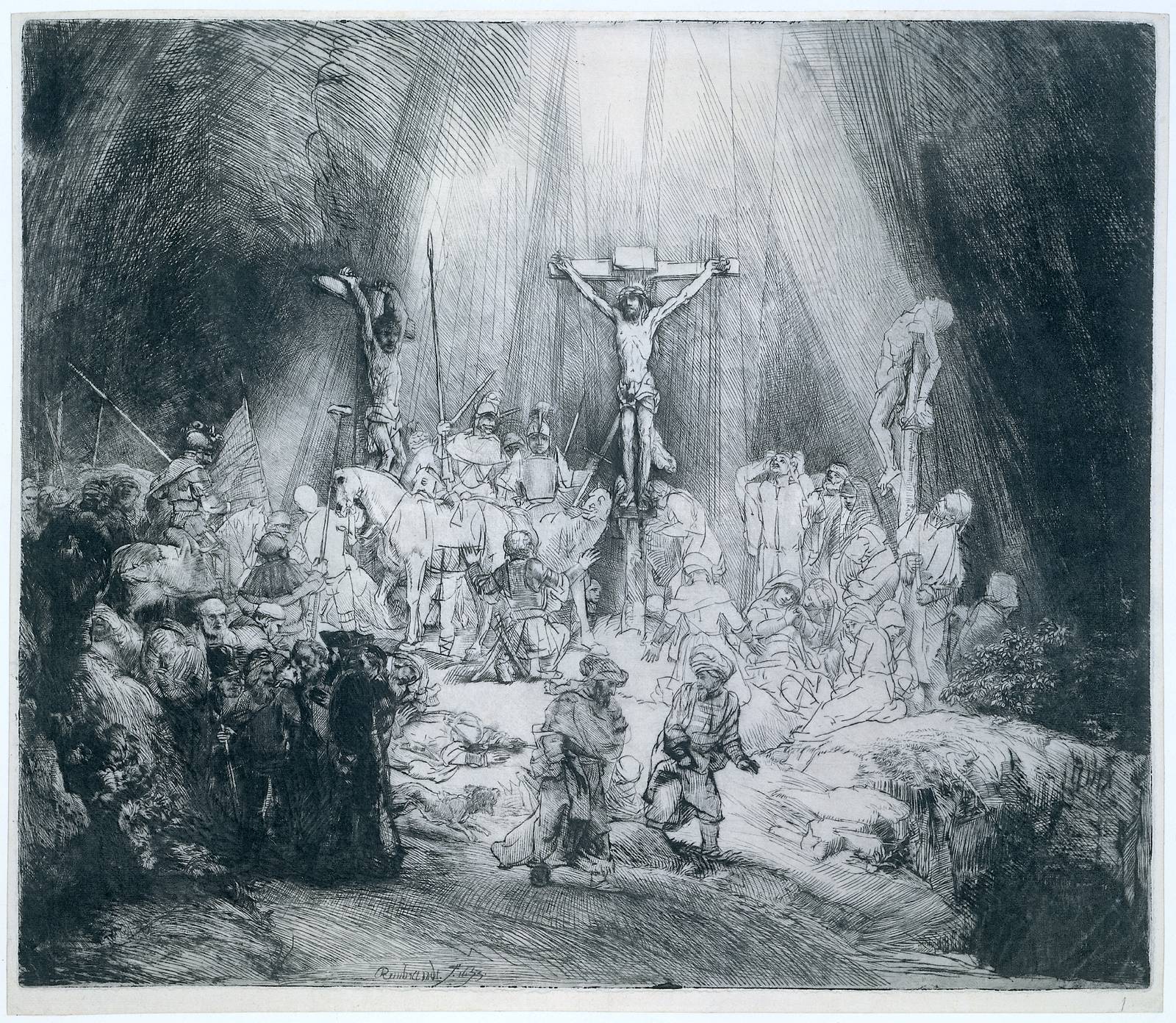
The Seven Last “Words” of Christ

March 21, 2014

“Father, forgive them for they know not what they do.”  (Luke 23:34)

To the good thief:  “Amen, I say to you: this day you will be with me in paradise.”  (Luke 23:43)

To Mary:  “Woman, behold your son.” And to his beloved disciple:  “Behold your mother.”  (Luke 19:26-27)

“My God, my God, why have you forsaken me?”  (Mark 15:34)

“I thirst.”  (John 19:28)

“It is consummated.”  (John 19:30)

“Father, into your hands I commend my spirit.”  (Luke 23:46)

HHS Mandate Court Date Set

March 19, 2014

The Annunciation by Fra AngelicoThe Supreme Court has set the date for oral arguments for Hobby Lobby’s challenge to the Obama HHS mandate. The nation’s highest court will hear debate from attorneys representing the Christian-owned business and the Obama administration on Tuesday, March 25 at 10 a.m.”

March 25th is the Feast of the Annunciation, when the Blessed Virgin Mary conceived our Lord.

Tempting the Messiah — 1st Sunday in Lent—Year A

March 7, 2014

Gospel: Matthew 4:1-11

Jesus Tempted in the Wilderness by James Tissot 1886-1894.The devil suggests Jesus should change stones into bread. He wants Jesus to be a materialistic Messiah who will focus on nourishing bodies to the neglect saving souls. Jesus replies that “one does not live on bread alone, but on every word that comes forth from the mouth of God.” Christ shall change bread into himself at the Last Supper “for the life of the world.” (John 6:51)

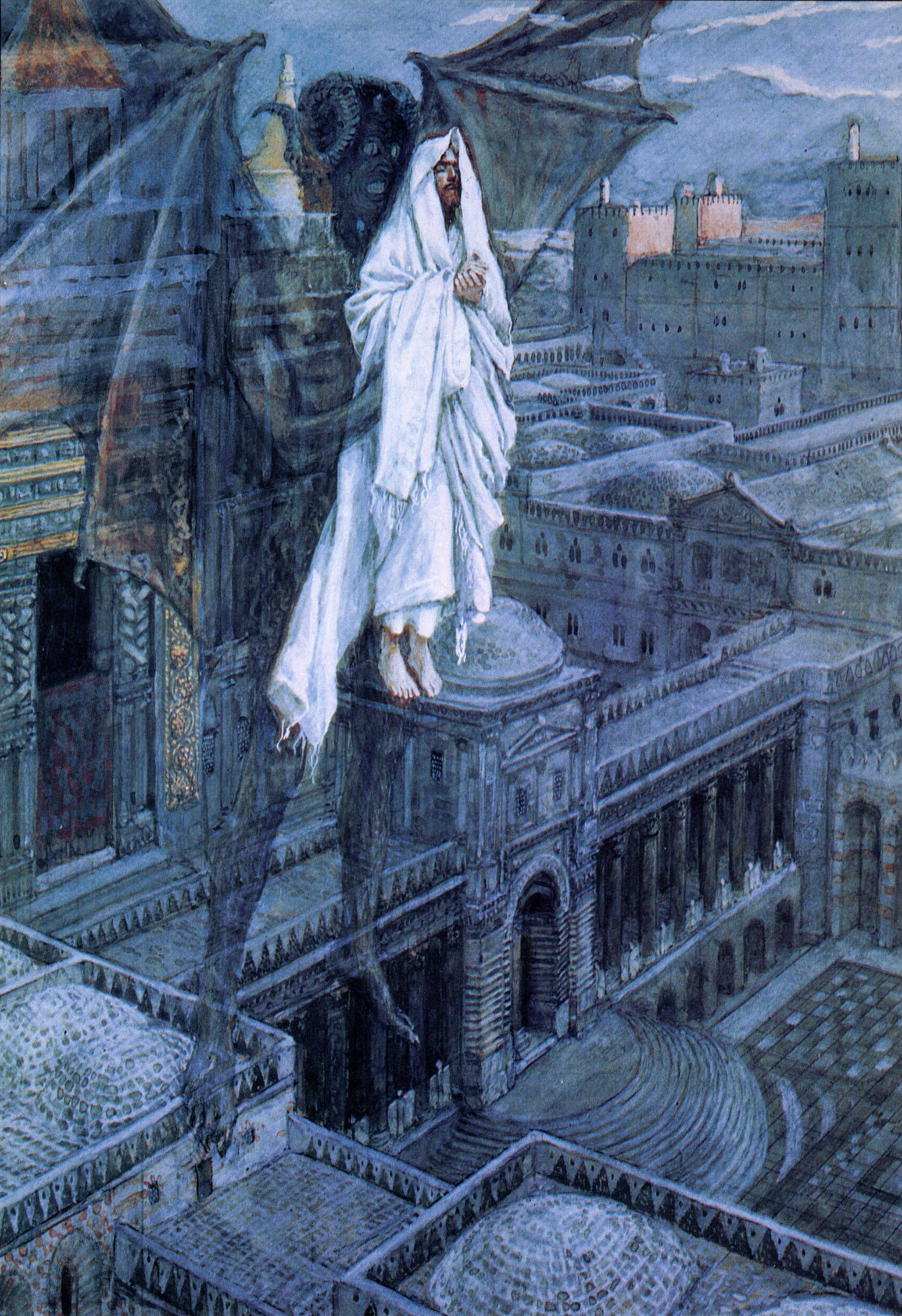
A depiction of Jesus being tempted at the temple by James Tissot, 1895The devil takes Jesus to a precipice atop the temple in Jerusalem and challenges him to throw himself down. He wants Jesus to be a Messiah who will hope to never suffer. Jesus responds that “you shall not put the Lord, your God, to the test” by trying to force him into doing our will. Christ shall be tested and condemned by the Sanhedrin in Jerusalem and be made a suffering Savior according to God’s plan. (Isaiah 53)

The devil takes Jesus up to a very high mountain, shows him all the kingdoms of the world, and promises to bestow them all if Jesus would simply prostrate himself and worship him. He wants Jesus to be a compromised Messiah who will pursue good by doing (or serving) evil. Jesus replies that “Lord, your God, shall you worship and him alone shall you serve.” By unwavering obedience to his heavenly Father, Christ shall become the king of all nations, enthroned high upon a cross on Mount Calvary. (Matthew 20:21)

Four Cheeks Turned — 7th Sunday in Ordinary Time—Year A

February 22, 2014

Gospel: Matthew 5:38-48

When attacked, our natural response is “fight or flight,” but Jesus suggests a  supernatural response: “When someone strikes you on your right cheek, turn the other one as well.” Since the Jews regarded the left hand as unclean, they would reflexively strike with the right hand. If the right cheek were hit, then one had been backhanded with contempt. Responding by turning the other cheek neither attacks not retreats, but insists on being regarded as an equal, whom one must strike (if at all) with an open hand. Jesus wants us to stand our ground in the face of injustice, assertively but lovingly, in hopes that the offender will reconsider his ways. Jesus modeled this response when he was struck during his trial before Annas:

The high priest questioned Jesus about his disciples and about his doctrine. Jesus answered him, “I have spoken publicly to the world. I have always taught in a synagogue or in the temple area where all the Jews gather, and in secret I have said nothing. Why ask me? Ask those who heard me what I said to them. They know what I said.” When he had said this, one of the temple guards standing there struck Jesus and said, “Is this the way you answer the high priest?” Jesus answered him, “If I have spoken wrongly, testify to the wrong; but if I have spoken rightly, why do you strike me?” (John 18:19-24)

Another saintly example was shown by Blessed Mother Teresa of Calcutta. Though reports vary, Mother Teresa was once begging bread from a baker for her orphanage. When the baker responded by spitting into her hand, she replied to effect, ‘I will keep this for me, but please give something for my children.’

In Victor Hugo’s Les Miserables, a bishop welcomes an impoverished convict to join his table and sleep at his home. However, that night, Jean Valjean steals his host’s silverware and goes away. The police catch him and take him to the bishop. Looking at Jean Valjean, the good bishop exclaims, “Ah! here you are! I am glad to see you. Well, but how is this? I gave you the candlesticks too, which are of silver like the rest, and for which you can certainly get two hundred francs. Why did you not carry them away with your forks and spoons?” Jean Valjean opens his eyes wide and stares at the venerable Bishop “with an expression which no human tongue can render any account of.” The bishop’s turn of the cheek spares the thief’s freedom and saves his soul.

And finally, a true story from a modern marriage: A woman’s husband had a terrible temper and every time it flared she would say, “That’s just like you to lose your temper!” But then, following a stroke of insight, she began responding differently. The next time he began to fly of the handle she told him, “That’s not like you to lose your temper,” and he nearly fell out of his chair. Even the kids looked at her funny, but she stuck with her new resolution. Months later, while at a restaurant together, he became irritated by the slow service. He started to fume about it, but then he suddenly stopped, turned to her, and said, “That’s not like me to lose my temper, is it?” This time, it is said, she nearly fell on the floor.

Was it true the first time the woman declared that it was not like her husband to lose his temper? The claim did not match his previous behavior, but perhaps he changed because she revealed to him that his uncontrolled anger was quite unlike the father, husband, and Christian man he truly and deeply wanted to be. This is the sort of realization and conversion we are to hope for in turning the other cheek.

Plus, a fifth story: “If a teen mugs you for your wallet…

Stained Glass Symbols — The Holy Cross

February 20, 2014

Holy Cross - Sacred Heart Catholic Church -  Wauzeka WIA Symbol of Christ’s Triumph

Jesus Christ’s cross is holy because it is the instrument he uses to save the world. The Roman Empire, in a demonstration of worldly wisdom and power, used crucifixion to humiliate, torture, and terrorize whoever would dare to oppose them. Jesus takes the cross, the worst evil the spiritual and human rulers of this world could wield against him, and employs it to achieve his victory.

Stained Glass Symbols — Mount Calvary’s Cross

February 18, 2014

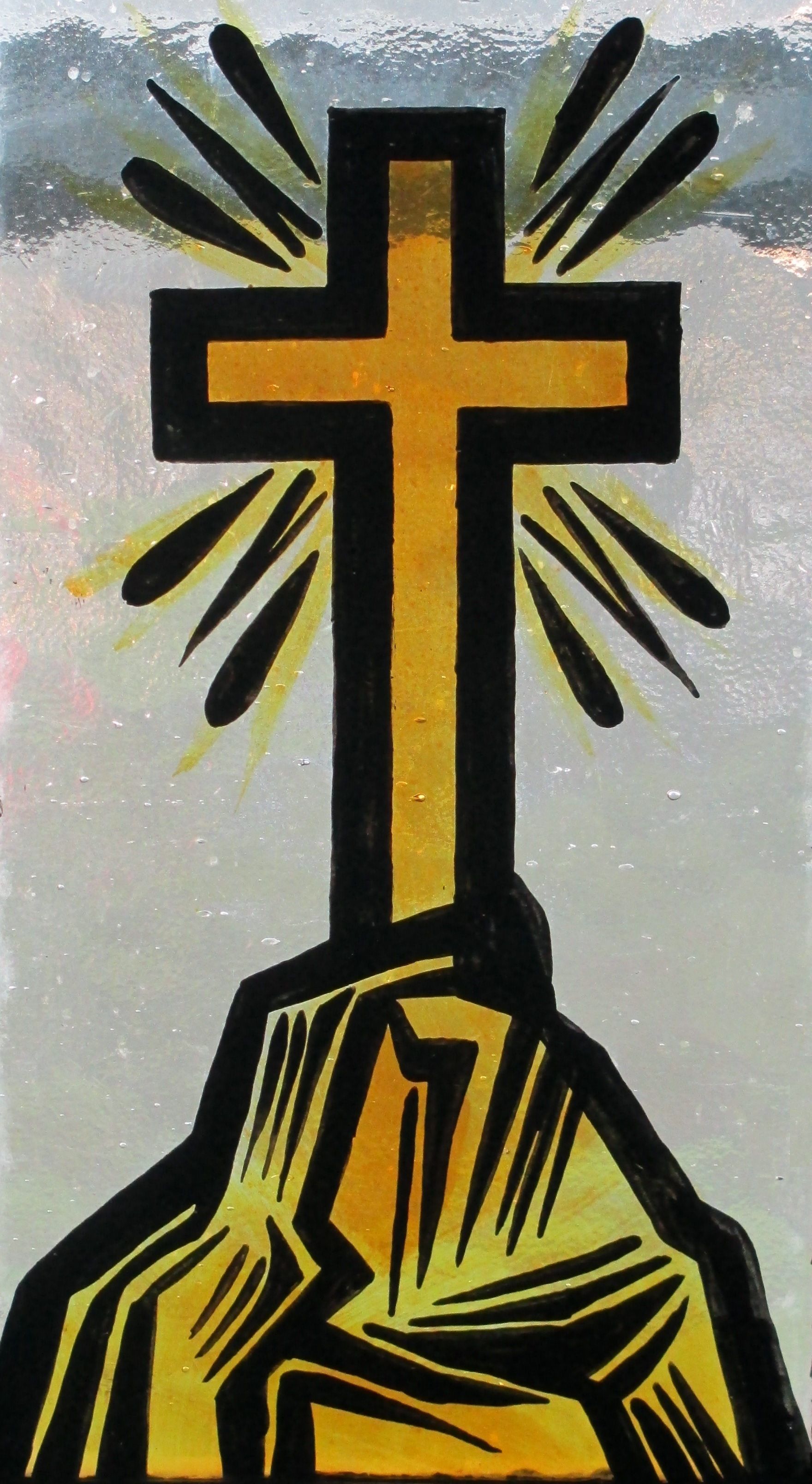
Mount Calvary's Cross - Sacred Heart Catholic Church -  Wauzeka WIA Symbol of the Source & Summit of the Christian Life

Jesus Christ’s sacrifice on Mount Calvary’s cross was offered in love of God and man. It is the source or fount for all saving grace, and the summit or pattern to which all Christians are called.

Refusing Signs — Monday, 6th Week of Ordinary Time—Year II

February 17, 2014

Readings: James 1:1-11, Mark 8:11-13

The Pharisees came forward and began to argue with Jesus, seeking from him a sign from heaven to test him. He sighed from the depth of his spirit and said, “Why does this generation seek a sign? Amen, I say to you, no sign will be given to this generation.

Yet, soon before this scene in Mark’s Gospel, Jesus took seven loaves and a few fish and miraculously fed about 4,000 people with them. That is a sign as surely as his resurrection will be, so how can Jesus say “no sign will be given to this generation”? Perhaps because there was no sign that his critics would accept.

The Pharisees sought “a sign from heaven.” If Jesus had performed some meteorological sign for them they may well have judged him as more evil than they had thought, in union with the demons of the air, just as they had condemned his manifest power to cast out demons. (Mark 3:21-30) They asked for proof but refused to accept evidence in his favor–they were of people of two minds, like St. James describes in the first reading:

But if any of you lacks wisdom, he should ask God who gives to all generously and ungrudgingly, and he will be given it. But he should ask in faith, not doubting, for the one who doubts is like a wave of the sea that is driven and tossed about by the wind. For that person must not suppose that he will receive anything from the Lord, since he is a man of two minds, unstable in all his ways.

Let us pray for those who do not believe; for the sincere, that they may be given sufficient evidence to change their minds, and for the obstinate, that their hardened hearts may be opened. And let us who believe in God (as even the Pharisees did) not cause Jesus to “[sigh] from the depth of his spirit.” Let us be trusting and docile in following him.

Stained Glass Symbols — The Dove

February 9, 2014

Holy Spirit Dove - Sacred Heart Catholic Church -  Wauzeka WIA Symbol of the Holy Spirit

From the Ark, at the time of the Flood, Noah released a dove three times to scout for land. The bird’s return with a fresh olive leaf in its beak signaled an end to the deadly judgment and the beginning of new life. Noah’s dove revealed that peace was restored between heaven and earth. When Jesus was baptized in the Jordan River by John the Baptist, they saw the Holy Spirit descend in bodily form, like a dove, and land upon Christ. By receiving Christ’s baptism, the Holy Spirit comes to rest on us, pouring into us the new life and graces of the Trinity.

Stained Glass Symbols — The Host & Chalice

February 8, 2014

Host and Chalice - Sacred Heart Catholic Church -  Wauzeka WIA Symbol of Christ’s Death

Jesus Christ is really and truly present in the Eucharist Host and chalice, yet the Host and chalice are symbolic as well. At the Last Supper, Jesus took bread, broke it, and said, “This is my body, which will be given up for you.” Then he took a chalice of wine and said, “This is the chalice of my blood… which will be poured out for you…” When a living creature’s blood is separated from its broken body, death naturally follows. Though Christ’s Body, Blood, Soul, and Divinity are fully present in every fragment of the Host and in every drop of the chalice, the symbolic separation of Jesus’ body and blood points to his sacrificial death.

Stained Glass Symbols — The Temple Menorah

February 6, 2014

Temple Menorah - Sacred Heart Catholic Church -  Wauzeka WIA Symbol of Christ

Menorah is the Hebrew word for “Candlestick.” You may be familiar with the nine-branched menorahs Jews employ to celebrate Hanukah, the “Festival of Lights,” however the menorah above features seven branches. This is the design God gave to Moses when commanding him to have a lampstand fashioned to stand within His tabernacle in the desert. (Exodus 25) Later, this pure gold lampstand lit the sanctuary of the Jewish Temple in Jerusalem. Christians see in the temple menorah a sign of Christ, the Light of the World, who is always in the Father’s presence.

It is from a story about the temple menorah that the feast of Hanukah comes. In the second century BC, the Greeks profaned the temple with pagan sacrifices and tried to force the Jews to abandon their faith. One family, called the Maccabees, rose up against their Greeks oppressors, defeated them, and rededicated the Jerusalem Temple in 165 BC. When those Jews relit the temple’s sanctuary lamp they could supply it with only one-day’s worth of olive oil and it would take a week to prepare more. Yet, the temple menorah kept miraculously burning for eight days until the new oil was ready. Rather than olive oil, Hanukah menorahs burn nine candles: one for each of the eight nights and one central candle from which the others are lit.

The “In Brief” Catechism On God “The Creator” (CCC #315-324)

September 6, 2013

● In the creation of the world and of man, God gave the first and universal witness to his almighty love and his wisdom, the first proclamation of the plan of his loving goodness, which finds its goal in the new creation in Christ.

●  Though the work of creation is attributed to the Father in particular, it is equally a truth of faith that the Father, Son and Holy Spirit together are the one, indivisible principle of creation.

●  God alone created the universe, freely, directly and without any help.

●  No creature has the infinite power necessary to “create” in the proper sense of the word, that is, to produce and give being to that which had in no way possessed it to call into existence “out of nothing.”

●  God created the world to show forth and communicate his glory. That his creatures should share in his truth, goodness and beauty—this is the glory for which God created them.

●  God created the universe and keeps it in existence by his Word, the Son “upholding the universe by his word of power” (Hebrews 1:3), and by his Creator Spirit, the giver of life.

●  Divine providence consists of the dispositions by which God guides all his creatures with wisdom and love to their ultimate end.

●  Christ invites us to filial trust in the providence of our heavenly Father, and St. Peter the apostle repeats: “Cast all your anxieties on him, for he cares about you.” (1st Peter 5:7)

●  Divine providence works also through the actions of creatures. To human beings God grants the ability to co-operate freely with his plans.

●  The fact that God permits physical and even moral evil is a mystery that God illuminates by his Son Jesus Christ who died and rose to vanquish evil. Faith gives us the certainty that God would not permit an evil if he did not cause a good to come from that very evil, by ways that we shall fully know only in eternal life.

The “In Brief” Catechism on the Revelation of God (CCC #68-73)

August 17, 2013

● By love, God has revealed himself and given himself to man. He has thus provided the definitive, superabundant answer to the questions that man asks himself about the meaning and purpose of his life.

●  God has revealed himself to man by gradually communicating his own mystery in deeds and in words.

●  Beyond the witness to himself that God gives in created things, he manifested himself to our first parents, spoke to them and, after the fall, promised them salvation (Genesis 3:15) and offered them his covenant.

●  God made an everlasting covenant with Noah and with all living beings (Genesis 9:16). It will remain in force as long as the world lasts.

●  God chose Abraham and made a covenant with him and his descendants. By the covenant God formed his people and revealed his law to them through Moses. Through the prophets, he prepared them to accept the salvation destined for all humanity.

● God has revealed himself fully by sending his own Son, in whom he has established his covenant forever. the Son is his Father’s definitive Word; so there will be no further Revelation after him.