The St. Wenceslaus parish bulletin (PDF) for the 20th Sunday in Ordinary Time on August 14th, 2016.
August 14th Parish Bulletin
August 9, 2016Our Pilgrimage to the Shrine
August 4, 2016
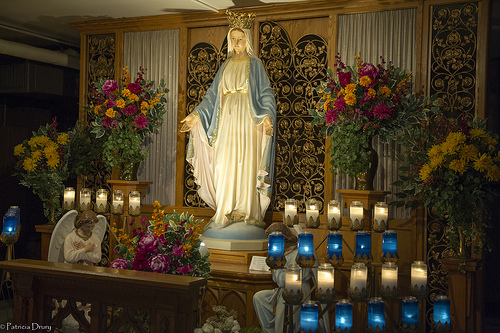
Register for our Tuesday, August 16th pilgrimage to The Shrine of Our Lady of Good Help outside of Green Bay. Our bus will depart from St. Wenceslaus’ parking lot at 7:30 AM and return there about 7:30 PM the same day. This pilgrimage is free, but you must mail (P.O. Box 109, Eastman WI 54626) or deliver a deposit to St. Wenceslaus to reserve your spots on the bus ($15 per person or $75 per family, whichever is less.) This check will be returned to you if and when you attend the pilgrimage. Required release forms for minors are available in the back of church or may be downloaded here. Remember to pack sack lunches. Please contact Father with any additional questions.
The Virgin Mary’s Wisconsin Apparition in 1859
August 4, 2016This account is according to Sister Pauline LaPlant, to whom the visionary, Adele Brise, often told her story:
She [Adele] was going to the grist mill about four miles from here [Champion] with a sack of wheat on her head […]. As Adele came near the place, she saw a lady all in white standing between two trees, one a maple, the other a hemlock. Adele was frightened and stood still. The vision slowly disappeared, leaving a white cloud after it. Adele continued on her errand and returned home without seeing anything more. She told her parents what had happened, and they wondered what it could be — maybe a poor soul who needed prayers?
On the following Sunday, she had to pass here again on her way to Mass at Bay Settlement, about eleven miles from her home […]. This time, she was not alone, but was accompanied by her sister Isabel and a neighbor woman [Mrs. Vander Niessen]. When they came near the trees, the same lady in white was at the place where Adele had seen her before. Adele was again frightened and said, almost in a tone of reproach, “Oh, there is that lady again.”

The Visionary, Adele Brise, 1831-1896
Adele had not the courage to go on. The other two did not see anything, but they could tell by Adele’s look that she was afraid. They thought, too, that it might be a poor soul that needed prayers. They waited a few minutes, and Adele told them it was gone. It had disappeared as the first time, and all she could see was a little mist or white cloud. After Mass, Adele went to confession and told her confessor how she had been frightened at the sight of a lady in white. He [Father William Verhoef] bade her not to fear, and to speak to him of this outside of the confessional. Father Verhoef told her that if it were a heavenly messenger, she would see it again, and it would not harm her, but to ask in God’s name who it was and what it desired of her. After that, Adele had more courage. She started home with her two companions, and a man who was clearing land for the Holy Cross Fathers at Bay Settlement accompanied them.
As they approached the hallowed spot, Adele could see the beautiful lady, clothed in dazzling white, with a yellow sash around her waist. Her dress fell to her feet in graceful folds. She had a crown of stars around her head, and her long, golden, wavy hair fell loosely around her shoulders. Such a heavenly light shone around her that Adele could hardly look back at her sweet face. Overcome by this heavenly light and the beauty of her amiable visitor, Adele fell on her knees.
“In God’s name, who are you and what do you want of me?” asked Adele, as she had been directed.
“I am the Queen of Heaven, who prays for the conversion of sinners, and I wish you to do the same. You received Holy Communion this morning, and that is well. But you must do more. Make a general confession, and offer Communion for the conversion of sinners. If they do not convert and do penance, my Son will be obliged to punish them.”
“Adele, who is it?” said one of the women. “O why can’t we see her as you do?” said another weeping.
“Kneel,” said Adele, “the Lady says she is the Queen of Heaven.” Our Blessed Lady turned, looked kindly at them, and said, “Blessed are they that believe without seeing. What are you doing here in idleness…while your companions are working in the vineyard of my Son?”
“What more can I do, dear Lady?” said Adele, weeping.
“Gather the children in this wild country and teach them what they should know for salvation.”
“But how shall I teach them who know so little myself?” replied Adele.
“Teach them,” replied her radiant visitor, “their catechism, how to sign themselves with the sign of the Cross, and how to approach the sacraments; that is what I wish you to do. Go and fear nothing. I will help you.”
The manifestation of Our Lady then lifted her hands, as though beseeching a blessing for those at her feet, and slowly vanished, leaving Adele overwhelmed and prostrate on the ground.
When the news spread about Adele Brise’s vision of the Blessed Virgin, most people believed the account and were astonished. Some considered the event a demented delusion. Adele Brise, however, considered it a commission to catechize the children and admonish the sinners of the Bay Settlement. To honor the alleged apparition, Adele’s father erected a makeshift chapel near the spot of Adele’s vision.
August 7th Parish Bulletin
August 4, 2016The St. Wenceslaus parish bulletin (PDF) for the 19th Sunday in Ordinary Time on August 7th, 2016.
Be Rich In What Matters — 18th Sunday of Ordinary Time—Year C
July 30, 2016The Parable of the Rich Fool by Rembrandt, 1627.
A large crowd surrounds Jesus as he preaches and teaches. During a brief pause, a man in the crowd says to Jesus, “Teacher, tell my brother to share the inheritance with me!” Presumably, his brother is there amongst them as well (otherwise how could Jesus reprove him?) Yet the Lord replies to the man, “Friend, who appointed me as your judge and arbitrator?” That seems like an odd response from Jesus. Is Jesus denying his own authority? On a different occasion, Jesus stated, “If I should judge, my judgment is valid, because I am not alone, but it is I and the Father who sent me.” Imagine if the man in the crowd had answered Jesus’ rhetorical question, “Friend, who appointed me as your judge and arbitrator?” The man might say, “Well Teacher, we think you’re God’s prophet, so you speak for God.”
To this, Jesus could reply, “Indeed, the words that I speak to you I do not speak on my own. But if you accept that I am God’s prophet, that I speak for God, then listen and heed all that I teach, not just the things you want to hear. On the last day, when I return in my glory with all the angels with me, I will sit upon my glorious throne with all peoples assembled before me and I shall judge and separate the righteous and the unrighteous, one from another, as a shepherd separates the sheep from the goats. Yet, my Father God did not send me into this world to condemn the world, but that the world might be saved through me.”
In our Gospel, Jesus goes on to tell the crowd (including those two feuding brothers): “Take care to guard against all greed, for though one may be rich, one’s life does not consist of possessions.” Jesus is warning the crowd, the brothers, and us that ‘personal bitterness and earthly greed will hinder you from entering the Kingdom.’ Rather, we must keep a heavenly perspective. As St. Paul urges in our second reading, “seek what is above, where Christ is seated at the right hand of God. Think of what is above, not of what is on earth.”
Of course, we all have material needs as human beings here on earth —we’re not angels and we need our daily bread. So Jesus teaches us to practice prudent stewardship, marked by frugality, generosity, and a trust in the Lord that frees us from worthless worrying. However, both Jesus in our Gospel and King Solomon in our first reading note the futility of amassing riches for ourselves.
Jesus tells a parable of “a rich man whose land produced a bountiful harvest. He asked himself, ‘What shall I do, for I do not have space to store my harvest?’” (Notice how “He asked himself, ‘What shall I do?” The man does not look beyond himself for holy wisdom or guidance.)
“And [then the rich man] said, ‘This is what I shall do: I shall tear down my barns and build larger ones.” (Why does he need to tear down his old barns? Does not the rich man, who just reaped a bountiful harvest, own plenty of land on which to build more barns? It seems his vanity desires to tear down the old barns so that his new barns may be huge and impressive.)
The rich man continues his conversation with himself, “[In my new barns] I shall store all my grain and other goods and I shall say to myself, ‘Now as for you, you have so many good things stored up for many years, rest, eat, drink, be merry!’” (He shows no thought for his family or friends, his neighbors or the needy, only his own personal pleasure.)
The rich man has made grand plans for himself, but God says to him, “You fool, this night your life will be demanded of you!” If this man is only interested in his own will, his own glory, and his own happiness in this life, then how will he love his neighbors, hallow God’s name, or desire God’s will in the next life?
To find ourselves at home in Heaven someday we should seek and follow God’s will for our time, talents, and treasure today. We should practice faithful stewardship, with prudence and trust, frugality and generosity. And this stewardship should include tithing and supporting worthy causes—not to buy Heaven (for God cannot be bribed or bought) but in order to become more virtuous and loving, to become more fit for Heaven. Those who store up treasure for themselves on earth profit nothing in the end. Let us not be foolish. Let us instead become rich in what matters to God by becoming more like Jesus, who has been so generous to us.
July 31st Parish Bulletin
July 27, 2016The St. Wenceslaus parish bulletin (PDF) for the 18th Sunday in Ordinary Time on July 31st, 2016.
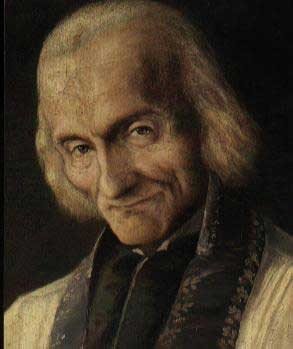
The Cure d’Ars on the Holy Mass
July 27, 2016
“All the good works in the world are not equal to the Holy Sacrifice of the Mass because they are the works of men; but the Mass is the work of God. Martyrdom is nothing in comparison for it is but the sacrifice of man to God; but the Mass is the sacrifice of God for man.”
“If we could comprehend all the good things contained in Holy Communion, nothing more would be wanting to content the heart of man. The miser would run no more after his treasures, or the ambitious after glory; each would shake off the dust of the earth, leave the world, and fly away towards heaven.”
—St. John Vianney
History’s Ten Wealthiest People and the Vanity of Riches
July 27, 2016In estimated billions of present-day dollars
- Cornelius Vanderbilt ($185, died 1877)
This railroad tycoon’s only large philanthropic gift gave about 1% of his fortune to build Vanderbilt University.
- Henry Ford ($199, died 1947)
This deceased automaker’s name survives on vehicles seen upon every road and junkyard.
- Muammar Gaddafi ($200, died 2011)
This dictator of Libya, after being discovered hiding in a desert culvert, was killed by his people.
- Jakob Fugger “the Rich” ($221, died 1525)
While he lived, this German merchant-financier declared, “The king reigns, but the bank rules!“
- William The Conqueror ($229, died 1087)
After killing many to capture England, this Duke of Normandy, France joined the dead.
- Mir Osman Ali Khan ($230, died 1967)
As head of the state of Hyderabad, India, he used a 185-carat diamond as a paperweight.
- Czar Nikolas II ($300, died 1918)
This Russian ruler was assassinated along with his family by communist revolutionaries.
- Andrew Carnegie ($310, died 1919)
This steel magnate and philanthropist said, “The man who dies rich dies disgraced.”
- John D. Rockefeller ($340, died 1937)
He sold oil drawn from Ohio’s earth and now lays buried in the same.
- Mansa Musa I ($400, died 1337)
This African king of Mali was the richest man to ever live. But have you ever heard of him?
Psalm 49:7-12 :
“No man can buy his own ransom, or pay a price to God for his life. The ransom of his soul is beyond him. He cannot buy life without end, nor avoid coming to the grave. He knows that wise men and fools must both perish and must leave their wealth to others. Their graves are their homes for ever, their dwelling place from age to age, though their names spread wide through the land. In his riches, man lacks wisdom; he is like the beasts that are destroyed.”
Abraham’s Intercessions for Sodom & Gomorrah
July 23, 2016A Mathematical Analysis of Genesis 18:22-33
Conversation
|
Bid # for Innocents |
# Decrease |
% Decrease |
Factional Decrease |
|
1st |
50 |
– |
– | – |
|
2nd |
45 |
5 |
10% | 1/10 |
|
3rd |
40 |
10 |
11.111% | 1/9 |
|
4th |
30 |
10 |
25% | 1/4 |
|
5th |
20 |
10 |
33.333% | 1/3 |
|
6th |
10 |
10 |
50% | 1/2 |
Holymon Go!
July 22, 2016Can you catch sight of each of the following persons or things depicted in the interior of St. Wenceslaus Church?
- Our single depiction of St. John the Baptist.
- The two appearances of St. Joseph.
- The Holy Spirit twice in the form of a dove.
- The two depictions of the devil as a serpent.
- How many halos are surrounding holy heads?
- How many depictions of St. Mary are here?
- How many angels do we have?
- How many images of Jesus are in our church?
Holymon Go! Answers
(Highlight to reveal):
His statue appears atop our Baptistery.- His statue and in a stained-glass window.
- He has this likeness in two of our windows.
- Under Mary’s feet; in a window and a statue.
- Our stained-glass windows depict twenty-four halos.
- Ten. (5 in windows, 4 in stations, and 1 statue, not including her Immaculate Heart window.)
- Six. (4 tabernacle statues and 2 in windows.)
- Twenty-three. (14 stations, 5 windows, 2 statues, and 2 crucifixes, not including sanctuary images of his Sacred Heart or the Eucharist.)
“A Man Who Lives His Ideas”
July 22, 2016This profile of Msgr. Urban Baer was written by Fr. Ed Bertz for the La Crosse Diocese’s Catholic Times-Review sometime between 1963 and 1967.
Though he had stood in the same sanctuary every Sunday for the past 15 years, it was different this time. He was speaking to his flock for the last time. “By golly, I want to thank all you wonderful people for your cooperation.” His legs felt weak. He clutched the pulpit tighter. Monsignor Urban Baer, pastor of St. Wenceslaus parish in Eastman, continued. “We have seen bad times and good times together. But God has been good to us.” The vigor of 15 years ago was gone — “My ‘ticker’ isn’t what it used to be” — but never had the congregation listened so closely. “You could hear a pin drop,” someone said. Even though the word had gone around that “Monsignor was going to retire,” no one wanted to accept that fact that the “priest who never said an unkind word to anyone” was going to leave them.
Early Life
He was born on December 8, 1903, in Marshfield, son of Peter and Mary Baer. He loved to romp and play with his five brothers and one sister but he felt God was calling him to the priesthood, and left St. John’s grade school for St. Lawrence Seminary in Mt. Calvary (Wis.) after the eighth grade. Seven years later, he entered Kenrick Seminary in St. Louis for his four-year theological studies and was ordained on June 9, 1929, by the famous Archbishop John Glennon (later a cardinal.) His first assignment was as assistant pastor at Holy Rosary parish, Darlington. One year later he became assistant at Sacred Heart parish in Eau Claire.
Lasting Effect
Then came an assignment that was to have a lasting effect on Father Baer’s ministry. He was named pastor of St. John the Baptist parish in Wuerzburg and its mission, St. Thomas in Milan, just as the stock market crash of 1929 was having its effect on the rural economy. It was the beginning of a rash of farm foreclosures. “Farmers just didn’t know where to turn.” Father Baer didn’t throw up his arms in despair. Remembering the words of Archbishop Ireland of St. Paul — “The priest’s place is also in the world if the world is to be won for Christ.” — he decided to do something. He studied the farm problem and sought advice from a priest who was doing something about rural economy “long before me.” Father Joseph Steinhauser was “dean of Catholic Rural life leaders,” Monsignor Baer says, adding that “I was only a young whippersnapper, cutting my eye teeth at that time.” A fast and true friendship grew between the two priests and still exists today
Farm Problems
But what can two priests do for such a complex problem with a multitude of causes? They did a lot. First of all, the farm foreclosures had to be stopped. Monsignor Baer promoted cooperatives and credit unions. Gradually the tide began to turn even though the two priests came under heavy fire because some thought their remedy too socialistic. Secondly, they preached and they wrote on the Christian principles involved in the farm movement. What Christian principles? “The land is man’s greatest material (that word is important) gift from God.” They reminded farmers of the responsibility of Christian stewardship of the soil and the Christian dignity of a farmer’s calling. These two things have tremendous ramifications. Finally, they promoted the family-size farm.
Monsignor believes that though farmers are leaving the land at an alarming rate and existing farms growing larger, the family-size farm is not a lost cause even today. “There will always be the family-size farm. Lord, save us if we don’t.” He expressed dismay at what he calls “factories in the field” — large farm corporations.
[The eight paragraphs omitted here may be read from the original article, posted in a frame in our parish hall along with other articles about Msgr. Baer.]
Then in August of 1950, [Father Baer] was appointed pastor at Eastman. Among the myriad achievements here was the construction of one of the first catechetical centers in the diocese. He was named a diocesan consulter in 1953. Pope Pius XII named him a domestic prelate [monsignor] in 1956.
He still thinks about that Sunday he said goodbye to his flock at Eastman. He’s only 12 miles away, now, living in a small house (1206 South 6th St.) in Prairie du Chien which sprawls along the Mississippi River just “down the hill” from Eastman. But the grey, balding man with “the world’s most affable disposition” hardly has time for daydreams or nostalgic reveries. He’s up early enough to celebrate Mass at 8 a.m. in a beautiful but tiny chapel. By special privilege of the bishop, he may sit down and rest at times during Mass, as the early sun floods through the east window. His day is an active one.
Besides talking to a steady stream of visitors and answering correspondence, he is gathering materials for still another book. “Good gravy, I’ve almost got all of the material for it already.” What’s the book going to be about? “The priest and his role in the community,” Monsignor answers in serious tone. “The priest must be active not only among his own parishioners but with the whole community. He must be concerned for the economic as well as the spiritual welfare of the people. He has to help lead the communities in all ways.” There’s no hollow ring to these thoughts coming from Msgr. Urban Baer, a man who lives his ideals!
July 24th Parish Bulletin
July 22, 2016The St. Wenceslaus parish bulletin (PDF) for the 17th Sunday in Ordinary Time on July 24th, 2016.
July 17th Parish Bulletin
July 16, 2016The St. Wenceslaus parish bulletin (PDF) for the 16th Sunday in Ordinary Time on July 17th, 2016.
Temptation Traps
July 16, 2016We human beings are creatures of habit. For better or worse, we find it easier to think and act in the ways that we are accustomed to. Without self-awareness, it can feel natural to follow established modes of thinking into sinful action. However, once we examine and challenge these temptations we can recognize them as the distortions of truth and reality that they are. Then, with God’s ever-present grace, we can choose and act to reject them.
We experience temptations as the thoughts, feelings, and desires that, if not resisted, would lead us away from God’s will and our greatest human fulfillment. And from where do our temptations flow? They come, as the classic saying goes, from “the World, the Flesh, and the Devil.” The World, our culture and the people around us, can suggest sinful paths. Likewise our Flesh, our passions and psychological wounds, can give rise to temptation. Finally, the Devil, with the fallen angels allied with him, can prompt ideas and moods within us in order to lead us towards sin. If we are to resist temptations we must first detect them amidst our thoughts, feelings, and desires.
The distorted thinking of our temptations comes to us in many forms. Do you fall for any of these common temptation traps? Study these and enter your next battle prepared, forewarned and forearmed!
Overgeneralization reaches a general conclusion based upon a single incident or piece of evidence:
“I just got dumped. I’ll never find love!”
“God didn’t grant my prayer. He doesn’t care.”
“I never hire those people, one stole from me once.”
All-or-Nothing Thinking has no tolerance or mercy for imperfection in ourselves or others:
“I broke my Lenten penance, so I’ve given it up.”
“I sinned, so my hours of resisting mean nothing.”
“I’ve never spoken to him since he was rude to me.”
Mental Filtering focuses on a situation’s negative details while dismissing all of the positive aspects:
“Yes, Son, but what about this B- in Science?”
“When I look back on my day, all I see are sins.”
“They said they liked it, but what she said irks me.”
Labeling generalizes from a couple of traits or events to declare a universal negative judgment:
“I need to lose some weight. I’m ugly.”
“I never do anything right; I’m worthless.”
“I’m taking more naps as I get older. I’m so lazy.”
Mind Reading presumes to know (without asking) how others feel or why they act as they do:
“I know I promised, but the kids won’t mind.”
“He’s late. He must not care about this team.”
“Her eyes are closed. She’s not listening to me.”
Magnifying exaggerates the significance of problems or events:
“I’ll never finish this paper by next week!”
“I did bad things in a dream. I’m so ashamed.”
“I prayed an hour, but I kept getting distracted!”
Minimizing downplays serious concerns to insignificance:
“A little peek at this website is no big deal.”
“This habit is a venial sin, so it’s OK if I do it.”
“Why are you complaining? My drinking is fine.”
Catastrophizing assumes the worst about the present and the future:
“What if I lose my job, get sick, and die?”
“I’ll never conquer this sin—why even try?”
“He’s moody tonight. Is our marriage in trouble?”
Personalization believes everything that happens is caused by, or is a reaction to, oneself:
“I jinxed the team, I didn’t wear my hat.”
“This happened because God is punishing me.”
“I saw my two friends; why didn’t they invite me?”
False Shoulds condemn us for weaknesses or choices that are not actually sins:
“I should always keep my family happy.”
“I sinned by missing Mass when I had the flu.”
“It still hurts, so I must not be forgiving them.”
Emotional Reasoning concludes that how we presently feel must be the true reflection of reality:
“I feel so sad, I must be failing.”
“This feels so good, how could it be wrong?”
“I feel guilty; God must be unhappy with me.”
If this topic interests you, check out Cognitive Behavior Therapy and “cognitive distortions.” CBT is the most widely-used technique for the treatment of many psychological issues (such as depression and anxiety) and is proven to be often effective.
Scripture Passages for Judges
July 11, 2016Today, Wisconsin Governor Scott Walker appointed my father, Charles V. Feltes, as the new Circuit Court Judge of Trempealeau County. Judge Feltes will be sworn in this August. If he wins election in April 2017, he will serve a six year term. Our family is very proud and I offer him these timeless passages from Sacred Scripture containing wisdom for judges:
Deuteronomy 1:17
In rendering judgment, do not consider who a person is; give ear to the lowly and to the great alike, fearing no one, for the judgment is God’s.
Leviticus 19:15
You shall not act dishonestly in rendering judgment. Show neither partiality to the weak nor deference to the mighty, but judge your neighbor justly.
You shall not favor the poor in a lawsuit.
Exodus 23:6
You shall not pervert justice for the needy among you in a lawsuit.
Exodus 23:7
You shall keep away from anything dishonest.
Exodus 23:8
Never take a bribe, for a bribe blinds the clear-sighted and distorts the words of the just.
Exodus 23:2
You shall not follow the crowd in doing wrong… you shall not follow the crowd in perverting justice.
1st Kings 3:4-15
The king went to Gibeon to sacrifice there, because that was the great high place. Upon its altar Solomon sacrificed a thousand burnt offerings. In Gibeon the LORD appeared to Solomon in a dream at night. God said: Whatever you ask I shall give you. Solomon answered: “You have shown great kindness to your servant, David my father, because he walked before you with fidelity, justice, and an upright heart; and you have continued this great kindness toward him today, giving him a son to sit upon his throne. Now, LORD, my God, you have made me, your servant, king to succeed David my father; but I am a mere youth, not knowing at all how to act—I, your servant, among the people you have chosen, a people so vast that it cannot be numbered or counted. Give your servant, therefore, a listening heart to judge your people and to distinguish between good and evil. For who is able to give judgment for this vast people of yours?”
The Lord was pleased by Solomon’s request. So God said to him: “Because you asked for this—you did not ask for a long life for yourself, nor for riches, nor for the life of your enemies—but you asked for discernment to know what is right—I now do as you request. I give you a heart so wise and discerning that there has never been anyone like you until now, nor after you will there be anyone to equal you. In addition, I give you what you have not asked for: I give you such riches and glory that among kings there will be no one like you all your days. And if you walk in my ways, keeping my statutes and commandments, as David your father did, I will give you a long life.” Solomon awoke; it was a dream! He went to Jerusalem, stood before the ark of the covenant of the Lord, sacrificed burnt offerings and communion offerings, and gave a feast for all his servants.