Please enjoy, and freely Like and Share this video.
My special thanks goes to Mary Walker for lending her voice to this project.
Please enjoy, and freely Like and Share this video.
My special thanks goes to Mary Walker for lending her voice to this project.
The St. Wenceslaus parish bulletin (PDF) for the 3rd Sunday in Ordinary Time on January 22nd, 2017.
The U.S. Constitution establishes that the president, “Before he enter on the Execution of his Office, he shall take the following Oath or Affirmation: —“I do solemnly swear (or affirm) that I will faithfully execute the Office of President of the United States, and will to the best of my Ability, preserve, protect and defend the Constitution of the United States.”
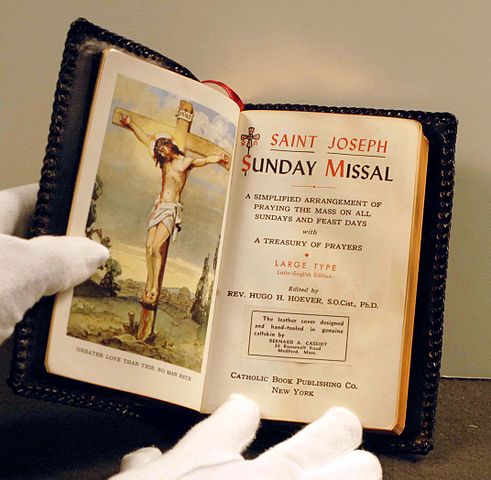
The Kennedy Catholic missal used for Johnson’s inauguration on November 22, 1963.
Typically, presidents-elect take their oaths upon open or closed Bibles — sometimes two or three stacked one atop another under the oath-taker’s hand — but there have been exceptions to this custom. John Quincy Adams (1825) and Franklin Pierce (1853) used law books, while John F. Kennedy’s Catholic missal was found on a side table in Air Force One’s presidential bedroom for the mid-flight swearing-in of Lyndon Johnson in 1963.
History has often recorded the verses to which the presidents’ Bibles were opened. In 1789, George Washington’s Bible was opened “at random, due to haste” to Genesis 49:13. (“Zebulun shall dwell at the haven of the sea; and he shall be for an haven of ships; and his border shall be unto Zidon.”) However, most presidents have intentionally selected their passages.
William McKinley (1897) and William Taft (1909) chose separate accounts of one Old Testament quote. Young King Solomon, invited by the Lord to request a wish, asks for wisdom to lead God’s vast people and it is abundantly granted him. (2nd Chronicles 1:10, 1st Kings 3:9-11)
Hebert Hoover’s (1929) verse, Proverbs 29:18, notes the importance of right purpose: “Where there is no vision, the people perish: but he that keepeth the law, happy is he.”
Franklin Delano Roosevelt selected 1st Corinthians 13’s teaching on love for all four of his inaugurals (1933, ’37, ’41, ‘45): “And now abideth faith, hope, charity, these three; but the greatest of these is charity.”
Dwight Eisenhower’s (1957) verse, Psalm 33:12, acknowledges our shared dependence on God for our blessedness, “Blessed is the nation whose God is the Lord; and the people whom he hath chosen for his own inheritance.”
Jimmy Carter (1977) and Warren Harding (1921) chose Micah 6:8: “…What doth the Lord require of thee, but to do justly, and to love mercy, and to walk humbly with thy God?”
Ronald Reagan (1981 & 1985) twice-chose 2nd Chronicles 7:14, where the Lord invites conversion to gain His blessings: “If my people… shall humble themselves, and pray, and seek my face, and turn from their wicked ways then will I hear from heaven, and will forgive their sin, and will heal their land.”
We, like all people, must beware of idolizing our presidents and other earthly leaders. (Even among popes only around 30% have been canonized and none of them have been sinless.) But we do well always to ask God’s grace for our leaders and for his blessings on the times in which we live.
For other presidential inaugural oaths’ Scripture passages, check out this list.

Catechism of the Catholic Church #1275-1284
 Christian initiation is accomplished by three sacraments together: Baptism which is the beginning of new life; Confirmation which is its strengthening; and the Eucharist which nourishes the disciple with Christ’s Body and Blood for his transformation in Christ.
Reflections on John 1:43-51
 In the early days of his public ministry, Jesus decided to go to Galilee. There he found his future apostle Philip and says to him, “Follow me.” Philip, from the same town along the northern coast of Galilee as Peter and Andrew, was so awed at encountering Jesus that he tracked down his friend Nathanael (also known as Bartholomew.) Philip told him, “We have found the one about whom Moses wrote in the law, and also the prophets, Jesus, son of Joseph, from Nazareth!” (Philip is sharing happy news, “We’ve found the promised Messiah, the Christ, and he’s not too far from here!”) But Nathanael is unimpressed and unconvinced, saying, “Can anything good come from Nazareth?” Philip winsomely replies, “Come and see.“
When Jesus sees Nathanael coming toward him he says of him, “Here is a true child of Israel. There is no duplicity in him.” Nathanael asks, “How do you know me?” Jesus answers, “Before Philip called you, I saw you under the fig tree.” Nathanael declares, “Rabbi, you are the Son of God; you are the King of Israel!” Jesus replies to him, “Do you believe because I told you that I saw you under the fig tree? You will see greater things than this.” Jesus tells him, “Amen, amen, I say to you, you will see the sky opened and the angels of God ascending and descending on the Son of Man.”
Why did Nathanael’s opinion about Jesus, that man from Nazareth, change so suddenly? Perhaps Nathanael was sitting under a particular fig tree when Philip found him and Nathanael, believing that there was no natural way Jesus could have known or guessed this, was instantly persuaded. Another explanation is that Jesus is referring to a memorable dream Nathanael has recently had. It’s strange that Jesus would describe an honest man as a son of Israel—that is, as a son of Jacob—whose duplicitous deeds are detailed in Genesis. But recall how Jacob once had a dream in which he saw the angels of God ascending and descending a stairway to Heaven while the Lord God stood beside him. (Genesis 28:10-19) Jesus alludes to that event in this encounter. Now if a stranger were to tell me about a conversation I thought no one else had witnessed, I’d be intrigued; but if someone were to accurately describe my dream from the night before, that person would have my full attention. Whatever the reason behind Nathanael’s change of heart it was the style of Philip and Jesus’ approaches that made it possible.
The Gospels show us through numerous episodes how the apostles started off as far from perfect. When told that Jesus was from Nazareth, Nathanael replies, “Can anything good come from Nazareth?” This story presents Nathanael’s prejudice and how that bias nearly made him reject the Christ out of hand. What did Nathanael hold against those Nazarenes living some thirty miles away? Did he think them unfriendly, lazy, unrefined, impious, unscrupulous? Whatever the reason, he looked down on them and it showed.
Nathanael’s rash dismissal of the Nazarene maligns someone Philip regards as a great and holy man. Yet Philip does respond in anger. Instead, he urges Nathanael to learn more. “Come and see.” Nathanael is persuaded by his friend to give this Jesus guy a chance—a fair hearing—and this modest openness eventually leads to him being won over. Still today, one of the best means for dissolving prejudices of every sort is through experiencing “the Other” firsthand.
As Jesus sees Nathanael approaching he demonstrates a penetrating supernatural knowledge of him. Jesus probably knew what Nathanael had previously remarked in secret but Jesus does not reproach or condemn him for it. Instead, Jesus compliments what is good in Nathanael: “Here is a true child of Israel. There is no duplicity in him.” Though they do not yet see eye-to-eye, Jesus affirms his sincerity. This opens a door to dialogue that not only changes Nathanael’s mind but his entire life, as he goes on to become an apostle for Christ.
We could imagine a pricklier Philip or a different Jesus rejecting and condemning Nathanael for his initial disrespect toward the Christ of God; however, we see both practice tolerance toward him. Christians are commonly caricatured as easily offended but I have found that the more faithful variety show extensive mercy—which is very different than indifference. We are called to loathe error, but to love everyone. True tolerance does not hate others for holding wrong beliefs but loves them while trying to lead them to the truth.
It would be an oversimplification to say that forceful confrontation is never called for. Jesus occasionally denounced others, like “that fox” King Herod, the hypocritical Pharisees, and the evil spirits. Sometimes Jesus manifested his displeasure through bold prophetic acts, like flipping money-tables at the Temple or cursing the fig tree. Yet Jesus possessed perfect wisdom and a clear vision into others’ hearts. “Jesus knew their thoughts” and “did not need anyone to testify about human nature.” (Luke 5:22, John 2:25) We, however, must guard ourselves to be “slow to wrath,” for apart from the Holy Spirit’s prompting, “the wrath of a man does not accomplish the righteousness of God.” (James 1:19-20)
In this era of division, let us promote unity in advocating for the truth. In our disagreements with friends or strangers, online or face to face, let us shun anger, sarcasm, and revilement and presume the other’s good faith and sincerity. This manner of winsome mercy won Nathanael’s mind and heart for Christ and it can be just as powerful today.
The St. Wenceslaus parish bulletin for the 2nd Sunday in Ordinary Time on January 15th, 2017.
The St. Wenceslaus parish bulletin for Epiphany on January 8th, 2017.
I have not seen and cannot recommend the recently-released Martin Scorsese film Silence, but reviewers describe it as haunting and unsettling for believers and non-believers alike. It is set in Japan during a fierce persecution of Roman Catholics in the mid-1600’s. In one scene, a Jesuit missionary is forced to watch arrested Japanese Christians be cruelly tortured before him. The young priest is told that these men and women’s sufferings will cease if he would only step on an image of Christ and renounce his faith. What does Jesus want his followers to do if faced with such a choice?
A person might think there is little harm done in trampling the crude likeness of someone, or by insincerely mouthing a few words, but Jesus told his disciples, “Everyone who acknowledges me before others I will acknowledge before my heavenly Father. But whoever denies me before others, I will deny before my heavenly Father.” (1) At the very start of his ministry it seems that Jesus himself was confronted with the film’s test; the temptation to deny God so that human suffering would end.
After his baptism, Jesus was led by the Spirit into the desert to be tempted by the devil. He fasted for forty days and forty nights, and afterwards he was hungry. The tempter approached and said to him, “If you are the Son of God, command that these stones become loaves of bread.” (2) But Jesus firmly refused.  What was so wicked about the devil’s suggestion? What could be wrong with alleviating hunger? Imagine if Jesus had relented, waving his hand over a nearby brown stone and then biting through its soft crust. Then the devil could accuse him, “So, you have provided food for yourself—how can you now refuse to wield your power to feed the whole world!?” Satan also pressured Jesus to insist that the Father spare him from death: “If you are the Son of God, throw yourself down [from this great height]…” But Jesus again refused. The tempter preferred Jesus to be a messiah who would give people an abundance of material wealth and safety while leaving them in their sins, separated from God forever.
Then the devil took him up to a very high mountain, and showed him all the kingdoms of the world in their magnificence, and he said to him, “All these I shall give to you, if you will prostrate yourself and worship me.” At this, Jesus said to him, “Get away, Satan! It is written: ‘The Lord, your God, shall you worship and him alone shall you serve.’” Jesus accepted suffering with and alongside us as a crucified savior-king and never surrendered to the temptation of becoming an earthly ruler who had denied God and bowed to Satan. Jesus Christ understood that he would be Isaiah’s “Suffering Servant” and “the Lamb of God who takes away the sins of the world” as St. John the Baptist proclaimed him. (3) Even as his desert tempter invited him to end all earthly hardship, Jesus in some sense foresaw the multitude of suffering martyrs who would follow his path after him. Jesus did not waiver. Jesus refused to capitulate to evil for this world’s fleeting, lesser goods because was not the will of God, his Father.
These reflections came to mind last week on the December 28th Feast of the Holy Innocents, those little ones who died in place of Jesus Christ. When Herod realized that he had been deceived by the magi, he became furious. He ordered the massacre of all the boys in Bethlehem and its vicinity two years old and under, in accordance with the time he had ascertained from the magi. (4) Modern biblical scholars estimate Bethlehem’s population was around 1,000 at that time, which means that up to about twenty infants were slain. (5)
These babies and toddlers have been venerated in the Church since the first century. Early Church Fathers, including St. Irenaeus of Lyon and St. Augustine, and the liturgical tradition of the Church have celebrated them as saints and martyrs. (6) This pair of titles is remarkable for those “who, though still unable to profess [Jesus] in speech, were crowned with heavenly grace on account of his birth.” (7) None of these young Jewish boys were baptized or made a conscious decision to die for Jesus, but they were all saved through Christ.
Jesus spoke of the importance of baptism for salvation, for instance saying, “Whoever believes and is baptized will be saved.” (8) Yet he also said, “Let the children come to me, and do not prevent them; for the Kingdom of Heaven belongs to such as these.” (9) The Church, lacking an explicit teaching from Christ about children who die unbaptized, “can only entrust them to the [great] mercy of God, as she does in her funeral rites for them.” (10) Perhaps the Lord, knowing his own provisions for their salvation, has kept us in our uncertainty lest we employ the twisted logic of Herod, Pharaoh, or Pilate to rationalize the intentional killing of little ones. In any case, it has been the firm conviction and long tradition of Christ’s Catholic Church that the Holy Innocents of Bethlehem now dwell with him in Heaven.
Jesus Christ and his martyrs, from Bethlehem to Japan, reveal and witness to strengthening truths: That this life, however long or short, is not all that there is. That God can bring salvation out of evil, even from crimes and disasters that break our hearts and surpass our understanding. And the martyrs affirm that, as Charles Spurgeon said, “Suffering is better than sinning. There is more evil in a drop of sin than in an ocean of affliction. Better [to] burn for Christ, than [to] turn from Christ.” Whatever terrible crosses may afflict us or those we love we can remember that our crucified Lord has suffered likewise and is always with us. Jesus tells us, “In the world you will have trouble, but take courage, I have conquered the world.” (11)

A memorial to “The Twenty-Six Martyrs of Japan,” a group of Roman Catholics executed by crucifixion on February 5, 1597 at Nagasaki. Their feast day (i.e., St. Paul Miki and companions) is February 6th.
Footnotes:
(1) – Matthew 10:32.
(2) – Matthew 4:1-11.
(3) – Isaiah 52:13-53:12, John 1:29 & 1:36.
(4) – Matthew 2:16.
(5) – Raymond E. Brown, The Birth of the Messiah, pp.104–121.
Donald A. Hagner, World Biblical Commentary, Matthew 1–13, pg.37.
“Holy Innocents” entry in the Catholic Encyclopedia.
(6) – Hugo H. Hoever, Lives of the Saints, pg.525.
(7) – Opening Mass Prayer for The Feast of the Holy Innocents.
(8) – Mark 16:16.
(9) – Matthew 19:14.
(10) – Catechism of the Catholic Church, #1261.
(11) – John 16:33.
The St. Wenceslaus parish bulletin (PDF) for Christmas on January 1st, 2017.
 Highlight to Reveal the Answers
(((A: Gabriel))) B: Michael
(((A: Luke))) B: Matthew
A: Jesus (((B: Mary)))
A: Bethlehem (((B: Nazareth)))
A: Christmas Trees (((B: Babies)))
A: Jesus Christ (((B: John the Baptist)))
(((A: Luke))) B: Matthew
(((A: 2,017 Years))) B: 3,300 Years
(((A: Feed Box))) B: Stable
A: St. Augustine (((B: St. Francis of Assisi)))
A: Luke (((B: Matthew)))
(((A: The East))) B: The West
(((A: Bishop in Turkey))) B: Norwegian Martyr
(((A: Baptism of the Lord))) B: Epiphany
So how did you do?
The St. Wenceslaus parish bulletin (PDF) for Christmas on December 25th, 2016.
The St. Wenceslaus parish bulletin (PDF) for the 4th Sunday of Advent on December 18th, 2016.
The St. Wenceslaus parish bulletin (PDF) for the 3rd Sunday of Advent on December 11th, 2016.
The St. Wenceslaus parish bulletin (PDF) for the 2nd Sunday of Advent on December 4th, 2016.
Readings: Isaiah 11, Luke 10
While recently visiting the Sea of Galilee in Israel I saw something in the skies I had never seen before. There were miles-wide concentric cloud rings with the occasional sound of long, rolling, man-made thunder. Though these things were interesting to behold, I hated the reason behind why they needed to be there. Northern Israel borders Syria and these high-altitude contrails and jet-engine sounds were from the Israeli Air Force’s U.S.-made F-15’s or F-16’s on defensive air patrols to ensure their neighbor’s civil war did not spill over into their own country.
The coastline of the Sea of Galilee is beautiful, peaceful, and prosperous. We were able to celebrate a Mass in an outside chapel near the site where Jesus appeared to his disciples after his resurrection and had breakfast with his disciples (as recorded in John 21.) But while we were free to tour and worship without threat or fear, the people of Aleppo, Syria were under siege just 250 miles north. There the Russian bear and the Syrian wolf are allied against the ISIS serpent in a battle for the right to rule over the suffering lambs and little children caught in the middle. The prophet Isaiah’s poetic vision of the radical peace the Messiah (or Christ) would someday establish has not yet fully come:
“Then the wolf shall be a guest of the lamb,
and the leopard shall lie down with the kid;
The calf and the young lion shall browse together, with a little child to guide them.
The cow and the bear shall be neighbors,
together their young shall rest;
the lion shall eat hay like the ox.
The baby shall play by the cobra’s den,
and the child lay his hand on the adder’s lair.
There shall be no harm or ruin on all my holy mountain; for the earth shall be filled with knowledge of the LORD, as water covers the sea.” (Isaiah 11:4-9)
 On one occasion, turning to the disciples in private, Jesus said, “Blessed are the eyes that see what you see. For I say to you, many prophets and kings desired to see what you see, but did not see it, and to hear what you hear, but did not hear it.” (Luke 10:23-24) Many great Old Testament figures longed for the promised Messiah but died before his coming. We are blessed to live in an age which has seen his arrival and blessed to have heard his message. Yet further blessed are we if we pray and prepare the path for the New Creation Christ promises to bring.
Along the sea of Galilee, it is possible to give no thought to the suffering and death happening not so far away. Likewise, in our beautiful, peaceful, prosperous country it is possible to ignore that there are grave evils in our midst, happening just out of sight. But blessed are we if we choose to long and labor for the life of the New Heavens and New Earth.
“Blessed are they who mourn,
for they will be comforted.
…Blessed are they who hunger and thirst
for righteousness, for they will be satisfied.
…Blessed are the peacemakers,
for they will be called children of God.
…Blessed are they who are persecuted for
the sake of righteousness, for theirs is the
kingdom of heaven.” (Matthew 5)

