The St. Wenceslaus parish bulletin for Easter, March 27th, 2016.
March 27th Parish Bulletin
March 24, 2016March 20th Parish Bulletin
March 24, 2016The St. Wenceslaus parish bulletin for Palm Sunday, March 20th, 2016.
Reflections on the Passion in Luke
March 18, 2016 At the Last Supper, Jesus says he has “eagerly desired to eat this Passover with you before I suffer…” Jesus did not allow stress to prevent him from enjoying the people and good things in his life. Do I experience joy at Holy Mass? Do I eagerly desire it?

- Taking a cup, Jesus says, “I shall not drink of the fruit of the vine until the kingdom of God comes.” The next time Jesus drinks wine is on his cross; so God’s kingdom has begun on earth. Despite my trials, what good things am I looking forward to?
- An argument breaks out among the apostles about which of them should be regarded as the greatest. Justifying ourselves through comparisons with others undermines our personal growth. Instead, Jesus commends imitating him as a servant to all.
- To save Jerusalem, David tearfully fled the city by way of the Mount of Olives to escape his traitorous son, Absalom. Jesus also retreats there but resolves not to elude his betrayer and escape his death so that he might save us all.
- Jesus is in such agony, praying so fervently in the garden, that his sweat becomes as drops of blood falling on the ground. This describes Hematidrosis, which has been observed in rare modern cases of people undergoing acute fear and intense mental contemplation. While I seek relief, do I offer my physical and emotional sufferings as a sacrifice?
- He approaches Jesus to kiss him and Jesus asks, “Judas, are you betraying the Son of Man with a kiss?” Does my familiar intimacy with holy things lead me to hold them cheaply?
- Jesus’ disciples realize what is about to happen and ask, “Lord, shall we strike with a sword?” However, they act before he can reply. Do I discern prayerfully and wait patiently for the Lord’s direction?
- One of the disciples (St. Peter) strike the high priest’s servant (Malchus) and cut off his right ear. Jesus exclaims, “Stop, no more of this!” He touches the servant’s ear and heals him. Those without faith in Jesus cannot be converted by violence, that cuts off their ears to hear. Do I share Jesus Christ and my Catholic Faith in a winsome way?
- Peter was willing to fight and die for Jesus in the garden, when he thought it would make a difference, but Peter did not recognize the importance of acknowledging Jesus to those around the fire. Do I recognize the importance of being faithful to Christ in all company and every moment?
- Both Peter and Judas regretted what they had done, but Peter returned to Jesus. When I sin, do I delay to repent and return to Jesus?
- Jesus was condemned for identifying as the Son of God and king of the Jews. When was the last time I suffered for telling the truth?
- Pilate is glad to refer Jesus’ case to Herod. Pilate never hates Jesus, but sins through not caring about him. Who am I indifferent towards?
- Herod enjoyed listening to John the Baptist until he had him executed. Jesus gives the unrepentant Herod only silence. Do I receive and heed God’s written and preached word when I can?
- Barabbas is a murderer and a rebel. His name means “Son of the Father.” The crowds call out for him to be released to them instead of Jesus. Is my hope greater in political actors rather than the Lord?
- Peter three-times denies Jesus and Pilate condemns Jesus after three-times declaring him innocent. They fold because they fear what others will say or do. Do I allow other people to persuade me to compromise on the truth or what is right?
- The crowd cries, “Crucify him!” Every decision to sin chooses, at least in a small way, to exile Christ from our world.
- Simon of Cyrene, coming in from the country, was pressed to carry Jesus’ cross. If Simon Peter had remained faithful, perhaps he would have come to Jesus’ aid. When I sin, what good do I forfeit?
- The women of Jerusalem mourning and lamenting Jesus, crying for his Passion to end, may have served as a temptation for Jesus. He redirects them to pray for their own families’ deliverance. Do I pray for the salvation of my family and friends?
- Two criminals were crucified beside Jesus. They symbolize all humanity, and Jesus suffers and dies among them. One is saved and one is likely lost.
- One criminal acknowledges, “We have been condemned justly, for the sentence we received corresponds to our crimes, but this man has done nothing criminal.” Do I consider what my sins would deserve apart from the saving mercy of God?
- Jesus says, “Father, forgive them, they know not what they do.” Do I assume malice where simple ignorance could explain the behavior of others?
- Jesus cries out in a loud voice, “Father, into your hands I commend my spirit,” and breathes his last. What do I want my final, dying words to be?
Jesus Washed Their Feet
March 10, 2016
[Jesus] loved his own in the world and he loved them to the end. … So, [during the Last Supper,] he rose from supper and took off his outer garments. He took a towel and tied it around his waist. Then he poured water into a basin and began to wash the disciples’ feet and dry them with the towel around his waist. … So when he had washed their feet and put his garments back on and reclined at table again, he said to them, “Do you realize what I have done for you? You call me ‘teacher’ and ‘master,’ and rightly so, for indeed I am. If I, therefore, the master and teacher, have washed your feet, you ought to wash one another’s feet. I have given you a model to follow, so that as I have done for you, you should also do. Amen, amen, I say to you, no slave is greater than his master nor any messenger greater than the one who sent him. If you understand this, blessed are you if you do it.”
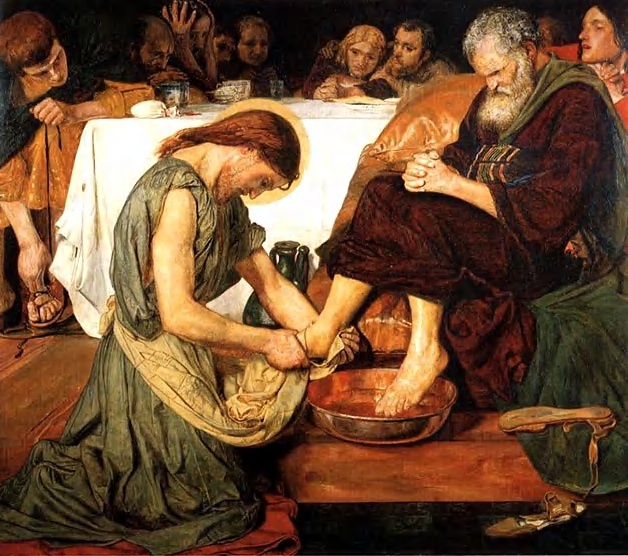
—The Gospel of John, chapter 13
In 1955, Pope Pius XII inserted an optional washing of the feet rite into the Mass of Holy Thursday, the liturgy which commemorates the events of the night before Jesus died. This foot-washing rite is called the Mandatum (from the Latin for “the Mandate”) for Jesus said, “as I have done for you, you should also do.”
Though the rubrics (that is, the rules for the liturgy) required no specific number of persons to have their feet washed in this optional rite, they indicated that the participants were to be men. This year, this rite which recalls Christ’s humble gesture of service and charity has been revised by a decree promulgated by Pope Francis. Where this rite is celebrated, pastors are to “select a small group of the faithful to represent the variety and the unity of each part of the people of God. Such small groups can be made up of men and women, and it is appropriate that they consist of people young and old, healthy and sick, clerics, consecrated men and women and laity.”
In past years, it has often been difficult to find people to humbly “bear their soles” on Holy Thursday but perhaps it may be a little easier this year. If you would volunteer to take a seat in this year’s washing of the feet, please contact Father so that he may create a representative group of our faithful.
March 13th Parish Bulletin
March 10, 2016The St. Wenceslaus parish bulletin for March 13th, 2016.
Time Travel & God’s Prophesies
March 3, 2016Many science-fiction stories have explored the idea of traveling through time and changing the past. For example, 1980’s “The Final Countdown” imagined a modern-day U.S. aircraft carrier being transported back to 1941 and facing the choice of either thwarting the Japanese attack on Pearl Harbor or allowing history to play out unchanged. In the early 1990’s, the TV time traveler Dr. Sam Beckett would “Quantum Leap” into other people’s lives, “striving to put right what once went wrong.” Just last fall, the internet hotly-debated the morality of going back in time to kill Adolf Hitler when he was still too young to have chosen or have committed any crimes.
I s it possible to go back in history and change the past? There’s good reason to think that it is logically impossible. Here is why: Imagine traveling back in time and, by some tragic accident, killing your grandparent as a child. This would mean that one of your parents would have never been born… so you would have never been born… which raises the question: who killed your grandparent? Or imagine a time traveler’s intended history-changing mission succeeding, such as stopping JFK’s assassination. If so, then there is no cause for the time traveler to have ever been sent back from the future at all. This sort of logical contradiction is called a paradox.
Most serious time travel stories avoid this paradox problem using the premise that the past can be visited but never truly altered. Time travelers simply fulfill the role they have always played in those past events. Any and all attempts to avert some disaster in history will either prove useless or actually contribute to bringing about the calamity.
Time travel is merely fantasy, but the prophesies of God, which have correctly foretold future events, are very real. Consider, for instance, these passages from the 22nd Psalm written by King David under the inspiration of the Holy Spirit some 1,000 years before the coming of Christ:
“My God, my God, why have you abandoned me? … All who see me mock me… Like water my life drains away; all my bones are disjointed. My heart has become like wax, it melts away within me. As dry as a potsherd is my throat; my tongue cleaves to my palate… They have pierced my hands and my feet. I can count all my bones. They stare at me and gloat; they divide my garments among them; for my clothing they cast lots. … I will live for the Lord…”
This psalm is clearly fulfilled in Christ’s sufferings on the cross; the onlookers’ gloating mockery, the gambling over his garments, his dehydration and laboring heart, wounds cutting to his bones. What other form of torture is there that pierces the hands and feet? Jesus spoke this psalm’s opening words even while sharing the psalm’s closing hope in a life restored. These events were accurately described a millennium before they occurred.
God prophesying future events raises questions about human freewill. If Jesus’ crucifixion could be long foretold then what responsibility could Judas, Caiaphas, or Pontius Pilate possibly bear for their roles in the Passion? The answer is that Eternal God, from his vantage point outside of time, can behold all of history, including the free choices that each of us make. C.S. Lewis reconciles God’s knowledge and our freedom in these passages from his book “Mere Christianity”:
“…God is outside and above the Time-line. In that case, what we call ‘tomorrow’ is visible to Him in just the same way as what we call ‘today’. All the days are ‘Now’ for Him. He does not remember you doing things yesterday; He simply sees you doing them, because, though you have lost yesterday, He has not. He does not ‘foresee’ you doing things tomorrow; He simply sees you doing them: because, though tomorrow is not yet there for you, it is for Him. You never supposed that your actions at this moment were any less free because God knows what you are doing. Well, He knows your tomorrow’s actions in just the same way— because He is already in tomorrow and can simply watch you. In a sense, He does not know your action till you have done it: but then the moment at which you have done it is already ‘Now’ for Him.”
God’s knowledge of our free choices does not make our choices any less free. As St. Augustine once noted, “Just as you do not compel past events to happen by your memory of them, so God does not compel events of the future to take place by his knowledge of them.” God’s divine knowledge does not strip us of human freewill, but it does permit him to communicate perfect prophesies to his people concerning events further along our timeline. Such prophesies concern not only the Messiah’s life, but our times and future as well.
Jesus Christ has already victoriously prevailed. His Second Coming in glory is foretold and assured, and his people’s final victory over sin and death is prophesized and certain. This is the connection between time travel stories and the prophesies of God: like the futility of time travelers attempting to avert some historic disaster, any and all attempts to prevent the ultimate triumph of Christ will either prove useless or actually contribute to bringing about the coming of his Kingdom. The enemies of Jesus schemed to destroy him and his movement, but their very plotting led to the fulfillment of his mission and the birth of the Church. This knowledge is a cause for Christian endurance and joy, even amidst our times of struggle. We know that we are free to serve a faithful role in helping bring about the great, holy, happy ending of history.
March 6th Parish Bulletin
March 3, 2016The St. Wenceslaus parish bulletin for March 6th, 2016.
Jesus is Risen, Not Undead
February 26, 2016All the classics of horror are Catholicism twisted. Vampires are the shadow opposite of Jesus in the Eucharist; they prey on the blood of others to possess eternal life apart from God. Depictions of Frankenstein are distortions of the Mystical Body of Christ, with the dead parts of many monstrously combined as one. And what are zombie stories but corruptions of the Resurrection? A new friend of mine teaches a faith formation class with a 5th grader who periodically pipes up saying, “Jesus was a zombie.” So, this week, she taught them about how Jesus is different from zombies.
Zombies are typically said to be created by a virus or a magic spell, but Jesus lives by the power of God. Zombies lose their memory and intellects, but the risen Jesus knows his friends and converses with them. The bodies of zombies decay and they can be “killed,” but the risen Jesus is free from corruption and can die no more. Zombies “desire” to kill people, but Jesus would give them life. (What other differences can you find with your family?)
After seeing The Passion of the Christ in 2004, I heard a fellow seminarian say that the movie ending with Jesus walking from the tomb on Easter morning frustrated him—he want to see what happened next, he wanted the story to continue. Last Friday, I had the great pleasure of seeing a new film which tells that story: Risen. In it, a Roman soldier named Clavius is tasked by Governor Pontius Pilate to find the body of Jesus the Nazarene and end rumors of his resurrection. Only about a dozen people were in the theater on opening night, so if you want to enjoy this highly-recommended film on the big screen you should make a point to see it soon.
Feb 28th Parish Bulletin
February 26, 2016The St. Wenceslaus parish bulletin for February 28th, 2016.
Feb 21st Parish Bulletin
February 16, 2016The St. Wenceslaus parish bulletin for February 21st, 2016.
Our Lady of Champion
February 12, 2016 In 2010, on the Feast of the Immaculate Conception at the Shrine of Our Lady of Good Help (about sixteen miles northeast of Green Bay, Wisconsin) Bishop David Ricken formally endorsed our country’s first Church-approved Marian apparition:
“I declare with moral certainty and in accord with the norms of the Church that the events, apparitions and locutions given to Adele Brise in October of 1859 do exhibit the substance of supernatural character, and I do hereby approve these apparitions as worthy of belief (although not obligatory) by the Christian faithful.”
This is the account of that Marian apparition according to Sr. Pauline LaPlant, to whom Adele Brise often told her story:
She was going to the grist mill about four miles from here [Champion, WI] with a sack of wheat on her head … As Adele came near the place, she saw a lady all in white standing between two trees, one a maple, the other a hemlock. Adele was frightened and stood still. The vision slowly disappeared, leaving a white cloud after it. Adele continued on her errand and returned home without seeing anything more. She told her parents what had happened, and they wondered what it could be—maybe a poor soul who needed prayers?
On the following Sunday, she had to pass here again on her way to Mass at Bay Settlement, about eleven miles from her home … This time, she was not alone, but was accompanied by her sister Isabel and a neighbor woman. When they came near the trees, the same lady in white was at the place where Adele had seen her before. Adele was again frightened and said, almost in a tone of reproach, “Oh, there is that lady again.”
Adele had not the courage to go on. The other two did not see anything, but they could tell by Adele’s look that she was afraid. They thought, too, that it might be a poor soul that needed prayers. They waited a few minutes, and Adele told them it was gone. It had disappeared as the first time, and all she could see was a little mist or white cloud. After Mass, Adele went to confession and told her confessor how she had been frightened at the sight of a lady in white. He bade her not to fear, and to speak to him of this outside of the confessional. Father Verhoef told her that if it were a heavenly messenger, she would see it again, and it would not harm her, but to ask in God’s name who it was and what it desired of her. After that, Adele had more courage. She started home with her two companions, and a man who was clearing land for the Holy Cross Fathers at Bay Settlement accompanied them.
As they approached the hallowed spot, Adele could see the beautiful lady, clothed in dazzling white, with a yellow sash around her waist. Her dress fell to her feet in graceful folds. She had a crown of stars around her head, and her long, golden, wavy hair fell loosely around her shoulders. Such a heavenly light shone around her that Adele could hardly look back at her sweet face. Overcome by this heavenly light and the beauty of her amiable visitor, Adele fell on her knees. “In God’s name, who are you and what do you want of me?” asked Adele, as she had been directed.
“I am the Queen of Heaven, who prays for the conversion of sinners, and I wish you to do the same. You received Holy Communion this morning, and that is well. But you must do more. Make a general confession, and offer Communion for the conversion of sinners. If they do not convert and do penance, my Son will be obliged to punish them.”
“Adele, who is it?” said one of the women. “O why can’t we see her as you do?” said another weeping.
“Kneel,” said Adele, “the Lady says she is the Queen of Heaven.” Our Blessed Lady turned, looked kindly at them, and said, “Blessed are they that believe without seeing. What are you doing here in idleness…while your companions are working in the vineyard of my Son?”
“What more can I do, dear Lady?” said Adele, weeping.
“Gather the children in this wild country and teach them what they should know for salvation.”
“But how shall I teach them who know so little myself?” replied Adele.
“Teach them,” replied her radiant visitor, “their catechism, how to sign themselves with the sign of the Cross, and how to approach the sacraments; that is what I wish you to do. Go and fear nothing. I will help you.”
The manifestation of Our Lady then lifted her hands, as though beseeching a blessing for those at her feet, and slowly vanished, leaving Adele overwhelmed and prostrate on the ground.
 When word spread about Adele Brise’s vision of the Blessed Virgin some believed the account with astonishment, while others judged it a demented delusion. Adele, however, considered it a commission to catechize the children and admonish the sinners of the Bay Settlement. Adele’s father erected a makeshift chapel near the spot of Adele’s vision.

Twelve years later, on October 8th, 1871, disaster came. The Great Peshtigo Fire remains the largest and deadliest forest fire in U.S. history. Between 1,200 and 2,400 lives were lost in Green Bay region. Hundreds fled to the shrine for refuge, beseeching Mary’s help. They lifted a statue of Mary and carried it around the grounds. When the wind and fire threatened suffocation in one direction, they turned in another direction to pray. Hours later, rain began to extinguish the raging fire. The shrine grounds were a green island in an ocean of smoldering ashes in every direction, and all those who fled to Mary’s shrine were saved.
Feb 14th Parish Bulletin
February 11, 2016The St. Wenceslaus parish bulletin for February 14th, 2016.
5th Week in Ordinary Time—Year II Meditations & Homily Builder
February 7, 2016Monday, 5th Week in Ordinary Time—Year II
- The ark held God’s words written in stone, while Jesus is the Word of God enfleshed.
- God’s ark was too holy to safely touch, but the Incarnation allows Jesus’ healing touch.
- The temple’s glory was great but passing, as this life’s joys and pains will be surpassed.
Petitions: Loving Reverence, Hope, The Sick
Tuesday, 5th Week in Ordinary Time—Year II
- It is good to dedicate buildings and possessions to God, but he loves true hearts more.
- The Lord who provides homes for the swallows wishes the elderly to be lovingly cared for.
- Those who hate God attack Christ’s Church and his disciples.
Petitions: The Parish, Moms and Dads, Right Priorities
Wednesday, 5th Week in Ordinary Time—Year II
- Solomon did not reject the Queen of Sheba as unclean in his sight, but dined with her.
- Sheba’s Queen notes seven glories of Solomon, while Jesus notes thirteen evils of man.
- Solomon’s greatest possession, his inner wisdom, was God’s gift. (1 Kings 3)
Petitions: Wisdom, Strangers and Guests, Pure Hearts
Thursday, 5th Week in Ordinary Time—Year II
- The Lord distained the nations, for “they sacrificed their sons and their daughters to demons.”
- A woman’s love can lead a man’s heart to do good (as with Jesus) or evil (like Solomon.)
- Our Lord always keeps his word and promises, “for he cannot deny himself.” (2 Timothy 2:12-13)
Petitions: Christian Fidelity, Unconverted Nations, Pro-Life
Friday, 5th Week in Ordinary Time—Year II
- Jesus and Ahijah led their charges aside to open their ears with God’s effective word.
- Both used tangible signs (in addition to words) to help others “walk in [God’s] ways.”
- Is seems that Jeroboam did not keep his secret either, for Solomon sought his life. (1 Kings 11:40)
Petitions: Christian Reunion, Sacraments, Keeping Confidences
Questions & Answers About Lent
February 5, 2016What is Lent?
 Lent is the liturgical season in which we prepare for Easter through prayer, penance, and fasting.
How long is Lent?
Lent runs from Ash Wednesday to Easter Vigil. It is actually 46 days long: 40 days of penance, plus six Sundays not considered days of penance.
Why is it called “Lent”?
The word “Lent” comes to us from old German and English words for “springtime.”
Why do we get marked with ashes?
The ancient Jews would put ashes atop their heads in repentance, mourning, and/or self-debasement. The ash crosses on our foreheads signify our desire to return or draw nearer to the Lord Jesus.
Who abstains and fasts in Lent?
Catholics who are at least 14-years-old are to abstain from meat on Ash Wednesday, Fridays in Lent, and Good Friday. Until at least their 59th birthday, Catholics who are at least 18-years-old are to fast on Ash Wednesday and Good Friday.
What is “fasting”?
Lenten fasting is eating just one full meal. Two additional smaller meals (less than one full meal put together) are allowed if necessary, but not eating solid foods between meals. (The physically, mentally, or chronically ill, as well as pregnant or nursing women, are excused from fasting and abstinence.)
Why the ages 18 to 59?
These ages consider the nutritional needs of the young & elderly, and the symbolic forty (years) between them reflects other periods of penance & preparation in the Bible (the Flood, the Exodus, Moses on Mt. Sinai, Jesus in the Desert, etc.)
Why isn’t fish considered “meat?”
In times past, fish was considered a food of the poor. It took multiple pounds of grain to raise one pound of livestock, but fish were simply caught. Eating fish instead of land-based meats conserved grain and was a penance in solidarity with the poor.
What can I do for Lent?
Add to your spiritual exercises, such as time for prayer, daily Mass, and the Stations of the Cross. Attend a penance service and go to confession. Go on pilgrimage to Sacred Heart Church, or to the cathedral or the shrine in La Crosse. Deny yourself occasions of sins and offer up sacrifices of self-denial; such as fasting, almsgiving, and good works.
 Parishable Items