False Presumptions — Wednesday, 7th Week of Ordinary Time—Year II

February 28, 2014

Readings: James 4:13-17, Mark 9:38-40

We must be careful not to cling to false presumptions about God’s activity regarding the present or the future. It is prudent to make plans for tomorrow and also good to strive for the reunion of all Christians into Christ’s one, holy, catholic, and apostolic Church. However, James warns us not to be presumptuous about our plans (instead of remaining open to God’s will,) while Jesus reminds us that even those who “do not follow us” can ‘perform mighty deeds in his name.’ “Whoever is not against us is for us.” God is never against us, and (unusually) neither are our separated brethren.

Magnanimous, Not Petty — 7th Sunday in Ordinary Time—Year A

February 23, 2014

“Petty” comes from the French word for “small” (“petit.“) “Magnanimous” comes from the Latin words for “great” and “soul” (“magna” and “anima.“) We are not called to be small, but of great soul in our interactions with others.

Four Cheeks Turned — 7th Sunday in Ordinary Time—Year A

February 22, 2014

Gospel: Matthew 5:38-48

When attacked, our natural response is “fight or flight,” but Jesus suggests a  supernatural response: “When someone strikes you on your right cheek, turn the other one as well.” Since the Jews regarded the left hand as unclean, they would reflexively strike with the right hand. If the right cheek were hit, then one had been backhanded with contempt. Responding by turning the other cheek neither attacks not retreats, but insists on being regarded as an equal, whom one must strike (if at all) with an open hand. Jesus wants us to stand our ground in the face of injustice, assertively but lovingly, in hopes that the offender will reconsider his ways. Jesus modeled this response when he was struck during his trial before Annas:

The high priest questioned Jesus about his disciples and about his doctrine. Jesus answered him, “I have spoken publicly to the world. I have always taught in a synagogue or in the temple area where all the Jews gather, and in secret I have said nothing. Why ask me? Ask those who heard me what I said to them. They know what I said.” When he had said this, one of the temple guards standing there struck Jesus and said, “Is this the way you answer the high priest?” Jesus answered him, “If I have spoken wrongly, testify to the wrong; but if I have spoken rightly, why do you strike me?” (John 18:19-24)

Another saintly example was shown by Blessed Mother Teresa of Calcutta. Though reports vary, Mother Teresa was once begging bread from a baker for her orphanage. When the baker responded by spitting into her hand, she replied to effect, ‘I will keep this for me, but please give something for my children.’

In Victor Hugo’s Les Miserables, a bishop welcomes an impoverished convict to join his table and sleep at his home. However, that night, Jean Valjean steals his host’s silverware and goes away. The police catch him and take him to the bishop. Looking at Jean Valjean, the good bishop exclaims, “Ah! here you are! I am glad to see you. Well, but how is this? I gave you the candlesticks too, which are of silver like the rest, and for which you can certainly get two hundred francs. Why did you not carry them away with your forks and spoons?” Jean Valjean opens his eyes wide and stares at the venerable Bishop “with an expression which no human tongue can render any account of.” The bishop’s turn of the cheek spares the thief’s freedom and saves his soul.

And finally, a true story from a modern marriage: A woman’s husband had a terrible temper and every time it flared she would say, “That’s just like you to lose your temper!” But then, following a stroke of insight, she began responding differently. The next time he began to fly of the handle she told him, “That’s not like you to lose your temper,” and he nearly fell out of his chair. Even the kids looked at her funny, but she stuck with her new resolution. Months later, while at a restaurant together, he became irritated by the slow service. He started to fume about it, but then he suddenly stopped, turned to her, and said, “That’s not like me to lose my temper, is it?” This time, it is said, she nearly fell on the floor.

Was it true the first time the woman declared that it was not like her husband to lose his temper? The claim did not match his previous behavior, but perhaps he changed because she revealed to him that his uncontrolled anger was quite unlike the father, husband, and Christian man he truly and deeply wanted to be. This is the sort of realization and conversion we are to hope for in turning the other cheek.

Plus, a fifth story: “If a teen mugs you for your wallet…

Recognizing the Christ — Thursday, 6th Week of Ordinary Time—Year II

February 20, 2014

Readings: James 2:1-9, Mark 8:27-33

St. Peter confesses that Jesus is the Christ, but “the elders, the chief priests, and the scribes” reject him. Would we have recognized and welcomed the Christ when he came?  Let us consider: Do we show partiality for or against others based on their popularity or prominence?

Would we have received Jesus’ challenging teachings? All the prophets were persecuted for sharing truths people refused to hear. How do we respond when someone critiques or challenges us?

Jesus was poor and perhaps wore “shabby clothes.” Do we have any friends who are poor?

As Dorothy Day said, “We love God as much as the one we love the least.” If we want to know whether we would have recognized and welcomed the Christ we should consider whether we receive and love him now, for Jesus says, “whatever you did for one of these least brothers of mine, you did for me.” (Matthew 25)

Stained Glass Symbols — The Holy Cross

February 20, 2014

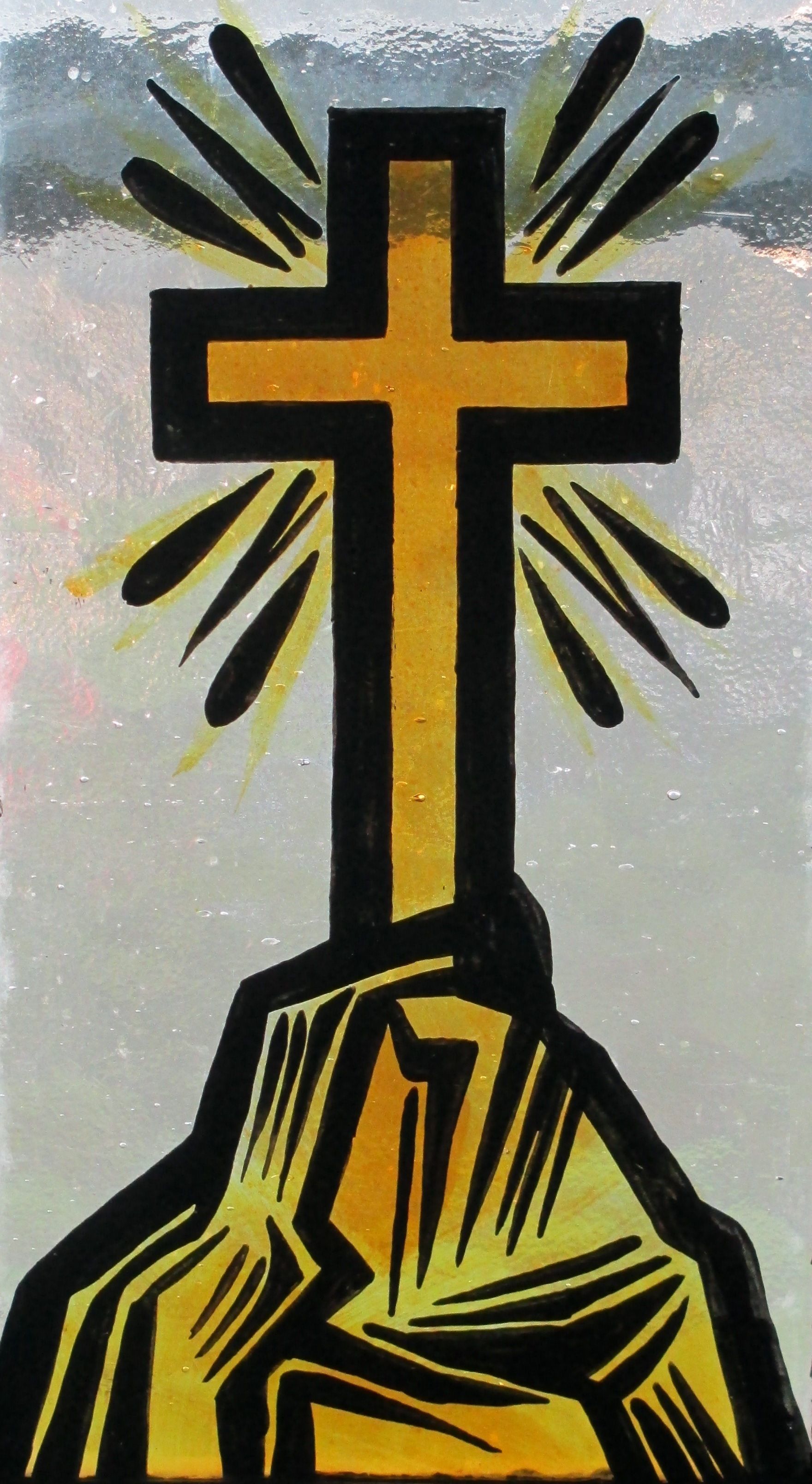
Holy Cross - Sacred Heart Catholic Church -  Wauzeka WIA Symbol of Christ’s Triumph

Jesus Christ’s cross is holy because it is the instrument he uses to save the world. The Roman Empire, in a demonstration of worldly wisdom and power, used crucifixion to humiliate, torture, and terrorize whoever would dare to oppose them. Jesus takes the cross, the worst evil the spiritual and human rulers of this world could wield against him, and employs it to achieve his victory.

Gradually Growing Trees — Wednesday, 6th Week of Ordinary Time—Year II

February 19, 2014

Readings: James 1:19-27, Mark 8:22-26

When Jesus and his disciples arrived at Bethsaida, people brought to him a blind man and begged Jesus to touch him.  He took the blind man by the hand and led him outside the village. Putting spittle on his eyes he laid his hands on the man and asked, “Do you see anything?” Looking up the man replied, “I see people looking like trees and walking.” Then he laid hands on the man’s eyes a second time and he saw clearly; his sight was restored and he could see everything distinctly.

Jesus healed the blind man gradually, and he sometimes does the same with us; transforming us over months, years, or a lifetime. The change is subtle and we fail to notice it, “like a man who looks at his own face in a mirror. He sees himself, then goes off and promptly forgets what he looked like.” If we’ve been following Jesus but doubt our own growth, let us reflect on how we used to look, months or years ago.

Halfway through his cure, the blind man beholds “people looking like trees and walking.” Perhaps this more than just a distorted perception, perhaps he sees a vision of a spiritual reality. Jesus walked and suffered with “a tree”: his cross. (Galatians 3:13) If we have the eyes to see, we recognize that every person walks with a cross of their own. So “everyone should be quick to hear, slow to speak, slow to anger,” remembering that people resemble gradually growing trees.

Stained Glass Symbols — The Triple Candelabra

February 19, 2014

Triple Candelabra - Sacred Heart Catholic Church -  Wauzeka WIA Symbol of the Holy Trinity

As a triple candelabra unites three lights, so the Holy Trinity is a united three in one. The three flames share one and the same fiery nature, as the three divine persons share the same divine substance. Like St. Patrick’s three-leafed shamrock, the triple candelabra is a visible symbol for an invisible mystery: that from all eternity, God has been one “what” and three “who’s.”

Stained Glass Symbols — Mount Calvary’s Cross

February 18, 2014

Mount Calvary's Cross - Sacred Heart Catholic Church -  Wauzeka WIA Symbol of the Source & Summit of the Christian Life

Jesus Christ’s sacrifice on Mount Calvary’s cross was offered in love of God and man. It is the source or fount for all saving grace, and the summit or pattern to which all Christians are called.

Refusing Signs — Monday, 6th Week of Ordinary Time—Year II

February 17, 2014

Readings: James 1:1-11, Mark 8:11-13

The Pharisees came forward and began to argue with Jesus, seeking from him a sign from heaven to test him. He sighed from the depth of his spirit and said, “Why does this generation seek a sign? Amen, I say to you, no sign will be given to this generation.

Yet, soon before this scene in Mark’s Gospel, Jesus took seven loaves and a few fish and miraculously fed about 4,000 people with them. That is a sign as surely as his resurrection will be, so how can Jesus say “no sign will be given to this generation”? Perhaps because there was no sign that his critics would accept.

The Pharisees sought “a sign from heaven.” If Jesus had performed some meteorological sign for them they may well have judged him as more evil than they had thought, in union with the demons of the air, just as they had condemned his manifest power to cast out demons. (Mark 3:21-30) They asked for proof but refused to accept evidence in his favor–they were of people of two minds, like St. James describes in the first reading:

But if any of you lacks wisdom, he should ask God who gives to all generously and ungrudgingly, and he will be given it. But he should ask in faith, not doubting, for the one who doubts is like a wave of the sea that is driven and tossed about by the wind. For that person must not suppose that he will receive anything from the Lord, since he is a man of two minds, unstable in all his ways.

Let us pray for those who do not believe; for the sincere, that they may be given sufficient evidence to change their minds, and for the obstinate, that their hardened hearts may be opened. And let us who believe in God (as even the Pharisees did) not cause Jesus to “[sigh] from the depth of his spirit.” Let us be trusting and docile in following him.

Catholicism

February 14, 2014
  • We love marriage and celebrate celibacy.
  • We scandalize with hard truths and easy mercy.
  • We feed the poor and hungry with food and beauty.
  • We observe days for fasting and feasting.
  • We insist that men lead as servants.
  • We help mothers and their children.
  • We respect women and men as unique and equal.
  • We condemn communism and critique capitalism.
  • We advocate for peace and, as a last resort, Just War.
  • We want everyone to go to Heaven and no one to be killed.
  • We have faith in human reason and employ reason in our Faith.
  • We believe in miracles and demons and investigate them critically.
  • We accept science and Divine Revelation.
  • We canonized God’s books and canonize His saints.
  • We honor Jesus’ Father and mother like He did, as our own.
  • We pray for living and dead neighbors and ask their prayers for us.

Increasing Intimacy in your Marriage & Home

February 13, 2014

Physical intimacy is an important aspect of marriage, but it is certainly not the only kind of intimacy. A marriage in which the intimacy shared is exclusively physical will not endure. The acronym “SPICE” contains five modes of sharing intimacy: Spiritual, Physical, Intellectual, Creative, and Emotional. Sharing your prayers, touches, ideas, projects, and feelings are all important elements to keeping your marriage strong.

Another issue in relationships between spouses and within households comes in how love is expressed and received. Gary Chapman’s 1995 book, “The Five Love Languages: How to Express Heartfelt Commitment to Your Mate,” suggests that people prefer to receive love in different ways. Chapman describes five main ways, or languages, by which love is experienced: Gifts, Quality Time, Acts of Service, Words of Affirmation, and Physical Touch. Some people feel love most deeply when their spouses help around the house and with the kids (Acts of Service) but feel little thrill from receiving gifts, such as golf clubs or jewelry.

A problem arises when people understandably, but mistakenly, assume that the significant others in their lives receive love best through the same love language as themselves. They try to love their neighbor just like themselves without realizing that their love languages differ. For instance, people whose main love language is Quality Time may feel neglected or even abandoned, despite their spouses’ tender caresses and sincere compliments, if not enough time is shared together between them at home. Knowing another’s love language allows you to love them in the manner they most want to be loved.

  • What are your top-two favorite Love Languages?
  • Can you guess what your spouse and children’s top Love Languages are?
  • Share your answers with each other—you may discover something new.
  • How can you add more SPICE, more Spiritual, Physical, Intellectual, Creative, and Emotional Intimacy, into your marriage and your home?

The Importance of Praise — Wednesday, 5th Week of Ordinary Time—Year II

February 12, 2014

Readings: 1 Kings 10:1-10, Mark 7:14-23

Solomon & the Queen of Sheba, Pleased to Meet Each Other.The Queen of Sheba was genuinely impressed by King Solomon and told him so: “The report I heard in my country about your deeds and your wisdom is true,” she told the king. “Though I did not believe the report until I came and saw with my own eyes, I have discovered that they were not telling me the half. Your wisdom and prosperity surpass the report I heard. Blessed are your men, blessed these servants of yours, who stand before you always and listen to your wisdom. Blessed be the LORD, your God, whom it has pleased to place you on the throne of Israel. In his enduring love for Israel, the LORD has made you king to carry out judgment and justice.” This was not flattery, lies told to manipulate him, but real praise. The praises the Queen spoke to the son of David equally apply to Jesus Christ.

When we perceive good things in another, we should note and compliment it. Not only does this encourage and help that person, but it benefits us as well; it increases our humility, gratitude, and joy. We should especially praise God, not because He needs it (though He appreciates it,) but because the praise which comes “from within the man, from his heart,” helps to sanctify him. As one Mass Preface says, “You have no need of our praise, yet our desire to thank You is itself Your gift. Our prayer of thanksgiving adds nothing to Your greatness, but makes us grow in Your grace, through Jesus Christ our Lord.”

Praying For Rain — February 10 — St. Scholastica

February 10, 2014

While some people only pray when they need or want something, others pray frequently but hesitate to ask anything for themselves. Like the Prodigal Son’s older brother, these think it more proper to never ask God for special gifts (not “even a young goat to feast on with” their friends.) However, the Office of Readings selection for St. Scholastica written by St. Pope Gregory the Great shows us that God is pleased to give His children the good gifts they request:

Scholastica, the sister of Saint Benedict, had been consecrated to God from her earliest years. She was accustomed to visiting her brother once a year. He would come down to meet her at a place on the monastery property, not far outside the gate. One day she came as usual and her saintly brother went with some of his disciples; they spent the whole day praising God and talking of sacred things. As night fell they had supper together.

Their spiritual conversation went on and the hour grew late. The holy nun said to her brother: “Please do not leave me tonight; let us go on until morning talking about the delights of the spiritual life.” “Sister,” he replied, “what are you saying? I simply cannot stay outside my cell.” When she heard her brother refuse her request, the holy woman joined her hands on the table, laid her head on them and began to pray. As she raised her head from the table, there were such brilliant flashes of lightning, such great peals of thunder and such a heavy downpour of rain that neither Benedict nor his brethren could stir across the threshold of the place where they had been seated. Sadly he began to complain: “May God forgive you, sister. What have you done?” “Well,” she answered, “I asked you and you would not listen; so I asked my God and he did listen. So now go off, if you can, leave me and return to your monastery.” Reluctant as he was to stay of his own will, he remained against his will. So it came about that they stayed awake the whole night, engrossed in their conversation about the spiritual life.

It is not surprising that she was more effective than he, since as John says, God is love, it was absolutely right that she could do more, as she loved more. Three days later, Benedict was in his cell. Looking up to the sky, he saw his sister’s soul leave her body in the form of a dove, and fly up to the secret places of heaven. Rejoicing in her great glory, he thanked almighty God with hymns and words of praise. He then sent his brethren to bring her body to the monastery and lay it in the tomb he had prepared for himself. Their minds had always been united in God; their bodies were to share a common grave.

Of Earth & The Universe — 5th Sunday in Ordinary Time—Year A

February 9, 2014

Literally, from the Greek:

You are the salt of the [ground] … You are the light of the [cosmos.]”

A Christian’s ordinary life on earth reveals the divine light responsible for the universe.

Stained Glass Symbols — The Dove

February 9, 2014

Holy Spirit Dove - Sacred Heart Catholic Church -  Wauzeka WIA Symbol of the Holy Spirit

From the Ark, at the time of the Flood, Noah released a dove three times to scout for land. The bird’s return with a fresh olive leaf in its beak signaled an end to the deadly judgment and the beginning of new life. Noah’s dove revealed that peace was restored between heaven and earth. When Jesus was baptized in the Jordan River by John the Baptist, they saw the Holy Spirit descend in bodily form, like a dove, and land upon Christ. By receiving Christ’s baptism, the Holy Spirit comes to rest on us, pouring into us the new life and graces of the Trinity.