By Fr. Victor Feltes
When I went to seminary in preparation for the priesthood, they had us study philosophy before studying theology. One reason for this was so we could better understand how people have thought in the past and present and might more effectively proclaim Christian truths today. This homily will begin more philosophically than usual, but its purpose is to lead toward the truths of Christ.
In our first reading from the Book of Tobit, we hear Tobiah praying with his wife on their wedding night. He says, “Blessed are you, O God of our ancestors… Let the heavens and all your creation bless you forever. You made Adam, and you made his wife Eve to be his helper and support; and from these two the human race has come. You said, ‘It is not good for the man to be alone; let us make him a helper like himself.’” Man and woman were made for each other. Both despite and because of our differences, men and women are drawn to each other in love and our natures complement each other. This is beautifully seen in the birth of children. Parents experience the gift of new children with wonder and joy. But a critic might dismiss all this.
“The instincts of warthogs and walruses attract them to their mates too, and female insects can hatch hundreds of offspring in a lifetime.” The critic might dismiss all human love and life as merely the results of natural laws with no divine designer necessary. A critic might look at our providential place within this complex universe and argue, “It’s no miracle that a puddle perfectly fills its pothole.” But why are nature’s laws the way they are rather than something else entirely? We can imagine alternate laws of nature for universes which would allow nothing interesting to exist. Why do we have fine-tuned natural laws which permit the marvelous things we see? And why is there anything rather than nothing? What is the explanation, the logic, the logos behind our universe?
In our second reading from the Letter to the Romans, we hear St. Paul exhorting Christians to act nobly. He says, “Offer your bodies as a living sacrifice, holy and pleasing to God… Let love be sincere; hate what is evil, hold on to what is good; love one another with mutual affection…” These high moral callings accord with our consciences. Even in our human weakness, they resonate with the deep longings of our hearts. The critic might dismiss these human experiences too, seeing them as just more instincts bred by natural selection. But if right and wrong and our perceptions of value are nothing more than feelings, mere biases built into us by survival in an indifferent universe, why should we care or be ruled by those delusions? We long for true meaning, but if everything will end in death — you and me and everything — what difference does anything make in the long run? Are good, evil, and meaning real or just nothing more than “feels”? I believe the choice before us all is ultimately either belief in nothing (nihilism) or belief in Christ (Catholicism).
Not once upon a time, but in real history, the Creator entered his creation. The Author appeared inside his story as its Main Character. Entering time as man into the center of our history, Jesus Christ declares himself “the Bridegroom.” He comes to wed his Bride, the Church. In our Gospel, Jesus teaches how “from the beginning the Creator made them male and female” and said, “…the two shall become one flesh… So they are no longer two, but one flesh. Therefore, what God has joined together, man must not separate.”
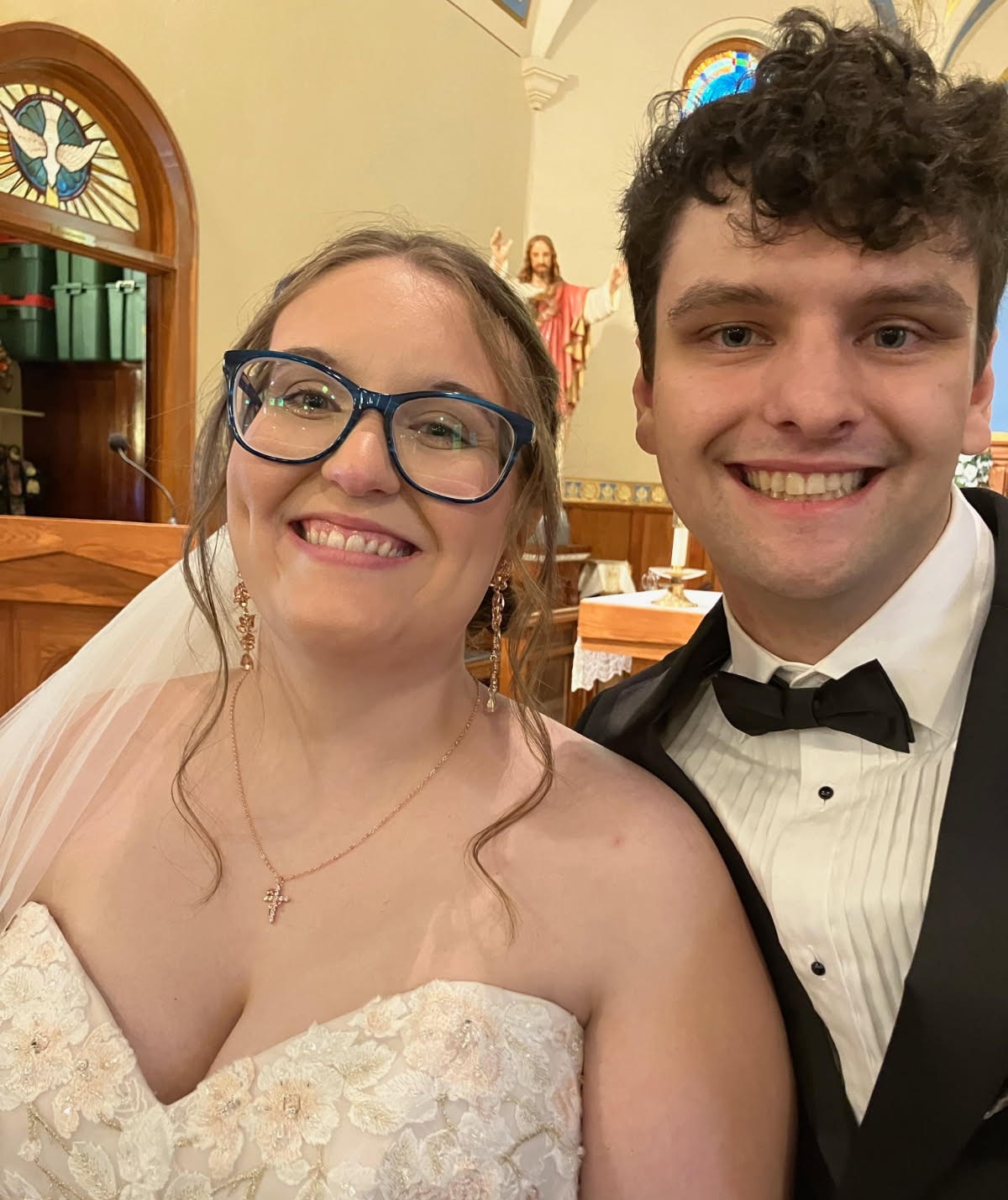
As the innocent New Adam, afflicted with thorns but naked without shame, Jesus’ obedience to God is tested at a tree. The Cross is the New Tree of the Knowledge of Good and Evil; however, if we eat from the Fruit of this tree, we can live forever. Eve was made for communion with God and Adam. The Church was made for communion with God and Christ. It is not good for mankind to be alone. Jesus Christ comes to reveal God’s truth and love for us anew, to reveal the reality of goodness and to conquer death. He calls you to seek and know him, to love and serve him, so that you are no longer two, but one flesh. And if you and Christ are already joined, this union you must not separate. Noah and Annie, remain in Christ, for only in him can you live and love in marriage as you ought. As St. John wrote: “God is love. Let us love one another, as God has loved us.”

